Key Person Insurance Marketing Ideas That Actually Reach Business Owners
The best key person insurance marketing ideas start with one fact: business owners don't search for 'key person insurance,' they search for a problem — losing a partner, a loan condition, a buyout funding gap. So the highest-ROI tactics are problem-led: owner outreach and 'what if your top earner dies' content that gets cited by AI search.
Business owners do not wake up wanting key person insurance. They wake up worried about losing the one person who keeps revenue flowing, or about a bank loan that requires coverage, or about what happens to their partner’s family if a buyout has no money behind it. That gap — between the product name and the actual fear — is where every good key person insurance marketing idea lives. Market the problem, route to the product, and you stop competing with every other agent who leads with “protect your business.”
We build marketing systems for insurance agents, and our authority comes from running our own lead operation in the senior market — live campaigns, not theory. The business-owner market is a different animal: fewer leads, longer cycles, much bigger cases. But the discipline transfers. Below are the ideas that produce booked reviews, not just clicks.
Why key person insurance marketing ideas have to start with the trigger
We build the keyword and message plan around symptoms rather than the product name, because an owner has to feel the problem before the product has a name to them. The searches that precede a case look like “what happens to my business if my partner dies,” “SBA loan life insurance requirement,” and “how to fund a buyout.” Your entire content and ad strategy should map to those triggers.
The three triggers that consistently produce cases:
- Partner or owner death exposure — a multi-owner business with no funded plan to buy out a deceased owner’s share.
- Lender requirement — a loan condition tied to a collateral shortfall on a business that depends on one owner.
- Top-earner concentration — one rainmaker, salesperson, or technical lead whose loss would cut revenue hard.
Build one message per trigger. A landing page that says “Your bank requires coverage on you — here’s how to satisfy it in 10 days” converts an owner who is mid-loan far better than a generic “business life insurance” page. Our insurance landing page approach is built around exactly this one-trigger, one-promise structure.
What the business is actually buying, and what the Code calls a key person
Key person insurance is a policy the business owns, pays for and collects on. The insured is an employee or owner whose loss would damage the company; the money is meant to replace lost revenue, fund a search and a signing bonus for a replacement, and steady a lender or a landlord while that happens. Nothing in that description is emotional, which is why consumer life copy fails here.
The tax code actually defines the phrase, in one narrow place. Under 26 U.S.C. 264(e)(3), for purposes of an interest-deduction exception in that subsection, “the term ‘key person’ means an officer or 20-percent owner, except that the number of individuals who may be treated as key persons with respect to any taxpayer shall not exceed the greater of— (A) 5 individuals, or (B) the lesser of 5 percent of the total officers and employees of the taxpayer or 20 individuals.” That definition governs section 264(e) and not the product itself, but it is a useful shape for a prospecting filter: officers and 20-percent owners, five to twenty of them at most in any one company.
Two tax facts belong in every piece of collateral you write, because getting either one wrong turns a marketing asset into a compliance problem. First, the premium is not deductible. Section 264(a)(1) says no deduction shall be allowed for “Premiums on any life insurance policy, or endowment or annuity contract, if the taxpayer is directly or indirectly a beneficiary under the policy or contract.” Second, the death benefit is generally excluded from gross income under 26 U.S.C. 101(a)(1) — but that exclusion opens with “Except as otherwise provided in paragraphs (2) and (3), subsection (d), subsection (f), and subsection (j)”. Two of those exceptions, the transfer-for-value rule and the employer-owned life insurance rule, are the ones this product walks into, and both are covered further down this page.
Four marketing ideas that reach owners, ranked by ROI
The table below ranks the four channels by the lead quality they produce against the time and money each one takes to start.
| Idea | Best for | Lead quality | Time to first case | Cost level |
|---|---|---|---|---|
| LinkedIn + referral outreach to a targeted owner list | Solo agents, established agencies | Very high | 2–6 weeks | Low |
| Problem-led content + AI-search visibility | Agencies building durable pipeline | High | 3–6 months | Medium |
| Buy-sell agreement marketing with CPAs/attorneys | Agents with local professional network | Highest | 1–3 months | Low–Medium |
| Paid ads + landing page system | Agents who want predictable volume | Medium–High | 2–4 weeks | Medium–High |
1. Targeted outreach beats broad blasting
You do not need 5,000 owners. You need the right 200. Pull a list by industry and revenue band, then run a four-touch sequence on LinkedIn and email built around a single trigger. The message is not “I sell key person insurance” — it is “Is your buy-sell agreement funded, or only signed? Worth a 15-minute check.” Specificity is the whole game in a low-frequency, high-value market, and the cadence itself is the same discipline we describe in our insurance lead follow-up cadence guide, stretched over weeks instead of days.
2. Market key person insurance with content that AI search will cite
This is where the network differentiates. When an owner asks ChatGPT or Google’s AI overview “how do I fund a partner buyout,” you want your page to be the cited source. That means clean answer-extractable content: clear questions as headers, a short direct answer up top, a table comparing cross-purchase vs. entity redemption, and a list of when each applies. Our GEO and AI-search service exists to make agent content the answer engines quote — a structural edge most insurance sites ignore. The same content marketing engine feeds the blog posts that rank and the FAQs the AI models pull from.
3. Buy-sell agreement marketing is your warmest channel
A buy-sell agreement can be drafted by an attorney, valued by a CPA, and still have no money behind it. That unfunded gap is your entire offer. Co-brand a one-page explainer with a local business attorney and an accountant: they look like they cover the full picture, you get introduced to owners at the exact moment the agreement is signed. We treat it as the highest-intent source in the niche because the owner already accepts the premise. It deserves its own dedicated page and process, which is why we map it inside our key person insurance marketing service under the broader group life and employee-benefits practice.
4. Paid ads plus a landing page for predictable volume
Outreach and referrals are excellent but lumpy. When you need volume on a schedule, paid drives it — but only into a trigger-specific landing page, never your homepage. LinkedIn and Meta both reach owners, though as the section on ad-platform targeting below explains, they no longer reach them the same way. Our PPC management for insurance agents is benchmarked to a cost per booked review, not clicks, because in this market the value of one closed case is what justifies the spend, not the click volume.
The lender requirement, in the SBA’s own words
“SBA loans require life insurance” is a line that shows up all over agent copy, and it is not what the rules say. The regulation that lists loan conditions, 13 CFR 120.160, opens with “The following requirements are normally required by SBA for all business loans” and then names three: personal guarantees, where “Holders of at least a 20 percent ownership interest generally must guarantee the loan”; appraisals; and hazard insurance, which “SBA requires… for 7(a) loans greater than $500,000 and for 504 projects greater than $500,000, on all collateral.” Life insurance is not in that list at all.
It is in the standard operating procedure the lender works from. SBA SOP 50 10 8, effective June 1, 2025, says that for Standard 7(a), EWCP, CAPLines, International Trade loans and pilot programs, “7(a) Lenders may follow their internal policy for similarly-sized non-SBA guaranteed commercial loans, except if the loan is not fully secured, life insurance is required in the amount of the collateral shortfall for the principals of sole proprietorships, single member LLCs, or for businesses otherwise dependent on one owner’s active participation.”
The table below turns that paragraph into the four things a landing page for the lender trigger can honestly promise.
| What the SOP says | Where it applies | What you can offer the borrower |
|---|---|---|
| Life insurance required in the amount of the collateral shortfall | Standard 7(a), EWCP, CAPLines, International Trade, when the loan is not fully secured and the business depends on one owner | A face amount sized to the shortfall, not to a round number |
| Lenders “may follow their internal written policy for their similarly-sized, non-SBA guaranteed commercial loans” | 7(a) Small Loans, SBA Express, Export Express | A read of that lender’s own policy before the borrower buys anything |
| “Credit life insurance or whole life insurance should not be required” | All programs under the paragraph | Term, priced against the loan term, with the reason in writing |
| Lenders “may accept the pledge of an existing life insurance policy” | All programs under the paragraph | A review of coverage the owner already has, before writing new coverage |
Two operational details in the same paragraph are worth building service promises around. The lender must obtain “a collateral assignment identifying the 7(a) Lender (for 7(a)), or the CDC/SBA (for 504), as assignee that is acknowledged by the Home Office of the Insurer” — the acknowledgement step is where closings stall, and an agent who names a turnaround for it is selling something the loan officer cares about. And if the principal cannot be insured, the SOP requires the lender to “obtain written documentation from a licensed insurer of the same”, which is a piece of paper an agent can produce and a loan officer cannot.
On the 504 side the SOP sets minimum terms directly: “10 years for a 10 year debenture” and “20 years for a 20 or 25 year debenture.” That is a fact worth putting in a lender-facing one-pager, because it answers the question a CDC asks first.
The 2024 Supreme Court decision that reopened every entity-redemption buy-sell
Buy-sell agreement marketing usually has a timing problem: the document was signed years ago and nobody has a reason to look at it again. In June 2024 the Supreme Court supplied one.
In Connelly v. United States, 602 U.S. 257, decided June 6, 2024, brothers Michael and Thomas Connelly were the sole shareholders of Crown C Supply, a building supply corporation in St. Louis. Their agreement gave the surviving brother an option to buy the deceased brother’s shares, and if he declined, the company itself was required to redeem them. To fund that, “Crown obtained $3.5 million in life insurance on each brother.” When Michael died, Thomas declined the option, Crown used $3 million of the proceeds to redeem the shares, and the estate reported those shares at $3 million. The IRS counted the insurance proceeds as a company asset, valued Crown at $6.86 million, valued Michael’s 77.18% stake at $5.3 million, and “determined that the estate owed an additional $889,914 in taxes.”
A unanimous Court, in an opinion by Justice Thomas, affirmed. The holding: “A corporation’s contractual obligation to redeem shares is not necessarily a liability that reduces a corporation’s value for purposes of the federal estate tax.” The reasoning is one sentence long: “Because a fair-market-value redemption has no effect on any shareholder’s economic interest, no willing buyer purchasing Michael’s shares would have treated Crown’s obligation to redeem Michael’s shares at fair market value as a factor that reduced the value of those shares.”
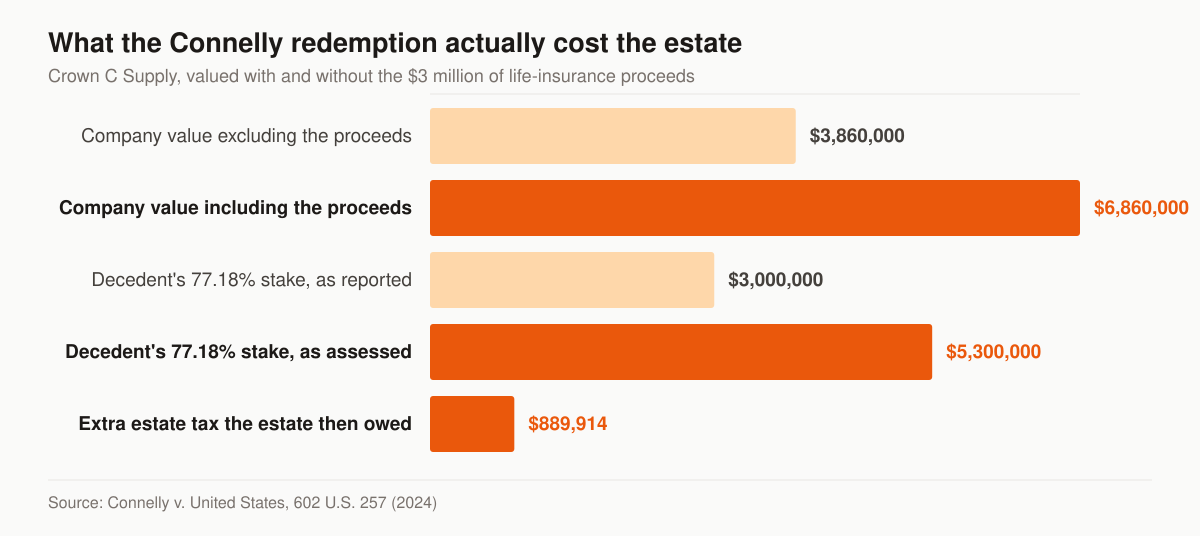
The valuation figures recited in the opinion. Source: Connelly v. United States, 602 U.S. 257 (2024).
Read the footnote before you write the email. The Court added: “We do not hold that a redemption obligation can never decrease a corporation’s value”, and gave an example — an obligation that forces a company to liquidate operating assets. The Court also said plainly that the outcome “is simply a consequence of how the Connelly brothers chose to structure their agreement.”
For a marketer, that combination is close to ideal. There is a specific, dated, citable event; it applies to a structure the prospect can identify in thirty seconds (“does your agreement have the company buying the shares?”); and the honest conclusion is a review rather than a product. The asset is a one-page explainer with the citation on it, co-branded with the attorney who drafted the agreement. The determination belongs to the owner’s counsel and accountant, and saying so in the piece is what makes a professional willing to put their name next to yours.
Cross-purchase or entity redemption: the comparison an owner will ask for
The moment the Connelly question lands, the owner asks the follow-up: so what should we have done? You are not there to answer it — the attorney is — but you need to hold the comparison in your head and put it on the page, because this is exactly the passage an answer engine will quote.
The table below sets the two standard structures side by side on the five points an owner raises in the first meeting.
| Entity redemption | Cross-purchase | |
|---|---|---|
| Who owns and pays for the policies | The company | The individual owners, on each other |
| Policies needed with four owners | Four, one per owner | Twelve, since each owner insures each of the other three |
| Where the death proceeds land | With the company | With the surviving owners directly |
| What Connelly says about the proceeds | Life-insurance proceeds payable to a corporation are an asset that increases its fair market value | The Court noted the proceeds “would have gone directly to Thomas—not to Crown” |
| The practical risk the Court named | The redemption obligation may not offset the proceeds | Each owner must keep paying the premiums on the others, “creating a risk that one of them would be unable to do so” |
The second structure carries a rule the first does not. Under 26 U.S.C. 101(a)(2), where a life insurance contract is transferred “for a valuable consideration,” the amount excluded from income is capped at “the sum of the actual value of such consideration and the premiums and other amounts subsequently paid by the transferee.” The statute then lists the transfers that escape that sentence: a transfer “to the insured, to a partner of the insured, to a partnership in which the insured is a partner, or to a corporation in which the insured is a shareholder or officer.” A transfer to a fellow shareholder is not on that list. Policies move between owners whenever a cross-purchase is restructured, someone retires, or a new partner buys in — which is why the restructuring conversation is a second appointment, not an objection.
There is a second trigger sitting in the same document, and it is the one we check for first. A buy-sell agreement can define a triggering event that includes an owner’s long-term disability, not only death — and a disability buy-out policy, which funds a purchase when an owner becomes disabled rather than dies, is a separate contract that has to be written on purpose. Ask which triggers the agreement lists, then ask what funds each one. If death is funded and disability is not, you have found a second case in a meeting you were already in, and you have found it by reading the client’s own document rather than by pitching a product.
Neither structure is the right answer in the abstract, and the Court took care to say so: “every arrangement has its own drawbacks.” Your marketing job is to be the person holding the comparison when the question gets asked, and the service page for this niche is where that comparison should live on your own domain rather than in an emailed PDF.
Notice and consent: the paperwork that decides whether the benefit is taxable
Here is the audit question that finds problems inside policies already in force, which makes it the strongest single lead magnet in this niche: did the insured sign a notice and consent before the contract was issued?
26 U.S.C. 101(j)(1) sets the default for an employer-owned life insurance contract: “the amount excluded from gross income of an applicable policyholder by reason of paragraph (1) of subsection (a) shall not exceed an amount equal to the sum of the premiums and other amounts paid by the policyholder for the contract.” In plain terms, the default is that the business gets its premiums back tax-free and the rest is income.
The exceptions that restore the ordinary treatment — for an insured who “was an employee at any time during the 12-month period before the insured’s death,” for a director or highly compensated employee at issue, and for proceeds paid to the insured’s family or used to buy an equity interest from them — are gated. Section 101(j)(2) opens: “In the case of an employer-owned life insurance contract with respect to which the notice and consent requirements of paragraph (4) are met, paragraph (1) shall not apply to any of the following:” Paragraph (4) is met only if, “before the issuance of the contract,” the employee “is notified in writing that the applicable policyholder intends to insure the employee’s life and the maximum face amount for which the employee could be insured at the time the contract was issued,” “provides written consent to being insured under the contract and that such coverage may continue after the insured terminates employment,” and “is informed in writing that an applicable policyholder will be a beneficiary of any proceeds payable upon the death of the employee.”
Three writings, all of them dated before issue. There is also an annual filing: 26 U.S.C. 6039I(a) requires every applicable policyholder owning one or more employer-owned life insurance contracts issued after the enactment date to file a return showing the employee count, the number insured, “the total amount of insurance in force at the end of the year under such contracts,” the policyholder’s identifying details, and “that the applicable policyholder has a valid consent for each insured employee (or, if all such consents are not obtained, the number of insured employees for whom such consent was not obtained).” That return is IRS Form 8925, “Report of Employer-Owned Life Insurance Contracts”.
Build the checklist as a gated asset and the offer writes itself: a review of the notice, the consent, the beneficiary language and the Form 8925 filing on coverage the business already owns. It asks for no purchase, it produces a finding often enough to be worth the meeting, and the finding is the reason the next policy gets written properly. Tax conclusions on any specific contract belong to the client’s CPA and counsel; the marketing asset’s job is to raise the question with the citation attached.
Why the price written into an old agreement may not hold
The other reliable finding in a stale buy-sell is the number in it. Owners assume the price they agreed on years ago is the price that will be used. The valuation regulation is more cautious than that.
Where there is no market for the shares, 26 CFR 20.2031-2(f) directs that fair market value be determined from “the company’s net worth, prospective earning power and dividend-paying capacity, and other relevant factors”, and adds that “consideration shall also be given to nonoperating assets, including proceeds of life insurance policies payable to or for the benefit of the company, to the extent such nonoperating assets have not been taken into account in the determination of net worth, prospective earning power and dividend-earning capacity.” That sentence is the regulatory root of the Connelly result, and it has been sitting in the CFR the whole time.
Paragraph (h) of the same section addresses the agreement price directly. “Little weight will be accorded a price contained in an option or contract under which the decedent is free to dispose of the underlying securities at any price he chooses during his lifetime.” And even where the decedent is not free to do that, “such price will be disregarded in determining the value of the securities unless it is determined under the circumstances of the particular case that the agreement represents a bona fide business arrangement and not a device to pass the decedent’s shares to the natural objects of his bounty for less than an adequate and full consideration in money or money’s worth.”
Two marketing consequences follow. The first is that “when was the valuation last refreshed?” is a question the CPA wants asked and the owner cannot answer, which makes it a clean co-marketing hook. The second is that funding sized to a decade-old price is a gap you can quantify without quoting anything — and quantifying a gap is what turns a content read into a booked review.
What Meta’s financial products category did to owner targeting
If you ran business-owner campaigns on Meta a few years ago and the results fell off, check the targeting rules before you rewrite the creative.
Meta’s Special Ad Category guidance states: “we have introduced a new Special Ad Category ‘Financial products and services’ for advertisers promoting financial products and services. Starting January 21, 2025, using this category is required for financial products and services campaigns for advertisers based in the United States or showing ads to audiences in the United States. Ads may be rejected if an appropriate category is not chosen.” Meta also notes that “The Credit Special Ad Category has been replaced by the financial products and services category.”
The consequence for a B2B owner campaign is stated on the same page. For housing, employment and financial products ads, “Certain audience options are limited or unavailable for these ads for advertisers based in or reaching the US and advertisers reaching Canada and certain countries in Europe: age, gender, ZIP code or postal code, exclusion targeting, lookalike audiences and saved audiences. Some interests will also be unavailable when you create your audience. Audiences based on city or pin drop locations will include an expanded radius.”
Read that list against what a key person campaign needs. Owner-shaped audiences were built out of exactly those levers — an age band, a tight radius around a business district, a lookalike off a client list, an exclusion of existing customers. With them unavailable, Meta becomes a reach channel with a blunt geography, and the qualifying work moves to the creative and the landing page. LinkedIn, where firmographic and seniority targeting is the product, carries the precision instead, and a named owner list carries more of it than either platform. If you are running Meta anyway, our guide to Facebook ads for insurance agents covers what still works inside the category, and the broader carrier and state advertising rules a licensed producer works under are in insurance marketing compliance for agents.
The co-marketing kit that makes a professional actually introduce you
Every agent says they want CPA and attorney referrals. Few bring anything to the meeting except a request. The fix is to arrive with an asset that makes the professional look complete to their own client.
The table below is the four-partner kit we build for this niche: what each professional sees first, what you bring, and what you ask for.
| Partner | What they see first | The asset you bring | What you ask for |
|---|---|---|---|
| Business attorney | The agreement they drafted, now years old | A one-page Connelly explainer with the citation, co-branded | To be named when a client signs or amends an agreement |
| CPA or controller | The payroll and the return | The Form 8925 and notice-and-consent checklist | A flag on any client whose return shows employer-owned coverage |
| SBA or commercial lender | A collateral shortfall in a file that needs to close | A named turnaround on the collateral assignment acknowledgement | A call at term-sheet stage, not at closing |
| Business broker or M&A advisor | A deal with a one-owner dependency | A continuity read the buyer’s bank will accept | An introduction during diligence |
Two rules keep this clean. Compensation to unlicensed third parties for insurance referrals is regulated state by state, and the arrangement should be cleared with your carrier and your own counsel before any money or gift changes hands — the safe default is co-marketing where each side pays for their own half. And every co-branded asset should live as an indexed page on your domain as well as a PDF, so the same words that persuade one attorney’s client get found by the next owner searching the question. That is the whole argument for pairing insurance SEO with outbound rather than choosing between them.
Build your own pipeline or buy leads to bridge the gap
There are two ways to fill a key person pipeline, and serious agents use both.
- Build owned pipeline — content, referral partners, and ads you control. Higher upfront effort, lower long-run cost, exclusive leads. This is what compounds.
- Buy to bridge — when you want volume now or want to test the niche before committing to a full marketing build, you can buy leads direct from getinsureleads and keep your calendar full while the owned system matures.
We are a marketing agency — we build the systems that generate your own leads. We do not sell leads on this site. When buying makes more sense for your stage, the link above goes to our sister brand built for exactly that. The build-versus-buy trade-off in general terms, including how to price it, sits in our lead generation service overview.
A simple 90-day plan
- Days 1–30: Pick one trigger. Build one landing page and a 200-owner outreach list. Sign one CPA or attorney as a co-marketing partner.
- Days 31–60: Publish three problem-led articles structured for AI-search citation. Launch a small paid test into the landing page. Run the outreach sequence.
- Days 61–90: Measure cost per booked review by channel. Double down on the cheapest source of qualified appointments. Add a second trigger.
We treat the measurement half of that plan as the first thing to fix, because the case volume in this niche is too low for click metrics to mean anything. Track four numbers instead: owners contacted, replies, booked reviews, and cases opened. At this volume a monthly report is noise, so read it quarterly and let the outreach cadence run on the calendar rather than on your mood. The mechanics of that — sequences that fire on a date, a CRM field for the agreement’s last review date, a reminder when a loan closes — are what the email and marketing automation build exists to install.
What this costs to run
A key person and buy-sell program is a retainer question rather than a project question, because the triggers arrive on their own schedule and the referral relationships need feeding between them.
The table below shows our published monthly tiers and the kind of practice each one fits.
| Tier | Monthly | What it runs | The practice it fits |
|---|---|---|---|
| Foundation | $2,500 | Optimized site and landing pages, local SEO with Google Business Profile, on-page SEO, monthly reporting | A producer whose site cannot survive the search an attorney runs before referring |
| Growth | $3,500 | Everything in Foundation, plus the ongoing SEO and content engine, AI-search visibility, reputation and reviews | A practice that needs the Connelly, notice-and-consent and lender assets published and cited |
| Full-Funnel | $5,500 | Everything in Growth, plus managed paid ads on Google and Meta, landing-page CRO, marketing automation and CRM, full-funnel reporting | An agency running paid reach and trigger-timed automation across a named owner list |
| One-time build | $2,500–$8,000 | A credible B2B site, built once | A producer whose site is the reason owner meetings stall |
Growth is the usual starting point here, because the buyer researches before responding and citation-backed content is what earns the meeting. Media sits in Full-Funnel and the spend is billed at cost, straight to the platforms. The full breakdown is on the pricing page, and how to size that number against a case this large is worked through in the insurance agency marketing budget guide.
The agencies that win the business-owner market are not the ones with the biggest ad budget — they are the ones who match the message to the moment an owner feels the risk. That is the same conversion discipline and ad rigor we run for our senior-market clients, applied to a market where the case sizes are larger and the cycles longer.
Want a number to aim at before you spend a dollar? Get a free marketing audit and we will map your trigger, your offer, and a realistic cost per appointment for the key person and buy-sell niche. Prefer to talk it through first? Contact us and we will tell you which of the three triggers your current site is closest to ranking for. Want the wider business-life strategy? Start with our group life and employee-benefits marketing overview, then drill into the key person and buy-sell playbook. For the broader picture on selling life to business owners, our marketing ideas for life insurance agents covers the adjacent personal-line plays, and how to sell life insurance covers the conversation itself. For the employer-paid side of the same buyer, see marketing group life and employee benefits.
- Group Life Insurance Marketing Strategies: Selling Employee Benefits to Employers, HR, and CFOs
Group life insurance marketing strategies that win employer, HR, and CFO buyers: a B2B playbook on targeting, offers, and building a benefits pipeline.
- Life Insurance Marketing Ideas That Move Policies, Not Just Impressions
Practical life insurance marketing ideas for agents, ranked by cost, speed, and effort, with a comparison table to pick the two you should run first.
- No Exam Life Insurance Marketing: A Playbook for Reaching Younger Buyers
No exam life insurance marketing for younger buyers: the offer math, the ad disclosure rules, and the funnel that turns a no-exam hook into bound policies.
- How to Run Mortgage Protection Facebook Ads Without Tripping Meta's Rules
How to run mortgage protection Facebook ads inside Meta's Special Ad Category: the targeting Meta removes and the creative that still converts.