Who we serve
Auto Insurance Agent Marketing That Wins Local Search
Auto insurance agent marketing captures high-intent local searches — 'car insurance near me', '[city] auto insurance', 'cheap full coverage [zip]' — and converts them on fast, mobile-first quote pages. Auto is a search business, so the work is winning local and organic visibility, then closing the leaks in the funnel.
Free · 15-minute teardown · no pitch deck
- We run our own final-expense book
- No pitch deck — we screen-share real numbers
- TCPA-aware · CMS/AEP-compliant · Meta Special Ad Category
- Core Web Vitals < 2.0s LCP
Auto insurance is a search business. Drivers don’t wait for a mailer — they pull out a phone and type “car insurance near me” the day their rate jumps or they finance a new vehicle. The agency that ranks and loads fast gets the quote. Everyone else gets the leftovers. That’s why we treat auto insurance agency SEO services as the line item to fund before the ad budget grows.
We build the engine you own: rankings, a quote-ready website, and paid funnels that feed it. We are a marketing agency, not a lead vendor — so if your goal is to buy auto leads or live transfers as a product, that’s a different motion entirely, and you should buy leads direct from getinsureleads rather than have us “sell” you traffic. Here, we make you the source.
Why auto insurance agency SEO services beat renting every click
Paid traffic works, but if it’s your only channel you’re renting your whole pipeline. SEO is the asset that compounds. A page ranking for “[city] auto insurance” keeps producing quotes after the ad budget pauses. The catch: auto search is competitive, dominated by direct carriers and aggregators, so winning means going local and going specific.
The opportunity sits in three layers, and we work them in this order:
- Local pack + Google Business Profile — the three-result map block above organic. Optimized profile, real reviews, accurate service-area signals. This is where “auto insurance near me” gets decided.
- Geo + intent pages — one strong page per city and per high-intent term (“cheap full coverage [zip],” “SR-22 insurance [city]”), not a thin doorway. Substance ranks.
- Conversion plumbing — the quote form, click-to-call, and page speed that turn a ranking into a real lead.
Our full approach to building this base lives on the insurance SEO service pillar; this page is the auto-specific application of it. Auto is one line inside a larger book — for the cross-line view of local visibility, account rounding, and bundling, see our P&C insurance agency marketing pillar.
Why drivers are shopping right now
Auto is a renewable line, so the marketing job is not creating demand — it is being visible on the day a household decides to look. Price sets that day, and price has moved. The consumer price index for motor vehicle insurance rose 17.4 percent in 2023, against 4.1 percent for all items, per Bureau of Labor Statistics data published by the Insurance Information Institute. Across the decade from 2014 to 2023, motor vehicle insurance rose 63.8 percent while the overall cost of living rose 28.7 percent.
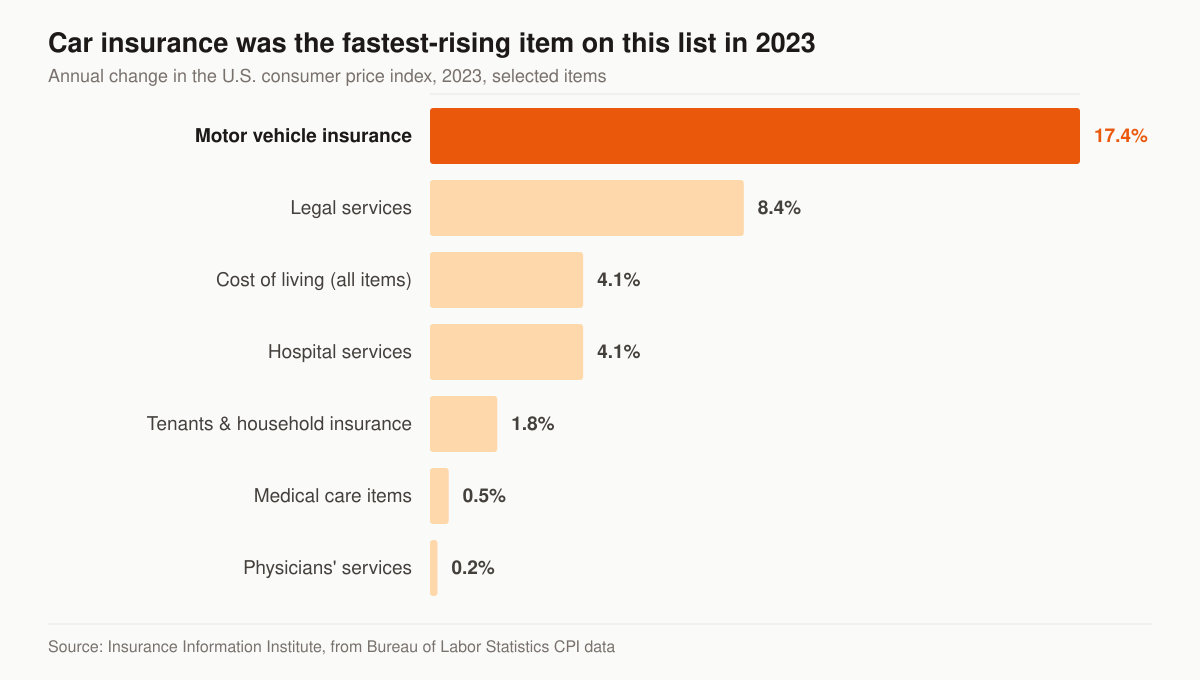
Annual change in the U.S. consumer price index, 2023, selected items. Source: Bureau of Labor Statistics data published by the Insurance Information Institute.
The pressure behind those increases is visible in the carriers’ own results on the same page. Private passenger auto liability ran a combined ratio after dividends of 111.2 in 2022 and 106.5 in 2023; collision and comprehensive ran 113.7, then 102.8. A combined ratio above 100 means the line paid out more in claims and expenses than it collected in premium. That pressure is what the 17.4 percent looks like once it reaches a renewal notice.
For an agency the consequence is operational rather than strategic. Renewal notices land on a rolling basis all year, each one is a shopping event, and the channel that catches a shopping event is the one already standing there when it happens — a ranking, a map-pack listing, a quote page that loads on a phone. A six-week campaign catches the households whose notice happens to fall inside those six weeks. That is the argument for building the durable surface first and using paid to fill in around it, which is the sequence the rest of this page follows.
Who an auto agency is actually competing with
Set the field before you set the budget. Auto is concentrated at the carrier level: in 2023 State Farm wrote 18.3 percent of U.S. private passenger auto direct premiums, Progressive 15.2 percent and Berkshire Hathaway 12.3 percent, and each of the ten largest groups held between 1.7 percent and 18.3 percent of the national total, per NAIC data published by the Insurance Information Institute.
The table below lists the ten largest writers of private passenger auto insurance by direct premiums written in 2023 — the advertising field an independent agency is standing in.
| Group | Share of U.S. private passenger auto direct premiums, 2023 |
|---|---|
| State Farm | 18.3% |
| Progressive | 15.2% |
| Berkshire Hathaway Inc. | 12.3% |
| Allstate Corp. | 10.4% |
| USAA Insurance Group | 6.2% |
| Liberty Mutual | 4.2% |
| Farmers Insurance Group of Companies | 4.2% |
| American Family Insurance Group | 2.1% |
| Travelers Companies Inc. | 2.1% |
| Nationwide Mutual Group | 1.7% |
Market share based on U.S. total, excluding territories. Source: NAIC data via S&P Global Market Intelligence, published by the Insurance Information Institute.
Those names are in the driver’s head before the search starts, and several of them sell direct. An independent agency does not win that on awareness, and buying awareness against companies with national television budgets is spending on their terms. Three advantages do not scale with a media budget:
- Comparison across carriers. A direct writer quotes one carrier. An independent agency quotes several in one conversation, which is the service a rate-shocked household is actually shopping for.
- Appetite a standard underwriter declines. SR-22 filings, non-owner policies, lapsed coverage, young drivers, older vehicles — covered in its own section below.
- Being physically near the searcher. Distance is one of the three factors Google names for local results, and it is a structural position no ad budget transfers.
To be plain about what depth buys: substance makes a page and a profile worth ranking, it does not fix a position or a timeline. How long it takes depends on how contested your zip codes are and what shape your profile is in today, which is what an audit measures before anyone quotes you.
What one auto household is worth, and what that lets you spend
Every acquisition decision on this page sits downstream of one number: what a bound auto household is worth to your agency over its life. The published market figure is a starting point rather than an answer. The countrywide average auto insurance expenditure was $1,062 in 2021, up 1.4 percent from $1,046 in 2020, per NAIC data published by Triple-I — and Triple-I is explicit that “The average expenditure measures what consumers spend for insurance on each vehicle.” A two-car household is two of those.
The table below sets the five most expensive states for auto insurance against the five least expensive, using NAIC average-expenditure data for 2021, the latest year published.
| Market | Average auto insurance expenditure, 2021 |
|---|---|
| New York — highest | $1,511.04 |
| Louisiana | $1,500.38 |
| District of Columbia | $1,434.53 |
| Florida | $1,431.56 |
| Rhode Island | $1,422.42 |
| United States average | $1,061.54 |
| Wisconsin | $757.50 |
| Idaho | $741.54 |
| Iowa | $725.30 |
| Maine | $712.97 |
| North Dakota — lowest | $691.50 |
Average expenditures for private passenger auto insurance, 2021. Source: National Association of Insurance Commissioners data, published by the Insurance Information Institute.
An agency in New York and an agency in North Dakota run the same funnel against very different economics on the same commission percentage and the same close rate. That is why a blanket “spend a fixed share of revenue” rule misfires, and why we build the budget from household value instead: premium per vehicle, times vehicles per household, times your commission rate, times the number of terms the household stays — then a share of that figure as the ceiling on what a bound policy may cost to acquire. The insurance agency marketing budget guide walks the arithmetic.
Where auto agents leak quotes (and what it costs)
We audit the funnel before touching ad spend, because doubling your quote rate costs less than doubling your clicks, and a leak is a fixed tax on every channel you run afterwards.
The table below lists the four leak points we check first on an auto site, the symptom each one shows, and what it costs you.
| Leak point | Common symptom | What it costs you |
|---|---|---|
| Slow mobile site | 4s+ load, failing Core Web Vitals | Clicks you paid for leave before the page paints |
| Buried phone / no click-to-call | Visitor has to scroll to act | Lost calls from ready buyers |
| Long quote form | 12+ fields, no progress | Started-but-abandoned quotes |
| No local proof | Generic site, no reviews | Lower map-pack trust + rank |
Fixing these is the fastest ROI in the whole program. The same speed-to-lead and quote-page discipline we run on our own senior-market book transfers directly to P&C — different buyer, identical conversion math.
The queries auto buyers actually type
Auto search is not one keyword; it is a set of intents that want different pages. Ranking for the generic head term is expensive and rarely the shortest route to a bound policy. Local SEO for auto insurance agents works because the qualified intent lives in the modifiers — a city, a zip, a coverage level, a filing requirement, a driver type.
The table below maps the query patterns an auto agency can realistically own to what the searcher has already decided and the page that should answer them.
| Query pattern | What the searcher has already decided | The page that answers it |
|---|---|---|
| “car insurance near me” | They want a local human, now | Google Business Profile plus a homepage with click-to-call |
| “[city] auto insurance” | Location fixed, agency not | A city page with real local substance |
| “cheap full coverage [zip]” | Coverage level fixed, still shopping price | A coverage explainer that ends in a quote form |
| “SR-22 insurance [city]” | They have a filing deadline | A dedicated SR-22 page naming your state’s rules |
| “non-owner car insurance” | No vehicle, still needs proof or a filing | A non-owner page — a query a general auto page cannot answer |
| “insurance for a new driver” | Adding a teen to the policy | A page on how a young driver rates and what reduces it |
| “car insurance quote [zip]” | Ready to transact | The quote page itself, with the fewest fields you can live with |
Two rules keep that library from turning into a doorway farm. One page per intent rather than one page per keyword variant, and every page carries something a national landing page does not have — your state’s actual filing rule, your carrier lineup, the local claim reality. Building it is the insurance SEO work, and turning it into car insurance lead generation you own rather than rent is the whole point of the exercise.
Which marketing channels work for auto insurance agents?
Auto insurance marketing runs on five channels: local SEO and Google Business Profile for “near me” searches, geo and intent pages for organic volume, Google search ads for high-intent quote traffic now, Facebook ads for cheap bundle and renewal-shopper reach, and bought leads as a throttle. Paid produces fastest; owned search compounds cheapest. Sequence paid first for cash flow, then build organic underneath so blended acquisition cost falls.
The table below compares those five channels on cost profile, how quickly each produces a first lead, and whether it keeps producing after you stop paying.
| Channel | Cost profile | Speed to first leads | Durability |
|---|---|---|---|
| Local SEO / Google Business Profile | Effort-heavy, no media spend | 60–120 days | Compounds — keeps producing |
| Organic SEO (geo + intent pages) | Content investment up front | 4–8 months | Highest — an asset you own |
| Google search ads | Priciest clicks in the mix | Days | Rented — stops with spend |
| Facebook ads | Cheapest reach, colder traffic | Days to weeks | Rented — stops with spend |
| Bought leads / live transfers | Pay per lead, shared or exclusive | Immediate | None — pure throttle |
On that last row: lead price is the wrong number to shop on. The cost-per-policy math on shared vs exclusive auto leads shows why the cheaper shared lead usually costs more per sold policy once contact and bind rates enter the equation.
Winning the map pack when distance is a ranking factor
Google publishes what local results are built on. “Local results are mainly based on relevance, distance, and popularity,” per its guidance on improving local ranking. The second of the three is the one auto agents underestimate: Google’s own definition is that “Distance refers to how far each business is from the customer who’s searching,” and no amount of on-page work moves your office.
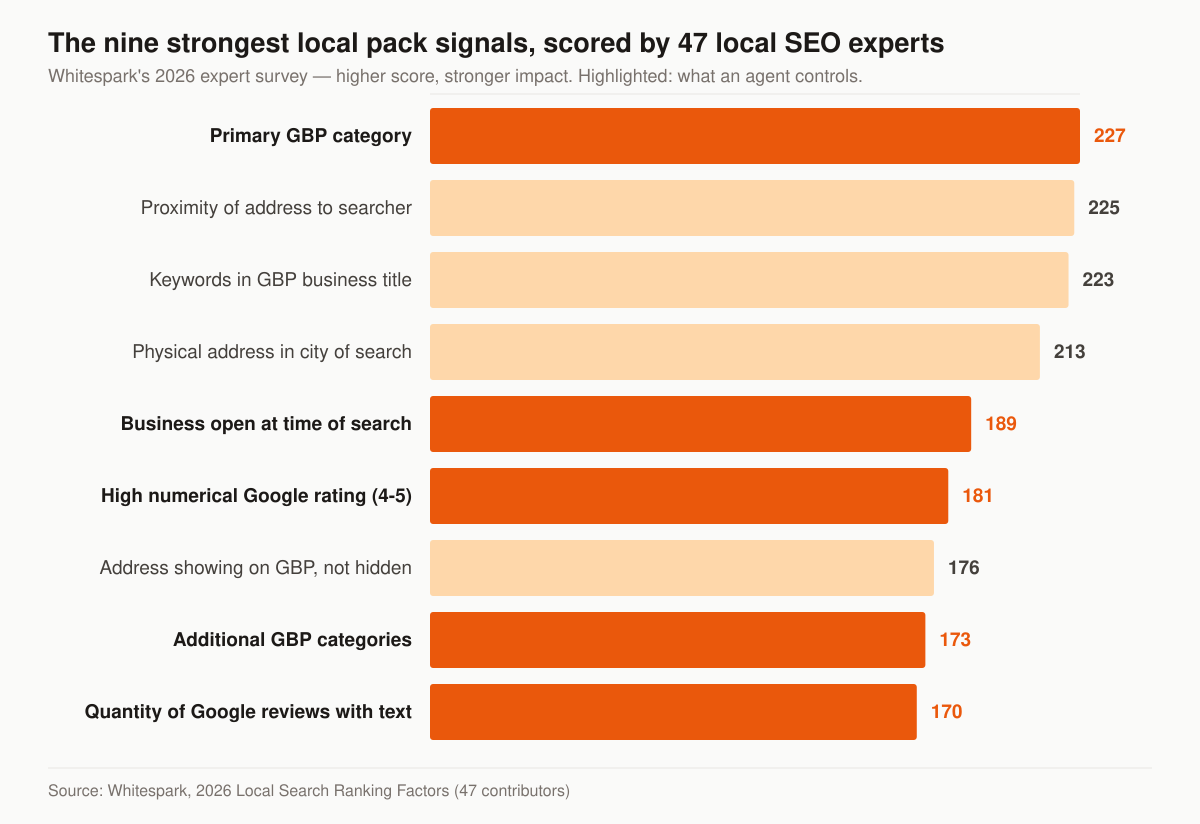
Local pack ranking factors scored by 47 contributors. Source: Whitespark, 2026 Local Search Ranking Factors.
That has three practical consequences for an auto agency:
- Your map-pack radius is geographic, not aspirational. A single office does not rank across a metro because it would like to. Zips at the edge of your service area are won on the organic side, with city pages, rather than inside the pack.
- The profile fields are the relevance lever. Category, hours, service area and a complete profile are what Google matches against the query. Getting the name field wrong is the expensive mistake, because recovery runs through an appeal rather than a fresh listing — what a suspended Google Business Profile costs walks that process.
- Reviews are a ranking input, not only social proof. Google’s line is that “More reviews and positive ratings can help your business’s local ranking,” which makes a stalled review stream a ranking input going cold.
The ongoing version of this work — profile, categories, review cadence, service-area signals — is our local SEO and map-pack service, and the review engine behind it is reputation management.
SEO plus paid: sequence it for cash flow
SEO is the base; paid fills the pipeline while it matures. We typically start clients on paid for immediate volume, then build organic underneath so you stop renting every lead. For auto specifically, Facebook ads for auto insurance agents drive bundle and renewal-shopper audiences cheaply, while the search side compounds in the background. If you’d rather route paid traffic to a purpose-built page, our auto insurance website design work makes sure the click has somewhere good to land.
A typical auto build runs in this order:
- Audit & fix — speed, quote form, click-to-call, tracking
- Local SEO — Google Business Profile, citations, review engine
- Geo content — city and high-intent term pages, built to rank
- Paid layer — Facebook + Google to fill the pipe now
- Measure — cost per quote, quote-to-bind, channel ROI
Where paid search is the priority rather than the filler, that work is run as PPC management for insurance agencies, with the bid ceiling set from your cost per bound policy rather than your cost per click.
How do you run Facebook ads for auto insurance?
Run Facebook as a lead campaign targeted to drivers in your service area, lead with a concrete offer — a rate comparison or bundle review, not a generic “get a quote” — send clicks to a quote page that loads fast on mobile, and judge the campaign on cost per qualified quote rather than cost per lead. Facebook traffic is colder than search, so the offer and your speed-to-lead matter more than targeting tricks.
The step-by-step Facebook ads guide for auto agents walks the full build — audiences, offer structure, and the math that tells you whether to scale or kill a campaign — and the managed version of it lives on our Facebook ads page linked above.
SR-22, non-owner and nonstandard auto: the segment the national brands market past
Triple-I describes the nonstandard market as “a niche market for drivers who have a worse than average driving record or drive specialized vehicles such as high-powered sports cars or custom-built cars,” made up of “both small specialty companies, whose only business is the nonstandard market, and well-known auto insurance companies with nonstandard divisions.” For an independent agency with the appetite to place it, that is a search segment with unusually explicit intent.
Take Texas as a worked example, because the state publishes its rules plainly. A Financial Responsibility Insurance Certificate (SR-22) is required by Texas Transportation Code Chapter 601 to verify a driver is maintaining motor vehicle liability insurance, and the Texas Department of Public Safety states flatly that “An insurance card or policy will not be accepted in place of a SR-22.” The minimums the certificate attests to are $30,000 for bodily injury to or death of one person in one crash, $60,000 for two or more persons in one crash, and $25,000 for damage to or destruction of property of others in one crash. A driver required to file must maintain coverage for two years beginning from the date of the conviction that requires the SR-22, and reinstating the license carries a $100 fee in addition to any other outstanding fees. Drivers who do not own a vehicle are directed to ask an insurance provider about a Texas Non-Owner SR-22 policy.
Read that as a marketing brief and four things fall out:
- The searcher has a deadline. A suspended driver license is not a browsing problem, which is why time to first contact matters more here than in a routine renewal shop.
- They already know the term. “SR-22 insurance [city]” is a specific query with a specific answer, and a page titled “auto insurance” does not answer it.
- Non-owner is its own query. A page that names the non-owner policy answers a question a general auto page cannot.
- You know the renewal date in advance. A two-year filing period is a calendar entry, and the insurer notifies the state the moment the filing lapses.
Every state runs this differently — filing periods, minimum limits and reinstatement mechanics all vary — so the page you build has to cite your own state’s authority rather than repeat a generic explainer. That is the same discipline as the rest of the program: local substance over generic coverage, which is what makes a page worth ranking and worth citing.
Calls, texts and reviews: the federal rules that shape auto follow-up
Speed to lead pushes an auto agency toward texting, and texting is the part of the funnel with actual federal rules attached. None of them stops the follow-up. All of them shape how the quote form and the sequence get built.
Consent, and what the quote form is really collecting. The FCC defines prior express written consent at 47 CFR 64.1200(f)(9) as “an agreement, in writing, bearing the signature of the person called that clearly authorizes the seller to deliver or cause to be delivered to the person called advertisements or telemarketing messages using an automatic telephone dialing system or an artificial or prerecorded voice, and the telephone number to which the signatory authorizes such advertisements or telemarketing messages to be delivered.” Read the scope before applying it: that definition governs autodialed and artificial-or-prerecorded marketing, not every call a producer places by hand. Where it applies, the agreement must carry a clear and conspicuous disclosure that “By executing the agreement, such person authorizes the seller to deliver or cause to be delivered to the signatory telemarketing calls using an automatic telephone dialing system or an artificial or prerecorded voice,” and that “The person is not required to sign the agreement (directly or indirectly), or agree to enter into such an agreement as a condition of purchasing any property, goods, or services.” An electronic signature counts, “to the extent that such form of signature is recognized as a valid signature under applicable federal law or state contract law.” A quote form that hides the consent language in a link, or makes agreeing to it the price of getting a quote, is failing the second half of that.
The calling window. No telephone solicitation to “Any residential telephone subscriber before the hour of 8 a.m. or after 9 p.m. (local time at the called party’s location),” per §64.1200(c)(1). The called party’s clock, not yours, which matters the moment a service area crosses a time zone.
Opting out. Paragraph (a)(10) governs revocation of consent “to receive calls or text messages made pursuant to paragraphs (a)(1) through (3) and (c)(2) of this section” — autodialed and artificial-or-prerecorded calls and texts, and telephone solicitations to numbers on the national do-not-call registry. Inside that scope, replying “stop,” “quit,” “end,” “revoke,” “opt out,” “cancel,” or “unsubscribe” to a text “constitutes a reasonable means per se to revoke consent”; other wording still counts “if a reasonable person would understand those words to have conveyed a request to revoke consent”; requests must be “honored within a reasonable time not to exceed ten business days from receipt of such request”; and senders covered by those paragraphs “may not designate an exclusive means to request revocation of consent.” One mechanic worth building into the sequence: a single confirmation text is permitted so long as it “merely confirms the text recipient’s revocation request and does not include any marketing or promotional information,” and is the only further message sent — and if it goes out within five minutes of receipt, “it will be presumed to fall within the consumer’s prior express consent.”
Reviews. The map-pack advantage above runs on reviews, and the FTC’s Rule on the Use of Consumer Reviews and Testimonials at 16 CFR 465.4 makes it “an unfair or deceptive act or practice and a violation of this part for a business to provide compensation or other incentives in exchange for, or conditioned expressly or by implication on, the writing or creation of consumer reviews expressing a particular sentiment, whether positive or negative, regarding the product, service, or business that is the subject of the review.” Asking every bound driver for a review sits outside that. Attaching a gift card to a five-star one is the behavior the section names.
The wider picture, including state advertising rules, is in insurance marketing compliance for agents.
What an auto insurance agent marketing program includes
Strategy is the section above. This is the deliverable list — what gets built, run, and reported on when an agency hands auto marketing over:
- A quote page built for a phone at a red light — one action, minimal fields, click-to-call in the thumb zone, and a load time that survives a cellular connection.
- The local search surface — Google Business Profile, city and service-area pages, and a review cadence, because auto is won by whoever looks local and available right now.
- Search campaigns on shopping-trigger queries — renewal-shock, new-driver, new-vehicle, and SR-22 intent rather than broad “car insurance” terms nobody can afford to outbid.
- Speed-to-lead routing — quote requests pushed to a phone in minutes, since a comparison shopper is talking to three other agents the same hour.
- Cross-line capture — every auto quote is a home and umbrella conversation. The funnel asks, which is what lifts the value of a lead you already paid for; the home insurance agent marketing program runs the other half of that bundle and the P&C agency program runs both as one book.
- Reporting to bound policies, not clicks or form fills.
The two sub-pages under this pillar go deeper on the first and third items: auto insurance agent website design and Facebook ads for auto insurance agents.
How to measure auto insurance marketing
Clicks and form fills are the wrong unit for a line that renews. An auto program is judged on bound policies, on how many vehicles and lines a household holds, and on whether that household is still there next term — and those numbers live in the agency management system rather than in an ad platform. Reporting that stops at the ad platform cannot tell you which channel to cut.
The table below is the reporting set we hold an auto program to, with where each number is read and the decision it drives.
| Number | Definition | Where it is read | The decision it drives |
|---|---|---|---|
| Cost per bound policy | Channel spend divided by policies bound from that channel | Ad platform spend joined to the AMS | Compares a paid click and a map-pack call in one unit |
| Quote-to-bind rate by source | Policies bound divided by quotes issued, split by source | AMS | Separates a traffic problem from a sales problem |
| Time to first contact | Minutes from form submission to a human attempt | CRM timestamps | A conversion lever you move without buying more traffic |
| Vehicles and lines per household | Total policies divided by total households | AMS | The account-rounding score for an auto book |
| Map-pack visibility by term and zip | Where the profile ranks for the terms that convert | Rank tracking across the service area | Shows local work landing before revenue reflects it |
| Review velocity | New reviews per month, and how recent the newest is | Google Business Profile | Google ties local ranking to review count and rating |
Reporting to bound policies rather than to leads is what makes a shared lead, an exclusive lead, a map-pack call and an organic quote request directly comparable. That is the comparison the shared versus exclusive auto lead math runs, and it is why lead price on its own is a poor thing to shop on. The channel-by-channel version of the same argument is in how auto insurance agents win clients online.
What auto insurance agent marketing costs
We publish prices because an agency owner comparing three shops should not have to sit through a discovery call to learn the band. There are three monthly tiers and one entry build.
The table below shows each published tier, what it runs, and the auto agency it usually fits.
| Tier | Monthly | What it runs | The agency it fits |
|---|---|---|---|
| Foundation | $2,500 | Optimized site and landing pages, local SEO with the Google Business Profile, on-page SEO, monthly reporting | A single-office agency whose profile and quote page are the bottleneck |
| Growth | $3,500 | Everything in Foundation, plus the ongoing SEO and content engine, AI-search visibility, and reputation and reviews | An agency that needs the map pack, the city and intent pages, and the review engine moving together |
| Full-Funnel | $5,500 | Everything in Growth, plus managed paid ads on Google and Meta, landing-page CRO, marketing automation and CRM, and full-funnel reporting | Multi-producer agencies ready to buy volume on top of visibility |
| One-time build | $2,500–$8,000 | A quote-ready site, built once | An agency whose site leaks quotes before any channel work is worth funding |
Ad spend is billed separately, straight to the platforms. Growth is the tier we usually point auto agencies toward, because the map pack, the pages behind it and the review engine have to move at the same time and no one of the three carries the other two. Managed paid search sits a tier higher, in Full-Funnel, which is the honest place for it: media is a recurring job rather than a bolt-on. The full breakdown of what sits inside each tier is on the pricing page, and which system to hand over first is what a free marketing audit answers before anything is signed.
Built by operators, applied to your book
We’re a practitioner shop. We run live lead campaigns ourselves, so the conversion systems we install for auto clients are tested, not theorized. We won’t pretend auto is final-expense; it isn’t. But the ad discipline, tracking, and quote-page craft that work for our senior-market clients are the first things we look for on an auto site, and the first things we install when they are not there.
See how this thinking plays out across P&C and other insurance verticals, or read a final-expense agency case study for the conversion playbook in detail.
Want to know exactly where your agency is leaking quotes and which channel to fix first? Start with a free marketing audit — we’ll map your local rankings, score your quote page, and show you the math before you spend a dollar with us. Prefer to talk it through first? Get in touch and we will model the economics with you.
Deeper guides
Go deeper on Auto Insurance Agent Marketing
Facebook Ads for Auto Insurance Agents (Managed Service)
Managed Facebook ads for auto insurance agents, run by an agency that generates insurance leads daily. Real ad discipline, tracked. Get a free ad audit.
Auto Insurance Agent Website Design That Generates Leads
Auto insurance agent website design that generates quote requests, not just looks pretty. Built by an operator who runs live insurance campaigns daily.
The services behind it
Guides that go deeper