Shared vs Exclusive Auto Insurance Leads: A Cost-Per-Policy Breakdown
Exclusive vs shared auto insurance leads comes down to cost per sold policy, not price per lead. Exclusive auto leads cost more but only you dial them, so contact and bind rates run higher. Shared leads are cheaper yet split among several agents, which drags real economics down fast.
Auto insurance shoppers behave differently from almost every other line. They are fast, price-first, and usually quoting several places at once. That behavior is exactly why the exclusive-versus-shared question hits harder in auto than in most verticals — and why the sticker price on a lead tells you even less than usual.
We have made the cost-per-sale case for exclusive vs shared final expense leads elsewhere. This is the auto version, because the funnel math and the buyer psychology are not the same. Final expense prospects are relationship-driven; auto prospects are stopwatch-driven. The exclusivity decision has to account for that.
What each lead type means in auto
An exclusive auto lead is sold to one agent — you are the only person quoting that driver. A shared (or “non-exclusive,” “competitive”) auto lead is sold to several agents at once, commonly three to eight, sometimes more via aggregators.
In auto there is a second, hidden layer of competition: even an “exclusive” lead from a comparison site may be a shopper who is simultaneously getting direct quotes from national carriers. So “exclusive” means exclusive among the agents that vendor sold it to — not exclusive in the prospect’s mind. Get the exclusivity window, resale policy, and whether the source is a comparison funnel in writing before you spend.
What auto insurance leads cost right now, by type
The funnel math below only means something once you know what the funnel is being fed. ActiveProspect — the company behind the TrustedForm consent-certificate product — publishes working price bands by line, and its auto figures put shared leads at roughly $10 to $25, exclusive leads at roughly $30 to $80, and live transfers at roughly $50 to $150 per transfer. The same page describes exclusive web leads as sold to a single buyer and states they “cost roughly 2 to 3 times more than shared leads, but often convert better.”
Four price points describe the whole auto lead market, and two of them overlap.
| Auto lead type | Published price | What the money actually buys |
|---|---|---|
| Shared web lead | $10–$25 | One form fill, delivered to several agents at the same moment |
| Exclusive web lead | $30–$80 | The same form fill, delivered to you alone by that one vendor |
| Live transfer | $50–$150 per transfer | A connected call, not a record you still have to dial |
| Aged shared record | $3.50 at 3–30 days old (1–249 leads); $0.25 at 86–365 days old (25,000+ leads) | Bulk dialer fuel, resold repeatedly, with the intent long cold |
Sources: the first three rows are ActiveProspect’s published auto bands, Insurance leads cost. The aged row is read directly off Aged Lead Store’s live auto price grid, which also prices the 31-to-85-day band at $2.00 for orders of 1–249 leads.
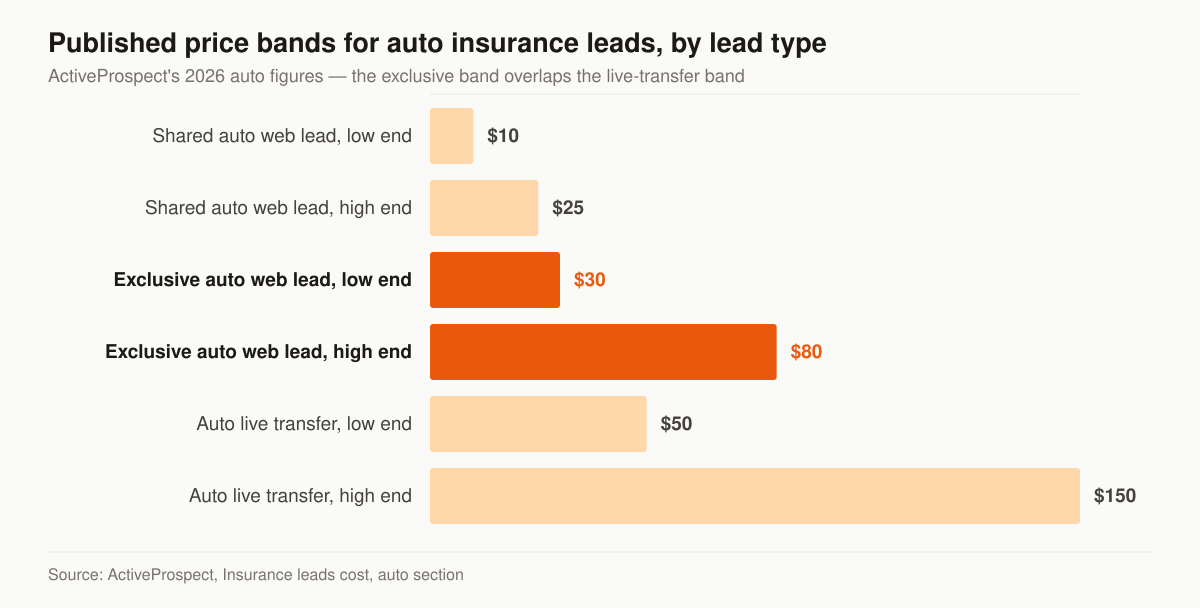
Published price bands for auto leads by type. Source: ActiveProspect, Insurance leads cost, auto section, page last updated 28 August 2026.
Read the overlap. The top of the exclusive band ($80) sits well above the bottom of the live-transfer band ($50), which means at the premium end of “exclusive” you are no longer choosing between two lead types — you are choosing between one more form fill and one connected call. That is a different decision, and we come back to it below.
One caution on the aged row: Aged Lead Store’s own page describes what it sells as shared internet leads intended for manual dialing of consumers “who were not on any DNC lists.” Cheap records carry their own operating rules, and those rules cost labor.
The cost-per-lead vs cost-per-policy math
We compare the two on cost per bound policy, never on price per lead. Watch the bottom row flip even though the shared lead looks cheaper per unit.
| Metric | Exclusive auto lead | Shared auto lead (sold 5x) |
|---|---|---|
| Cost per lead | $22 | $7 |
| Contact rate | 60% | 32% |
| Quote rate (of contacted) | 60% | 45% |
| Bind rate (of quoted) | 28% | 18% |
| Net bind rate (lead → policy) | ~10.1% | ~2.6% |
| Leads needed per policy | ~9.9 | ~38.5 |
| Cost per bound policy | ~$218 | ~$269 |
The shared lead is roughly 68% cheaper per lead and still costs more per bound policy. The per-lead discount evaporates because you are calling a driver several agents already reached (lower contact), who has already been quoted (lower quote-to-you), and who is mid-comparison (lower bind).
These percentages are illustrative, not a promise — the point is the structure. Small drops in contact and bind rate, compounded across the funnel, swamp a large drop in lead price. Plug in your own numbers. If you do not know your contact and bind rates by source, that is the first thing to fix, and it is exactly what a free marketing audit reverse-engineers from the data you already have.
How exclusive is exclusive when the shopper is collecting 3.5 quotes?
Vendor exclusivity is a distribution promise, not a description of the driver’s afternoon. J.D. Power’s 2026 U.S. Insurance Shopping Study — based on responses from 12,437 insurance customers who requested an auto insurance price quote from at least one competitive insurer in the previous six months, fielded from January 2025 through January 2026 — reports that “Customers now receive an average of 3.5 quotes, the highest level in the study’s history”.
Four figures from that release define the room your exclusive lead walks into.
| What the 2026 study measured | Figure |
|---|---|
| Average quotes an auto shopper now receives | 3.5, described as the highest level in the study’s history |
| Share of customers shopping their auto policy, year over year | Declined from 57% to 53% |
| New auto policies purchased digitally | 48%, up from 36% five years ago |
| Recent shoppers who say usage-based insurance matters in their shopping process | 44% |
Source: J.D. Power, 2026 U.S. Insurance Shopping Study, released 4 June 2026. The study is in its 20th year and measures auto shoppers specifically.
Three consequences for the exclusivity decision. First, an exclusive lead is exclusive to you among that vendor’s buyers, while the shopper is separately collecting quotes from carrier apps and direct sites — so exclusivity buys you a clear lane, not an empty road. Second, the year-over-year drop from 57% to 53% means slightly fewer shoppers to compete over, which pushes vendor prices in the wrong direction for buyers. Third, if 48% of new auto policies are bought digitally, the person on the other end of your exclusive lead expects to be answered, not pitched — the same behavior our page on how auto insurance agents win clients online is built around.
Speed to lead decides more than the label
In auto, speed is not a tiebreaker — it is often the whole game. A shared lead dialed in under two minutes can beat an exclusive lead you call an hour later, because you become the first real quote. The auto shopper who has already bound coverage by lunch is worthless at 4 p.m. regardless of how “exclusive” the lead was.
This is why a disciplined lead follow-up cadence matters more than the exclusivity checkbox for most P&C agents. The agents bleeding money are usually losing it to slow, inconsistent dialing, not to the exclusive-vs-shared choice itself.
Aggregator, generator, or your own form: where the record came from
The label on the invoice tells you how many buyers got the record. It does not tell you who created it, and that second question predicts more of your outcome. Vendors themselves draw the line. EverQuote’s agent-facing post, published in 2020 by an EverQuote agency business consultant, splits shared leads into two origins: lead aggregators, which it says “have a lower price point because their leads are not delivered in real time and because they have a higher share rate; the leads are shared among multiple, sometimes dozens, of other agents”, and lead generators, which “source leads organically themselves or via partners, by driving traffic to their websites through advertising and search engine marketing.” HBW Leads draws the same aggregator-versus-generator split on its own auto comparison page.
That distinction reshapes the share count. In the same post EverQuote states that “EverQuote shared leads are distributed with a maximum of three insurance agencies—on average, EverQuote sends one consumer lead to 1.9 agents”. A shared lead capped at three buyers and a shared lead resold to dozens carry the same word on the invoice and completely different economics. If a vendor cannot state its cap and its average, you are buying the word, not the product.
There is a third origin that never appears in these comparisons because nobody sells it: a form on your own site, filled in by someone who came looking for you. That record is exclusive by construction, its consent language is yours, and its marginal cost is whatever the traffic cost. It is a different budget line, not a different lead tier, and it is the one we build.
Live transfers and inbound calls: the third column nobody puts in the table
Once you accept that what you are really buying is contact rate, the live transfer stops looking like an extravagance. ActiveProspect describes live transfer leads as “warm phone transfers” that are “typically the most expensive but come closest to a ready-to-talk prospect”, and prices them at roughly $50 to $150 for auto. Compare that to an exclusive auto form fill at the top of its band, $80, and the premium for having the driver already on the line is smaller than the exclusivity debate implies.
The catch is that a transfer moves your risk rather than removing it. On a form fill your exposure is a wrong number and a wasted dial. On a transfer your exposure is a qualified-sounding call that was never qualified — the wrong state, an uninsurable driving record, a caller who thought they were being connected to their existing carrier. So the return policy is the whole negotiation. Ask what minimum call duration counts as billable, who arbitrates a disputed transfer, and whether the credit is cash or account balance.
Two questions decide whether transfers belong in your mix at all: can somebody pick up every time one arrives, and does your rater produce a real number while the caller is still on the phone? If either answer is no, you are paying live-transfer prices for form-fill outcomes. Agencies that cannot staff the phone reliably should read our appointment-setting service page before they buy calls.
Where shared auto leads still win
- You are new and protecting capital. Shared leads keep upfront spend low while you build quoting speed. The cost-per-policy penalty is real, but so is the lower risk of burning your budget in week one.
- You quote instantly and at volume. If you hit shared leads in the first minute or two, you often become the first quote, which collapses the contact-rate gap.
- You have a tight quoting workflow. Price-shopped drivers reward a fast, confident, bundle-aware pitch. A slow rater kills you on shared leads.
Where exclusive auto leads earn the premium
- Contact rate. No one else is dialing; you control the callback windows.
- Bind rate. The driver has not been quoted five times this morning, so price is not the only conversation.
- Account rounding. A calmer first call lets you review the whole household and cross-sell home, umbrella, or a bundle — which is where auto actually becomes profitable. Monoline auto is thin margin; the account-rounding math for P&C agencies is what turns a break-even lead into a lifetime-value win.
- Cleaner attribution. One agent per lead means honest source data you can scale on.
There is a supply constraint on the other side of that premium, and vendors say so plainly. EverQuote’s post notes that “Exclusive leads are often available with limited volume and vendors charge a premium for them.” Before you rebuild a week around exclusive flow, ask the vendor how many auto leads your filters actually produced in each of the last three months in your states. A tier you can only half-fill is a schedule problem, not a lead-type upgrade.
Two different purchases sit behind this comparison. If you want exclusive auto leads or live transfers delivered as a product, that is a lead-purchasing transaction — buy leads direct from getinsureleads, our sister brand built for exactly that. We don’t sell leads on this site; we build the quote funnels and follow-up systems that generate them.
Does exclusivity actually help you round the account?
This is where monoline auto stops being a loss leader, and the published data says the door is mostly staying shut. In the 2026 J.D. Power study, among recent customers who were actively shopping an auto policy, 45% say they have a homeowners policy — but only 20% received a homeowners quote while shopping for auto insurance. Owning the second policy and being asked about it are not the same event, and the gap between those two figures is the round nobody made.
Stephen Crewdson, managing director of insurance intelligence at J.D. Power, framed the sequencing in the release: “Most customers are only shopping their auto policy, and if the auto quote isn’t competitive, they don’t stick around to discuss home, life or other financial products.” He added that “if an insurer can’t be competitive on auto, the door usually closes on any chance to bundle additional policies”.
Apply that to the lead decision and the exclusivity premium reads differently. Rounding requires a conversation that survives past the auto number, and a shared lead is structurally the worst place to have one: the driver is comparing quotes, you are the third caller, and there is no slack in the call for a homeowners question. An exclusive lead does not guarantee the round — the competitive auto quote is still the price of admission — but it buys the minutes in which asking is not an interruption. Model your cost per bound policy against expected rounded premium rather than the auto commission alone, or you will price exclusivity as if the household were one policy deep.
Solo producer or a team of five: staffing changes the answer
SmartFinancial’s agent resource makes a point the price comparison usually skips: shared leads suit agencies with capacity to work larger numbers of prospects, while exclusive leads can suit individual agents managing their own pipeline. That is a staffing question wearing a lead-buying costume, and it is answerable with arithmetic you already have.
Count how many first-dial attempts your team can make in the first five minutes of a lead arriving, during your actual buying hours, on your worst-staffed day. That number, not your budget, is your shared-lead capacity. Shared leads pay only when you are consistently first through, and being first through is a headcount-and-routing problem: someone must be free, the record must land in a dialer rather than an inbox, and the rater must already be open.
Exclusive leads relax the clock without removing it. Because you are not racing three other agencies, a callback at hour two is a delay rather than a loss, which is precisely what a solo producer who is also servicing renewals needs. The honest version of the trade: shared leads convert labor into savings, exclusive leads convert money into slack. Buy whichever one you have more of. If you have neither, fix routing before you change vendors — a CRM that timestamps first contact by source will tell you inside a fortnight which constraint is actually binding.
The consent trail is different, and it is yours to prove
Exclusivity is a distribution term. It says nothing about whether you may lawfully dial the number, and the two get conflated constantly in vendor sales calls.
Start with the definition. Under 47 CFR 64.1200(f)(15), a “telephone solicitation” excludes a call or message “To any person with that person’s prior express invitation or permission” or “To any person with whom the caller has an established business relationship”. Read the second exclusion against §64.1200(f)(5), which defines that relationship for telephone-solicitation purposes as “a prior or existing relationship formed by a voluntary two-way communication between a person or entity and a residential subscriber with or without an exchange of consideration, on the basis of the subscriber’s purchase or transaction with the entity within the eighteen (18) months immediately preceding the date of the telephone call or on the basis of the subscriber’s inquiry or application regarding products or services offered by the entity within the three months immediately preceding the date of the call, which relationship has not been previously terminated by either party.” That is two clocks, not one: eighteen months from a purchase or transaction, three months from an inquiry or application, and the paragraph is written for a residential subscriber. A bought lead record is an inquiry, not a purchase, so the three-month clock is the one that governs it — and the relationship runs to the entity the consumer inquired with.
That last clause is where shared and exclusive leads genuinely diverge. When you buy a record — either type — the consumer inquired with the generator, not with you, so what you are relying on is whatever consent that form captured and passed down the chain. On an aggregator record the chain is longer and the original page is often unnamed. Two more mechanics apply regardless of lead type: §64.1200(c)(2)(i)(D) expects a registry version “obtained from the administrator of the registry no more than 31 days prior to the date any call is made,” and §64.1200(d)(6) states that “A do-not-call request must be honored for 5 years from the time the request is made.”
None of that makes shared leads unlawful or exclusive leads safe. It makes the paperwork part of the price. Our full treatment of TCPA compliance when you buy insurance leads covers the consent standard, the vacated one-to-one rule, and the record-keeping to demand from any vendor before the first dial.
What to get in writing before you buy either type
Vendors answer these questions differently on the phone than they do in a contract, which is the reason to ask for the contract. Eight terms decide what you actually bought, and none of them are the per-lead price.
| Ask the vendor | Why it changes your economics | What a clean answer sounds like |
|---|---|---|
| Exact share count, and the cap | Your position in the queue drives contact rate more than lead quality does | A stated maximum and a stated average, both in the agreement |
| Exclusivity window, and resale after it | An “exclusive” lead resold as aged next month is a shared lead on a delay | A named number of days, plus whether resale ever occurs |
| Delivery latency | A real-time post and a nightly batch are different products at the same price | Posted to your CRM at form submission, with a timestamp you can audit |
| Source disclosure | You cannot fix what you cannot attribute, and comparison funnels behave differently | The generating property named, or at minimum the channel |
| Consent record | The record you may need is the one captured at the form, not a summary | A per-lead consent certificate or session record you can retrieve |
| Return and credit policy | Determines whether bad records are a cost or a rounding error | Written criteria, a filing window, and cash-or-credit stated |
| Filters available | Wrong-state and wrong-carrier leads are pure loss on any lead type | State, ZIP radius, current carrier, and phone type at minimum |
| Volume commitment and minimum spend | Exclusive tiers throttle; a commitment you cannot fill is a monthly write-off | Trailing volume by state for the last three months, and a stated exit term |
Two of these deserve extra weight in auto specifically. Delivery latency, because the line’s whole advantage goes to whoever quotes first. And current-carrier filtering, because a driver already with a direct writer is a different conversation from one shopping an independent agency.
How to compare your own two options
- Pull 90 days of auto leads by source.
- Tag each exclusive or shared.
- Calculate contact, quote, and bind rate for each source.
- Divide total spend by bound policies for each — that is your real cost per policy.
- Multiply against average commission plus expected rounded premium to get lifetime return, not just cost.
That last step is the auto-specific twist: because rounding is where the money is, an exclusive lead’s cleaner first conversation can justify its price even when the raw cost-per-policy gap is narrow.
For the full picture on sourcing, funnels, and predictable auto lead flow, see our approach to auto insurance agent marketing, and for the digital-presence side, how auto insurance agents win clients online.
How to run a 60-day split test instead of arguing about it
The comparison above is a model. Your market is the measurement, and 60 days is usually enough to get one.
- Fix the variables you are not testing. Same producers, same hours, same rater, same script, same follow-up cadence. If the exclusive leads get your best closer, you have tested your closer.
- Buy into one week’s dialing capacity, not one month’s budget. Size both buys so every lead gets its first dial inside your target window. A test that outruns your phones measures your phones.
- Timestamp everything at the record level. Lead received, first dial, first contact, quote delivered, bound. Cost per bound policy is a division problem, and both numbers have to come from the same system.
- Let the cohort finish. Auto shoppers who did not bind in week one sometimes bind at renewal. Cutting the window at 30 days flatters whichever source produces faster, shallower business.
- Score three numbers, not one. Cost per bound policy, policies per household bound, and average premium per bound policy. Exclusive leads frequently lose the first and win the second.
- Write down the decision rule before you look. “We keep whichever source has the lower cost per bound policy at equal premium” is a rule. Reading the results and then deciding what mattered is not.
Run it twice a year. Lead markets reprice, vendors change their share caps, and a conclusion from two seasons ago is a hypothesis today.
When buying stops being the answer
Both columns of this comparison have the same ceiling: you are renting access to a shopper somebody else acquired, at whatever the auction clears. Every improvement you make to your close rate raises the price the vendor can charge the next buyer. That is not a reason to stop buying leads — it is a reason to make sure buying is not the whole plan.
The alternative is owning the acquisition. Auto sits at the top end of insurance click prices, as our breakdown of insurance PPC cost per click by line lays out, so this is not a cheap route — but the record it produces is exclusive by construction, the consent language is yours, and the asset compounds instead of resetting each month. The same argument in its P&C form runs through our P&C insurance marketing strategy guide, and the mechanics of the page that has to convert the click sit on our insurance landing pages service.
Where that lands in our own pricing is deliberately public. Managed programs run $2,500 per month at Foundation, which covers the site and landing pages, local SEO and Google Business Profile, on-page SEO and monthly reporting; $3,500 at Growth, which adds the ongoing SEO and content engine, AI-search visibility and reputation work; and $5,500 at Full-Funnel, which is the tier that adds managed Google and Meta ads, landing-page CRO and marketing automation. A one-time website or landing-page build is $2,500–$8,000. Ad spend is billed at cost, straight to the platforms. If your answer to this article is “generate my own auto leads rather than bid for other people’s,” Full-Funnel is the tier that does it — the full detail is on our pricing page, and the plumbing is described under insurance lead generation.
The takeaway
Stop comparing exclusive vs shared auto insurance leads by price per lead. In a line this price-sensitive and fast-moving, that number lies. Compare cost per bound policy, factor in speed to lead, and weigh account-rounding potential — and the cheaper-looking shared lead often turns out to be the more expensive sale.
- Cross-Selling and Account Rounding for P&C Agencies
How P&C agencies use cross-selling and account rounding to lift retention and lifetime value — the trigger points and marketing systems that make the ask.
- How Auto Insurance Agents Win Clients Online
How auto insurance agents get clients online: the three channels that produce quotes, the cost-per-bound-policy math, and the speed-to-lead rule behind it.
- How to Run Facebook Ads for Auto Insurance Agents
A step-by-step guide to Facebook ads for auto insurance agents: audience setup, offers that beat rate-shoppers, ad structure, and the math behind scaling.
- P&C Insurance Marketing: A Channel-by-Channel Strategy Guide
P&C insurance marketing across 6 channels: referral partners, local SEO, reviews, retention, cross-sell, paid search — plus real costs and a 90-day plan.