Cross-Selling and Account Rounding for P&C Agencies
Cross-selling and account rounding grow a P&C agency by turning one-policy customers into multi-line households that renew longer and cost nothing new to acquire. The system is mechanical: track monoline accounts, trigger the next-logical-line offer at renewals and life events, and make the ask with review requests and scheduled touchpoints rather than hope.
Most property and casualty agencies are sitting on their cheapest growth channel and treating it like an afterthought. It isn’t a new ad platform or a fresh lead source. It’s the book you already have. Every monoline account on your renewal list is a household you’ve already paid to acquire, already underwritten, and already earned some trust with, carrying exactly one policy when it could carry three.
This is a marketing-systems piece, not a sales-script pep talk. We build the tracking, timing, and outreach that make cross-selling and account rounding happen on schedule instead of when someone remembers. We sell those systems, not policies, so what is being pitched here is a way to stop leaking lifetime value. Rounding is the retention half of a program — the acquisition half, and how the two are sequenced, sits in our P&C insurance marketing strategy guide.
Cross-selling vs. account rounding vs. bundling
These three terms get used interchangeably and shouldn’t be — they describe different parts of the same motion, and each one is measured differently.
| Term | What it is | Whose view |
|---|---|---|
| Cross-selling | The act of selling an additional, different line to an existing client | Your sales motion |
| Account rounding | The end state: every eligible line for that household or business written with you | Your book strategy |
| Bundling | The multi-policy offer and discount that incentivizes it | The client’s incentive |
You cross-sell the next line, using a bundle as the carrot, in service of rounding the account. Keeping them separate matters because each needs a different metric: cross-sell wants a conversion rate on offers made, account rounding wants policies-per-household, and bundling wants a discount that pencils out against the retention it buys.
The math that makes rounding the highest-ROI play
You don’t need invented statistics to see why this works — the mechanics are structural. Two levers do the heavy lifting:
- Zero incremental acquisition cost. The lead, the quote conversation, the trust-building, the underwriting relationship — all already paid for. A second line written to an existing client skips the entire top of the funnel that makes new-business acquisition expensive.
- Compounding retention. Each additional line raises the household’s switching cost, and higher retention extends the years you collect renewal commission. Lifetime value is roughly premium × margin × years retained, so lifting the “years retained” term through more policies-per-household moves LTV more than almost anything you can do at acquisition.
Put plainly: a monoline auto client is one competitor’s teaser quote away from gone. The same client carrying auto, home, and umbrella has to unwind three relationships to leave, and rarely bothers. That is why policies-per-household is the single P&C retention metric worth obsessing over, and why an agency that rounds accounts systematically out-earns one that only chases new logos.
How much rounding opportunity is actually sitting in front of you
You can size the gap before you open your own book, because the shopping research already describes it. The JD Power 2026 U.S. Insurance Shopping Study — based on responses from 12,437 insurance customers who requested an auto insurance price quote from at least one competitive insurer in the previous six months, fielded January 2025 through January 2026 — found that among recent customers actively shopping an auto policy, 45% say they have a homeowners policy, but only 20% received a homeowners quote while shopping for auto insurance.
That is the whole argument for a rounding program in two numbers. The household was already at the counter, already holding a second exposure, and the second quote was never put in front of them.
The same study sets the pressure around that gap. The share of customers shopping for auto insurance declined from 57% to 53% year over year, customers now receive an average of 3.5 quotes — the highest level in the study’s history — and 48% of new auto policies are purchased digitally, up from 36% five years ago.
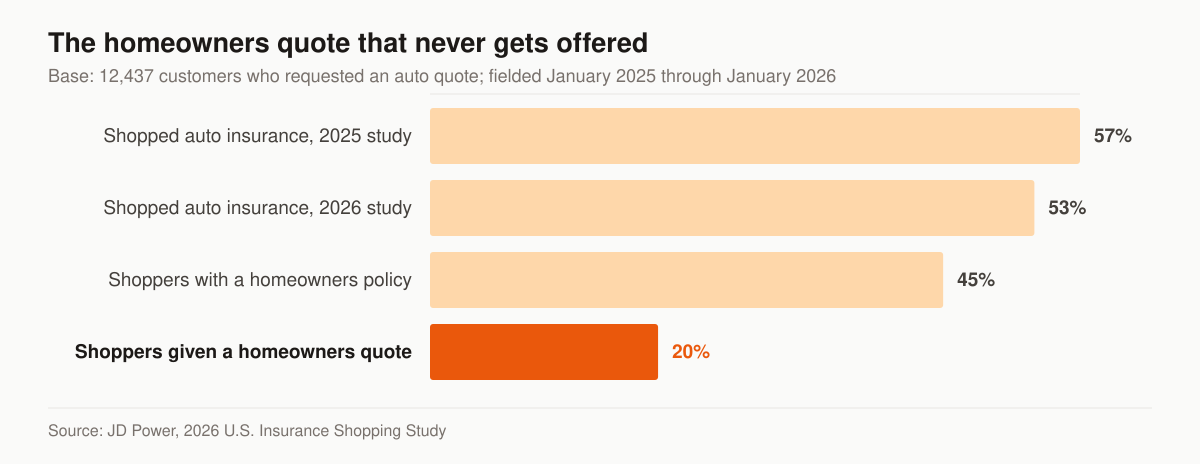
Source: JD Power, 2026 U.S. Insurance Shopping Study (4 June 2026).
The release quotes Stephen Crewdson, managing director, insurance intelligence at JD Power: “Most customers are only shopping their auto policy, and if the auto quote isn’t competitive, they don’t stick around to discuss home, life or other financial products. In practice, if an insurer can’t be competitive on auto, the door usually closes on any chance to bundle additional policies,” he said.
Read that as an order of operations. Rounding does not start with a cross-sell email. It starts with being competitive and fast on the line the household came to you for, because that is what buys the right to ask about the second one.
The trigger map: when to make the offer
Random cross-sell blasts train clients to ignore you. Relevant, timed offers convert. Build outreach around the moments the client is already thinking about coverage:
- Renewal windows — the annual moment they’re already evaluating a policy. Attach the next-line offer to the renewal touch.
- Life events — new home, new teen driver, marriage, a business expansion, a new vehicle. Each one changes what they need and opens a natural, non-salesy reason to talk.
- Post-service highs — right after you resolved a claim well or earned a five-star review, trust is at its peak. That’s the moment for the ask, not a cold Tuesday.
- Onboarding — the first 30–90 days of a new monoline client, while engagement is highest, is prime time to quote the obvious second line.
The job of your marketing stack is to catch these triggers automatically so a producer never has to remember them.
The next-logical-line ladder, by the policy the household already holds
The trigger tells you when to speak; the ladder tells you what to offer, and it is decided by the policy already on the books rather than by whatever line you are trying to grow this quarter.
| Policy already in force | Next line to quote | The trigger that opens it | What to check before you offer |
|---|---|---|---|
| Personal auto | Homeowners or renters | Renewal, a move, a home purchase, a mortgage pre-approval | Whether the household owns or rents, and whether the garaging address matches the mailing address |
| Homeowners | Personal auto, then personal umbrella | Renewal, a new vehicle, a new driver in the household | Underlying liability limits, and the umbrella carrier’s required minimums |
| Renters (HO-4) | Personal auto now; homeowners at purchase | Lease renewal, a mortgage pre-approval, a first child | Whether a home purchase is already in motion |
| Auto and home both written | Personal umbrella, scheduled personal property | A liability limit change, a jewelry or firearm purchase, a pool, a boat | Underlying limits on both policies, and any excluded property |
| Personal lines household with a side business | Business owners policy, commercial auto | An LLC filing, a first employee, a vehicle used for deliveries | Whether business use is excluded on the personal auto policy |
| Commercial BOP | Workers’ compensation, commercial auto, cyber, employment practices liability | A first hire, a new lease, a contract demanding a certificate of insurance | The insurance requirements written into the client’s contracts |
Two figures from the NAIC tell you which property form you will be quoting most of the time on that ladder. In the NAIC’s Homeowners Insurance Report for 2021 data, released January 2024, HO-3 coverage accounts for nearly 78.16% of owner-occupied exposures, and HO-4 coverage accounts for 75% of non-owner-occupied exposures. So the property half of a personal-lines round is an HO-3 for owners and an HO-4 for tenants far more often than it is anything else, and the quoting workflow you build should assume those two forms first.
The lines also differ in what they add to the household’s annual spend, which is worth knowing before you decide where to put producer time. The countrywide average auto insurance expenditure increased 1.4 percent to $1,062 in 2021 from $1,046 in 2020, according to NAIC data published by the Insurance Information Institute, with the average expenditure highest in New York ($1,511), followed by Louisiana ($1,500) and the District of Columbia ($1,435). On the property side, the NAIC reported the HO-3 average premium up 7.6% nationwide over 2020 while the HO-4 average premium fell 1.7% between 2020 and 2021, and it notes that tenant and condominium policies do not cover the building, so their exposures concentrate at significantly lower insurance amounts. We plan a renters round as a retention move and an owner-occupied round as a revenue move, on the strength of that exposure-amount difference.
Finding the monoline accounts: what your agency system has to hold
A rounding program is a database query, not a hunch. If a producer has to remember which households are monoline, the program is already dead. Before you build any outreach, confirm your agency management system or CRM can answer these on demand:
- A household or account key that groups policies to the same people. Without it, a two-policy household reads as two one-policy customers and never enters the queue.
- Policy count per household, refreshed at bind and cancel, not at annual review.
- Line of business and policy form, so you can tell an HO-3 owner from an HO-4 tenant and offer the right next line.
- Effective and expiration dates on every policy, plus x-dates on the lines a competitor currently holds. We treat the x-date as the field that earns its keep here, because it converts a decline into a dated callback.
- Exposure flags the file already implies: owns or rents, number of vehicles against number of licensed drivers, business-entity ownership, a mortgage, a teen in the household.
- Consent and opt-out state per channel, so an offer never goes to a client who asked you to stop.
- Last-contact date and last service outcome, which is what turns a good claim experience into a timed opening.
From those fields you can build the only three reports the program needs: monoline households sorted by expiration month, households whose file shows an exposure you do not insure, and accounts with a positive service event in the last thirty days. Everything else is decoration. If your current system cannot produce them, that is a platform problem rather than a producer problem — the comparison we keep for agency owners is in the best CRM for insurance agents, and the workflow layer that fires off those reports is covered in insurance marketing automation.
The marketing systems that actually make it happen
Intentions don’t round accounts; systems do. Three pieces carry most of the load:
1. Renewal and life-event touchpoints (automated timing, human offer). A sequence that fires ahead of every renewal and after logged life events, reminding the client of gaps and teeing up the producer’s call. The automation guarantees the timing; the person makes the offer. This is exactly what email and follow-up automation for agents is built to run.
2. Review requests that double as cross-sell openers. Asking for a review after a good interaction does two jobs: it builds the local reputation that wins new search traffic, and the positive-sentiment moment it creates is the ideal launch point for a next-line conversation. Our reputation and review management for agents wires the ask into the workflow, and the mechanics of getting the review itself are in our guide to getting more Google reviews as an insurance agent.
3. Bundle offers on a fast quote path. When the client says yes to a second line, the quote has to be immediate. A slow, form-heavy path kills momentum you already earned. Keeping the second-line quote as frictionless as the first is a conversion problem, not a sales problem.
All three pieces run as one managed system inside our client retention program if you would rather not stitch them together yourself.
What you are allowed to send: the TCPA and CAN-SPAM lines on cross-sell outreach
Cross-sell outreach goes to people who are already clients, which does change the rules — but less than agencies assume, and only for some channels.
A live call to a client is not a telephone solicitation while the relationship is live. 47 CFR 64.1200(c)(2) bars initiating a telephone solicitation to a residential telephone subscriber registered on the national do-not-call registry. The definition at 64.1200(f)(15) excludes from that term a call or message “To any person with whom the caller has an established business relationship”. The relationship itself is defined at 64.1200(f)(5) as a prior or existing relationship formed by a voluntary two-way communication between a person or entity and a residential subscriber, with or without an exchange of consideration. Its clock is the part to write on the wall, because the definition runs “on the basis of the subscriber’s purchase or transaction with the entity within the eighteen (18) months immediately preceding the date of the telephone call or on the basis of the subscriber’s inquiry or application regarding products or services offered by the entity within the three months immediately preceding the date of the call, which relationship has not been previously terminated by either party.”
Two limits sit directly under it. Paragraph (f)(5)(i) provides that a subscriber’s seller-specific do-not-call request “terminates an established business relationship for purposes of telemarketing and telephone solicitation even if the subscriber continues to do business with the seller” — a client who asked you to stop calling is still a client and still off the list. Paragraph (f)(5)(ii) provides that the relationship “does not extend to affiliated entities unless the subscriber would reasonably expect them to be included given the nature and type of goods or services offered by the affiliate and the identity of the affiliate”. That is the sentence to read before a sister agency, a downline, or an FMO calls your book on your behalf.
None of that reaches autodialed or prerecorded outreach. 64.1200(a)(1) prohibits initiating a call, other than one made for emergency purposes or made with the prior express consent of the called party, using an automatic telephone dialing system or an artificial or prerecorded voice to the lines it lists — including, at (a)(1)(iii), “any telephone number assigned to a paging service, cellular telephone service, specialized mobile radio service, or other radio common carrier service, or any service for which the called party is charged for the call.” Where the call “includes or introduces an advertisement or constitutes telemarketing,” 64.1200(a)(2) raises the standard to prior express written consent. A bundle offer is an advertisement. An in-force policy is not consent.
On email, the moment you bolt an offer onto a renewal notice you have written a commercial message. Under the FTC’s CAN-SPAM Rule, 16 CFR 316.3(b) treats a message as transactional or relationship only where it “consists exclusively of transactional or relationship content” as set out in 316.3(c) — which, for an ongoing relationship, means notification of a change in the terms or features, notification of a change in the recipient’s standing or status, or “At regular periodic intervals, account balance information or other type of account statement.” Mix promotion into that and 316.3(a)(2) deems the primary purpose commercial where a recipient reasonably interpreting the subject line “would likely conclude that the message contains the commercial advertisement or promotion of a commercial product or service”, or where the transactional content does not appear, in whole or in substantial part, at the beginning of the body of the message. A commercial message then carries the rule’s duties, including a working opt-out and a valid physical postal address, which 316.2(p) defines as the sender’s current street address, a Post Office box the sender has accurately registered with the United States Postal Service, or a private mailbox accurately registered with a commercial mail receiving agency.
Here is how that lands channel by channel, which is the version worth pinning above a producer’s desk.
| Cross-sell channel | What an existing client relationship gives you | What it does not give you |
|---|---|---|
| Live agent call to a residential line | The established-business-relationship exclusion at 64.1200(f)(15), on the (f)(5) clock: 18 months from a purchase or transaction, three months from an inquiry or application | Any call after a seller-specific do-not-call request under (f)(5)(i), or a call by an affiliate the subscriber would not reasonably expect under (f)(5)(ii) |
| Autodialed or prerecorded call, or any such call to a wireless number | Nothing on its own — (a)(1) requires prior express consent, and (a)(2) requires prior express written consent when the call includes or introduces an advertisement | Consent inferred from the policy the client already bought |
| Renewal or service email with no offer in it | Transactional or relationship treatment under 316.3(b), provided it consists exclusively of 316.3(c) content | Room to add a bundle pitch and keep that treatment |
| Renewal email carrying a bundle offer | Nothing — 316.3(a)(2) deems it commercial on the subject-line or placement tests | Relief from the commercial-message duties, including opt-out and a physical postal address |
This is the federal floor, not the whole floor. State telemarketing statutes, state anti-rebating rules governing any incentive attached to the offer, and your carriers’ own marketing guidelines all sit on top of it. The sitewide version of that map is in our insurance marketing compliance guide for agents, and it is worth a read before you point automation at a book you spent years building.
Who is allowed to make the ask
A rounding program routes work to whoever is closest to the client, which is exactly where agencies get into trouble: the service staff who spot the gap are frequently not licensed for the line they spotted. Producer licensing is state law and lines of authority differ by state, so the operative text is your own — but the shape of the prohibition is visible in California Insurance Code § 1631, which reads: “Unless exempt by the provisions of this article, a person shall not solicit, negotiate, or effect contracts of insurance, or act in any of the capacities defined in Article 1 (commencing with Section 1621) unless the person holds a valid license from the commissioner authorizing the person to act in that capacity.”
Three verbs decide the workflow: solicit, negotiate, effect. Design the hand-off so an unlicensed teammate does none of them.
- Safe for an unlicensed teammate: recording a life event in the CRM, updating exposure fields, noting an x-date the client volunteers, asking permission for a licensed colleague to follow up, and putting that call on the calendar.
- Requires the licence: quoting, recommending a line, comparing coverage, explaining what a policy would or would not pay, and binding.
Build the split into the software rather than the training deck. A form field that captures “client mentioned they bought a boat” and routes the account to a licensed producer costs nothing and removes the temptation to answer the coverage question in the moment. We build marketing systems, not compliance advice, so run the finished workflow past your E&O carrier and your state’s producer-licensing rules before it goes live.
A simple account-rounding operating cadence
You can run this with a CRM and a calendar. The point is that it runs every month, not when someone feels ambitious.
- Segment the book by policies-per-household. Flag every monoline account — those are your rounding targets.
- Overlay the trigger calendar. Tag upcoming renewals and any logged life events against those monoline accounts.
- Queue the offer. For each flagged account, pick the next-logical line (auto → home → umbrella is the common ladder) and schedule the touch to land at the trigger.
- Make the ask human. Producer calls or sends a personal note with a specific, relevant bundle offer — not a generic “we also do home.”
- Measure offers made and rounds closed. Track your cross-sell conversion rate, not just total policies. If offers-made is low, the system isn’t firing; if made-but-not-closed is low, the offer or the quote path needs work.
The numbers that tell you whether rounding is working
Six measures cover the whole program, and each one fails in a different place, which is what makes the set worth tracking rather than any single headline rate.
| Metric | How to compute it | What a bad reading points at |
|---|---|---|
| Monoline share of households | Households with exactly one policy ÷ total households | The queue is refilling faster than the team is working it |
| Offers made per month | Logged cross-sell offers ÷ eligible monoline accounts | The trigger automation is not firing, or nobody is logging the ask |
| Offer-to-quote rate | Second-line quotes issued ÷ offers made | The offer is not relevant to that household, or the ask is too vague to act on |
| Quote-to-bind rate | Second lines bound ÷ second-line quotes issued | Price, carrier appetite, or a quote path with too many steps |
| Policies per household | Total in-force policies ÷ total households | The scoreboard for the program as a whole |
| Retention split by policy count | Renewed households ÷ households up for renewal, reported separately for one, two, and three-plus policies | Whether the rounding is buying the retention you are paying for |
Track the last one as a split rather than an average. An agency-wide retention rate hides the exact question a rounding program exists to answer: whether two-line and three-line households renew better than your monoline households do. You can measure that inside your own book within a single renewal cycle, without any industry benchmark, and it is the number to bring to a carrier conversation about contingent commission. What running the whole system costs is published on our pricing page rather than quoted on a call.
Why rounding offers get declined, and what to do with each
A declined offer is data, not failure, and each reason has a different next step:
- The line is already placed elsewhere, mid-term. Ask for the x-date, record it, and schedule the callback sixty days ahead of it. This converts a no into a dated opportunity, which is what the x-date field is there to do.
- The bundle does not beat their current standalone price. Do not argue with arithmetic. Log the comparison, note the carrier, and revisit at their next renewal when their rate moves.
- They did not know you write the line. This is an awareness problem, not a sales problem, and it is fixed upstream by regular contact that says what you do — which is what a client newsletter is for.
- The timing was wrong. An offer that lands the week after a rate-increase letter or during a disputed claim reads as tone-deaf. Suppress cross-sell touches for accounts with an open service issue; that suppression rule belongs in the automation, not in a producer’s memory.
- The second quote took too long. Shoppers in the JD Power 2026 study collected an average of 3.5 quotes on the auto line alone, so a second-line quote that lands days after the conversation is arriving into a habit of comparison. Speed on the follow-up is the same discipline as speed on a new lead, and our insurance lead follow-up cadence applies to your own book unchanged.
Rounding a commercial account is a different motion
Everything above assumes a household. Commercial accounts round on a different calendar and through a different door.
The unit is the account rather than the family, and the opening is usually contractual: a new lease, a client demanding a certificate of insurance with specific limits and an additional-insured endorsement, a first hire that triggers workers’ compensation, an acquisition, or an audit. Those events arrive with a deadline attached, which is what makes the trigger worth catching — and what makes missing it expensive.
Sequence the offer by obligation rather than by commission. Statutory coverage comes first (workers’ compensation where the headcount now requires it), contractual coverage second (the limits and endorsements the client’s own contracts demand), and discretionary coverage third (cyber, employment practices liability, management liability, excess). An owner who has just been told a contract requires an umbrella limit they do not carry is receptive to the rest of the review in a way no cold campaign will reproduce.
The owner’s personal exposure is part of the account, too. A commercial client with partners has a buy-sell agreement that may be unfunded, and a business with staff has a benefits decision every year — both are rounding conversations that start from the commercial file. We cover those two specifically in key person and buy-sell insurance marketing and marketing group life and employee benefits.
Where this fits your wider P&C growth
Account rounding is the retention half of a P&C agency’s growth. The acquisition half — ranking for local quote intent, running geo-targeted ads, and converting new households — is covered in the home insurance agent marketing playbook and how auto insurance agents win clients online, since home and auto are the two lines most rounds start from. And because every round depends on catching the client at the right moment, the same discipline as an insurance lead follow-up cadence applies internally: the offer that never gets made converts at zero.
Rounding accounts isn’t a campaign you launch once. It’s a system you leave running so the book you already paid for keeps compounding. If you want a look at where your renewals and monoline accounts are leaking, the full P&C agency marketing system lays out the silo, and you can get a no-pitch teardown of your current funnel through our free marketing audit.
- Shared vs Exclusive Auto Insurance Leads: A Cost-Per-Policy Breakdown
Shared vs exclusive auto insurance leads compared on cost per sold policy, contact and bind rates, and where each wins — so P&C agents pick what actually pays.
- P&C Insurance Marketing: A Channel-by-Channel Strategy Guide
P&C insurance marketing across 6 channels: referral partners, local SEO, reviews, retention, cross-sell, paid search — plus real costs and a 90-day plan.
- How Auto Insurance Agents Win Clients Online
How auto insurance agents get clients online: the three channels that produce quotes, the cost-per-bound-policy math, and the speed-to-lead rule behind it.
- How to Run Facebook Ads for Auto Insurance Agents
A step-by-step guide to Facebook ads for auto insurance agents: audience setup, offers that beat rate-shoppers, ad structure, and the math behind scaling.