Service
Insurance Client Retention Marketing: Keep the Book You Built
A running retention system — onboarding, renewal reviews, lapse-prevention outreach, win-back, and a referral engine — that protects the persistency of the book you already paid to build and turns satisfied clients into your cheapest new business.
- We run our own final-expense book
- No pitch deck — we screen-share real numbers
- TCPA-aware · CMS/AEP-compliant · Meta Special Ad Category
- Core Web Vitals < 2.0s LCP
Insurance client retention marketing is the system that keeps the book you already paid to acquire: structured onboarding, renewal and review touchpoints, lapse-prevention outreach, win-back for clients who left, and a referral engine. It is the one growth channel that does not start by buying another lead.
What you get
What your insurance client retention marketing program includes
- A structured onboarding sequence that confirms the sale, sets expectations, and captures a referral or review while trust is at its peak
- Renewal and annual-review touchpoints scheduled ahead of each policy anniversary so clients hear from you before a competitor does
- A lapse-prevention flow triggered by payment failures and pre-renewal windows to catch the leavable cancellations
- A win-back campaign that re-approaches clients who already lapsed instead of writing them off
- A referral engine — timing, templates, and tracking — that asks at high-trust moments and measures introductions, not just intentions
- Cross-sell prompts wired to renewals and life events, feeding the next-logical-line offer to the right households
- Segmentation by tenure, line, and value so your best clients get proportionate attention
- A monthly report on persistency, referrals generated, win-backs recovered, and cross-sells triggered
How it works
How the insurance client retention marketing engagement runs
- 01
Retention audit
We map where your book leaks — lapse points, silent stretches between touches, and the referral and cross-sell moments you are currently missing — to find the cheapest wins first.
- 02
Build the lifecycle touchpoints
We build the onboarding, renewal-review, lapse-prevention, and win-back sequences against your CRM and policy calendar so every client hears from you at the moments that decide whether they stay.
- 03
Stand up the referral engine
We install the timing, templates, and tracking that turn high-trust moments — a smooth onboarding, a handled claim, a five-star review — into a steady flow of introductions instead of an annual scramble.
- 04
Measure persistency and refine
We report on persistency, referrals, win-backs, and cross-sells each month and tune the touchpoints toward what actually keeps clients and generates introductions.
A new lead arrives with a price attached. A lost client does not — which is why the first number gets managed and the second gets absorbed. A policyholder who lapses takes their renewals, their referrals, and their cross-sell potential with them, and each of those has to be re-bought at new-lead prices. Retention marketing is the discipline of not letting that happen.
This is a system, not a sentiment. “Take care of your clients” is not a plan. A plan is a set of scheduled, triggered touchpoints across the client lifecycle — onboarding, renewals, lapse windows, and referral moments — that run whether or not you remember to make the call.
It is also regulated work. The moment a renewal reminder becomes a call, a text, or a plan-specific message, it lands inside the same rulebook that governs acquisition: the FCC’s telemarketing rules at 47 CFR 64.1200, and for senior-market books the CMS beneficiary-contact rules at 42 CFR 422.2264. Both are quoted below, because the difference between a legal renewal call and an illegal one is usually a date on a calendar.
Retention marketing vs. one-off cross-selling
Cross-selling gets all the attention because it is the visible ask. But the ask only lands if the relationship is alive when you make it. Retention is the wider system; cross-selling is one lever inside it.
This table sets out the six levers the program runs, what each one does, and the trigger that fires it.
| Lever | What it does | When it fires |
|---|---|---|
| Onboarding | Confirms the sale, sets expectations, first referral ask | First 30 days after the sale |
| Renewal touchpoint | Reminds and reassures before the anniversary | Ahead of each policy renewal |
| Lapse prevention | Catches payment failures and drifting clients | Payment-fail + pre-renewal windows |
| Win-back | Re-approaches clients who already left | After a lapse |
| Referral engine | Turns trust into introductions | High-trust moments (claim, review) |
| Cross-sell prompt | Offers the next-logical line | Renewals and life events |
For the account-rounding tactic specifically, our cross-selling and account rounding guide goes deep on the triggers and the math. This service is the machine those triggers plug into.
How much of a book actually turns over?
More than the year-over-year numbers suggest, because a single year understates a cumulative problem. A study of 6,520,169 people who newly enrolled in Medicare Advantage between 2012 and 2016, published in the American Journal of Managed Care and built on the CMS Master Beneficiary Summary File, tracked how many changed insurance at least once after joining.
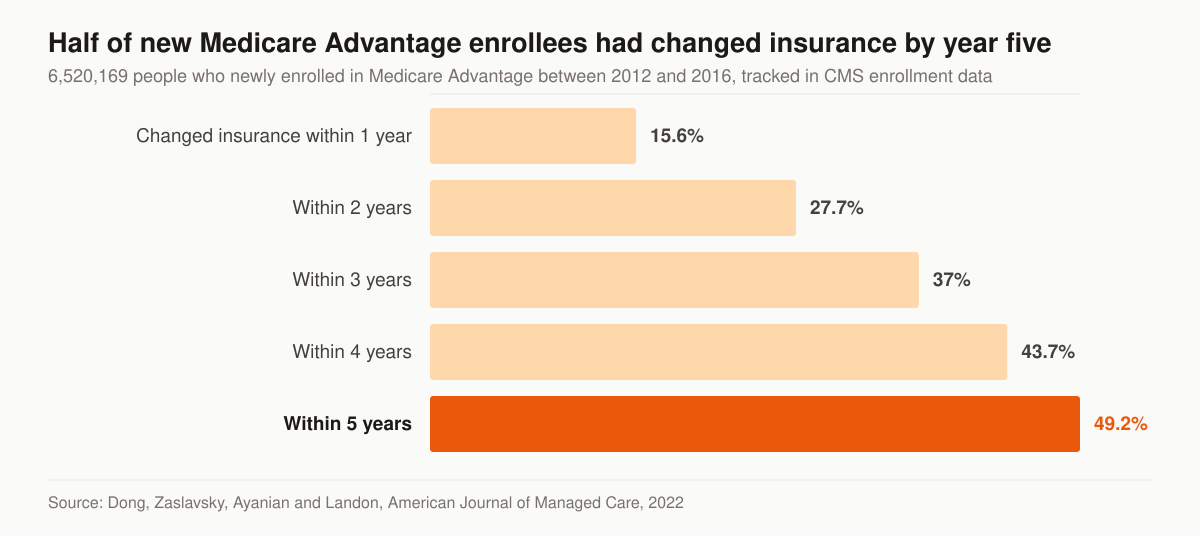
Source: Dong, Zaslavsky, Ayanian and Landon, “Turnover Among New Medicare Advantage Enrollees May Be Greater Than Perceived”, American Journal of Managed Care, 2022;28(10):539–542.
The authors report that 15.6% of new enrollees had changed insurance one or more times by the 1-year mark, 27.7% by 2 years, 37.0% by 3 years, 43.7% by 4 years, and 49.2% by 5 years. Their framing is the point: “changes that are perceived as small on a year-to-year basis can add up significantly over time.”
Three limits on reading that as your own churn. First, “changed insurance” there means switching Medicare Advantage insurers or disenrolling to traditional Medicare — it is not a measure of whether the client kept the same agent, and a client who moves carriers with you is a retained relationship. Second, the study covers new enrollees only, and the authors note their results “may overestimate the overall rate of insurance change within MA as older enrollees tend to change insurance at lower rates.” Third, it excludes employer plans, Special Needs Plans, PACE, cost plans and demonstrations.
Property and casualty tells a similar story from the other side. The JD Power 2026 U.S. Insurance Shopping Study, based on 12,437 customers who requested an auto quote, found the share of customers shopping for auto insurance declined from 57% to 53% year over year while remaining “elevated by historical standards,” with shoppers now receiving an average of 3.5 quotes — the highest in the study’s history. A shopping rate near half the market is not a retention emergency by itself. It is the reason the renewal touchpoint has to land before the shopping starts rather than after.
Retention rate, persistency, and policy count: which number are you managing?
These three get used interchangeably. They measure different things, and a program that improves one can leave another flat.
This table sets out how we define each measure, what it is good for, and the way each one can mislead you.
| Measure | What it counts | What it is good for | How it misleads |
|---|---|---|---|
| Policy retention | Policies in force at renewal ÷ policies eligible to renew | Tracking whether the book is shrinking | A household that drops two of three policies still counts as partly retained |
| Household retention | Households still writing anything with you | Telling you whether relationships are ending | Hides a household shrinking from three lines to one |
| Persistency | The share of a cohort still paying premium after a set period | Life and final expense books, where early lapse is the risk | Meaningless without naming the cohort and the window |
| Premium retention | Renewal premium retained against expiring premium | Seeing the revenue effect, not just the count | Rate increases can make a shrinking book look healthy |
| Policies per household | Lines in force ÷ households | The cross-sell and account-rounding view | Improves when small households leave, not only when big ones grow |
We set the baseline from your own system before the first touchpoint goes live, then report the same definitions every month. Changing the definition halfway is how a retention program starts producing wins nobody can bank.
Stop the preventable lapses in your book
Not every lapse is preventable — you cannot market your way out of a genuinely better competing rate. Some lapses are quieter than that: a failed payment nobody followed up on, a client who forgot they had you, a renewal that passed without a single touch. Those are leavable, and closing the silence gap catches them:
- Payment-failure outreach that treats a declined card as a save opportunity, not a cancellation.
- Pre-renewal reviews that reach the client before they start shopping.
- Annual check-ins that surface the life changes — new home, new baby, new job — that either lapse or expand a policy.
The touchpoints share a list and consent record with your email automation and agency newsletter, so retention outreach reinforces the ongoing nurture instead of colliding with it.
The onboarding sequence, touch by touch
The first thirty days decide how much attention the rest of the relationship gets. A client who never hears from you after the policy documents arrive has no reason to remember your name at renewal, and no reason to refer you before then. The sequence we build is short and specific rather than a drip that runs for a year:
- Same day, the confirmation. What they bought, what it covers, what happens next, and who to call. Plain language, not the carrier’s declarations page.
- Day two or three, the expectation-setter. When their first payment draws, what a claim looks like if they need one, and how to reach a human.
- Week two, the check-in. One question, not a survey: did the policy documents arrive and does anything look wrong? This is the touch that catches a wrong address or a failed first draft before it becomes a lapse.
- Week three or four, the ask. A review request or a referral ask, one or the other, never both in the same message. Trust is high and nothing has gone wrong yet.
- Day forty-five, the file-and-forget. Confirm the record is complete — birthdays, renewal date, other lines in the household, communication preference — so every later touchpoint has something to fire against.
We treat step four as non-optional. A referral engine with no scheduled ask is a hope, and the same is true of review velocity, which needs a request flow behind it rather than goodwill. The lead follow-up cadence guide covers the pre-sale half of the same discipline.
Can you call or text your own policyholders? The TCPA established business relationship
This is the question that decides whether a retention program can use the phone at all, and the answer sits in one definition. The FCC’s rules define a telephone solicitation at 47 CFR 64.1200(f)(15) as a call or message encouraging a purchase, but exclude a call or message “To any person with whom the caller has an established business relationship.” A call that is not a telephone solicitation is not blocked by the national Do Not Call registry.
The relationship itself is defined at 64.1200(f)(5) as “a prior or existing relationship formed by a voluntary two-way communication between a person or entity and a residential subscriber with or without an exchange of consideration, on the basis of the subscriber’s purchase or transaction with the entity within the eighteen (18) months immediately preceding the date of the telephone call or on the basis of the subscriber’s inquiry or application regarding products or services offered by the entity within the three months immediately preceding the date of the call, which relationship has not been previously terminated by either party.”
This table turns that definition into the clocks a retention calendar actually has to respect.
| Trigger | Window the relationship lasts | What ends it early |
|---|---|---|
| A purchase or transaction by the client | 18 months from the transaction | The client’s own do-not-call request to you, or either party terminating the relationship |
| An inquiry or application by the client | 3 months from the inquiry | The same |
| A company-specific do-not-call request | Ends the relationship for telemarketing immediately | Nothing reinstates it except new permission |
| An affiliate of yours | Does not carry over by default | Only extends if the client “would reasonably expect them to be included given the nature and type of goods or services offered by the affiliate and the identity of the affiliate” |
The eighteen-month clock is why win-back has a deadline. A client who lapsed twenty months ago and is on the registry is no longer reachable by phone on the strength of the old relationship; a client who lapsed ten months ago still is. That date, not the size of the lapsed list, is what a win-back calendar has to be built around.
What the established business relationship does not cover
Four limits, all in the same section, all of them routinely missed.
It is not consent for an autodialed or prerecorded call or text. 64.1200(a)(2) requires prior express written consent for a call “that includes or introduces an advertisement or constitutes telemarketing, using an automatic telephone dialing system or an artificial or prerecorded voice” to a mobile number, among the protected lines that paragraph lists. The relationship exemption sits in the definition of a telephone solicitation; it does not appear in that paragraph at all.
It does not override your own list. 64.1200(d) requires anyone making “any call for telemarketing purposes to a residential telephone subscriber” to maintain an internal do-not-call list, with a written policy available on demand, trained personnel, and requests honored “within a reasonable time from the date such request is made. This period may not exceed ten (10) business days from the receipt of such request.” That obligation does not care whether the client is yours.
A client’s opt-out survives the ongoing relationship. Under 64.1200(f)(5)(i), a seller-specific do-not-call request “terminates an established business relationship for purposes of telemarketing and telephone solicitation even if the subscriber continues to do business with the seller.” A policyholder can keep paying you premium and still be un-callable.
Revocation is easy on purpose. 64.1200(a)(10) lets a called party revoke consent “by using any reasonable method,” names “stop,” “quit,” “end,” “revoke,” “opt out,” “cancel,” and “unsubscribe” in a reply text as reasonable per se, requires any other wording to be honored if “a reasonable person would understand those words to have conveyed a request to revoke consent,” gives you the same ten-business-day ceiling, and says a caller “may not designate an exclusive means to request revocation of consent.”
State telemarketing statutes go further than the federal floor in several states, and a few require registration or narrower calling hours. Our TCPA compliance guide for agents buying leads covers the acquisition side of the same rules, and the insurance marketing compliance guide covers the wider set. We build the suppression logic into the sequences; you keep the licensed judgment.
Renewal and annual-review touchpoints: when they have to run
A renewal touchpoint that arrives with the renewal notice is late. The client has already had the rate increase in hand, already opened a comparison tab, already answered somebody’s quote form. The touchpoint has to run against the policy calendar, not the mail date.
- Sixty to ninety days out for the annual review invitation, which is a conversation about coverage rather than price, and the only touch that reliably surfaces a life change.
- Thirty days out for the renewal confirmation, which pre-frames any rate movement instead of letting the carrier’s notice be the first word.
- Renewal day for the thank-you, which costs nothing to send and is the easiest touch to drop.
- Post-claim, whenever it happens, because a claim handled well is a retention event and a claim handled badly is a lapse with a delay on it.
Each of those runs from a date already sitting in your management system. Building them means wiring the calendar to the sequences, which is why the retention build and the CRM decision are the same conversation in practice.
When can you contact a Medicare client about plan business?
For Medicare Advantage books this is not a judgement call. 42 CFR 422.2264(b) is titled “Contact for plan business” and opens: “MA organizations may contact current, and to a more limited extent, former members, including those enrolled in other products offered by the parent organization, to discuss plan business …” Two of the permitted activities reach agents directly: calling “current enrollees, including those in non-Medicare products, to discuss Medicare products,” and “Agents/brokers calling clients who are enrolled in other products they may sell, such as automotive or home insurance.”
There is a limit attached in the same list: “MA organizations may not make unsolicited calls about other lines of business as a means of generating leads for Medicare plans.” A P&C book is not a Medicare prospecting list. And under 422.2264(b)(2), a plan that reaches out about plan business must give every beneficiary it contacts written notice, at least once a year, “of the individual’s ability to opt out of future calls regarding plan business.”
This table separates the retention contact a Medicare book allows from the contact it does not, with the paragraph each one comes from.
| Retention activity | Permitted? | Where the rule sits |
|---|---|---|
| Calling a current enrollee about plan business | Yes | 422.2264(b)(1)(i) |
| Calling a current client in your P&C or life book about Medicare | Yes | 422.2264(b)(1)(iv) |
| Unsolicited calls about other lines used to generate Medicare leads | No | 422.2264(b)(1)(v) |
| Unsolicited mail or email (email must carry an opt-out) | Yes | 422.2264(a)(1) |
| Unsolicited calls, texts, robocalls or voicemails to prospects | No | 422.2264(a)(2)(iv) |
| Calling someone because a client referred them | No, not unsolicited | 422.2264(a)(2)(iv)(A) |
| Calling a former enrollee who has disenrolled | No, except a disenrollment survey for quality improvement | 422.2264(a)(2)(iv)(B) |
| Returning a call, or calling someone who sent a business reply card | Yes — not unsolicited | 422.2264(a)(3) |
Scope matters here. Part 422 is the Medicare Advantage program; stand-alone Part D plans are governed by the parallel section at 42 CFR 423.2264. Our CMS Medicare marketing rules guide walks the wider communications subpart, and the Medicare OEP marketing rules cover the season where retention outreach and marketing rules collide hardest. These sequences run for Medicare agencies with the plan-specific language routed through your compliance path.
Win-back campaigns: what changes once a client has already left
Win-back sounds like the simplest deliverable on the list. Three conditions decide whether the campaign is worth building.
The channel changes by line of business. For a Medicare Advantage book, an unsolicited call to a former enrollee who has disenrolled is out under 422.2264(a)(2)(iv)(B), with the narrow exception of “disenrollment surveys for quality improvement purposes.” What remains open is 422.2264(a)(1): unsolicited direct contact “by conventional mail and other print media (for example, advertisements and direct mail) or email (provided every email contains an opt-out option).” So the Medicare win-back is a mail and email campaign that has to earn an inbound call, not an outbound calling list.
The clock changes by date. For non-Medicare lines, the eighteen-month established-business-relationship window above is the outer edge of a phone win-back to a registered number. Practically that means a win-back list has an expiry date, and the sensible build runs the sequence at fixed intervals after the lapse rather than as an annual sweep of everyone who ever left.
The reason changes the offer. A client who left on price gets a different message from a client who left after a claim, and a client who left because they moved states may not be winnable at all. If your system does not record a cancellation reason, that is the first fix, because a win-back campaign with no reason code is a discount offer sent to people who did not leave over money.
Can you pay a client for a referral?
The instinct — a gift card for every introduction — runs straight into state insurance law, and the statutes are narrower than the instinct. Texas is a clean illustration. Under Texas Insurance Code § 4005.053(c), an agent may not pay, permit or give, directly or indirectly, to any person who does not hold an agent license “a fee or other valuable consideration for referring a customer who seeks to purchase an insurance product or seeks an opinion on or advice regarding an insurance product, based on that customer’s purchase of insurance.”
Read the last clause. What the statute prohibits is compensation tied to the purchase. Subsection (d) then carves out a narrow allowance: the prohibition does not stop an agent from giving, in connection with an offer or sale, “an item that is a promotional advertising item, educational item, or traditional courtesy commonly extended to consumers and that is valued at $25 or less.”
That is one state. Anti-rebating statutes and promotional-gift ceilings differ substantially across states, and our newsletter service page charts four of them side by side. The safe default we build to is the same everywhere: thank people, do not pay them per policy, keep any token inside your state’s ceiling, and never make the thank-you contingent on the referral converting.
For Medicare books there is a second constraint that has nothing to do with money. Under 422.2264(a)(2)(iv)(A), unsolicited “Calls based on referrals” are prohibited outright. The referral has to arrive as an inbound contact — 422.2264(a)(3) confirms that “returning phone calls or calling an individual who has completed a business reply card requesting contact is not considered unsolicited.” So a compliant Medicare referral engine is built to make the referred person call you, not to collect their number from a client.
Segmenting the book by tenure, line, and value
Treating every client the same is what produces a book where the largest accounts get the same automated birthday email as a monoline auto policy written last month. Four cuts do most of the work:
- Tenure. First-year clients lapse for different reasons than ten-year clients. The first year gets the onboarding sequence; the tenth gets the review that finds what changed.
- Lines per household. A monoline household is the one a competitor can quote away with a single policy, and the one with the clearest next offer.
- Value. Premium and commission per household decide how much human attention the relationship justifies, and which touches stay automated.
- Channel preference. A client who never opens email and answers every text should not be on the same sequence as one who does the reverse. Preference is a field, not a guess.
Those segments also feed the wider insurance sales funnel, because a retention segment is a targeting segment the moment you have a second product to offer it.
What we report on each month, and what we ignore
This table is the standing monthly report — the number, why it is on the report, and the vanity metric it replaces.
| What we report | Why it is on the report | What it replaces |
|---|---|---|
| Policy and household retention | The two numbers the program exists to move | “Everyone seems happy” |
| Lapses saved after a payment failure | Fast-moving, and the attribution is clean | Total emails sent |
| Referrals generated, and how many converted | Introductions are countable; goodwill is not | Referral “intentions” from a survey |
| Win-backs recovered, by lapse reason | Tells you which reasons are winnable and which are not | A win-back open rate |
| Cross-sells triggered, and policies per household | Whether the relationship is deepening or just surviving | Cross-sell emails delivered |
| Review velocity and response rate | The public trust surface the referral ask rides on | Star average alone |
We do not report open rates as an outcome. An open is not a decision, and a retention program that optimizes for them starts writing subject lines instead of keeping clients.
What retention marketing will not fix
Four things, stated plainly so nobody buys this expecting them.
A rate you cannot defend. If your carrier’s renewal is materially above the market and there is no remarket option, the touchpoint just delivers the bad news earlier. Earlier is still better — it gives you the conversation — but it is not a save.
A claims experience that went badly. Marketing can bring the client back into the conversation. It cannot rewrite what happened.
A service model that does not answer the phone. Every sequence in this program eventually routes a human interaction to your office. If that interaction does not happen, the sequence has only documented the problem.
A book you do not have clean data on. Renewal dates, cancellation reasons, household links and communication preferences are the fuel. A sequence cannot fire against a date your system does not hold, so filling those fields is the first job of month one rather than something you have to finish before we start.
How much does insurance client retention marketing cost?
Retention is not sold as a standalone line item — it runs inside a monthly tier. The published tiers are Foundation $2,500/mo, Growth $3,500/mo, and Full-Funnel $5,500/mo. Growth is the tier this program maps to: it carries the reputation and review engine the referral asks ride on, the ongoing content engine behind renewal and review touchpoints, and monthly reporting. Marketing automation and CRM — the layer the triggered lapse-prevention and win-back sequences actually run in — is a Full-Funnel line, so a book that needs those sequences built rather than run against tooling you already own lands at Full-Funnel. If your site cannot carry the forms and consent capture the sequences depend on, a one-time build runs $2,500–$8,000. Ad spend, where a win-back uses paid retargeting, is billed at cost straight to the platform. Full breakdown on the pricing page.
How long before retention shows up in the numbers
Three clocks, and only one of them is fast. Payment-failure saves move immediately — the outreach either recovers a declined draft this week or it does not, and the attribution is clean. Referrals and review velocity move next, usually within the first couple of months, because the ask is being made to clients you already have rather than to strangers you have to find. Retention itself is the slow one, and it cannot be rushed: a six-month auto policy takes two terms to show a trend and an annual policy takes two years, because the measurement window is the policy term. Anyone quoting you a retention lift inside a quarter is quoting a number that has not had time to exist yet.
That is also why the baseline matters more here than in any other program we run. We pull your current retention, persistency and policies-per-household from your own system in the first month, in writing, before a single touchpoint fires — so the comparison later is against a recorded starting point rather than a memory.
How we run insurance client retention for you
We build the lifecycle sequences inside your CRM against your policy calendar, so the touchpoints stay your asset and follow each client from sale to renewal to referral. Suppression runs underneath all of it: your internal do-not-call list, revocation requests, and the established-business-relationship dates above are enforced by the sequence rather than remembered by a person. For senior-market books, renewal and review outreach stays inside CMS Medicare marketing rules — educational and general, never gated or incentivized. You are the licensed party; we provide marketing services, not licensed insurance advice. It fits especially well for Medicare and P&C books where persistency and multi-line households drive the economics.
Want to see where your book is leaking clients and referrals? Start with a free marketing audit, or reach the team to scope a retention build.
Guides that go deeper
Frequently asked questions
Isn't retention just cross-selling? How is this different from that guide?
Why spend on retention when I could buy more leads?
What causes policyholders to lapse, and can marketing stop it?
How does a referral engine work without being pushy?
Can I call a client who is on the national Do Not Call registry?
Is retention outreach compliant for Medicare and senior-market clients?
How do you measure retention — by policy or by household?
Do you charge separately for retention work?
See exactly where your agency is leaking leads.
15 minutes. We screen-share our own live lead dashboard and tear down your funnel line by line — no pitch deck, just numbers.
- Site speed & conversion
- Local + AI-search visibility
- Ad efficiency
- Your cost per lead vs ours
No obligation · no pitch deck