Who we serve
Senior Market Insurance Marketing: The 2026 Playbook for Agents and Agencies
Senior market insurance marketing is the compliance-first system for winning clients near and in retirement across final expense, Medicare, life, annuity, and IUL. It blends direct mail with digital, respects TCPA and CMS rules, and earns trust with both the senior and the adult children who help decide.
Free · 15-minute teardown · no pitch deck
- We run our own final-expense book
- No pitch deck — we screen-share real numbers
- TCPA-aware · CMS/AEP-compliant · Meta Special Ad Category
- Core Web Vitals < 2.0s LCP
The senior market is where we live. Every generalist “done-for-you” insurance marketer can spin up a Facebook ad and a template website; almost none of them understand why a final-expense lead goes cold in ten minutes, why a Medicare campaign has to respect a calendar, or why the person filling out the form is often the prospect’s daughter. Senior market insurance marketing is its own discipline, and it is the one we run a live lead operation inside of every day.
It is also not a small niche: CMS counts 70.2 million people on Medicare as of March 2026, and LIMRA reported in April 2026 that US life insurers have set sales records in four of the past five years, with new annualized premium topping $17.5 billion in 2025.
A boundary first, because we keep it clean: this side builds marketing systems you own. If you want to buy senior leads as a finished product — exclusive, live-transfer, or aged — that runs through our sister brand, getinsureleads. Everything here is about the engine you keep.
What is senior market insurance marketing?
Senior market insurance marketing is the work of generating clients for the products people buy near and in retirement: final expense, Medicare, later-life term and whole life, annuities, and IUL. It differs from general insurance marketing on three axes — heavier compliance, a blended direct-mail-and-digital channel mix, and a calendar driven by turning-65 birthdays and fixed Medicare enrollment windows.
Master those three — TCPA on every dial, CMS rules on Medicare, the calendar underneath both — and the five product lines below stop being five jobs and become one coherent practice.
What is the best senior market insurance marketing strategy?
The best senior market insurance marketing strategy is a five-step system, not a single channel: build a targeted list, blend direct mail with digital, capture compliant consent at the point of lead capture, call every lead within minutes, and run the whole thing against the Medicare calendar. Skip any one step and the other four leak.
- Build the list before the creative. Target by age band and line — T65 birthdays for Medicare, age and mortgage data for final expense, asset proxies for annuity and IUL. A precise list beats clever copy sent to the wrong people.
- Blend mail and digital; don’t pick one. Mail buys intent, digital buys volume. Size the blend to how many dials you can actually make in a day, not to what a vendor is selling this quarter.
- Capture consent at the point of capture. Provable TCPA consent on every form, reply card, and transfer — and, on the Medicare side, the disclosures and Scope of Appointment the rules require. Compliance built into the funnel costs nothing; compliance retrofitted after a complaint costs the contract.
- Call in minutes, not hours. Speed-to-lead decides the economics of every digital senior lead. A lead worked at minute three and the same lead worked at hour three are two different products at two different prices.
- Run it on the calendar. T65 cohorts refresh monthly; Medicare’s windows concentrate the rest. The calendar below turns that into a year-round plan instead of a Q4 scramble.
What the senior market actually includes
“Senior market” is an audience before it is a product line. It is Americans near or in retirement, and the coverage built for that stage of life. Five lines make up the core, each with its own pillar:
- Final expense — small whole-life burial insurance, the highest-volume senior line. Our final-expense marketing pillar is the deepest playbook on the site.
- Medicare — Advantage and Supplement plans, governed by CMS and a hard enrollment calendar. See Medicare marketing.
- Life insurance — later-life term and whole life, often bought for legacy or final costs. See life insurance marketing.
- Annuities — retirement-income and safe-money products for a more affluent, deliberate buyer. See annuity agent marketing.
- IUL — indexed universal life used for tax-advantaged accumulation and legacy, a longer, more educational sale. See IUL insurance agent marketing.
They share an audience, a trust threshold, and a compliance envelope — which is why marketing them well is one skill, not five unrelated ones. The lines are converging on the product side too: “Today, an aging population and shifting distribution trends may prompt more insurers to integrate more wealth management, chronic illness and long-term care solutions into their life insurance products,” notes Steve Wood, research director at LIMRA Markets Research, in LIMRA’s April 2026 commentary on the Insurance Barometer Study.
Two audiences cut across all five lines and deserve their own playbooks. Reaching the military community means respecting affiliation and solicitation rules and the SGLI/VGLI transition — see veteran insurance marketing for agents. Reaching Spanish-speaking seniors means in-language creative and CMS translation compliance, not a translated English ad — see bilingual insurance marketing for agents.
How big is the senior market, and which band is growing
The senior market is not a shrinking niche. It is the audience the country is aging into. The 2020 Census counted 55.8 million people age 65 and over — 16.8% of the population, about 1 in 6 people, up from 4.9 million (4.7%) in 1920, per the Census Bureau’s analysis of the 2020 count. The decade that produced that number was unusual: the 65-plus population grew 38.6%, from 40.3 million in 2010 to 55.8 million in 2020, the fastest growth rate of any decade since 1880 to 1890, and it grew five times faster than the total population, which grew by 7.4%.
For a marketing plan, the total is the less useful half of that. What matters is which band inside it moved.
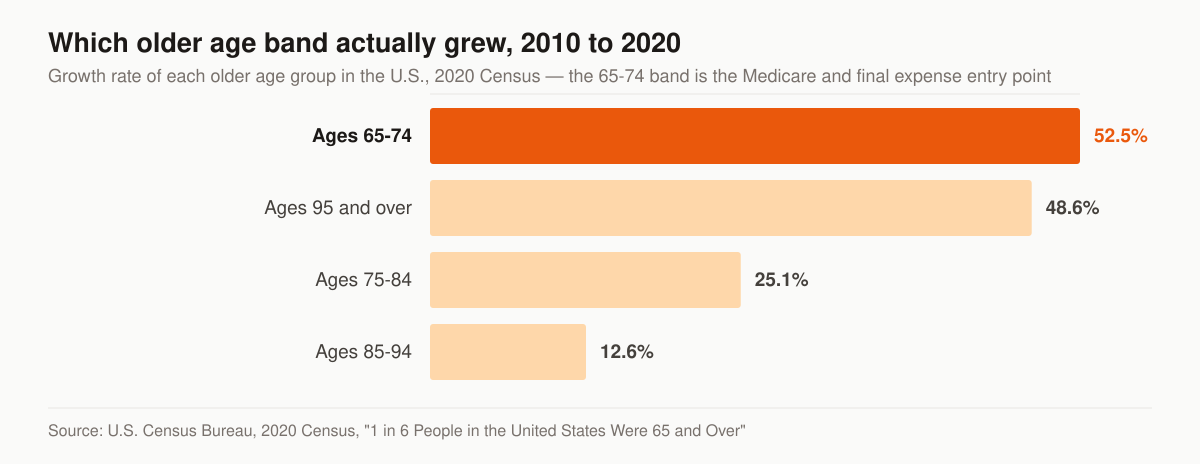
Source: U.S. Census Bureau, 2020 Census: 1 in 6 people in the United States were 65 and over.
The 65-to-74 group grew 52.5%, from 21.7 million to 33.1 million, which the Census Bureau reports as the largest growth of any older age group in that decade. By 2020 it held over half of the 65-and-over population and represented 1 in 10 Americans. That band is the T65 and Medicare pipeline and the front end of a final expense book, which is the arithmetic behind running a monthly turning 65 campaign cadence instead of a Q4 push.
The same source names the ceiling. The growth came largely from baby boomers, born between 1946 and 1964, who began turning 65 in 2011, and “By 2030, all baby boomers will be age 65 and over and the growth in the older population is projected to start slowing.” Treat that as a date on the calendar rather than a fact about demography. An agency building owned rankings and a book worth cross-selling is compounding into a cohort that is still filling. An agency renting leads will still be renting them when it stops.
Why senior market marketing is a different discipline
The senior buyer changes almost every assumption a generalist marketer brings. Three differences drive the whole approach.
| Dimension | General insurance marketing | Senior market marketing |
|---|---|---|
| Compliance weight | Standard advertising rules | TCPA scrutiny + CMS rules for Medicare |
| Primary channel | Search and paid social | Direct mail and digital, blended |
| Timing | Always-on | Calendar-driven for Medicare (AEP/OEP) |
| Decision-maker | The insured | Often the insured and an adult child |
| Trust bar | Moderate | High — cautious buyer, family involved |
None of these are cosmetic. Get the calendar wrong on Medicare and you are marketing into a window where you cannot enroll. Ignore the adult child on final expense and you are pitching to half your audience. Treat TCPA casually with a senior list and you invite exactly the complaints regulators act on.
Compliance is the moat, not the friction
Senior market marketing lives under real constraints, and the agencies that treat them as a discipline rather than an afterthought win the clients who care about staying licensed.
- TCPA governs every call and text. The rule of practice is to capture and store clear, provable consent at the point of lead capture — on the form, the reply card, the transfer — and to honor do-not-call and revocation requests. We build consent capture into every form and landing page and keep the records. We provide marketing services, not legal advice — your compliance counsel signs off on your scripts and disclosures.
- CMS rules add a second layer for Medicare: what you can say, how you can contact, and when you can enroll — concentrated around the Annual Enrollment Period and the Open Enrollment Period. That is why the Medicare playbook is calendar-driven and kept separate from final expense.
- You are probably a TPMO. CMS defines a third-party marketing organization as “organizations and individuals, including independent agents and brokers, who are compensated to perform lead generation, marketing, sales, and enrollment related functions as a part of the chain of enrollment” (42 CFR 422.2260). That sweeps in the agent, the FMO, and the marketing vendor. TPMO status carries the standardized disclaimer (required under 42 CFR 422.2274) and the rule that marketing and sales calls be recorded and retained for six years. Our scope-of-appointment and TPMO compliance guide covers the operational detail.
- Honest product routing. Steering a healthy senior into the wrong product to close a sale is both a trust and a compliance problem. Marketing has to route each prospect to the product they actually qualify for.
One rule changed under agents’ feet, and most of the senior-market internet has not caught up. The Scope of Appointment used to have to be recorded at least 48 hours before a personal marketing appointment. CMS removed that 48-hour window in the Contract Year 2027 final rule (published April 6, 2026, effective June 1, 2026). The current text of 42 CFR 422.2264(c)(3) requires only that the SOA be agreed upon and recorded prior to the appointment, in writing for in-person appointments, and it stays valid for 12 months from the beneficiary’s signature. If a marketing partner is still building your funnel around a 48-hour cooling-off window, they are working from a rulebook that expired — ask them what else they have not re-read. Verify current requirements against CMS guidance each plan year; your compliance counsel signs off, not your marketer.
The channel mix: direct mail plus digital, sized to your dials
Unlike most modern verticals, the senior market still rewards direct mail — and punishes agencies that go all-digital or all-mail without matching the mix to how fast they actually dial.
- Direct mail reaches seniors who are not heavy internet users and produces higher-intent, phone-comfortable respondents. It costs per piece whether or not it converts, and it scales slowly.
- Facebook and digital produce more volume, faster, at a lower cost per raw lead — but intent is softer and a lead not called within minutes goes cold. This is where compliant social campaigns earn their keep.
- Owned search and AI visibility compound underneath both. Our insurance SEO and AI-search / GEO work makes sure that when a senior — or their adult child — searches or asks an AI assistant, you are the answer.
The honest test for any mix is cost per issued policy, not cost per raw lead. A cheap lead nobody works is the expensive one.
The senior-market seasonal calendar
Senior-market demand runs on a calendar, and the calendar is the strategy: turning-65 cohorts refresh every month while Medicare’s fixed windows concentrate everything else into two quarters.
| Season | When | What it means for your marketing |
|---|---|---|
| Turning 65 (T65 / IEP) | Every month, year-round | A new cohort ages into Medicare monthly, so a steady-cadence turning 65 campaign system beats seasonal bursts on cost and consistency |
| Medicare AEP | Oct 15 – Dec 7 (Q4) | Peak competition and peak cost; pages, creative, and rankings must be live by early October — the core of a calendar-driven Medicare program |
| Medicare OEP | Jan 1 – Mar 31 (Q1) | Marketing that targets OEP or pushes Medicare Advantage switching is prohibited; inbound, educational, and T65 marketing stay open |
The Medicare window dates are set on Medicare.gov’s enrollment periods page, and the OEP marketing restrictions come from 42 CFR Part 422, Subpart V. An agency that plans Q1 around T65 campaigns instead of going dark is buying share while competitors wait for October.
Cross-selling and retention in the senior market
Cross-selling is where senior-market economics stop being about cost per lead, because the second policy on an existing client costs no acquisition dollars at all. A Medicare client is a final expense prospect; a final expense client often needs hospital indemnity; an annuity client has a legacy conversation waiting. The book you already own is a list you have already paid for, and reaching it again costs no acquisition dollars.
The catch is that CMS decides how you may do it. Marketing non-health-care-related products during any Medicare Advantage sales activity or presentation is cross-selling, and it is prohibited outright under 42 CFR 422.2263(b)(4). In a personal marketing appointment you also may not market health-care-related lines beyond the scope the beneficiary already agreed to, and you may not market non-health products such as annuities at all (42 CFR 422.2264(c)(3)). Final expense is life insurance — so it does not belong in the Medicare appointment.
What that leaves is a sequencing problem, and sequencing is a marketing job:
- Separate the conversation from the appointment. Cross-sell through owned channels — a newsletter, a review request, a birthday or policy-anniversary touch — rather than inside a Medicare sales meeting. Route final expense and life offers to the book through their own campaigns.
- Widen the scope on purpose, in advance. Where the additional line is health-care related, the Scope of Appointment has to name it before the appointment, not during it.
- Retention is a marketing channel. A client who hears from you twice a year does not answer the competitor’s AEP mailer. Service touches, plan-change check-ins, and a site their adult child can find again are cheaper than replacing the policy.
Annuity and IUL buyers sit at the other end of this — longer, more educational sales where the existing relationship is most of the advantage. See annuity agent marketing for how that sequence runs.
Trust and the adult-children audience
Seniors research carefully, and for final expense and later-life products the adult child is frequently the one who searches, fills the form, or sits in on the call. That reshapes the creative and the site. Messaging that speaks to the family’s peace of mind converts better than a pitch aimed only at the insured, and a website an adult child can vet in thirty seconds — clear, credible, fast — does quiet work that a landing page full of urgency badges cannot. This is also where genuine authority signals matter: real credentials, real explanations, and content an AI engine will cite.
FMO, lead vendor, or marketing agency: which do you need?
Most senior-market agents are sold all three and told they are the same thing. An FMO gives you carrier contracts and back-office support. A lead vendor sells leads by the piece. A marketing agency builds demand infrastructure you own. They are complements, not substitutes — and knowing which gap you actually have decides which one to hire. There is a fourth gap none of the three fills: when nobody in the agency owns the strategy that sits above all of them, that seat is what a fractional insurance CMO takes.
| What they provide | How they’re paid | What you own after | |
|---|---|---|---|
| FMO / IMO (field or independent marketing organization) | Carrier contracts, appointments, commission processing, training, sometimes co-op dollars or bundled leads | Carrier override — “free” to you, funded from the commission chain | Your contracts and your book. The leads and tooling usually stay theirs |
| Lead vendor | Leads as a finished product — exclusive, shared, live-transfer, or aged | You pay per lead, per transfer, or per call | The policies you close. Nothing compounds; stop buying and the pipeline stops |
| Marketing agency | Demand infrastructure: site, rankings, AI-search visibility, compliant ad funnels, consent capture, follow-up systems | You pay a fee for the build and the program | The asset. Rankings, content, funnels, and data stay yours whether or not you renew |
The honest test is what you have left if the relationship ends. Leave an FMO and you re-contract. Stop paying a lead vendor and the phone stops. Leave an agency that did the job properly and you keep the website, the rankings, the funnels, and the list — which is the whole reason this side of the business exists, and why we route lead buying to getinsureleads instead of blending the two.
What senior market marketing costs
The FMO model makes marketing look free, because the override pays for it before you ever see an invoice. It is not free, it is bundled, and what it buys generally is not yours to keep. An agency retainer is the opposite trade: a visible line item that leaves an asset behind. We publish our rates rather than quoting case by case, so you can hold them against what an FMO’s co-op allowance or a lead vendor’s monthly spend is already costing you.
Here is what each published tier does for a senior-market practice.
| Tier | Monthly | Where it fits a senior-market agent |
|---|---|---|
| Foundation | $2,500/mo | Optimized website and landing pages, local SEO and Google Business Profile, on-page SEO, monthly reporting — the base layer when your only current asset is a carrier or FMO microsite |
| Growth | $3,500/mo | Everything in Foundation, plus an ongoing SEO and content engine, AI-search visibility (GEO/AEO), and reputation and reviews — the tier that builds T65 and final expense rankings before October |
| Full-Funnel | $5,500/mo | Everything in Growth, plus managed Google and Meta ads, landing-page CRO, and marketing automation / CRM — for agencies buying volume as well as ranking for it |
A one-time website build runs $2,500–$8,000 depending on scope and can be bought before any monthly program, which is how we start an agent who has nothing of their own to rank yet. Ad spend is billed at cost, straight to the platforms, so a Medicare or final expense media budget never disappears into a retainer. Programs are month to month with no lock-in.
Which tier you start at is a function of your weakest link, not your headcount. No real web presence yet: Foundation. A site that exists but that nobody finds in Google or an AI assistant: Growth. Visibility handled and ready to buy volume on top of it: Full-Funnel. The full inclusion list is on the pricing page, the build itself is described under insurance web design, and the renewal and cross-sell side that makes the second policy so cheap sits under client retention.
The differentiator no generalist can copy
A generalist done-for-you marketer markets senior products the way they market gym memberships. We run a live senior-market lead book, so the compliance instincts, speed-to-lead systems, and channel economics we install for clients are tested rather than theorized. You can see every line we serve on the insurance niches hub, and the lead generation service that powers the demand side of all of them.
Want your senior-market program mapped against how we actually run ours? Start with a free marketing audit — we will look at your channels, your compliance posture, and where your book leaks — or get in touch to model the economics together.
The services behind it