The T65 Marketing Calendar: A Month-by-Month Campaign System
A T65 marketing calendar assigns one job to each month before a prospect's 65th birthday: awareness at months six to four, a direct-mail drop at month three when the Initial Enrollment Period opens, phone and email follow-up through months two and one, then a decision touch in the birthday month. Steady monthly cohorts beat a once-a-year scramble.
Turning 65 marketing gets run as a side effect of AEP: blast everyone in October, then go quiet until the next October. That’s backwards. The T65 market is the one part of the Medicare calendar that refills every single month — which means it rewards campaigns that run on a fixed cadence, not a once-a-year sprint.
This page lays out that system: who to reach, when, through which channels, and how to keep every touch inside CMS rules. It’s built by people who actually generate insurance leads — we run our own final-expense and senior-market lead operation, so this comes from live campaigns, not theory. The same intake discipline that holds our numbers steady is exactly what makes T65 predictable.
The cohort is also the largest it has ever been. The Alliance for Lifetime Income’s January 2024 Peak 65 research counts more than 4.1 million Americans turning 65 each year through 2027 — over 11,200 every day, up from roughly 10,000 a day over the prior decade (LIMRA/ALI Peak 65). And the U.S. Census Bureau projects that by 2030, all baby boomers will be age 65 or older (Census Bureau, Dec. 2019). A market replenishing at that rate deserves a system, not a seasonal mailer.
Why a monthly T65 calendar beats chasing AEP
AEP is a seven-week knife fight. Everyone bids on the same keywords, mailboxes flood, and your cost-per-acquisition spikes for a window you can’t widen. Turning 65 marketing is the opposite shape: a new cohort ages into Medicare every month, so you can spread T65 campaigns across all twelve and keep costs flat.
| Factor | AEP marketing | T65 marketing |
|---|---|---|
| Timing | Fixed: Oct 15 – Dec 7 | Evergreen, monthly cohorts |
| Competition | Peak, everyone at once | Steady, spread out |
| Cost-per-acquisition | Spikes in-season | Predictable year-round |
| Relationship depth | Rushed | Time to nurture pre-IEP |
| Cash flow | Lumpy | Recurring |
The strategic point: a T65 system smooths your revenue and lets you build a real relationship before the Initial Enrollment Period (IEP) even opens. It also changes the job your AEP marketing calendar has to do — Q4 becomes a conversion window for relationships you already built instead of a cold-start scramble. That’s harder for a competitor to interrupt than a last-minute mailer.
When should you start marketing to T65 prospects?
Start at 64 — we set the first touch six months before the 65th birthday. The Initial Enrollment Period itself is a seven-month window that starts three months before the month someone turns 65 and ends three months after it, per Medicare.gov’s enrollment timeline. But the buying decision forms before the window opens, so your campaign has to lead the IEP, not chase it.
- 6 months out — first awareness touch. Educational, no plan pitch. Get on the radar before competitors do.
- 4-5 months out — value content: how Part B works, enrollment deadlines, common mistakes. Build trust.
- 3 months out (IEP opens) — the appointment ask. Now there’s a real decision to make and a deadline behind it.
- Birth month — urgency follow-up for anyone still undecided.
- Post-enrollment — onboarding and referral ask. The relationship doesn’t end at the application.
The mistake we see most: agents make their first touch at 60 days out. By then the prospect has Googled everything and is already mid-conversation with someone else. Front-load the awareness, then drip into the IEP window.
The month-by-month T65 contact timeline
From the 64th birthday to the close of the IEP is roughly a 15-month runway: nine months of pre-window nurture, then the 7-month Initial Enrollment Period that starts 3 months before the birth month and ends 3 months after it (Medicare.gov). This table maps what to send at each step and what the beneficiary-contact rules in 42 CFR §422.2264 allow — unsolicited mail and opt-out email are permitted the whole way; cold calls and texts never are.
| Timing | What to send / do | Channel | What the rules allow |
|---|---|---|---|
| 64th birthday (12 mo. out) | Enter the cohort list; make sure your local presence — Google Business Profile, reviews, T65 landing page — is findable when they start researching | List building + local SEO | Contact the prospect initiates is never “unsolicited” (§422.2264(a)(3)) |
| 11–7 months out | Light educational drip: how Medicare works, Parts A/B basics, common myths — no plan talk | Mail or email | Unsolicited mail and print are permitted; every email must carry an opt-out (§422.2264(a)(1)) |
| 6 months out | First flagship piece: a timeline explainer — “your 7-month enrollment window opens in 3 months” | Direct mail + digital retargeting | Same mail/email lane; cold calls, texts, and social DMs stay prohibited (§422.2264(a)(2)) |
| 5 months out | Cost-and-deadline content: the Part B late-enrollment penalty, how coverage start dates work | Email sequence → landing page | A returned reply card or form fill is consent — calling them back is not cold calling (§422.2264(a)(3)) |
| 4 months out | Educational seminar invitation | Mail + paid social | Event must be advertised as educational with no plan-specific pitch; reply cards and SOA forms may be collected (§422.2264(c)(1)) |
| 3 months out — IEP opens | The appointment ask, with the mechanics spelled out: enroll before the birth month and Part B starts the month they turn 65 | Email + calls to consented prospects | Scope of Appointment agreed and recorded before any personal marketing appointment — in writing for in-person (§422.2264(c)(3)) |
| 2–1 months out | Deadline follow-up for the unbooked; second seminar date | Email/retargeting + booked appointments | Same SOA and consent rules |
| Birth month | Urgency touch for the undecided: enrolling this month means coverage starts the next month | Phone (consented) + email | Consented callbacks only — no unsolicited voicemail drops (§422.2264(a)(2)(iv)) |
| 1–3 months after — IEP closes | Last-window outreach: sign-ups now start the following month, and missing the window means waiting for the Jan–Mar General Enrollment Period, possibly with a late penalty. Then onboarding + referral ask for the enrolled | Email + mail; referral kit at policy delivery | Referred prospects must contact you — cold-calling a referral is prohibited (§422.2264(a)(2)(iv)(A)) |
Coverage-start mechanics in the table come straight from Medicare.gov’s enrollment-period page: sign up before the birth month and Part B coverage begins the month they turn 65; sign up during the birth month or the three months after and it begins the following month.
What to do when the T65 prospect is still working
A calendar that assumes every 65th birthday produces an application will misprice its own pipeline. Part of every cohort is still employed, still on a group health plan, and will not buy anything from you this year — and that share has been rising for two decades.
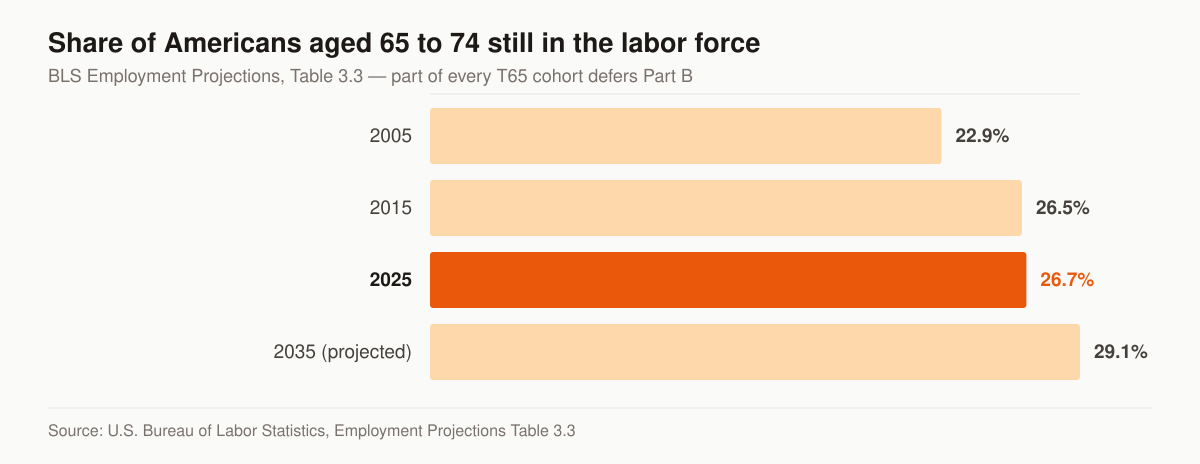
Labor force participation for ages 65 to 74 was 22.9% in 2005 and 26.7% in 2025, projected to 29.1% by 2035. Source: U.S. Bureau of Labor Statistics, Employment Projections Table 3.3, last modified September 1, 2026.
Deferral is not a lost lead, it is a dated one. Medicare.gov’s working past 65 guidance sets the re-entry date explicitly: “Once you stop working (or lose your health insurance, if that happens first) you have an 8-month Special Enrollment Period (SEP) when you can sign up for Medicare (or add Part B to existing Part A coverage). The SEP starts when you stop working (or lose insurance), even if you choose COBRA or other coverage that’s not Medicare.” The Medicare.gov enrollment-period table frames the same window from the other end — it “Starts: The first month after your Initial Enrollment Period ends” and “Ends: 8 months after the group health plan coverage or the employment ends, whichever happens first.”
Four employment situations, what Medicare.gov’s working past 65 page says about each, and what each one does to the calendar entry.
| Prospect’s situation | What Medicare.gov says | Calendar consequence |
|---|---|---|
| Group health plan available to everyone at the company | They can wait until they or their spouse stop working, or lose the insurance, to sign up for Part B without a late enrollment penalty | Log the expected retirement or coverage-end date; the cohort entry moves, it does not close |
| Self-employed, retiree coverage, or a plan not offered to everyone | “Ask your insurance provider if your coverage is employer group health plan coverage (as defined by the IRS). If it’s not, sign up for Medicare when you turn 65 to avoid a monthly Part B late enrollment penalty.” | The standard IEP calendar applies with no deferral |
| On COBRA and not yet enrolled | “Don’t wait until your COBRA coverage ends to sign up for Part B — COBRA coverage doesn’t extend your limited time to sign up for Medicare.” | Treat as urgent; the IEP clock is already running |
| Contributing to a Health Savings Account | “you and your employer should stop contributing to your HSA 6 months before you retire or apply for benefits from Social Security (or the Railroad Retirement Board)” | The first substantive conversation has to happen six months earlier than the IEP alone implies |
Penalty arithmetic is why the deferral conversation earns a place on the calendar instead of a quiet delete. Medicare.gov’s penalty page states the Part B late enrollment penalty as “an extra 10% for each year you could have signed up for Part B, but didn’t,” added to the monthly Part B premium. It puts the Part D penalty at “an extra 1% for each month (that’s 12% a year)” and lists two triggers for it: “Don’t join a Medicare drug plan when you first get Medicare” and “Go 63 days or more without creditable drug coverage.” IRS Publication 969 closes the HSA question in one line: “Beginning with the first month you are enrolled in Medicare, your contribution limit is zero.”
Operationally this costs one CRM field and one trigger. The field is the expected retirement or coverage-end date. The trigger re-enters the record into the nurture sequence ahead of that date, which Medicare.gov’s own timing advice dates for you: “If your employer coverage is ending, check when your current coverage ends and sign up for Medicare about a month earlier.” Build it once inside your marketing automation and the deferral cohort stops leaking out of the pipeline between birthdays.
The second deadline your T65 calendar should own: the Medigap window
A T65 calendar that ends at the enrollment leaves a second deadline on the table, and it is the one that decides whether the client can ever move to a Medicare Supplement without answering health questions.
Medicare.gov’s Medigap guidance is specific about when it opens and how long it runs: “It starts the first month you have Medicare Part B and you’re 65 or older,” and from there “you get a 6 month Medigap Open Enrollment Period”. What that window buys the client is underwriting relief — “An insurance company can’t refuse to sell you any of the medical policies it offers. They also can’t use medical underwriting to decide whether to accept your application or deny you coverage due to pre-existing health problems.” And the sentence that makes it a calendar item rather than a footnote: “Your Medigap Open Enrollment Period is a one-time enrollment period. It doesn’t repeat every year, like the Medicare Open Enrollment Period.”
So the T65 runway does not end in the birth month. It runs six months past the Part B start date, and those six months carry their own touch schedule.
The six months after Part B starts are a second campaign, not an onboarding afterthought.
| Month after Part B starts | Touch | Why it belongs in this month |
|---|---|---|
| Month 1 | Welcome call, ID card check, and a plain statement of the Medigap window’s closing date | The window opens the first month the client has Part B at 65 or older |
| Month 2 | Plan-use education: finding in-network providers, pharmacy setup, reading the first explanation of benefits | Questions surface once the coverage gets used, not when it is bought |
| Month 3 | Coverage review for anyone who took Original Medicare without a supplement | Half the guaranteed-issue window is still open |
| Month 4 | Referral invitation, framed so the referred person contacts you rather than the reverse | The client now understands the process well enough to describe it |
| Month 5 | Final Medigap reminder naming the exact closing date | Medical underwriting returns once the window shuts |
| Month 6 | Annual review scheduled and AEP pre-framed | Turns a one-time enrollment into a recurring relationship |
That schedule is also the cheapest cross-sell you own, because the same household is already inside your Medicare Supplement marketing segment and needs no new acquisition spend.
Where the T65 calendar collides with AEP and OEP
Two dates in 42 CFR part 422 change what a turning 65 campaign may say, and they sit at opposite ends of the year.
The first is October 1. 42 CFR §422.2263(a) reads: “MA organizations may begin marketing prospective plan year offerings on October 1 of each year for the following contract year. MA organizations may market the current and prospective year simultaneously provided materials clearly indicate what year is being discussed.” For a January birthday, that means the August and September touches stay on timeline mechanics and enrollment education; next year’s plan lineup waits for the date, and once it arrives the material has to label which year it is describing.
The second is the Open Enrollment Period. §422.2263(b)(7) lists, among the things MA organizations may not do in marketing: “Knowingly target or send unsolicited marketing materials to any MA enrollee during the Open Enrollment Period (OEP).” The same paragraph then carves age-ins out by name. Under §422.2263(b)(7)(i)(A), during the OEP an MA organization may “Conduct marketing activities that focus on other enrollment opportunities, including but not limited to marketing to age-ins (who have not yet made an enrollment decision), marketing by 5-star plans regarding their continuous enrollment special election period (SEP), and marketing to dual-eligible and LIS beneficiaries who, in general, may make changes once per calendar quarter during the first 9 months of the year”. That carve-out is the structural argument for building the T65 system at all: in the quarter when switch-focused Medicare outreach is frozen, your age-in cohort is named in the regulation as still in play. The rules that still bind you in Q1 are unchanged.
What each stretch of the year allows a T65 campaign to do.
| Period | What the T65 calendar may do | Authority |
|---|---|---|
| Jan 1 – Mar 31 (OEP) | Keep marketing to age-ins who have not yet made an enrollment decision | §422.2263(b)(7)(i)(A) |
| Apr 1 – Sep 30 | Run the full calendar against the current contract year only | §422.2263(a) |
| Oct 1 – Dec 7 (AEP) | Add prospective plan year offerings, with the year clearly indicated on the material | §422.2263(a) |
| Dec 8 – Dec 31 | Continue cohort touches; the Scope of Appointment requirement is unchanged by the date | §422.2264(c)(3) |
None of that removes the process rules that run underneath every month of the calendar — the Scope of Appointment and TPMO obligations apply the same in February as in October, and the wider set of CMS Medicare marketing rules governs the creative itself.
Channels that feed a T65 pipeline
No single channel carries a turning 65 system. You want a mix so one cohort never depends on one source — the T65 four below are a subset of the nine Medicare client acquisition channels that feed a book year-round.
- Search and AI search — people aging into Medicare research heavily online. Ranking for “turning 65 Medicare” questions and getting cited in AI answers puts you in front of self-directed researchers. This is where our Medicare AEP and AI-search GEO strategy for agents earns its keep.
- Paid social and search — targeted ads to the right age band, pointed at a dedicated landing page. Our Medicare paid-ads management for agents keeps spend pinned to cost-per-appointment, not vanity clicks.
- Direct mail + digital retargeting — mail still performs for this demographic; pairing it with retargeting lifts response without lifting CPL much.
- Referrals and reviews — every enrolled client knows others aging in. A reputation system turns that into inbound.
Side by side, with the compliance lane each channel occupies under §422.2264:
| Channel | Cost | Effort | Compliance lane | Best role |
|---|---|---|---|---|
| Direct mail | Highest per-touch | Medium — a monthly production loop | Explicitly permitted unsolicited (§422.2264(a)(1)); TPMO disclaimer on the piece where it applies | Reaching the cold cohort before the IEP opens |
| Facebook / paid social | Medium, auction-priced | Medium — creative + landing page upkeep | Ads are fine; unsolicited direct messages are prohibited (§422.2264(a)(2)(iii)) | Retargeting mail cohorts, filling seminars |
| Educational seminars | Medium — venue + promotion | High — live delivery, repeated monthly | Must be advertised as educational, no plan-specific selling; reply cards and SOA forms may be collected (§422.2264(c)(1)) | Trust-building and appointment volume |
| Lowest | Low once the sequence is automated | Unsolicited email permitted with an opt-out in every send (§422.2264(a)(1)) | The 15-month nurture spine | |
| Google Business Profile / local SEO | Low cash, high patience | Medium up-front, compounding after | Inbound — beneficiary-initiated contact is never unsolicited (§422.2264(a)(3)) | Capturing self-directed researchers |
The connective tissue is our done-for-you turning 65 marketing program, which sequences these channels against the IEP timeline instead of firing them at random.
How to run a turning 65 direct mail campaign
Direct mail is still the channel T65 prospects expect — and the one that punishes a one-off blast and rewards a monthly loop. It’s also the one cold channel the regulation leaves fully open, in its own words:
“MA organizations may make unsolicited direct contact by conventional mail and other print media (for example, advertisements and direct mail) or email (provided every email contains an opt-out option).”
— 42 CFR §422.2264(a)(1), Beneficiary contact
That open lane is exactly why the mailbox gets crowded — execution quality decides who wins it. A turning 65 direct mail campaign is a production cycle that repeats every month:
- Pull the cohort monthly. Build each month’s list from prospects turning 65 four to six months out, so the piece lands before the IEP opens and before competitors saturate the mailbox.
- Lead with education, not a plan pitch. Explain the enrollment timeline and offer help. Plan-specific claims drag your creative into stricter compliance territory, and plan talk before a Scope of Appointment is off-limits anyway.
- Give every piece one response path. A short URL or QR code to a dedicated landing page, or a tracked phone number — one call to action, measured per drop.
- Carry the required disclaimers. If TPMO requirements apply to you or the vendors mailing on your behalf, the disclaimer belongs on the piece, the page, and the call script.
- Pair each drop with digital retargeting. Matching the mail cohort with ads keeps the campaign in front of the same households between touches.
- Judge each cohort on cost per appointment. A direct mail campaign is working when it books conversations, not when it wins on mail volume — and the follow-up matters as much as the piece, so wire a real lead follow-up cadence behind it.
Capture and convert: the page and the follow-up
Traffic is wasted without a landing page built for a first-time Medicare researcher. A generic agency homepage buries the one thing they want — clarity on their timeline and a low-friction way to talk to a human.
- A focused landing page that leads with the IEP deadline and captures consent cleanly. See how we approach high-converting Medicare landing pages.
- A follow-up sequence (email, text, call) that runs automatically across the months-long window so no cohort goes cold.
- A Scope of Appointment step before any plan-specific conversation, so you’re compliant before you ever quote.
If your near-term need is buying T65 contacts or live transfers as a product rather than generating them, that’s a different lane — you can buy Medicare leads direct from getinsureleads and keep your marketing site focused on owned, first-party generation.
The weekly routine that keeps the monthly calendar running
Months are how a T65 system is planned. Weeks are how it actually gets executed, and a monthly calendar with no weekly owner degrades into a mailer that goes out whenever someone remembers. We run the calendar above on a fixed weekly loop so that each month’s cohort work has a slot rather than a good intention.
One week of the T65 loop, and what breaks when each slot is skipped.
| Slot | Work | What it protects |
|---|---|---|
| Monday | Pull the cohort turning 65 four to six months out and stage next month’s mail file | The drop date, which is the only part of the calendar that cannot be caught up later |
| Tuesday | Work consented callbacks and reply cards from the previous drop | Response decay, and the consent record itself — a reply card is the document that makes the callback something other than a cold call |
| Wednesday | Publish or refresh one educational asset aimed at an IEP question | Inbound share, since beneficiary-initiated contact sits outside the unsolicited-contact restrictions entirely |
| Thursday | Confirm next week’s appointments and complete the Scope of Appointment record for each | Compliance, and the appointment no-show rate |
| Friday | Review cohort-level cost per appointment and mark records that need a re-entry date | The deferral cohort, which is invisible unless someone dates it |
The Wednesday slot compounds. Everything else expires the week it happens; a page that answers an IEP question keeps earning inbound for years, which is why the search and AI-search work sits alongside the mail loop rather than competing with it.
How much of this loop you hand over is what separates our tiers. Our published pricing runs Foundation at $2,500 a month for the site, local SEO, on-page SEO and reporting; Growth at $3,500, which adds the ongoing SEO and content engine, AI-search visibility and reputation work; and Full-Funnel at $5,500, which adds managed paid ads, landing-page CRO and the marketing automation and CRM layer the re-entry triggers live in. A one-time website build runs $2,500 to $8,000. Read the tier comparison for what each one includes before assuming a T65 program needs the top of that range.
Compliance is the system, not a footnote
CMS treats your marketing as part of the sale, and TPMO rules apply to agencies and the vendors who market on agents’ behalf. Treat compliance as a trust signal — getting it right is also what keeps your campaigns live.
- TPMO disclaimer — if you don’t offer every plan in the service area, the disclaimer must appear on materials and websites and be read in the first minute of an inbound call.
- Consent and recording — calls tied to Medicare marketing carry consent and recording obligations; your lead-capture and dialer setup must honor them.
- No plan-specific talk pre-SOA — keep early touches educational until a Scope of Appointment is on file.
- Honest claims — no “all plans,” no implied government affiliation, no pressure framing.
We provide the marketing services; the agent is the licensed party making the recommendation. A compliant system is also a durable one — it doesn’t get your numbers pulled mid-AEP.
Make it run on autopilot
A turning 65 marketing system is worth building because it compounds. Each month’s cohort feeds the next, the IEP timeline never changes, and the channels stack. Plug it into the broader Medicare marketing program and you have a year-round engine instead of a Q4 gamble. And because Medicare is one line inside the wider senior market insurance marketing picture, the same T65 pipeline can feed final expense and life offers to the same households.
Want us to map your T65 numbers — cohort size, channel mix, projected cost-per-appointment? Start with a free marketing audit and we’ll show you where a steady-cadence system beats your current AEP-only push. Just as important is knowing what you can’t do off-season — see Medicare OEP marketing rules for agents — and how a full-year system performs in our Medicare agency case study.
- How to Get Medicare Clients: 9 Channels Ranked by Cost and Risk
How to get Medicare clients as an agent: 9 channels ranked by cost, speed, and CMS risk — plus what CMS caps agent commissions at, and the rules.
- Medicare OEP Marketing Rules: What Agents Can and Can't Do (Jan 1–Mar 31, 2027)
Medicare OEP marketing rules for 2027: the 5 things CMS bans Jan 1-Mar 31 under 42 CFR 422.2263, and 7 compliant plays that still win share.
- Medicare AEP Marketing Strategy for Agents: The 2026 Playbook
Medicare AEP marketing strategy: the Oct 1 start date, the Oct 15-Dec 7 calendar, CMS rules, and what CY2027 commission lets you pay per enrolled beneficiary.
- ACA Marketing Compliance for Agents: The CMS Rules, in Plain English
ACA marketing compliance for agents in plain English: CMS marketplace rules, TPMO-style disclaimers, consent, and what changes each plan year.