ACA Marketing Compliance for Agents: The CMS Rules, in Plain English
ACA marketing compliance for agents runs on the CMS Marketplace standards of conduct at 45 CFR 155.220: marketing that is not misleading, documented consumer consent before you assist, documented eligibility application review, and ten-year records. CMS now names banned practices by example, and the rules changed for 2026, 2027 and again in 2028.
Most ACA agents do not get in trouble for the plan they recommended. They get in trouble for how the enrollment happened: a consent record that does not exist, a subsidy figure quoted before the consumer was ever determined eligible, or an agent-of-record change the consumer never knowingly agreed to. The marketing mechanics are where the complaints come from.
This is a plain-English map of ACA marketing compliance for agents. It is a marketing-operations summary, not legal advice. You are the licensed party; we run the marketing. And the single most important thing to internalize up front: these rules tighten almost every plan year. Everything below is a starting point to verify against current CMS marketplace guidance, not a permanent answer.
Why ACA compliance is its own rulebook
Agents who also sell Medicare often assume the ACA marketplace works the same way. It does not. Medicare Advantage marketing runs on the Medicare Communications and Marketing Guidelines, with formal TPMO disclaimers, full call recording, and Scope of Appointment forms. The ACA marketplace is governed by a different stack of CMS standards tied to your Marketplace agreements, HealthCare.gov (or your state exchange), and the Center for Consumer Information and Insurance Oversight (CCIIO).
The instincts carry over — do not overstate, get consent, keep records — but the specific obligations differ. So if your “compliance” process is a copy-paste of your Medicare one, you have a gap.
Almost everything that follows lives in one regulation: 45 CFR §155.220, “Ability of States to permit agents and brokers and web-brokers to assist qualified individuals, qualified employers, or qualified employees enrolling in QHPs.” Paragraph (j) is the standards of conduct, paragraph (c) covers web-broker websites, paragraphs (g) and (h) cover termination and reconsideration, and paragraph (k) covers penalties. Bookmark the section rather than a summary of it, because the summaries go stale within a plan year.
What CMS counted, and why the rules moved
The tightening did not arrive out of nowhere. CMS published its own tally of what was happening on the Federally-facilitated Marketplace, and the numbers explain every documentation rule below.
From January 2024 through August 2024, CMS “received 90,863 complaints that consumers had their FFM plan changed without their consent” and “183,553 complaints that consumers were enrolled in FFM coverage without their consent”. Between June 2024 and October 2024 the agency “suspended 850 agents and brokers’ Marketplace Agreements for reasonable suspicion of fraudulent or abusive conduct related to unauthorized enrollments or unauthorized plan switches” — agents who were then “prohibited from participating in Marketplace enrollment, including receiving related commissions” (CMS, Update on Actions to Prevent Unauthorized Agent and Broker Marketplace Activity, October 17, 2024).
CMS then changed the plumbing rather than only the rulebook. “Beginning July 19, 2024, CMS began blocking agents and brokers from making changes to a consumer’s FFM enrollment unless the agent or broker is already associated with the consumer’s enrollment.” A consumer who wants to move to a different agent has to join a three-way call with the Marketplace Call Center, or make the change themselves on HealthCare.gov or through an approved Direct Enrollment partner site with a consumer pathway. In the same release CMS reported that after the change “the overall number of plan changes associated with an agent or broker has decreased by nearly 70%”, and that changes to agent or broker commission information “have decreased nearly 90%.”
That is the marketing lesson underneath the compliance one. Quietly acquiring an agent-of-record position is no longer a mechanism you can build volume on. The funnel that still works is the one where a consumer arrives already asking for you by name, with a consent record attached — which is a content, search and reputation problem rather than a data problem.
The four things CMS actually polices
Here is the short list in plain language, before we go deeper.
- Accurate representations — never overstate plans, subsidies, or who you are.
- Documented consent — get and keep written consent before you touch an application.
- Eligibility application review — the consumer must confirm the data you submit.
- Clean agent-of-record changes — no enrollments or switches the consumer did not knowingly authorize.
Each of the four fails in a specific, repeatable way, and the failure is almost always a missing record rather than a missing intention:
| Rule | What it covers | Common mistake |
|---|---|---|
| Accurate representations | Plan benefits, premiums, subsidy eligibility, your identity | Quoting an exact APTC before a determination, or implying you are HealthCare.gov |
| Documented consent | Written consumer consent to assist, retained for record-keeping | Verbal-only consent with no archived proof |
| Eligibility application review | Consumer confirms the application data before submission | Submitting attestations the consumer never saw |
| Agent-of-record integrity | Only enroll/switch with knowing authorization | Unauthorized plan switches to chase a commission |
Accurate representations
This is the heart of obamacare marketing compliance. Your ads, landing pages, and scripts must be truthful and not misleading. Three traps catch agents most:
- Subsidy claims. Advance Premium Tax Credit (APTC) amounts depend on income, household, and the second-lowest-cost silver plan. Promising “free coverage” or a specific dollar amount before a consumer is determined eligible is a misrepresentation risk.
- Identity. You are an independent agent, not the government. 45 CFR §155.220(j)(2)(i) obliges you to give consumers “correct information, without omission of material fact” about the Federally-facilitated Exchanges, the QHPs offered through them and insurance affordability programs, and to “refrain from conduct that is misleading (including by having a direct enrollment website that HHS determines could mislead a consumer into believing they are visiting HealthCare.gov), coercive, or discriminates based on race, color, national origin, disability, age, or sex.” The marketing-specific twin added by the 2027 rule, §155.220(j)(3)(ii), repeats the duty with the word marketing in it: refrain from marketing that is “misleading, materially inaccurate, coercive, or discriminates” on those same grounds. Do not imply you are HealthCare.gov, a state exchange, or a CMS program.
- Plan facts. Networks, drug formularies, and out-of-pocket maximums must be represented as they actually are.
We treat truthful framing and plain identity disclosure — who you are, who you are not, and that you represent a limited set of plans — as checklist items rather than afterthoughts on every ACA page we build. That is our own standard, not a quotation of a CMS script; the ACA rulebook has no equivalent of the Medicare TPMO disclaimer, which is covered further down. See how we structure it in our ACA agent marketing services, and how we apply it specifically to compliant ACA landing pages.
Documented consent
This one is written down precisely. 45 CFR §155.220(j)(2)(iii) requires an agent, broker, or web-broker to “Obtain and document the receipt of consent of the consumer or their authorized representative … prior to assisting with or facilitating enrollment through a Federally-facilitated Exchange”. The documentation has to record “the scope, purpose, and duration of the consent”, the date, the consumer’s name, the name of the agent or agency being granted consent, and “a process through which the consumer or their authorized representative may rescind the consent” — and you “must maintain the documentation … for a minimum of 10 years, and produce the documentation upon request in response to monitoring, audit, and enforcement activities”. Acceptable proof includes a signature (electronic or otherwise), verbal confirmation captured in an audio recording, or a written reply to a communication you sent. Verbal-only consent with nothing archived is the gap that sinks agents when a complaint lands. Build consent capture into the funnel itself: a timestamped form field, not a checkbox someone clicks for the consumer.
This sits next to federal telemarketing law. The TCPA still governs how you call and text consumers regardless of CMS, and consent for one channel is not blanket consent for all of them, forever.
Eligibility application review
Before you submit, the consumer must review and confirm the eligibility application information — income, household size, and the attestations. 45 CFR §155.220(j)(2)(ii) requires you to “document that eligibility application information has been reviewed by and confirmed to be accurate by the consumer … prior to the submission of information,” through an action that “produces a record” — a signature, a captured verbal confirmation, or a written reply. That record must include the review date, the consumer’s name, “an explanation of the attestations at the end of the eligibility application,” and your name, and it too is held for a minimum of 10 years. Submitting numbers the consumer never saw is exactly the pattern CMS flags in unauthorized-enrollment enforcement. Make the review step explicit and recorded.
Agent-of-record integrity
Unauthorized enrollments and plan switches have been a top CMS enforcement priority. The rule is simple to state and easy to violate under commission pressure: only enroll or switch a consumer’s plan or agent-of-record with their knowing authorization. The consent and review trail above is what proves you did.
The marketing practices CMS names by example
For years the ACA marketing standard was a general one — do not mislead — and agents had to reason from it. The 2027 Payment Notice final rule put worked examples into the regulation itself. 45 CFR §155.220(j)(3)(iii) now lists “Examples of prohibited misleading marketing practices agents, brokers, and web-brokers may not include in their marketing of FFE plans”, introduced with “include, but are not limited to” — so the list is a floor, not a boundary. CMS describes the same policy in its fact sheet as “stronger regulations on marketing practices” plus “requirements for timely production of marketing materials for monitoring, audit, and enforcement purposes” (CMS, HHS Notice of Benefit and Payment Parameters for 2027 Final Rule, May 15, 2026; the rule is effective July 20, 2026).
Read the seven examples against the ad formats you actually run, because each one describes a creative that converts well and is nonetheless out:
| Prohibited example, §155.220(j)(3)(iii) | Where it shows up in a real funnel |
|---|---|
| Providing “cash, monetary rebates, gift cards, travel vouchers, or cash equivalents as an inducement for enrollment or otherwise” | Gift-card incentives on a quote form; “enroll this week and get” offers |
| Offering gifts unless they are of nominal value, offered to similarly situated consumers “without regard to whether or not the consumers enroll,” and not cash equivalents | A prize draw open only to people who enroll |
| “Falsely asserting or suggesting that consumers will always qualify for zero-dollar insurance/zero-dollar premiums” | “$0 health insurance” as a headline with no eligibility condition stated |
| “Falsely using identical or facsimiles of government or other official logos and notations” | Eagle-and-shield iconography, a seal-style badge, HealthCare.gov-alike page furniture |
| “Miscommunicating enrollment timelines and deadlines” | An evergreen ad still promising a deadline the exchange has moved |
| “Misconstruing legislation, regulations, or Executive Orders, including listing fake or incorrect references or citations” | “New 2026 government subsidy program” copy citing a bill that does not say that |
| “Utilizing the image or likeness and/or utilize a quote from a notable figure, such as a celebrity or politician, in an advertisement claiming that figure has endorsed you or your agency when that endorsement is not truthful” | Celebrity thumbnails and AI-generated endorsements in paid social |
CMS’s own tip sheet for the same audience adds the ones that do not fit a table. You “may not provide consumers with inaccurate or misleading information or omit material facts about the Marketplace, qualified health plans (QHPs), premium tax credits, cost-sharing subsidies, and other insurance affordability programs”, and the agency warns that its list “is not an exhaustive list. Any practices that mislead consumers are not compliant” (CMS, Agent, Broker, and Web-broker Guidelines for Compliant Marketplace Advertising and Marketing).
The production duty is the quieter half of the change. §155.220(j)(3)(iv) requires you to “produce any marketing material upon request, within the specified timeframe HHS mandates,” and the tip sheet spells out that this includes “any materials created by a third-party”. Deleting an underperforming ad is a media decision; it is not a records decision. Keep the final creative, the dates it ran, the channel, the landing page it pointed at, and the source of every premium and deadline claim in it.
Whose email, phone number and address go on the application
This one sits inside the standards of conduct rather than under any heading that says “marketing,” so it is easy to miss when you are designing a funnel rather than reading the regulation. It also invalidates a lead-capture shortcut that is trivial to configure into a CRM.
45 CFR §155.220(j)(2)(ii) permits entering “only an email address on an application for Exchange coverage … that belongs to the consumer or the consumer’s authorized representative”, and attaches two conditions: the address “must be accessible by the consumer … and may not be accessible by the agent, broker, or web-broker assisting the consumer”, and it “may not have domains that belong to the agent, broker, or web-broker or their business or agency.”
The other contact fields get the same treatment. Telephone numbers “may not be the personal number or business number of the agent, broker, or web-broker assisting the consumer, or their business or agency, unless the telephone number is actually that of the consumer or their authorized representative.” Mailing addresses must belong to, or be primarily accessible by, the consumer, must not be “for the exclusive or convenient use of the agent, broker, or web-broker,” and must be “an actual residence or a secure location where the consumer or their authorized representative may receive correspondence, such as a P.O. Box or homeless shelter.”
Income gets its own paragraph. §155.220(j)(2)(ii)(E) permits entering “only a consumer’s household income projection that the consumer or the consumer’s authorized representative … has knowingly authorized and confirmed as accurate”, and states that projections “must be calculated and attested to by the consumer.” You may answer questions about what counts as income. You may not choose the number that produces the subsidy.
Why a marketing page cares: routing Marketplace notices to an agency inbox so nothing gets missed sounds like good service design, and it is a violation. Build the follow-up on your own copy of the record — your consent file, your CRM timeline, your reminder cadence — and leave the consumer’s contact fields to the consumer. Our insurance lead follow-up cadence guide covers how to run that without touching the application.
A note on buying ACA leads
If your plan is to buy ACA leads, live transfers, or aged data rather than generate your own, that is a different transaction with its own consent exposure — and it is not what this site sells. We build marketing systems; for purchasing lead inventory directly, you can buy leads direct from getinsureleads and keep that lead-buying relationship separate from your marketing build. Either way, the consent documentation obligations above still land on you as the enrolling agent.
Your lead vendor’s creative is your compliance problem
CMS’s tip sheet is blunt about where responsibility lands, and it is not on the vendor. “You are responsible for ensuring all marketing-related materials that are created, written, released, or otherwise produced by an individual or entity you have contracted with to perform marketing activities adhere to all Marketplace requirements. CMS may hold you accountable for activities conducted on your behalf.” The same document tells agents they “must make available any marketing materials, including any materials created by a third-party, to the Marketplace in response to monitoring, auditing, or enforcement activities.”
Three practical consequences follow.
Review the creative before the leads arrive. CMS states that it “does not provide approval of marketing and advertising for the Marketplace, so you should always be cautious if a third party is saying they are CMS-compliant”, and instructs agents to “personally review their materials and advertisements prior to use.” A vendor’s compliance badge is a marketing claim about a marketing claim. Ask for the ad account’s live creative, the landing pages behind it, and the consent language, not a certificate.
Treat multi-sold data as a risk, not a discount. The tip sheet advises: “You should avoid purchasing a lead that has been sold to multiple agents, brokers, or web-brokers. Consumer information sold to multiple entities may lead to consumer confusion and complaints against you and your business.” Consumer complaints are what CMS counted and acted on in 2024, so shared data raises the odds of the event described further down, not just the competition on the call. We make the parallel economic argument in exclusive versus shared leads for other lines; on the Marketplace the compliance argument arrives first.
A checkbox is not consent. Where a consumer starts the relationship “by providing information through an online form via a lead, website, social media, or marketing survey response,” CMS writes that “simply checking a box in an online form would likely not be sufficient evidence of consumer consent”, and lists acceptable routes as “an in-person conversation, phone call, text message, or email.” The agency names the pattern it is chasing — lead generators running “click-to-enroll” practices under which agents assist in a way “that does not meet federal requirements for obtaining and documenting consumer consent or documenting consumer review and confirmation of the accuracy of the eligibility application information”.
CMS also gives two warning signs that a lead source is advertising non-compliantly: “Referred consumers are already enrolled in Marketplace or other coverage”, and “Referred consumers ask for cash, discounts, or rebates when you speak with them.” If you see either, the agency asks you to report the ad to its Agent/Broker Email Help Desk with the link, a screenshot, the advertiser’s name, the date and platform, and the National Producer Number of the agent linked to the ad. Reporting a competitor’s ad is a strange thing to have on a marketing checklist, and it is on the official one.
The consent overlap with telemarketing law is separate and still applies. See our guide to TCPA compliance when buying insurance leads for the dialing side, which CMS’s tip sheet also flags when it tells agents to review how a lead company “handles compliance with the ACA, the HIPAA, the TCPA, and any other federal statutes and regulations.”
If your website quotes plans, you may be a web-broker
An agent site that publishes articles, captures inquiries and books calls is a website. A site where the consumer completes the plan selection or the eligibility application is a web-broker site, and 45 CFR §155.220(c)(3) attaches a list of duties that ordinary agent marketing never triggers. It is possible to reach that state without deciding to: adopting an enhanced direct-enrollment platform and skinning it in your own brand does not move the obligation off you.
When a web-broker’s site is used to complete the QHP selection, the site must disclose premium and cost-sharing information, the summary of benefits and coverage, the metal level, enrollee satisfaction survey results, quality ratings and the provider directory. It must also “Provide consumers the ability to view all QHPs offered through the Exchange”; “Display all QHP data provided by the Exchange”; “Not provide financial incentives, such as rebates or giveaways”; “Maintain audit trails and records in an electronic format for a minimum of ten years”; give consumers the ability “to withdraw from the process and use the Exchange Web site … instead at any time”; and, for the Federally-facilitated Exchange, “prominently display a standardized disclaimer provided by HHS, and provide a Web link to the Exchange Web site”.
Two of the duties constrain the commercial design of the page directly. The site may “Not display QHP advertisements or recommendations, or otherwise provide favored or preferred placement in the display of QHPs, based on compensation the agent, broker, or web-broker receives from QHP issuers”, and it must “Prominently display a clear explanation of the rationale for QHP recommendations and the methodology for its default display of QHPs.” A “best plans for you” module is therefore a published methodology, not a widget you tune for margin.
Is there an ACA version of the Medicare TPMO disclaimer? No, not in the sense the question is normally asked. The standardized “We do not offer every plan available in your area” script is a Medicare Advantage and Part D requirement at 42 CFR §422.2267(e)(41), and the ACA standards of conduct do not import it. What the Marketplace rules require instead is the HHS standardized disclaimer on a web-broker site under §155.220(c)(3)(i)(G), plus the general duty at §155.220(j)(2)(i) to refrain from conduct that is misleading — a duty that names the exact failure mode, “including by having a direct enrollment website that HHS determines could mislead a consumer into believing they are visiting HealthCare.gov”. Saying plainly who you are is still the right instinct. Reciting the Medicare script on an ACA page is not how you satisfy the ACA rule. The distinction shapes how we lay out an ACA agent website, and the parallel Medicare requirements are covered in CMS Medicare marketing rules for agents.
Deadlines, SEPs and the claims that get an ad pulled
“Miscommunicating enrollment timelines and deadlines” is one of the seven named prohibited practices, and two of the dates behind it were changed by the 2025 and 2027 final rules. An evergreen ad is now a live compliance exposure rather than an efficiency.
Open Enrollment changed shape. The 2025 Marketplace Integrity and Affordability final rule set that each OEP “must start no later than November 1 and end no later than December 31, and the OEP may not exceed 9 calendar weeks”, that “all enrollments pursuant to Open Enrollment Period must begin on January 1”, and that “For Exchanges on the Federal platform, the OEP will run from November 1 through December 15 preceding the coverage year, beginning with the OEP for plan year 2027” (CMS, 2025 Marketplace Integrity and Affordability Final Rule, June 20, 2025). State-based exchanges set their own windows inside those parameters, so a multi-state campaign needs per-state deadline copy rather than one national date in the headline.
The year-round income pathway is gone. The same rule finalized “the repeal of the monthly SEP for individuals with projected household incomes at or below 150% of the FPL,” and closed the obvious workaround in the next breath: “HHS also clarifies that a change in income is not an Exceptional Circumstance within the meaning of 45 CFR 155.420(d)(9). Thus, Marketplaces may not offer income-based SEPs under this authority.” The 2027 Payment Notice then extended the repeal, finalizing that “Exchanges will continue to be prohibited from offering the 150% FPL SEP after PY 2026.” Any script, chatbot flow or paid-search landing page that still qualifies low-income prospects into year-round enrollment is advertising a route that does not exist.
Promising an effective date got riskier. The 2027 rule requires Exchanges on the Federal platform “to conduct verification for at least 75% of new enrollments through SEPs” and allows verification of SEP categories beyond loss of minimum essential coverage. On top of that, §155.220(j)(2)(viii) requires you to obtain authorization from the consumer to submit an SEP eligibility request and to “make the consumer aware of the specific triggering event and special enrollment period for which the agent, broker, or web-broker will be submitting an eligibility determination request on the consumer’s behalf.” Picking a qualifying event from a dropdown to get an application moving is the precise pattern that paragraph was written against.
The practical version for a campaign: state the deadline for the exchange the prospect actually uses, describe the qualifying event rather than the outcome, and never write copy that implies coverage starts on a date the verification queue has not reached yet. For the campaign-timing side of the same season rather than the rulebook, see our ACA open enrollment pipeline guide.
Suspension, termination and what a violation costs
Marketplace enforcement runs as a documented sequence. Knowing the sequence tells you which records you will be asked for, and how long you will have to find them.
45 CFR §155.220(g) sets the trigger: HHS may terminate an agreement for cause where “a specific finding of noncompliance or pattern of noncompliance is sufficiently severe”. The 2025 Marketplace Integrity and Affordability final rule then wrote the burden of proof into the regulation, finalizing “the adoption of a ‘preponderance of the evidence’ standard of proof with respect to issues of fact” for those determinations. The grounds are broad — a violation of any standard in the section, any term of your Marketplace agreements, any applicable state law, or “Any Federal law applicable to agents, brokers, or web-brokers.”
Every stage of the process runs on a short clock, which is why a ten-year record has to be retrievable rather than merely retained:
| Step | Timing | Cite |
|---|---|---|
| Notice of noncompliance, then termination if unresolved | 30 days from the date of the notice | §155.220(g)(3)(i) |
| Immediate termination where the state license lapses | No cure period | §155.220(g)(3)(ii) |
| Suspension on reasonable suspicion of fraud or abusive conduct | Up to 90 calendar days | §155.220(g)(5)(i)(A) |
| HHS decision after you submit rebuttal evidence | Within 45 calendar days of receipt | §155.220(g)(5)(i)(B) |
| Request reconsideration of a termination | Within 30 calendar days of the written notice | §155.220(h)(2) |
| CMS Administrator’s reconsideration decision | Within 60 calendar days | §155.220(h)(3) |
Two details in that table decide outcomes. A suspension is “effective on the date of the notice that HHS sends”, and during it you are not registered with the Federally-facilitated Exchanges and may not assist with enrollment or with applications for premium tax credits and cost-sharing reductions — in the middle of Open Enrollment that is the whole season. And the finding travels: §155.220(g)(6) provides that “The State department of insurance or equivalent State agent or broker licensing authority will be notified by HHS in cases of suspensions or terminations effectuated under this paragraph (g).”
Money is the separate lever. Under §155.220(k), an agent, broker or web-broker who fails to comply “May be denied the right to enter into agreements with the Federally-facilitated Exchanges in future years” and “May be subject to civil money penalties as described in § 155.285.” Those penalties are counted per application.
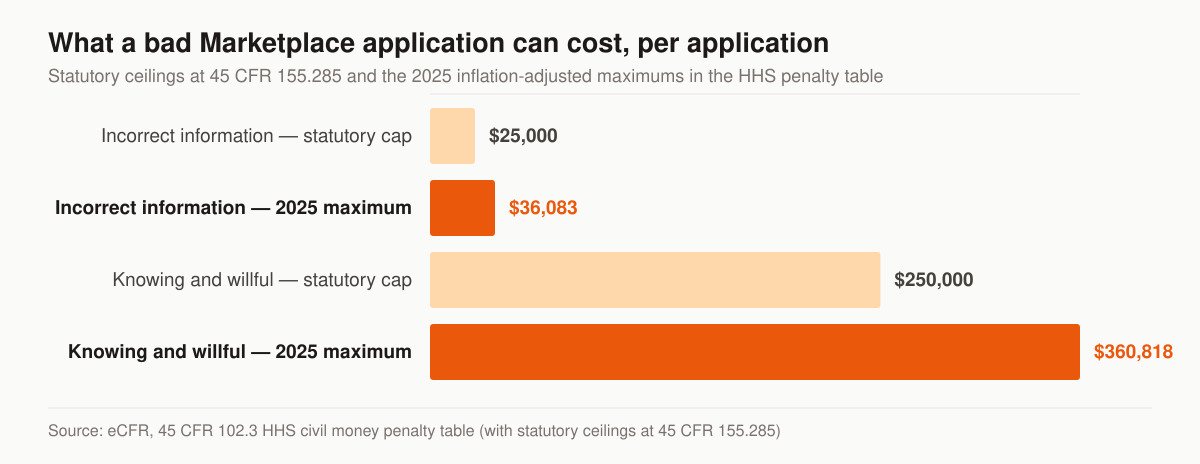
Civil money penalty ceilings per Exchange application. The statutory caps are at 45 CFR §155.285(c)(1); the inflation-adjusted maximums are the 2025 column of the HHS penalty table at 45 CFR §102.3.
The lower tier attaches to negligence or disregard, which §155.285(a)(1)(i) defines borrowing from the tax code: “Negligence” includes “any failure to make a reasonable attempt to provide accurate, complete, and comprehensive information”, and “Disregard” includes “any careless, reckless, or intentional disregard for any rules or regulations of the Secretary.” There is a good-faith exit. §155.285(b)(3) provides that no penalty will be imposed for incorrect information “if HHS determines that there was a reasonable cause for the failure to provide correct information … and that the person acted in good faith”, and §155.220(j)(4) applies the same relief to the standards of conduct. Good faith is far easier to establish when the consent record and the application-review record exist and can be produced the week they are asked for.
What changes every plan year (and why it matters)
CMS updates marketplace standards and operational guidance regularly. Recent plan years have brought tighter consent documentation, expanded scrutiny of agent-of-record changes, and shifts in Open Enrollment Period (OEP) and Special Enrollment Period (SEP) windows and eligibility. The practical takeaway:
- Re-read current CMS and HealthCare.gov agent guidance before each OEP.
- Confirm your carrier’s and FMO’s interpretation — they routinely go beyond the CMS floor.
- Re-approve marketing creative annually; last year’s compliant ad may not be this year’s.
The 2028 consent form changes what “documented” means
One change is already written into the regulation with a date attached, which makes it the one to design for rather than react to. For enrollments for plan years beginning on or after January 1, 2028, both records — consent and eligibility application review — “must be collected by having the consumer or the consumer’s authorized representative take an action to execute an HHS-approved and -created consumer consent form” (§155.220(j)(2)(iii)(C), with the parallel provision for application review at (j)(2)(ii)(A)(2)). CMS puts it the same way in the 2027 Payment Notice fact sheet: agents, brokers and web-brokers “must use this form for enrollments for plan years beginning on or after January 1, 2028.”
The clarification attached to it is the part worth designing for now. The regulation states that “A signature that is simply typed on the documentation or a filled-in check box does not properly indicate consent was provided by the consumer or the consumer’s authorized representative”, and the application-review twin says such an action “does not clearly indicate the eligibility application information was reviewed and confirmed accurate by the consumer or the consumer’s authorized representative”. What does count: a hand-written or electronic written signature or initials on the HHS form, an email from the consumer or their authorized representative, or a recorded verbal conversation.
Until 2028 the earlier methods still govern — a signature, a captured verbal confirmation, or a written reply to a communication you sent. But the direction of travel is clear enough to act on. If the consent step in your funnel today is a tick box on a landing page, it is already the weakest evidence CMS accepts, and it stops qualifying outright for plan-year 2028 enrollments.
Annual registration and training, and the list carriers check
Two things changed in the training path. CMS finalized “the removal of the requirements in § 155.222 that HHS approve vendors to facilitate annual agent and broker training for a given plan year, effectively discontinuing the vendor program”, while confirming that “Agents and brokers will still have full access to complete annual Exchange training and registration requirements provided directly by CMS.” The requirement did not go away; the approved route narrowed to CMS’s own Marketplace Learning Management System.
Verification is public, which matters commercially as well as legally. CMS publishes the Agent and Broker FFM Registration Completion List of National Producer Numbers that finished registration for the current year and says it “posts this list as frequently as daily”, alongside a Registration Termination List for agreements CMS has terminated. The agency also states that agents and brokers “who do not have an approved health-related Line of Authority (LOA), as determined by their resident state, do not have access to Marketplace systems and are not allowed to assist consumers with Marketplace enrollment” (CMS, Registration and Training for Marketplace Agents and Brokers). Confirm your NPN is on the completion list before you turn a lead budget on: an unregistered agent with a full appointment calendar is buying conversations they cannot convert.
For the strategy side of those windows rather than the rulebook, our guide on open enrollment marketing ideas for agents and how ACA agents fill their pipeline during OEP work inside these constraints.
A pre-OEP marketing self-audit
Each item maps to a specific paragraph above, so a failed check tells you which rule to re-read instead of leaving you with a general worry.
- Ad claims — no cash, gift-card or voucher inducement; no promise that everyone qualifies for a zero-dollar premium; no government-style logos or seals; no endorsement you cannot evidence (§155.220(j)(3)(iii)).
- Deadlines — every date in live creative matches the current Open Enrollment window for the exchange that prospect actually uses, not a national date reused from last season.
- SEP copy — the 150% FPL pathway is out of scripts, chat flows and automations, and every SEP submission names the specific triggering event to the consumer first (§155.220(j)(2)(viii)).
- Consent record — one per consumer, carrying scope, purpose, duration, date, the consumer’s name, your name and a rescission process, retrievable for ten years rather than merely archived somewhere (§155.220(j)(2)(iii)(B)).
- Application-review record — a second, separate record showing the consumer reviewed the eligibility data, with the review date and an explanation of the attestations (§155.220(j)(2)(ii)(A)(1)).
- Contact fields — no agency email domain, agency phone number or agency mailing address on any consumer’s application, and no income figure you chose (§155.220(j)(2)(ii)(B)–(E)).
- Vendor file — for every lead source: the creative you personally reviewed, the consent method, and whether the data was also sold to anyone else.
- Marketing archive — final creative, run dates, channel, landing page and the source of each premium or deadline claim, ready to produce on request (§155.220(j)(3)(iv)).
- Registration — your NPN appears on the current plan-year Registration Completion List and your resident-state line of authority covers health.
- Website — if consumers select a plan or complete an application on it, the §155.220(c)(3) display duties are met, including the HHS standardized disclaimer and the published recommendation methodology.
If two or more come back uncertain, fix the funnel before you buy another lead. That sequencing is why our pricing puts the build ahead of the spend — the Foundation tier is website, landing pages and local SEO, and managed ads only appear at Full-Funnel — and why an ACA marketing engagement starts with the pages and the consent flow rather than with traffic.
Compliance as a marketing asset, not a tax
Here is the operator’s view, and it is the same one we apply to our own book. Agents who treat CMS rules as friction cut corners and end up in complaint files. Agents who build the rules into the funnel — captured consent, recorded review, honest subsidy framing — produce a paper trail that protects commissions and a clean lead source that survives an audit.
We can say that because we run the systems. We run our own final-expense and senior-market lead operation, so this comes from live campaigns, not theory. The conversion systems and ad discipline behind it are the same ones we apply to ACA — accurate creative converts better and audits cleaner.
A few ways the rules shape good ACA marketing:
- Landing pages say plainly who you are and who you are not, and capture consent explicitly rather than in fine print.
- Lead sources are documented so consent is provable when a carrier or CMS reviews.
- Scripts open honestly about who you are and never quote a subsidy before eligibility.
If you are not sure whether your current funnel would survive a CMS or carrier review, that is exactly what a free marketing audit is for — we look at your pages, consent flow, and ad claims with fresh eyes. If you want help implementing, the full breakdown lives on our ACA marketing services for agents page.
The one-line summary
Tell the truth about plans and subsidies, capture and keep written consent before you assist, make the consumer confirm the application, never switch a plan or agent-of-record without knowing authorization, keep your records — and re-verify all of it against current CMS marketplace guidance every plan year, because the rules move and your license is the one on the line.
This article is marketing guidance, not legal or compliance advice. CMS marketplace rules are updated frequently; confirm specifics with official CMS and HealthCare.gov sources, your carrier, and your upline before acting.
- How ACA Agents Fill Their Pipeline During OEP
A practitioner's playbook for ACA lead generation during Open Enrollment: build a marketing pipeline that keeps producing long after Dec 15, not just OEP.
- Medicare AEP Marketing Strategy for Agents: The 2026 Playbook
Medicare AEP marketing strategy: the Oct 1 start date, the Oct 15-Dec 7 calendar, CMS rules, and what CY2027 commission lets you pay per enrolled beneficiary.
- How to Get Medicare Clients: 9 Channels Ranked by Cost and Risk
How to get Medicare clients as an agent: 9 channels ranked by cost, speed, and CMS risk — plus what CMS caps agent commissions at, and the rules.
- The T65 Marketing Calendar: A Month-by-Month Campaign System
A month-by-month T65 marketing calendar for Medicare agents: when to mail, when to call, and which touch belongs in each month before the IEP opens.