How ACA Agents Fill Their Pipeline During OEP
ACA lead generation for agents during OEP works when you treat the 45-day window as a demand spike to capture, not survive: run always-on search and landing pages to own intent early, layer paid social for reach, and qualify hard so enrollment hours go to subsidy-eligible buyers. Owned channels built before November 1 beat buying in cold.
Open Enrollment is the only stretch of the year when ACA demand shows up on its own. From November 1 to January 15, people who ignored health coverage for ten months suddenly start searching, comparing, and asking for help. The agents who win OEP aren’t the ones who spend the most in those 45 days — they’re the ones who built the capture system in September and October. This is a playbook for aca lead generation for agents that treats the window as a spike to harvest, not a fire to fight.
We build these systems for a living. Our authority comes from a final-expense and senior-market lead operation we actually run — live campaigns, not theory. ACA isn’t final expense, so we won’t pretend the lineage transfers directly. What does transfer is the discipline: the same conversion systems, landing-page math, and ad governance that keep our senior-market clients full apply cleanly to Marketplace enrollment.
Why most ACA pipelines run dry by December 16
The December 15 deadline for January 1 coverage creates a brutal demand curve. Searches and form fills cluster in the first two weeks of December, then collapse. Agents who only turn on marketing in late November are buying attention at the most expensive, most competitive moment — and they have no list to fall back on when the spike passes.
The fix is sequencing. A pipeline that holds up has three layers running before the rush:
- Owned demand capture — a fast agent website and ranked content so you collect intent for free while competitors bid against each other.
- Paid amplification — search and social ads that scale up into the spike and down after it, not on/off in a single week.
- A nurture asset — an email and SMS list so the people who weren’t ready on December 1 still convert during the January 15 tail and into Special Enrollment Periods.
Miss the first and third layers and you’re renting your whole pipeline. That’s fine for one season; it’s a bad business.
The OEP timing map
ACA marketing is a calendar game. Get the windows right and the same budget produces more enrollments because you’re spending when intent is highest and qualification is easiest.
The table below is the calendar we build an ACA program against, phase by phase.
| Phase | Dates (typical) | Marketing job | Primary channel |
|---|---|---|---|
| Pre-build | Sept–Oct | Rank content, fix the site, warm the list | SEO, email |
| Ramp | Nov 1–30 | Capture early shoppers, build retargeting pools | Search ads, social |
| Peak | Dec 1–15 | Maximize spend, fast-route every qualified lead | PPC, live booking |
| Tail | Dec 16–Jan 15 | Convert the undecided, work the list hard | Email, retargeting |
| Off-season | Jan 16+ | Catch SEP events, keep SEO compounding | SEO, nurture |
Note the deadline distinction: ACA Open Enrollment runs roughly Nov 1–Jan 15 with a Dec 15 cutoff for Jan 1 coverage. Medicare’s OEP (Jan 1–Mar 31) is a different animal — never blur the two in ad copy or you invite both confusion and compliance risk. For campaign ideas to slot into each phase of the calendar, our open enrollment marketing playbook covers the tactic layer.
How much of Open Enrollment volume is actually new business
Size the prize before you set a budget, because the headline enrollment number is not the addressable market. CMS reports that 23.0 million consumers signed up for 2026 individual market health insurance coverage through the Marketplaces since the 2026 OEP opened on November 1, 2025 — 15.8 million plan selections in the 30 states on the HealthCare.gov platform, and 7.2 million in the 20 states and the District of Columbia running their own state-based Exchanges.
Split that by consumer type and the marketing picture changes. Of the 22,973,219 cumulative plan selections CMS counted, 19,591,030 were returning consumers who selected a plan for 2026 or were automatically re-enrolled. 3,382,189 were new to the Marketplaces.
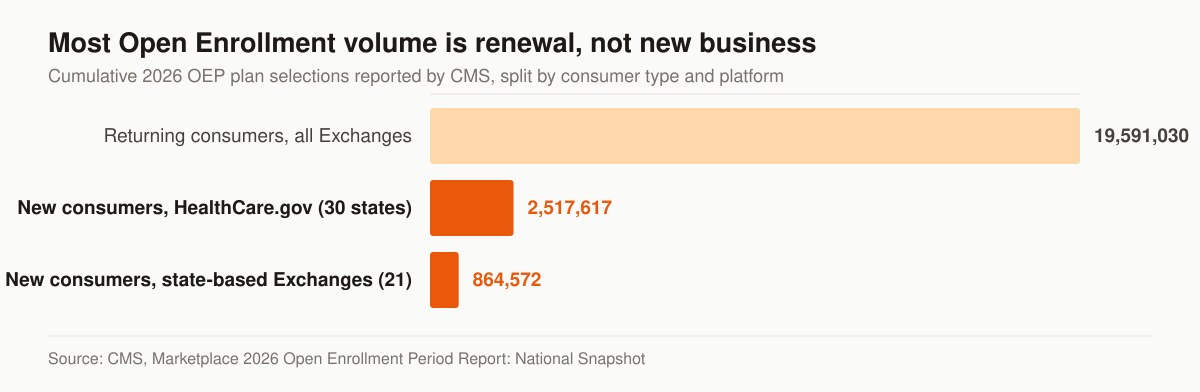
Source: CMS, Marketplace 2026 Open Enrollment Period Report: National Snapshot, published January 28, 2026.
Three planning consequences follow.
First, acquisition and retention are separate campaigns with separate creative, and the retention half is where the volume sits. If your only OEP asset is a cold-traffic ad set, you are competing for the smaller pool while your own book renews with somebody else’s guidance — or with nobody’s.
Second, the new-consumer pool is not spread evenly across platforms. 2,517,617 of the new consumers came through HealthCare.gov and 864,572 through state-based Exchanges, so the enrollment path your landing page describes should match the platform your licensed states actually use. Our ACA agent marketing overview breaks the state-level picture down further.
Third, a plan selection is not a paid policy. CMS defines the cumulative metric as people who submitted an application and selected a plan, net of cancellations, and states that consumers “generally need to pay their first month’s health plan premium, if applicable” for coverage to be effectuated. The report “does not report the number of effectuated enrollments.” Model your commission forecast on effectuation, not on submitted applications, and build a first-premium reminder into the follow-up sequence.
One calendar footnote in the same report is worth stealing for your media plan: CMS pulled its figures through January 15, 2026 for the federal platform and January 10, 2026 for state-based Exchanges, “except Idaho, which had an OEP from October 15, 2025, through December 15, 2025.” A state Exchange can open and close its window on different dates than the federal one. Confirm your state’s dates before you set a campaign end date.
The registration gate that decides whether an ad can convert
There is an order of operations here that no amount of ad budget substitutes for. An ACA campaign that generates leads before you are registered and licensed to enroll produces contacts you cannot legally help, which is spend with no route to a commission.
Under 45 CFR 155.220(j)(1), an agent or broker who assists with enrollment through a Federally-facilitated Exchange, or assists individuals in applying for advance payments of the premium tax credit and cost-sharing reductions for QHPs sold through a Federally-facilitated Exchange, must have executed the required agreement under § 155.260(b), be registered with the Federally-facilitated Exchanges, and comply with the standards of conduct in paragraph (j)(2).
CMS is blunt about the licensing half. Its registration page states that “Agents and brokers who do not have an approved health-related Line of Authority (LOA), as determined by their resident state, do not have access to Marketplace systems and are not allowed to assist consumers with Marketplace enrollment.” The Agent and Broker Federally-facilitated Marketplace Registration Completion List carries the National Producer Numbers of everyone who has completed Marketplace registration for the current year, and CMS “posts this list as frequently as daily.”
The training itself is annual and it is not the same job every year. For Plan Year 2027, CMS says agents and brokers who are new to the Marketplace, “or who did not complete Plan Year 2026 registration and training, will be required to take the full Individual Marketplace training,” while those who completed Plan Year 2026 registration “will be eligible to take a shorter training for Plan Year 2027 as well as optional review modules.” Both are offered in English and Spanish. As of that page’s July 13, 2026 update, Plan Year 2026 registration and training was closed and the Marketplace Learning Management System was offline while CMS prepared the Plan Year 2027 cycle — which is exactly why the pre-build phase in the calendar above sits in September and October rather than in November.
The table below is the pre-flight check to run before a dollar of ACA ad spend goes live.
| Gate | Where it is handled | What it is checked against | What a gap costs you |
|---|---|---|---|
| Health line of authority in your resident state | Your state department of insurance, via the National Insurance Producer Registry | CMS’s resident-state line-of-authority data | No access to Marketplace systems at all |
| Executed FFE agreements under § 155.260(b) | CMS Enterprise Portal | 45 CFR 155.220(j)(1)(i) | You are outside the standards-of-conduct regime the rule assumes |
| Plan-year Marketplace registration and training | Marketplace Learning Management System | 45 CFR 155.220(j)(1)(ii) | Leads you cannot enroll this plan year |
| NPN on the Registration Completion List | data.healthcare.gov | CMS posts the list as often as daily | Carriers and FMOs cannot confirm your status |
| Public-facing MLMS profile display setting | Marketplace Learning Management System profile | CMS agent and broker FAQ | You stay invisible in the two CMS referral queues below |
Sequence the media plan against that table. Ads go live after the last row is green, not before, and the pages behind them get built while you are waiting — that is the work an insurance sales funnel built before OEP is for.
Channels that fill an ACA pipeline
Each channel does a specific job. Stacking them is what produces volume; relying on one is what produces drought.
- Search (PPC): highest-intent aca leads for agents. Someone Googling “ACA plans 2026 subsidy” is shopping now. Costs more per click, converts hardest. Pair every campaign with a dedicated, conversion-built landing page — sending paid clicks to a homepage wastes most of the spend.
- Paid social (Meta): widens reach and builds retargeting audiences cheaply. Lower intent, so qualify harder on subsidy eligibility before booking time.
- SEO and content: the compounding layer. Ranked guides on subsidies, deadlines, and SEP triggers feed leads year-round at near-zero marginal cost. This is what keeps producing on January 16.
- Email and SMS automation: the cheapest enrollments you’ll get. The list you build in November converts in the December tail and through SEP season.
The single highest-leverage asset across all paid channels is the landing page. Our ACA landing-page system for agents is built to turn cold Marketplace clicks into qualified consults, because a 2% versus 6% conversion rate is the difference between a profitable OEP and a wasted ad budget — same traffic, three times the enrollments.
To go deeper on the supporting channels, our ACA agent marketing overview maps the full silo, and the search-ads pillar for insurance agents covers bid and budget discipline for the peak window. For the always-on layer, insurance SEO is how the pipeline survives past mid-January.
Two lead queues CMS already runs for you
Before you buy a click, take the free inbound. HealthCare.gov’s own “Get help applying & more” page routes Marketplace shoppers to certified humans two ways: the Find Local Help directory, where consumers “Search our online directory and set up a time to talk in-person, over the phone, or by email,” and Help On Demand, where a consumer enters their information and gets “contacted by phone or email (usually within the same business day).”
Help On Demand is not a lead vendor. CMS describes it as “a CMS-contracted service developed and hosted by Help On Demand” that “connects consumers seeking assistance with Marketplace-registered, state-licensed agents and brokers in their area who can provide immediate assistance with Marketplace plans and enrollments,” and states that “Only agents and brokers who have completed Marketplace training and registration are eligible to participate.”
Two things make this channel worth building around. The intent is pre-qualified, because the consumer started on HealthCare.gov rather than on an ad. And the response expectation is published by the government, not invented by a sales trainer: same business day. That is the service level your follow-up has to hit on these referrals, and it should set the floor for every other channel too — our lead follow-up cadence covers what the first hour and the first week should actually contain.
Getting listed is a profile setting, not an application. CMS’s agent and broker FAQ, published June 22, 2026, says to update your public-facing profile in the Marketplace Learning Management System on the CMS Enterprise Portal, and that “To display your contact information for Find Local Help or participate in Help On Demand, you must select one of the first three Find Local Help/Help On Demand options in your MLMS profile.” Those three options are:
- “I would like all my contact information displayed for all states where I have a valid health license.”
- “I would like my contact information, except my street address, displayed for all states where I have a valid health license.”
- “I would like all my contact information displayed but only for my home state.”
Two operational details from the same answer save a wasted week. You have to click the “Save/Update” button rather than the “Next” button for the change to stick, and CMS asks you to “allow one (1) to two (2) business days for the updates to process.” Do it in October, not on November 1.
Treat the listing as a directory profile, because that is what it is. The name, phone, service area and licensed states you publish there should match what your website and Google Business Profile say, for the same reason consistency matters in local SEO for insurance agents: a shopper who checks you against a search result and finds two different numbers has a reason to go back to the directory. Note also that Find Local Help and Help On Demand are federal-platform channels. State-based Exchanges run their own consumer-facing directories, so if you are licensed in California, Pennsylvania or another state Exchange, that is a separate listing to claim.
The cost math you should run before you spend
Channel CPL means nothing until you multiply it by your funnel. Two numbers decide whether ACA marketing pays: subsidy-eligibility rate (what share of leads actually qualify for a meaningful premium tax credit) and close rate.
We run our own senior-market lead operation, so we build these budgets as operators — but ACA economics differ (different intent, different commission structure), so don’t copy anyone’s numbers; copy the method. If your ACA paid-social CPL is $12 and only 1 in 3 leads is subsidy-eligible and you close 1 in 5 of those, your true cost per enrollment is $12 ÷ (0.33 × 0.20) ≈ $182. That’s the number that should drive your budget, not the headline CPL.
Buying leads vs. building the system
Sometimes you need volume immediately and don’t have time to build. That’s a legitimate use case — but it’s a different product than what marketing creates. Generating leads builds an exclusive, warm, compounding asset. Buying leads gives you speed and volume now, with shared or aged contacts.
If your need this OEP is to buy ACA leads or live transfers as a product, get them direct from getinsureleads — that’s our sister brand built for buying leads. This page is about building the systems that generate your own. Keep the two jobs separate and you’ll know exactly what each dollar is doing.
Compliance is a conversion lever, not just a rule
ACA marketing sits under CMS TPMO expectations: accurate plan and subsidy claims, no misleading “free government program” framing, proper consent for outreach, and recordkeeping. We provide the marketing; you’re the licensed, compliant party.
Treat it as a trust signal. Marketplace shoppers are skeptical and have been burned by “$0 health plan” clickbait. Clean disclaimers and honest subsidy language convert better with this audience because they signal you’re a real agent, not a bait-and-switch. For the specifics, our guide on ACA marketing compliance and CMS rules breaks down what’s safe to say.
What your intake form and CRM have to record
Consent in ACA is not a checkbox on a landing page. 45 CFR 155.220(j)(2)(iii) requires you to “Obtain and document the receipt of consent of the consumer or their authorized representative designated in compliance with § 155.227, employer, or employee prior to assisting with or facilitating enrollment through a Federally-facilitated Exchange or assisting the individual in applying for advance payments of the premium tax credit and cost-sharing reductions for QHPs.”
The rule then says what the record has to contain. Under (j)(2)(iii)(B), the documentation “must include a description of the scope, purpose, and duration of the consent provided by the consumer or their authorized representative …, the date consent was given, name of the consumer or their authorized representative, and the name of the agent, broker, web-broker, or agency being granted consent, as well as a process through which the consumer or their authorized representative may rescind the consent.” A separate record covers the application itself: under (j)(2)(ii)(A)(1), the review documentation “must include the date the information was reviewed, the name of the consumer or their authorized representative, an explanation of the attestations at the end of the eligibility application, and the name of the assisting agent, broker, or web-broker.”
Both records have to be kept for a minimum of ten years and produced on request during CMS monitoring, audit and enforcement activity. That is a data-retention requirement, and it lands on whatever system your marketing stack drops leads into — which is one reason the CRM choice is a compliance decision as much as a sales one. Our comparison of the best CRM for insurance agents covers what to look for.
The form of the record is changing. For plan years ending prior to January 1, 2028, the rule’s non-exhaustive examples of acceptable documentation include a signature “(electronically or otherwise)”, “verbal confirmation by the consumer or their authorized representative that is captured in an audio recording,” or “a response from the consumer or their authorized representative to an electronic or other communication sent by the agent, broker, or web-broker.” For plan years beginning on or after January 1, 2028, that documentation “must be collected by having the consumer or the consumer’s authorized representative take an action to execute an HHS-approved and -created consumer consent form,” and the rule is explicit that “A signature that is simply typed on the documentation or a filled-in check box does not properly indicate consent was provided by the consumer or the consumer’s authorized representative.” If your funnel currently relies on a typed name and a ticked box, that mechanism has a stated expiry.
The table below maps the paragraphs that collide with a marketing stack onto the thing they change in your funnel.
| What 45 CFR 155.220(j)(2) requires | What it changes in the funnel |
|---|---|
| Consent obtained and documented before you assist | A consent step that runs before the appointment, not on the enrollment call |
| Consent record naming scope, purpose, duration, date, consumer, agency, and how to rescind | A structured consent object in the CRM, not a free-text note |
| Application-review record naming date, consumer, attestations and assisting agent | A second, separate record generated at enrollment |
| Ten-year retention, produced on request | Retention policy and export path chosen before the season, not after an audit letter |
| Email entered on the application must belong to the consumer or their authorized representative, be accessible to them, not accessible to you, and not on a domain belonging to you, your business or your agency | No agency-owned inbox on applications, and no “we’ll use our email so we get the notices” workaround |
| Telephone number entered may not be your personal or business number, or your agency’s, unless it is genuinely the consumer’s | No tracking number on the application; keep call tracking on the marketing side of the line |
| No “scripting and other automation of interactions with CMS Systems or the Direct Enrollment Pathways, unless approved in advance in writing by CMS” | Automate your marketing, not your Marketplace interactions |
That last row draws the boundary for anyone building an automated pipeline. Sequencing email, routing leads, scoring and reminding are all fair game — our insurance email automation work lives entirely on that side of the boundary. Driving CMS systems with a script is a different act, and the rule requires advance written approval from CMS.
The SEP calendar that keeps the pipeline alive after January 15
Open Enrollment ends. Qualifying life events do not. HealthCare.gov states that outside Open Enrollment “you can only enroll in or change Marketplace plans if you qualify for a Special Enrollment Period … based on certain life changes,” and it publishes the triggering events and their windows. Those windows are your off-season editorial calendar.
The table below turns each published trigger into the search and email demand it creates.
| Triggering event, per HealthCare.gov | The published window | What it means for your pipeline |
|---|---|---|
| Got married | You may qualify if it happened in the past 60 days; pick a plan by the last day of the month and coverage can start the first day of the next month | Steady, dateable demand; pairs with any life-stage content you already run |
| Had a baby, adopted a child, or placed a child for foster care | Past 60 days; coverage “can start the day of the event—even if you enroll in the plan up to 60 days afterward” | The retroactive start date is the line worth leading with in the copy |
| Lost qualifying health coverage | Lost “in the past 60 days” OR expects to lose it “in the next 60 days” | Forward-looking as well as backward-looking, so layoff and COBRA-expiry content can be published ahead of the event |
| Lost Medicaid or CHIP coverage | Past 90 days | Longer than the 60-day windows above; worth its own page rather than a bullet |
| Moved to a new home in a new ZIP code or county | Move-based trigger, with moving “only for medical treatment or staying somewhere for vacation” excluded | Pairs with local pages in the counties you are licensed in |
| Turned 26, or your state’s maximum dependent age, and can no longer be on a parent’s plan | Loss-of-coverage trigger through a family member | Predictable, age-dated, and reachable with an annual email to your book’s dependents |
| Offered an individual coverage HRA or a QSEHRA | Offered “in the past 60 days” OR expects to be “in the next 60 days” | An employer channel: the offer itself opens the window |
Two conditions attach to that table and both matter operationally. HealthCare.gov warns that “If you don’t provide acceptable documents about losing coverage, you won’t qualify for a Special Enrollment Period,” so a document-collection step belongs in your SEP intake, not in a scramble at the end. And for the HRA trigger, HealthCare.gov says that if you qualify you must “contact the Marketplace Call Center to complete your enrollment. You can’t do this online” — a routing detail that changes what your landing page’s next step should say.
There is a consent rule specific to this half of the year too. Under 45 CFR 155.220(j)(2)(viii), when providing information to the Federally-facilitated Exchanges that may result in a determination of eligibility for a Special Enrollment Period, you must “obtain authorization from the consumer to submit the request for a determination of eligibility for a special enrollment period and make the consumer aware of the specific triggering event and special enrollment period for which the agent, broker, or web-broker will be submitting an eligibility determination request on the consumer’s behalf.” Naming the specific trigger back to the consumer is part of the rule, not a courtesy.
None of this is paid-media work. SEP demand arrives one household at a time on the day something changes, which is a search-and-email problem: ranked pages that answer “I lost my job, can I get health insurance now” and a list that already has the person’s address. That is the case for treating ACA agent SEO as the January 16 budget line rather than the thing you cut when the season ends.
Your next move before November 1
The agents with full pipelines in December are the ones who built capture infrastructure in the fall. That is exactly what an insurance sales funnel built before OEP delivers: pages, follow-up, and tracking wired together before the spike hits. If you want a concrete read on where your funnel leaks — site speed, landing-page conversion, channel mix — get a free marketing audit and we’ll model the OEP math against your real numbers. Our pricing is published: Foundation at $2,500 a month, Growth at $3,500, Full-Funnel at $5,500, and a one-time build from $2,500 to $8,000. Managed Google and Meta ads sit in the Full-Funnel tier, and ad spend is billed at cost straight to the platforms — so the OEP arithmetic above stays yours to check.
One audience note before you build the creative: a large share of marketplace enrollment happens in Spanish-dominant households, and a translated headline on an English funnel is not the same offer — bilingual insurance agent marketing covers running it as its own funnel.
A pipeline you built is one you keep. A pipeline you rented disappears on January 16. Build the capture layer now, and OEP becomes the start of a year-round system instead of a 45-day scramble.
- ACA Marketing Compliance for Agents: The CMS Rules, in Plain English
ACA marketing compliance for agents in plain English: CMS marketplace rules, TPMO-style disclaimers, consent, and what changes each plan year.
- 15 Open Enrollment Marketing Ideas for Agents (ACA, Medicare, Group)
15 open enrollment marketing ideas for agents, segmented for ACA OE, Medicare AEP, and employer group windows — with verified 2026 dates and deadlines.
- Medicare AEP Marketing Strategy for Agents: The 2026 Playbook
Medicare AEP marketing strategy: the Oct 1 start date, the Oct 15-Dec 7 calendar, CMS rules, and what CY2027 commission lets you pay per enrolled beneficiary.
- How to Get Medicare Clients: 9 Channels Ranked by Cost and Risk
How to get Medicare clients as an agent: 9 channels ranked by cost, speed, and CMS risk — plus what CMS caps agent commissions at, and the rules.