15 Open Enrollment Marketing Ideas for Agents (ACA, Medicare, Group)
The best open enrollment marketing ideas are built before the window opens. Below are 15 concrete plays segmented by market — ACA Open Enrollment (Nov 1 – Jan 15), Medicare AEP (Oct 15 – Dec 7), and employer group OE — covering landing pages, ads, email, events, and the follow-up speed that decides who actually enrolls.
Open enrollment marketing for agents fails for one boring reason: people start in November. By then the search auction is hot, your competitors’ ads are already optimized, and you’re shipping a landing page while leads pile up unworked. The agents who win OEP treat it like a launch — built in Q3, tested in October, running on autopilot by November 1.
This is the playbook we’d hand a serious ACA or Medicare agent. It’s built on the same conversion systems and ad discipline we run for our senior-market clients, where we operate our own final-expense lead book. The mechanics transfer. The deadlines don’t move for anyone.
What is open enrollment marketing?
Open enrollment marketing is the seasonal advertising, content, and follow-up an insurance agent runs to win enrollments inside a fixed annual window — ACA Open Enrollment (November 1 – January 15), Medicare’s Annual Enrollment Period (October 15 – December 7), and employer group open enrollment (set by each employer). Enrollment marketing is the same discipline under a different name.
What separates open enrollment marketing from year-round insurance marketing is the wall at the end of it. HealthCare.gov is explicit: after January 15, a consumer can only enroll in or change a Marketplace plan if they qualify for a Special Enrollment Period. Medicare.gov puts the same wall at December 7 for the Annual Enrollment Period. And the January 1 – March 31 Medicare Advantage Open Enrollment Period — the “OEP” agents argue about — is a narrow, current-enrollee-only window with its own Medicare OEP marketing rules that prohibit switch-targeted outreach. Everything in this playbook exists to compress a year of buying decisions into eight to ten weeks, and to stay compliant while doing it.
Open enrollment marketing ideas: the short list
If you only skim one section, these are the open enrollment marketing ideas that actually move enrollment numbers:
- Build one landing page per market — separate ACA, Medicare, and group pages
- Remarket your existing book first — the cheapest enrollments of the season
- Run deadline countdown emails keyed to December 15 and December 7
- Buy high-intent paid search early, before the auction prices spike
- Retarget quoted-but-unenrolled visitors through the whole window
- Publish plan-change content by October 1 so it ranks in-season
- Wire speed-to-lead follow-up that fires in minutes, not days
All 15 ideas are expanded below, grouped by the market and window they fit.
Why open enrollment is a seasonal sprint, not a campaign
Three windows drive the season, and two of them overlap:
| Season | Audience | Window | Key deadline |
|---|---|---|---|
| ACA Open Enrollment | Under-65, individual/family | Nov 1 – Jan 15 | Dec 15 for Jan 1 coverage |
| Medicare AEP | 65+, MA & Part D | Oct 15 – Dec 7 | Dec 7 (coverage starts Jan 1) |
| Employer group OE | Employees + dependents | Set by each employer | The plan’s renewal date |
The ACA dates come straight from HealthCare.gov’s dates and deadlines: Open Enrollment starts November 1, December 15 is the last day to enroll for January 1 coverage, and January 15 is the final cutoff. The Medicare window is per Medicare.gov’s enrollment periods — October 15 to December 7, with coverage starting January 1. Employer plans are the odd one out: job-based plans set their own open enrollment periods, so the client’s renewal date is your calendar.
January 15 is the HealthCare.gov cutoff, not a national one. Covered California runs open enrollment November 1 through January 31, and New York’s marketplace ran the same window for 2026 coverage — roughly two extra weeks of live enrollment intent that a campaign built to the January 15 cutoff has already stopped spending against. Check your state’s dates on HealthCare.gov’s Marketplace-in-your-state list before you set an end date on the campaign, because a state-based marketplace can move the deadline your countdown emails are built around.
The prize scales with the market: CMS reports 23.1 million consumers selected or were automatically re-enrolled in Marketplace coverage during the 2026 Open Enrollment Period, and plan choices moved hard toward Bronze — up 10 percentage points over 2025 — which means more price-shoppers who need an agent’s help comparing real out-of-pocket costs (CMS, March 2026).
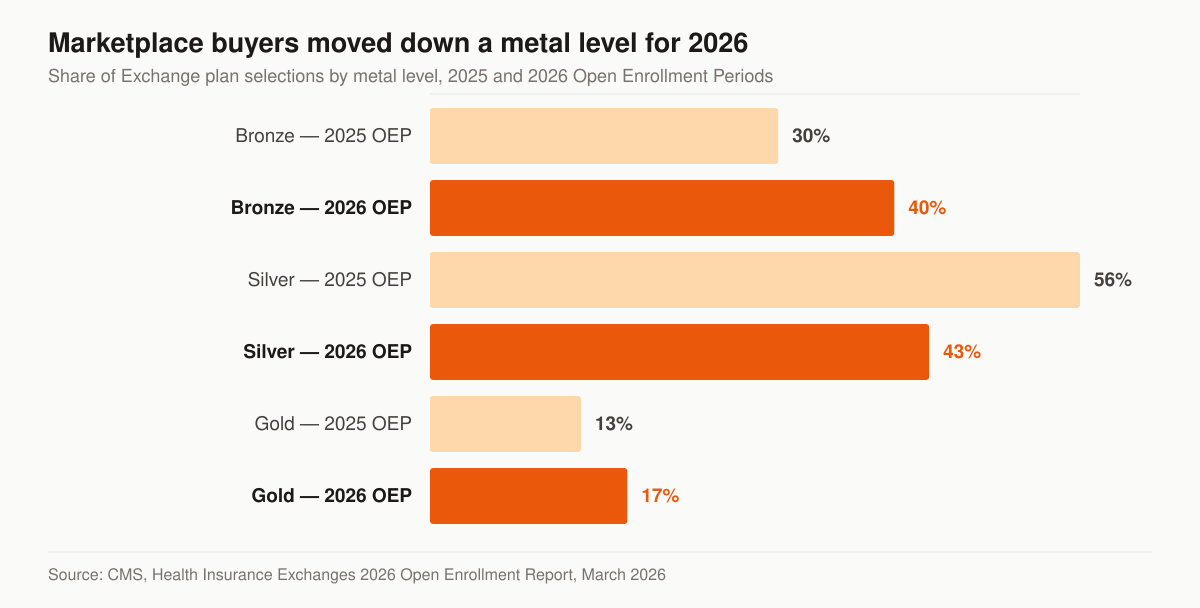
Source: CMS, Health Insurance Exchanges 2026 Open Enrollment Report and its March 27, 2026 release. CMS publishes the 2026 shares, the 2025 silver share, and the percentage-point change for bronze and gold; the 2025 bronze and gold bars are the 2026 shares net of that reported change.
Note the overlap. Mid-October through mid-December, an agent working both markets is fighting two auctions at once. That’s why a single blended “insurance” campaign underperforms — the searcher typing “ACA plans 2026” and the one typing “change my Medicare plan” want different pages, different proof, and different disclaimers. Separate funnels win.
The compressed window is the whole problem. You don’t have a year to optimize; you have weeks. A lead that sits 48 hours during OEP is functionally dead — someone else enrolled them. Speed-to-lead isn’t a nice-to-have here, it’s the difference between a profitable season and a pile of wasted ad spend.
15 open enrollment marketing ideas for agents
Every idea below is something you can ship, not a theme. They’re grouped by the market they fit; we’d pick five or six for a given agency, not all fifteen.
ACA open enrollment ideas (Nov 1 – Jan 15)
- Stand up a dedicated ACA landing page by mid-October. Not your homepage — a page that answers “am I eligible, what will it cost, what’s the deadline” above the fold and ends in a quote request. OE traffic bounces off generic agency sites.
- Remarket last year’s quote list before spending on cold traffic. People you quoted but didn’t enroll are the cheapest wins of the season. A short email and SMS sequence starting late October beats any cold audience you can buy.
- Run a December 15 countdown sequence. That’s the last day to enroll for January 1 coverage, so build three or four sends around it — deadline emails are the rare promo that’s also a genuine service.
- Buy high-intent search in week one, not week four. CPCs climb through November; capturing “enroll in ACA” terms early costs less and trains the account while volume builds. Structure and pacing are covered in our Google Ads guide for insurance agents.
- Retarget quoted-but-unenrolled visitors through January 15. The December 16 – January 15 stretch (coverage starting February 1) is a real second season, and pacing that ends December 15 never reaches it — leave budget for it.
- Build a Spanish-language funnel, not a translated ad. In-language pages and creative reach a market segment most competitors serve badly; our bilingual insurance marketing playbook covers what actually converts.
Medicare AEP ideas (Oct 15 – Dec 7)
- Publish plan-change content early enough to rank by October. CMS lets plans market prospective-year offerings starting October 1 (42 CFR §422.2263(a)), which means the educational content you want ranking for AEP questions needs to be indexed months before that. Anything that names plans or benefits is marketing material, so write it inside the CMS Medicare marketing rules.
- Sprint Google reviews in September. Beneficiaries comparing agents read reviews at exactly this moment; a systematic ask to this year’s happy clients is free AEP marketing. Here’s how agents get more Google reviews without begging. Compliance note: keep the ask plan-neutral — the moment you reuse a review in an ad or a post, it becomes regulated marketing material.
- Bake the TPMO disclaimer into creative before launch, not after review. Compliant ads sail through and stay live mid-season; our Scope of Appointment and TPMO compliance guide covers what goes where.
- Host a genuinely educational event. CMS rules (42 CFR §422.2264) let you inform beneficiaries about Medicare and answer their questions at educational events — no plan pitches or applications — which makes them a clean top-of-funnel play in October. The educational-versus-marketing line is unforgiving: no plan-specific materials in the room, no enrollment forms on the table.
- Decide your January posture in November. Once AEP ends you can’t chase switchers — the Medicare OEP marketing rules ban OEP-targeted outreach from January 1 to March 31 — so queue the inbound and turning-65 plays before the window closes.
Employer group OE ideas (set by each employer)
-
Build a renewal-month calendar for group prospects. Job-based plans set their own open enrollment windows, so the “season” is whenever each employer’s plan renews. A simple spreadsheet of renewal months turns group OE into a year-round pipeline instead of a Q4 scramble.
-
Hand HR a benefits-communication kit. Enrollment-deadline emails, a plain-English FAQ, a one-page plan summary — the broker who makes HR’s open enrollment easier is the broker who keeps the account. More on this in our group life and employee benefits marketing guide. The centerpiece is a ready-to-send open enrollment announcement to employees; hand HR this and it can go out close to verbatim:
Subject: Open enrollment starts [DATE] — your [YEAR] benefits choices
Open enrollment runs [START DATE] through [END DATE]. This is the one time each year you can change your health, dental, and vision plans without a qualifying life event.
Review your options in [BENEFITS PORTAL] and submit your elections by [DEADLINE]. If you do nothing, you’ll be [DEFAULT: re-enrolled in your current plan / left without coverage].
Questions about which plan fits your family? Join the 20-minute walkthrough on [DATE/LINK], or reply and we’ll set up a one-on-one.
-
Run short decision-support webinars during the client’s window. Twenty recorded minutes on “how to pick your plan” gets shared internally, positions you as the advisor, and surfaces employees with individual-market needs.
-
Ask for the referral at enrollment confirmation. The moment coverage is locked is the moment satisfaction peaks — for group clients that means the HR contact’s peer network; for individual clients, their household. Build the ask into the confirmation touch, then keep leads warm with a real follow-up cadence.
Three open enrollment email templates you can copy
Open enrollment email is where the season’s money leaks out — a single “open enrollment is here” blast and then nothing else. These three do the actual work of the season. Swap the brackets for your details, and keep any Medicare send plan-neutral unless your creative has cleared carrier and TPMO review.
1. ACA December 15 countdown (send Dec 10–14, to quoted-and-unenrolled + past clients)
Subject: December 15 is the deadline for January 1 coverage
Quick heads-up: December 15 is the last day to enroll or change plans for coverage that starts January 1. Miss it and your earliest start date slides to February 1.
If you’ve been putting off comparing plans, it takes about 15 minutes with me on the phone. I’ll show you what changed in your plan’s premium, deductible, and network for [YEAR] — and whether a different plan saves you money.
[BOOK A 15-MINUTE CALL] — or just reply “call me” and I’ll ring you today.
2. Medicare AEP final week (send Dec 1–5, to your permitted-contact list only)
Subject: Your Medicare plan review closes December 7
The Annual Enrollment Period ends December 7. After that date, most people can’t change their Medicare Advantage or Part D coverage until next fall.
If we haven’t reviewed your plan for [YEAR], it’s worth 20 minutes. Drug formularies and networks change every year, and the plan that fit you last year may not be the cheapest one this year.
Reply with a time, or call me at [PHONE]. [TPMO DISCLAIMER — required wording, placed per your carrier’s review]
3. Quoted-but-not-enrolled reactivation (send Nov + again in early Jan)
Subject: You asked for a quote — did you get covered?
I quoted you on [DATE] and never heard back, which usually means one of three things: you found coverage elsewhere, the price scared you off, or life happened.
If it’s #2 or #3, it’s worth another look — subsidies and plan pricing change every year, and the number you saw may not be the number today.
Reply with a “yes” and I’ll re-run it. Takes me five minutes. [ENROLLMENT DEADLINE] is the cutoff.
When should agents start open enrollment marketing?
Start building in Q3 — mid-September at the absolute latest. Landing pages, tracking, creative, and follow-up sequences should be live and tested two to three weeks before November 1 for ACA, and before October 15 for AEP, since plan-year marketing opens October 1 and the search auction heats up from there.
Ideas 1, 7, and 12 above carry the longest lead times, so sequence them first; the AEP-specific strategy stack covers the Medicare build order in detail.
The June-to-January open enrollment prep calendar
Open enrollment prep is a seven-month build, not a Q4 scramble. This is the month-by-month sequence for an agent working both markets — the ACA column and the Medicare column run in parallel, and the two collide in November.
| Month | ACA task | Medicare AEP task |
|---|---|---|
| June | Pull last season’s numbers — cost per lead, contact rate, close rate — and cut the channels that didn’t clear | Same audit for AEP; rebuild your turning-65 and orphan-book lists |
| July | Rebuild the ACA landing page and quote flow; fix broken tracking before it matters | Draft educational content topics — nothing plan-specific or benefit-specific yet |
| August | Write the email and SMS sequences; rebuild remarketing audiences from last season’s traffic | Book venues and set the educational-event calendar for October |
| September | Creative and disclaimers drafted and reviewed; test every form end to end | Carrier certifications done; TPMO disclaimer built into creative, not bolted on |
| October | Publish and index plan-change content; warm-audience ads live; final page test before Nov 1 | Oct 1: prospective-year marketing is permitted. Oct 15: AEP opens — ads live, dialer on |
| November | Nov 1: ACA OE opens. Full budget on, speed-to-lead under five minutes | Peak dialing; mid-month reminders; retarget everyone quoted but not enrolled |
| December | Dec 15 countdown sequence for Jan 1 coverage, then pivot to the Dec 16 – Jan 15 second season | Dec 7 final-week push. After Dec 7, stop all AEP switch messaging |
| January | Jan 15 federal cutoff (Jan 31 in California, New York, and other state marketplaces) | OEP opens Jan 1 — no OEP-targeted outreach. Inbound, age-ins, 5-star, and D-SNP only |
The October row is the one agents get wrong. CMS lets plans market prospective-year offerings starting October 1 (42 CFR §422.2263(a)) — but content you want ranking by then has to be published months earlier, because indexing and rankings don’t respect your enrollment calendar.
The Q3 build checklist (ship before October)
If these aren’t live and tested before November, you’re starting behind. Build in this order:
- Landing pages, one per intent — separate ACA and Medicare pages, each answering the searcher’s exact question above the fold. Generic homepages convert OEP traffic poorly.
- Tracking and pixels installed and firing — verify conversion events fire before you spend a dollar, not after week one.
- Compliant ad creative with disclaimers baked in — TPMO language and CMS-aligned claims drafted and reviewed in September, not improvised in November.
- Follow-up sequences wired — SMS + email automation that fires within minutes of a form fill, then nurtures across the window.
- A dialing plan — who calls, how fast, and what happens to a lead at hour 1, hour 24, day 3.
For the deeper builds, route to the specialists: spin up high-intent open-enrollment landing pages built for ACA conversion, and stand up the automated follow-up that catches leads in minutes so nobody enrolls behind you. The full seasonal program lives under our ACA agent marketing services — that’s the funnel everything here feeds.
The channel mix that actually fills the pipeline
You don’t need every channel. You need two or three running well.
- Paid search — captures active intent (“enroll in ACA,” “Medicare plans near me”). Highest cost, highest urgency. Expect CPCs to climb through November; budget for it. See our insurance PPC approach for how we keep cost-per-lead in line when the auction heats up.
- Paid social — better for ACA’s younger, browse-mode audience and for retargeting. Cheaper clicks, longer nurture. Our Medicare and ACA Facebook ads playbook covers the compliance-safe creative angles.
- Email and SMS to your existing book — the cheapest enrollments you’ll get all season. Past clients, last year’s quotes, your “not yet” list. If you’re not remarketing your own database first, you’re leaving the easy money on the table.
A note on buying leads: if you need raw volume to fill a short window and your team can dial fast, you can buy leads direct from getinsureleads to supplement what you generate. Keep that buying off your own marketing site — generate the leads you own, buy the leads you need, don’t blur the two.
Compliance is a conversion lever, not a tax
For ACA and Medicare, CMS rules govern your marketing, and TPMO disclaimer requirements apply to a lot of what you’ll run. Get this right and it helps you: clean, transparent disclaimers signal that you’re a legitimate operator, which lifts trust and conversion. Get it wrong and you risk takedowns mid-season — the worst possible time.
The split is simple: we provide the marketing services; the licensed agent is the responsible party for plan-specific claims and representations. Draft disclaimers in September, review them once, and stop thinking about them. Don’t let a compliance scramble eat your November.
The math that tells you it’s working
Open enrollment marketing for agents lives or dies on one number: how many worked leads you need to hit goal. Work backward from close rate.
| Input | Worked example (plug in your own) |
|---|---|
| Enrollment goal | 100 |
| Close rate on worked leads | assume one in six for the math |
| Worked leads needed | ~600 |
| Contact rate | ~60% |
| Form fills needed | ~1,000 |
| Target CPL | your number × 1,000 = budget |
Those inputs are placeholders for arithmetic, not benchmarks — every figure should be your figure, measured from last season. The point is the discipline: a goal without this math is a wish. If your blended cost per acquisition clears your commission per enrollment with margin, scale spend. If it doesn’t, fix the funnel — usually the landing page or the speed of first contact — before you add budget.
Ship it before the window opens
The agents who dread open enrollment are the ones improvising it. The ones who profit from it built the machine in Q3 and spent November dialing, not debugging.
If you want a second set of eyes on your funnel before the season hits, grab a free marketing audit — we’ll pressure-test your pages, tracking, and follow-up against the OEP clock. And if you’re planning the broader calendar, our take on how ACA agents fill the pipeline during OEP and the CMS compliance rules ACA agents need to know are the next two reads. Build now. Enroll later.
- How ACA Agents Fill Their Pipeline During OEP
A practitioner's playbook for ACA lead generation during Open Enrollment: build a marketing pipeline that keeps producing long after Dec 15, not just OEP.
- Medicare AEP Marketing Strategy for Agents: The 2026 Playbook
Medicare AEP marketing strategy: the Oct 1 start date, the Oct 15-Dec 7 calendar, CMS rules, and what CY2027 commission lets you pay per enrolled beneficiary.
- How to Get Medicare Clients: 9 Channels Ranked by Cost and Risk
How to get Medicare clients as an agent: 9 channels ranked by cost, speed, and CMS risk — plus what CMS caps agent commissions at, and the rules.
- Medicare OEP Marketing Rules: What Agents Can and Can't Do (Jan 1–Mar 31, 2027)
Medicare OEP marketing rules for 2027: the 5 things CMS bans Jan 1-Mar 31 under 42 CFR 422.2263, and 7 compliant plays that still win share.