Medicare OEP Marketing Rules: What Agents Can and Can't Do (Jan 1–Mar 31, 2027)
The Medicare OEP marketing rules forbid agents from advertising, mailing, calling, or targeting ads to the Open Enrollment Period (Jan 1-Mar 31, 2027) or prompting beneficiaries to switch Medicare Advantage plans. Per CMS, you can't knowingly market to OEP-eligible beneficiaries or use phrases like 'switch your plan now.' You can market educationally year-round — where compliant agents win share.
January through March gets written off as a dead quarter. That’s a mistake born from confusion — the assumption that the same rules that powered an AEP enrollment blitz apply year-round. They don’t. The Medicare Open Enrollment Period (OEP) runs January 1 – March 31, 2027, and CMS marketing rules clamp down hard on what you can do during it. Get this wrong and you risk a complaint, a clawback, or a referral to your upline’s compliance team. Get it right and you own a quarter your competitors abandon.
This is marketing guidance, not legal advice. The binding rules live in 42 CFR Part 422, Subpart V — the Medicare Advantage Communication Requirements — backed by CMS’s Managed Care Marketing guidance, and you (the licensed agent) are the accountable party. Read this as a map of where the lanes are: 5 things CMS prohibits outright, 7 lanes that stay open all quarter, 4 campaigns you can run instead, and 6 other Q1 enrollment paths that sit outside the OEP.
Can you market during Medicare OEP?
Yes — you just can’t market the OEP itself. Under 42 CFR §422.2263(b)(7), plans and their agents may not knowingly target or send unsolicited marketing to enrollees during the January 1 – March 31, 2027 window, reference OEP in advertising, or push Medicare Advantage members to switch plans. Age-in marketing, beneficiary-initiated responses, and educational or brand marketing remain permitted.
The same prohibition binds the drug side: §423.2263(b)(7) repeats it word-for-word for Part D sponsors, so a standalone PDP campaign gets no free pass.
What is the Medicare OEP?
The Medicare Open Enrollment Period (OEP) runs January 1 – March 31 and is open only to beneficiaries already enrolled in a Medicare Advantage plan. Per 42 CFR §422.62(a)(3), they get one election: switch to another MA plan, or drop MA for Original Medicare and add a standalone Part D plan. Coverage starts the first of the following month.
Knowing exactly who the window covers is a marketing control, not trivia — most non-compliant OEP creative is aimed at people the OEP doesn’t even reach. Here is the enrollee’s actual menu, per Medicare.gov and §422.62:
| What the beneficiary wants to do | Allowed in the OEP (Jan 1–Mar 31)? |
|---|---|
| Already in Medicare Advantage — switch to another MA plan, with or without drug coverage | Yes — this is the one election |
| Drop MA, return to Original Medicare, and join a standalone Part D plan | Yes — the Part D election coordinates with it |
| Make a second change after the first one lands | No — the election is once per OEP (§422.62(a)(3)(i)) |
| Sitting in Original Medicare — join a Medicare Advantage plan | No — OEP is for current MA enrollees only |
| Sitting in Original Medicare — join or switch a standalone Part D plan | No — that needs AEP or an SEP |
| Enroll in, or disenroll from, an MA MSA plan | No — MSA enrollment is limited to the ICEP or the annual coordinated election period (§422.62(d)(1)); disenrollment runs through the annual election period or an SEP (§422.62(d)(2)) |
Read the last three rows as a targeting rule. A “switch your plan now” campaign that lands in front of an Original Medicare household or a standalone-PDP member isn’t just prohibited under §422.2263(b)(7) — it’s aimed at someone who has no OEP election to make.
OEP Is Not AEP: The Rule That Trips Up Agents
The single biggest error is treating OEP like a second AEP. They are opposites in posture.
During the Annual Enrollment Period (Oct 15–Dec 7), you market plan choices aggressively — the offensive plays live in our open enrollment marketing ideas for agents, and the season’s Medicare-specific sequencing is broken out in our Medicare AEP marketing playbook. During OEP, CMS prohibits marketing that targets the OEP or that prompts a beneficiary to switch their Medicare Advantage plan. The period exists for beneficiaries to fix a bad AEP decision — not for agents to re-pitch them.
| Factor | AEP (Oct 15–Dec 7, 2026) | OEP (Jan 1–Mar 31, 2027) |
|---|---|---|
| Posture | Offense — actively market plans | Defense — inbound only |
| Outbound to prospects | Permitted (with TPMO rules) | Prohibited if it targets OEP/switching |
| Reference “OEP” in ads | N/A | Not allowed |
| Mailers/emails about switching | Permitted | Prohibited (unsolicited) |
| Respond to inbound requests | Yes | Yes |
| Educational/brand marketing | Yes | Yes |
The phrase “everyone’s OEP-eligible in Q1” gets thrown around to justify aggressive outreach. Don’t let it. The eligibility of a beneficiary doesn’t grant you permission to knowingly market to them during OEP.
5 Things CMS Says You Cannot Do During OEP
The prohibitions are spelled out in §422.2263(b)(7) of the CMS marketing regulations, and repeated verbatim for Part D sponsors at §423.2263(b)(7) — so a drug-plan campaign gets no free pass. During the 2027 OEP you must not:
- Send unsolicited materials that reference OEP or advertise the chance to make an additional enrollment change — no “It’s OEP, time to switch” mailers, emails, texts, or calls.
- Specifically target beneficiaries who are in the OEP because they made an AEP choice — including buying mailing lists or using other means to identify them.
- Reference OEP in advertising as a call to action (“Use your OEP window now”).
- Engage in or promote agent or broker activity that treats OEP as a sales window — the regulation names this one directly.
- Call or otherwise contact former enrollees who selected a new plan during AEP.
3 Prohibited Lines and Their Compliant Rewrites
Most OEP violations are a copy problem, not a strategy problem — the campaign is fine until a line of copy points at the window or at a plan switch. The rewrites below keep the same audience and the same channel; they just move the hook off the OEP and onto a lane §422.2263(b)(7)(i) leaves open.
| Prohibited wording (references OEP or prompts a switch) | Compliant rewrite (educational, no OEP hook) |
|---|---|
| “It’s not too late — use your Open Enrollment window to switch Medicare Advantage plans before March 31.” | “How does your Medicare Advantage plan actually work this year? Here’s a plain-English breakdown of your coverage.” |
| “Regret the plan you picked in AEP? We’ll move you to a better one this quarter.” | “Turning 65 this spring? Here’s what to review before your Initial Coverage Election Period closes.” |
| “Q1 OEP special: free plan review for anyone who enrolled during AEP.” | “Free Medicare education session: how Parts A, B, and D fit together. No plan-specific sales presentation.” |
The pattern is consistent. Strip the deadline, strip the switch, and market the education or the age-in — the audience stays, the prohibited trigger goes.
If your business model needs outbound enrollment leads, OEP is the wrong season to source them — and this site doesn’t sell leads anyway. When you do need volume the compliant way, you can buy Medicare leads direct from getinsureleads and let your team handle outreach inside the rules. On this side, we build the marketing systems that generate inbound interest instead.
7 Things You CAN Do — And Where Agents Win
The rules restrict outbound and OEP-specific marketing. They do not shut down your business. In fact, §422.2263(b)(7)(i) lists what stays open, and these lanes run year-round:
- Marketing to age-ins — the regulation explicitly permits marketing to beneficiaries aging into Medicare who haven’t made an enrollment decision, which is why a turning 65 campaign is the natural Q1 play.
- Educational content that doesn’t reference OEP or push a switch (how Medicare works, Part D basics, dual-eligibility, SEPs).
- Responding to beneficiary-initiated requests — if they call, email, or fill your form, you can help.
- Logging that request before you answer it — the beneficiary-initiated exception is only worth what you can prove. Timestamp the form fill, keep the inbound call recording, save the email thread, and note it in the CRM before the OEP conversation happens. §422.2263(b)(7)(i)(B)–(D) permits sending materials, taking a one-on-one meeting, and discussing OEP through the call center at the beneficiary’s request — in a complaint or an audit, the log is what separates a permitted response from unsolicited outreach.
- Brand and reputation marketing — Google reviews, a credible website, local visibility.
- Existing-client service on non-OEP topics.
- Inbound lead generation — SEO, AI-search, and a converting site that capture people who came looking for you.
This is the whole game. Because outbound OEP marketing is banned, the demand doesn’t disappear — it just routes to whoever is findable. The agents who built a Medicare agent website that ranks and converts, who invested in Medicare SEO before the season, and who show up in AI Overviews capture inbound that their dark-mode competitors physically can’t pursue.
We’ve watched this dynamic in our own lead operation. We run our own final-expense and senior-market book, so this comes from live campaigns, not theory. The mechanism that produces our results isn’t outbound spray; it’s compliant inbound systems built to catch demand at the moment of intent. The same conversion discipline applies to OEP: be the answer when a confused beneficiary starts searching.
The January–March OEP Marketing Calendar
Every lane in this calendar is permitted all quarter — the months assign emphasis, so each block of work feeds the next. It also assumes the assets exist; if they don’t, building them is January’s real job.
| Month | Emphasis | Compliant activity to run | Keep out of the mix |
|---|---|---|---|
| January 2027 | Age-ins + inbound capture | Launch the Q1 age-in campaign — explicitly permitted by §422.2263(b)(7)(i)(A); answer every inbound request same-day (beneficiary-initiated contact is always in-bounds); publish educational content on the Part B General Enrollment Period, which also runs Jan 1–Mar 31 | Any mailer, ad, or email that references OEP or an “additional enrollment change” (§422.2263(b)(7)(ii)(A)) |
| February 2027 | Education + community | Hold an educational event under §422.2264(c)(1) — advertised as educational, no plan-specific pitches, business cards and Scope of Appointment forms allowed; run D-SNP/LIS eligibility outreach by mail or opt-out email; convert January’s closes into Google reviews | Buying lists that identify beneficiaries who switched plans during AEP (§422.2263(b)(7)(ii)(B)) |
| March 2027 | Retention + AEP groundwork | Market a 5-star plan’s continuous-enrollment SEP if the contract holds the rating; call current clients on plan business with the required annual written opt-out notice (§422.2264(b)); commission the SEO and content that must rank before October 1, when next-year marketing opens (§422.2263(a)) | Calling former enrollees who selected a new plan during AEP (§422.2263(b)(7)(ii)(D)) |
4 Compliant Campaigns You Can Run During OEP
You don’t need the OEP itself to fill a first-quarter pipeline. Under §422.2263(b)(7)(i)(A), agents may still market other enrollment opportunities during January–March: beneficiaries aging into Medicare, a 5-star plan’s continuous-enrollment SEP, and dual-eligible or LIS beneficiaries with election periods of their own. Add referral and retention work under the beneficiary-contact rules in §422.2264, and every campaign below runs without touching a prohibited lane.
That permission isn’t an interpretation — it’s the regulation’s own list of what may be marketed during the OEP:
“Conduct marketing activities that focus on other enrollment opportunities, including but not limited to marketing to age-ins (who have not yet made an enrollment decision), marketing by 5-star plans regarding their continuous enrollment special election period (SEP), and marketing to dual-eligible and LIS beneficiaries who, in general, may make changes once per calendar quarter during the first 9 months of the year”
— 42 CFR §422.2263(b)(7)(i)(A), Medicare Advantage Communication Requirements
1. Age-in (T65) outreach
The cleanest OEP-season campaign because the regulation names it first: marketing to people aging into Medicare who haven’t made an enrollment decision. Channel rules come from §422.2264(a) — unsolicited direct mail and print are permitted, email is permitted when every send carries an opt-out, and cold calls, texts, and social DMs are not. Run it as a monthly cohort loop, not a blast; the full month-by-month T65 contact plan maps every touch from the 64th birthday to the end of the IEP.
2. 5-star SEP campaign
If you represent a contract holding an overall 5-star rating, §422.2263(b)(7)(i)(A) permits marketing its continuous-enrollment SEP right through Q1. One trap: §422.2263(c)(6)(i) bars marketing the 5-star SEP after November 30 for a contract that has not received an overall 5-star rating for the next contract year — so verify the current-year rating before any creative goes out, and identify the plan by its HPMS marketing name as §422.2263(b)(9) requires.
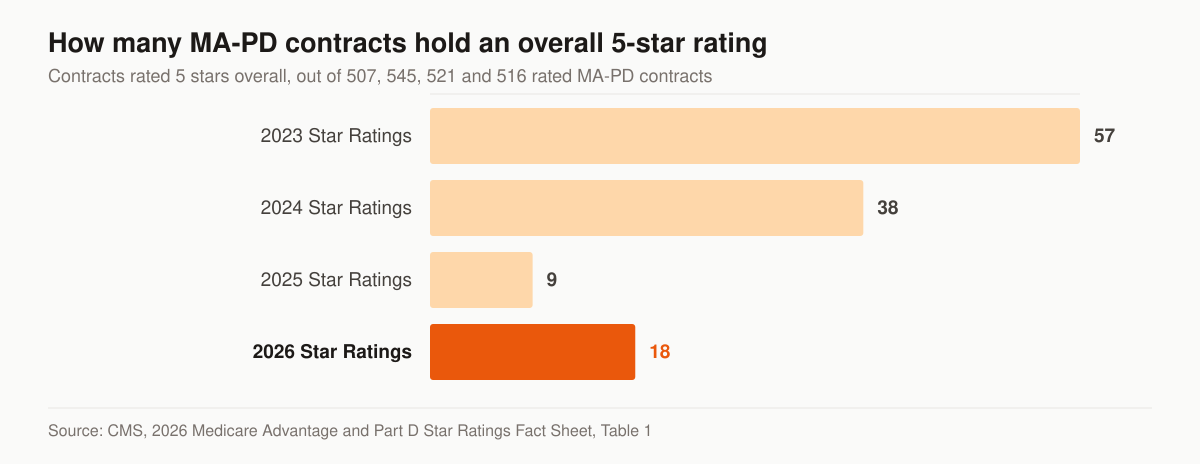
Chart: MA-PD contracts holding an overall 5-star rating, from Table 1 of the CMS 2026 Medicare Advantage and Part D Star Ratings Fact Sheet — 57 of 507 rated contracts in 2023, 9 of 521 in 2025, and 18 of 516 in 2026. The list is recalculated every year, which is why §422.2263(c)(6)(i) makes the current rating the thing to check before the creative ships.
3. D-SNP and LIS eligibility outreach
Dual-eligible and Low-Income Subsidy beneficiaries have enrollment opportunities the regulation treats separately from OEP — the quoted provision above describes them as able, in general, to make changes during the first nine months of the year. Eligibility-focused outreach to this population is permitted; the constraint is channel and sequence: mail and opt-out email for the unsolicited touch (§422.2264(a)(1)), then a recorded Scope of Appointment before any personal marketing appointment (§422.2264(c)(3)).
4. Referral and retention loop
Q1 is when AEP clients are freshest — and §422.2264 draws a sharp line through referral programs: calls based on referrals are explicitly prohibited as unsolicited contact (§422.2264(a)(2)(iv)(A)), but a referred beneficiary who contacts you is fair game, because beneficiary-initiated contact is never unsolicited (§422.2264(a)(3)). So the compliant mechanic is: give every new client something to hand over — a card, a link, your Google profile — and let the referral dial the phone. Meanwhile, calling your current clients about plan business is permitted under §422.2264(b), provided you deliver the annual written notice of their right to opt out of those calls.
6 Compliant Q1 Enrollment Paths Beyond OEP
Compliant Q1 enrollment paths beyond OEP exist because the OEP is only one of several election periods running from January through March. Each has its own trigger and its own window — and none of them is the OEP, so marketing them avoids the §422.2263(b)(7) ban on referencing OEP. Windows below come from Medicare.gov’s Special Enrollment Periods list and 42 CFR §422.62.
| Enrollment path | Window | Who qualifies |
|---|---|---|
| ICEP / age-in (turning 65) | Begins 3 months before Medicare entitlement, ends 3 months after | People new to Medicare who haven’t made an enrollment decision (§422.62(a)(1)) |
| 5-star SEP | Once, Dec 8 through Nov 30 of the plan year | Anyone in the service area of a 5-star-rated MA, drug, or Cost plan (§422.62(b)(15)) |
| Integrated D-SNP SEP | Once per calendar month, effective the 1st of the next month | People with Medicare and full Medicaid benefits, joining or switching an integrated D-SNP |
| Medicaid / Extra Help (LIS) SEP | Once per calendar month | People on Medicaid or receiving Extra Help — switch drug plans, or leave an MA-PD for Original Medicare plus a PDP. Not available to “at-risk” beneficiaries under a drug-management program |
| Chronic-condition SEP (C-SNP) | Anytime; ends once they enroll | People with a qualifying severe or disabling chronic condition, joining a C-SNP that serves it (§422.62(b)(13)) |
| Contract non-renewal SEP | Dec 8 through the last day of February | People whose MA, drug, or Cost plan contract wasn’t renewed |
Two rules travel with all six. The creative may not reference the OEP or the ability to make an additional enrollment change (§422.2263(b)(7)(ii)(A)), and a Scope of Appointment still precedes any personal marketing appointment (§422.2264(c)(3)). Age-in is the largest of the six by volume, and the only one with a predictable monthly cohort — our T65 contact plan sequences it.
TPMO Rules Don’t Take a Holiday
A common blind spot: agents assume Third-Party Marketing Organization (TPMO) requirements only matter during AEP. They apply year-round. If an agency runs your ads, hosts your lead form, or operates a call center on your behalf, it is a TPMO and must carry the standardized CMS disclaimer, follow call-recording rules, and respect Scope of Appointment requirements.
We provide marketing services — websites, SEO, AI-search optimization, content — not licensed advice or enrollment. You and your TPMO partners stay the compliant, licensed parties. That separation is a feature: it keeps your marketing engine running while keeping the regulated activity squarely with the people licensed to do it.
The 5-Step OEP Pipeline Play (Compliant)
Here’s the sequence that turns a “dead” quarter into a pipeline quarter:
- Build inbound assets before OEP — content and SEO ranking by December so January traffic is already flowing.
- Lead on education, not enrollment — answer real Medicare questions; the plan conversation happens after they initiate.
- Convert inbound fast — speed-to-lead and a clean booking flow beat a bigger ad budget every time.
- Protect compliance — TPMO disclaimers live, calls handled correctly, no OEP-switching language anywhere.
- Stack reputation — every closed client becomes a review that compounds your findability for next season.
Want the full seasonal system mapped to your market? Start with our Medicare marketing services for agents, and if you’re planning the year, the turning-65 marketing system keeps a steady non-AEP pipeline flowing. For the broader rhythm, our Medicare AEP and OEP planning playbook ties the seasons together.
The agents who treat OEP as defense-plus-inbound — instead of a banned second AEP — don’t just stay compliant. They quietly take the share everyone else leaves on the table.
Get a free marketing audit and we’ll show you exactly where your inbound is leaking — built by people who actually generate insurance leads, not a generalist agency guessing at CMS rules.
Compliance note: This article is marketing guidance, not legal advice. Always verify current CMS Medicare Marketing Guidelines and TPMO requirements; the licensed agent is responsible for compliance.
- Medicare AEP Marketing Strategy for Agents: The 2026 Playbook
Medicare AEP marketing strategy: the Oct 1 start date, the Oct 15-Dec 7 calendar, CMS rules, and what CY2027 commission lets you pay per enrolled beneficiary.
- The T65 Marketing Calendar: A Month-by-Month Campaign System
A month-by-month T65 marketing calendar for Medicare agents: when to mail, when to call, and which touch belongs in each month before the IEP opens.
- How to Get Medicare Clients: 9 Channels Ranked by Cost and Risk
How to get Medicare clients as an agent: 9 channels ranked by cost, speed, and CMS risk — plus what CMS caps agent commissions at, and the rules.
- 15 Open Enrollment Marketing Ideas for Agents (ACA, Medicare, Group)
15 open enrollment marketing ideas for agents, segmented for ACA OE, Medicare AEP, and employer group windows — with verified 2026 dates and deadlines.