Who we serve
Annuity Marketing for Agents
Annuity marketing for agents engineers booked appointments instead of impressions: educational content that ranks, a website that converts a slow-research buyer, and ad discipline that controls cost per appointment. Because annuities sell on a long, trust-heavy decision cycle, the job is to be the credible, factual presence at every step before a prospect calls.
Free · 15-minute teardown · no pitch deck
- We run our own final-expense book
- No pitch deck — we screen-share real numbers
- TCPA-aware · CMS/AEP-compliant · Meta Special Ad Category
- Core Web Vitals < 2.0s LCP
Annuity marketing fails for a boring reason: it treats a long research decision like a one-click impulse buy. A pre-retiree weighing a fixed indexed annuity against a CD, a MYGA, or staying in the market does not convert off a single ad. They read. They compare. They ask AI tools and friends. Then, eventually, they pick an agent who was credible at every one of those steps.
That is the whole game. Annuity marketing for agents is about being the trusted, factual presence across a long decision cycle — the retirement-age buyer here is the same one at the center of senior market insurance marketing, just further up the asset curve — and then making the next step obvious. Below is how we build that system, and where the compliance lines sit.
The demand side is not the constraint. LIMRA’s final tally put total US annuity sales at $464.1 billion in 2025, up 7%, from a survey it says represents 93% of the US annuity market, with fourth-quarter sales of $117.2 billion marking the ninth consecutive quarter above $100 billion (LIMRA, March 23, 2026). In the same release, LIMRA research head Bryan Hodgens ties the run to demographics: “We are currently in the middle of Peak 65, where 4.1 million Americans are turning 65 each year ― many who don’t have pensions or other income sources to meet their basic living expenses in retirement.” The buyers exist. The question is whether your marketing reaches them before someone else’s does, and whether it survives a compliance read when it does.
What actually moves annuity prospects
We do not have a final-expense-style lead book to cite here, and we will not pretend we do. What transfers is the discipline: the same conversion mechanics and ad-cost control we build for the senior market, applied to a slower, higher-trust product. Our case studies are illustrative composites of that method rather than verified client results, and the method is the point — the channel matters less than the system around it.
| Channel | Best job for annuities | Speed to appointment |
|---|---|---|
| SEO + content | Capture research-stage “compare” searches | Slow (3–6 mo), compounds |
| AI search / GEO | Get quoted in ChatGPT, Perplexity, AI Overviews | Medium, early-mover edge |
| Paid social / search | Fill near-term pipeline, retarget readers | Fast (weeks) |
| Seminars and webinars | Educate a group before any one-on-one | Medium, batch-driven |
| Agent website | Convert the slow researcher into a booking | Immediate force-multiplier |
No single row wins. The agents who scale run several rows at once, with one website doing the converting. Which rows you can run at all comes down to who you can reach without tripping a compliance rule, and that is the job annuity lead generation programs do: educational seminars, safe-money paid social, and rate-and-alternative search, aimed at the 55-to-70 buyer weighing a rollover, an RMD decision, or a move to safer money.
Which annuity product should your marketing be about?
Deciding what to write and advertise starts with what people are actually buying, and the product lines are not close to evenly matched. The chart below shows full-year 2025 US retail annuity sales split by product line.
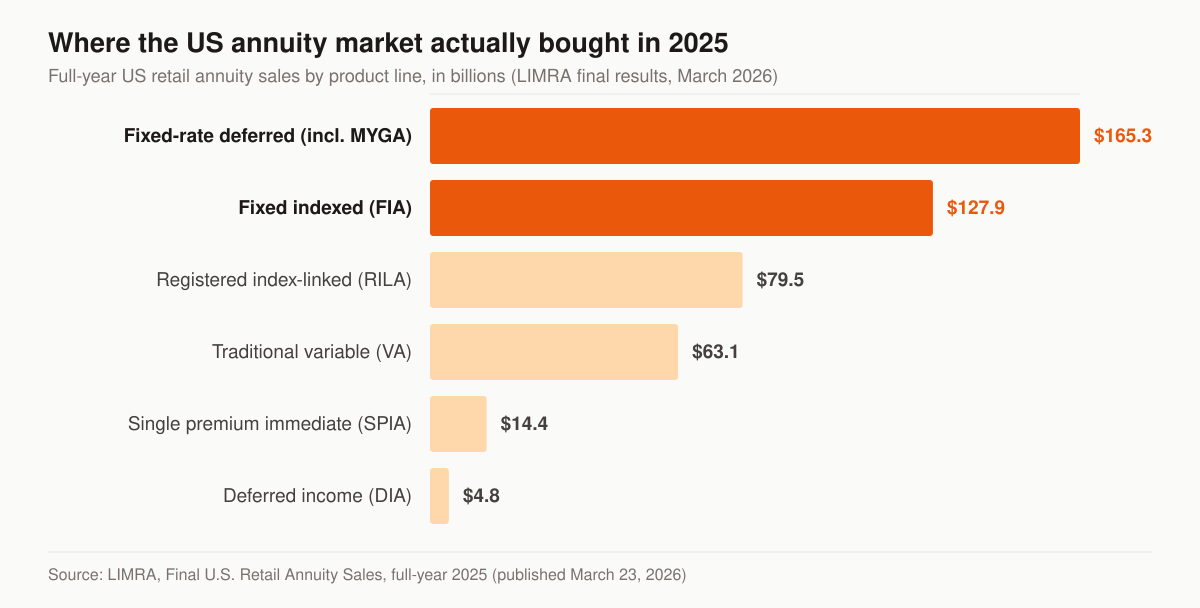
Source: LIMRA, Final U.S. Retail Annuity Sales, full-year 2025, published March 23, 2026.
This table maps each product line to the buyer question your content has to answer for it, using LIMRA’s 2025 sales figures and growth direction. The point is not that one line is “better” — it is that a fixed-only producer and a securities-registered producer should be publishing different pages.
| Product line | 2025 sales | Direction vs 2024 | The buyer question your content answers |
|---|---|---|---|
| Fixed-rate deferred (MYGA) | $165.3B | +6% | “Where do I park money for a fixed term without market risk?” |
| Fixed indexed (FIA) | $127.9B | +1% (fifth straight year of growth, a record) | “Can I get some index-linked credit without downside exposure?” |
| Registered index-linked (RILA) | $79.5B | +20%, 11th straight year of growth | “I’ll take a buffer instead of a floor for more upside” |
| Traditional variable (VA) | $63.1B | +8% | “I want market participation inside a tax-deferred wrapper” |
| Single premium immediate (SPIA) | $14.4B | +6% | “Turn this lump sum into a paycheck now” |
| Deferred income (DIA) | $4.8B | −3% | “Start a paycheck later, at a date I pick” |
Two implications for your editorial calendar. First, if your license covers fixed products only, the two largest lines in that table are the two you can write. Second, RILA grew 20% year over year, more than any other line in that table — LIMRA also notes it is “10 times the sales recorded a decade ago for this product line” — and it carries a second regulatory layer covered below. Marketing a product you cannot place is wasted traffic.
How to market annuities without tripping compliance
This is where sloppy marketing puts the agent at risk. Annuities are factual products. The marketing has to be too.
- No guaranteed-return or “get rich” framing. Describe income options, tax deferral, and principal-protection features exactly as the product defines them, with caps and conditions intact.
- Match the claim to the contract. “Tax-deferred growth” is fine; implied market upside without risk is not.
- Keep suitability with the licensed agent. We provide marketing services; you remain responsible for suitability and any FINRA-regulated products.
- Separate education from the pitch. Lead with how the instrument works, not with a number that sounds too good to be true.
Done right, compliance is a trust signal. The reader who senses you are being straight with them is the one who books. The specifics below come from Georgia’s advertising regulation for life insurance and annuity contracts (Ga. Comp. R. & Regs. Subject 120-2-11), quoted here because it is public, specific, and written to cover annuity contracts by name. Your own state’s rule is the one that binds you, and you have to read it rather than assume it matches Georgia’s. We provide marketing services, not legal advice — your compliance counsel and your carriers sign off on creative before it runs.
The insurer owns your advertisement, even the one you wrote
Georgia’s rule defines an advertisement broadly enough to catch almost everything a marketer produces: “printed and/or published material, audiovisual material, mailing envelopes, descriptive literature used by an insurer in direct mail, newspapers, magazines, radio and television scripts, billboards or similar displays,” plus “prepared or extemporaneous sales talks, presentations, and material for use or used by sales personnel, agents or counselors” (Ga. Comp. R. & Regs. 120-2-11-.03). Your seminar deck is an advertisement. So is your landing page, your reel script, and the envelope your mailer arrives in.
And the responsibility does not stop with you. The same regulation requires that “Every insurer shall establish and at all times maintain a system of control over the content, form and method of dissemination of all advertisements of its policies. All such advertisements, regardless of by whom written, created, designed, or presented, shall be the responsibility of the insurer.” That single clause explains why carriers demand advertising approval and why an agency that ships creative without routing it through carrier review is handing you a problem. Insurers must also keep “a specimen copy of every printed, published, or prepared advertisement” on file for “a period of either four years or until the filing of the next regular report on the examination of the insurer, whichever is the longer period of time.” Build your creative archive to match, because someone will ask for it.
Words a state advertising rule will not let you use
Georgia’s rule carries a prohibited-terminology list. It bars using “investment,” “investment plan,” “founder’s plan,” “charter plan,” “expansion plan,” “profit,” “profits,” “profit sharing,” “deposit,” “interest plan,” “savings,” “savings plan,” “or other similar terms” where they could mislead a prospective purchaser about what they are actually getting. Three more constraints matter for annuity creative specifically:
- Name the product. An advertisement “shall not use as the name or title of a policy any phrase which does not include the words ‘life insurance’ or ‘annuity’ unless accompanied by other language clearly indicating it is life insurance or an annuity.” Branded program names need that qualifier attached.
- Do not borrow a title you do not hold. The rule restricts using “financial planner, investment advisor, financial consultant, or financial counseling” in a way that implies an advisory business whose compensation is unrelated to sales, “unless such is actually the case.”
- Do not dress up as the government. No advertisement may use words, symbols, or materials “so similar to a combination of words, symbols, or physical materials used by a governmental program or agency” that they tend to mislead prospects into thinking the solicitation is connected to that program. Eagles, seals, and “official notice” mailer treatments aimed at a 65-year-old are exactly what this is about.
The MYGA-versus-CD comparison needs care, and it needs the right clause. Georgia’s explicit bar on comparing a product to outside instruments is scoped to a single product type: “Life insurance policies shall not be compared to savings accounts, stocks, bonds, or any other financial instrument or investment in such a way as to mislead a person as to the true nature of life insurance or life insurance surrender values or other policy benefits” (120-2-11-.10(2)(k)). That is a life insurance clause. It is not the rule that governs an annuity-versus-CD page.
What governs that page is the rest of the same regulation. Advertisements “shall be truthful and not misleading in fact or by implication,” judged by the Commissioner from “the overall impression that the advertisement may be reasonably expected to create upon a person of average education or intelligence within the segment of the public to which it is directed” (120-2-11-.05(1)). No advertisement may “omit material information” where the omission has “the capacity, tendency, or effect of misleading or deceiving purchasers or prospective purchasers … as to the nature or extent of any policy benefit” or “state or federal tax consequences” (120-2-11-.06(2)). And the terminology restriction above reaches the “savings,” “deposit,” and “interest plan” framing a rate comparison invites, wherever using those terms in connection with a policy could mislead a prospect about what they are getting. None of that forbids the comparison. It forbids the version that prints two rates side by side and stops there. The compliant version explains liquidity, surrender charges, tax treatment, and who guarantees what — which, conveniently, is also the version that gets quoted by an AI answer engine.
If you are securities-registered and the comparison runs in a retail communication, FINRA puts an explicit checklist under it: “Any comparison in retail communications between investments or services must disclose all material differences between them, including (as applicable) investment objectives, costs and expenses, liquidity, safety, guarantees or insurance, fluctuation of principal or return, and tax features” (FINRA Rule 2210(d)(2)). Those seven items are a usable outline for the page even when you are fixed-only and FINRA does not reach you.
Rate claims, illustrations, and the source line
Deferred annuity advertising carries its own subsection. Any illustration based on rates higher than the guaranteed accumulation rate must “set forth with equal prominence comparable illustrations or statements containing or based upon the guaranteed accumulation interest rates,” non-guaranteed rates “must be clearly and prominently labeled as such,” and an illustrated rate above what the company is currently crediting is allowed only where “such higher rates have been publicly declared by the company with an effective date for new issues not more than three (3) months subsequent to the date of declaration.” Tax framing is bounded too: an ad may not imply preferential tax treatment “unless the advertisement fully, clearly and accurately describes the tax deferred nature of the contract, including the tax consequences on surrender.”
Statistics carry their own clause: “No advertisement shall contain statistical information relating to any insurer or any policy unless it accurately reflects recent and relevant facts. The source of any such statistics used in any advertisement shall be identified therein.” If a stat appears in your ad, the source appears with it. That is the same standard this page holds itself to, and it is the same standard that earns citations from AI answer engines — one rule, two payoffs.
Testimonials, endorsements, and what you cannot fake
Testimonials must “be genuine; represent the current opinion of the author; be applicable to the policy advertised, if any; and be accurately reproduced,” and when the person giving one receives any benefit “directly or indirectly other than required union scale wages,” the ad must carry disclosure “identical to, or substantially similar to, the following: ‘THIS IS A PAID ENDORSEMENT.’” A testimonial that constitutes a solicitation can only come from someone currently licensed to solicit insurance in that state. Manufactured social proof is not a gray area here — it is a rule violation with your name on it.
Best interest changed the intake form, not just the sale
The NAIC’s Suitability in Annuity Transactions Model Regulation (#275) is the framework state regulators use for annuity recommendations. The NAIC’s Center for Insurance Policy and Research explains that membership approved revisions in February 2020 “clarifying that all recommendations by agents and insurers must be in the best interest of the consumer and that agents and carriers may not place their financial interest ahead of the consumers’ interest in making a recommendation,” and that the model “now requires agents and carriers to act with ‘reasonable diligence, care and skill’ in making recommendations.” That page, last updated November 1, 2023, states that “40 states have adopted the model revisions” (NAIC CIPR).
Producer training rides along with it. The Illinois Department of Insurance states that resident producers “are required to complete a one time four (4) hour certification course for Annuity Products,” and that a non-resident producer who satisfies a substantially similar requirement in their own state “shall be deemed to satisfy the training requirements in this State” (Illinois DOI). Carriers add product-specific training on top of that.
This table shows where a best-interest regime lands on the marketing side rather than the sales side. These are build decisions, not disclaimers.
| Best-interest obligation | What it changes in your funnel |
|---|---|
| Recommendation must reflect the consumer’s profile | Lead forms and intake scripts capture age, objective, time horizon, and liquidity needs before a call, not after |
| Reasonable diligence, care and skill | Content sets expectations honestly, so the appointment starts from an informed prospect instead of a corrected one |
| Documentation of the basis for a recommendation | CRM fields and call notes are part of the marketing spec, not an afterthought bolted on by the agent |
| Producer and product training completed first | Campaign launch waits on training and carrier approval; put both on the project timeline |
Marketing that ignores this produces leads your process cannot legally act on. Marketing that respects it produces a shorter, calmer first call — which is why our annuity appointment setting qualification script asks profile questions early instead of saving them for the agent.
If you sell RILAs or variable annuities, your marketing has a second rulebook
Registered products bring FINRA rules into your creative process. Under FINRA Rule 2210, “An appropriately qualified registered principal of the member must approve each retail communication before the earlier of its use or filing with FINRA’s Advertising Regulation Department,” with records kept per SEA Rule 17a-4. A landing page is a retail communication. So is a paid social ad, an email blast, and a webinar invitation.
FINRA Rule 2330 governs the transaction itself for deferred variable annuities: a registered principal must review a recommended purchase or exchange and “determine whether he or she approves” of it before the application goes to the issuing insurance company, and in any event “no later than seven business days after an office of supervisory jurisdiction of the member receives a complete and correct application package,” and firms must document training so associated persons “understand the material features of deferred variable annuities” — surrender periods, tax penalties, mortality and expense fees, investment advisory fees, riders, and market risk.
The operational consequence is a slower creative loop. You cannot ship four ad variants on a Tuesday afternoon and swap headlines by Thursday. Build an approval queue into the calendar, batch variants so one review covers several, and keep an approved-copy library so campaign launches draw from pre-cleared blocks. An agency that has never worked inside a principal-review cycle can quietly blow your timeline in month one.
Seminar marketing: the fill is the whole job
We keep recommending seminars in this niche because the format suits the decision: a cautious pre-retiree can work through the material in a group before sitting one-on-one with someone earning a commission. But the presentation is not the marketing. Filling the room is, and every step of the fill is regulated creative.
- List and targeting. Age band, geography, and asset proxies define who gets invited. Mail, paid social, and local search each fill differently, and annuity Facebook ads face targeting limits the mailer does not.
- The invitation is an advertisement. It falls squarely inside the state definition quoted above, including the envelope. Government-lookalike treatments are prohibited; product names need their qualifier; any statistic on the piece needs its source printed alongside.
- Registration and confirmation. A registration page that captures profile fields feeds the best-interest intake and gives you a retargetable audience even from no-shows.
- Reminder sequence. Attendance, not registration, is the metric. Automated confirmation and reminder touches are what protect the seat you paid for — the job our insurance email automation work does.
- Seminar to appointment. The handoff from room to calendar is where seminar spend leaks, and it is the specific problem annuity appointment setting solves.
- The replay. Record it, gate it, and run it as an evergreen webinar. One night of content becomes a year of a landing-page asset.
The economics come down to four inputs: list and creative cost, venue and meal cost, seats filled, and kept appointments per seat. Divide total cost by kept appointments and you have the seminar number to compare against paid social.
The TCPA rules that decide your dial plan
Annuity prospects get called. That puts your follow-up under the FCC’s telephone solicitation rules at 47 CFR 64.1200, and four provisions shape the operating plan more than any script does.
| Rule | What the regulation says | What it means for the dial plan |
|---|---|---|
| Calling window | No telephone solicitation to a residential subscriber “before the hour of 8 a.m. or after 9 p.m. (local time at the called party’s location)” | Your dialer schedules on the prospect’s clock, not your office’s — a real constraint on a multi-state book |
| National do-not-call registry | Registrations “must be honored indefinitely, or until the registration is cancelled by the consumer or the telephone number is removed by the database administrator.” The error safe harbor is available only to a caller whose routine business practice includes written procedures, trained personnel, a recorded list of numbers not to contact, and a registry version “obtained from the administrator of the registry no more than 31 days prior to the date any call is made,” with records documenting that process | Monthly scrub minimum with the scrub log retained — plus the other three safe-harbor elements evidenced, not assumed |
| Internal do-not-call requests | A request must be recorded at the time it is made and honored “within a reasonable time,” which “may not exceed ten (10) business days from the receipt of such request” | The suppression list is a system, not a sticky note |
| Revocation of consent | Consent may be revoked “using any reasonable method”; replying “stop,” “quit,” “end,” “revoke,” “opt out,” “cancel,” or “unsubscribe” to a text is per se reasonable, and revocation must be honored “within a reasonable time not to exceed ten business days” | Your SMS platform must parse all seven words, not just STOP — and honor any other reply “if a reasonable person would understand those words to have conveyed a request to revoke consent” |
Speed-to-lead still decides the economics of a digital annuity lead, but speed inside these boundaries is the only kind that counts. Our TCPA guidance for agents buying leads covers the consent-record side in more detail. Again: marketing services, not legal advice — your compliance counsel signs off on your consent language and your scripts.
The AI-search angle in annuity marketing
Your future clients are asking AI tools to do the comparison shopping for them. “Is a MYGA better than a CD?” “How are annuities taxed at withdrawal?” If your content is structured to answer those questions cleanly, the engines quote you inside the answer, before any agent gets a click.
That is Generative Engine Optimization, and it rewards the same things annuity buyers reward: plain answers, factual sourcing, clean question-and-answer structure. It pairs directly with classic search engine optimization built for insurance so you win both the AI answer box and the organic listing under it. The mechanics — passage structure, cited primary sources, entity coverage — are laid out in our guide to AI search for annuity agents, and the build side is AI-search optimization.
One useful side effect: the advertising rule that forces you to print the source of every statistic produces exactly the citation-dense passage an answer engine prefers to quote. Compliance and GEO want the same page.
The annuity questions your content has to answer
Depth beats breadth here. The same short list of questions recurs, and a site that answers all of them holds the reader through the whole research cycle instead of donating them back to the SERP after one page.
This table pairs the recurring research question with the fact that has to be right and the page type that should carry it. Every number in the middle column comes from the linked primary source.
| What they search | The fact your page must get right | Page type |
|---|---|---|
| “annuity taxes at withdrawal” | Pension or annuity payments taken before age 59½ “may be subject to an additional 10% tax on early distributions, unless the distribution qualifies for an exception” (IRS Topic 410) | Explainer with a worked example |
| “annuity and RMDs” | RMDs begin at age 73, and the first one can be delayed “until April 1 of the following year” (IRS RMD FAQs) | Timeline explainer tied to a rollover decision |
| “MYGA vs CD” | The truthful-and-not-misleading standard, the material-omission rule, and the terminology restrictions in your state’s advertising rule (Ga. Comp. R. & Regs. 120-2-11) | Mechanics comparison, not a rate table |
| “is my agent required to act in my best interest” | The Model #275 best-interest standard and its state-by-state adoption (NAIC CIPR) | Trust page that doubles as an E-E-A-T signal |
| “fixed indexed annuity vs RILA” | The floor-versus-buffer distinction, and that one is a registered product | Product-choice explainer |
| “annuity surrender charge” | The contract’s own schedule, described as the contract defines it | FAQ plus a glossary entry |
Each of those is a page, not a paragraph, and each links to the next one in the sequence a buyer follows. That is what content marketing for insurance builds: a set of pages that answers the whole decision instead of one post that ranks and then dead-ends.
The website does the closing
Every channel above dumps traffic somewhere. If that somewhere is a generic template, you leak the appointment. A purpose-built annuity agent website handles the research-stage visitor: comparison content, clear income-need framing, social proof, and a booking step that respects how cautiously these buyers move.
Three details separate an annuity site from a generic agent site. The reader is often reading on a phone but will book from a laptop later, so the booking path has to survive a device switch. The reader frequently forwards the page to a spouse or an adult child, so the page has to make sense to a second reader who arrives with no context. And the reader wants to know what happens on the call before they agree to it, so we put a two-line description of the appointment beside the calendar embed instead of shipping the embed bare.
How the annuity marketing spokes connect
The pillar is the strategy; the spokes are where the work happens. Each solves one part of the long annuity decision, and they are strongest wired together:
- Annuity lead generation — who the 55-to-70 buyer is, the trigger events (rollover, RMD, safe-money migration), and the compliant channels that reach them.
- Annuity appointment setting — pre-qualifying for investable assets and fit, cutting no-shows, and turning seminar interest into kept calls.
- Annuity Facebook ads — safe-money creative that clears Meta’s financial-product review, and lead-form-versus-landing-page math.
- Annuity website and funnel — the conversion engine every channel above feeds.
Generation fills the top, setting protects the middle, the funnel closes, and paid social scales whatever works. Skip one and the others leak. Agents writing accumulation cases alongside annuities usually run this pillar next to IUL insurance agent marketing, because the buyer overlaps and the compliance posture is nearly identical.
How to measure annuity marketing when the sale takes months
A long decision cycle breaks naive reporting. Leads that arrive in March close in June, so a month-over-month view makes a working campaign look broken in month one and a failing one look fine in month three. Cohort by the month the lead arrived, not the month the case placed, and judge the cohort when it matures.
This table defines the five numbers worth reporting and the failure each one catches. They are formulas, not benchmarks — plug in your own results.
| Metric | How it is calculated | What a bad reading tells you |
|---|---|---|
| Cost per lead | Channel spend ÷ leads | Targeting or creative problem, upstream of everything else |
| Cost per booked appointment | Channel spend ÷ appointments booked | Your follow-up or booking step is leaking, not your ads |
| Kept-appointment rate | Appointments kept ÷ appointments booked | Confirmation and reminder sequence is thin, or the lead was never qualified |
| Application rate | Applications ÷ appointments kept | Wrong prospect profile, or the content set the wrong expectation |
| Cost per placed premium dollar | Channel spend ÷ premium placed from that cohort | The honest cross-channel comparison, and the one that lets a seminar and a paid-social campaign be judged together |
Instrumentation is the unglamorous half: call tracking numbers per channel, a source field on the calendar booking, CRM stages that match the table above, and UTM discipline so organic and paid do not swallow each other’s credit. Without those four, every number in the table is a guess with a decimal point.
What annuity marketing costs
Published, so you can decide before a call. Foundation runs $2,500/month, Growth $3,500/month, and Full-Funnel $5,500/month, with one-time website and funnel builds between $2,500 and $8,000 depending on scope. We put annuity work at Growth, because that tier carries the ongoing SEO and content engine plus the AI-search visibility work, and the pillar-and-spoke set needs both running at once. The full breakdown of what sits in each tier is on the pricing page, and the wider menu is under marketing services for insurance agents.
Buying versus building demand
Building owned demand through SEO and content is the long-term compounding play, but it ramps slowly. If you need annuity prospects this quarter, you can buy leads direct from getinsureleads, our sister brand — we build marketing systems here, we do not sell leads on this page. We recommend running both: bought leads cover today, owned demand covers next year. The practical split is budget-driven: bought volume keeps the calendar full while the owned assets mature, and the owned assets are what let you eventually stop renting.
Where to start with annuity agent marketing
Pick the gap that is costing you appointments right now, then build outward. A first quarter that actually compounds usually looks like this.
| Window | Focus | What exists at the end of it |
|---|---|---|
| Days 1–30 | Foundation and compliance | Training and carrier approvals confirmed, tracking installed, the product-line decision made, one conversion-ready landing page live |
| Days 31–60 | Publish and fill | The core question set from the table above published and internally linked, first paid or seminar campaign running against a scrubbed list |
| Days 61–90 | Measure and cut | Cohort reporting live, the weakest channel cut, budget moved to the one producing the lowest cost per kept appointment |
If you want a numbers-first look at your current funnel, the place to start is a free marketing audit. Want to see how the niche pages connect to our full marketing services for insurance agents? Start there and follow the silo. Either way, the goal is the same: a system that turns a long, careful annuity decision into a booked, qualified appointment.
Deeper guides
Go deeper on Annuity Agent Marketing
Annuity Leads for Agents
Annuity leads for agents from seminars, safe-money social, and rate-search SEO. Buyer psychology, suitability rules, and speed-to-lead for high-ticket cases.
Annuity Appointment Setting for Agents
Annuity appointment setting for agents: pre-qualification, the best-interest boundary, TCPA reminder rules, published preset prices, no-show fixes.
Annuity Facebook Ads for Agents
Annuity Facebook ads for agents. Meta's Financial products and services category, advertiser verification, safe-money angles, and instant-form limits.
Annuity Agent Website and Funnel Design That Books Appointments
Annuity agent website and funnel design that turns retirement-income traffic into booked appointments. Structure, capture, compliant copy. Free teardown.
The services behind it
Guides that go deeper