Who we serve
Annuity Appointment Setting for Agents
Annuity appointment setting for agents turns raw interest into a confirmed, pre-qualified income-review call. Because a suitable prospect needs investable assets, the right age, and a real product fit, the setter screens before booking, then runs a reminder cadence to protect the show rate. For a high-ticket sale, a kept appointment is worth more than a day of cold dials.
Free · 15-minute teardown · no pitch deck
- We run our own final-expense book
- No pitch deck — we screen-share real numbers
- TCPA-aware · CMS/AEP-compliant · Meta Special Ad Category
- Core Web Vitals < 2.0s LCP
We do not treat the close as the expensive failure in an annuity pipeline. The expensive failure is the gap between an inquiry and a kept appointment — the unreturned call, the seminar attendee who never got a follow-up, the booked slot that no-showed because the reminder never went out. Annuity appointment setting for agents exists to own that gap, so what reaches your calendar is a screened prospect at a confirmed time.
This is a conversion spoke under our annuity marketing pillar. It pairs directly with annuity lead generation upstream: generation fills the top, setting protects the middle, and your calendar collects the result. The done-for-you version of this layer is our insurance appointment setting service, applied here to annuity economics.
This page works through what the setter screens for, where the best-interest standard starts and what that means for a script, what has to be disclosed before a recommendation, phone versus in-person, why the first touch is a text, the federal rules the reminder cadence runs on, the seminar workflow, what preset annuity appointments cost on the open market and who is on them, how to work out your own cost per kept appointment, and which of our tiers carries the work.
Why annuity appointments need heavier qualification
On a low-ticket line you can afford to book loosely and sort it out on the call. Annuity economics do not allow that. Your selling hours are the scarcest, most expensive resource you own, and every unqualified appointment burns one. Worse, a poorly screened annuity prospect wastes a suitability conversation that goes nowhere because the money or the fit was never there.
So the setter qualifies before booking, against criteria that map to both closeability and suitability:
- Age band — is the prospect in the window where an annuity decision is live (typically 55-70)?
- Money in motion — is there a rollover, maturing CD, or reallocation actually happening, and roughly how much?
- Income and time horizon — do they need income now, or accumulation over a defined period?
- Decision authority — is this one person, or a couple who both need to be on the call?
- Product fit signal — does the situation point toward a MYGA, a SPIA, or a fixed indexed annuity conversation?
A prospect who misses on money-in-motion is not thrown away — they move into nurture until a trigger appears. Screening is about sequencing, not rejection.
There is a second reason to screen at the booking stage rather than on the call, and it is regulatory rather than economic. The NAIC’s Suitability in Annuity Transactions Model Regulation (#275) defines “consumer profile information” as a list running to fourteen enumerated items, among them annual income, financial experience, insurance needs, financial objectives, intended use of the annuity, financial time horizon, existing assets or financial products, liquidity needs, liquid net worth, risk tolerance, the financial resources used to fund the annuity, and tax status. Section 6.A(1)(b) of the model says the care obligation includes “making reasonable efforts to obtain consumer profile information from the consumer prior to the recommendation of an annuity.” Nobody is going to hand a stranger their liquid net worth on a booking call, and they should not be asked to. But the setter’s five screening questions are the front end of that same collection, and a booking script written with the profile in mind produces a first appointment that starts halfway through the fact-find instead of at the beginning of it.
Where the setter stops and the best-interest standard starts
The three pages ranking at the top of this search do not go near it, and it is what decides how your booking script gets written.
The NAIC revised model #275 in 2020 to a best-interest bar. Its own CIPR summary, last updated 1 November 2023, states: “To date, 40 states have adopted the model revisions.” The purpose section of the model itself is to require producers “to act in the best interest of the consumer when making a recommendation of an annuity.”
Everything in that sentence hangs on the word recommendation, and the model defines it twice over. Section 5.M(1): “‘Recommendation’ means advice provided by a producer to an individual consumer that was intended to result or does result in a purchase, an exchange or a replacement of an annuity in accordance with that advice.” Section 5.M(2) then carves out what is not one: “Recommendation does not include general communication to the public, generalized customer services assistance or administrative support, general educational information and tools, prospectuses, or other product and sales material.”
Read those two together and the setter’s job description writes itself. Confirming an age band, asking what prompted the call, checking whether a spouse needs to be present, and offering two times are administrative support and general communication. Saying “an indexed annuity would protect that rollover” is advice intended to result in a purchase, and it belongs to a licensed producer who is going to document the basis for it.
The model also reaches vendors, and it is worth knowing exactly how far. Section 6.A(5) applies the best-interest obligation to “every producer who has exercised material control or influence in the making of a recommendation and has received direct compensation as a result of the recommendation or sale, regardless of whether the producer has had any direct contact with the consumer,” then adds: “Activities such as providing or delivering marketing or educational materials, product wholesaling or other back office product support, and general supervision of a producer do not, in and of themselves, constitute material control or influence.” A marketing layer that builds funnels, sends reminders and books calendar time sits on the second side of that sentence. A setter who starts steering product selection does not.
This table splits an annuity booking sequence into the part a setter can run and the part the model reserves for the producer.
| Step in the sequence | Setter | Licensed producer |
|---|---|---|
| Confirm the person and the form they filled in | Yes | — |
| Ask what prompted the enquiry (rollover, CD, RMD) | Yes | — |
| Establish age band and whether a spouse joins the call | Yes | — |
| Send a general educational guide or seminar recording | Yes | — |
| Offer two times and confirm a slot | Yes | — |
| Collect consumer profile information in full | Starts it | Completes it |
| Compare a MYGA against the prospect’s CD | — | Yes |
| Say which product suits the prospect | — | Yes |
| Make the written record of the recommendation and its basis | — | Yes |
None of that is legal advice, and your state’s adopted version of #275 is what actually binds you rather than the model text. Two things follow for the build: the script is written so a non-licensed person can run every line of it, and the handover point is a defined moment rather than a drift.
What has to be in the prospect’s hands before the appointment
Appointment setting is usually described as a scheduling problem. Under #275 it is also a disclosure problem, because several obligations attach before the recommendation rather than at the application.
Section 6.A(2)(a) of the model requires that “Prior to the recommendation or sale of an annuity, the producer shall prominently disclose to the consumer on a form substantially similar to Appendix A” a set of items including which product types the producer is licensed to sell, an affirmative statement describing whether the producer is authorized to sell from one insurer, from two or more, or from two or more while primarily contracted with one, and “A description of the sources and types of cash compensation and non-cash compensation to be received by the producer, including whether the producer is to be compensated for the sale of a recommended annuity by commission as part of premium or other remuneration received from the insurer, intermediary or other producer or by fee as a result of a contract for advice or consulting services” — followed by a notice of the consumer’s right to request, under Subparagraph (b), a reasonable estimate of the amount of that cash compensation. Section 6.A(2)(c) adds that prior to or at the time of the recommendation the producer must have a reasonable basis to believe the consumer has been informed of features “such as the potential surrender period and surrender charge, potential tax penalty if the consumer sells, exchanges, surrenders or annuitizes the annuity, mortality and expense fees, investment advisory fees, any annual fees, potential charges for and features of riders or other options of the annuity, limitations on interest returns, potential changes in non-guaranteed elements of the annuity, insurance and investment components and market risk.”
Section 6.A(4) then requires the producer at the time of recommendation or sale to make a written record of the recommendation and its basis, and to obtain a signed statement on a form substantially similar to Appendix B where a consumer refuses to provide profile information. Section 9 requires those records to be retained and made available to the commissioner.
The practical effect on the calendar is small and worth designing in. The Appendix A disclosure is a document, and a document that arrives with the confirmation email is one the prospect has actually read before the call rather than one you present at minute two of a thirty-minute slot. The same is true of a state annuity buyer’s guide where your state requires one. A booking confirmation is a delivery mechanism you already own, and using it for the disclosure turns a compliance step into pre-appointment warmth.
Phone versus in-person: pick by ticket and complexity
Neither format is universally better. The right call depends on the case in front of you.
This table sets the two appointment formats against the factors that actually decide which one a case gets.
| Factor | Phone / video appointment | In-person appointment |
|---|---|---|
| Scales cheaply | Yes | No |
| Best for | MYGA, simple income cases | Larger, complex FIA decisions |
| Older-buyer comfort | Varies | Often preferred |
| First-appointment fit | Strong for qualifying | Strong for closing |
| Follow-up speed | Immediate | Requires travel |
| Document handover | Email before, screen-share during | Paper on the table |
| Spouse attendance | Easier to arrange, harder to read | Harder to arrange, easier to read |
A common, efficient pattern: a phone or video first appointment to confirm suitability and fit, then an in-person meeting to close the larger cases where a 66-year-old wants to shake a hand before moving six figures.
The market has moved further toward remote than an agent building a first program tends to assume. Revenx’s appointment page states plainly of its preset programs, “These are all remote appointments,” and adds that “The first call we generally recommend being a phone call though we do have a setup that works with Zoom and Google Meets.” Pinnacle Financial Services describes its pre-set life and annuity appointments as “currently held virtually using ZOOM, GoToMeeting, or just via phone.” Both were read on 6 September 2026. If you build an appointment program on the assumption that a first meeting means driving somewhere, you are building a slower and more expensive version of what the market already runs.
The first touch is a text, not a dial
Speed to lead is usually described as dialing faster. That skips a step, because the dial has to be answered before speed means anything.
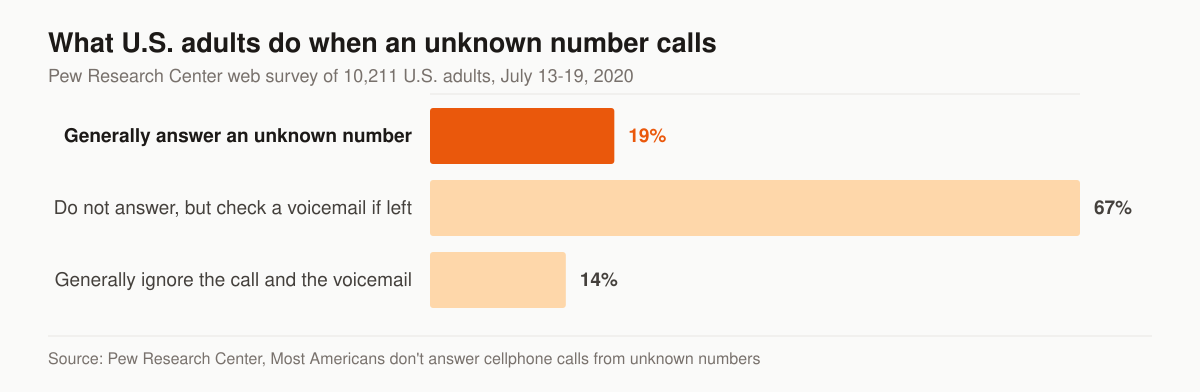
How U.S. adults handle a call from an unknown number. Source: Pew Research Center, Most Americans don’t answer cellphone calls from unknown numbers, a survey of 10,211 U.S. adults, 13 to 19 July 2020.
Pew reports that 19% of U.S. adults generally pick up cellphone calls from unknown numbers, 67% do not answer but check a voicemail if one is left, and 14% generally ignore any voicemail left after not answering. Your setter is an unknown number to a person who filled in a form twenty minutes ago, and a retiree who screens calls is screening yours along with everything else.
So the opening move is a text that names the form, names the agency and offers two times. It converts the caller from a stranger into something the prospect can place, and it gives the two-thirds who screen calls a reason to pick up the follow-up dial. The dial still happens; it just stops being the identification step. The channel-by-channel version of that sequence is in insurance lead follow-up cadence.
The TCPA rules an annuity booking and reminder cadence runs on
Every part of this — the first text, the confirmation, the day-before reminder, the no-show follow-up — is a regulated contact. The governing rule is 47 CFR 64.1200, and each paragraph carries its own scope, so read the opening clause before assuming one applies to you.
Paragraph (a)(2) covers automated outreach to mobile numbers. It bars any person or entity from initiating “any telephone call that includes or introduces an advertisement or constitutes telemarketing, using an automatic telephone dialing system or an artificial or prerecorded voice,” to the lines described in (a)(1)(i) through (iii) — which include “any telephone number assigned to a paging service, cellular telephone service, specialized mobile radio service, or other radio common carrier service” — “other than a call made with the prior express written consent of the called party,” with carve-outs for tax-exempt nonprofit calls and HIPAA “health care” messages that do not describe an annuity booking text. Both halves of the trigger matter: the content has to be telemarketing and the delivery has to be automated or prerecorded.
Paragraph (f)(9) defines the consent. Prior express written consent “means an agreement, in writing, bearing the signature of the person called that clearly authorizes the seller to deliver or cause to be delivered to the person called advertisements or telemarketing messages using an automatic telephone dialing system or an artificial or prerecorded voice, and the telephone number to which the signatory authorizes such advertisements or telemarketing messages to be delivered.” The written agreement must also disclose that “The person is not required to sign the agreement (directly or indirectly), or agree to enter into such an agreement as a condition of purchasing any property, goods, or services” — which is why the checkbox on your seminar registration or rate-guide form cannot be pre-ticked and cannot gate the download.
Revocation is where reminder programs go wrong, because the sequence is automated and the opt-out arrives as a human reply. Paragraph (a)(10) lets a called party revoke consent “by using any reasonable method to clearly express a desire not to receive further calls or text messages from the caller or sender,” treats “stop,” “quit,” “end,” “revoke,” “opt out,” “cancel,” or “unsubscribe” in reply to a text as reasonable per se, and requires that all such requests “must be honored within a reasonable time not to exceed ten business days from receipt of such request.” It also says callers “may not designate an exclusive means to request revocation of consent.” Paragraph (a)(12) permits one confirmation text provided it “merely confirms the text recipient’s revocation request and does not include any marketing or promotional information,” and adds that “If the confirmation text is sent within five minutes of receipt, it will be presumed to fall within the consumer’s prior express consent.”
One distinction matters more on an annuity page than anywhere else, because so much annuity demand comes off seminar registration cards. Paragraph (f)(15) defines “telephone solicitation” and excludes a call or message “To any person with that person’s prior express invitation or permission” or “To any person with whom the caller has an established business relationship.” A signed seminar registration card is a different posture from a purchased list under the do-not-call rules in paragraph (c). It is not the same thing as the prior express written consent that paragraph (f)(9) requires for an automated text, and treating one as the other is the mistake that turns a warm event into an exposure.
This table maps each paragraph of 47 CFR 64.1200 onto the part of an annuity booking cadence it governs.
| Paragraph | What it says, in short | Which touch it governs |
|---|---|---|
| (a)(2) | Automated or prerecorded telemarketing to a wireless number needs prior express written consent | The first outbound text and every automated reminder |
| (f)(9) | Defines that consent as a signed written agreement naming the seller and the number, with a no-purchase-condition disclosure | The opt-in wording on the seminar card, rate guide and web form |
| (a)(10) | Consent may be revoked by any reasonable method; honor within ten business days at most, and no exclusive opt-out channel | Reply handling on every reminder and recycle message |
| (a)(12) | One confirmation text is allowed if it carries no marketing content | The automatic “you are unsubscribed” reply |
| (c)(1) | No telephone solicitation to a residential subscriber before 8 a.m. or after 9 p.m. local time at the called party’s location | Dial windows and scheduled send times across time zones |
| (c)(2) | Registered do-not-call numbers honored indefinitely unless canceled by the consumer or removed by the administrator; the safe harbor needs a registry version obtained no more than 31 days before the call | List hygiene before any outbound dial |
| (d)(3) | Internal do-not-call requests recorded at the time made and honored within ten business days at most | Your own suppression list |
| (f)(15) | “Telephone solicitation” excludes calls made with prior express invitation or permission, or under an established business relationship | Why a signed seminar card sits differently from a bought list |
Read the section yourself rather than relying on a vendor’s summary, and take the plain-English tour of how it bites lead buyers in TCPA compliance for insurance agents buying leads. We are marketers, not your counsel; the cadence is built to these rules and your compliance officer signs off on the wording.
The seminar-to-appointment workflow
Seminars and dinner events generate warm interest, and the follow-up that captures it is usually the part nobody owns. Interest decays from the moment the room empties, so the setting workflow is built to complete the booking before people are back in their cars:
- Book from the room. Offer and schedule the one-on-one review at the event, while intent is highest.
- Confirm within a day. A same-week reminder that restates the personal benefit of the review, not a generic “see you then.”
- Screen the walk-ins. Registrants who did not book get a qualifying call, not a mass email.
- Recycle non-bookers into nurture so a “not yet” becomes an appointment next quarter instead of a dead contact.
Two mechanical details decide whether that workflow survives contact with a real room. The registration card has to carry the consent language paragraph (f)(9) describes if you intend to text anyone afterwards, because collecting a mobile number is not the same as being allowed to automate a message to it. And the Appendix A producer disclosure described earlier is easier to hand over on the night, in a room where you are already handing out paper, than to chase by email a week later.
The seminar channel also feeds itself. Retirement Prospects, a lead vendor whose annuity lead page is one of the top results for this topic, reports of its own leads that “In our experiments, we find that 1/3 of these people attended a seminar when we kept inviting them over a few months.” That is their observation of their own list rather than a general finding, but the structural point holds: a non-booker is a seminar registrant in waiting, which is why the recycle step is worth more than it looks.
Reducing no-shows on high-ticket calls
A booked appointment is a promise, not a sale. On annuity cases the show rate is driven by two structural things before anything else: how warm the booking was, and how long the gap is before the call. A slot booked by a stranger nine days out is a different object from a slot booked inside 48 hours by someone the prospect just spoke to.
The cadence that protects it — a confirmation at booking, a day-before reminder on the prospect’s preferred channel, and a brief same-day human touch — turns fragile slots into kept ones. Four rules we build into the sequence:
- Shorten the gap before adding reminders. Reminders manage decay; they do not reverse it.
- Restate the job of the call. “Confirming Thursday at 2” is a diary entry. “Thursday at 2, thirty minutes, we will look at what the rollover could produce as income and what it would cost to move it” is a reason to show up.
- Confirm on the channel they replied to. Switching channel for the sender’s convenience is how reminders get missed.
- Recycle rather than write off. A no-show has already told you the topic is relevant. It goes back into the sequence with a fresh offer of times.
The follow-up engine behind that cadence is our insurance email and SMS automation service, which runs the reminders and the long nurture sequence so no contact goes cold.
It is worth knowing that not everyone in this market believes the setting layer is the right answer. Retirement Prospects, which sells annuity leads and deliberately does not set appointments, answers the question on its own page: “We have found that appointment-setting systems have a high rate of no-shows.” It goes on to recommend that agents “do not delegate first contact with these exclusive annuity leads to an assistant”. That position deserves a straight answer rather than a dismissal, and it is right about cold third-party bookings and wrong as a general rule: a booking made by someone the prospect has never heard of, for a date a week out, with one email reminder, does no-show. The variables that fix it are gap length, who made the booking, and whether the reminder restates the value of the call. If your setter cannot move those three, the criticism lands.
What a preset annuity appointment costs on the open market
Before you decide whether to build a setting layer, price the alternative. The vendors in this market publish their rates, so this is checkable rather than a matter of rumor.
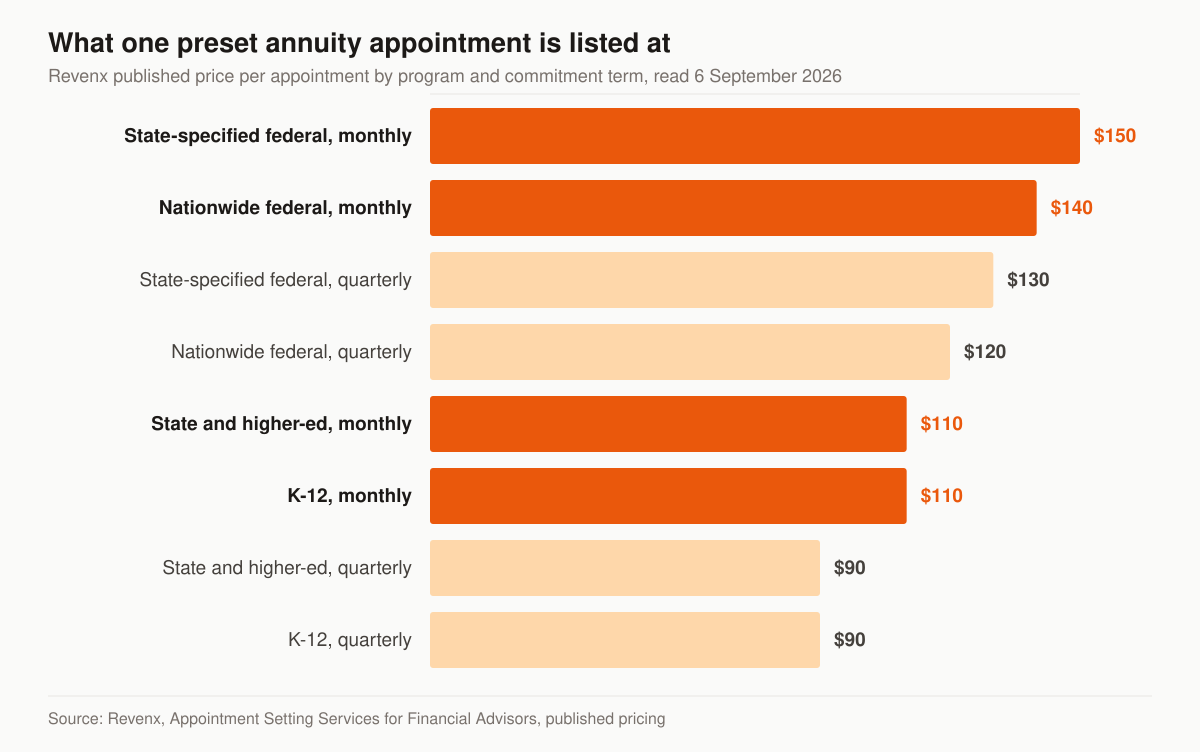
Published price per preset appointment by program and commitment term. Source: Revenx, Appointment Setting Services for Financial Advisors, pricing read 6 September 2026.
This table sets three vendors’ published offers side by side, from a raw lead to a preset appointment, with the replacement terms each one attaches as its own page states them.
| Vendor and page | What you actually buy | Published price | Replacement terms as published |
|---|---|---|---|
| Retirement Prospects | Exclusive annuity lead — contact details only, no appointment | $32 per lead, plus a one-time $299 set-up and exclusivity fee | Replaces a lead without a valid name, phone number or physical address |
| Pinnacle Financial Services | Pre-set life and annuity appointment with a pension-eligible public employee | $64 per appointment | “Only pay for appointments that are kept. You are not charged for canceled or rescheduled appointments.” |
| Revenx | Preset appointment, state and higher-education program | $110 per appointment monthly, $90 quarterly | General policy: replaces all prospect cancellations, plus “up to 30% of your total appointments that you mark as a no show, providing you’ve done at least 48 hours of follow up” |
| Revenx | Preset appointment, K-12 program | $110 per appointment monthly, $90 quarterly | The K-12 plan cards publish a better term than the general policy: “Up to 50% of Your Order is Replaced Off They No Show” |
| Revenx | Preset appointment, nationwide federal program | $140 per appointment monthly, $120 quarterly | General policy as above: cancellations, plus no-shows up to the 30% cap |
| Revenx | Preset appointment, state-specified federal program | $150 per appointment monthly, $130 quarterly, with a $2,000 onboarding fee waived on quarterly and annual terms | General policy as above: cancellations, plus no-shows up to the 30% cap |
All three pages were read on 6 September 2026; prices change, so check them before quoting anything back to yourself.
Read the replacement column before the price column, and read it on the vendor’s own page rather than from a summary. One page can carry more than one answer: Revenx’s FAQ states the general policy as cancellations plus a 30% no-show cap, its K-12 plan cards publish “Up to 50% of Your Order is Replaced Off They No Show”, and its ROI answer describes what the company owns as “replacing cancellations plus up to 10 no shows a month on our standard plan”. Which of those governs your contract is a question for the contract, not the marketing page — but it is the question that decides what you pay.
Three further things are worth reading out of that table rather than the headline numbers. The replacement terms are the real price, because an appointment that never happens at $64 with a keep-only guarantee costs nothing, while the same outcome at $150 under a 30% cap costs $150 once the cap is used up. Commitment length moves the unit price on the same product — $150 to $130, $140 to $120, $110 to $90 — so the advertised figure and the figure you pay are two different numbers. And the gap between a $32 lead and a $110 appointment is the price the market puts on the dialing, screening and reminding — which is exactly the work a setting layer either buys or builds.
Revenx is also careful about what it will not claim, and the sentence is worth borrowing as a filter: “We do not and cannot promise or guarantee any specific ROI, production level, or income.” Any vendor in this market that does promise one is telling you something about itself.
Who is actually on a bought public-employee appointment
Read the results for this search closely and a pattern appears that nobody names out loud. Both of the preset-appointment vendors at the top of it sell appointments with public employees. Pinnacle describes its pre-sets as appointments “with teachers (k-12 and state colleges/universities), hospital employees, police, firemen, and veterans. All are state or federal pension eligible and/or have individual retirement accounts.” Revenx sells three programs — state government and higher education employees, federal government employees, and K-12 employees.
That is a rational target. These are people with a pension decision, a defined contribution balance and a retirement date they can name. But it changes what you should ask before you buy, because the money those prospects hold usually sits inside an employer plan, and the model regulation has something specific to say about employer plans.
Section 4 of #275 lists what the regulation does not reach: “Unless otherwise specifically included, this regulation shall not apply to transactions involving: A. Direct response solicitations where there is no recommendation based on information collected from the consumer pursuant to this regulation; B. Contracts used to fund: (1) An employee pension or welfare benefit plan that is covered by the Employee Retirement and Income Security Act (ERISA); (2) A plan described by Sections 401(a), 401(k), 403(b), 408(k) or 408(p) of the Internal Revenue Code (IRC), as amended, if established or maintained by an employer; (3) A government or church plan defined in section 414 of the IRC, a government or church welfare benefit plan, or a deferred compensation plan of a state or local government or tax-exempt organization under Section 457 of the IRC; or C. Settlements of or assumptions of liabilities associated with personal injury litigation or any dispute or claim resolution process; or D. Formal prepaid funeral contracts.” Section 5.A meanwhile defines the annuity the regulation covers as one “that is an insurance product under state law that is individually solicited, whether the product is classified as an individual or group annuity.”
Whether a given public-employee case falls inside or outside your state’s adopted version is a question for your compliance officer, not for a marketing page — and the answer differs depending on whether you are writing a contract inside a 403(b) or 457 arrangement or recommending a rollover into an individually solicited annuity. The point for an appointment program is narrower and practical: the scope question should be settled before you buy the calendar, because it changes the script, the documentation and which of your carrier appointments the case can even be written through.
This table lists what to establish about a preset-appointment program before the first invoice, and what each answer changes.
| Question to ask the vendor | Why it decides anything |
|---|---|
| Who exactly is the prospect, and what plan holds their money? | Determines whether the case is a rollover, an in-plan contract, or neither |
| What did the prospect agree to when they booked? | Sets the opening of the call and the honesty of the frame |
| Is the appointment exclusive to me? | Two producers on one prospect changes what the slot is worth |
| What is the replacement policy on a no-show, and what does it require of me? | This is the real unit price, not the sticker |
| How long is the gap between opt-in and the booked slot? | A lever on show rate that you hand to someone else |
| What consent was captured, and can you produce the record? | Your reminder cadence inherits their opt-in |
| Is there an onboarding fee, and is it waived on longer terms? | Changes cost per appointment materially at low volume |
Working out your own cost per kept appointment
Booked appointments are a vanity number. The figure that decides whether any of this pays is cost per kept appointment, set against what a written case is worth to you. Neither half is a number anyone else can supply.
Pinnacle publishes a commission range on its own page, which is a reasonable starting input if you have nothing better: it tells agents they “can expect upwards of 100% of the first years premium as a commission on life insurance, and between 6% and 8% commission on annuities (on average).” That is one FMO’s statement about its own contracts on 6 September 2026, not a market rate, and your actual schedule comes from your IMO and each carrier. Use yours.
This table is the arithmetic, with the inputs left blank because they are yours. Fill it in before you buy anything.
| Input | Where the number comes from | Yours |
|---|---|---|
| Price per booked appointment | The vendor’s published rate, or your program cost divided by bookings | |
| Show rate | Your own last 90 days, not the vendor’s brochure | |
| Cost per kept appointment | Price per booked appointment divided by show rate | |
| Close rate on kept appointments | Your own history for this product and this prospect type | |
| Cost per written case | Cost per kept appointment divided by close rate | |
| Average premium per case | Your own book | |
| Commission rate | Your carrier and IMO schedule | |
| Commission per case | Average premium multiplied by commission rate | |
| Margin per case | Commission per case minus cost per written case |
Two notes on using it honestly. A show rate you have not measured is not an input, it is a wish; run the program for a quarter before you trust the bottom row. And the row worth attacking first is show rate rather than price. Work it through on the $150 program: at a 50% show rate the kept appointment costs $300, and negotiating the price to $130 brings that to $260, while lifting the show rate to 75% brings it to $200 at the original price. That is the argument for owning the reminder cadence rather than renting it.
Buying versus building your annuity appointments
Building a setting system on top of your own generation produces exclusive, screened appointments and lowers cost per sale over time. If you need booked time faster than that ramps, you can buy leads direct from getinsureleads, our sister brand — we build marketing systems here and do not sell leads or appointments as a product. Serious producers run both: purchased volume for this month, an owned setting engine for the long game.
The difference between the two is not really price, it is ownership of the three variables that decide show rate. On a bought appointment, someone else controls who made the booking, how long the gap is, and what the reminder says. You inherit the outcome and argue about replacements. On an owned system those three are settings you change on a Tuesday.
Wherever the appointments come from, they should land on a funnel-built annuity website, be fed by demand from annuity Facebook ads and organic search, and sit inside your broader insurance lead generation system. The CRM question underneath all of it — where the slot, the reminder and the outcome are written — is worked through in our read on CRM options for insurance agents, and the wider channel strategy in how to get annuity clients with marketing.
What we charge, and which tier carries appointment setting
Our rates are published rather than quoted, and they do not move by niche. Managed programs run $2,500 per month at Foundation, $3,500 at Growth and $5,500 at Full-Funnel, with a one-time website build of $2,500–$8,000. Ad spend is billed at cost, straight to Google or Meta, and never marked up. Programs run month to month.
This table shows what each published tier carries for an annuity appointment program.
| Tier | Monthly | What it carries for annuity appointment setting |
|---|---|---|
| Foundation | $2,500 | Optimized website and landing pages, local SEO and Google Business Profile, on-page SEO, monthly reporting |
| Growth | $3,500 | Everything in Foundation, plus the ongoing SEO and content engine, AI-search visibility, and reputation and reviews |
| Full-Funnel | $5,500 | Everything in Growth, plus managed paid ads, landing-page CRO, marketing automation and CRM, full-funnel reporting |
Read that against what a booking cadence needs to run. The reminder automation, the consent record, the recycle sequence and the write-back that produces a cost-per-kept-appointment number all live in marketing automation and CRM, which is a Full-Funnel line. That is the straight answer rather than the comfortable one. Foundation is the right start when there is no page worth sending an annuity click to; Growth is where the organic question corpus gets built alongside. Full details, including what the monthly fee excludes, are on the pricing page.
Set against the market table above, the comparison is not tier price versus appointment price — it is a fixed monthly cost that produces an owned, compounding asset against a variable per-appointment cost that stops the month you stop paying. Running both for a period is the honest recommendation rather than the tidy one.
What to measure, and when each number becomes readable
An annuity program cannot be judged on its close rate in month one, because the cases booked in month one are still in suitability review or underwriting. Agreeing up front which number is legible when is what stops a working program being canceled at week six.
This table sets the reporting sequence, ordered by the point at which each figure starts telling the truth.
| Metric | What it tells you | When it becomes readable |
|---|---|---|
| Opt-ins by source | Whether the offer and the channel are producing interest at all | Week one |
| Time to first touch | Whether the speed-to-lead rule is actually holding | Week one |
| Opt-in to booked rate | Whether the qualification script is too loose or too tight | Week two to four |
| Show rate | Whether the reminder cadence and the booking gap are working | Month one to two |
| Cost per kept appointment | The real unit price of the program | Month two onward |
| Suitable-appointment rate | Whether the screen is booking the right prospect, not just a willing one | Month two onward |
| Application rate on kept appointments | Whether the frame set at booking survives the review call | Month three onward |
| Issued cases and placed premium | The number that pays you | Month four onward |
Two build requirements make that sequence possible, and both are marketing work rather than sales work. Source has to be stamped on the contact at capture, so an appointment traces back to the ad, page or seminar that produced it. And the case outcome has to be written back against that source once the carrier issues, or every review reverts to arguing about booking counts.
Where annuity appointment programs stall
Four failure modes account for the programs we are asked to rescue, and none of them is a lead-quality problem.
The offer is a product, not a decision. An ad that says “learn about annuities” books people who want to learn about annuities. An ad built on the decision the prospect already faces — what happens to the 401(k) the year they retire, or what to do with a CD that just matured — books people with money in motion.
The calendar is fiction. Slots are opened that the producer never intended to defend, the setter fills them, half get moved, show rate collapses and the lead source takes the blame. Capacity is an input to the campaign, not an output of it.
The consent record does not exist. The reminder sequence runs on an opt-in nobody can produce. That is fine until it is not, and it is trivially fixable at build time and expensive to retrofit.
The destination cannot convert. Paid demand arrives on a page that explains fixed indexed annuities for eight scroll-lengths and offers a contact form at the bottom. Booking has to be the primary action, above the fold, on a page built for it — which is why the annuity website and funnel belongs in the appointment budget rather than in a separate project. If you want that read on your own funnel before committing to anything, get in touch.
Start by finding the leak
Before you add appointment setting, find out where your current pipeline actually leaks — inquiries never contacted, appointments booked but not kept, or kept but not suitable. Each has a different fix, and only one of them is solved by buying more appointments. A free marketing audit maps your annuity funnel step by step and shows the two or three changes that add the most kept, qualified appointments for the least effort.
The services behind it