Who we serve
Life Insurance Agent Marketing for the Senior Market
Life insurance agent marketing is the system that turns ad spend, content, and referrals into booked appointments at a known cost per sale. For senior-market agents, it works best when you niche down, run consistent paid lead flow, and build a referral loop instead of chasing one-off tactics.
Free · 15-minute teardown · no pitch deck
- We run our own final-expense book
- No pitch deck — we screen-share real numbers
- TCPA-aware · CMS/AEP-compliant · Meta Special Ad Category
- Core Web Vitals < 2.0s LCP
Most life insurance agent marketing fails for one reason: it is a pile of disconnected tactics with no number attached. A boosted post here, a bought lead list there, a referral that showed up by luck. You cannot scale what you cannot measure.
This page lays out how we run senior-market marketing as a system, with a cost per lead and a close rate you can defend. For reference, we run our own senior-market lead operation, so this comes from live campaigns, not theory.
What is life insurance agent marketing?
Life insurance agent marketing is the set of activities that put a licensed agent in front of someone who needs coverage and then converts that attention into a booked appointment at a measurable cost: paid acquisition, a website that answers buying questions, search and AI-search visibility, a compliant call and text cadence, and a referral loop that runs on a schedule rather than on luck.
Two things sit outside it. It is not the sale — needs analysis, underwriting and suitability stay with the licensed agent, and that side of the machine is covered in our guide to the needs-based process for selling life insurance. It is not product selection either. Nothing here tells you which carrier or which chassis to place; it tells you how the introduction gets made and what the introduction costs.
The distinction matters because the two get billed together. An agent who says marketing is not working sometimes means closing is not working, and an agent who says the leads are bad sometimes means nobody called them inside the hour. Separating the funnel from the sale is the first thing we do on an audit, because the two fail differently and they get fixed differently.
Start with the math, not the tactic
Before you pick a channel, work backward from a sale. Take your average commission, multiply by the close rate you can realistically hit, and that tells you what a lead is worth. Then you can judge any channel honestly.
These are the four numbers a channel has to be able to report before it earns a line in your budget.
| Lever | What it controls | Typical senior-market range |
|---|---|---|
| Cost per lead | Channel efficiency | Varies widely by channel and geography |
| Close rate | Follow-up + targeting | roughly one-in-six on warm leads |
| Average commission | Product + carrier mix | varies by line |
| True cost per sale | The number we manage to | cost per lead ÷ close rate |
If a channel cannot show you those four numbers, it is not marketing. It is hope. The month-by-month version of this arithmetic, run against commission rather than clicks, is in our insurance agency marketing budget guide.
Who is actually in the market for life insurance right now
The market question comes before the channel question, and for life insurance it has a published answer. The 2026 Insurance Barometer Study, conducted annually by LIMRA and Life Happens, surveyed more than 5,200 US adults ages 18 to 75 who share responsibility for household financial decisions. Ownership stands at 52% of American adults. On the other side of that line, 48% do not own life insurance, and 38% — roughly 92 million adults — say they need coverage or need more than they have. Nearly one in three consumers (29%) does not own life insurance but says they need it, and a further 22 million own coverage they believe is insufficient.
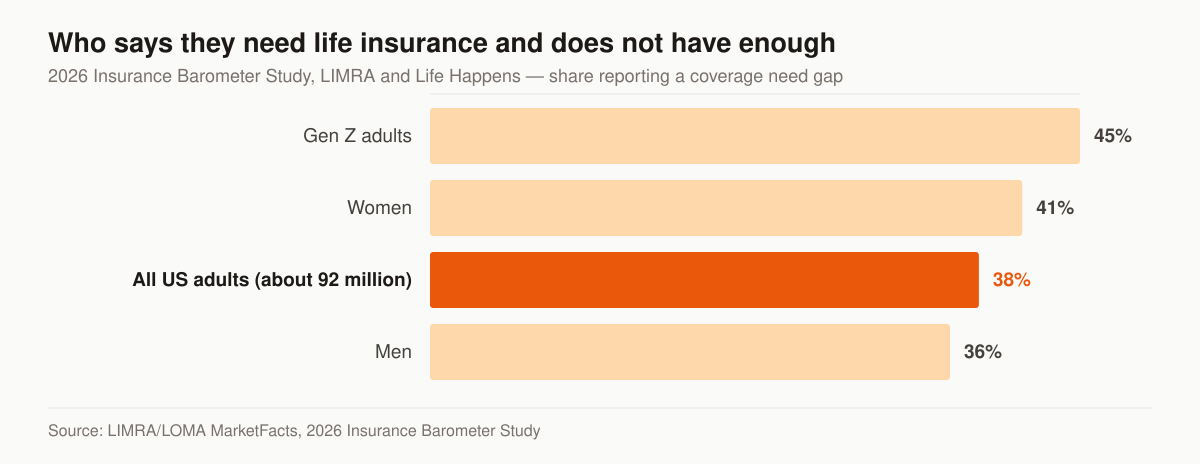
Source: LIMRA and LOMA, MarketFacts, “92 Million Reasons to Talk About Life Insurance”, September 2026, reporting the 2026 Insurance Barometer Study.
The gap is not spread evenly, which is what turns it into a targeting input rather than trivia. Women report a need for life insurance at 41% against 36% of men. Among Gen Z adults, 44% already own coverage and 45% report a need gap — a useful correction if you have written that generation off.
The reasons people give are documented too, and they are not objections to the product. Among consumers with a coverage gap, one third say they are not sure how much life insurance they need or what type of policy to buy, and another third say they simply have not gotten around to it. Two of the three stated barriers are confusion and inertia. Both respond to a clearer offer and a shorter path, not a louder pitch.
For message hierarchy, the same study reports why owners bought: 57% own life insurance to help pay final expenses, 39% to leave an inheritance or transfer wealth, and 27% to replace lost income if a wage earner dies. If you sell in the senior market, the leading stated reason for owning coverage is the job your product was built for — which is the demand case behind our final expense marketing playbook and the wider senior market insurance marketing practice.
The cost objection is the creative brief
LIMRA’s MarketFacts write-up of the 2026 study puts the top barrier plainly: “The most cited reason for going without coverage is the belief that it costs too much.” What makes that useful to a marketer is that the belief is measurable and wrong. The study finds that healthy adults under age 30 overestimate the cost of a typical term life insurance policy by 5 to 6 times.
The 2025 Barometer measured the same error on a specific policy. Asked to guess the premium of a $250,000 20-year level term policy for themselves, healthy adults in the 18–30-year-old range overestimated the median cost about 10–12 times more than its true cost (LIMRA and Life Happens, June 25, 2025). Bryan Hodgens, senior vice president, head of LIMRA Research, described what that does to a sale: “This remains one of the biggest challenges for our industry to overcome — convincing consumers that life insurance is far more affordable than they realize.”
The marketing conclusion is unglamorous. A page or an ad that leads with a real face amount next to a real premium answers the stated objection directly, where a page that leads with responsibility and family photographs does not. Term is where this bites hardest, because term is the product the misperception is measured against — our term life insurance marketing page covers how we structure that offer. Simplified and no-exam products carry the same opportunity and an extra disclosure duty, covered in marketing no-exam life to younger buyers.
One caution before you publish a premium: state advertising rules require the source of any statistic in an advertisement to be identified in the advertisement itself, and quoted rates carry their own disclosure conditions. The compliance section below covers both.
Where life insurance buyers do their research now
The channel answer has moved, and the study measures the move rather than guessing at it. Among Americans who use social media, 66% use YouTube to learn about financial products and services and 62% use Facebook for financial education. Nearly half — 46% — say it is important for financial professionals to connect with them on social media. And 37% of Americans describe themselves as only somewhat knowledgeable, or not knowledgeable at all, about life insurance.
Artificial intelligence sits in the same research layer. The 2025 Barometer found that nearly six in 10 young adults say they would use an AI tool to research a life insurance policy. The purchase, though, still wants a person: 42% say they would prefer to buy from a financial professional in person, while three in 10 would prefer to purchase directly from a company over the phone, through mail, or via an online video service.
Read those two findings together and the assignment is clear enough. Research happens on video, in social feeds and inside AI answers; the transaction still routes to a licensed human. So the job is to be the credible source in the research layer and the obvious next step at the end of it. That is what our SEO for life insurance agents page and our AI search visibility service are built to do, and the mechanics of getting quoted by an answer engine are in how to get your insurance agency recommended by ChatGPT.
Niche down before you scale up
Senior-market life is not one audience. A 58-year-old buying term life to cover a mortgage is nothing like a 74-year-old buying whole-life final expense to cover a funeral. Generic messaging speaks to neither.
Picking one niche tightens everything:
- Ad targeting gets sharper, even under Meta’s Special Ad Category limits that remove age and ZIP-level selection for insurance offers.
- Your website and scripts can answer one buyer’s exact objection instead of hedging.
- Cost per lead drops because relevance lifts response.
Final expense is where we usually start a senior-market agent, because the buyer is motivated and the sale is simple. See our final expense marketing playbook for the channel mix we run there, and our broader insurance lead generation service for how we build owned lead flow.
Meta moved insurance into a Special Ad Category, and senior targeting went with it
This is the platform change that reshaped senior-market Facebook accounts, and it is worth stating precisely, because the workaround is not obvious from inside Ads Manager.
In October 2024 Meta introduced a Special Ad Category called “Financial products and services”, replacing the previous Credit ads category. Meta’s own documentation names what falls inside it: “Examples of financial products and services ads include those promoting insurance, bank accounts, investment services and payment services” (Meta Business Help Center, Special Ad Categories have expanded). From January 21, 2025 the designation became mandatory for advertisers based in the United States or reaching US audiences with financial products and services campaigns, and Meta warns that “Ads may be rejected if the advertiser does not choose an appropriate Special Ad Category.”
The category is not a label you tick and forget. It withdraws tools. In Meta’s words: “Certain audience options are limited or unavailable for these ads for advertisers based in or reaching the US and advertisers reaching Canada and certain countries in Europe: age, gender, ZIP code or postal code, exclusion targeting, lookalike audiences and saved audiences.” Meta adds that some interests become unavailable and that “Audiences based on city or pin drop locations will include an expanded radius” (Meta Business Help Center, How to choose a Special Ad Category).
For a final-expense or senior-life advertiser, that list was the targeting strategy. Age is gone. ZIP is gone. The lookalike built from your own buyer list is gone.
This table maps each lever the category withdraws to the thing that has to do that job instead.
| Targeting lever | Status under financial products and services | What carries the job instead |
|---|---|---|
| Age | Limited or unavailable | Creative that shows the buyer’s age band and copy that names the life stage |
| Gender | Limited or unavailable | Self-selection in the message, not exclusion in the audience |
| ZIP or postal code | Limited or unavailable | City or pin-drop targeting, with the expanded radius Meta applies |
| Exclusion targeting | Limited or unavailable | Suppression after the click, in your CRM and site logic |
| Lookalike audiences | Limited or unavailable | Broad delivery plus a clean conversion signal, with the offer filtering |
| Saved audiences | Limited or unavailable | Audiences rebuilt inside each campaign |
The practical consequence is that the offer became the targeting. An ad whose first line names the buyer and the job — burial costs, a mortgage payoff, a final expense benefit for a spouse — qualifies the audience that the settings no longer can. We build campaigns under that constraint through insurance Facebook ads management; the creative-level mechanics are in our guide to Facebook ads for insurance agents.
Build predictable lead flow
You need volume you can turn on. The three reliable engines for senior-market life:
- Paid social — the workhorse for final expense and life. High volume, lower intent, demands fast follow-up.
- Paid search — fewer leads, higher intent, more expensive clicks. Better for term and Medicare-adjacent life.
- Content and AI search — slower to build, cheapest over time, and increasingly how buyers find agents through tools like ChatGPT. Our SEO for life insurance agents page covers how we build this compounding channel.
All three engines convert on your website, so the quote paths there decide what the traffic is worth — see how we structure life insurance agent websites to book appointments.
All paid lead flow lives under TCPA. The FCC’s one-to-one consent rule was vacated in January 2025, but TCPA itself still governs how you call and text. Treat compliant consent as a trust signal, not a hurdle. For the specifics on senior life leads, our life insurance leads guide breaks down sourcing and quality. A fourth engine still turns up in most life agents’ pipelines and belongs in the same compliance conversation: telemarketed life insurance leads, where Do Not Call scrubbing and a documented consent or established business relationship decide whether the list is workable at all.
The TCPA rules that decide your dial plan
Every dial and text to a life insurance lead runs under 47 CFR 64.1200. The paragraphs that actually shape an agent’s day are short enough to read, and reading them beats absorbing them second-hand.
Consent for autodialed and prerecorded marketing. Paragraph (a)(2) prohibits initiating “any telephone call that includes or introduces an advertisement or constitutes telemarketing, using an automatic telephone dialing system or an artificial or prerecorded voice” to the lines in (a)(1) — which include “any telephone number assigned to a paging service, cellular telephone service, specialized mobile radio service, or other radio common carrier service, or any service for which the called party is charged for the call” — “other than a call made with the prior express written consent of the called party”. The paragraph also carries exceptions for tax-exempt nonprofit callers and for certain health care messages, neither of which covers a commercial life offer. Two limits are built into that sentence: it governs autodialed or prerecorded calls, and it governs calls that advertise or constitute telemarketing. How a manually dialed call to a lead who asked to be called is treated is a question for your counsel, not for a marketing page.
What prior express written consent has to contain. Paragraph (f)(9) defines it as “an agreement, in writing, bearing the signature of the person called that clearly authorizes the seller to deliver or cause to be delivered to the person called advertisements or telemarketing messages using an automatic telephone dialing system or an artificial or prerecorded voice, and the telephone number to which the signatory authorizes such advertisements or telemarketing messages to be delivered.” The agreement must carry a clear and conspicuous disclosure that signing authorizes those calls and that “The person is not required to sign the agreement (directly or indirectly), or agree to enter into such an agreement as a condition of purchasing any property, goods, or services.” Electronic and digital signatures count where they are valid under applicable federal or state contract law.
Hours and the national registry. No telephone solicitation to a residential subscriber “before the hour of 8 a.m. or after 9 p.m. (local time at the called party’s location)” under (c)(1), and none to a number on the national do-not-call registry under (c)(2). The safe harbor in (c)(2) applies only where the caller “can demonstrate that the violation is the result of error”, and then only against a set of routine-practice standards that reads like an operations checklist: written procedures, trained personnel, a recorded list of numbers you may not contact, a process that uses a version of the registry “obtained from the administrator of the registry no more than 31 days prior to the date any call is made”, and a process governing how the registry data itself may be bought or shared.
Your own list. Paragraph (d) requires anyone making telemarketing calls to a residential subscriber to maintain an internal do-not-call list, backed by a written policy “available upon demand” and by trained personnel.
Revocation, and the ten-day clock. Under (a)(10) a called party may revoke consent “by using any reasonable method to clearly express a desire not to receive further calls or text messages from the caller or sender.” Replying to a text with “stop,” “quit,” “end,” “revoke,” “opt out,” “cancel,” or “unsubscribe” is a reasonable means per se. All revocation requests “made in any reasonable manner must be honored within a reasonable time not to exceed ten business days from receipt of such request”, and callers “may not designate an exclusive means to request revocation of consent.”
The established business relationship, and its clock. A “telephone solicitation” excludes a call “To any person with whom the caller has an established business relationship” under (f)(15). Paragraph (f)(5) times that relationship: it runs from “the subscriber’s purchase or transaction with the entity within the eighteen (18) months immediately preceding the date of the telephone call or on the basis of the subscriber’s inquiry or application regarding products or services offered by the entity within the three months immediately preceding the date of the call, which relationship has not been previously terminated by either party.” Eighteen months from a sale, three months from an inquiry — and a seller-specific do-not-call request ends it even if the client keeps doing business with you.
Where the one-to-one rule went. On January 24, 2025 the Eleventh Circuit ruled for the Insurance Marketing Coalition: “Accordingly, we grant IMC’s petition for review, vacate Part III.D of the 2023 Order, and remand for further proceedings” (Insurance Marketing Coalition Ltd. v. FCC, No. 24-10277). Read the scope before you relax: the court described the vacated provision as “another sweeping rule affecting only telemarketing and advertising robocalls and robotexts”. Everything quoted above survived it. Our guide to TCPA compliance when buying insurance leads covers what that means for a vendor’s consent trail.
State advertising rules govern the words on your page
Federal rules govern how you make contact. State insurance advertising rules govern what the page, the reel script and the mailer are allowed to say — and their definition of an advertisement is wide enough to catch all three.
Georgia’s regulation on the advertising of life insurance and annuity contracts (Ga. Comp. R. & Regs. Subject 120-2-11) works as a specimen because it is public, specific, and written to cover life policies by name. Your own state’s rule is the one that binds you, and you have to read it rather than assume it matches. We provide marketing services, not legal advice; your carriers and your compliance counsel sign off on creative before it runs.
- Savings and investment language is conditioned, not simply banned. The rule bars the terms “investment,” “investment plan,” “founder’s plan,” “charter plan,” “expansion plan,” “profit,” “profits,” “profit sharing,” “deposit,” “interest plan,” “savings,” “savings plan,” or other similar terms “in connection with a policy in a context or under such circumstances or conditions as to have the capacity or tendency to mislead a purchaser or prospective purchaser of such policy or a policyholder to believe that he will receive, or that it is possible that he will receive, something other than a policy or some benefit not available to other persons of the same class and equal expectation of life, when such is not the fact” (120-2-11-.05(2)). The condition is the operative part.
- “No medical exam” needs a companion line. Where issuance is not guaranteed, terms such as “Non-Medical,” “No Medical Examination Required,” or similar “shall be accompanied by a further disclosure of equal prominence and in juxtaposition thereto to the effect that issuance of the policy may depend upon the answers to the health questions contained in the application” (120-2-11-.06(3)).
- Graded and modified plans must show the limitation. “An advertisement for a policy containing graded or modified benefits shall prominently display any limitation of benefits” (120-2-11-.06(7)) — which is a direct constraint on how a two-year graded whole life final expense offer can be written.
- Statistics carry a source line. “No advertisement shall contain statistical information relating to any insurer or any policy unless it accurately reflects recent and relevant facts. The source of any such statistics used in any advertisement shall be identified therein” (120-2-11-.06(12)). It is the standard this page holds itself to.
- Your bio is regulated too. Terms such as financial planner, investment advisor, financial consultant or financial counseling may not be used “in such a way as to imply that the person who is engaged in the business of insurance is generally engaged in an advisory business in which compensation is unrelated to sales unless such is actually the case” (120-2-11-.10(1)(o)).
- Name the carriers you represent. “An advertisement for the sale of life insurance by any agent shall clearly inform the prospective purchaser of the full name of all insurance companies which said agent is authorized to represent” (120-2-11-.07(4)).
- Nothing may look governmental. No advertisement may use words, symbols or materials so similar to those “used by a governmental program or agency” that they “tend to mislead prospective insureds into believing that the solicitation is in some manner connected with such governmental program or agency” (120-2-11-.07(2)) — a live risk in senior-market creative that borrows the look of a benefits notice.
Georgia’s rule also puts the insurer on the hook for your creative: “Every insurer shall establish and at all times maintain a system of control over the content, form and method of dissemination of all advertisements of its policies. All such advertisements, regardless of by whom written, created, designed, or presented, shall be the responsibility of the insurer” (120-2-11-.04(2)). That single clause is why carrier advertising review exists and why an agency that ships creative without routing it is handing you a problem. The wider compliance picture for agents sits in insurance marketing compliance for agents.
Make referrals a system, not an accident
Referrals are the cheapest leads you will ever get, yet the referral loop is the part of the machine we most often find with no owner. Build a deliberate loop: ask at the point of issue, when trust is highest; follow up at the policy anniversary; and give existing clients a simple reason to introduce you, like a beneficiary review.
A working referral system carries a meaningful share of new business once it matures, and referred prospects arrive pre-trusted, so it lowers your blended cost per sale even when paid channels get pricier. It also fits the research findings above: a referred prospect arrives with the confusion and inertia barriers already partly solved, because someone they trust has vouched for the process.
How we measure a life insurance marketing program
Reporting is where a program either earns the next month or does not. Impressions and clicks are diagnostics; cost per sale is the verdict. Three habits keep the number honest.
Attribute at the booking, not at the click. A life sale can take weeks between first touch and application, and the last click before a phone call rarely tells you what created the interest. Tag the lead source at capture, carry it into the CRM, and report on issued policies by source rather than by session.
Separate speed from quality. A lead that goes cold because nobody dialed it in the first hour is a follow-up failure, not a channel failure, and the fix is a cadence rather than a new vendor. Our insurance lead follow-up cadence sets out the dial and text schedule we build against.
Watch the conversion step you own. Every channel above lands on your site, so a quote path that leaks turns good traffic into a bad cost per sale. That is a page problem with a page fix, covered on our life insurance agent website page.
What life insurance agent marketing costs
Our rates are published, so you can put a real number in a budget before you speak to anyone.
| Program | Monthly | Built for | What it covers |
|---|---|---|---|
| Foundation | $2,500/mo | Solo agents getting online right | Optimized website and landing pages, local SEO and Google Business Profile, on-page SEO, monthly reporting |
| Growth | $3,500/mo | Agents and small agencies scaling | Everything in Foundation, plus an ongoing SEO and content engine, AI-search visibility, reputation and reviews |
| Full-Funnel | $5,500/mo | Agencies serious about volume | Everything in Growth, plus managed Google and Meta ads, landing-page CRO, marketing automation and CRM, full-funnel reporting |
A one-time website build runs $2,500–$8,000 and is where a lot of agents start, before moving onto a monthly program once leads are flowing. Ad spend is not inside the retainer — your media budget is a pass-through billed at cost, straight to Google and Meta, so the platform fee and the management fee never blur together. Programs run month to month with no long lock-in. The full breakdown, including what is excluded, is on our pricing page.
Which tier fits is a question about your weakest link rather than your revenue. No real web presence: Foundation. A decent site nobody finds in Google or AI search: Growth. Visibility handled and ready to buy volume: Full-Funnel.
The first 90 days, in order
Sequence matters more than effort, because each step makes the next one cheaper.
- Fix the destination first. Every channel converts on your site. Paying for traffic into a page that does not answer the cost question wastes the budget that bought it.
- Pick one niche and one offer. One buyer, one product line, one promise you can put in a headline.
- Turn on one fast channel. Paid social or paid search, at a budget you can sustain for a full quarter — not a two-week test that ends before the data means anything.
- Instrument the follow-up. Lead source at capture, a written dial and text cadence, consent recorded and stored.
- Start the compounding channel in parallel. Content and AI-search work begun in month one is what lowers blended cost in month six. Started in month six, it does nothing until month twelve.
- Add the referral loop at first issue. The ask costs nothing and the loop takes months to mature, so it has to begin with your first policy, not your hundredth.
Agents who want a broader menu of tactics to slot into that sequence can work through our life insurance marketing ideas list.
Put the life insurance marketing layers together
Strong life insurance marketing is layered: paid flow for predictability, content for long-term cost, referrals for margin. The mistake is running one and calling it a strategy. And once the calendar fills, conversion becomes the constraint — our guide to the needs-based process for selling life insurance covers that side of the machine.
This table is the sequencing in one view: what each phase is for, and which channel owns it.
| Stage | Primary channel | Goal |
|---|---|---|
| Day 1 volume | Paid social / search | Fill the pipeline |
| Months 2–6 | Content + AI search | Lower blended cost |
| Ongoing | Referral system | Protect margin |
We are a marketing agency, not licensed insurance advisors — you are the licensed party, and compliance stays on your side of the table. What we own is the funnel and the numbers behind it.
If you want a read on your current channels before you spend another dollar, request a free marketing audit and we will show you where your real cost per sale is leaking — the same way we would walk through our own book.
Deeper guides
Go deeper on Life Insurance
SEO for Life Insurance Agents
SEO for life insurance agents that ranks buyer-intent terms and feeds your pipeline: keyword map, technical fixes, content. Free SEO audit.
Term Life Lead Generation and Funnels That Convert
Term life insurance agent marketing built by operators who generate insurance leads. Funnels, paid ads, and SEO tuned to term life. Get a free audit.
Cash Value Life Insurance Marketing, Run as a Funnel
Whole life insurance marketing for agents, built by an operator running its own final-expense lead campaigns. Funnels, content, and ads that close.
Life Insurance Website Design Built Around the Quote Funnel
Life insurance agent websites are judged on booked appointments. Get the quote UX per product line, licensing display, lead magnets, and trust signals.
Exclusive Life Insurance Leads, Priced on Cost Per Sale
Life insurance lead generation for agents: lead types, exclusivity, and the senior-market angle. See costs and close-rate math. Get a free audit.
The services behind it
Guides that go deeper