Simplified Issue Life Insurance Marketing: How SI vs GI Changes Your Funnel
Simplified issue life insurance marketing wins when your ad and landing page match the product's real promise: a few health questions, no medical exam, a decision in days. The common mistake is marketing simplified issue like guaranteed issue. SI buyers are often healthier and want more coverage; GI buyers were usually declined elsewhere.
It is easy to read “no exam life insurance” as one product. It isn’t. Simplified issue and guaranteed issue sit on the same shelf, but they answer different buyer questions, attract different prospects, and convert on different promises. If your ads blur the line, you pay for clicks that never close. This is a marketing problem before it’s a product problem, and it’s the core of simplified issue life insurance marketing done right.
There is a second reason to keep the two straight, and it isn’t a conversion argument. State life insurance advertising rules treat “no medical exam” and “guaranteed acceptance” as two different representations with two different disclosure obligations. Blur them in the creative and you have a compliance exposure sitting on top of a leaky funnel. Both problems have the same fix, which is the useful part.
Simplified issue vs guaranteed issue: the marketing difference
The product mechanics drive everything downstream, so start with the split that matters for your funnel.
| Factor | Simplified Issue (SI) | Guaranteed Issue (GI) |
|---|---|---|
| Health questions | A few knockout questions | None |
| Medical exam | No | No |
| Typical approval | Healthier applicants approved fast | Everyone approved |
| Face amount | Higher (often to $50k+) | Capped low (often ≤ $25k) |
| Death benefit | Usually immediate | Often graded 2–3 years |
| Price per $1k | Lower | Higher |
| Best-fit buyer | Wants speed + value, decent health | Declined elsewhere, wants acceptance |
The takeaway: SI sells speed and value to a healthier buyer; GI sells acceptance to someone who’s been turned down. Two promises. One funnel can’t carry both without leaking conversions.
The mistake that tanks close rate
We treat guaranteed-issue language in a simplified issue ad — “no questions asked, everyone approved, guaranteed acceptance” — as the first thing to fix in an underperforming SI campaign. It’s tempting because it’s frictionless. It also poisons the pipeline.
Here’s the causal chain. The GI-style ad attracts prospects who expect zero underwriting. They hit the SI application, see health questions, and one of two things happens: they bounce (you paid for the click and got nothing), or they apply, get declined or rated, and feel misled. Either way your effective close rate drops and your cost per acquisition climbs. The fix isn’t a better headline — it’s an honest one.
Regulators describe the same failure in different vocabulary. Virginia’s rule on the form and content of life advertising, 14VAC5-41-30 B, says an advertisement “shall not have the capacity or tendency to mislead or deceive,” and then supplies the test: “Whether an advertisement has the capacity or tendency to mislead or deceive shall be determined by the commission from the overall impression that the advertisement may be reasonably expected to create within the segment of the public to which it is directed.” Overall impression, judged against the audience you targeted. A technically accurate body paragraph does not rescue a headline that promised acceptance.
The advertising rule that governs the phrase “no medical exam”
This is the provision that decides your SI creative, and it is short enough to read in full.
Virginia’s general disclosure rule, 14VAC5-41-40 B, provides: “If an advertisement uses the terms ‘nonmedical,’ ‘no medical examination required,’ or similar terms where issue is not guaranteed, these terms shall be accompanied by a further disclosure of equal prominence and juxtaposition to the effect that issuance of the policy may depend upon the answers to the health questions contained in the application.”
Alabama’s 482-1-132-.06(3) is the same construction with a few words moved: “In the event an advertisement uses ‘non-medical,’ ‘no medical examination required,’ or similar terms where issue is not guaranteed, terms shall be accompanied by a further disclosure of equal prominence and in juxtaposition thereto to the effect that issuance of the policy may depend upon the answers to the health questions set forth in the application.”
Four things in that text change how you write the ad, and three of them are limiters rather than prohibitions.
Read the rule clause by clause before you argue with it.
| Clause | What it actually says | What it does to the creative |
|---|---|---|
| “nonmedical,” “no medical examination required,” or similar terms | The trigger is not a fixed word list | “No exam,” “skip the physical,” “no needles” are candidates for the same treatment |
| where issue is not guaranteed | The scope limiter | It bites on simplified issue. A true guaranteed issue policy is outside this clause |
| “shall be accompanied by a further disclosure” | An addition, not a deletion | You may still say no medical exam. You add the health-question fact next to it |
| “of equal prominence and juxtaposition” | Placement and weight are both specified | A footer disclaimer under a hero headline is not juxtaposition |
Read straight, the rule is not an obstacle to simplified issue marketing. It describes the ad that already converts best: no medical exam — a few health questions decide it. The compliant line and the honest line are the same line, which is the argument this whole page is making from a different direction.
Two cautions on scope. First, these are two states’ codified rules, quoted because they are public and checkable; the wording travels between them, but your state’s chapter is the one that governs your ad, so read it before you write. Second, the definition of “advertisement” is broader than the paid-media sense of the word. Virginia’s 14VAC5-41-20 sweeps in “websites and other Internet displays or communications, social media, or other forms of electronic communications” along with “Prepared or extemporaneous sales talks, presentations, and material for use or used by agents.” Your organic Facebook post and your webinar opener sit inside the same rule as your paid creative.
If compliance language is where your campaigns keep stalling, the sitewide view is in our insurance marketing compliance guide for agents.
How to position each product in the ad
Match the promise to the underwriting. Lead with what the prospect can actually verify.
- Simplified issue creative: “No medical exam. A few health questions. Coverage decision in days.” Add a face-amount range and a starting monthly price for a sample age. Specificity lets the prospect self-qualify before the call.
- Guaranteed issue creative: “No health questions. Guaranteed acceptance, ages 50–80.” Name the graded benefit plainly — it builds trust and pre-handles the objection your agents would otherwise eat on the phone.
- Don’t mix the two in one ad set. Run them as separate campaigns with separate landing pages so the message stays clean and your data stays readable.
If you want the full creative system behind this — funnels, qualifying pages, and tracking — that lives in our broader life insurance marketing programs, which is where the SI/GI split gets operationalized. The sentence-level craft is in our notes on insurance copywriting, and the GI side gets its own treatment in how to market guaranteed issue final expense.
Graded benefits and the words a GI ad cannot use
The graded death benefit is the part of guaranteed issue that agents soften in the creative and then explain on the phone. Two provisions say to do it the other way around.
On disclosure, Virginia’s 14VAC5-41-40 D provides: “An advertisement for a life insurance policy containing graded or modified benefits shall prominently display any limitation of benefits,” and adds that “An advertisement of or for a life insurance policy under which the death benefit varies with the length of time the policy has been in force shall accurately describe and clearly call attention to the amount of minimum death benefit under the policy.” Alabama’s 482-1-132-.06(7) carries identical wording. So the graded period is not fine print; the minimum death benefit during it is something the ad has to call attention to.
On vocabulary, the two states diverge, and the difference is instructive. Virginia’s 14VAC5-41-80 B: “An advertisement for a policy marketed by direct response techniques or a life insurance policy containing graded or modified benefits shall not use the phrase ‘affordable,’ ‘inexpensive,’ ‘low cost,’ or any phrase or word of similar import when the policy being advertised is guaranteed issue.” Alabama’s 482-1-132-.06(8) reaches the policy types described in its own subparagraphs (6) and (7) — direct-response marketed policies and graded-or-modified-benefit policies — and says such an advertisement “shall not use the words ‘inexpensive,’ ‘low cost,’ or other phrase or words of similar import when the policies being marketed to persons who are fifty (50) or older are guaranteed issue.”
Line them up and the drafting choices are visible: Virginia adds “affordable” to the banned list and sets no age condition; Alabama leaves “affordable” out and applies the restriction to marketing aimed at people fifty or older. Both conditions run together with “guaranteed issue” — neither provision touches a simplified issue ad. That is another reason to run SI and GI as separate campaigns with separate copy decks: the words that are safe in one are conditioned in the other, and a shared creative library is how the wrong adjective ends up on the wrong policy.
Direct mail sits squarely inside that clause, because a mailer is a direct response technique. Our final expense mailer templates post covers the production math for that format.
Price in the creative, and the rule about quoting one age
A real premium in the ad qualifies the prospect before the click, which is why we put one there. It is also the line most likely to be stale by the time it renders.
Start with what a small policy actually costs. NerdWallet publishes sample simplified issue rates sourced from Choice Mutual, valid as of May 13, 2026. For men at $10,000 of coverage: $31 a month at age 50, $43 at 60, $70 at 70, $134 at 80. For women at the same face amount: $24, $33, $53 and $98.
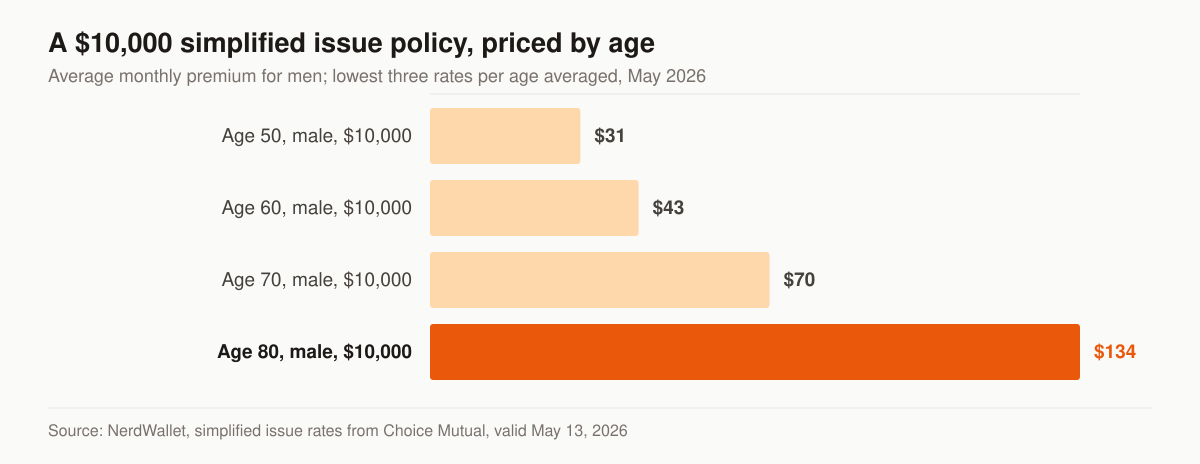
Average monthly premium for a $10,000 simplified issue policy, men, by age. Source: NerdWallet, Simplified Issue Life Insurance: Is It Worth It?, rates from Choice Mutual valid May 13, 2026.
The published rate table is the reason a single “starting at” number cannot carry a whole campaign.
| Coverage | Age 50 | Age 60 | Age 70 | Age 80 |
|---|---|---|---|---|
| $10,000, male | $31 | $43 | $70 | $134 |
| $10,000, female | $24 | $33 | $53 | $98 |
| $20,000, male | $57 | $83 | $136 | $265 |
| $20,000, female | $45 | $62 | $102 | $192 |
Source: NerdWallet, average monthly simplified issue premiums, rates from Choice Mutual valid May 13, 2026.
A 65-year-old who clicked an ad built on the age-50 rate arrives already disappointed, and the agent spends the first two minutes of the call resetting an expectation the ad created. That is a conversion cost before it is anything else. It is also addressed directly in the advertising rules.
Virginia’s 14VAC5-41-80 F: “An advertisement of a policy at a particular issue age, sex, or amount shall not lead prospective policyholders to believe that the cost competitiveness of the policy is similar at other issue ages, sex, or amounts unless that is a fact.” Read against the table above, that provision is describing something the rate card already shows: the male $10,000 premium is $31 at age 50 and $134 at age 80.
The companion provision covers the number itself. Virginia’s 14VAC5-41-40 C: “An advertisement shall not contain figures, dollar amounts, or statistical information unless it accurately reflects recent and relevant facts. The source of any figures, dollar amounts, or statistics used in advertisements shall be identified therein.” Alabama’s 482-1-132-.06(18) is narrower on its face, reaching “statistical information relating to any insurer or policy,” and likewise requires that “The source of any statistics used in advertisement shall be identified.”
Three practical consequences for the ad build:
- Label the profile next to the price. Age, sex, face amount and product. “From $31/month for a 50-year-old man, $10,000 simplified issue whole life” is a defensible line; “from $31/month” alone leans on an implication the rule addresses.
- Put the source in the creative, not the landing page footer. Both rules ask that the source be identified in the advertisement.
- Date the rate and put a refresh on the calendar. “Recent and relevant” is a moving target, and a rate card from two years ago fails it quietly.
If the price lands on a page rather than inside the ad unit, that page is doing the qualifying work — which is what our insurance landing pages service is built around. Our own retainers are published on the pricing page and start at $2,500 a month, for the same reason we tell agents to publish a premium: a visible number filters the conversation before it starts.
How much coverage you can actually promise
Face amount is the other number that ends up in headlines, and the published sources do not agree on the ceiling — which is itself the finding.
NerdWallet reports that “Though some insurers offer as much as $500,000 in coverage, most simplified issue term policies offer coverage ranging from $100,000 to $250,000,” that “Customers older than 55 are frequently limited to $100,000,” and that “Many simplified issue whole life insurance policies have maximum death benefits between $25,000 and $50,000.” Western & Southern’s own simplified issue explainer states that “Simplified issue policies usually offer coverage up to $300,000 or $500,000” and, in its FAQ, that “Most simplified issue policies have maximum death benefits between $250,000 and $500,000. Some insurers may offer up to $1 million in coverage, which is less common with simplified underwriting.” The same page puts final expense coverage “usually capped at $25,000 to $50,000, with higher premiums for the amount of coverage.”
Two credible sources, two different bands, and a clear instruction for the creative.
| Product family | Published band | Source |
|---|---|---|
| Simplified issue term | $100,000–$250,000 typical, some to $500,000 | NerdWallet |
| Simplified issue term, applicants over 55 | Frequently limited to $100,000 | NerdWallet |
| Simplified issue whole life | Maximum death benefit $25,000–$50,000 in many policies | NerdWallet |
| Simplified issue generally | Usually up to $300,000 or $500,000 | Western & Southern |
| Simplified issue generally, maximums | $250,000–$500,000; up to $1 million less common | Western & Southern |
| Final expense | Usually capped at $25,000–$50,000 | Western & Southern |
The instruction is not “pick the bigger number.” It is that the range in your ad comes off your carrier’s issue grid for the age band you are targeting, not off a range you read online. The bands above disagree because they are describing different mixes of product and applicant age — which is exactly what your grid resolves and a market summary cannot.
For the funnel that sits downstream of the number, our life insurance leads page covers the intake and routing side.
The underwriting your ad cannot see
“No medical exam” is true. “No underwriting” is not, and the gap between the two is where SI applications get flagged. Knowing what the carrier checks lets you write an ad that survives the application.
The carrier pulls third-party data. NerdWallet lists three sources: the MIB file, prescription drug history from databases that “compile records from health insurance companies, pharmacies and health care providers,” and motor vehicle records, where “Insurance companies will check for DUIs, suspended driver’s licenses and speeding tickets when you apply.” It gives the mechanism plainly: “if your prescription records show you take medication for a heart condition, the insurer might ask you to take a medical exam.”
MIB’s own consumer page fills in what that file is and, more usefully for marketing, what it is not. MIB says it “manages a contributory database of underwriting information that is maintained by our member companies and referenced by them during the underwriting process,” and that “You will only have an MIB Consumer File if you applied for life insurance with a member carrier in the last 7 years, and information of underwriting significance is found during the application and/or underwriting process. This is true whether or not you actually purchase the insurance policy you applied for.”
Two details in that page change how you handle the “declined elsewhere” prospect your GI creative attracts.
First, MIB states that its codes do not “Indicate what action another member company took with respect to the application (approval, denial, approved with a substandard rating).” A prior decline is not itself recorded as a decline. Second, MIB says “Carriers are not enabled to make underwriting decisions based on your MIB Consumer File without further investigation.” Read together, a prospect who tells you they were turned down somewhere is describing an outcome the next carrier does not read directly out of a database, and the conditions behind it still get assessed on their own terms. That is a reason to run the SI knockout questions on a self-reported decline rather than routing it straight to guaranteed issue.
There is a nurture asset in the same page. MIB is, in its words, “a nationwide specialty consumer reporting agency under the federal Fair Credit Reporting Act (FCRA),” and consumers “have the right to obtain a copy of their MIB Consumer File (if one exists), and MIB will provide one free of charge once per year.” Telling a stalled applicant how to request their own file is a genuinely useful email that sells nothing, and it belongs in the sequence for prospects who went quiet after a rated offer.
Match the check to the ad promise it can break.
| What the carrier checks | Source | The ad promise it strains |
|---|---|---|
| MIB Consumer File, 7-year window | MIB | “Your past applications don’t matter” |
| Prescription drug history | NerdWallet | “Your medications won’t come up” |
| Motor vehicle record: DUIs, suspensions, tickets | NerdWallet | “Only health matters” |
| Application answers vs third-party data | NerdWallet | “One quick form and you’re covered” |
None of that argues for a smaller promise. It argues for a promise sized to the product: a few questions, no exam, a decision that depends on the answers.
How fast is “fast,” and what you can say about it
Speed is the SI value proposition, and the published descriptions of it differ enough that a blanket claim is risky.
NerdWallet says that with simplified issue, “Usually, you’ll find out immediately whether your application has been approved or denied. If approved, you can typically have your policy in force that same day,” and contrasts that with a traditional policy that “requires a medical exam and may take four to eight weeks to be placed in force.” Western & Southern’s page describes “an accelerated underwriting process, taking days to weeks rather than months,” and separately says “with simplified issue life insurance, you can get coverage in days or hours.”
Immediately, same day, days to weeks. All three are published descriptions, and none of them is a promise your carrier made. The honest ad line comes from your carrier’s own service standard for the product you are quoting, and the safe generic is the one already in this page’s creative guidance: a decision in days. If your carrier does bind same-day on a clean application, say so and name the condition — “same-day decision on a clean health questionnaire” is a claim with its own qualifier attached, which is what keeps it true for the applicants whose answers send the file to an underwriter instead.
Who owns the ad, and who has to approve it
The production question that is easiest to leave until last is the one that sets the calendar.
Virginia’s chapter assigns responsibility at the top: 14VAC5-41-10 B provides that “All advertisements, regardless of by whom written, created, designed, or presented, shall be the responsibility of the insurer or the agent who created or presented the advertisement.” Then 14VAC5-41-150 A adds the gate: “All advertisements written, created, designed, or presented by an agent or other party responsible for advertisement shall be approved by the insurer.”
The obligation runs both directions. The same section requires that “Each insurer shall establish and at all times maintain a system of control over the method of dissemination, content, and form of all advertisements of its policies,” and that this system “shall include regular and routine notification to agents, brokers, and others authorized by the insurer to disseminate advertisements of the requirement and procedures for company approval prior to the use of any advertisement that is not furnished by the insurer.” If you have never received that notification from a carrier you write for, that is a question worth asking before your next launch, not after.
Retention is specified too, though note whose obligation it is. The rule directs each insurer to keep a home-office file of specimen advertisements, and provides that “All advertisements shall be maintained in the file for a period of five years after discontinuance of their use or publication.” That is the insurer’s file. It is not a record of what you ran, which is why we treat an agency-side archive as part of the campaign build: every creative variant, the approval it came back with, the dates it was live, and a screenshot of the landing page as it appeared. Ad platforms rewrite and retire creative on their own schedule; your archive is the only version that stays put.
Practically, this reorders the launch checklist. Copy is drafted, the disclosure is set at equal prominence beside the “no exam” line, the rate profile and its source are labeled, the package goes to the carrier, and only then does the campaign get a start date. Discovering the approval step at launch pushes the start date, and the time it takes comes out of whatever was allocated to optimization. The channel-level build for the paid side is in our insurance Facebook ads service page.
Testimonials and reviews in simplified issue creative
Social proof is where a clean SI campaign picks up an avoidable problem, because the tidying that makes a review look good in an ad is the tidying the rule addresses.
Virginia’s 14VAC5-41-100 A: “A testimonial, appraisal, analysis, or endorsement used in an advertisement shall be genuine; represent the current opinion of the author; be applicable to the policy advertised, if any; and be accurately reproduced with sufficient completeness to avoid misleading or deceiving prospective insureds as to the nature or scope of the testimonial, appraisal, analysis, or endorsement.” The same paragraph adds the consequence: “In using testimonials, appraisals, analyses, or endorsements the insurer or agent makes as its own all the statements contained therein, and these statements are subject to all provisions of this chapter.”
Three operating rules follow from that sentence. Cropping a four-star review down to its one enthusiastic clause is a completeness question. A 2019 testimonial about a product you no longer write fails both “current opinion” and “applicable to the policy advertised.” And a client who says in their own words that the policy paid out with no questions asked has, once you run it, become your claim about the product — with the graded-benefit disclosure obligations that attach to it.
Paid endorsements carry two separate obligations, and they are not the same obligation. Virginia’s 14VAC5-41-100 B first covers financial interest: if the endorser “has a financial interest in the insurer or a related entity as a stockholder, director, officer, employee, or otherwise, that fact shall be clearly and prominently disclosed in the advertisement.” The prescribed wording attaches to the second case only: “If an individual receives any financial benefit directly or indirectly, greater than required union scale wages, that fact shall be clearly and prominently disclosed in the advertisement by language identical or substantially similar to the following: ‘THIS IS A PAID ENDORSEMENT.’” Alabama’s testimonial provision adds a records obligation on the claim-story format: “When an endorsement refers to benefits received under a policy for a specific claim, the claim date, including claim number, date of loss and other pertinent information shall be retained by the insurer for inspection for a period of five (5) years after the discontinuance of its use or publication.”
The workable version of social proof here is the unedited review shown in full, on your own profile, about your service rather than about a policy outcome. That is a different asset from an ad testimonial and it is governed differently — the mechanics of collecting it are in how to get more Google reviews for insurance agents.
Qualify on the page, not on the phone
Your landing page should sort the prospect before an agent ever picks up. A short intake with three or four knockout health questions can branch the prospect:
- Healthy, higher budget → route toward simplified issue or even term life coverage, where the value story is strongest.
- Moderate health, wants permanent coverage → route toward simplified issue whole life.
- Serious conditions or recent decline → route toward guaranteed issue framing.
Branching on the page hands the agent a pre-sorted lead. Less time re-explaining which product fits, faster speed-to-issue, higher close rate. We treat that intake as the same conversion discipline behind any senior-market funnel: the underwriting language changes, the funnel logic doesn’t.
The branch is worth designing against the product families rather than against a generic “healthy / unhealthy” split, because simplified issue is an underwriting approach rather than a single policy. Western & Southern puts it directly: “Simplified issue is an underwriting approach, not one single policy. Depending on the insurer and product, it may be available with term life, whole life, universal life, or final expense coverage.” NerdWallet agrees that “Simplified issue underwriting is available for most types of life insurance. This includes term life, whole life and even some types of universal life insurance.”
Build the routing table first, then write the questions that feed it.
| Signal from the intake | Product family to route toward | What the follow-up call opens with |
|---|---|---|
| Under 60, no named condition, wants income replacement | Simplified issue term | Face amount and term length, not premium |
| Wants permanent coverage, moderate health | Simplified issue whole life | Fixed premium and the coverage cap for their age |
| Age 55+, small face amount, funeral-cost framing | Final expense | The published $25,000–$50,000 band and what it covers |
| Self-reported recent decline or serious condition | Guaranteed issue framing | The graded period and the minimum death benefit during it |
| Under 40, healthy, price-sensitive, no urgency | Fully underwritten term | Why the exam is worth four to eight weeks |
That last row matters more than it looks. NerdWallet is explicit that with a traditional policy “it could save you money on premiums, especially if you’re young and in good health.” An SI funnel that closes a healthy 34-year-old on a more expensive product has produced a sale and a future replacement. The younger, healthier end of the no-exam market is a distinct campaign with distinct economics, covered in marketing no-exam life to younger buyers.
What this looks like in numbers
A clean SI funnel differs from a muddled one on two measurable axes: bounce rate, because the ad promise matches the page, and application-to-issue, because the page pre-qualifies. Neither requires a new traffic source to move. Both require the message and the underwriting to agree.
Instrument the four numbers that separate a message problem from a traffic problem.
| Metric | What a mismatched SI/GI message does to it | Where the fix lives |
|---|---|---|
| Landing page bounce | Rises, because the page contradicts the ad | Creative and headline, not bid strategy |
| Form start to form complete | Falls at the first health question | Question order and the disclosure placement |
| Application to issue | Falls through declines and ratings | Ad targeting and the knockout logic |
| Cost per issued policy | Rises even while cost per lead looks fine | The whole chain above, measured end to end |
The reason to separate SI and GI campaigns at the ad-set level is that this table becomes unreadable when you don’t. A blended cost per lead across two products with different approval rates and different face amounts tells you nothing you can act on.
When buying leads makes more sense than building
Some agents don’t want to run their own funnel at all. If you’d rather purchase simplified issue or final-expense leads and live transfers as a product, that’s a different motion — and a different brand. You can buy leads direct from getinsureleads, our sister operation. On this site we build the marketing systems and lead-generation funnels; we don’t sell leads here. Keeping those two offers separate is deliberate.
One thing carries across both routes. A purchased lead arrives with whatever expectation the vendor’s creative set, and if that creative used guaranteed-issue language on a prospect you intend to write simplified issue, you inherit the mismatch this page has been describing — you just didn’t pay for the click. Ask a lead vendor for the actual ad and landing page a lead came through, not the category name. The answer tells you what the prospect thinks they signed up for.
Where to take this next
If you’re deciding whether to build the funnel or buy the leads, the honest answer depends on your time, your budget, and your appetite for owning the channel. We’ll map it for you against real numbers in a free marketing audit — no pitch, just where your SI/GI funnel is leaking and what it would cost to fix.
A few next steps:
- If you market across products, read how the SI/GI split fits the wider life insurance marketing strategy before you touch ad copy.
- If your prospects skew younger and healthier, SI and term overlap heavily — see our notes on marketing no-exam life to younger buyers.
- If your creative is already written, run it against the four clauses in the disclosure table above before it goes to the carrier for approval.
- If you want a credibility check on our method, we’re people who actually generate insurance leads, and the compliance reading on this page is the same reading we do before a campaign ships.
Simplified issue isn’t guaranteed issue with a shorter form. It’s a distinct value promise to a distinct buyer, with its own disclosure obligations attached to the exact phrase that makes it sell. Market it that way and the close rate follows.
- No Exam Life Insurance Marketing: A Playbook for Reaching Younger Buyers
No exam life insurance marketing for younger buyers: the offer math, the ad disclosure rules, and the funnel that turns a no-exam hook into bound policies.
- How to Sell Life Insurance: The Needs-Based Process
How to sell life insurance with a needs-based process: discovery scripts, an objection-handling table, licensing basics, and an honest look at the odds.
- Life Insurance Marketing Ideas That Move Policies, Not Just Impressions
Practical life insurance marketing ideas for agents, ranked by cost, speed, and effort, with a comparison table to pick the two you should run first.
- How to Generate IUL Leads With Marketing
How to generate IUL leads with your own marketing versus buying them. Published lead prices, the consent rules on a bought lead, and the channel plan.