Who we serve
Term Life Lead Generation and Funnels That Convert
Term life insurance agent marketing services are the funnels, paid-ad campaigns, SEO, and follow-up systems that put your quote form in front of price-shopping families and convert them into bound policies. Term is a comparison purchase, so the work is winning the comparison — and correcting what the buyer wrongly assumes a policy costs.
Free · 15-minute teardown · no pitch deck
- We run our own final-expense book
- No pitch deck — we screen-share real numbers
- TCPA-aware · CMS/AEP-compliant · Meta Special Ad Category
- Core Web Vitals < 2.0s LCP
Term life is the price-transparent end of the life book. The product is close to a commodity — a face amount, a level period, a health class — and a shopper can line up several carriers on one screen before speaking to anybody. That means term life insurance agent marketing services live or die on two things: getting in front of the shopper at the moment of intent, and being the agent who answers first with a clear number. Everything below is built around those two levers.
We are an operator-led shop. Our authority comes from the final-expense lead operation we actually run — live campaigns, not theory. Term life is a different buyer, so we don’t claim final-expense lineage here. What carries over is the part that’s product-agnostic: ad discipline, tracking down to cost-per-bound-policy, and follow-up systems that don’t let a quote request go cold.
What term life marketing actually has to do
The term buyer has already decided three things before you meet them: how much coverage, how many years, and roughly what they expect to pay. Your marketing has to (1) reach them while they’re shopping, (2) put a credible quote in front of them with minimal friction, and (3) be first to follow up. Miss any one and the policy binds with someone else.
This is why generic “leads” don’t fix a term practice. A lead you can’t reach in five minutes, or a landing page that asks for a phone number before showing a price, burns spend. We build the funnel so the prospect gets value first and you get speed-to-lead second.
The price your prospect imagines is not the price you would quote
The third thing on that list — what they expect to pay — is the one the research says is wrong, and wrong by a wide margin. The 2025 Insurance Barometer Study, run jointly by LIMRA and the nonprofit Life Happens, asked respondents to estimate the premium on a $250,000, 20-year level term policy for themselves at their current age and self-assessed health. LIMRA’s write-up of the result: healthy adults in the 18 to 30 range “overestimated the median cost about 10–12 times more than its true cost.” Life Happens, reporting the same study, puts it at “seven to 12 times” for the youngest and healthiest respondents, those 35 and under, and says “about three-quarters of adults overestimate the true cost of life insurance.”
That is not a product problem. It is a pricing-perception problem, and pricing perception is advertising’s job. The same study reports that when people with a coverage need gap are asked why they have not bought, “the most common reason they give is cost (46%)” — and that 41% of adults say they are “only somewhat or not at all knowledgeable about life insurance” — a knowledge problem before it is a price problem. Two more reasons in that list are also addressable in an ad: being unsure how much and what type to get (22%) and procrastination (21%).
Each of the published objections maps to a specific thing the funnel can do about it, which is what makes this study worth reading as a creative brief rather than a statistic.
| What the study found | The share it reports | What the funnel does about it |
|---|---|---|
| Cost, given as a reason for not buying (need-gap consumers) | 46% | Show a real premium range in the ad and above the fold, not after a form |
| Adults only somewhat or not at all knowledgeable about life insurance | 41% | Explain level term in one paragraph, before the calculator |
| Unsure how much coverage or what type to get | 22% | A coverage-amount helper that outputs a number, not a brochure |
| Procrastination | 21% | A dated next step — a booked slot, not “we’ll be in touch” |
| Healthy adults 18–30 overestimating the cost of a $250,000 20-year term policy | 10–12 times | Lead with the number; the correction is the hook |
Source for all rows: LIMRA, “Adults Age 30 and Younger Overestimate Life Insurance Cost by 10–12 Times” (June 25, 2025) and Life Happens, “They Don’t Understand Life Insurance and Overestimate Its Cost”, both reporting the 2025 Insurance Barometer Study. Read September 2026.
One caveat worth holding onto: this is a consumer-perception survey, not a rate table. It tells you what shoppers believe, which is what your ad has to move. It does not tell you what any particular prospect will be quoted, and neither should your creative.
The term market you are advertising into is close to flat
Category growth changes how you should think about a marketing budget. If a product line is expanding, a competent campaign rides the tide. If it is flat, every policy you write came from another agent or another channel, and the marketing has to be better rather than merely present.
LIMRA’s full-year 2025 sales release puts term in the second category. Industry-wide new annualized premium exceeded $17.5 billion in 2025, up 10% year over year, with policy count up 7%. Term life new premium rose 3% to $3.1 billion, with policies sold up 2%, and represented 17% of total sales. In the fourth quarter alone, term new premium was $786 million, 5% above the same quarter of 2024. LIMRA’s own forecast: “LIMRA is forecasting term sales growth to remain relatively flat in 2026.”
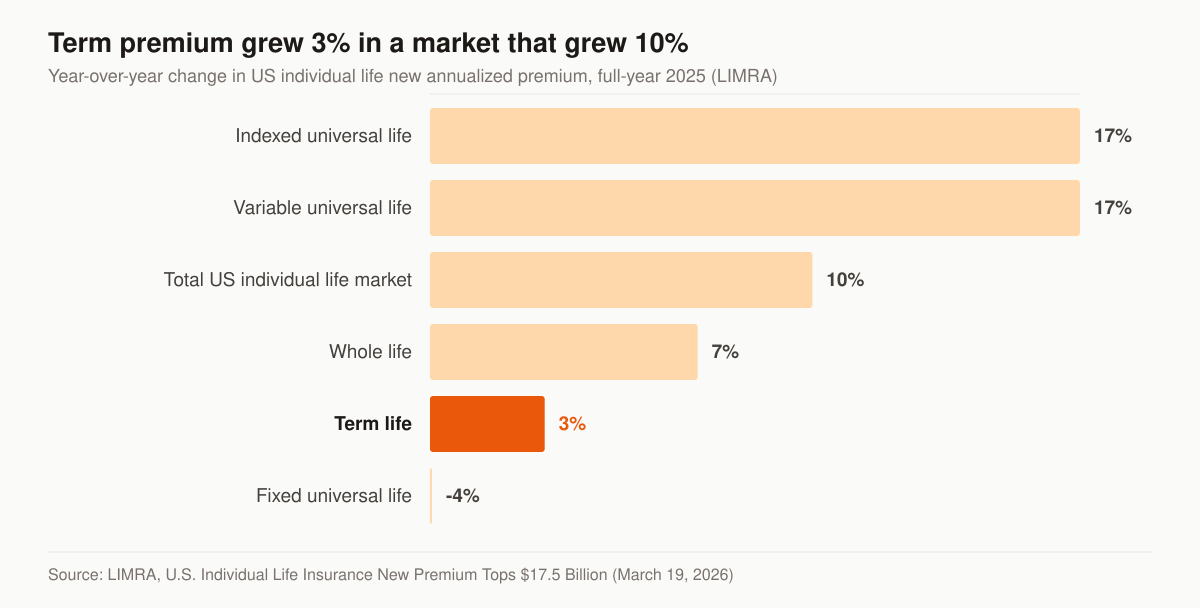
Source: LIMRA, “U.S. Individual Life Insurance New Premium Tops $17.5 Billion to Set New Sales Record in 2025” (March 19, 2026), read September 2026. LIMRA states that its Retail Individual Life Insurance Sales Survey “represents 85% of the U.S. life insurance market.”
Two things follow for an agent buying marketing. First, share in term is taken, not grown — which is an argument for comparison content and for being findable at the exact moment of shopping, rather than for broad awareness spend. Second, the reason LIMRA gives for term’s fourth-quarter uptick is instructive: “Several carriers attribute their growth to rising consumer interest, underwriting automation and expanded distribution.” We read underwriting automation on that list as the reason a no-exam offer is now worth testing as a headline rather than carrying it as a footnote.
The channels we run for term life agents
Each channel does a specific job. We rarely run just one — paid buys you flow now, organic compounds, and follow-up converts what both produce.
The table below is a job description per channel, not a ranking; the right mix depends on whether your constraint is flow, cost or capacity.
| Channel | Job it does | Realistic timeline | Best for |
|---|---|---|---|
| Paid search (PPC) | Catch high-intent “term life quote” searches | 1–2 weeks to first quotes | Agents who need flow now |
| Meta / Facebook ads | Create demand among young families | 2–4 weeks to optimize | Mortgage-protection crossover, no-exam term |
| SEO & content | Own comparison and “how much” queries | 3–9 months, compounds | Agents building a durable asset |
| Email / SMS nurture | Convert quote requests into booked calls | Immediate | Every agent — the leak we fix first |
For the demand-creation side, our Facebook and Meta ad approach and paid search management handle the top of funnel, while our SEO program builds the comparison content that wins the slower, higher-intent searches. Agents running term against a mortgage-balance angle should read the mortgage protection lead generation page as well — same buyer, different framing.
What a term life click and lead cost in published benchmarks
Nobody publishes a term-life-specific cost per lead. What is published sits one level up, at the category, and it is still worth knowing because it tells you the shape of the economics before you spend anything. LocaliQ and WordStream’s 2026 search advertising benchmarks report the Finance and Insurance category at a $3.39 average cost per click, a 9.83% average click-through rate, a 2.64% average conversion rate and a $74.44 average cost per lead. The all-industry averages in the same set are $5.42, 6.64%, 8.18% and $66.69.
Read the four numbers side by side and the category’s problem is obvious: the traffic is cheap and it converts badly.
| Metric | Finance & Insurance | All industries |
|---|---|---|
| Average cost per click | $3.39 | $5.42 |
| Average click-through rate | 9.83% | 6.64% |
| Average conversion rate | 2.64% | 8.18% |
| Average cost per lead | $74.44 | $66.69 |
Source: LocaliQ / WordStream, 2026 Search Advertising Benchmarks, read September 2026. These are whole-category figures across Google Ads and Microsoft Ads accounts, not term life specifically, and the category bundles banking, lending and insurance together.
An insurance click costs less than the average click and gets clicked more often than the average ad — and then converts at roughly a third of the all-industry rate, which is what drags cost per lead above average. On a term campaign, that conversion rate is the number you can actually move. The click price is set by the auction. The landing page is set by you. This is why we sequence landing-page work before bid work on a term account, and it is the reason our insurance landing pages service exists as a separate line item rather than a bullet inside ad management. For the line-by-line click costs across products, our guide to insurance PPC cost per click by line goes deeper than the category average can.
Segmenting term by length, face amount and health class
“Term life” is not one offer. It is at least four, and running them through one ad set is how a term account ends up with a respectable cost per lead and a poor cost per policy. The three variables that split the audience are the same three the shopper has already decided: how long, how much, and how healthy.
- Term length. A 10-year term sold to a 55-year-old covering a business loan and a 30-year term sold to a 32-year-old covering a mortgage and two children are different products, different premiums and different anxieties. The ad copy that works for one reads as irrelevant to the other.
- Face amount. A $100,000 policy and a $1,000,000 policy carry different underwriting paths, different commission economics and different objections. Set a coverage-amount floor on your targeting and your lead filters if your carrier mix does not support small face amounts.
- Health class and exam appetite. Carriers told LIMRA that underwriting automation was part of what drove term’s 2025 growth, which is what makes a no-exam offer worth its own ad set rather than a line of body copy. Some shoppers will pay a premium to skip the exam; others will not. Our guide to marketing no-exam life to younger buyers covers the creative side.
Four offers, four different landing pages — this is the segmentation we build a term account around by default.
| Offer | Who it speaks to | Primary hook | Where it usually runs |
|---|---|---|---|
| 20-year level term, mid face amount | Young family with a mortgage | Cover the years the kids are at home | Paid search, Meta |
| 30-year level term, higher face amount | Early-30s buyer maximizing the level period | Lock the rate for the whole mortgage | Paid search, SEO |
| No-exam / accelerated underwriting term | Time-poor or exam-averse shoppers | Apply today, no paramed visit | Meta, paid search |
| Return-of-premium term | Buyers who dislike “paying for nothing” | Premiums returned if you outlive the term | Meta, retargeting |
Return of premium deserves a compliance note rather than a marketing one, and it is in the ad-rules section below.
What a term quote page has to do before it asks for a phone number
A term shopper arrives mid-comparison. They are not deciding whether to buy life insurance; they are deciding which tab to keep open. A page that opens with a form is asking for a commitment the visitor has not made yet.
The sequence we build, in order:
- A number above the fold. A range, a starting premium, or a calculator that runs without an email. Given what the Barometer study says about cost perception, the number is the argument.
- The product named plainly. Level term, the length, what happens at the end of the level period. The NAIC model regulation requires an advertisement to “prominently describe the type of policy advertised” — good compliance and good conversion happen to be the same edit here.
- A coverage-amount helper. The Barometer study puts “unsure of how much and what type to get” at 22% of the reasons people give for not having life insurance. A three-input helper that outputs a face amount answers that objection on the page.
- One form, short. Name, date of birth, state, tobacco, coverage amount, term length, phone. Every field beyond that is a conversion tax you are choosing to pay.
- A dated next step. A booked slot beats “an agent will contact you,” which is what the procrastination number is telling you.
- The consent line, written properly. Covered next — it is a legal artifact, not a checkbox to copy from a competitor.
Page speed and mobile layout sit underneath all of it. A life insurance agent website built for capture, rather than a brochure with a contact page bolted on, is the version of this that compounds.
The consent line under your quote form
A term quote request is a permission to call, and the permission is the part that can be defective. The federal rules live in 47 CFR 64.1200. Each paragraph carries its own scope — paragraph (a) governs autodialed and prerecorded calls, paragraph (c) governs telephone solicitations, and paragraph (d) governs telemarketing calls to residential subscribers and the internal do-not-call list they require — so read the opening clause before you apply any of it.
These are the artifacts a term funnel should be able to produce on request, and the rule text behind each one.
| The artifact | The rule, in its own words | Citation |
|---|---|---|
| The signed consent, naming the number | Prior express written consent means “an agreement, in writing, bearing the signature of the person called that clearly authorizes the seller to deliver or cause to be delivered to the person called advertisements or telemarketing messages using an automatic telephone dialing system or an artificial or prerecorded voice, and the telephone number to which the signatory authorizes such advertisements or telemarketing messages to be delivered.” | 47 CFR 64.1200(f)(9) |
| The disclosure text above the button | The agreement must disclose that “The person is not required to sign the agreement (directly or indirectly), or agree to enter into such an agreement as a condition of purchasing any property, goods, or services.” | 47 CFR 64.1200(f)(9)(i)(B) |
| A revocation path that is not the only one | For calls and texts under paragraphs (a)(1) through (3) and (c)(2), revocation requests made in any reasonable manner “must be honored within a reasonable time not to exceed ten business days from receipt of such request” — and callers covered by those paragraphs “may not designate an exclusive means to request revocation of consent.” | 47 CFR 64.1200(a)(10) |
| A registry scrub on a clock | One of the standards in the error-based safe harbor: the caller “uses a process to prevent telephone solicitations to any telephone number on any list established pursuant to the do-not-call rules, employing a version of the national do-not-call registry obtained from the administrator of the registry no more than 31 days prior to the date any call is made, and maintains records documenting this process.” | 47 CFR 64.1200(c)(2)(i)(D) |
| An internal do-not-call list with a retention period | “A do-not-call request must be honored for 5 years from the time the request is made.” | 47 CFR 64.1200(d)(6) |
| Calling hours your dialer enforces | Paragraph (c) bars a telephone solicitation to “Any residential telephone subscriber before the hour of 8 a.m. or after 9 p.m. (local time at the called party’s location)” | 47 CFR 64.1200(c)(1) |
Two details matter specifically for a comparison-shopping product like term. First, the revocation rule treats a reply of “stop,” “quit,” “end,” “revoke,” “opt out,” “cancel,” or “unsubscribe” to a text as a per-se reasonable revocation, and requires other wording to be honored too “if a reasonable person would understand those words to have conveyed a request to revoke consent.” A term shopper who has filled in several quote forms will opt out of one or two, and your suppression list is what keeps that record out of your dialer.
Second, the rule that would have forced consent to be collected one seller at a time is not in force. In Insurance Marketing Coalition Limited v. FCC, No. 24-10277, decided January 24, 2025, the Eleventh Circuit vacated the FCC’s one-to-one consent restriction, holding that the restriction fell outside the FCC’s statutory authority to implement the TCPA because it altered the ordinary meaning of “prior express consent”. The court remanded the matter to the agency. The 2012 definition of prior express written consent quoted in the table above remains in force, as the summary from Wiley’s telecom practice sets out. What that means practically: a shared-consent form is not per se unlawful again, and a comparison funnel that names its partners is workable — but the consent still has to be clear, still has to name the number, and still has to be producible years later.
We are a marketing firm, not your counsel. Our job is to build a form that captures and stores the artifact; your compliance attorney signs off on the language. If you also buy leads, TCPA compliance for agents buying leads covers the vendor-side version of the same questions.
What a term life ad is allowed to say
Term marketing runs on price comparison, and price comparison is the part of life advertising that regulators wrote rules about. The baseline text is the NAIC’s Advertisements of Life Insurance and Annuities Model Regulation (MDL-570). It is a model — each state adopts and amends its own version — and your carrier layers an advertising-approval process on top. Read yours. But the model tells you the shape of what the states enforce, and the clauses below are the ones a term campaign runs into.
Every row is a clause in the model regulation, restated as the ad decision it forces.
| Model regulation clause | What it says | What it means for a term ad |
|---|---|---|
| Section 3B | “All advertisements, regardless of by whom written, created, designed or presented, shall be the responsibility of the insurer, as well as the producer who created or presented the advertisement.” Insurers must maintain “a system of control” that includes annual notice of the procedures for “company approval prior to the use of any advertisements that is not furnished by the insurer” | Your own creative is in scope. Route it through carrier approval before it runs |
| Section 5C | Where an ad uses “non-medical,” “no medical examination required,” or similar terms and issue is not guaranteed, they must be accompanied by “a further disclosure of equal prominence and in juxtaposition thereto” that issuance may depend on the application’s health questions | The disclosure has to survive every crop and placement, not sit in a footer |
| Section 5E | “An advertisement shall prominently describe the type of policy advertised” | Say “20-year level term life insurance,” not “coverage” or “protection plan” |
| Section 5I(1) | “An advertisement for a policy with non-level premiums shall prominently describe the premium changes” | If you advertise a level period, say what happens after it |
| Section 5I(3) | “An advertisement shall not contain a statement or representation that premiums paid for a life insurance policy can be withdrawn under the terms of the policy.” The clause then carves out advance premium funds and unconditional premium refund offers | Return-of-premium creative needs the carrier’s exact wording, not a paraphrase |
| Section 5M | The words “free,” “no cost,” “without cost” and words of similar import “shall not be used with respect to any benefit or service being made available with a policy unless true.” Where there is no charge to the insured, “the identity of the payor shall be prominently disclosed” | A free quote is fine; billing a reduced first-year premium as free coverage is not |
| Section 5R | An advertisement “shall not contain statistical information relating to any insurer or policy unless it accurately reflects recent and relevant facts. The source of any statistics used in advertisement shall be identified” | Cite the study on the ad, not just on the landing page |
| Section 5V | “An advertisement shall not make unfair or incomplete comparisons of policies, benefits, dividends or rates of other insurers. An advertisement shall not disparage other insurers, insurance producers, policies, services or methods of marketing.” | Comparison tables are allowed; incomplete ones and competitor-bashing are not |
| Section 6A | “The name of the insurer shall be clearly identified in all advertisements about the insurer or its products”; where an ad lists “a composite of several different policies or contracts of different insurers,” it “shall so state” | A multi-carrier quote widget needs the composite disclosure |
| Section 9A | Insurers keep a specimen file of every advertisement “for a period of five (5) years after discontinuance of its use or publication” | Archive your creative and its run dates; you will be asked for them |
| Section 10 | “An insurer or its officer, directors, producers or employees that violate any of the provisions of this regulation, or knowingly participate in or abet such violation, shall be subject to a fine up to $1000 for each violation and suspension or revocation of its certificate of authority or license.” | The per-violation structure is why a bad headline scaled across placements is expensive |
Section 5V is the clause we watch most closely on term creative. The comparison angle is the whole reason a term shopper clicks — and the model regulation permits it while banning the incomplete version of it. In practice that means a comparison has to state what is being compared: same face amount, same term length, same health class, same issue age. A screenshot of one competitor’s higher premium with the underwriting class cropped out is exactly the “incomplete comparison” the clause names.
Why follow-up is where term agents leak money
A term quote request is worth nothing until someone answers it. Two failure modes turn a paid quote request into nothing: nobody calls quickly, and nobody calls again. We instrument three things against them:
- Speed-to-lead — automated text/email inside 60 seconds, agent alert simultaneously.
- Cadence — a defined multi-touch sequence over the first two weeks, not one call and a shrug.
- Attribution — every bound policy traced back to channel, so budget moves toward what actually closes.
This is the part that separates a marketing spend from a marketing system. It is also the fix we run first, because you have already paid for the lead and the change is routing rather than budget. The mechanics are unglamorous and they all live in your CRM: post leads by API rather than by email, fire the first attempt automatically rather than waiting for someone to notice a notification, and write the cadence down. Our insurance lead follow-up cadence guide is the version we hand clients, and the best CRM for insurance agents roundup covers which platforms accept real-time posts. The automation layer that makes any of it repeatable is our email and SMS automation work.
Where the term inquiry goes when it does not qualify
A term funnel produces prospects it cannot place. A 62-year-old asking about 30-year term, a shopper with a disclosed condition that prices out of preferred, a face amount below what your carriers will write — these show up in any term campaign, and an agent who treats them as waste is paying full price for leads they then throw away.
Routing them is a marketing decision as much as a sales one:
- Declines and heavy impairments route to simplified issue or guaranteed issue. Our guide to marketing simplified issue life insurance covers how that offer is positioned differently.
- Older shoppers with small face amounts are a final expense conversation, not a term one. The final expense marketing hub is where that book lives.
- Buyers who want permanence move to whole life. Our whole life marketing page covers the slower, education-led funnel that product needs.
- Term buyers who convert later stay in nurture. A conversion privilege on the policy you place today is a permanent-product conversation you own for years, which is a part of term economics that a per-lead invoice does not price.
Building the routes changes the arithmetic on the whole account, because the denominator on your cost per placed policy stops being “term applications” and starts being “everything the campaign produced.”
Measuring a term program from click to placed policy
Term is a product where vanity metrics are easy to collect, because clicks are cheap and quote requests are easy. A campaign can look excellent three steps upstream of the event that actually pays you.
These are the six measurements we put on a term account, and what each one is actually for.
| Measurement | What it tells you | What you do when it moves the wrong way |
|---|---|---|
| Cost per click | The auction’s price, mostly outside your control | Check match types and negatives before touching bids |
| Quote-request conversion rate | Whether the landing page earns the form | Rewrite the page above the fold; this is the movable number |
| Cost per quote request | Click price divided by that rate | Fix the rate first, the price second |
| Contact rate | Whether the follow-up system works at all | Time-to-first-dial, then cadence length |
| Application rate per contact | Whether the offer matches the traffic | Re-segment by term length and face amount |
| Cost per placed policy | The number that pays your bills | Move budget between channels on this and nothing else |
Placement is the step that reporting tends to stop short of. An application is not a policy — underwriting, requirements and the delivery of the contract sit between them, and a channel that produces applications which do not place is more expensive than its cost-per-application suggests. Track it to placed and, if you can, to persistency.
How AI assistants are changing term life discovery
The comparison a term shopper runs used to happen across a row of browser tabs. Increasingly it happens inside one answer. The 2025 Barometer study found that “nearly six in 10 young adults say they would use an AI tool to research a life insurance policy.” In the same study, 42% say they would prefer to buy from a financial professional in person. Research moved; the purchase did not. The same study reports that 62% of all adults, and 80% of those under 45, use social media to seek information on financial or insurance products, up from 29% when the question was first asked in 2019.
For a term practice, both numbers point the same way. They describe young adults — the group a 20- or 30-year level period is built around — researching in assistants and feeds, then asking a human for the transaction. Being the source those systems reach for is a content problem — structured answers, plain explanations of level term, real comparison tables — which is what our AI search visibility work is for, and what life insurance SEO builds underneath it. The mechanics of being cited rather than merely indexed are covered on both pages.
How this fits the rest of your life practice
Term is usually one product in a broader life book. If you also write whole life or final expense, the same infrastructure should feed all of it. This page sits under our life insurance marketing pillar, which connects to adjacent plays like whole life marketing and the underlying insurance lead generation systems that power every funnel we build. If your question is where the leads themselves come from and what they cost, life insurance lead generation for agents breaks down the vendor market in detail.
A few principles we hold across all of it:
- Quote-first landing pages. Show a path to a number before asking for a phone.
- One offer per ad set. No-exam term, return-of-premium, and 30-year level are different pitches.
- Honest math. We report cost per bound policy, not vanity clicks.
Buying leads vs. generating them
Generating your own term life leads gives you exclusive prospects and an asset you own — but it takes time to scale. If you need volume this week while the funnels mature, you can buy leads direct from getinsureleads. We build generation systems on this site; we don’t sell leads here. You can run both: bought leads for immediate flow, owned funnels for margin and durability.
The trade-off is not really about price per record. It is about what you hold at the end. A bought lead produces a policy or it does not; an owned funnel produces the policy and the thing that produced it, and the second asset is the one that lowers next quarter’s cost per sale.
What term life marketing costs here
We publish our rates rather than quoting them case by case: Foundation at $2,500 per month, Growth at $3,500, Full-Funnel at $5,500, and a one-time website build of $2,500–$8,000. Ad spend is not inside the retainer — your media budget is a pass-through billed at cost, straight to Google and Meta, never marked up.
Which tier fits a term practice depends on where the funnel is broken. If there is no page worth sending a term shopper to, that is Foundation — site, landing pages, local SEO, on-page work. If the page is fine but nothing finds it, that is Growth, which adds the ongoing content engine, AI-search visibility and reputation work. If visibility is handled and the constraint is volume, Full-Funnel adds managed Google and Meta ads, landing-page CRO and the marketing automation that makes speed-to-lead a setting rather than an intention. Full detail, including the exclusions, is on the pricing page.
Start with the numbers
We don’t pitch retainers blind. The first step is a teardown of your current funnel, ad accounts, and follow-up — where the spend leaks and what a realistic cost per bound policy looks like for your market.
Grab a free marketing audit and we’ll show you the math before you commit to anything. If you’d rather ask a question first, get in touch. And if you want to see how we think about the broader life book, the life insurance marketing overview is the place to start.
Guides that go deeper