No Exam Life Insurance Marketing: A Playbook for Reaching Younger Buyers
No exam life insurance marketing works when the ad leads with the friction it removes — coverage without the medical exam, a decision in hours instead of weeks — and the page is honest about what replaces the exam: a health questionnaire and an outside data check that can still route the applicant back to a paramed visit.
Younger buyers do not wake up wanting life insurance. They wake up with a mortgage, a new baby, or a partner who just asked “what happens if something happens to you?” That is the moment no exam life insurance marketing has to catch — and the reason your ad should lead with the friction it removes, not with mortality. We treat the medical exam as the first thing to take off the table, because it is the piece of friction an ad can remove in five words. What the page does next, with the health questionnaire and the data check that replace the exam, decides whether the lead converts or complains.
We did not learn this on auto or home. We learned it running real lead campaigns. The numbers we lean on here come from the senior-market operation we actually operate — see the final-expense lead operation we run for the full picture. The audience is older there, but the discipline is identical: lead with the objection you remove, qualify hard, and call fast.
Why “no exam” is the offer, not a feature
A younger buyer is healthy. That is exactly why a no-exam product fits them: accelerated underwriting uses data instead of fluids, so a clean applicant can get a decision quickly rather than in weeks. The NAIC’s accelerated underwriting topic page puts the traditional path plainly — “Traditional life insurance underwriting requires the collection of extensive medical information including a physical exam and fluids testing (blood, urine, and saliva). The timeline from the start of the application process to the issuance of a policy can be up to a few months.” Against that baseline, the NAIC says accelerated underwriting “can effectively reduce the length of the application process from several weeks to just a few hours.” Your marketing should treat that compression as the headline.
The same prospect reacts to three ad angles in three different ways, and the difference is concreteness.
| Ad angle | Implied effort | Younger-buyer response |
|---|---|---|
| “Protect your family’s future” | Vague, high | Scrolls past — sounds like work |
| “Coverage decision in minutes, no medical exam” | Low, concrete | Stops — removes the dread |
| “Term life from $X/mo, apply on your phone” | Low, priced | Clicks — money + speed |
The winning angles share two traits: they are concrete, and they name the thing the buyer was dreading. “Simplified issue” means nothing to a 30-year-old. “No needles, no nurse visit, answer a few health questions” means everything. Keep the product-correct language (“simplified issue,” “accelerated underwriting”) for the body copy and the agent’s call, where it sets honest expectations about coverage caps.
Wisconsin’s life advertising rule makes that split a requirement rather than a stylistic preference. Section Ins 2.16 (5) (a) reads: “Advertisements, representations, and solicitations shall be truthful and not misleading in fact or in implication and shall accurately describe the policy, the insurance business, any insurer, or any intermediary to which they apply. No advertisement may contain words or phrases the meaning of which is clear only by implication or by familiarity with insurance terminology.” An ad built on the phrase “simplified issue” is an ad whose meaning is clear only to people who already sell insurance.
What the application data says about buyers under 40
Before you set a budget, look at what the market is actually doing. The MIB Life Index tracks US life insurance application activity reported to MIB by its member carriers, and its June 2026 US report shows a clean age gradient. Comparing Q2-2026 with Q2-2025, MIB reports ages 0-29 up +2.0%, ages 30-39 up +7.7%, ages 40-49 up +15.5%, ages 50-59 up +23.8%, ages 60-69 up +27.7%, and ages 71+ up +45.5%. Overall activity ended the first half of 2026 up +15.4% year-to-date.
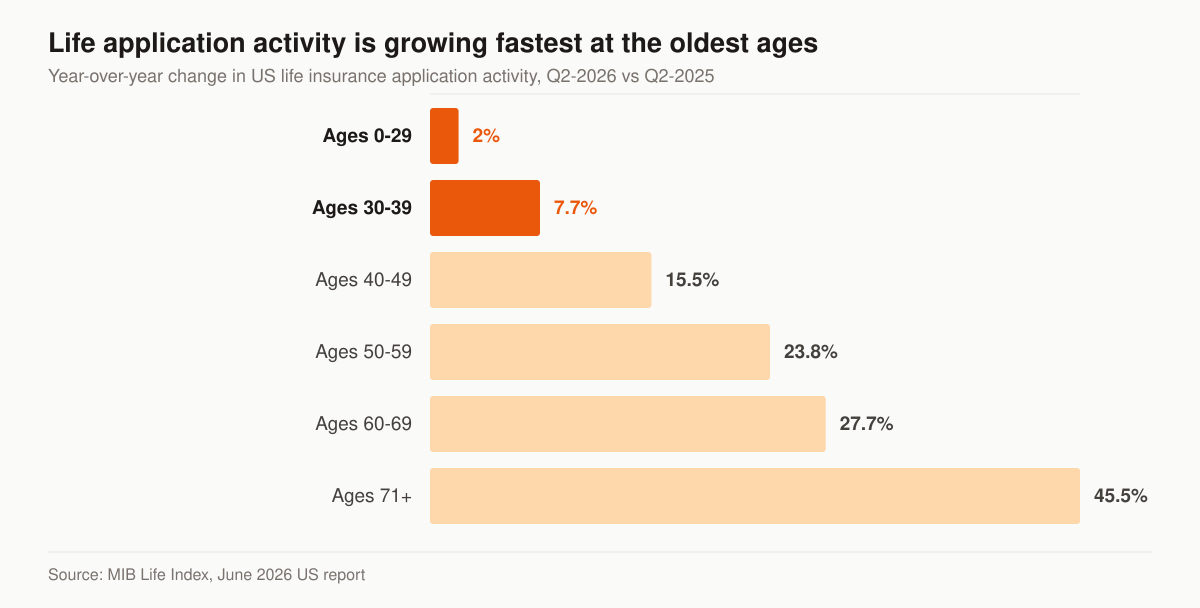
Application activity growth by age band, Q2-2026 vs Q2-2025. Source: MIB Group, MIB Life Index, June 2026 US report.
Read the bottom two bars as a warning, not a verdict. On a year-to-date basis through mid-year 2026, MIB reports activity “was flat for ages 0-29.” Your younger-buyer campaign is fishing in the slowest-moving band in the market. That does not make it a bad campaign; it makes it a campaign that has to win on offer and speed rather than ride a rising tide. MIB also notes a methodology change for 2026 that refined its age and face amount bands and restated the historical series, so compare its 2026 numbers with its own restated history rather than with figures you saved from an older report.
The face amount detail is where the marketing decision actually lives. Comparing Q2-2026 with Q2-2025, MIB reports that ages 0-29 “saw declines for amounts from $1 up to but not including $100K, flat activity for amounts from $250K up to but not including $500K, and growth for other face amounts, in the double digits for amounts $1M and over.” For ages 30-39, MIB reports “growth for amounts $100K and over, in the double digits for amounts from $1M up to but not including $5M, and declines for amount from $1 up to but not including $100K.”
The small-face no-exam offer is the part of this market that is shrinking, and the ad copy should follow the growth.
| Age band | Where MIB reports declines | Where MIB reports the strongest growth | What that does to your creative |
|---|---|---|---|
| Ages 0-29 | $1 up to but not including $100K | Double digits at $1M and over | Stop leading with a $25,000 policy; quote a real income-replacement number |
| Ages 30-39 | $1 up to but not including $100K | Double digits from $1M up to but not including $5M | Size the offer to the mortgage and the salary, not to a burial cost |
| Ages 40-49 | Growth across all face amounts | Double digits at $100K–$250K and $500K–$5M | A second campaign, not the same one stretched upward |
Product mix points the same direction. On the same Q2 comparison, MIB reports Term Life up +28.2%, Whole Life up +22.8% and Universal Life up +8.1%. Term is where the younger no-exam buyer lands, which is why the funnel should terminate on a strong term life insurance marketing page rather than a generic life page.
The demand side tells you why the number in the ad matters so much. The 2026 Insurance Barometer Study from LIMRA and Life Happens surveyed more than 5,200 US adults ages 18 to 75 who share responsibility for household financial decisions. LIMRA reports that 48% of American adults do not own life insurance and 38% — roughly 92 million adults — say they need coverage or need more than they have. On cost, the study is blunt: “The most cited reason for going without coverage is the belief that it costs too much”, and “healthy adults under age 30 overestimate the cost of a typical term life insurance policy by 5 to 6 times.” Among those with a coverage gap, one-third say they are not sure how much coverage they need or what type to buy, and another third say they simply have not gotten around to it.
None of that is an objection to your product. All of it is friction, and friction is what an ad, a landing page and a fast callback remove.
The three products hiding behind “no exam”
“No exam” is a benefit statement, not a product. Three different underwriting paths deliver it, and they carry different caps, different timelines and different buyers. If your ad set mixes them, your close rate pays for it.
Match the ad to the product before you write a word of copy, because the caps are not close to each other.
| Path | Health questions | Published coverage ceiling | Published decision window | Fits |
|---|---|---|---|---|
| Accelerated underwriting term | Full questionnaire, no fluids | Up to $3 million (Policygenius) | As little as 24 hours for qualifying applicants (Policygenius) | Healthy applicants under 60 wanting real face amounts |
| Simplified issue | A short set of knockout questions | Typically up to $40,000 (Policygenius) | A few days to two weeks (Policygenius) | Moderate health, final-expense sized need |
| Guaranteed issue | None | Up to $25,000 (Policygenius) | Near-certain approval, no health questions (Policygenius) | Applicants declined elsewhere |
Those figures come from Policygenius’s no-medical-exam life insurance guide, which is also one of the pages your prospect reads before your call. Worth noticing: the same guide’s carrier comparison table lists the average time for no-exam approval as up to 3 weeks for Banner Life, up to 4 weeks for Pacific Life, up to 4 weeks for Transamerica, up to 2 weeks for Mutual of Omaha, and as varying by applicant for Protective. So the instant-decision headline and the published approval window are two different numbers on the same page. Quote the one your carrier will stand behind.
There is also a price trade behind the convenience. The NAIC describes simplified underwriting as techniques “which allow an applicant to forgo the medical exam and collection of fluids in exchange for generally higher premiums.” Policygenius lists the same trade-off as a drawback of no-exam coverage: “You may pay more than with fully underwritten policies”. A 32-year-old marathon runner who would ace a paramed exam may be paying a convenience premium, and the honest version of your pitch says so — then explains why skipping the exam and the fluid draw is worth that premium to them.
The simplified-issue side of this has its own funnel logic, including how to keep it from colliding with guaranteed issue in the same ad account. That is worked out separately in our post on simplified issue life insurance marketing. The rest of this page stays on the accelerated-underwriting, younger-buyer path.
What accelerated underwriting actually reads
If the ad promises “no exam,” the agent should be able to say what replaced it. The NAIC’s Accelerated Underwriting (A) Working Group adopted this definition in its educational paper: “Accelerated underwriting (AU) is the use of big data, artificial intelligence, and machine learning to underwrite life insurance in an expedited manner. The process generally uses predictive models and machine learning algorithms to analyze applicant data, which may include the use of non-traditional, non-medical data, provided either by the applicant directly or obtained through external sources. The process is typically used to replace all or part of traditional underwriting in life insurance and to allow some applicants to have certain medical requirements waived, such as paramedical exams and fluid collection.”
Read the qualifiers: all or part, some applicants, certain medical requirements. Nothing in that definition promises every applicant a waived exam, and the NAIC’s topic page says so directly: “AU alone does not always lead to issuance of a policy. For some applicants, the available data will be insufficient to adequately evaluate their risk profile, so they will still need to complete the traditional underwriting process, including the physical exam.”
On the inputs, the NAIC page lists external sources including “credit reports, motor vehicle records, and the Medical Information Bureau”, and adds that “insurers increasingly rely on external data sources, predictive models and algorithmic or machine learning techniques to evaluate risk and determine eligibility for accelerated pathways.” Policygenius describes the same step for the consumer: “The insurer checks your prescription history, driving record, and public records.”
The gap between what a no-exam ad implies and what the mechanism does is where complaints start.
| What the ad implies | What accelerated underwriting actually does | What the call should say |
|---|---|---|
| “No exam” | Waives the paramed visit and fluid collection for applicants the data clears | “No blood work and no nurse visit if the file clears” |
| “No hassle” | Runs an outside data check on prescription history, driving record and public records | “The carrier verifies what you tell us against its own data sources” |
| “Instant decision” | Produces a fast decision for some applicants; others get routed to full underwriting | “Most files come back quickly; some get referred for an exam” |
| “You’re approved” | An accelerated path can end in an adverse underwriting decision | “If the answer is no, you will be told the reason and what it was based on” |
That last row is regulator territory, not sales technique. The Accelerated Underwriting (A) Working Group’s regulatory guidance — which NAIC’s topic page says was “adopted by the Life Insurance and Annuities (A) Committee on August 14, 2024” — lists among its regulatory considerations that “Reason(s) for an Adverse Underwriting Decision are provided to the consumer along with all information upon which the insurer based its Adverse Underwriting Decision,” and that “The insurer has a mechanism in place to correct mistakes if found in consumer data.” The same document opens by stating that “Regulators should ensure that accelerated underwriting programs are fair, transparent, safe, and secure and in compliance with existing law.”
For an agent, the practical read is short. A declined accelerated-underwriting applicant is entitled to a reason and to a route for correcting bad data, and telling them that on the call turns a dead lead into a second application. It is also a conversation your follow-up sequence should be built to have — the cadence for that is in our insurance lead follow-up cadence.
The disclosure your no-exam ad is required to carry
This is the section most no-exam creative skips, and it is the one with a rule written specifically for the phrase you are about to put in a headline.
North Carolina’s life insurance advertising rule, 11 NCAC 12 .0427, states at paragraph (c): “In the event an advertisement uses ‘Non-Medical’, ‘No Medical Examination Required’ or similar terms where issue is not guaranteed, such terms shall be accompanied by a further disclosure of equal prominence and in juxtaposition thereto to the effect that issuance of the policy may depend upon the answers to the health questions.”
Take the conditions seriously. The trigger is “where issue is not guaranteed” — which describes every accelerated-underwriting and simplified-issue offer. The remedy is not a disclosure somewhere on the page; it is one of “equal prominence” and “in juxtaposition thereto”. A grey six-point footnote under a bold headline does not meet a rule written with those two phrases in it.
Several other paragraphs of the same rule land on ordinary lead-gen mechanics. Paragraph (e): “An advertisement shall prominently describe the type of policy advertised.” Paragraph (l): “An advertisement shall not contain statistical information relating to any insurer or policy unless it accurately reflects recent and relevant facts. The source of any such statistics used in an advertisement shall be identified therein.” Paragraph (p): “An advertisement shall not make use of any method of marketing that fails to disclose in a conspicuous manner that a purpose of the method of marketing is solicitation of insurance and that contact will be made by an insurance agent or insurance agency.”
Wisconsin adds the speed rule. Ins 2.16 (7) (d): “An advertisement may refer to immediate coverage or guaranteed issuance of a policy only if suitable administrative procedures exist so that the policy is issued within a reasonable time after the application is received.” The same section, at (7) (a), bars an advertisement “that exaggerates a benefit or minimizes cost by overstatement, understatement or incompleteness.” And Wisconsin says how a regulator will judge the creative, at (4) (c): the commissioner determines whether an advertisement has the capacity or tendency to mislead or deceive “from the overall impression that the advertisement may be reasonably expected to create upon a person of average education or intelligence within the segment of the public to which it is directed.”
Run each line of your creative against a rule before it runs against an audience.
| Line in the creative | Rule that reaches it | What the compliant version looks like |
|---|---|---|
| “No medical exam required” | NC 11 NCAC 12 .0427(c) | Equal-prominence line, next to it: issuance may depend on the answers to the health questions |
| “Instant approval” | WI Ins 2.16 (7) (d) | Say it only if the carrier’s process issues within a reasonable time after application |
| “Simplified issue coverage” | WI Ins 2.16 (5) (a) | Plain-language description; jargon that reads only to insiders does not qualify |
| “Get your free quote” with no context | NC 11 NCAC 12 .0427(p) | Conspicuous notice that this is a solicitation of insurance and an agent will make contact |
| “9 out of 10 approved in a day” | NC 11 NCAC 12 .0427(l) | Recent, relevant, and the source named in the ad itself |
| “Coverage from $12/month” | WI Ins 2.16 (7) (a) | The issue age, health class, face amount and term the quote assumes, on the same asset |
Two caveats on scope, because the rules are state law and not one national standard. These are North Carolina’s and Wisconsin’s rules, cited because their text is public and specific; your own states will have their own versions, and Wisconsin’s definition of “advertisement” at Ins 2.16 (3) (a) was written around direct mail, newspapers, magazines, radio and TV scripts, billboards and similar displays, though it separately reaches “Descriptive literature and sales aids of all kinds authored, issued, distributed or used by an insurer, intermediary or third party for presentation to members of the public”. Read your state’s rule rather than assuming this one transfers.
The broader compliance frame for agent-run campaigns is set out in insurance marketing compliance for agents, and if any part of your follow-up uses an autodialer or a prerecorded message, read TCPA compliance for insurance agents buying leads before you switch it on.
The channel mix that reaches a 30-year-old
This buyer lives on a phone and responds to interruption, not search-only. Your job is to interrupt them at a life event, then make the next step trivially easy.
- Meta prospecting (the workhorse). Target life-event and interest signals — recent homeowners, new parents, recently married — not just an age band. The no-exam hook does the qualifying. Our Facebook ads approach for life insurance agents covers the creative and audience structure in depth, and the managed version of that work sits in insurance Facebook ads.
- Search and AI-answer capture. Younger buyers also ask AI assistants and Google “do I need a medical exam for life insurance?” Pages that answer that cleanly get cited. Build that visibility with SEO and AI-search optimization for life agents so you show up in the answer, not just the ad.
- Fast landing pages. A mobile page that loads slow or buries the form kills this audience. Tight, single-offer insurance landing pages — one promise, one form, one call to action — convert the click you paid for.
- Video that answers the underwriting question. Among Americans who use social media, LIMRA reports that “66% use YouTube to learn about financial products and services, and 62% use Facebook for financial education”, and that “Nearly half (46%) say it’s important for financial professionals to connect with them on social media.” A three-minute video explaining what replaces the exam is a sales asset, not a vanity project.
LIMRA’s Gen Z findings also tell you when this buyer is willing to start. Asked where they would consider purchasing life insurance, “Forty-four percent would consider purchasing life insurance when opening a checking or savings account. A third would be interested after the birth of a child (34%), through a credit card membership (32%), or through a gym or wellness program (32%).” Among Gen Z adults, 44% already own coverage and 45% report a need gap.
There is one Gen Z finding that belongs to no-exam marketing specifically. LIMRA reports that this group “will trade engagement for affordability: 71% would complete annual health screenings to lower their premium, 69% would take health courses, and 64% would share fitness or wellness data in exchange for a lower cost of coverage.” Accelerated underwriting is exactly that trade — data in exchange for speed and a waived exam — and a majority of the audience has already said yes to the shape of it. Say the trade out loud in the creative instead of hiding the data check behind the word “simple.”
Build the calendar around the moments this buyer names, not around your renewal cycle.
| Trigger | Signal you can act on | Asset that catches it |
|---|---|---|
| New mortgage | Recent-mover and new-deed data | A payment-anchored landing page; see mortgage protection marketing for young families |
| Birth of a child | 34% of Gen Z would consider buying after it | Meta creative and an email to your existing book |
| Opening a bank account | 44% of Gen Z would consider buying then | Community and partner placements |
| Wellness or gym membership | 32% of Gen Z would consider buying there | Local partnership content, not a hard offer |
| “Do I need a medical exam?” search | Query-level intent | An answer page built for AI citation, not a quote form |
The product home for all of this is term life, and MIB’s product split supports that: Term Life up +28.2% in the Q2 comparison, against +22.8% for Whole Life and +8.1% for Universal Life. Anchor your funnel to a strong term life insurance marketing page so the ad, the landing page, and the call all tell the same story. If you are still deciding which life product to build the funnel around, the life insurance marketing hub lays out the options, and life insurance leads covers the acquisition side.
The funnel math younger-buyer campaigns live or die on
Cheap clicks are not the goal. Applications are. A common mistake is optimizing the ad set to lowest cost per lead, then wondering why nobody binds. Watch the whole chain:
- Cost per lead (CPL) — what you pay for a form fill. Useful, but only the first number.
- Lead-to-application rate — how many filled forms actually start an application. No-exam offers help here because the barrier is low.
- Accelerated-path qualification rate — the share of applicants the carrier clears without a paramed exam. This step is easy to leave out of a reporting dashboard, and it is where a no-exam campaign quietly leaks, because the NAIC notes that applicants whose data is insufficient “will still need to complete the traditional underwriting process, including the physical exam.”
- Application-to-bind rate — the money number. Speed of follow-up drives this more than ad spend does.
- Cost per bound policy — CPL divided by the product of the rates above. This is the figure that tells you whether the campaign pays.
For reference, we run our own senior-market book, so these funnel rates come from live campaigns, not theory. Younger-buyer life CPLs will differ by market — treat your first 30 days as data collection, not profit. The transferable lesson is that close rate moves the economics further than CPL does, and we treat faster calls and a tighter offer as the first fixes, ahead of a bigger budget.
Step three deserves its own tracking field. If a quarter of your applicants get referred to a full exam, your creative promised something your carrier could not deliver for them, and every one of those people is now a complaint risk as well as a lost sale. Two responses work: tighten the pre-qualification on the landing page so the applicant who will clearly be referred self-selects out, or change the promise from “no exam” to “no exam for most healthy applicants — we will tell you in a day.” The second one costs a little click-through and buys back the referral leakage.
Track the whole chain, and set the cut rule before the campaign teaches you a bad habit.
| Metric | What it tells you | Cut or fix when |
|---|---|---|
| Cost per lead | Front-end efficiency | It rises with no lift in applications started |
| Lead-to-application | Whether the promise survives the form | The form fills but the application never starts |
| Accelerated-path qualification | Whether the offer matches the carrier | A rising share gets referred to a paramed exam |
| Application-to-bind | Offer and agent fit | Applications start and stall at the same step |
| Cost per bound policy | Whether the campaign pays | It exceeds first-year commission value |
Segment that table by campaign rather than averaging it. A 28-year-old buying $1 million of term and a 44-year-old buying $250,000 do not share a CPL, and blending them hides whichever one is losing money. For a sense of what search traffic costs in this line before you commit, insurance PPC cost per click by line has the published benchmarks.
Compliance and tone for a skeptical audience
Younger buyers are quick to flag anything that smells like a scam, so factual framing protects both conversion and your license. State the product honestly: simplified-issue and accelerated-underwriting policies have coverage caps and a health questionnaire — “no exam” does not mean “no questions.” Avoid guaranteed-outcome or “get rich” language entirely, especially if you cross-sell IUL later. The agent is the licensed party; the marketing’s job is to deliver a qualified, honest conversation.
Two habits carry most of that load. The first is naming the data check rather than hiding it, which is also the direction the NAIC’s guidance points: the working group wrote that transparency matters “because consumers should understand what personal data is being accessed by insurers and how that data is being used.” A prospect who learns about the prescription-history check from you is a prospect who trusts the rest of the call. The second is writing the disclosure into the creative template rather than bolting it on at approval time — the sentence-level craft for that is in insurance copywriting.
Testimonials deserve a specific warning on a page like this, because a “got covered in a day” quote is the obvious social proof for a no-exam offer. North Carolina’s rule requires that testimonials “be genuine; represent the current opinion of the author; be applicable to the policy advertised, if any; and be accurately reproduced”, and that a financial interest or benefit received by the person giving it be disclosed in the advertisement. Reconstructing a client’s words from memory fails the “accurately reproduced” test even when the sentiment is real.
What running this costs
The build and the retainer are separate decisions. A one-time website build runs $2,500 to $8,000 depending on scope. Ongoing programs run in three tiers: Foundation at $2,500 per month, which covers the website and landing pages, local SEO and Google Business Profile, on-page SEO and monthly reporting; Growth at $3,500 per month, which adds the ongoing SEO and content engine, AI-search visibility, and reputation and reviews; and Full-Funnel at $5,500 per month, which adds managed paid ads across Google and Meta, landing-page CRO, and marketing automation and CRM. A no-exam campaign that depends on Meta prospecting sits at that third tier. Ad spend is billed at cost, straight to the platforms, never marked up. The full breakdown is on our pricing page, and if you would rather talk through which tier fits a life book, start a conversation.
What to do this week
- Write three ad variants, each leading with the no-exam benefit in the first five words, and pair each with an equal-prominence line saying issuance may depend on the answers to the health questions.
- Pull your carrier’s actual accelerated-underwriting decision window and face-amount ceiling, and make the ad promise match it rather than the fastest case in the brochure.
- Re-size the offer. MIB’s data says the growth in the under-40 bands sits at $1 million and above, not at $25,000.
- Point every variant at one mobile landing page with a single offer, a short qualifying form, and a conspicuous notice that an agent will make contact.
- Add “accelerated-path qualification rate” as a tracked field so you can see referral leakage before it shows up as a complaint.
- Commit to calling every lead within minutes, not hours — speed to first contact is the lever we reach for first.
If you want volume immediately while your owned funnel ramps, you can buy leads direct from getinsureleads at getinsureleads.com — we build marketing systems here, we do not sell leads on this site, so a purchased-lead backstop keeps you producing without muddying your brand.
Want a second set of eyes on your current setup? Grab a free marketing audit and we will map your no-exam funnel against the same systems we run for clients. And if you are weighing which life product to build around first, start with our broader marketing ideas for life insurance agents to see where no-exam term fits in the wider plan.
- Simplified Issue Life Insurance Marketing: How SI vs GI Changes Your Funnel
A practitioner's guide to simplified issue life insurance marketing: how SI vs GI changes your messaging, your lead quality, and your close rate.
- How to Sell Life Insurance: The Needs-Based Process
How to sell life insurance with a needs-based process: discovery scripts, an objection-handling table, licensing basics, and an honest look at the odds.
- Life Insurance Marketing Ideas That Move Policies, Not Just Impressions
Practical life insurance marketing ideas for agents, ranked by cost, speed, and effort, with a comparison table to pick the two you should run first.
- Mortgage Protection Marketing Ideas for Reaching Young Families
Mortgage protection marketing ideas built around how young families actually buy: persona targeting, ad angles, and conversion systems that fit them.