Who we serve
Facebook Ads for IUL Agents That Book Real Appointments
Facebook ads for IUL agents run inside Meta's financial products and services Special Ad Category, which fixes age at 18 through 65+, removes lookalike audiences and strips most interests. The creative sells a conversation rather than a return, the form does the qualifying, and cost per funded case is the number that decides the channel.
Free · 15-minute teardown · no pitch deck
- We run our own final-expense book
- No pitch deck — we screen-share real numbers
- TCPA-aware · CMS/AEP-compliant · Meta Special Ad Category
- Core Web Vitals < 2.0s LCP
An IUL ad account can fail in two separate places, and clearing one says nothing about the other. The creative trips a compliance wire, or the funnel collects leads who cannot fund a policy. Facebook ads for IUL agents only pay off when both problems are solved at the same time — clean creative on the front, ruthless qualification underneath, and a campaign structure built for the targeting restrictions Meta actually applies to insurance. Below is how we structure it, and the published rules and numbers we hold ourselves to.
This is the paid spoke under our IUL agent marketing program. The platform-level build sits in our insurance Facebook ads service, and the line-by-line compliance reading is in our guide to marketing IUL compliantly.
Why most IUL Facebook ads underperform
Indexed universal life is a non-guaranteed product. The moment an ad implies a fixed return — “earn 8% tax-free,” “guaranteed growth,” “get rich with IUL” — you’ve created reputational and compliance exposure that no CPL can justify. Meta also throttles ads that read as financial hype, so the hooks that feel strongest are usually the ones that get rejected or buried.
The second failure is downstream. Cheap leads are easy. Cheap leads who can afford a funded illustration are not. An ad set optimized for raw form-fills will hand you a pipeline full of people who clicked because the word “tax-free” caught their eye, then never answer the phone.
There is now a third failure that did not exist a few years ago, and it is the one agents inherit from outdated playbooks: building the campaign as though the old audience panel still exists. It does not, and Meta enforces its absence with a hard error rather than a warning.
Your IUL campaign is a financial products and services campaign
Meta introduced a Special Ad Category for financial products and services in October 2024, and its developer documentation says the input FINANCIAL_PRODUCTS_SERVICES “will replace the CREDIT input as of January 14, 2025.” The same page states the requirement in one sentence: “Starting January 14, 2025, using this category is required for financial products and services campaigns for advertisers based in the United States or showing ads to audiences in the United States. Ads may be rejected if an appropriate category is not chosen.”
Worth noting for anyone comparing sources: Meta’s own milestone list further down that page dates the same requirement to “January 21, 2025.” Both dates appear in the same document, so cite whichever one your compliance file needs and treat the requirement itself as settled either way.
Indexed universal life is insurance, insurance is a financial product, and the category is therefore not a judgment call for an IUL campaign the way it can be for a borderline brand ad. Three consequences follow immediately.
The first is that the restriction set is borrowed wholesale. Meta writes that the “Audience and product restrictions outlined in this developer document for HOUSING and EMPLOYMENT Special Ad Categories inputs will also apply to the new FINANCIAL_PRODUCTS_SERVICES input.” Everything the housing rules removed, the financial rules remove too.
The second is that the field is mandatory even when the answer is no. Meta writes that “All campaign creations require the special_ad_categories field.” A campaign that does not belong in a category must send NONE or an empty array. There is no default that quietly gets it right for you.
The third is that misdeclaring is not a paperwork error. Meta’s enforcement note reads: “If you send us an incorrect special_ad_category, there is a risk your ads will be paused until the campaign is adjusted.” And once the category is declared, “all audience restrictions will be enforced with a hard error” — the ad set will not save, rather than quietly underdelivering.
What the category removes, and what survives it
This is where an inherited IUL playbook does real damage, because the tactics it recommends are no longer available and the ad set will refuse them rather than degrade politely.
This table maps each audience lever to what Meta’s developer documentation says about it once a financial products and services campaign is tuned for the category.
| Audience lever | Status | Meta’s own wording |
|---|---|---|
| Age band | Fixed | “Options are generally fixed to include ages 18 through 65+ for housing, employment, and financial products and services ads” |
| Gender | Fixed | “Specific gender cannot be chosen” — genders defaults to all genders |
| Radius targeting | Floored | Location selection “must include all areas equal or larger than 15 mile or 25 kilometer radius for the US and Canada” of any city, address or dropped pin |
| ZIP and neighborhood | Removed | zips, neighborhood, subcity, metro_area, small_geo_area, subneighborhood and electoral_district are listed as unsupported location categories |
| Location exclusion | Removed | “Location exclusion is not supported” |
| Detailed targeting | Restricted | Behavior and demographic targeting, interest exclusion and detailed targeting exclusion are “not permitted”; supported interests “have to be part of a previously approved list” |
| Lookalike audiences | Removed | “Lookalike audiences are unavailable for housing, employment, and financial products and services ads” |
| Saved audiences | Removed | Listed under removed features alongside lookalikes |
| Custom audiences | Supported | Custom audience inclusion, exclusion and expansion are all listed as supporting features |
| Advantage+ audience | Supported | Listed as a supporting feature, along with detailed targeting expansion |
| Bid multipliers | Removed | Error text: “You cannot use bid multipliers under a Special Ad Category” |
Read the last three rows before the first eight, because they are the ones that tell you where the campaign still has leverage. The warm side of the funnel survives largely intact while the cold side loses its precision entirely.
That inverts the build. Instead of assembling a narrow cold audience and retargeting loosely, you buy wide, let the creative and the form do the filtering, and spend the retargeting budget on people the creative already qualified — video viewers who watched most of an explainer, form openers who did not submit, and your own customer list uploaded as a custom audience.
One build note that saves a launch day: before you attach a customer-list audience, check it. Meta exposes an is_eligible_for_sac_campaigns field on the audience, queried together with special_ad_categories and special_ad_category_countries. An ineligible list fails at the ad-set level rather than warning you first.
Compliant creative is the system, not a footnote
We treat compliance as a conversion advantage. Ads that sell a conversation convert better with serious buyers anyway. Our IUL creative rules:
- No guaranteed or projected returns. Sell the concept (tax-advantaged accumulation, living benefits, flexibility), never a number.
- No “get rich” or income-replacement promises. Frame around planning and protection.
- Plain disclaimers in-frame. “Not a bank product. Returns are not guaranteed.” The agent is the licensed party; the ad invites a discussion.
- Education-first hooks. A short explainer video that teaches one idea outperforms a salesy static image with this audience.
This mirrors how we keep clients clean across every regulated line — the same discipline we apply to Medicare TPMO rules and ACA marketing carries directly into IUL.
Two provisions from the NAIC’s Advertisements of Life Insurance and Annuities Model Regulation get missed in paid social specifically, because they are about what the ad omits rather than what it claims. Section 6A requires that “The name of the insurer shall be clearly identified in all advertisements about the insurer or its products, and if any specific individual policy is advertised it shall be identified either by form number or other appropriate description.” A carousel that names a product concept but never names a carrier is the format this addresses. Section 6C prohibits an advertisement from using any combination of words, symbols or materials “so similar to a combination of words, symbols or physical materials used by a governmental program or agency or otherwise appear to be of such a nature that they tend to mislead prospective insureds into believing that the solicitation is in some manner connected with a governmental program or agency” — which is the eagle-and-seal creative treatment that circulates in senior and retirement niches.
One qualifier that changes how you use all of this: the NAIC text is a model regulation, not law in itself. It binds you in the version your state adopted, and the model’s own applicability section is written per state — “This regulation shall apply to any life insurance or annuity advertisement intended for dissemination in this state.” A Facebook campaign delivering in twelve states is being read against twelve adopted rules at once, which is an argument for building creative to the strictest of them rather than the average.
Equal prominence is a layout problem before it is a legal one
If your ad shows or implies growth, it is referencing nonguaranteed elements, and the advertising model has three specific things to say about that. It is worth reading them in order, because they escalate.
Section 5O(1): “An advertisement shall not utilize or describe nonguaranteed elements in a manner that is misleading or has the capacity or tendency to mislead.” Section 5O(2): “An advertisement shall not state or imply that the payment or amount of nonguaranteed elements is guaranteed.” And then Section 5O(3), which is the one that decides your creative format: “Unless otherwise specified in [insert reference to state equivalent to the NAIC Life Insurance Illustrations Model Regulation], an advertisement that includes any illustrations or statements containing or based upon nonguaranteed elements shall set forth, with equal prominence comparable illustrations or statements containing or based upon the guaranteed policy elements.”
Equal prominence is a design constraint. A 9:16 video with a full-bleed accumulation curve and a grey disclaimer card at the end is hard to defend against it. Neither does primary text where the guaranteed column sits behind the “See more” truncation while the non-guaranteed number sits in the thumbnail. This is why our IUL creative leads with the mechanism rather than the illustration: a video that explains how index crediting works, what a cap does, and what a policy loan costs has nothing to pair, because it has printed no number that needs a twin.
Section 5O(6) adds the sentence that has to appear whenever a nonguaranteed element is mentioned at all: the ad “shall indicate that the insurer reserves the right to change any such element at any time and for any reason.” The model then allows an insurer that has agreed to limit that right to say so. In practice this is carrier-supplied language, which is the argument for routing anything that names a product or shows a number through the carrier’s advertising desk before launch rather than after a complaint. The detailed version of that workflow, including how AG 49-A governs what the underlying illustration may show, is in marketing IUL compliantly, and the messaging angle sits in how to talk about tax-free retirement.
Testimonials, ad comments and the review section
Social proof is the format paid social pushes hardest and the one the advertising model regulates most directly. Section 5Q(1) requires that testimonials, appraisals or analysis used in advertisements “must be genuine; represent the current opinion of the author; be applicable to the policy advertised, if any; and be accurately reproduced with sufficient completeness to avoid misleading or deceiving prospective insureds as to the nature or scope of the testimonial, appraisal, analysis or endorsement.” The clause after that is the one to underline: “In using testimonials, appraisals or analysis; the insurer or insurance producer makes as its own all the statements contained therein, and these statements are subject to all the provisions of this regulation.”
Read that against a comment thread. A happy client who replies under your ad with a number — a rate, a cash value, a projection — has written a claim that the regulation treats as yours the moment you feature it. Screenshotting that comment into a creative moves it from user content into an advertisement. Section 5Q(2) then requires prominent disclosure where the person giving the testimonial “has a financial interest in the insurer or related entity as a stockholder, director, officer, employee or otherwise, or receives any benefit directly or indirectly other than required union scale wages,” which covers the downline producer and the client who received anything for the review.
Our working rule on IUL accounts is to moderate the comment section as part of the creative, not as community management: hide replies that state returns, answer product questions with an invitation to a call, and never promote a comment into an ad without carrier review. Whether a state’s adopted rule reaches an unpromoted organic comment is a question for your counsel, not for us.
The funnel that actually books appointments
This table sets out the five stages of an IUL paid-social funnel and the single number that tells you whether each stage is working.
| Stage | Goal | What we measure |
|---|---|---|
| Ad creative | Stop the scroll, set the frame | CTR, video hold rate |
| Qualifying form / landing page | Filter for fundability | Cost per qualified lead |
| Instant follow-up | Speed-to-lead under 5 min | Contact rate |
| Appointment | Book a real call | Cost per booked appointment |
| Funded case | Revenue | Cost per funded policy |
The form is where qualification happens — age band, budget comfort, reason for interest. That filtering matters more than any audience setting, and under the Special Ad Category it is doing work the audience panel is no longer allowed to do. For the appointment-booking layer specifically, we pair these ads with our IUL appointment setting system so leads don’t cool off.
The instant-form-versus-landing-page decision turns on case size. An instant form costs less per lead because there is no page load to lose people at; a landing page costs more per lead and gives you room for the guaranteed-and-nonguaranteed pairing that Section 5O(3) asks for, plus the qualifying context a target-premium case justifies. On a product with IUL’s case value, the extra step frequently pays for itself, which is why we treat landing page work as part of the ad budget rather than a separate project.
What an IUL lead costs on Meta, in published numbers
We have not found a published cost per lead for indexed universal life specifically, and any agency that quotes you one is quoting its own account, not a benchmark. What does exist is a published cross-industry benchmark set, and it is enough to size a budget honestly.
WordStream’s 2025 Facebook Ads Benchmarks report, drawn from 726 US leads-objective campaigns running 1 April 2024 through 30 June 2025, puts the median cost per lead across all industries at $27.66 and the median cost per click at $1.92. The conversion rate on those campaigns averages 7.72% and the click-through rate 2.59%. The report notes that its “averages” are technically median figures, to account for outliers.
Two caveats matter for an IUL advertiser. The first is that the leads-objective table does not publish a Finance and Insurance row at all, so the $27.66 figure is the all-industry median rather than your category. The second is that where the report does break out Finance and Insurance — on traffic-objective campaigns — the category is the most expensive one it measures.
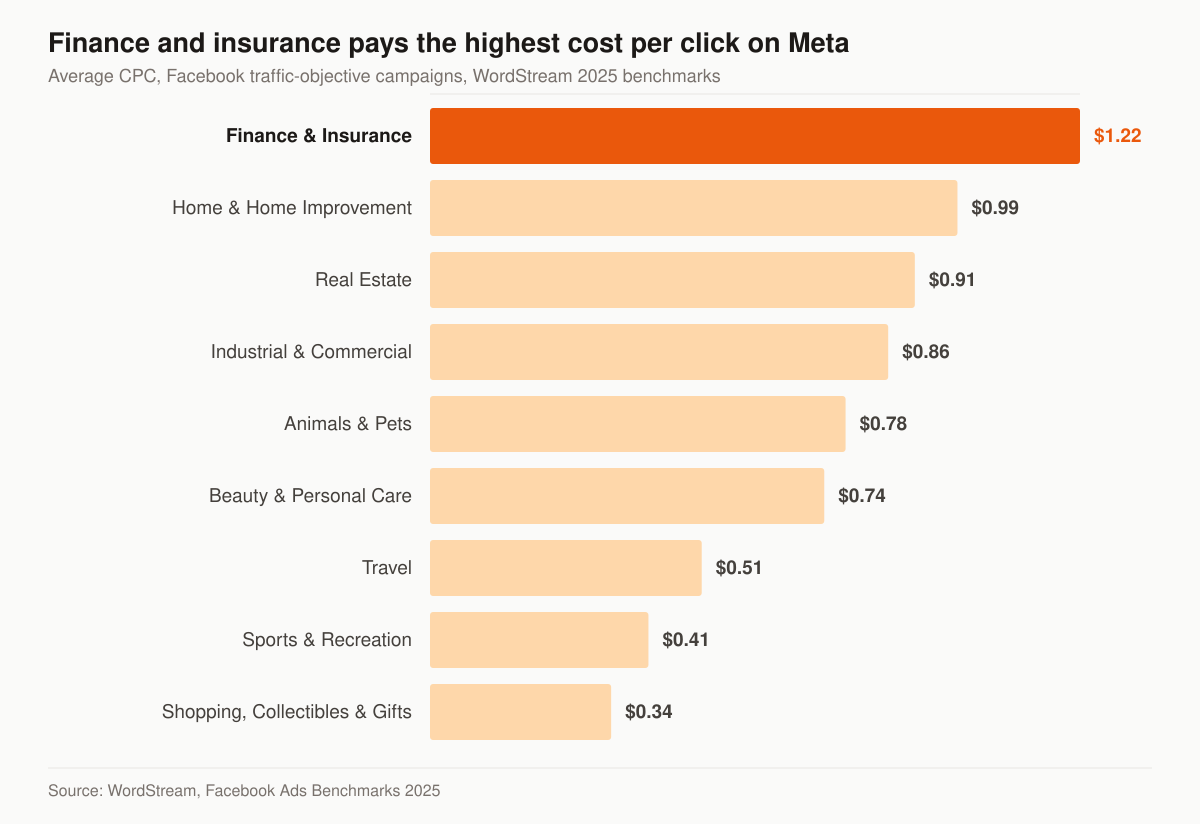
Source: WordStream, Facebook Ads Benchmarks 2025, traffic-objective campaigns. Finance and Insurance pays $1.22 per click against an all-industry average of $0.70, and posts a 0.98% click-through rate against an all-industry 1.71%.
Both halves of that comparison are the story: you pay more per click and get clicked less, which is what a high-consideration financial product looks like in a feed built for impulse. The report’s own explanation is that categories like Finance and Insurance “can’t always rely on compelling visuals” and that only part of the audience is in market at any moment.
The direction of travel matters as much as the level.
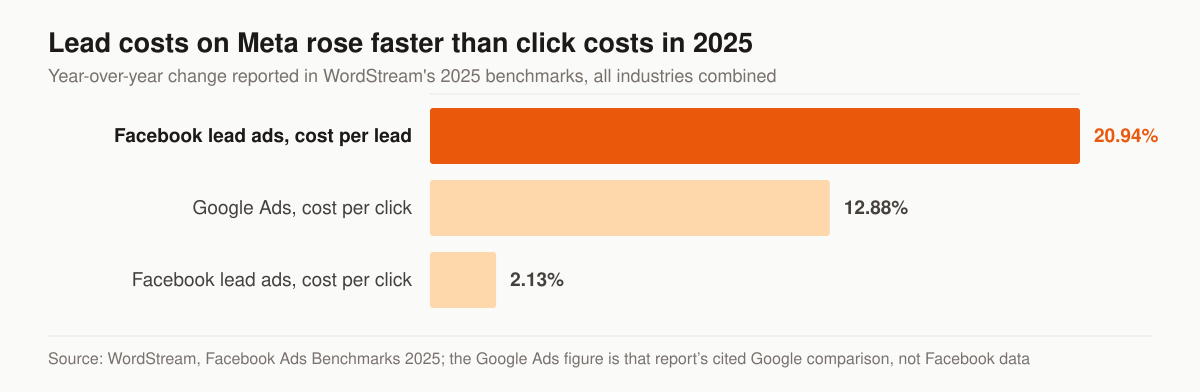
Source: WordStream, Facebook Ads Benchmarks 2025. Leads-objective cost per lead rose 20.94% year over year while cost per click for the same objective rose 2.13%; the report puts the Google Ads cost-per-click increase at 12.88% over the same period.
Read those two bars together and the diagnosis writes itself: the click did not get much more expensive, the lead did. The auction price barely moved while the cost of a completed form jumped, which points at conversion rate rather than bidding. WordStream reports that 12 of 15 industries saw conversion rate fall year over year. For an IUL advertiser that is an instruction rather than a lament — the fixable part of your CPL sits in the form and the offer, not in the bid.
For the cross-channel version of this arithmetic, our comparison of Facebook ads and Google Ads for insurance agencies sets the two auctions side by side, and PPC for insurance covers the search half.
What you may do with the phone number once the form is submitted
Speed-to-lead is the advice every agent has heard. The consent question is separate from the speed question, and it is federal rule text rather than folklore.
The operative paragraph is 47 CFR 64.1200(a)(2). It prohibits initiating, or causing to be initiated, “any telephone call that includes or introduces an advertisement or constitutes telemarketing, using an automatic telephone dialing system or an artificial or prerecorded voice,” to the lines described in paragraphs (a)(1)(i) through (iii) — which include “any telephone number assigned to a paging service, cellular telephone service, specialized mobile radio service, or other radio common carrier service” — other than with “the prior express written consent of the called party”, with narrow carve-outs for tax-exempt nonprofits and certain HIPAA health-care messages. Note the scope: the prohibition attaches to the dialing technology and the line, not to every call a producer places.
The definition of that consent is where a Facebook lead form succeeds or fails. Paragraph (f)(9) defines prior express written consent as “an agreement, in writing, bearing the signature of the person called that clearly authorizes the seller to deliver or cause to be delivered to the person called advertisements or telemarketing messages using an automatic telephone dialing system or an artificial or prerecorded voice, and the telephone number to which the signatory authorizes such advertisements or telemarketing messages to be delivered.” The agreement must carry a clear and conspicuous disclosure that signing authorizes those calls, and that the person “is not required to sign the agreement (directly or indirectly), or agree to enter into such an agreement as a condition of purchasing any property, goods, or services.” An electronic or digital signature counts where it is valid under applicable law.
This table turns each requirement in the rule into the field or setting it becomes inside a Meta instant form.
| What the rule requires | Where it lives in the campaign |
|---|---|
| Consent in writing, bearing a signature | A consent block in the form’s custom questions, captured with the submission record |
| The specific number authorized | The phone field, stored with the consent record rather than beside it |
| Disclosure naming autodialed or prerecorded calls | Disclaimer text on the form, not on the landing page it links to |
| Disclosure that signing is not a condition of purchase | The same disclaimer block, in the same type size |
| Proof of what the person saw | A dated screenshot of the live creative and form, kept with the lead record |
| Revocation honored within ten business days | A CRM suppression path wired before launch, not after the first complaint |
That last row is its own rule. Paragraph (a)(10) lets a called party revoke consent “by using any reasonable method to clearly express a desire not to receive further calls or text messages from the caller or sender.” It names the words that constitute revocation per se in a reply text — “stop,” “quit,” “end,” “revoke,” “opt out,” “cancel,” or “unsubscribe” — and requires that all revocation requests “made in any reasonable manner must be honored within a reasonable time not to exceed ten business days from receipt of such request.” It also forbids designating an exclusive means of revoking.
None of this is legal advice, and state telemarketing statutes sit alongside the federal rule rather than under it. What we do is build the form and the follow-up path to the language your counsel approves, then keep the artifacts that show what a lead saw. The lead-buying version of the same question is covered in TCPA compliance for insurance agents buying leads, and the cadence that follows consent is in our lead follow-up cadence guide.
Targeting and scaling inside the restrictions
- Start broad, because you have no alternative. With interests restricted to an approved list and lookalikes gone, the optimizer needs conversion signal to find buyers. Over-narrow targeting starves it and the panel will not let you narrow much anyway.
- Upload funded clients as a custom audience, not as a lookalike seed. Meta lists custom audience inclusion, exclusion and expansion among supported features, and lookalikes among removed ones. The funded-client list still earns its keep as an exclusion on prospecting and an inclusion on cross-sell.
- Retarget engaged video viewers with a second, deeper asset. Warm audiences survive the category, so this is where the qualified appointments concentrate.
- Feed conversions back via the Conversions API so optimization survives signal loss. When the audience panel is fixed, the conversion event is the targeting.
- Plan geography by city and state, not by pin. A 15-mile radius floor and no location exclusion means separate campaigns per market, so a wasted impression is visible rather than buried.
- Treat creative volume as the budget line that used to be targeting. When the panel is fixed, the ad is the only variable left that you control.
Why an IUL campaign gets rejected, and what the error means
Rejections on financial accounts feel arbitrary until you read the error strings, at which point they resolve into a short list of build mistakes.
This table pairs the enforcement text Meta publishes with the fix on an IUL account.
| What you see | Meta’s published text | What to change |
|---|---|---|
| Certification required, error 2859024 | “A business admin must review and accept our non-discrimination policy before you can run ads” | A business admin accepts the policy in Business Settings before launch day |
| Custom age selection unavailable | “You must select the age range 18-65+ for your audience” | Stop selling age targeting as a deliverable; move the filter into the form |
| Lookalike audiences unavailable | “Using Lookalike Audiences is unavailable when running ads in this Special Ad Category” | Rebuild the audience as a customer-list custom audience |
| Location radius unavailable | “You must include a radius of at least 15 miles (or 25 kilometers) from any selected city, address, or dropped pin” | Re-plan coverage by metro and price the overspill in |
| Detailed targeting unavailable | “Some of the detailed targeting options you selected aren’t available when running ads in this Special Ad Category” | Drop the interest stack; let the hook self-select |
| Ads paused after review | “If you send us an incorrect special_ad_category, there is a risk your ads will be paused until the campaign is adjusted” |
Declare the category at campaign creation rather than after a rejection |
Meta’s separate advertising standard for financial and insurance products adds two constraints that catch IUL creative. Its published wording is that “Ads promoting credit cards, loans or insurance services must be targeted to people 18 years or older.” It adds that advertisers promoting financial products and services “may be required to verify their business and/or individual identity and demonstrate they are authorized by the relevant regulatory authorities where this is a requirement”, subject to Meta’s own review. The same standard says Meta prohibits “ads that directly request the input of any personally identifiable information or certain types of financial information”, which rules out the “enter your policy amount” style of qualifying field in the ad unit itself. And for ads targeting the United States, Meta says ads can’t “Promote investment products or opportunities that suggest user interaction with the advertiser via on-platform or off-platform direct messaging services” — the comment-for-a-DM mechanic that IUL creators lean on.
What to measure, and when each number becomes readable
Paid reporting fails IUL programs the same way search reporting does: the agency reports leads, the producer wants issued cases, and nobody agreed in advance which number is legible when.
This table sets the reporting sequence for an IUL paid-social program, ordered by the point at which each figure starts telling the truth.
| Metric | What it tells you | When it becomes reliable |
|---|---|---|
| Ad approval and delivery | Whether the category and creative cleared review | Day one to day three |
| Cost per click and hold rate | Whether the hook works on a cold audience | Week one |
| Cost per lead | Whether the form and offer match the hook | Week two to four |
| Contact and set rate | Whether follow-up speed and consent are wired | Week two onward |
| Cost per kept appointment | Whether the leads are real | Week four onward |
| Cost per issued case | Whether the channel pays | Month three onward |
Two build requirements make that sequence possible, and both are marketing work rather than reporting work. The lead source has to be written into the CRM at capture, and the case outcome has to be written back against it. Without the write-back, the program gets judged on cost per lead forever, because nothing further down the funnel ever reaches the report. The same instrumentation feeds IUL appointment setting and the organic side in IUL agency SEO.
What managed IUL Facebook ads cost, and which tier they sit in
Our rates are published rather than quoted, and they do not move by niche. Managed programs run $2,500 per month at Foundation, $3,500 at Growth and $5,500 at Full-Funnel, with a one-time website build of $2,500–$8,000. Ad spend is billed at cost, straight to Meta, and never marked up. Programs run month to month.
This table shows where the paid-social work described on this page sits across the three published tiers.
| Tier | Monthly | What it carries for an IUL paid-social program |
|---|---|---|
| Foundation | $2,500 | Optimized website and landing pages, local SEO and Google Business Profile, on-page SEO, monthly reporting |
| Growth | $3,500 | Everything in Foundation, plus the ongoing SEO and content engine, AI-search visibility, and reputation and reviews |
| Full-Funnel | $5,500 | Everything in Growth, plus managed paid ads on Google and Meta, landing-page CRO, marketing automation and CRM, full-funnel reporting |
Managed Meta campaigns sit at Full-Funnel, because that is the tier the paid-ads management and landing-page CRO live in. Foundation is the right start when the destination page is the constraint and there is nothing worth sending traffic to yet. The tier-by-tier detail, including what the monthly fee does not include, is on the pricing page.
Where IUL Facebook campaigns stall
Four failure modes are what we check for first on an IUL paid account, and none of them is a bidding problem.
The campaign was built for the old panel. Age bands, ZIP radii and interest stacks were promised in the proposal and refused by the platform, so the account launched with a broken audience and a confused optimizer. The rebuild is structural, not tactical.
The creative pairs a number with nothing. A growth figure or an illustration screenshot runs without the guaranteed side at equal prominence, which is a state advertising-rule exposure before it is a Meta problem, and the producer’s name is on it rather than the agency’s.
The consent block was an afterthought. The form collects a phone number with no written-consent language, and the follow-up sequence that was sold as speed-to-lead is the part counsel later asks about.
The lead lands somewhere that cannot book. Ranking and reach are the cheap half. If the destination buries the calendar under three scroll-lengths of product explanation, the program produces readers rather than appointments — which is the argument for treating IUL web design as part of the ad budget. If you want that read on your own account before committing to anything, get in touch.
The proof behind the playbook
We don’t run IUL ads on theory. We run our own senior-market lead operation — live campaigns, not slides — and the same conversion systems and ad discipline transfer straight to indexed universal life. You can see how the broader strategy fits together on the IUL agent marketing pillar, how organic generation works in how to generate IUL leads with marketing, and how paid social slots into your whole presence via our insurance social media service.
If your goal is to buy indexed universal life leads as a finished product rather than build the ad engine yourself, that’s a different model — you can buy leads direct from getinsureleads. This page is about owning the generation system.
Start with a number, not a guess
Before you spend another dollar on indexed universal life Facebook ads, get the math checked. Our free marketing audit reviews your current creative for compliance flags, checks that the campaign is declared and built for the financial products and services category, models your funnel from CPL to funded case, and tells you whether paid social is the right channel for your book — or whether PPC would convert your traffic more efficiently.