How to Generate IUL Leads With Marketing
To generate IUL leads you have two levers: build an owned marketing engine — content, SEO, paid ads, landing pages that capture tax-free-retirement intent — or buy leads from a vendor. Building costs more upfront but compounds, and the leads arrive pre-educated. Buying is faster to first appointment but the meter never stops. Agents who scale run both.
IUL is a considered sale. Nobody fills out a form at 11pm and buys indexed universal life by Friday — they need to understand caps, downside protection, and why “tax-free retirement income” isn’t a pitch but a mechanism. That single fact decides how you generate IUL leads. You’re not buying clicks; you’re building a system that finds people early and walks them to a suitability conversation.
This post is the operator’s version of the build-vs-buy decision: what the market actually looks like, what vendors publish as prices, the consent that travels with a purchased lead, the channels that pull weight, and where buying still makes sense. We run our own insurance lead operation, so the method here is what we operate rather than a slide — the figures below come from published sources, each one named where it appears.
The two ways to generate IUL leads
There are only two. You build an owned marketing engine, or you buy leads from a vendor. Everything else is a flavor of one of these.
The row that decides most of this is the fourth one: whether the money you spend leaves an asset behind.
| Build (owned engine) | Buy (vendor leads) | |
|---|---|---|
| Time to first lead | Days (paid) to months (SEO) | Same day |
| Cost trend over time | Falls as content/pixel mature | Flat — meter never stops |
| Lead quality | You control intent and education | Whatever the seller ships |
| You own the asset? | Yes — pages, list, pixel data | No — you rent each lead |
| Who wrote the consent language | You did | The lead generator did |
| Best for | Long pipeline, lower long-run CPL | Filling the calendar this week |
The mistake agents make is treating this as either/or. The agents who actually scale IUL run both — buy to keep appointments on the books now, build so that in twelve months the leads they generate themselves cost less than the ones they rent.
Who is buying IUL right now, and what that tells you about your lead
Before you pick a channel, look at the shape of the market you are fishing in. LIMRA’s individual life insurance industry sales survey reported that industry-wide new annualized premium exceeded $17.5 billion in 2025, up 10% year over year, and that the number of policies sold rose 7% for the year. Inside that total, indexed universal life new premium reached a record-high $4.5 billion, 17% higher than 2024, while IUL policy sales increased 8%. IUL new premium represented 25% of the total US life insurance market in 2025.
Two of those numbers do not move together, and the gap is the useful part.
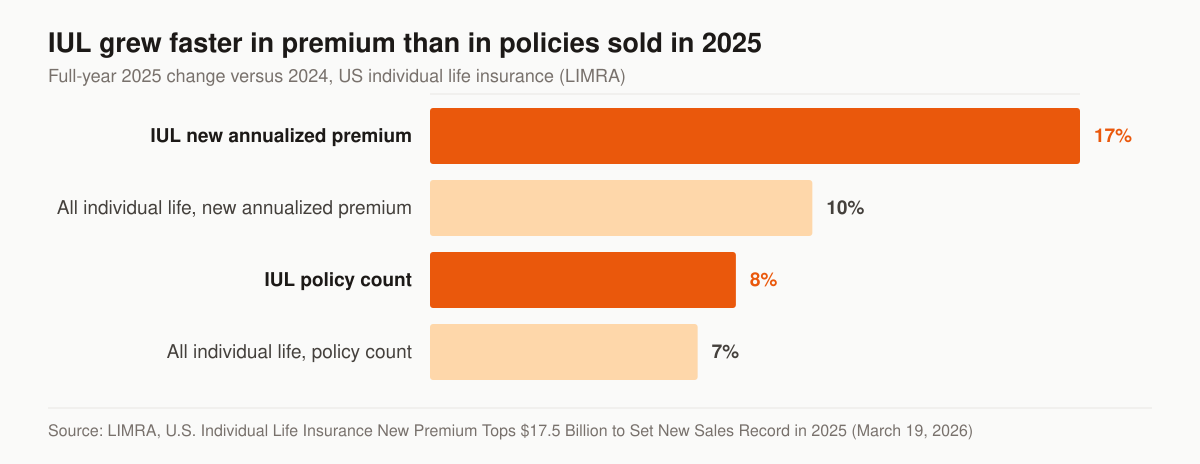
On both lines, new premium grew faster than the number of policies sold. Source: LIMRA, U.S. Individual Life Insurance New Premium Tops $17.5 Billion to Set New Sales Record in 2025, March 19, 2026. LIMRA states that its Retail Individual Life Insurance Sales Survey “represents 85% of the U.S. life insurance market.”
Premium rising faster than policy count means the average case got larger, not that a wave of new buyers arrived. For a lead-generation plan, that points one direction: the marginal dollar is better spent qualifying harder than filling faster. A funnel tuned to produce a high count of low-information form fills is aimed at the slower-growing half of that chart.
LIMRA attributed the year to distribution and product as much as demand. Karen Terry, corporate vice president and head of LIMRA Insurance Research, said: “Broader distribution, enhanced products and a strong equity market all contributed to the IUL growth in the fourth quarter and in 2025.” The same release states that “LIMRA is forecasting double-digit IUL sales growth in 2026, supported by the increased distribution reach as additional products become available.” Read that as competitive context: more agents will be appointed to sell this product into the same search results you are trying to rank in. Our IUL agent marketing services page lays out what claiming that territory involves.
The economics, honestly
A bought lead has a published price, and the published price is the easy part to compare. ActiveProspect, which sells consent-verification tooling to lead buyers, publishes bands for life insurance leads specifically.
These are bands for life insurance, not a blended average across auto, home and health — the numbers below sit at the high end of the market for exactly that reason.
| Lead type | Published band (life insurance) | What the price is buying |
|---|---|---|
| Aged | $5 to $15 per lead | Older data; ActiveProspect notes “reduced response and conversion rates” |
| Shared web | $20 to $45 per lead | The same record sold to several agents |
| Exclusive | $75 to $150 per lead | One buyer, no race to the phone |
| Real-time exclusive or live transfer | $80 to $200+ per transfer | A warm handoff to a person already on the line |
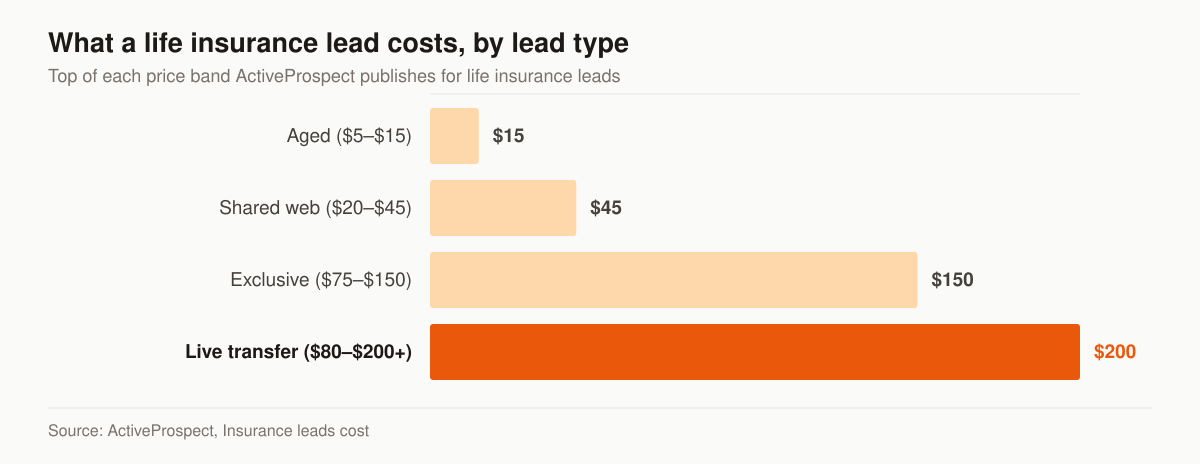
Top of each published band. Source: ActiveProspect, Insurance leads cost.
None of those numbers improves with time. Buy a hundred next month and they cost the same, minus any volume discount. ActiveProspect’s own framing of the downstream math is worth quoting rather than paraphrasing, because it is a vendor telling buyers the sticker price is not the number that matters: “Industry analysis of purchased life insurance leads shows that, after you factor in close rates (often in the 2 to 3 percent range) and the time required for follow-up, the total acquisition cost per life client can easily reach $2,000 to $3,000.” That is their characterization of industry analysis, not a figure we measured — treat it as a reason to instrument your own funnel, which the measurement section below covers.
An owned engine inverts the curve. Months 1 through 4 your blended cost-per-lead looks ugly because you’re paying for content, pages, and ad testing before anything compounds. Then articles start ranking, your retargeting pool fills, and the pixel learns who converts. Marginal CPL drops, and the pages keep working on months you spend nothing new on them.
We run our own final-expense lead operation across live campaigns, so the method here is what we operate, not theory. IUL is a higher-consideration, higher-premium product, so its CPL won’t match a cheap final-expense lead — but the same discipline (tight targeting, education-led creative, relentless nurture) is what makes an owned IUL engine beat a rented one over time. That transfer of method, not a final-expense lineage claim, is the point.
The four channels that produce IUL leads
You don’t need ten channels. You need four working together.
- SEO and content. Capture people already searching “is IUL a good investment,” “tax-free retirement,” “cash value life insurance.” High intent, slow to build, lowest long-run cost. This is the foundation — see how we approach search and AI-search visibility for IUL agents.
- Paid social. Facebook and Instagram create demand you can’t capture from search alone. Education-led creative, disciplined audience targeting, and ad copy that survives platform review. Our breakdown of running Facebook ads for IUL prospecting covers the creative and targeting specifics.
- Landing pages. Traffic from search and social means nothing if it lands on a generic homepage. Purpose-built pages — one offer, one form, one promise — are what turn a click into a lead, and they are where your consent language lives. Our insurance landing page work treats the disclosure as part of the design rather than a footer afterthought.
- Email and SMS nurture. We plan on the assumption that a form fill is not a buyer today. Nurture turns “not now” into a booked call over 60 to 90 days, and for a high-consideration product that is where a large share of appointments come from. If booking calls is your bottleneck, our appointment-setting system for IUL agents sits on top of the nurture layer, and our guide to lead follow-up cadence covers the timing.
The throughline: search and paid bring people in, pages convert them, nurture closes the gap. Pull one out and the math breaks.
The consent is the thing you are actually buying
Agents compare lead vendors on price, exclusivity and freshness. The fourth attribute is the one that decides whether the lead is safe to dial, and it is the one that never appears on the pricing page: what the consumer agreed to, in writing, before their record was sold.
Federal law puts that in a specific place. Under 47 CFR 64.1200(f)(9), the term prior express written consent means “an agreement, in writing, bearing the signature of the person called that clearly authorizes the seller to deliver or cause to be delivered to the person called advertisements or telemarketing messages using an automatic telephone dialing system or an artificial or prerecorded voice, and the telephone number to which the signatory authorizes such advertisements or telemarketing messages to be delivered.” The written agreement has to carry a clear and conspicuous disclosure telling the signer that they are authorizing those calls and that they are “not required to sign the agreement (directly or indirectly), or agree to enter into such an agreement as a condition of purchasing any property, goods, or services.” A signature can be electronic or digital, “to the extent that such form of signature is recognized as a valid signature under applicable federal law or state contract law.”
Note the scope limiter: that definition governs calls made with an automatic telephone dialing system or an artificial or prerecorded voice. Manually dialing a number is a different analysis, and the do-not-call rules in the next section apply on their own terms regardless.
The Eleventh Circuit spent twenty-six pages in 2025 describing exactly how the lead a vendor sells you comes into existence. In Insurance Marketing Coalition Limited v. FCC, No. 24-10277 (11th Cir. Jan. 24, 2025), the court set out the mechanic: “Consumers visit the comparison-shopping website and enter information about themselves and the product they want to purchase,” then “The website then sells the ‘leads’—i.e., the consumers’ information—to the matched affiliates so that the affiliates can robocall or robotext the consumers with offers, quotes, or some other message.”
What the court decided matters to anyone budgeting for purchased leads. The FCC’s 2023 Order would have required that consent name one seller at a time and that the calls be “logically and topically associated with the interaction that prompted the consent.” The court vacated it, holding that the restrictions “impermissibly conflict with the ordinary statutory meaning” of the phrase, and summarizing the statute in a sentence worth memorizing: “Callers must obtain ‘prior express consent’—not ‘prior express consent’ plus.” The disposition was “PETITION GRANTED; ORDER VACATED IN PART AND REMANDED.”
The practical consequence for a lead buyer runs the opposite way from how it is usually reported. Because one-to-one consent is not required, a single checkbox on a comparison-shopping site can again name a list of partners, and your agency can be one of the names on it. That is legal. It is also a very different thing from a prospect who read your page, understood what an IUL is, and typed their number into your form — which is the practical case for building rather than renting.
Two more provisions decide what happens after the first call. Section 64.1200(a)(10) says a called party may revoke consent “by using any reasonable method,” and that replying to a text with “stop,” “quit,” “end,” “revoke,” “opt out,” “cancel,” or “unsubscribe” is a reasonable means per se. All revocation requests “made in any reasonable manner must be honored within a reasonable time not to exceed ten business days from receipt of such request,” and callers “may not designate an exclusive means to request revocation of consent.” Paragraph (a)(11) adds that using some other route — a voicemail or an email to a number or address intended to reach the caller — “creates a rebuttable presumption that the consumer has revoked consent” once the called party produces evidence the request was made. The FCC adopted that ten-business-day clock in its Strengthening the Ability of Consumers To Stop Robocalls final rule.
Every one of those obligations attaches to you, the caller, not to the vendor who sold you the record. The compliant framing of the offer itself is a separate discipline, covered in our guide to IUL marketing compliance.
The do-not-call clocks that run before you dial
Consent is one gate. The national do-not-call registry is a second, and it runs on its own set of deadlines. These are the ones that decide whether a lead sitting in your CRM is still callable.
Every figure in this table is written into 47 CFR 64.1200 — read it against your dialer settings, not against your vendor’s assurances.
| Clock | What the rule says | Provision |
|---|---|---|
| Registry version you scrub against | A version “obtained from the administrator of the registry no more than 31 days prior to the date any call is made” | §64.1200(c)(2)(i)(D) |
| Calling hours | No telephone solicitation to a residential subscriber “before the hour of 8 a.m. or after 9 p.m. (local time at the called party’s location)” | §64.1200(c)(1) |
| Relationship built on a purchase or transaction | Eighteen (18) months immediately preceding the date of the call | §64.1200(f)(5) |
| Relationship built on an inquiry or application | Three months immediately preceding the date of the call | §64.1200(f)(5) |
| Honoring a company-specific do-not-call request | Within a reasonable time that “may not exceed ten (10) business days from the receipt of such request” | §64.1200(d)(3) |
| Keeping that request on your internal list | “A do-not-call request must be honored for 5 years from the time the request is made” | §64.1200(d)(6) |
Three of those rows change how you should think about buying leads.
Start with the three-month inquiry window, because an aged lead is defined by being old. Once a file passes three months from the inquiry, the inquiry-based established business relationship in §64.1200(f)(5) has expired, whatever the vendor calls the product. If a number on that file is on the registry, you need the prior express invitation or permission route in §64.1200(c)(2)(ii) — which the rule says “must be evidenced by a signed, written agreement between the consumer and seller which states that the consumer agrees to be contacted by this seller and includes the telephone number to which the calls may be placed.” That is a document, and it either came with the file or it did not. Our page on aged final expense leads works through the same arithmetic on a cheaper product.
The second row worth reading twice is §64.1200(d)(3)’s allocation of blame: “If such requests are recorded or maintained by a party other than the person or entity on whose behalf the call is made, the person or entity on whose behalf the call is made will be liable for any failures to honor the do-not-call request.” Outsourcing the suppression list does not outsource the liability.
The third is the safe harbor in §64.1200(c)(2)(i). It is not automatic. It asks for written procedures, trained personnel, a recorded list of numbers you may not contact, the 31-day registry process with records documenting it, and a purchasing process that does not share registry access costs. An agency that dials purchased IUL leads without those five artifacts has no safe harbor to point at.
None of this is legal advice — we build marketing systems, and you are the licensed party. It is the reason the consent architecture of a funnel is a design decision rather than a legal afterthought, and it is a large part of what our lead generation work actually consists of.
A 90-day plan to start generating IUL leads
- Weeks 1–2: Stand up one focused landing page and conversion tracking. Pick a single angle — tax-free retirement income or college-funding for younger earners — not everything at once. Write the consent language on the form before you write the headline.
- Weeks 2–6: Launch paid social with 3–4 education-led creatives. Feed every form-fill into an automated nurture sequence on day one.
- Weeks 3–12: Publish content targeting the questions IUL buyers actually search. These won’t rank instantly, but they’re the assets that drop your CPL later. Our post on marketing tax-free retirement to clients covers how to frame that topic without tripping carrier review.
- Ongoing: Watch cost-per-appointment, not just cost-per-lead. A $45 lead that books at twice the rate beats a $20 lead that ghosts.
For the full picture of how these pieces fit into one engine, our IUL agent marketing services lay out the system end to end, and the IUL-specific website and funnel build is where the landing-page layer lives.
What to measure before the build-versus-buy argument starts
Build-versus-buy arguments stall when the two sides quote different metrics. The vendor quotes cost per lead. The agency quotes cost per placed policy. Neither number settles anything on its own, and the honest fix is to instrument the same five steps for every source you use, bought and owned alike.
This is the ladder we set up, in this order:
- Contact rate. Of the records that arrived, how many produced a live conversation. This is where a $15 aged file and a $150 exclusive one stop looking comparable, and it is measurable inside a week.
- Appointment set rate. Of the live conversations, how many ended with a time on the calendar. A source that talks well and books badly we read as a targeting problem before a script problem.
- Appointment held rate. Set and held are different numbers, and the gap between them is a nurture and reminder problem you can fix without touching the lead source at all.
- Application submitted rate. For IUL this is the first step that reflects suitability rather than interest, which is why it moves independently of everything above it.
- Placed and paid rate. Underwriting and first-premium collection sit between an application and revenue. A source can look strong at step four and weak here.
Then divide spend by step three, not step one. Cost per appointment held is the number that lets an exclusive lead at the published $75 to $150 band and a month of content spend sit in the same column and be compared. Track it by source and by week, not as a lifetime average, because a lifetime average hides the month a vendor’s quality changed.
Two disciplines make the ladder honest. Attribute at the point of capture rather than reconstructing it later from memory, and keep bought and owned cohorts separate all the way to placement, because blending them is what produces the “our leads close at X%” claim that nobody can reproduce.
When buying leads is the right call
Building is the long game, but sometimes the calendar can’t wait. If you’ve got open appointment slots this week, capacity to dial, and you’d rather not let production stall while content ramps — buying leads is a rational move, not a failure of nerve. It also pairs cleanly with an owned engine: buy for near-term volume, build for long-term cost.
Three conditions make the purchase a good one rather than a habit. You have a dialer and a person to work the file the day it lands, because freshness is the whole of what a real-time lead offers over an aged one. You have the consent record for every number, in the form §64.1200(f)(9) or §64.1200(c)(2)(ii) describes, and you keep it. And you have the measurement ladder above running, so the decision to renew is a number rather than a feeling.
One boundary: we build the marketing systems that generate leads — we don’t sell leads on this site. If your move right now is to buy IUL leads, live transfers, or appointments directly, that’s a different transaction. You can buy insurance leads direct from getinsureleads, our sister brand, and keep the two clean: their meter for volume now, our engine for the asset you own later.
What building the engine costs
The reason build-versus-buy stays theoretical for a lot of agents is that the buy side has a price list and the build side does not. Ours is published. Managed programs run at three flat monthly tiers — Foundation at $2,500, Growth at $3,500 and Full-Funnel at $5,500 — with a one-time website and funnel build at $2,500 to $8,000, month to month and no lock-in. Ad spend is a pass-through billed directly to Google and Meta rather than marked up through us. The pricing page lists what sits in each tier.
The comparison to run is not tier price against lead price. It is tier price against the monthly lead invoice you are already paying, plus the fact that one of those two lines leaves pages, a list and pixel history behind at the end of the year and the other does not. If you want the budgeting frame rather than the price list, our guide to the insurance agency marketing budget works through how the split gets set.
Compliance is a conversion advantage
IUL marketing has a trap: overstate the upside and you lose the ad account and invite trouble. Treat the product factually — it’s cash-value life insurance with caps, participation rates, and downside protection, not a guaranteed-return investment. Drop the “get rich” and “guaranteed return” framing entirely. Done right, compliant copy actually converts better with cold audiences because it survives platform review and builds trust instead of triggering skepticism. You’re the licensed party handling suitability; the marketing system just gets qualified people in front of you.
The same logic applies one layer down, at the form. A consent disclosure written to be understood — naming your agency, saying what will be sent, and saying that agreeing is not a condition of anything — is both what §64.1200(f)(9) describes and what a cautious retirement-age prospect wants to read before typing a phone number. Hiding it shrinks neither your obligation nor your bounce rate. The full treatment of what carrier advertising desks and ad platforms will and won’t accept is in IUL marketing compliance.
Where to start
If you only do one thing: stop renting your entire pipeline. Keep buying if you need volume today, but start building the owned engine in parallel so next year’s leads are cheaper and better than this year’s. Want the numbers on your own funnel? Grab a free marketing audit and we’ll map which channel should be producing your IUL leads, and which one to work on first. If your book leans toward retirement-income buyers, the adjacent play is how to get annuity clients with marketing. If you’d rather talk through your states, carriers and current lead sources before anything else, get in touch.
This article is general marketing guidance, not legal or compliance advice. Verify every telemarketing requirement with counsel and with the rules in force in the states where you are licensed.
- Life Insurance Marketing Ideas That Move Policies, Not Just Impressions
Practical life insurance marketing ideas for agents, ranked by cost, speed, and effort, with a comparison table to pick the two you should run first.
- How to Get Annuity Clients With Marketing (Without Buying a Single Lead)
How to get annuity clients without buying leads: a numerate, repeatable system for annuity client acquisition you can run week after week.
- Mortgage Protection Marketing Ideas for Reaching Young Families
Mortgage protection marketing ideas built around how young families actually buy: persona targeting, ad angles, and conversion systems that fit them.
- No Exam Life Insurance Marketing: A Playbook for Reaching Younger Buyers
No exam life insurance marketing for younger buyers: the offer math, the ad disclosure rules, and the funnel that turns a no-exam hook into bound policies.