Mortgage Protection Marketing Ideas for Reaching Young Families
The best mortgage protection marketing ideas start with the buyer, not the product: young families who just closed on a house, carry a 30-year note, and never considered what happens to that payment if a paycheck disappears. Reach them with new-homeowner targeting, 'protect the payment' messaging, and a fast quote path, then back every claim with a number.
Most mortgage protection marketing fails for the same reason: it sells a policy to a person who came online to think about a house. Young families don’t wake up wanting life insurance. They wake up thinking about the 30-year note they just signed and whether they overpaid. The mortgage protection marketing ideas that work meet them inside that thought, not outside it.
Below is the persona-first approach we use to build campaigns, written for agents who’d rather see the mechanism than read another listicle.
Start with the persona, not the product
Picture the actual buyer. They closed on a house in the last 6 to 18 months. Combined household income, two earners or one-and-a-half, a mortgage payment that now dominates the monthly budget. Maybe a kid, maybe one on the way. They have never sized a death benefit in their life and they don’t want a 45-minute lecture.
What keeps that person up is specific and concrete: if one of us is gone, can the other one keep the house? That is the whole pitch. Everything in your funnel should answer that one question fast.
When you market mortgage protection from the buyer’s anxiety instead of the product’s features, three things change:
- Your headline gets shorter. “Keep your family in the house” beats “Affordable mortgage protection life insurance plans.”
- Your form gets shorter. Ask for the mortgage balance and a birthday, not a medical history.
- Your follow-up gets warmer. You’re helping them protect a specific payment, not closing a generic policy.
The buyer data that has to sit behind the persona
The persona above is a real segment. It is not the whole market, and the published survey data is worth reading before you spend, because the picture many agents carry is a decade or two out of date.
The National Association of REALTORS® has run its Profile of Home Buyers and Sellers since 1981. In the 2025 edition, “First-time home buyers dropped to the lowest historical share since data collection began in 1981, dropping to just 21%.” The median first-time buyer is 40 years old, “the highest recorded.” The median repeat buyer is 62; in 1981 that figure was 36. The share of buyers with a child under 18 at home “has dropped to a historic low of 24% of buyers, from a high of 58% in 1985” — 32% among first-time buyers, 22% among repeat buyers. All-cash buyers “remained at an all-time high this year at 26%,” and sellers “have now owned their home for a median of 11 years before selling.”
Read the survey as a targeting brief rather than as background reading.
| NAR 2025 figure | Value | What it does to a young-family campaign |
|---|---|---|
| First-time buyer share | 21% | Only 21% of buyers are buying a first home; “congrats on your first house” misses the rest |
| Median age, first-time buyers | 40 | The couple in your creative is probably younger than the buyer reading it |
| Median age, repeat buyers | 62 | A second, older mortgage-holding segment exists and needs its own ad |
| Buyers with a child under 18 | 24% | Child-centered imagery speaks to the 24% who have one at home |
| All-cash buyers | 26% | 26% of buyers took no mortgage, so there is no payment to protect |
| Median years owned before selling | 11 | The loan is still there years after the close, and so is the coverage gap |
None of that kills the young-family angle. It sizes it. Run “young families” as one campaign with its own creative and its own landing page, and let a second campaign speak to the older repeat buyer carrying a mortgage toward retirement. Trying to make one ad serve both is how CPL drifts and nobody books.
The second dataset worth reading is the demand side. The 2026 Insurance Barometer Study, run annually by LIMRA and Life Happens, surveyed more than 5,200 US adults ages 18 to 75 who share responsibility for household financial decisions. It reports that 48% of American adults do not own life insurance, and 38% — roughly 92 million adults — say they need coverage or need more than they have. Among Gen Z adults, 44% already own coverage and 45% report a need gap.
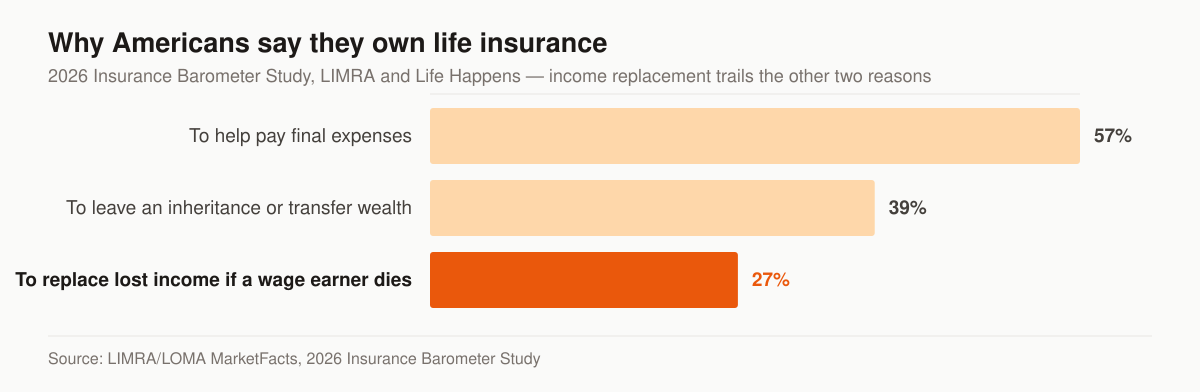
Why Americans say they own life insurance. Source: LIMRA/LOMA MarketFacts, 2026 Insurance Barometer Study.
Look at the bottom bar. The study reports that 57% own life insurance to help pay final expenses, 39% to leave an inheritance or transfer wealth, and 27% to replace lost income if a wage earner dies. Income replacement — the exact job a mortgage protection policy does — is cited by 27%. That is the gap your campaign is selling into. You are not competing for a motive the buyer already holds; you are installing one, which is why the creative has to make the loss concrete and the next step small.
The messaging that lands with young families
Young families respond to plain, payment-anchored language. Drop the words “premium,” “underwriting,” and “beneficiary” from your top-of-funnel creative. Use them later.
The rewrite below is the whole method in six lines: name the payment, not the product.
| Generic angle (weak) | Persona angle (strong) |
|---|---|
| “Get a life insurance quote” | “Protect the payment that keeps your family home” |
| “Affordable coverage options” | “Coverage sized to your mortgage, from a few dollars a day” |
| “Comprehensive financial protection” | “If something happens to you, the house is paid off” |
| “Speak to a licensed agent today” | “See your number in 60 seconds” |
The right column works because it names the thing the buyer already cares about. That’s the entire trick of persona marketing: you don’t create the desire, you connect to one that already exists. If you want the sentence-level version of this, our note on insurance copywriting covers how to write the hook and the form label so they promise the same thing.
There is one more lever in that right column, and the survey data says it is the one agents under-use.
Price is the objection, so put a real number in the creative
The 2026 Insurance Barometer Study is blunt about why the coverage gap persists. LIMRA reports the barrier in one sentence: “The most cited reason for going without coverage is the belief that it costs too much.” It then quantifies how wrong that belief is: “The study finds that healthy adults under age 30 overestimate the cost of a typical term life insurance policy by 5 to 6 times.”
The other two barriers are not conviction either. “Among those with a coverage gap, one-third say they aren’t sure how much life insurance they need or what type of policy to buy. Another third say they simply haven’t gotten around to it.” And 37% of Americans “describe themselves as only somewhat knowledgeable, or not knowledgeable at all, about life insurance.”
Nothing in that list is an objection to your product. All three are friction, and friction is what an ad and a landing page can remove.
Match each reported barrier to the asset that clears it, then build that asset.
| Barrier the study reports | Share reporting it | What removes it |
|---|---|---|
| Belief that coverage costs too much | “The most cited reason for going without coverage” | A real premium example on the ad and above the form |
| Unsure how much or what type to buy | One-third of those with a gap | A one-input calculator: mortgage balance in, face amount out |
| Haven’t gotten around to it | Another third of those with a gap | A booked time, not a callback promise |
| Only somewhat or not at all knowledgeable | 37% of American adults | Two short lines on what the policy pays and to whom |
A word of caution on the price line, because it is the one that gets agents in trouble. A number in an ad is a representation. It has to come out of a live quote for a stated profile — age, term, face amount, health class — and the ad has to name that profile. “From $X/month for a 35-year-old, non-tobacco, $300,000, 30-year term” is defensible. “From $X/month” alone is not.
Where to find them: channel and targeting
New homeowners leave a trail. The marketing job is to be present at the moments right after a close, when the mortgage is top of mind and coverage is an obvious gap.
- Facebook and Instagram lead ads — still the volume channel for this niche, but read the compliance note below before you build the campaign.
- Search and local SEO — people who search “mortgage protection insurance” are mid-decision; capturing that intent compounds over time and doesn’t reset when you pause ad spend.
- Referral loops with realtors and loan officers — they touch the buyer at the exact moment of the close. A simple co-branded landing page can turn one closing into a warm intro, and the section below covers the federal rule that governs how those arrangements get paid.
- Direct mail to recent closings — old-school, but recent-mover data is clean and the audience is unmistakably in-market. Our final expense mailer templates post covers the format and postage mechanics; the copy changes for this audience, the production math does not.
For the ad-driven side, our mortgage protection lead-generation playbook breaks down the funnel math, and the Facebook ads approach for this niche covers creative and audience structure in detail.
Two findings in the Barometer study should shape where that budget goes. On research behavior: among Americans who use social media, “66% use YouTube to learn about financial products and services, and 62% use Facebook for financial education,” and “Nearly half (46%) say it’s important for financial professionals to connect with them on social media.” A YouTube channel that answers mortgage protection questions in three minutes is not a vanity project for this audience; it is where they check you.
On buying moments, the study asked Gen Z adults where they would consider purchasing life insurance: “Forty-four percent would consider purchasing life insurance when opening a checking or savings account. A third would be interested after the birth of a child (34%), through a credit card membership (32%), or through a gym or wellness program (32%).”
Build the calendar around trigger moments, because that is how this buyer thinks about it.
| Trigger moment | Signal you can act on | Channel that fits |
|---|---|---|
| Closing on a house | Recent-mover and new-deed data | Direct mail, co-branded referral page |
| Birth of a child | 34% of Gen Z would consider buying after it | Meta creative, email to existing P&C book |
| Opening a bank account | 44% of Gen Z would consider buying then | Partner and community placements |
| Refinance or rate change | Loan reset, payment change | Email and retargeting to your own list |
| Anniversary of the close | Your own CRM date field | Automated email and a call task |
That last row is the one agents skip. The NAR figure above — sellers had owned for a median of 11 years — means the person who closed three years ago is still in the house, still carrying the note, and still uncovered. A single annual touch to everyone who ever quoted with you costs nothing and reaches a segment no new-closing list contains.
Whatever the channel, the leads still have to be worked in minutes rather than evenings. The touch-by-touch schedule is in our insurance lead follow-up cadence, and if any part of that cadence uses an autodialer or a prerecorded voice, read TCPA compliance for insurance agents buying leads before you switch it on.
What Meta’s Special Ad Category does to this campaign
This is the part agents learn the expensive way. Meta introduced a “Financial products and services” Special Ad Category, and its help page on choosing a Special Ad Category states: “Starting January 21, 2025, using this category is required for financial products and services campaigns for advertisers based in the United States or showing ads to audiences in the United States. Ads may be rejected if an appropriate category is not chosen.” Mortgage protection copy that references homeownership can also pull a campaign toward the housing category. The restrictions are the same either way.
Meta lists what goes away: “Certain audience options are limited or unavailable for these ads for advertisers based in or reaching the US and advertisers reaching Canada and certain countries in Europe: age, gender, ZIP code or postal code, exclusion targeting, lookalike audiences and saved audiences. Some interests will also be unavailable when you create your audience. Audiences based on city or pin drop locations will include an expanded radius.” Its own instruction is the opposite of how most ad guides tell agents to build: “We encourage you to broaden—not restrict—your audience.”
So the “homeowners aged 30-50 who recently moved” audience is not available to you, and neither is the saved audience you built last year. Don’t build your strategy on tight demographic targeting you may not be allowed to use. Build it on creative that self-selects the right audience. A “new homeowner? protect your payment” hook does the targeting work that Meta won’t let your audience settings do. We treat compliance as a trust signal, not a hurdle — agents are the licensed parties, and clean campaigns last longer than clever ones that get flagged.
The full build under those constraints — the personal-attributes rule that gets hooks rejected, the fields the instant form may not ask for, and the learning-phase budget floor — is set out in how to run mortgage protection Facebook ads. If you send traffic off-platform instead, the page it lands on does the qualifying, which is what insurance landing pages are built for.
Referral partners: what you may and may not pay a loan officer
Everyone in this niche eventually asks a loan officer or a listing agent for introductions. It is the warmest lead source available. It is also the one with a federal statute attached, and the statute is written broadly enough that an informal arrangement can land inside it.
RESPA’s anti-kickback rule is at 12 CFR 1024.14. Paragraph (b) reads: “No person shall give and no person shall accept any fee, kickback or other thing of value pursuant to any agreement or understanding, oral or otherwise, that business incident to or part of a settlement service involving a federally related mortgage loan shall be referred to any person. Any referral of a settlement service is not a compensable service, except as set forth in § 1024.14(g)(1).”
Read the scope before you read the prohibition. The rule reaches referrals of a settlement service in a federally related mortgage loan, and 12 U.S.C. 2602(3) defines settlement services as “any service provided in connection with a real estate settlement including, but not limited to, the following: title searches, title examinations, the provision of title certificates, title insurance, services rendered by an attorney, the preparation of documents, property surveys, the rendering of credit reports or appraisals, pest and fungus inspections, services rendered by a real estate agent or broker, the origination of a federally related mortgage loan (including, but not limited to, the taking of loan applications, loan processing, and the underwriting and funding of loans), and the handling of the processing, and closing or settlement”.
Life insurance is not one of the items named. Do not read that as a safe harbor: the list is expressly “not limited to” those items. What is unambiguous is the other direction. Loan origination and the services of a real estate agent or broker are both on the list, so when you send a buyer to a loan officer or a listing agent, you are referring a settlement service, and payment for that referral sits inside the rule. Where a loan officer sends a borrower to you the analysis is more fact-specific — and any two-way arrangement between the same parties is exactly the “practice, pattern or course of conduct” the rule then goes looking for.
Three definitions in the same section do the real work.
- “Thing of value” is not limited to cash. Paragraph (d) says the term “includes, without limitation, monies, things, discounts, salaries, commissions, fees, duplicate payments of a charge, stock, dividends, distributions of partnership profits, franchise royalties, credits representing monies that may be paid at a future date, the opportunity to participate in a money-making program, retained or increased earnings, increased equity in a parent or subsidiary entity, special bank deposits or accounts, special or unusual banking terms, services of all types at special or free rates, sales or rentals at special prices or rates, lease or rental payments based in whole or in part on the amount of business referred, trips and payment of another person’s expenses, or reduction in credit against an existing obligation.” Buying the printing, paying for the client-appreciation dinner, or handing over the leads from your own ad account are all transfers of value.
- The agreement does not have to exist on paper. Paragraph (e): “An agreement or understanding for the referral of business incident to or part of a settlement service need not be written or verbalized but may be established by a practice, pattern or course of conduct. When a thing of value is received repeatedly and is connected in any way with the volume or value of the business referred, the receipt of the thing of value is evidence that it is made pursuant to an agreement or understanding for the referral of business.”
- Two exceptions are the ones co-marketing is built on. Paragraph (g)(1)(iv) permits “A payment to any person of a bona fide salary or compensation or other payment for goods or facilities actually furnished or for services actually performed,” and (g)(1)(vi) permits “Normal promotional and educational activities that are not conditioned on the referral of business and that do not involve the defraying of expenses that otherwise would be incurred by persons in a position to refer settlement services or business incident thereto.”
Those two exceptions carry their own conditions, and the conditions are the whole test: the payment has to buy something actually furnished, at a price the section elsewhere ties to “the reasonable value of such goods, facilities or services,” and the activity must not be conditioned on referrals or pick up a cost the partner would otherwise have paid themselves.
Run every proposed arrangement against the text before it starts, not after a regulator asks.
| Arrangement | Where it sits against the rule text |
|---|---|
| Flat fee per closing referred to you | A fee “pursuant to any agreement or understanding” that business shall be referred |
| You pay the loan officer’s share of a joint mailer, they refer | Paragraph (d) counts the print bill as a thing of value; (g)(1)(vi) excludes defraying an expense they would otherwise incur |
| Split cost of a genuinely joint mailer, both logos, both offers, no referral condition | The shape (g)(1)(vi) describes, provided each side pays for its own share and nothing is conditioned on referrals |
| You buy the leads and hand them over “as a favor” | Value transferred repeatedly and tied to volume — the evidence paragraph (e) describes |
| You pay for a co-branded landing page you own and operate | Payment for a facility actually furnished, if the partner is not being paid and the referral is not the consideration |
| You refer buyers to the loan officer for a thank-you cheque | A referral of a settlement service, which the rule says “is not a compensable service” |
The penalties are in the statute rather than the regulation. Under 12 U.S.C. 2607(d)(1), “Any person or persons who violate the provisions of this section shall be fined not more than $10,000 or imprisoned for not more than one year, or both.” Paragraph (d)(2) makes violators “jointly and severally liable to the person or persons charged for the settlement service involved in the violation in an amount equal to three times the amount of any charge paid for such settlement service.” Paragraph (h) of the regulation adds a records duty: “Any documents provided pursuant to this section shall be retained for five (5) years from the date of execution.”
State insurance law sits on top of federal law, and it is not uniform. Illinois, for one, provides that a loan officer of a financial institution “who is involved in the application, solicitation, or closing of a loan transaction may not solicit or sell insurance in connection with the same loan, but such loan officer may refer the loan customer to another insurance producer who is not involved in the application, solicitation, or closing of the same loan transaction” — and exempts institutions other than credit unions with less than $100,000,000 in deposits, and credit unions with less than $30,000,000. That is one state, one statute, and it applies to employees of financial institutions. Your own state’s anti-rebating and producer-licensing rules will have their own shape.
The practical version we use: partners get a co-branded page and a co-hosted first-time-buyer session, each side pays its own costs, nothing is conditioned on volume, and the arrangement is written down before it starts.
What “coverage sized to your mortgage” actually means
“Coverage sized to your mortgage” is a good ad line. It is also two different products, and the buyer cannot tell them apart, so the call has to.
Illinois defines the category in statute as “mortgage life insurance (term or ordinary), mortgage disability insurance, mortgage accidental death insurance, or any combination thereof, including both individual and group policies, and any certificates issued thereunder, on credit transactions of more than 10 years duration and written in connection with a credit transaction that is secured by a first mortgage or deed of trust and made to finance the purchase of real property or the construction of a dwelling thereon or to refinance a prior credit transaction made for such a purpose.” Note what the definition covers and what it does not: it is written around the loan, not around the household.
The same code describes what decreasing term means in practice. Setting a conversion right on group mortgage life policies, it requires an individual decreasing term policy where “The initial amount of coverage under the individual policy shall be an amount equal to the amount of coverage terminated under the group policy and shall decrease over a term that corresponds with the scheduled term of the insured debtor’s mortgage loan.”
That is the fork. A decreasing-term benefit tracks the loan down; a level-term benefit does not. Both are honestly described as “sized to your mortgage” on day one, and they behave differently in year eighteen.
Say the same thing in the ad, then draw the distinction on the call.
| What the buyer hears | What it can actually be | What the call has to establish |
|---|---|---|
| “Coverage sized to my mortgage” | Level term at the original balance, or decreasing term tracking the schedule | Which structure you are quoting, and what the benefit looks like mid-term |
| “The house gets paid off” | A death benefit paid to a named beneficiary, who may choose to pay the house off | That the money goes to the family, and the family decides |
| “It’s tied to my loan” | An individually owned policy, not something the lender bills | Who owns the policy and who receives the benefit |
| “No exam” | Simplified issue or accelerated underwriting, with caps and health questions | The face-amount ceiling and that questions are still asked |
Getting that fork right in the first minute is also a conversion lever, not just a compliance one. The buyer who understands that their family receives the money — not the bank — asks a different second question. If your funnel also sells no-exam term to the same age band, our post on marketing no-exam life to younger buyers covers how to keep the two offers from competing with each other.
Build vs. buy: be honest about your pipeline
You have two ways to fill the calendar, and the right answer is usually both, sequenced.
- Generate your own through a conversion-built website and ads. Higher upfront effort, lower long-run cost per acquisition, and you own the asset. This is where a real mortgage protection agent website earns its keep — a fast site that turns a click into a booked call.
- Buy leads to keep the pipeline warm while you build. If you want to purchase mortgage protection or final-expense leads directly, buy leads direct from getinsureleads — that’s a lead product, and it lives on our sister brand, not here. We sell the marketing systems; they sell the leads.
Keeping that line clean matters. A marketing-services page that quietly turns into a lead vendor confuses the buyer and dilutes both offers.
Why trust this approach
We don’t theorize about lead generation; we run it. We operate our own final-expense and senior-market lead book, so the playbook here comes from live campaigns, not theory.
Mortgage protection is a younger audience than our senior-market hub, so we don’t claim final-expense lineage on it. What transfers is the discipline: the same persona-first targeting, the same payment-anchored messaging, and the same refusal to confuse clicks with closes that we apply for our senior-market clients. You can see the broader system on our mortgage protection marketing hub.
Measure what actually matters
Clicks are vanity. Track the four numbers that decide whether a campaign lives:
Spend against the bottom of this table, not the top.
| Metric | What it tells you | Cut if… |
|---|---|---|
| Cost per lead (CPL) | Front-end efficiency | It rises with no lift in appointments |
| Lead-to-appointment rate | Lead and follow-up quality | Below your channel benchmark for 2+ weeks |
| Appointment-to-close | Offer and agent fit | The leads book but never buy |
| Cost per acquisition | The number that pays you | It exceeds first-year commission value |
A cheap lead that never closes is more expensive than a pricey one that books. Two habits keep that table honest. Set the benchmarks from your own first 30 days of spend rather than a borrowed figure, because CPL in this niche moves with market and offer. And segment the table by campaign — young families and mortgage-carrying near-retirees will not share a CPL, and averaging them hides whichever one is losing money.
What running this costs
The build and the retainer are separate decisions. A one-time website build runs $2,500 to $8,000 depending on scope. Ongoing programs run in three tiers: Foundation at $2,500 per month, Growth at $3,500 per month, and Full-Funnel at $5,500 per month, which is where managed paid ads across Google and Meta sit. Ad spend is billed at cost, straight to the platforms, never marked up. What sits in each tier is set out on our pricing page, and if you would rather talk through which one fits a mortgage protection book, start a conversation.
Next step
If you want a second set of eyes on your current funnel, the math, the messaging, the compliance setup, start with a free marketing audit. And if you sell adjacent products, the same persona logic applies across life insurance marketing; the buyer changes, the discipline doesn’t. One persona worth splitting out here: VA-loan households, where the mortgage, the move, and the service record all sit together — see marketing to veteran and military families.
Pick the persona first. The mortgage protection marketing ideas that convert young families all flow from getting that one thing right.
- How to Run Mortgage Protection Facebook Ads Without Tripping Meta's Rules
How to run mortgage protection Facebook ads inside Meta's Special Ad Category: the targeting Meta removes and the creative that still converts.
- No Exam Life Insurance Marketing: A Playbook for Reaching Younger Buyers
No exam life insurance marketing for younger buyers: the offer math, the ad disclosure rules, and the funnel that turns a no-exam hook into bound policies.
- How to Generate IUL Leads With Marketing
How to generate IUL leads with your own marketing versus buying them. Published lead prices, the consent rules on a bought lead, and the channel plan.
- Life Insurance Marketing Ideas That Move Policies, Not Just Impressions
Practical life insurance marketing ideas for agents, ranked by cost, speed, and effort, with a comparison table to pick the two you should run first.