Who we serve
Mortgage Protection Lead Generation for Agents Who Want to Own the Pipeline
Mortgage protection lead generation for agents builds a system that produces leads you own, ads, landing pages, and follow-up you control, instead of renting a feed of shared leads everyone else is also calling. The economics turn on speed-to-lead and consistent follow-up, not on buying the cheapest list.
Free · 15-minute teardown · no pitch deck
- We run our own final-expense book
- No pitch deck — we screen-share real numbers
- TCPA-aware · CMS/AEP-compliant · Meta Special Ad Category
- Core Web Vitals < 2.0s LCP
Most mortgage protection agents don’t have a lead problem. They have an ownership problem. They rent a shared feed, call the same prospect six other agents are calling, and start over every month with nothing built. Generating your own leads fixes that — you own the traffic, the brand on the callback, and the data.
This page is about generating mortgage protection leads, not buying them. If you want to buy leads, live transfers, or aged data as a product, that’s a clean hand-off: buy leads direct from getinsureleads. Everything here is the build-your-own path.
What mortgage protection lead generation for agents actually involves
A real lead-gen system is four parts working together, not a single ad. Skip one and the math falls apart.
| Component | What it does | Why it moves CPL or close rate |
|---|---|---|
| Targeting | Reaches new homeowners and recent refinancers | Defined trigger event = warmer intent, lower waste |
| Landing page | One offer, one form, no menu | Published benchmarks put insurance landing pages above the financial-services median |
| Speed-to-lead | Auto text + call within minutes | Contact odds fall sharply with delay in the published research below |
| Follow-up | Multi-touch CRM sequence | Sales that arrive after the first conversation leak when follow-up is manual |
The product has a built-in hook: people who just took on a mortgage are thinking about protecting the home. Your job is to be in front of that moment with a single, clear offer — not a generic “get a quote” ad.
The five things people call a mortgage protection lead
Agents compare prices across formats that are not the same product. Before you can judge a cost per lead, you have to know what the number is buying, because the five common formats differ in what the prospect actually did, what permission came with it, and how long it takes to arrive.
This table sets the five formats side by side so a quoted price can be read against what the prospect actually did.
| Format | What the prospect did | Typical arrival | What comes attached |
|---|---|---|---|
| Mail-back response card | Wrote their details on a card and posted it | Weeks after the mail drop | A physical response in the prospect’s handwriting |
| IVR / call-in response | Dialed a number on a mailer and answered prompts | Days after the drop | A recording of the call and the answers given |
| Instant form on Facebook | Tapped through a prefilled in-platform form | Seconds | Platform-supplied contact fields, low friction |
| Landing-page form | Read a page and typed their details in | Seconds | Your own consent text, your own field set |
| Live transfer | Was screened by a call center and handed over | Live, on the phone | A prospect already talking to someone |
Two of those are direct-mail products, and the vendors who sell them are explicit about the sequencing. Insurance Marketing Hub’s live mortgage protection page describes the mail-back route as leads “generated when a homeowner fills out and returns a physical response card sent via direct mail”, and the IVR route as leads “from homeowners who call a toll-free number and provide their information verbally, triggering an instant audio recording and lead profile.” Its published timing is that direct mail leads “typically begin to return within 1–2 weeks of the mail drop, depending on region and response volume”, while a combined IVR campaign returns responses “within 3–5 days of the drop.”
The vendors are equally direct about which channel they favor. Lead Concepts, a mailer house that has been running this niche for decades, states on its mortgage protection page that “Direct mail is, by far, the best way to reach potential mortgage protection leads.” Read that as a claim by a company that sells direct mail — but read it, because it tells you what the incumbent competition in your ZIP codes is doing, and how a homeowner in your market has been conditioned to expect the offer to arrive.
The two formats we build for an owned system are the last two: your own landing page, and your own paid-social or paid-search traffic feeding it. Those are the only two where you write the consent language, keep the audience data, and can change the offer the same afternoon.
Where the response comes from, and how long it stays warm
The trigger event in this niche is public: a mortgage was recorded, or an inquiry was made. Which of those two pipes your data comes from is now a legal question as much as a commercial one, because the Homebuyers Privacy Protection Act became Public Law 119-36 on September 5, 2025 and narrowed the credit-bureau side of it. The full statutory quotation, the two data pipes and what each one is still allowed to feed sit on the mortgage protection marketing pillar — read that before you place a data order.
What belongs here is the operational consequence. An owned funnel does not buy the trigger at all. It buys attention from people who are living through the trigger, and it captures their own submission. That difference matters twice: once for the data-sourcing rules, and once for what you are allowed to do with the phone number afterwards, which is the subject of the section further down.
It also changes how long the lead is worth working. The Fair Credit Reporting Act already limited what a prescreen list could even contain: under 15 U.S.C. 1681b(c)(2), a person receiving a prescreened list may receive “only— (A) the name and address of a consumer; (B) an identifier that is not unique to the consumer and that is used by the person solely for the purpose of verifying the identity of the consumer; and (C) other information pertaining to a consumer that does not identify the relationship or experience of the consumer with respect to a particular creditor or other entity.” That is a statutory ceiling on the fields, and it exists whether or not the list is still available to you after Public Law 119-36. A prospect who filled in your own form is on the other side of that ceiling entirely: they chose the channel, stated the need, and left a timestamp and a consent record you wrote. No statute caps what a person may volunteer about themselves on your page.
The offer is the campaign, not the ad
It is easy to rewrite headlines for weeks and leave the offer untouched. The offer is the part the prospect is deciding about.
A mortgage protection offer has to name three things in the first screen: the event (“you just closed”), the risk (“the payment doesn’t stop if you do”), and the specific thing that happens next (“a rate for your loan balance and term, in about the time it takes to read this page”). What it must not do is present a menu. A page that offers a quote, a guide, a callback and a newsletter has asked the visitor to make four decisions before making one.
There is a published yardstick for whether your page is doing its job. Unbounce’s Conversion Benchmark Report puts the insurance subcategory at a median landing-page conversion rate of 18.2%, against a financial-services median of 8.3%; within the same category, investing sits at 3.9% and credit and lending at 8.8%. Insurance converts well relative to its neighbours, which cuts both ways — it means a mortgage protection page limping along at low single digits is underperforming a benchmark, not fighting a hard category.
Three build decisions matter more here than the visual design, and we treat them as the first things to get right. First, the form asks for what the quote actually needs and nothing else; every field beyond that is a decision point you added. Second, the page carries the consent language on the page itself rather than behind a link, because the record you keep should be able to reproduce what the person saw. Third, the thank-you state tells the prospect exactly who is calling, from what number, and roughly when — a callback the prospect is expecting is a different conversation from a callback they are not. The mechanics of all three sit in our insurance landing pages service.
Speed-to-lead: what was actually measured
Speed-to-lead is easy to assert and rarely cited. The underlying research is the InsideSales.com/MIT Lead Response Management Study presented in October 2007 by Dave Elkington and Professor James Oldroyd, then a faculty fellow at MIT. Its scope is stated plainly in the deck: “We examined 3 years of data across six companies that generate and response to web leads, from over fifteen thousand leads and over one hundred thousand call attempts.”
Its headline findings on delay are these, in the study’s own words:
“The odds of contacting a lead if called in 5 minutes versus 30 minutes drop 100 times. The odds of qualifying a lead if called in 5 minutes versus 30 minutes drop 21 times.”
“The odds of calling to contact a lead decrease by over 10 times in the 1st hour. The odds of calling to qualify a lead decrease by over 6 times in the 1st hour. After 20 hours every additional dial your salespeople make actually hurts your ability to make contact to qualify a lead.”
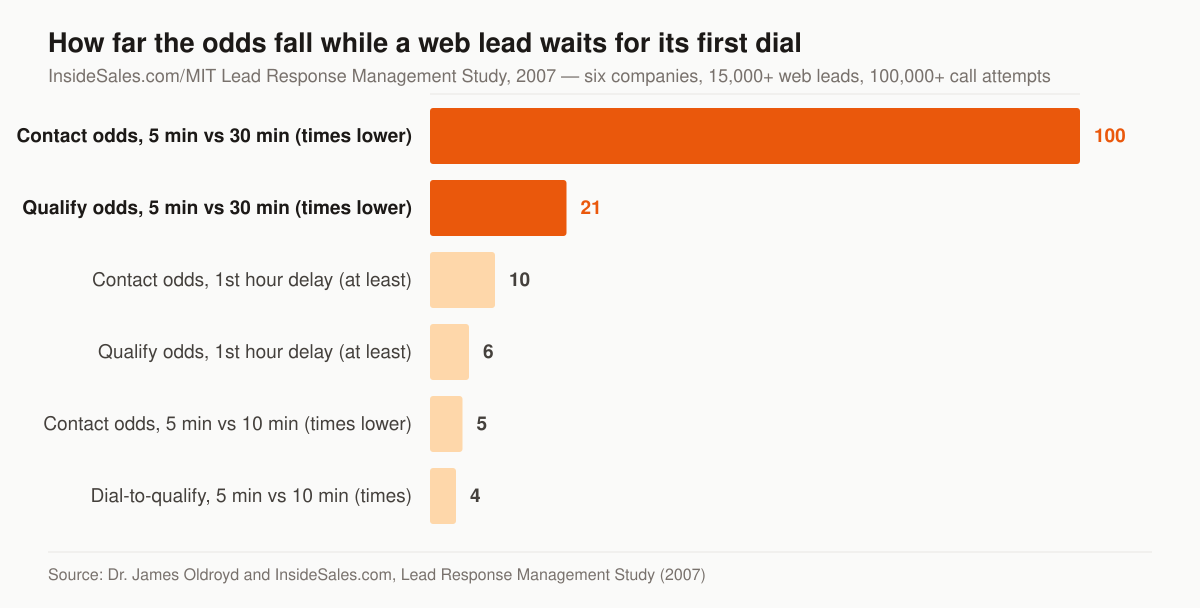
How far the odds fall while a web lead waits for its first dial. Source: Dr. James Oldroyd and InsideSales.com, Lead Response Management Study (2007).
Three honest caveats before you build a policy on that chart. It is a 2007 study. It covers web-generated leads across six unnamed companies, not mortgage protection specifically. And the study says outright that it “did not address close ratios” — it measured contact and qualification, which are the two stages before a sale, not the sale.
What survives the caveats is the shape of the curve, and the shape is what your build has to answer to. It is why the routing has to be automatic rather than diligent. A dialer that fires on form submission does not care whether it is 4pm on a Thursday; a human working from a list does. The same study also found timing effects independent of delay — “4 to 6pm is the best time to call to make contact with a lead (by 114% over the worst time block)” — which is an argument for stacking a scheduled second attempt on top of the instant one rather than replacing it. Our insurance lead follow-up cadence guide sets out the full sequence we run underneath that.
The twenty-hour line deserves separate attention because it points the other way. Past that mark, the study reports, additional dials worked against contact-to-qualify. That is an argument for changing channel rather than changing volume — a text, an email, a scheduled callback offer — instead of adding one more dial to a number that has already ignored the last several.
Before you dial: the registry, the hours, and the three-month window
You generated the lead, so it is yours. That does not by itself make the phone number callable, and this is the part of an owned funnel we insist on building before the traffic rather than after it.
Start with scale. The Federal Trade Commission’s Do Not Call Registry Data Book for fiscal year 2025, released in December 2025, reports that more than 4.7 million additional phone numbers were added to the Registry in FY 2025, “bringing the total to about 258.5 million active registrations as of September 30, 2025.” Your generated leads are drawn from the same pool of US numbers, so a scrub process is not an edge case in the build — it is part of the build.
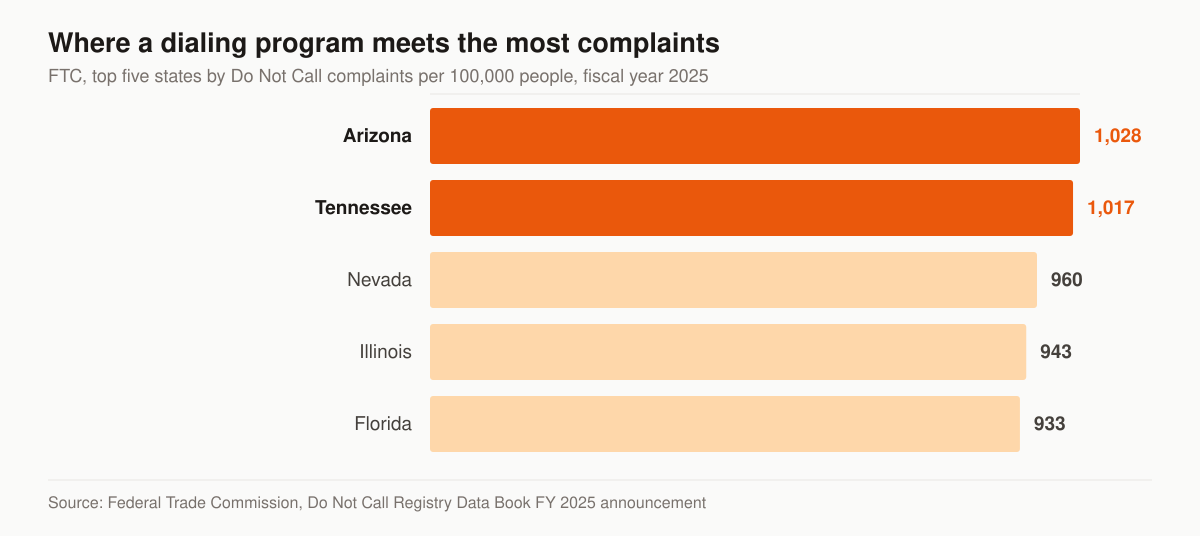
Top five states by Do Not Call complaints per 100,000 people, FY 2025. Source: Federal Trade Commission, Do Not Call Registry Data Book announcement, December 11, 2025.
Read that chart as complaint density per head of population, not as a map of enforcement risk for your agency specifically. It is still worth knowing which of your licensed states sit at the top of it before you scale dialing there.
The rules themselves are in the FCC’s regulations at 47 CFR 64.1200, and four provisions do most of the work for a lead-gen program.
This table pairs each provision with the build decision it forces.
| Provision | What the regulation says | What it means for the funnel |
|---|---|---|
| 64.1200(c)(1) | No telephone solicitation to a residential subscriber “before the hour of 8 a.m. or after 9 p.m. (local time at the called party’s location)” | The dialer needs the prospect’s local time, not yours |
| 64.1200(c)(2) | No solicitation to a registered number; registrations “must be honored indefinitely” unless cancelled or removed | Scrubbing is a standing process, not a launch task |
| 64.1200(c)(2)(i)(D) | The safe harbor requires “a version of the national do-not-call registry obtained from the administrator of the registry no more than 31 days prior to the date any call is made” | Your registry file has a shelf life measured in days |
| 64.1200(c)(2)(ii) | Permission “must be evidenced by a signed, written agreement between the consumer and seller which states that the consumer agrees to be contacted by this seller and includes the telephone number to which the calls may be placed” | The number itself has to be inside the agreement |
The fourth row is the one an owned funnel can actually build against, because you control the form. A bought lead arrives with somebody else’s consent language attached to somebody else’s seller name.
There is a second route, and it has a clock on it. The regulation defines an established business relationship for telephone-solicitation purposes at 64.1200(f)(5) as a relationship “formed by a voluntary two-way communication between a person or entity and a residential subscriber with or without an exchange of consideration, on the basis of the subscriber’s purchase or transaction with the entity within the eighteen (18) months immediately preceding the date of the telephone call or on the basis of the subscriber’s inquiry or application regarding products or services offered by the entity within the three months immediately preceding the date of the call, which relationship has not been previously terminated by either party.” Two windows, not one: eighteen months from a transaction, three months from an inquiry. A form fill reads as an inquiry on its face, though whether it is one on your facts is a question for counsel rather than for a marketing page. The regulation also states that a seller-specific do-not-call request terminates the relationship “even if the subscriber continues to do business with the seller,” and that the relationship “does not extend to affiliated entities unless the subscriber would reasonably expect them to be included given the nature and type of goods or services offered by the affiliate and the identity of the affiliate.”
Autodialed and prerecorded marketing calls sit under a separate and stricter standard — prior express written consent, defined at 64.1200(f)(9) — which our TCPA compliance guide for insurance agents covers alongside the record-keeping that makes a consent defensible. We provide marketing services, not legal advice; take your scripts, your disclosure wording and your scrub schedule to compliance counsel before the first dial.
Why we’re the ones to build it
We run a real lead operation. That’s the credential: this is built by people who actually generate insurance leads, not consultants reading a playbook.
Mortgage protection isn’t final expense, so we won’t pretend the lineage carries over. What carries over is the same conversion system and ad discipline — tight targeting, single-offer pages, and follow-up that runs on its own — that keep those senior-market numbers stable month over month.
The compliance line that protects your ad account
Mortgage protection ties to a home loan, so Meta usually classifies these campaigns under the Housing Special Ad Category. That removes age, gender, and tight ZIP targeting and changes how creative reads. Run it the normal way and you risk rejections or an account flag.
We set every campaign inside that category from the start. See our mortgage protection Facebook ads approach for the creative and targeting workarounds, and the Facebook ads compliance guide for mortgage protection for the detail. Agents are the licensed parties — we keep the marketing inside the rules.
One knock-on effect of that category is worth naming here rather than there. With exact age, gender and tight geography removed, the campaign learns almost entirely from the conversion event you send back. That makes the quality of your lead event a targeting lever in its own right: send back a raw form fill and the optimizer will find more people who fill in forms, and send back a qualified or booked appointment and it looks for those instead. In an owned funnel you decide which event to fire. On a bought feed you do not.
A generated lead beats a bought lead on three fronts
- Exclusivity — nobody else is dialing your lead at the same second.
- Recognition — the prospect saw your ad and page, so the callback isn’t cold.
- Compounding — every campaign builds an audience and a data asset you keep.
The trade-off is honest: generating takes setup and ad spend before it pays. Buying is instant volume with zero build. Plenty of agents run both. If today’s need is raw volume, buy mortgage protection leads from getinsureleads and let the owned system grow underneath it.
This table is the decision as we actually put it to agents, rather than a pitch for one column.
| Question | Generate your own | Buy a feed |
|---|---|---|
| How soon is there volume? | After the build and the learning period | This week |
| Who else is calling this person? | Nobody | Depends entirely on the exclusivity you bought |
| Whose consent language is on it? | Yours, written for your seller name | The vendor’s |
| What is left if you stop paying? | Pages, audiences, creative, conversion history | Nothing |
| What does the callback sound like? | A follow-up to something they did | A cold call to something they half-remember |
| What breaks first at scale? | Follow-up capacity | Contact rate, once the same lead is worked by several agents |
When agents run both, the split we recommend is by job rather than by preference: the bought feed keeps the calendar full while the owned funnel is still in its learning period, and then the mix shifts. The same reasoning, worked through with numbers on a neighboring product, is in our build versus buy analysis for burial insurance lead generation.
What it costs to stand one up, and what it costs to run
Two invoices, and conflating them is how an agent ends up unable to say whether the channel worked.
The build is one-time. A website or landing-page build with us runs $2,500 to $8,000 depending on scope — a single mortgage protection landing page and a thank-you flow sit at the lower end; a full agent site with several offer pages sits higher.
The management is monthly, published, and flat. Our Foundation tier at $2,500 per month covers the website and landing pages, local SEO and Google Business Profile, on-page SEO and monthly reporting. Growth at $3,500 adds the ongoing SEO and content engine, AI-search visibility, and reputation work. Full-Funnel at $5,500 is the tier that includes managed paid ads across Google and Meta, landing-page CRO, and the marketing automation and CRM layer — which is to say, it is the tier that actually runs a lead-generation program end to end. Full detail, including what sits in each tier, is on the pricing page.
Your media is a third line and it is a pass-through. Ad spend is paid straight to the platforms at cost and is never marked up by us. A percentage-of-spend fee quietly rewards an agency for spending more of your money; a flat fee against pass-through media does not.
For a sense of what the alternative side of the market publishes, Insurance Marketing Hub’s live mortgage protection page prints weekly direct-mail spend bands against expected returns: $250 to $300 a week for 3 to 10 leads, $500 to $600 for 7 to 16, $750 to $900 for 10 to 25, and $1,000 to $1,200 for 14 to 30. That is a vendor’s own published estimate for its own product, carrying its own caveat that the estimates “are based on historical data and are dependent on a variety of external factors.” It is a useful reference point for what a mail program costs to feed, and not a forecast for a paid-social funnel, which behaves differently because you can change the spend the same day.
What to measure, and in what order
Cost per lead is the number that gets quoted first and the one we weight last. A cheap lead nobody reaches costs more than it saves.
Read this table top to bottom — each row is only worth reading once the row above it is stable.
| Metric | What it tells you | When to judge it |
|---|---|---|
| Form-fill rate | Whether the page and offer match the traffic | Within days |
| Cost per lead | Whether the creative and audience are viable | Within a week or two |
| Contact rate | Whether routing and dial timing work | Once a cohort has been worked |
| Appointment rate | Whether the lead was qualified or just cheap | Once a cohort has been worked |
| Cost per issued policy | Whether the channel pays | After underwriting on the first cohort |
The order matters because each row can hide a failure in the row below it. A funnel with a strong form-fill rate and a poor contact rate is a routing problem wearing a marketing costume. A funnel with an acceptable cost per lead and a poor appointment rate points at the offer: the page promised something easier than the conversation that followed.
Two instrumentation notes make that table real rather than aspirational. Every lead needs a source, campaign and creative stamped on it at capture, or the reporting collapses into a single undifferentiated pile. And issued-policy outcomes have to travel back into the same system the leads landed in, which is the whole reason the CRM layer belongs inside the program rather than beside it. Our insurance sales funnel service is where that plumbing gets built, and the best CRM options for insurance agents comparison covers the tooling end.
The build order, and why it is not negotiable
A lead-gen system has a sequence. Running it out of order is how agents end up with traffic arriving at a page that cannot record where it came from.
- Offer and page first. One offer, one form, consent text on the page, thank-you state that sets the callback expectation.
- Measurement before media. Analytics, conversion events, and source stamping live and tested with a real submission before a dollar is spent.
- Routing and scrub. Instant text and dial, local-time rules, and a registry scrub process on a standing schedule rather than a launch checklist.
- Cadence. The multi-touch sequence written and loaded before the first lead lands, including the channel change past the point where extra dials stop helping.
- Traffic. Paid social or paid search, launched with several angles at once so the first read is a comparison.
- Read creative early, read the program late. Cost per lead tells you which hook works within days. Cost per issued policy needs a cohort to be dialed, quoted and underwritten before it means anything.
Steps two and three are the two that cannot be retrofitted cheaply. Conversion history you never recorded is not recoverable, and a consent record you never captured cannot be reconstructed after the fact.
How the pieces fit together
This page is one spoke of a larger system. The mortgage protection marketing pillar covers the full vertical — websites, ads, and positioning for young-family buyers. For the engine itself, our insurance lead generation service is the global playbook every niche funnel is built on. And if you want the offer to land, pair this with a purpose-built mortgage protection agent website so callbacks have somewhere credible to go. If the buyer picture itself is what you are working on, our guide to marketing mortgage protection to young families covers the message rather than the machinery.
We’re transparent about what works because we run it on our own dollars first. Book a free marketing audit and we’ll map what a system you own would cost to stand up, what CPL is realistic in your market, and whether generating or buying makes more sense for where your agency is right now. If you’d rather start with a question than a teardown, get in touch.