Who we serve
P&C Insurance Agency Marketing for Property & Casualty Agents
P&C insurance agency marketing is the local growth system for property and casualty agents — auto, home, umbrella, renters, and commercial lines. It combines local SEO, Google Business Profile and reviews, comparison-rater quote funnels, and referral partnerships with realtors and lenders, then compounds through cross-sell and account rounding across each household.
Free · 15-minute teardown · no pitch deck
- We run our own final-expense book
- No pitch deck — we screen-share real numbers
- TCPA-aware · CMS/AEP-compliant · Meta Special Ad Category
- Core Web Vitals < 2.0s LCP
Property and casualty is local and renewable by nature — and the line routinely marketed as if it were a one-time transaction. A P&C household does not buy once; it holds an auto policy, maybe a home policy, an umbrella, a boat, and renews all of them every term. P&C insurance agency marketing that understands this stops chasing single leads and starts building two engines at once: local visibility that captures new households, and cross-sell that deepens the ones you already have.
We are an operator-led marketing shop, not a lead vendor. If your goal is to buy auto or home leads as a finished product, that is a different motion — you can buy leads direct from getinsureleads, our sister brand. Everything on this page is about the assets you own: your rankings, your reviews, your website, and the referral relationships that feed them.
Two layers, two pages. This pillar is the execution layer — the local-visibility, quote-funnel, and cross-sell systems we build for P&C agencies. For the strategy layer — six acquisition channels ranked, hard-market plays, and a 90-day rollout order — start with the P&C insurance marketing. The prize is worth the discipline: U.S. property/casualty net premiums written reached $857.8 billion in 2023, up 10.2% year over year, per the Insurance Information Institute — a market that big is contested everywhere except the place you can actually win it, your own zip codes.
What “P&C” actually covers — and why it changes the marketing
Property and casualty is a family of lines, not a single product, and the marketing shifts with each:
- Personal auto — a high-volume, heavily searched line. See our dedicated auto insurance agent marketing pillar for the local-search and quote-funnel playbook.
- Homeowners — triggered by home purchase, renewal hikes, and claims; the natural bundle anchor. Our home insurance agent marketing pillar goes deep on this line.
- Umbrella, renters, condo, landlord — low-friction add-ons that round the account and rarely get their own campaign, so they live inside cross-sell and website copy.
- Small commercial — BOP, general liability, and commercial auto for local businesses, a longer sales cycle that rewards relationship and referral marketing over cold clicks.
The through-line is that P&C is renewable and bundle-friendly. That single fact is why the marketing worth funding first is rarely “get more leads” — it is “be found locally, then round every account you win.”
Personal lines vs. commercial lines: which systems carry the weight
Personal and commercial lines share an agency, not a playbook. The strategy guide covers why the two buyers behave differently. The table below shows how that difference lands on each marketing asset an agency owns — the same six assets, run two different ways depending on which book they are serving.
| Marketing asset | Personal lines play | Commercial lines play |
|---|---|---|
| Google Business Profile + map pack | Primary acquisition — “insurance agency near me” is decided here | Supporting proof when a referred owner checks you out |
| Website quote path | Comparison-rater funnel: minimum fields, click-to-call | Industry pages that prove specialization, plus a fast COI request path |
| Reviews | Volume and freshness drive map-pack rank and clicks | Fewer but deeper — business owners telling a service story |
| Paid search | High-intent “[line] insurance [city]” capture, tight geo | Narrow niche terms only; generic commercial terms burn budget |
| Referral partners | Realtors, lenders, escrow — transaction-triggered | CPAs, commercial bankers, attorneys — relationship-triggered |
| Retention & cross-sell | Bundling and account rounding per household | Annual review, added lines, umbrella placements |
If commercial lines are your growth priority, the commercial lines section of the strategy guide goes deep on niche specialization and the professional referral web.
Who a P&C agency is actually competing with
Set the field before you set the budget. State Farm alone wrote 9.9% of U.S. property/casualty direct premiums in 2023, and each of the ten largest groups held between 2.1% and 9.9% of the national total, per NAIC data published by the Insurance Information Institute. In homeowners the concentration is sharper still: State Farm’s share of homeowners direct premiums written was 17.8% in 2023, ahead of Allstate at 8.9% and Liberty Mutual at 6.9%, per Triple-I’s homeowners fact file.
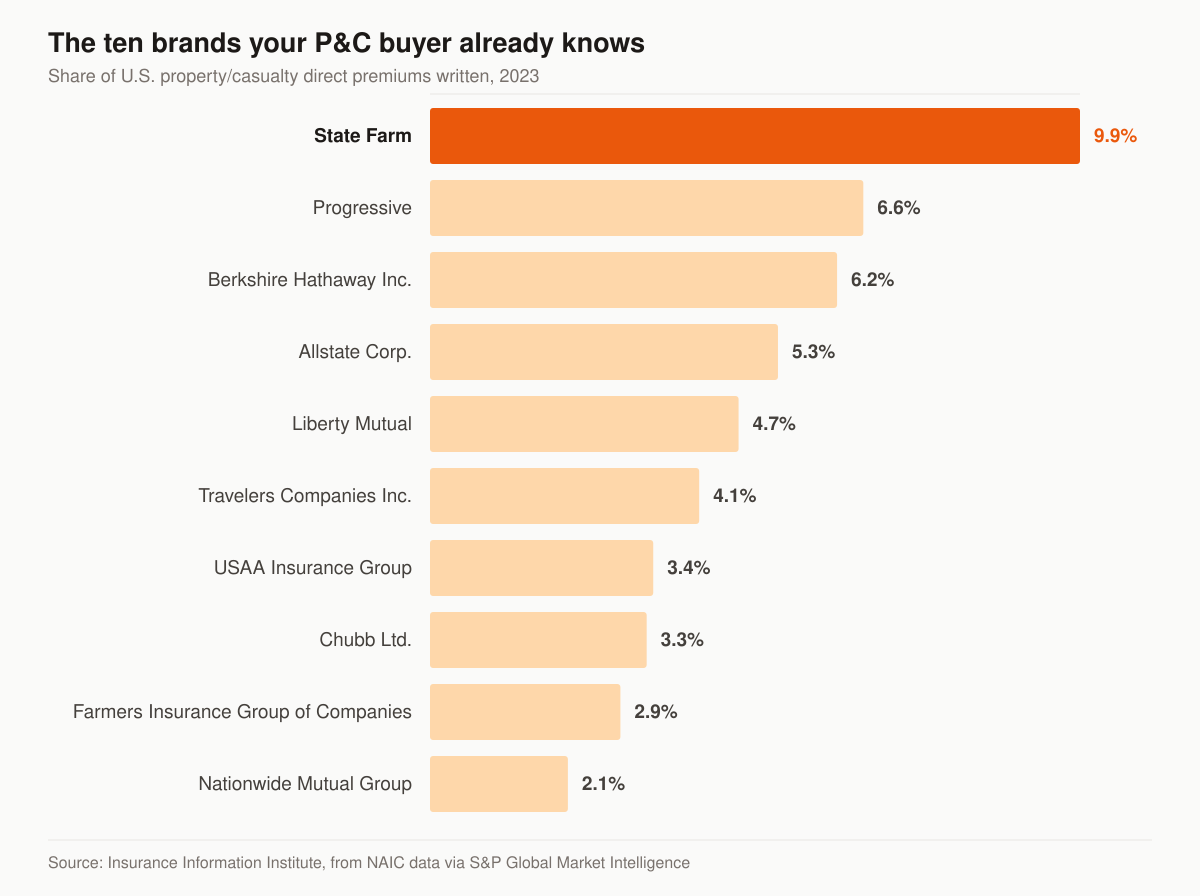
Share of U.S. property/casualty direct premiums written, 2023. Source: Insurance Information Institute, from NAIC data via S&P Global Market Intelligence.
Those are the names already in your prospect’s head before they search. An independent agency does not compete with them on awareness and should stop trying — every dollar spent buying brand recall in a market where ten national advertisers are also buying it is a dollar spent on their terms. What the chart actually argues for is the opposite discipline: compete on the surfaces where national scale stops helping.
- The map pack. A national carrier’s presence in a zip code is usually a local agent’s office with a local profile rather than a corporate listing, which means the fight is often agency-versus-agency rather than agency-versus-brand. That is a fair fight, and it is decided by profile completeness, category accuracy, and review freshness.
- Specific queries. Nobody outbids a direct writer on “car insurance.” The queries an independent agency can hold are the ones with a line, a city, a risk characteristic, or a carrier constraint attached — the long tail that a national landing page answers generically and a local page answers exactly.
- Referral relationships. A realtor’s recommendation is not an auction. It has no CPM, it does not reprice when a carrier raises its ad budget, and a competitor cannot buy it out from under you in a quarter.
To be clear about what depth does and does not buy: substance makes a page worth citing and a profile worth clicking, and it is the precondition for competing at all. It is not a promise of a position. Timelines depend on how contested your zip codes are and what shape your profile is in today, which is what an audit measures before anyone quotes you.
The P&C growth engine: local visibility plus account rounding
Budget tends to pour into net-new acquisition while the cheaper win sits untouched in the book. A working P&C program balances both. Paid search is the lever that fills the pipe while the local and organic work matures — tight geo targeting, high-intent “[line] insurance [city]” terms, and a bid ceiling set from your cost per bound policy rather than your cost per click. That is the job PPC management for insurance agencies does, and it is the same discipline whether you run it as a retail agency or as a broker placing through wholesalers.
The table below sets the six growth levers side by side with what each one costs and where it is run, so a budget conversation starts from cost profile rather than from channel preference.
| Growth lever | What it does | Cost profile | Where it lives |
|---|---|---|---|
| Local SEO + Google Business Profile | Wins “insurance agency near me” and map-pack rank | Time + content, compounding | Local SEO & map pack, insurance SEO |
| Reviews & reputation | Builds map-pack trust and click-through | Systematized, low ongoing | Reputation management |
| Comparison-rater quote funnel | Converts high-intent traffic into quotes | One build, lifts every channel | Insurance web design |
| Paid search & social | Fills the pipe while SEO matures | Per-click, stops with spend | Insurance PPC |
| Account rounding / cross-sell | Second and third policy per household | Near-zero lead cost, no media to buy | Email + website offers |
| Referral partnerships | Recurring warm intros from realtors/lenders | Relationship time | Co-marketing |
Account rounding deserves its own emphasis. Adding a home policy to an existing auto client — or an umbrella to a home client — skips the lead cost entirely, and it leaves the household with a second thing to move before it can leave you. A marketing system that routinely surfaces bundle offers to your current book is working an audience that costs nothing to reach, which is not true of a single cold channel on this page. That system — renewal touchpoints, bundle offers, and review asks across your existing book — is exactly what our insurance client retention service runs.
Hard-market retention: when the whole book is in play
When carriers push rate, every renewal becomes a shopping event — your competitors’ and yours. The retention plays that matter are timed to the renewal itself: a pre-increase conversation that explains the why, a re-shop across your carrier lineup, and a cross-line quote delivered before the premium shock lands. There is also a carrier-side signal worth watching, because it tells you when appetite is likely to reopen. Per Triple-I’s homeowners fact file, the homeowners line’s 2023 combined ratio after dividends was 110.9% — a loss and LAE ratio of 84.5% plus an expense ratio of 26.1% and 0.4% in policyholder dividends. A line running that far above break-even is a line where carriers restrict binding authority, tighten roof-age and wildfire rules, and stop paying for growth. Watch that ratio come down and the win-back file gets productive again; while it stays up, your marketing budget is better aimed at rounding the households you can already place. The full hard-market playbook — the rate-increase talk track, the win-back file, appetite-aligned spend — lives in the hard-market section of the strategy guide so it stays in one place.
P&C is hyper-local: win the map pack, then the click
Nobody drives across a metro for an insurance agency. P&C buyers search “[city] insurance agency,” “home and auto insurance near me,” or “cheap car insurance [zip],” and for all three the map pack sits above the organic results. That makes three things non-negotiable:
- A complete, accurate Google Business Profile — correct categories, service area, hours, and a steady flow of recent reviews. Everything else in the map pack is built on top of it, and it is the core of our local SEO and map-pack service.
- Real reviews, asked for routinely — Google’s own local-ranking guidance says “More reviews and positive ratings can help your business’s local ranking,” and buyers comparing four agencies at once read them before they call. A compliant review-request habit built into your bind process compounds quietly.
- Geo and line pages that carry substance — one strong page per city and per high-intent line, not thin doorway pages. The technical foundation lives on our insurance SEO pillar.
Google’s own rules for an insurance agency profile
Google publishes the guidelines its reviewers apply, and four of them bear directly on how an insurance agency sets up its profile. These are quoted from Google’s guidelines for representing your business, not from folklore.
Name. The profile name must be the business name as it is “used consistently on your storefront, website, stationery, and as known to customers.” Google’s own examples strike marketing taglines, service or product information, and location qualifiers out of the name field: “Midas Auto Service Experts” becomes “Midas,” and “Equinox near SOHO” becomes “Equinox SOHO.” The P&C version of that violation is “Smith Insurance — Cheap Auto and Home Insurance Tulsa.” Google states the consequence plainly: “Including unnecessary information in your business name isn’t permitted, and could result in the suspension of your Business Profile.”
Producers are individual practitioners. Google names “insurance or real estate agents” as individual practitioners and gives each one a profile when they are public-facing and “can be contacted directly at the verified location during stated hours.” Three consequences an agency owner should plan around:
- Google’s line is that “A practitioner shouldn’t have multiple Business Profiles to cover all of their specializations.” A producer with three specialisms still gets one profile.
- “Sales associates or lead generation agents for corporations aren’t individual practitioners and aren’t eligible for a Business Profile” — so a licensed CSR who does not carry their own book does not get a listing.
- Where one public-facing producer represents a branded carrier at a location, Google’s guidance is a recommendation rather than a requirement: “it’s best for the practitioner to share a Business Profile with the organization,” created as a single profile in the format
[brand/company]: [practitioner name]. Its own worked example is “Allstate: Joe Miller.” Where several producers share an office, the agency holds the location profile and each producer’s own profile carries only their name.
Address and service area. An agency that visits clients rather than receiving them should hide its address, and Google states that a service area’s boundaries “shouldn’t extend farther than about 2 hours of driving time from where your business is based,” while adding that “For some businesses, larger service areas may be appropriate.” The rule on rented addresses carries its own condition: “If your business rents a physical mailing address but doesn’t operate out of that location, also known as a virtual office, that location isn’t eligible for a Business Profile.” A co-working desk qualifies only where the office “maintains clear signage, receives customers at the location during business hours, and is staffed during business hours by your business staff.” An agency running from a home office and leaving its address visible is publishing exactly the location Google’s own rule tells a service-area business to hide.
Categories. Use “as few categories as possible,” pick the ones that pass Google’s own test — “This business IS a” rather than “this business HAS a” — and note Google’s explicit instruction: “Do not use categories solely as keywords or to describe attributes of your business.” An agency writing auto, home and small commercial is still an insurance agency; adding six product categories to catch six queries is the behaviour the rule names.
Guessing here is expensive, because recovery runs through a documented appeal rather than a fresh listing — the process is in what to do when a Google Business Profile is suspended. The ongoing version of this work, including the review cadence that keeps a profile ranking after it is clean, is our local SEO and map-pack service.
The comparison-rater funnel: turn a click into a quote
P&C buyers are shopping price and coverage side by side, so the fastest ROI is usually not more traffic — it is a website that turns the traffic you already have into quote requests. A quote or comparison-rater funnel that loads fast on mobile, asks for the minimum up front, and offers click-to-call captures the buyer at the exact moment of intent. A slow or cluttered site leaks quotes no matter how well you rank. This is why we treat the site as the multiplier for every other channel — detail on our insurance web design service.
The renewal calendar: what a P&C book should receive, and when
Account rounding fails when it is an intention rather than a calendar. A P&C book renews on a rolling basis — every week has households at 60 days out and households binding tomorrow — so the outreach has to fire off each policy’s own date rather than off a monthly newsletter send. The trigger lives in the agency management system, which is the whole reason this is a marketing system and not a producer’s memory.
The table below maps a single household’s renewal window to the one message that belongs in it, and the channel that message should run on.
| Window | Trigger | The message that belongs there | Channel |
|---|---|---|---|
| 60 days out | Policy renewal date | Annual review offer — confirm vehicles, drivers, roof age, coverage limits | Email, then call |
| 45 days out | Rate change visible in the carrier feed | Pre-increase conversation explaining what moved and why | Call |
| 30 days out | Household holds one line only | Cross-line quote: home to an auto client, umbrella to a home client | Email with a quote link |
| Renewal day | Policy binds | One review request, no incentive attached | Email or text |
| 30 days after | New household onboarded | Referral thank-you to the realtor or lender who sent them | Call |
| Any time | Life event — home purchase, new vehicle, new driver, move | Re-quote the whole household, not the one policy | Trigger-based |
We build the calendar this way rather than as a general newsletter for two reasons. The first is that the message matches what the household is actually doing that month, so the cross-line offer arrives before the renewal decision rather than after it. The second is that the audience is already paid for: these are households the agency has already acquired, already services, and already earns commission on. Running it consistently is what our email and marketing automation work builds, and it is the operating core of the client retention program.
Reviews, calls and texts: the federal rules that bind P&C outreach
Two federal rules sit on top of everything above, and both reach a two-producer agency exactly as they reach a national carrier. Neither one stops the marketing on this page. Both shape how it is built.
Reviews. The FTC’s Rule on the Use of Consumer Reviews and Testimonials, 16 CFR part 465, took effect on 21 October 2024. Section 465.4 makes it an unfair or deceptive practice to provide “compensation or other incentives in exchange for, or conditioned expressly or by implication on, the writing or creation of consumer reviews expressing a particular sentiment” — a gift card for a five-star review is exactly that. The rule leaves the compliant habit untouched: §465.2(d)(1) carves out of §465.2(b) and (c) any “Reviews or testimonials that resulted from a business making generalized solicitations to purchasers to post reviews or testimonials about their experiences with the product, service, or business,” which is precisely the ask-every-bound-client routine that produces map-pack proof. Section 465.5(c) closes the other shortcut — an officer or manager soliciting reviews from employees, agents, or immediate relatives — but it has two elements rather than one. The solicitation has to result in a review written “without a disclosure of the reviewer’s material relationship to the business,” and the officer or manager has to have “Encouraged the prospective reviewer not to make such a disclosure,” “Did not instruct that prospective reviewers disclose clearly and conspicuously their relationship to the business,” or “knew or should have known that such a review appeared without such a disclosure and failed to take remedial steps.” A written instruction to disclose is what keeps an agency on the right side of it. Our reputation management service walks the rule section by section.
Calls and texts. The FCC’s telemarketing rules live at 47 CFR 64.1200, and four mechanics decide whether a renewal or cross-sell campaign is lawful:
- The calling window. No telephone solicitation to a residential subscriber “before the hour of 8 a.m. or after 9 p.m. (local time at the called party’s location),” per §64.1200(c)(1). The called party’s clock, not the agency’s — which matters the moment a service area crosses a time zone.
- The relationship clock. An established business relationship rests on the subscriber’s “purchase or transaction with the entity within the eighteen (18) months immediately preceding the date of the telephone call,” or on an “inquiry or application regarding products or services offered by the entity within the three months immediately preceding the date of the call,” per §64.1200(f)(5). A lapsed household stops carrying that exemption eighteen months after its last transaction, which puts a hard expiry date on a win-back file that is easy to treat as evergreen. The relationship also ends the moment the household asks that agency to stop calling: a seller-specific do-not-call request “terminates an established business relationship for purposes of telemarketing and telephone solicitation even if the subscriber continues to do business with the seller,” per §64.1200(f)(5)(i).
- Revocation, and what it covers. Read the scope before relying on this one. Paragraph (a)(10) governs revocation of consent “to receive calls or text messages made pursuant to paragraphs (a)(1) through (3) and (c)(2) of this section” — autodialed and artificial-or-prerecorded-voice calls and texts, and telephone solicitations to numbers on the national do-not-call registry. Within that scope, replying “stop,” “quit,” “end,” “revoke,” “opt out,” “cancel,” or “unsubscribe” to a text “constitutes a reasonable means per se to revoke consent,” and other wording still counts “if a reasonable person would understand those words to have conveyed a request to revoke consent.” Requests “must be honored within a reasonable time not to exceed ten business days from receipt of such request,” and senders of messages covered by those paragraphs “may not designate an exclusive means to request revocation of consent.” An agency running automated renewal texts that accepts opt-outs through one web form only is outside the rule.
- The paperwork. Anyone making calls for telemarketing purposes to a residential telephone subscriber must have a “written policy, available upon demand, for maintaining a do-not-call list,” and must train the personnel who make those calls, per §64.1200(d)(1) and (d)(2). Both are one-page documents, and neither writes itself.
The practical consequence for a P&C program is that the renewal calendar above should be email-first, with calls placed inside the window and texts sent only where consent and a working revocation path exist. The wider set of rules an agency operates under, including state advertising requirements, is covered in insurance marketing compliance for agents.
Referral partnerships: the channel P&C agencies underuse
Every home purchase needs a policy bound before closing, which makes realtors and mortgage lenders a recurring, warm source of home-and-auto bundles. The marketing job is to make you the obvious, low-friction choice they trust to send clients to:
- Be fast and professional — quick quote turnaround and a clean site signal reliability to the partner’s own reputation.
- Give them something to hand off — a simple co-branded page or one-pager beats a business card.
- Stay top of mind — a light, consistent touch (a monthly note, a shared closing-season reminder) keeps you first when a client asks “who do I call for insurance?”
These relationships are slow to build and hard for a competitor to displace, which is exactly what makes them worth the patience.
Small commercial: the certificate-and-appetite motion
Small commercial rarely gets marketing of its own, because the personal-lines plays do not transfer to it. A contractor does not shop at renewal the way a driver does; they buy when a general contractor demands a certificate, when a lease requires proof, or when their current agent misses a class. Three assets convert that:
- Publish appetite, not services. A local business owner is checking one thing before they call: whether you can actually place their class. A page that names the classes you write, the limits their contracts typically demand, and the endorsements that trip up their trade answers that in one read. A page titled “commercial insurance” answers nothing, and it competes with every other agency’s identical page.
- Make the certificate the front door. A certificate of insurance is routine servicing work that is rarely leisurely — the client asks because a general contractor, a landlord, or a job site is waiting on it. A COI request form with a stated turnaround is a service improvement, a retention asset, and a piece of responsiveness a prospect can see before they buy.
- Work the renewal date, not the season. Commercial policies renew on a known date. An organized agency asks for the expiration date at first contact, then puts the account on a calendar far enough ahead of that date to gather loss runs and market the risk properly, rather than showing up with one quote a week before renewal.
The referral web behind all three is a different set of people than personal lines uses — CPAs, commercial bankers, trade associations, attorneys — and it is slower and stickier. The commercial lines section of the strategy guide covers how to pick the two or three industries worth specializing in before you build the pages.
Do P&C insurance wholesalers and MGAs change the marketing plan?
Wholesalers and MGAs don’t replace an agency’s marketing — they widen what it can promise. Access to surplus-lines and specialty markets through a wholesaler lets a retail P&C agency market to risks standard carriers decline: coastal property, high-value homes, niche commercial classes. The marketing rule is to advertise only appetite you can actually place, then treat every new wholesaler relationship as a reopened territory worth a campaign.
If you are the wholesaler, flip the audience: your buyers are retail agents, not insureds, so the plays that matter are appetite clarity, published submission requirements, and turnaround speed agents can rely on — B2B visibility among producers rather than consumer lead generation. Either way, the discipline is the same one that runs through this page: market what you can bind, and measure to the bound policy.
How to measure P&C agency marketing
Clicks are the wrong unit for a book that renews. A P&C program is judged on bound policies, on how many lines each household holds, and on whether those households are still there next term — and every one of those numbers lives in the agency management system rather than in an ad platform. Reporting that stops at the ad platform is reporting that cannot tell you which channel to cut.
The table below is the six-number reporting set we hold a P&C program to, with where each number is read and what decision it drives.
| Number | Definition | Where it is read | The decision it drives |
|---|---|---|---|
| Cost per bound policy | Channel spend divided by policies bound from that channel | Ad platform spend joined to the AMS | Compares a paid click and a referral in the same unit |
| Quote-to-bind rate by channel | Policies bound divided by quotes issued, split by source | AMS | Separates a traffic problem from a sales problem |
| Policies per household | Total policies divided by total households | AMS | The account-rounding score |
| Map-pack visibility by term and zip | Where the profile ranks for the terms that convert | Rank tracking on your service area | Tells you whether local work is landing before revenue does |
| Review velocity | New reviews per month, and how recent the newest is | Google Business Profile | Google ties local ranking to review count and rating, so a stalled stream is a ranking input going cold |
| Retention by cohort | Share of households still on the books at renewal | AMS | Turns a retention slide into an acquisition problem you can price |
The last input is your market’s premium level, because it sets what a bound household is worth before any of the ratios above matter.
The table below shows the widest and narrowest average homeowners premiums in the country against the national average, using NAIC data for HO-3 owner-occupied policies.
| Market | Average homeowners premium, 2021 |
|---|---|
| Florida — highest | $2,437 |
| Louisiana | $2,259 |
| Oklahoma | $2,155 |
| Texas | $2,146 |
| United States average | $1,411 |
| Idaho | $884 |
| Nevada | $863 |
| Utah | $831 |
| Oregon | $793 |
| Wisconsin — lowest | $780 |
Average premiums for HO-3 owner-occupied homeowners policies, 2021, the latest year published. Source: National Association of Insurance Commissioners data, published by the Insurance Information Institute.
An agency in Florida can justify an acquisition cost an agency in Wisconsin cannot, on the same close rate and the same commission percentage. That is why a blanket “spend X% of revenue” rule misleads, and why the insurance agency marketing budget guide works from what a household is worth over its retention life instead.
What does a P&C insurance marketing company do?
A P&C insurance marketing company builds and runs the growth systems an agency does not have the hours to run itself: local SEO and Google Business Profile, review generation, the quote-request funnel on the website, paid search, and the cross-sell campaigns that round existing accounts. The good ones report to bound policies, not clicks.
The honest version of the hire-versus-DIY question is that nothing on this page requires an agency. A disciplined producer can claim the Google Business Profile, ask every bound client for a review, and call ten realtors — the plays are not secret. What an agency buys is throughput and sequencing: the geo pages actually get written, the review asks actually fire, the ad account actually gets pruned every week, while you sell. So hire when the work is real and the calendar is not, and stay in-house while the list of unfinished basics is still short. Our insurance marketing services are organized channel by channel for exactly that reason — you can hand over one system at a time instead of all of them at once.
What a P&C marketing engagement costs
We publish prices because a P&C agency owner comparing three shops should not have to sit through a discovery call to learn the band. There are three monthly tiers and one entry build.
The table below shows what each published tier runs and the kind of P&C agency it usually fits.
| Tier | Monthly | What it runs | The agency it fits |
|---|---|---|---|
| Foundation | $2,500 | Optimized site and landing pages, local SEO with the Google Business Profile, on-page SEO, monthly reporting | A single-location agency whose profile and site are the bottleneck |
| Growth | $3,500 | Everything in Foundation, plus the ongoing SEO and content engine, AI-search visibility, and reputation and reviews | An agency that needs the local surface, the geo and line pages, and the review engine running together |
| Full-Funnel | $5,500 | Everything in Growth, plus managed paid ads on Google and Meta, landing-page CRO, marketing automation and CRM, and full-funnel reporting | Multi-producer agencies ready to buy volume on top of visibility |
| One-time build | $2,500–$8,000 | A quote-ready site, built once | An agency whose site leaks quotes before any channel work is worth doing |
Growth is where we point most P&C agencies, because personal lines needs the map pack, the content behind it, and a working review engine moving at the same time, and no one of the three carries the other two. Paid search sits a tier higher, in Full-Funnel, which is the honest place to put it: managed media is its own recurring job rather than a bolt-on. The full breakdown of what sits inside each tier is on the pricing page, and the sequencing question — which system to hand over first — is what a free marketing audit answers before anything is signed.
Where this fits, and how to start
P&C is the property-and-casualty half of a full agency book; the other half is the senior and life market we anchor in. You can see every line we serve on the insurance niches hub, and how we frame marketing investment and pricing openly before any engagement. If you want the strategy layer first — every channel, what each one costs, and the sequence to run them in — jump straight to the 90-day P&C marketing plan inside the full strategy guide.
The honest first step is a number, not a pitch. A free marketing audit maps your local rankings, scores your quote page, and shows where your P&C book is leaking — new-business capture, account rounding, or both — before you spend a dollar with us. Prefer to talk it through first? Get in touch and we will model the economics with you.
The services behind it
Guides that go deeper