P&C Insurance Marketing: A Channel-by-Channel Strategy Guide
P&C insurance marketing is the acquisition and retention system an agency runs across six channels: local search, reviews, referral partnerships, paid search, retention and cross-sell, and the quote path itself. Personal and commercial lines need separate plans — independent agencies write 87.7% of commercial lines premium but only 39.5% of personal lines, per the Big "I" 2026 Market Share Report.
P&C insurance marketing runs on two engines: an acquisition engine that wins new households and businesses through referral partners, local search, reviews, and paid ads — and a retention engine that keeps them through renewal outreach, cross-sell, and bundling. Fund only the first and the math turns against a renewable, price-shopped product. We treat an underfunded retention engine as the first thing to check in a stalled book.
The market cycle is the backdrop for all of it. U.S. homeowners rates rose 10.4% in 2024 on top of a 12.7% increase in 2023, per S&P Global Market Intelligence (January 2025), and a record 57% of auto customers shopped their policy in the past year, per J.D. Power (April 2025). Rate-shocked, heavily shopped books are the environment this plan assumes.
This guide is the strategy layer: what each channel actually does, how personal and commercial lines differ, and a 90-day rollout order you can run with a small team. It is written for agency owners and producers who want a plan, not a listicle that ends at “post more on social media.”
What does P&C insurance marketing actually cover?
Property and casualty is everything that protects things rather than lives. Personal lines: auto, homeowners, renters, condo, landlord, umbrella, boat. Commercial lines: business owners policies (BOP), general liability, commercial auto, workers’ compensation, professional liability, and the specialty coverages that hang off them.
Three structural traits decide how the marketing has to work:
- Every policy renews. The buyer re-decides every six or twelve months. That makes retention a marketing function with its own calendar, not a service afterthought.
- It is price-shopped. P&C buyers compare quotes side by side, so speed to a real number and a frictionless quote path convert better than any clever ad.
- It is hyper-local. Nobody drives across a metro for an insurance agency. The buying decision happens in local search results and referral conversations inside your service area.
It is also a genuinely contested channel. Independent agencies place 62% of all U.S. P&C premium, per the Big “I” 2026 Market Share Report — the rest flows through captive agents and direct writers spending national ad budgets. You will not outspend a direct carrier on brand advertising. You can out-position everyone in your zip codes on visibility, proof, and relationships, which is what the rest of this guide is about.
How big is the P&C insurance market?
The global property and casualty insurance market is projected to grow from $1,976.60 billion in 2026 to $2,877.32 billion by 2034, a 4.80% CAGR, per Fortune Business Insights — which also puts North America at 44.40% of the global market. Big numbers, and almost none of them are addressable by your agency.
That gap is the whole strategic point. A market this large is why direct writers can spend nine figures on national brand advertising and still call it rational, and why trying to compete on reach is a losing trade for a local agency. Your addressable market is the households and businesses inside your service area — a few thousand renewals a year, not two trillion dollars. So you win on proximity, proof, and relationships a national brand cannot buy: the map pack in your zip codes, recent reviews, the realtor who sends every closing your way. The execution layer for that — local visibility, quote funnels, cross-sell — lives on the P&C agency marketing pillar.
Personal lines vs. commercial lines: two different marketing problems
Treating P&C as one market is the first strategic mistake. The buyer, the trigger, and the winning channel all change between personal and commercial lines:
| Personal lines | Commercial lines | |
|---|---|---|
| Typical buyer | A household shopping price at renewal or a life event | An owner or office manager buying risk transfer |
| Trigger events | Rate hike, new car or home, teen driver, a move | New business, lease or contract requiring a COI, renewal, an audit |
| Sales cycle | Days — quote and bind | Weeks to months — relationship-led |
| Winning channels | Map pack, local SEO, paid search, review volume | Referral partners, industry specialization, direct outreach |
| Price behavior | Comparison-shopped hard | Coverage, service, and expertise weighted |
| Core retention lever | Bundling and account rounding | Annual review plus added lines and endorsements |
The same Big “I” report shows how differently the two markets are wired: independent agencies write 87.7% of commercial lines premium but 39.5% of personal lines. Read that as a strategy memo. In personal lines you are fighting direct writers on visibility and speed, and the local assets you own are the edge. In commercial lines the independent channel already dominates — your competition is other agents, and the fight is won on relationships and specialization, not clicks.
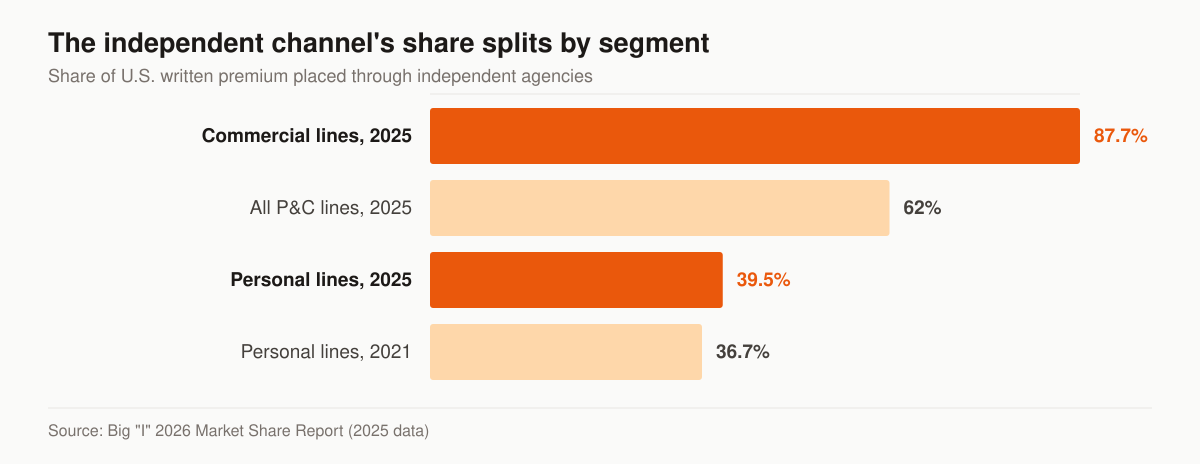
Personal lines has gained 2.8 points of independent-channel share since 2021 and still sits under 40%; commercial lines held at 87.7%. Source: Big “I” 2026 Market Share Report, 2025 data.
How do P&C agencies get more clients?
P&C agencies get more clients from six channels: referral partnerships, local SEO and Google Business Profile, review velocity, paid search, retention marketing, and cross-sell. Here is each one, in rough order of return for a typical local agency.
- Referral partnerships — realtors, lenders, CPAs, and commercial bankers; the highest-trust channel and the hardest for a competitor to displace.
- Local SEO and Google Business Profile — where “insurance agency near me” is actually decided, before anyone reaches an organic result.
- Reviews — proof at the moment of comparison, and a map-pack ranking input, so the channel pays twice.
- Paid search — fast and unforgiving; only as good as the quote page and the follow-up behind it.
- Retention marketing — renewal-timed contact that defends a book being shopped every term.
- Cross-sell and account rounding — a second and third policy per household, at zero acquisition cost.
1. Referral partnerships: the highest-trust channel
Every financed home purchase needs a policy bound before closing. That single fact makes realtors and mortgage lenders a recurring, warm source of home-and-auto households. Run the relationship as a channel rather than leaving it to chance:
- Build a named list of ten local partners: realtors, lenders, property managers, and for commercial lines, CPAs and commercial bankers.
- Give each one something to hand off — a co-branded one-pager or a simple landing page beats a stack of business cards.
- Earn the referral with speed: a partner’s reputation rides on your quote turnaround, so same-day responses are the product.
- Stay top of mind with a light monthly touch, and track referred households like any other lead source.
These relationships are slow to build and nearly impossible for a competitor to displace, which is exactly why they compound.
2. Local SEO and Google Business Profile
P&C search intent is hyper-local — “[city] insurance agency,” “home and auto insurance near me” — and the decision usually happens inside the three-listing map pack. Your Google Business Profile is the highest-leverage free asset you own: correct categories, service area, hours, photos, and a steady flow of recent reviews. Behind it, one substantial page per city you serve and per high-intent line, not thin doorway pages. This is slow-building and compounding, the opposite of paid spend, and it is the core of local SEO for insurance agencies.
3. Reviews: proof at the moment of comparison
A P&C shopper comparing four agencies trusts the one with visible, recent proof. Review volume and freshness also feed map-pack rank, so this channel pays twice. The fix is a habit, not a campaign: wire the review ask into your bind and claims-resolution process so it fires after every good interaction. The mechanics — timing, wording, compliance — are covered in how to get more Google reviews as an insurance agent, and the systematized version lives in our reputation management service.
4. Paid search: expensive clicks, unforgiving math
High-intent auto and home insurance terms are among the most expensive clicks you can buy, and insurance converts worse than almost any other category once the click lands (the benchmark numbers are in the cost section below). That does not make paid search a bad channel — it makes it an unforgiving one. The economics only work when everything downstream of the click is tight:
- Tight geography and match types. Broad-match “car insurance” across a metro burns budget; exact and phrase match around your actual service area does not.
- A fast quote page. Paying premium click prices to land buyers on a slow, form-heavy page is how agencies conclude “ads don’t work.”
- Tracking to bound policies. Cost per click and cost per lead are vanity numbers in P&C; cost per bound household is the decision metric.
Our per-line breakdown of insurance PPC costs by line of business covers the relative economics, and the insurance PPC service is how we run it. One more budget line worth chasing: ask every carrier you are appointed with whether co-op marketing funds or advertising reimbursement programs are available to you. Where they exist, co-op dollars are the cheapest paid budget you will add all year.
5. Retention marketing: defending a book that is being shopped
Your renewals are under attack whether you see it or not. J.D. Power’s 2025 U.S. Insurance Shopping Study found that 57% of auto insurance customers actively shopped for a new policy in the past year — the highest rate in the study’s 19-year history, up from 49% the year before. That record is what a hard market does to a book: the 2023–2025 rate increases pushed households into the market at a rate no agency’s service quality caused and none can opt out of. In that environment, silence between renewals is a churn strategy.
Retention marketing is renewal-timed contact with a job to do: a pre-renewal touch that reframes value before the new premium lands, a rate-increase conversation script instead of a surprise invoice, and an annual coverage review that surfaces gaps. It runs on the same automation discipline as lead follow-up, and it is what our client retention system for agencies is built around.
6. Cross-sell and account rounding: the cheapest growth you own
Every monoline household in your book is a client you already paid to acquire, carrying one policy where it could carry three. The same J.D. Power study puts numbers on why rounding matters: a third of active shoppers are looking to bundle auto with home, and bundled customers stay with their insurer 7.0 years on average versus 5.5 for non-bundlers. More lines per household means higher switching costs, longer tenure, and zero incremental acquisition cost.
The mechanics — trigger points, the monoline segmentation, the operating cadence — get their own deep dive in cross-selling and account rounding for P&C agencies. If you only build one retention system this year, build that one.
How much does P&C insurance marketing cost?
P&C insurance marketing costs run on three inputs, not one price: cash spend on ads, tools, and mail; time spent on the owned assets — Google Business Profile, reviews, content — that cost hours instead of dollars; and management, whether in-house, freelance, or an agency retainer. We publish our own tiers openly on the pricing page.
Managed programs in this market run $2,500–$5,500 per month, with a one-time website build at $2,500–$8,000 and ad spend billed on top — our own published bands, and a reasonable frame for judging anyone else’s. What no single number can capture is that every channel has a different cost shape and a different clock:
| Channel | What you actually pay for | Time to first result |
|---|---|---|
| Google Business Profile + reviews | Staff time; no media cost | Weeks to a couple of months |
| Local SEO (geo and line pages) | Content and technical work, compounding | Months, not weeks |
| Referral partnerships | Relationship time plus one handoff asset | A quarter or two, then recurring |
| Paid search | Per-click media plus management | Days — and it stops when spend stops |
| Retention and cross-sell | Automation setup, then near-zero variable cost | The next renewal cycle |
| Website and quote path | One-time build that multiplies every channel | Immediate on launch |
Paid search is where the math punishes P&C hardest, and the benchmarks show why. LocaliQ and WordStream’s 2026 Search Advertising Benchmarks put the blended Finance & Insurance category at a $3.39 average CPC — below the $5.42 all-industry average — but at a 2.64% conversion rate, the lowest of any category in the benchmark, which drags average cost per lead to $74.44 against a $66.69 all-industry average. Clicks that do not convert are not cheap clicks. High-intent auto and home terms run well above that blended average, which is what our insurance PPC cost per click by line breakdown covers. Budget to a cost per bound household, and the channel order above sorts itself out.
What marketing works for commercial lines?
Commercial lines marketing is a referral-and-specialization game, not a traffic game. The buyer is a business owner who asks their existing advisors before they ever search, and the sales cycle runs weeks or months. What works:
- Pick two or three industries and go deep. “We insure contractors and restaurants” beats “we do business insurance” in every conversation and every search result. Specialization is what referral partners can actually repeat.
- Build the professional referral web. CPAs, commercial lenders, attorneys, and trade associations are the commercial equivalent of realtors — recurring sources who send you their clients’ insurance problems.
- Publish industry-specific pages. One substantial page per target industry, covering the real exposures and coverage decisions that industry faces, does double duty: it ranks for niche commercial searches and it proves expertise when a referral checks you out.
- Work COI and contract triggers. Certificates of insurance, lease requirements, and new contracts create hard deadlines — the closest thing commercial lines has to urgency. Make it known you turn COIs around fast.
- Run a renewal-review motion on your own commercial book. Every commercial account grows or changes; the annual review is where added lines, higher limits, and umbrella placements happen.
Paid search plays a smaller role here than in personal lines, with one exception: specific, high-intent niche terms in your metro can be worth testing precisely because generic commercial terms are contested and vague.
Marketing P&C in a hard market
A hard market turns carrier decisions into marketing events. The 2023–2025 cycle was the sharpest in decades: homeowners rates rose 10.4% in 2024 after a 12.7% increase in 2023, with 33 states taking double-digit increases, per S&P Global Market Intelligence’s January 2025 filings analysis. The rate had a reason — Triple-I’s June 2024 issues brief puts the 2023 homeowners net combined ratio at 110.9, the line’s worst underwriting result since 2011. And where carriers could not get adequate rate, they left: county-level data released by the Senate Budget Committee in December 2024, from insurers covering roughly 65% of the national homeowners market, shows non-renewal rates climbing from 2018 through 2023 and spreading well beyond Florida, California, and Louisiana — into the Carolinas, coastal New Jersey, southern New England, and Oklahoma.
Every one of those decisions — an increase, a pullback, a non-renewal — lands on a household or business in your service area. Each is a marketing trigger with a specific play:
- Treat the rate increase as a scheduled conversation, not an invoice. Thirty to forty-five days before renewal on any account taking a material increase, a call or note that explains the why — loss costs, reinsurance, the carrier’s underwriting results — and offers a re-shop keeps the shopping trip inside your agency instead of on a comparison site. In a hard market this is the highest-leverage item on the retention calendar.
- Build a win-back file and re-quote it every cycle. Households you lost on price, prospects a carrier declined, and non-renewed accounts are all still in-market. Appetite moves both ways: the risk nobody would write in 2023 may quote cleanly today. Re-shopping across carriers as conditions change is exactly the independent-channel value a direct writer cannot copy — so run win-back as a standing campaign, not a one-off.
- Point marketing only at appetite you can place. Geo pages, ads, and referral pitches promising lines or territories your carriers have pulled back from generate quotes you cannot bind — paid-for leads that end in apologies. Align spend with current appetite, and when a carrier reopens a line or territory, treat the reopening itself as a campaign trigger.
- Round accounts before the increase hits. Monoline households facing rate shock are the likeliest to shop the entire relationship. A cross-line quote delivered at the pre-renewal touch converts a churn risk into a deeper account, with the tenure math covered in the bundling numbers above.
The cycle turning does not end the work — it redirects it. Auto premium increases fell from 13% at the start of 2024 to less than 2% at year-end, per J.D. Power, and shopping still hit a 19-year record. “Auto insurance rate taking reached multi-decade highs in the first quarter of 2024, which put record numbers of customers into the market shopping for lower-priced policies as the year progressed,” said Stephen Crewdson, managing director of insurance business intelligence at J.D. Power, in the April 2025 study release. Softening rates give shoppers somewhere to go, so win-back and remarketing get more productive as the market eases — which is precisely when agencies that dismantled the hard-market playbook lose the households it would have recovered.
The 90-day P&C marketing plan
Strategy without sequence dies in a busy agency. Here is the rollout order, built so each phase feeds the next — the same sequence we run inside the P&C agency marketing system. To write it down, use the one-page insurance agency marketing plan template (print-ready PDF, ungated).
- Days 1–7: Instrument. Set up call tracking and form tracking, and define one spreadsheet or CRM view: leads, quotes, bound policies, and source. Nothing else in this plan is manageable without it.
- Days 1–14: Segment the book. Flag every monoline household and every renewal date for the next 120 days. This list is your cheapest revenue and your churn-risk radar in one.
- Days 8–21: Fix the Google Business Profile. Categories, service area, hours, photos, services. Then wire the review ask into your bind process so velocity starts now.
- Days 15–30: Fix the quote path. Mobile-fast page, minimum fields up front, click-to-call. Every later channel multiplies through this page.
- Days 22–45: Launch the partner list. Ten named referral partners, first outreach done, handoff asset delivered. Book one coffee or call per week from here on.
- Days 30–60: Publish the local pages. One substantial page per priority city and per high-intent line — auto, home, and your top commercial niche first.
- Days 45–75: Start renewal-timed retention. Pre-renewal touches on the next 90 days of renewals, plus a rate-increase talk track your team actually uses.
- Days 60–80: Run the first cross-sell round. Take the monoline segment from step 2, pick the next logical line per household, and make timed, specific offers at renewal touchpoints.
- Days 60–90: Test paid search — if the foundation holds. Tight geo, exact match, tracked to bound policies, and only after the quote page and follow-up are proven. Ask carriers about co-op funds before you fund it all yourself.
- Day 90: Review against bound policies. Kill what produced nothing, double what produced households, and set the next quarter’s targets on policies per household and retention, not clicks.
Where this guide fits
This post is the strategy layer. The execution silo — the specific local SEO, review, quote-funnel, and cross-sell systems we build for property and casualty agencies — lives on the P&C insurance agency marketing pillar. The retention half of a P&C book — onboarding, renewal and review touchpoints, win-back, and a referral engine — runs as its own program: insurance client retention marketing. For line-level depth, the auto insurance client-acquisition playbook and the home insurance agent marketing playbook cover the two lines most P&C growth starts from.
The honest first step is a diagnosis, not a channel. A free marketing audit maps your local rankings, scores your quote path, and shows whether your book is leaking on the acquisition side, the retention side, or both — before you commit a dollar to any of the channels above.
- Cross-Selling and Account Rounding for P&C Agencies
How P&C agencies use cross-selling and account rounding to lift retention and lifetime value — the trigger points and marketing systems that make the ask.
- How Auto Insurance Agents Win Clients Online
How auto insurance agents get clients online: the three channels that produce quotes, the cost-per-bound-policy math, and the speed-to-lead rule behind it.
- Home Insurance Marketing Budget: What to Spend, Where, and What It Should Return
What to budget for home insurance marketing, how to split it across channels, and how to price every dollar against a bound policy instead of a click.
- Shared vs Exclusive Auto Insurance Leads: A Cost-Per-Policy Breakdown
Shared vs exclusive auto insurance leads compared on cost per sold policy, contact and bind rates, and where each wins — so P&C agents pick what actually pays.