How Auto Insurance Agents Win Clients Online
Auto insurance agents win clients online through three channels and one rule: rank for local 'car insurance near me' intent, run tightly geo-targeted paid ads to a fast quote form, and reply to every lead within five minutes. Auto is price-shopped and high-intent, so the agent who shows up first and follows up fastest usually binds the policy.
Most auto insurance agents lose online for one boring reason: a driver requests a quote, and nobody calls back fast enough. The policy goes to whoever answered first. So before we talk channels, understand the shape of the problem. Auto is a price-shopped, high-volume, high-intent line. The buyer already knows they want car insurance. They are not asking whether to buy; they are asking who to buy from. That changes how marketing works.
This is a top-of-funnel playbook for auto insurance agent marketing — the channels, the math, and the follow-up engine that turns clicks into bound policies. We build these systems for senior-market clients every day, and the same conversion discipline and ad mechanics apply directly to auto.
Why auto insurance marketing is different
Three traits define the auto buyer, and each one dictates a tactic:
- High intent, low patience. A quote request expires in minutes. The first agent with a real number usually wins.
- Comparison behavior. The same shopper hits three or four agents at once. You are not competing on whether, you are competing on speed and clarity.
- Cyclical triggers. Rate hikes, renewals, new cars, new drivers, and moves create predictable spikes you can target.
The agencies that win do not have a secret channel. They have a faster, tighter loop: be visible where drivers search, capture the quote, and respond before the competitor does.
What the auto shopper actually does online
You can guess at buyer behavior or you can read a study that measured it. JD Power’s 2026 U.S. Insurance Shopping Study, released 4 June 2026 and now in its 20th year, is based on responses from 12,437 insurance customers who requested an auto insurance price quote from at least one competitive insurer in the previous six months, fielded from January 2025 through January 2026.
Four findings from that study should change how an auto agency spends.
| What the 2026 study measured | Figure | What it changes for you |
|---|---|---|
| Customers shopping their auto policy, year over year | Declined from 57% to 53% | Fewer shoppers than last year, but JD Power describes the level as still elevated by historical standards |
| Quotes the average shopper receives | 3.5, “the highest level in the study’s history” | You are one of several tabs, not the only call |
| New auto policies purchased digitally | 48%, up from 36% five years ago | The quote page is the storefront, not the office |
| Recent shoppers interested in embedded insurance sold through the dealer or manufacturer | 36% | The car itself is becoming a distribution channel |
Source: JD Power 2026 U.S. Insurance Shopping Study, 4 June 2026.
The 3.5-quote figure is the one to sit with. It means the driver on your form has already asked, or is about to ask, roughly two and a half other people the same question. Nothing in your funnel can change that. What you control is whether your number arrives first and whether it is understandable when it does. JD Power’s Stephen Crewdson frames the shift as “moving from a crisis-driven market to a digital‑ and AI‑driven market”, with mobile apps and AI tools making comparison easier — which is a polite way of saying the friction that used to protect a local agent has been removed.
Two more findings from the same release are worth planning around. First, shopping is not evenly distributed: the study’s new state-level analysis reports that states in the South like Oklahoma, Mississippi and Texas remain high-shopping, high-switching markets, while New England states like New Hampshire and Vermont show consistently low shop and switch rates. The same monthly budget buys a different-sized pool of in-market drivers depending on which of those you sit in, so benchmark against your own market rather than the national shop rate.
Second, the bundle sits on the table untouched. Among recent customers actively shopping an auto policy, 45% say they have a homeowners policy, but only 20% received a homeowners quote while shopping for auto insurance. That gap is a revenue line you can capture with a single extra question on the phone — the systematic version is covered in cross-selling and account rounding for P&C agencies.
The rate cycle decides how many shoppers exist
Auto marketing has a weather system, and it is the rate environment. When premiums jump, shopping spikes and your ads get cheap attention. When premiums flatten, the same ad has to work harder.
Right now the wind has turned. In the Bureau of Labor Statistics CPI release for July 2026, the motor vehicle insurance index declined 0.3 percent in July after falling 2.0 percent in June, and the unadjusted 12-month change through July 2026 was −4.5 percent. Over that same 12 months, motor vehicle maintenance and repair rose 6.6 percent. Car ownership did not get cheaper — the pressure moved from the premium line to the repair line.
Two BLS series describe the auto customer’s year, and they point in opposite directions.
| CPI item, U.S. city average | 12-month change through July 2026 | Change in July 2026 (seasonally adjusted) |
|---|---|---|
| Motor vehicle insurance | −4.5% | −0.3% |
| Motor vehicle maintenance and repair | +6.6% | +0.6% |
Source: BLS, Consumer Price Index, Table 2, July 2026.
For your campaigns that means three concrete things. The “did your rate go up?” hook is aimed at a shrinking group, so it should stop being your only ad. A falling premium index makes a comparison offer stronger than an outrage offer — plenty of drivers are still paying last year’s renewal number. And because repair costs are still climbing, coverage-quality conversations (deductibles, OEM parts, rental reimbursement) land better now than they did during the rate shock, when everything was price. Adjust the copy, not the channel.
The three channels that actually produce quotes
You do not need ten tactics. You need three working channels and a follow-up system behind them. Here is how they compare for a typical independent auto agency:
| Channel | Speed to first lead | Relative cost per lead | Best for | Effort to maintain |
|---|---|---|---|---|
| Google Search ads | Days | Higher, high intent | “car insurance near me” switchers | Medium |
| Local SEO + Google Business Profile | Months, then free | Lowest over time | Recurring local intent | Medium, compounding |
| Facebook / Instagram ads | Days | Lower, lower intent | New drivers, bundle offers, retargeting | Medium |
A practical sequence:
- Start with paid search to generate quoted leads this week and learn which messages bind. Search captures people actively shopping. See how we structure these in paid search and PPC for insurance agents.
- Layer in local SEO so your cost per lead drops over the next two quarters. Ranking your Google Business Profile and location pages for local terms is the cheapest long-run lead source you own. Our approach is detailed in insurance SEO that compounds.
- Add Facebook for cheap reach and retargeting — new-driver families, bundle offers, and re-engaging quote abandoners. The auto-specific Facebook ads playbook covers creative and targeting.
What Google says decides whether you show in the local pack
“Car insurance near me” resolves to a map pack before it resolves to a list of websites, and the map pack is not the same auction as your ads. Google publishes what feeds it, and the published version is short enough to act on.
Google’s own guidance states plainly that “There’s no way to request or pay for a better local ranking on Google”, and that “Local results are mainly based on relevance, distance, and popularity.” It then defines each one: “Relevance is how well a Business Profile matches what someone is searching for.” “Distance refers to how far each business is from the customer who’s searching.” “Prominence means how well-known a business is”. Google says that factor is “also based on info like how many websites link to your business and how many reviews you have”, and adds that “More reviews and positive ratings can help your business’s local ranking.”
Read those three as a work list rather than a theory.
- Relevance is the part you fill in. Category, services, description, hours, and the attributes on the profile are what Google matches against the query. An agency profile categorized generically will lose auto queries to one that names auto.
- Distance is the part you cannot edit, and it is why a single office chasing a whole metro loses. It is also the argument for location pages and, where you genuinely operate, additional verified locations — not fabricated ones.
- Prominence is the part that compounds. Reviews and links accumulate; they do not reset when you pause ad spend.
Google also notes that “Businesses with complete and accurate info are more likely to show up in local search results”. Completing a profile is the least glamorous hour on this page and it costs nothing. Fill the profile out completely, keep the hours honest, and reply to reviews — Google’s guidance says replying “shows that you value their feedback”, and that “Positive reviews and helpful replies can help your business stand out.”
For auto specifically, two profile details earn their keep. Hours matter because drivers shop after work, and a profile that says closed at 5pm removes you from the 4-to-6pm window that follow-up research says is prime calling time. And photos of the actual office and staff give a price-shopper the one thing the comparison sites cannot show: a person. We do this work as local SEO for insurance agents; the review side is broken down in how to get more Google reviews, and if the profile ever disappears, what to do about a suspended Google Business Profile is the recovery path.
Source: Google Business Profile Help, “Tips to improve your local ranking on Google”.
The math: stop counting clicks, count bound policies
Auto marketing fails when agents optimize for traffic. Optimize for cost per bound policy instead. The chain is simple:
- Clicks → quote requests (your landing page job)
- Quote requests → quoted leads you actually reach (your speed-to-lead job)
- Quoted leads → bound policies (your close job)
If auto leads cost roughly $15–$40 and you bind 1 in 8 to 1 in 12, your cost per policy is the number that matters — not the click price. For context on how a disciplined operation reads these numbers: we run our own final-expense lead operation, so every dollar is read against a bound policy, not a click. Auto economics differ, but the habit — every dollar tied to a bound policy — is identical.
Click price still sets the floor, and in auto that floor is high: national carriers bid the head terms to defend share, which is why our breakdown of what a click costs by insurance line puts auto at the top of the range. That is an argument for local and long-tail terms, not for abandoning search.
Speed to lead is the whole game
We treat speed to lead as the first fix in marketing for auto insurance agents, because it costs less than any other change on this page. The 2007 Lead Response Management Study run by Dr. James Oldroyd with InsideSales.com — three years of data across six companies that generate and respond to web leads, “over fifteen thousand leads and over one hundred thousand call attempts” — put a number on it: “The odds of contacting a lead if called in 5 minutes versus 30 minutes drop 100 times. The odds of qualifying a lead if called in 5 minutes versus 30 minutes drop 21 times.” Build the follow-up like this:
- Instant text-back the second a quote form is submitted.
- An automated call task or alert so a human dials within minutes.
- A structured multi-touch sequence — text, call, email — over the first 7 days, not a single voicemail.
If your follow-up lives in a spreadsheet, you are leaking policies. We wire this up as CRM and email automation for agents. Pair it with a quote page built to load fast and convert — see insurance landing pages — and your contact rate climbs without spending another ad dollar. Which system you wire it into matters less than that it fires unattended; choosing a CRM for an insurance agency walks the trade-offs.
When to call, not only how fast
Speed is the headline finding of the Lead Response Management Study, but it is not the only one. The same 2007 research measured when a dial lands, and the swings are large enough to reorder a day. Its stated findings: “4 to 6pm is the best time to call to make contact with a lead (by 114% over the worst time block)” and “8-9am and 4-5pm are the best times to call to qualify a lead (by 164% better 1-2pm, the worst time of the day)”. On days, “Wednesdays and Thursdays are the best days to call in order to contact (by 49.7% over the worst day) and qualify (by 24.9% over the worst day) leads.”
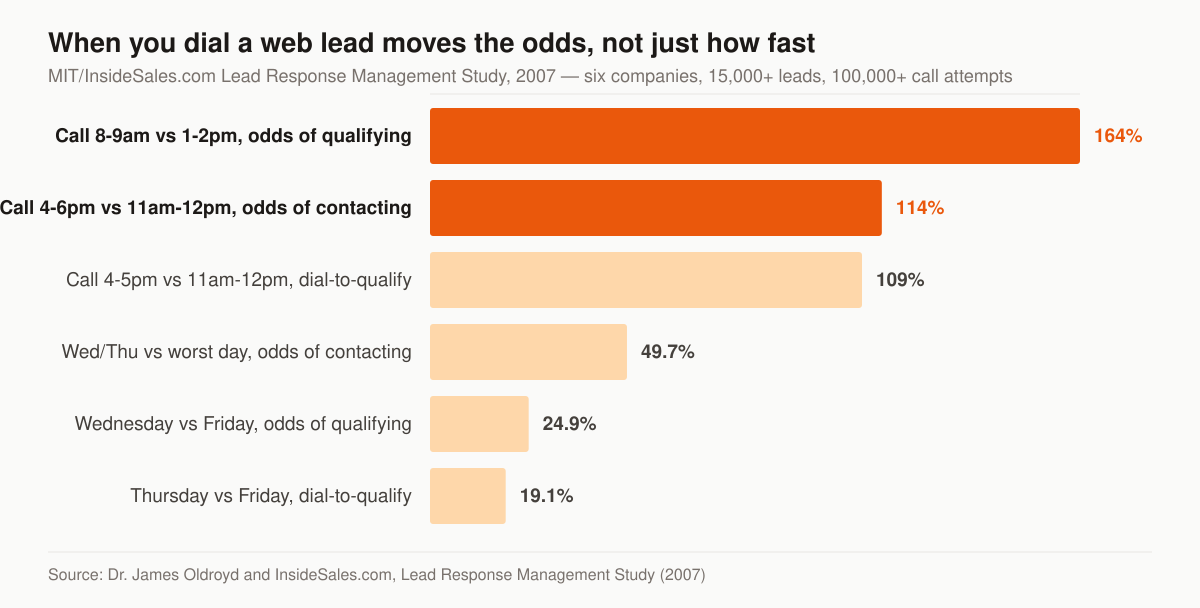
Improvement over the worst slot, by day and hour of the dial. Source: Dr. James Oldroyd and InsideSales.com, Lead Response Management Study, 2007.
Three caveats keep this honest. The study is from 2007, it covers six companies rather than an industry, and it measured contact and qualification — the authors state plainly that “This study did not address close ratios.” Treat the pattern as a hypothesis to test in your own dialer, not a law.
Read that way, it still changes the schedule. The study also reports that “The odds of calling to contact a lead decrease by over 10 times in the 1st hour” and, more usefully for anyone running a chase list, that “After 20 hours every additional dial your salespeople make actually hurts your ability to make contact to qualify a lead.” A dial is not free even when the minute is: a stale list worked at random costs the same labor as a fresh one and returns less.
The researchers also tested this on themselves with insurance forms. Filling out web-based health insurance questionnaires with lead providers, they recorded that one rep submitted at 8:30am “and had his first call in 1 minute, his second in 3 minutes, his 3rd in an hour and 45 minutes” while their sales manager filled his out at 4pm and “didn’t get a single call that day. He got his first of 5 calls at noon the next day (almost the worst time to call), and the last one two days later.”
Put the two findings together into a working schedule rather than a rule of thumb.
| Time from form submission | What to fire | Why |
|---|---|---|
| 0–60 seconds | Automated text and email confirming a human is calling | Holds the lead while the dial queues |
| Within 5 minutes | First human dial | The 5-versus-30-minute gap is where the study’s 100x contact difference sits |
| Same day, 4–6pm if the form came in earlier | Second dial | Reported as the strongest contact block |
| Next morning, 8–9am | Third dial | Reported as the strongest block for qualifying |
| Days 2–7, tapering | Text, call, email mix | Past the first day the marginal dial is weak; vary the channel instead |
Our full sequence, including what to say on each touch, is set out in an insurance lead follow-up cadence.
Before you dial or text that quote request, read the rule you are relying on
Auto lead follow-up is telemarketing law’s home turf, and the exemption you are leaning on is narrower than the shorthand suggests. Under 47 CFR 64.1200, the term “telephone solicitation” means “the initiation of a telephone call or message for the purpose of encouraging the purchase or rental of, or investment in, property, goods, or services, which is transmitted to any person”, and the definition excludes a call or message “To any person with that person’s prior express invitation or permission” or “To any person with whom the caller has an established business relationship”.
That is the clause your web form sits under — and it is why a lead you generated yourself is on different footing from a list you bought. The established-business-relationship route carries its own clocks: the rule defines it, for telephone solicitations, on the basis of “the subscriber’s purchase or transaction with the entity within the eighteen (18) months immediately preceding the date of the telephone call or on the basis of the subscriber’s inquiry or application regarding products or services offered by the entity within the three months immediately preceding the date of the call, which relationship has not been previously terminated by either party.”
Four separate rules apply to the same phone number, and clearing one does not clear the others.
| Rule in 47 CFR 64.1200 | What it says | What it means for an auto quote form |
|---|---|---|
| (f)(15) — telephone solicitation | Excludes calls made with “prior express invitation or permission” or to someone with an established business relationship | The form fill is the permission record; keep it, timestamped |
| (f)(5) — established business relationship | Eighteen months from a purchase or transaction, three months from an inquiry or application | A quote request is an inquiry, so the shorter clock governs |
| (c)(1) — calling hours | No telephone solicitation to a residential subscriber “before the hour of 8 a.m. or after 9 p.m. (local time at the called party’s location)” | Time-zone your dialer, not your office clock |
| (a)(1) and (a)(2) — automated calls | Bars calls using “an automatic telephone dialing system or an artificial or prerecorded voice” to numbers including any assigned to cellular telephone service, absent the prior express consent of the called party, and requires “prior express written consent” where such a call includes or introduces an advertisement or constitutes telemarketing | A manual dial and an autodialed call are not the same compliance question |
Paragraph (d) adds a requirement people forget: anyone making telemarketing calls to a residential subscriber must have “instituted procedures for maintaining a list of persons who request not to receive such calls” made by or on behalf of that entity, including a written policy available on demand. Your CRM needs a suppression field, and someone has to own it.
None of this is legal advice, and state telemarketing statutes sit on top of the federal floor. It is here because speed-to-lead advice that ignores it is incomplete: the fastest possible follow-up on a record you have no permission to call is a liability, not a lead. Our wider treatment is in insurance marketing compliance for agents.
Source: eCFR, 47 CFR 64.1200, current text.
The quote page, in numbers rather than adjectives
“Fast site” is an adjective until someone attaches a threshold. Google’s published Core Web Vitals guidance gives one: web.dev states that “sites should strive to have Largest Contentful Paint of 2.5 seconds or less”, and that the number to watch is “the 75th percentile of page loads, segmented across mobile and desktop devices.” Its threshold figure describes the bands as “Good LCP values are 2.5 seconds or less, poor values are greater than 4.0 seconds, and anything in between needs improvement”.
The percentile is the part agents miss. Your own phone on office wifi is not the 75th percentile. A five-year-old Android on a weak signal in a dealership parking lot is much closer to it, and that is the device your quote page has to load on. Pull the field data, not the lab score.
Around that number, the auto quote page has a short job list:
- Ask for the minimum that lets you quote. Every field is a chance to close the tab. Name, ZIP, phone, and vehicle count get you to a call; VIN and current declarations page can wait for the conversation.
- Make the phone number tappable and visible above the fold. A share of drivers will skip the form entirely, and JD Power’s finding that 48% of new auto policies are now purchased digitally still leaves the majority who are not.
- Say what happens next, with a time. “We will text you in under five minutes” is a promise you can actually keep with the automation above, and it stops the shopper filling in the next form.
- Do not bury the price conversation. The shopper is holding 3.5 quotes. Ambiguity reads as expensive.
The build standard behind this is in insurance web design and, for auto specifically, auto insurance agent website design.
Source: web.dev, Largest Contentful Paint (LCP).
Auto insurance agency marketing ideas that are worth your time
A short list of high-ROI plays, beyond the core three channels:
- Bundle offers (auto + home). Higher retention, lower churn, and a cleaner pitch than auto alone. Making this systematic across your book is the subject of cross-selling and account rounding for P&C agencies.
- Renewal and rate-hike retargeting. Run ads timed to common renewal windows; “got a rate increase?” is a hook we lean on, though the CPI section above explains why it now reaches a smaller audience. The flip side — keeping your own book from shopping at renewal — is what retention and renewal marketing systematizes.
- Review velocity. Drivers pick on trust. A steady flow of Google reviews lifts both map rankings and close rate — handled in reputation management for agents.
- A fast, mobile-first site. A slow page silently costs you quote requests on a phone; our insurance web design standard targets sub-2-second loads, against the 2.5-second LCP threshold above.
How to tell whether any of this is working
Auto reporting goes wrong in a specific way: the dashboard fills with numbers that move every week and none of them are the one you get paid on. Five figures, reviewed weekly, are enough to run the channel.
Each of these answers a different question, and none of them substitutes for another.
| Number | How to get it | What it tells you |
|---|---|---|
| Form-to-contact rate | Contacts ÷ quote requests, by source | Whether your follow-up works at all. Fix this before touching budget |
| Median first-response time | Timestamp of first outbound touch minus form timestamp | The one metric the response-time research is actually about. Median, not average — one 3am lead will hide a bad week |
| Contact-to-quote rate | Quotes given ÷ contacts reached | Whether the leads are quotable, or whether you are buying the wrong ZIPs |
| Quote-to-bind rate | Policies bound ÷ quotes given | Your closing and your pricing competitiveness, tangled together |
| Cost per bound policy, by source | Channel spend ÷ policies bound from that channel | Decides where next month’s money goes |
Two rules make the table useful. Tag every lead with its source at the point of capture, because retro-attributing a bound policy three weeks later is guesswork. And hold each channel to the same window — a search lead and a Facebook lead do not bind on the same clock, so compare 60-day cohorts, not this week against last week.
If your current setup cannot produce those five numbers, that is the finding. A free marketing audit reverse-engineers them from whatever data you already have, and ranking an insurance agency website on Google covers the organic side of the same measurement problem.
What running this costs
Two costs sit side by side and get confused constantly: what you pay a team to build and run the engine, and what you pay the platforms for traffic. Our own numbers are published rather than quoted case by case — Foundation is $2,500/mo, Growth is $3,500/mo, and Full-Funnel is $5,500/mo, with a one-time website or landing-page build running $2,500–$8,000. Ad spend is a pass-through billed straight to Google or Meta, never marked up, and it is separate from the fee. The full breakdown of what sits in each tier is on the pricing page.
For an auto agency the practical read is this: Foundation buys the site, local SEO and Google Business Profile work that the map-pack section above describes; Growth adds the ongoing content and AI-search visibility that lowers cost per lead over quarters; Full-Funnel adds managed paid ads and the automation that makes the five-minute response real. Which one fits depends on your weakest link, not your revenue. If you would rather work through that against your own market before spending anything, tell us what you are working with.
Should you buy auto leads or generate your own?
Both have a place. Generating your own leads — through your site, your ads, your SEO — gives you exclusive contacts at a falling cost and an asset you own. Bought leads start faster but are usually sold to several agents at once, which is exactly why speed to lead matters so much on them.
If you need volume today while your owned pipeline matures, treat lead-buying as a separate decision and use a real lead vendor: you can buy auto leads and live transfers direct from getinsureleads. We do not sell leads here — we build the systems that generate them — so keep the two functions clean and measure each on cost per bound policy.
Put it together
Winning clients online as an auto agent is not mysterious. Be visible where drivers shop, capture the quote on a fast page, and out-respond every competitor on speed. Stack search, local SEO, and Facebook behind a CRM that never lets a lead go cold.
When you are ready to build the full engine — strategy, ads, and follow-up tuned to your market — start with our auto insurance agent marketing program, or get a free, numbers-first look at your current funnel with a free marketing audit. It is built by people who actually generate insurance leads, not just talk about it. Two adjacent reads: the channel-specific how to run Facebook ads for auto insurance agents, and the marketing playbook for home insurance agents for the other half of a personal-lines book. And for the full property-and-casualty picture beyond auto — commercial lines, referrals, retention — the P&C insurance marketing strategy guide maps every channel.
- Shared vs Exclusive Auto Insurance Leads: A Cost-Per-Policy Breakdown
Shared vs exclusive auto insurance leads compared on cost per sold policy, contact and bind rates, and where each wins — so P&C agents pick what actually pays.
- Home Insurance Marketing Budget: What to Spend, Where, and What It Should Return
What to budget for home insurance marketing, how to split it across channels, and how to price every dollar against a bound policy instead of a click.
- How to Run Facebook Ads for Auto Insurance Agents
A step-by-step guide to Facebook ads for auto insurance agents: audience setup, offers that beat rate-shoppers, ad structure, and the math behind scaling.
- P&C Insurance Marketing: A Channel-by-Channel Strategy Guide
P&C insurance marketing across 6 channels: referral partners, local SEO, reviews, retention, cross-sell, paid search — plus real costs and a 90-day plan.