How to Run Facebook Ads for Auto Insurance Agents
To run Facebook ads for auto insurance agents, flag the campaign under Meta's financial products and services Special Ad Category, geo-target your licensed area at the required 15-mile minimum radius, lead with a concrete rate-comparison offer instead of a generic quote, and judge it on cost per bound policy, not cost per lead.
Auto insurance is a different animal from the senior-market lines we cut our teeth on. Buyers are already shopping, margins per policy are thin, and a “cheap lead” can quietly cost you more than an expensive one once you count the dead numbers. So this guide on how to run Facebook ads for auto insurance agents is built around the number we hold a campaign to: cost per bound policy, not cost per click.
We don’t sell auto leads here. We build the marketing systems that generate them. The discipline below is the same ad math and conversion plumbing we run in our own live senior-market campaigns — applied honestly to a low-margin one.
The math that decides if Facebook ads work for you
Before you touch Ads Manager, write down four numbers. If you can’t, you’re gambling, not marketing.
| Metric | What it is | Auto reality |
|---|---|---|
| CPL | Cost per lead | Often low — that’s the trap |
| Quote rate | Leads who give a real quote | Many “leads” never engage |
| Bind rate | Quotes that become policies | Low on auto vs. life lines |
| Cost per bound policy | CPL ÷ (quote rate × bind rate) | The number that decides the channel |
A $9 lead at a 4% bind rate costs you $225 per policy. A $22 lead at a 12% bind rate costs you $183. The “expensive” lead is cheaper. Run your numbers; the point is that CPL alone lies.
For context on how we hold this line, we run our own final-expense operation — a tighter loop than auto allows, which is exactly why the qualification and speed rules below matter even more on auto.
What the 2026 auto shopper is doing before your ad reaches them
Auto is the personal line where the prospect arrives mid-comparison. That behavior is measured, and the measurements should shape the ad before they shape the report.
The JD Power 2026 U.S. Insurance Shopping Study, released 4 June 2026 and based on responses from 12,437 insurance customers who requested an auto insurance price quote from at least one competitive insurer in the previous six months, reports that the share of customers shopping for auto insurance “declined from 57% to 53% year over year, but still remains elevated by historical standards.” Those shoppers now receive an average of 3.5 quotes, which JD Power calls the highest level in the study’s history. And 48% of new auto policies are now purchased digitally, up from 36% five years ago.
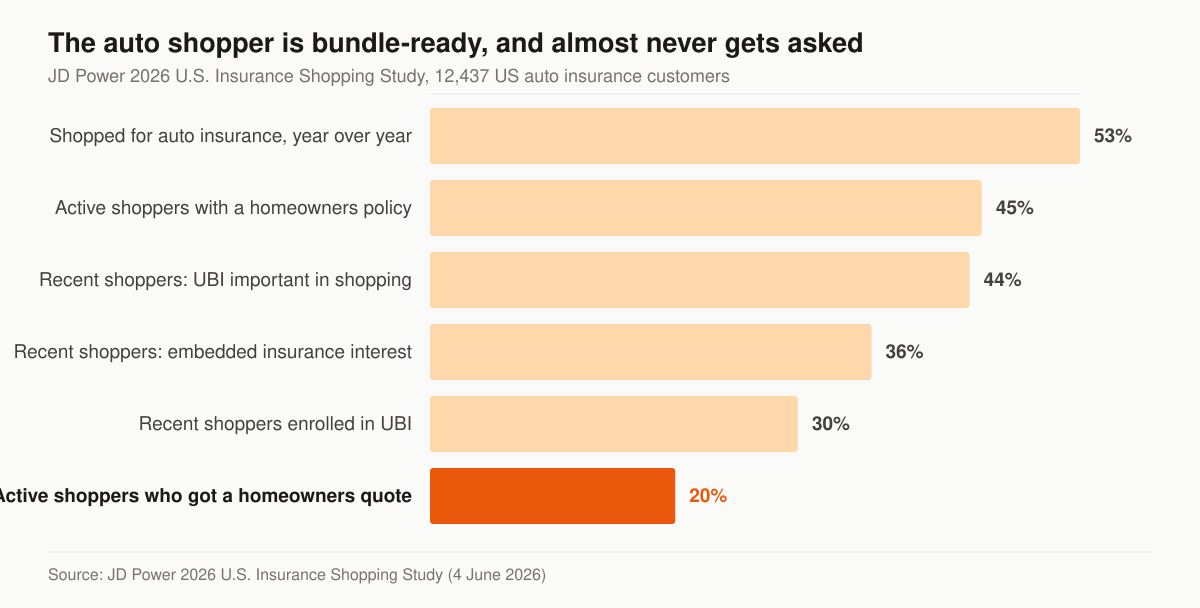
Auto shopper behavior, 2026. Source: JD Power, 2026 U.S. Insurance Shopping Study, 4 June 2026, fielded January 2025 through January 2026 among 12,437 US auto insurance customers.
The two bars at the bottom of that chart are the ones to build an offer around. Among recent customers actively shopping an auto policy, 45% say they have a homeowners policy, but only 20% received a homeowners quote while shopping. Stephen Crewdson, managing director of insurance intelligence at JD Power, states the consequence directly: “Most customers are only shopping their auto policy, and if the auto quote isn’t competitive, they don’t stick around to discuss home, life or other financial products. In practice, if an insurer can’t be competitive on auto, the door usually closes on any chance to bundle additional policies.”
The price backdrop moved too, and it moved against the 2024 playbook. In the Bureau of Labor Statistics consumer price index for July 2026, motor vehicle insurance fell 4.5% over the twelve months from July 2025, while all items rose 3.4%. An ad built on “rates went up again” is now arguing with the prospect’s own renewal notice in a fair number of markets. The rate-shock hook has a shelf life; the switching-moment hook does not.
Every row below is a published figure, with the ad decision it should drive.
| Signal | Figure | Source | What it changes in the campaign |
|---|---|---|---|
| Shopping rate | 53%, down from 57% year over year | JD Power 2026 Insurance Shopping Study | Demand is off its 2025 peak but not back to normal; expect a longer consideration window |
| Quotes per shopper | 3.5 on average, highest in the study’s history | JD Power 2026 | You are one of several quotes, so speed and clarity beat volume |
| Digital purchase share | 48% of new auto policies, up from 36% five years ago | JD Power 2026 | The path from ad to bind can be digital end to end; friction in your form is the constraint |
| Bundle gap | 45% of active shoppers have a homeowners policy, 20% got a homeowners quote | JD Power 2026 | Account rounding is the margin on a thin line; ask about home on the call, every time |
| Usage-based insurance | 44% of recent shoppers say UBI is important in their shopping process | JD Power 2026 | Telematics is a mainstream creative angle, not a niche one |
| Motor vehicle insurance CPI | −4.5% for the twelve months ended July 2026 | Bureau of Labor Statistics, CPI news release | Retire “rates keep climbing” copy unless your market contradicts the national index |
If you want the whole channel mix rather than paid social alone, our auto insurance agency marketing overview covers where ads sit against SEO and referral.
Step 1 — Pick the offer that filters out tire-kickers
Auto buyers respond to specifics. “Get a free quote” is invisible. These convert better because they imply a reason to switch:
- Rate re-shop — “Paying more than $X/month? See if you’re overpaying.” Targets dissatisfied current policyholders.
- Life-event triggers — new car, new driver in the household, moved ZIP, recently married. Real switching moments.
- Bundle angle — auto + home savings. Higher-value, stickier clients.
- Specific savings claim — only if you can substantiate it. Don’t invent a number you can’t back.
- Telematics angle — a discount for safe or low-mileage driving. JD Power reports 20% of all customers use UBI policies, 30% of recent shoppers and 34% of those buying from a new insurer are enrolled, and 44% of recent shoppers say UBI is important in their shopping process.
- Dealer alternative — 36% of recent shoppers say they are interested in embedded insurance sold through the automobile dealer or manufacturer. A “compare it against the dealer’s offer” angle meets a comparison the buyer is already making.
The offer is the targeting. A sharp offer pre-qualifies before Meta’s algorithm ever runs.
One framing rule applies to all six. Meta’s advertising standard on privacy violations and personal attributes says ads “must not contain content that asserts or implies personal attributes,” and its prohibited list includes vulnerable financial status. Describe the product rather than the reader: “Auto coverage compared across [N] carriers in one call” survives review; a hook asking whether the reader can still afford their premium is the shape that trips it. Our pillar on Facebook ads for insurance agents works through Meta’s own acceptable and unacceptable examples line by line.
Step 2 — Build the campaign in Ads Manager
Keep the structure boring on purpose so the data stays readable.
First, the setting that overrides every targeting instinct you have: flag the campaign under the financial products and services Special Ad Category. Meta’s page on the category expansion says “Examples of financial products and services ads include those promoting insurance, bank accounts, investment services and payment services,” and Meta’s Special Ad Category page says “Starting January 21, 2025, using this category is required for financial products and services campaigns for advertisers based in the United States or showing ads to audiences in the United States. Ads may be rejected if an appropriate category is not chosen.” Selecting it fixes age at 18 through 65+, blocks specific-gender selection, rules out ZIP, neighborhood, and sub-city locations, requires a location selection of at least a 15-mile (25 km) radius in the US and Canada, and makes lookalike audiences unavailable.
- Objective: Leads (lead form) or Sales/Leads with a website conversion event if you send traffic to a page.
- Special Ad Category: Financial products and services. Set it before you build anything else. In Ads Manager the path is Special Ad Categories, then Categories, then Countries.
- Geo: Your licensed, serviceable area only — but at a 15-mile minimum radius, not a tight ZIP ring. Meta’s own worked example: target the city of Seattle and “your audience will also include people within a 15-mile radius of Seattle’s city center.” You also cannot exclude locations, so a metro that spills over a state line will be paid for whether you write there or not.
- Age/targeting: Not yours to set. Age comes back as 18 through 65+; let the algorithm optimize on conversions.
- Placements: Advantage+ placements to start; cut underperformers after you have data.
- Form: Short, and legal — see the next section, because the qualifying questions auto agents reach for first are the ones Meta prohibits.
Install the Meta Pixel and the Conversions API so you can optimize on bound policies, not just form fills. We treat optimizing on the wrong event as the first thing to check when an auto campaign plateaus. A purpose-built managed Facebook ads program for auto insurance agents wires this conversion tracking end-to-end, but you can stand up a clean version yourself if you’re disciplined.
What Meta will not let your instant form ask
This is where auto differs from every other line, and where a lot of otherwise sound advice — including an earlier version of this page — is simply wrong. Rating an auto policy needs a ZIP, a date of birth, a driver’s license number, a VIN and the incumbent carrier. Meta prohibits collecting nearly all of it on a financial products and services instant form.
Meta’s “About lead ads” page states it plainly: “To help prevent potential discriminatory practices, if you use lead ads for housing, employment, or financial products and services opportunities based in the US or targeted to the US or Canada, you may not collect certain information. This includes personal information such as age, gender, marital/relationship status and location information, such as street address, city, postal code and zip code.” The same note adds one narrow door: “In some cases, advertisers may use custom fields to ask about their customer’s location preferences for their service, but may not mimic prohibited prefill questions or ask the prohibited information shared above.”
A second Meta page, on questions prohibited on your instant form, applies to every advertiser and closes the rest. Its list bars questions requesting “Insurance information including, but not limited to, insurance company name, plan details, usage or policy numbers,” plus “Government-issued identifiers including, but not limited to, social security numbers, drivers license numbers, photo identification numbers, passport numbers and military ID numbers,” “Financial information including, but not limited to, credit or debit card numbers, bank account numbers, routing numbers, credit score, net worth, income, bankruptcy status and debt status,” “The date of birth for a child,” and “The same or substantially similar information to the questions available in the prefill questions field.” Meta’s consequence is not a warning: “If your instant form includes any questions that are found to violate the Advertising Standards, your lead ad will not run.”
Map each rating field you wanted to the answer Meta’s policy gives, and the workaround that survives it.
| What you wanted on the form | Meta’s status | Where it actually gets collected |
|---|---|---|
| ZIP or postal code | Named as information you may not collect on a financial products and services lead ad | The geo targeting already fences the market; confirm the ZIP in the first call |
| Date of birth or age | Named in the same list | The call, before you rate |
| Driver’s license number | Prohibited as a government-issued identifier | The call or the quoting portal, never a Meta form |
| Current carrier name | Prohibited as insurance information | The call — and it is the first question worth asking there |
| Policy number or plan details | Prohibited as insurance information | The declarations page the prospect uploads after the call starts |
| Credit score or income | Prohibited as financial information | Nowhere in your ad funnel |
| A child’s date of birth | Prohibited outright | The application, once you are in a compliant intake flow |
| Marital or relationship status | Named as information you may not collect | The call |
| How and when to reach them | Not on the prohibited lists; Meta explicitly documents an appointment request question and custom questions for this | The form — this is the qualifying question that survives |
That last row is the one to build on. Meta’s own guidance on responding to leads says to “Use the custom questions or the appointment request question to find out when and how to best reach your customers,” and notes that “Some may prefer to be reached via phone on weekends and others via Messenger in the evenings.” On auto, where the prospect is holding two other quotes, a form that captures the callback window is worth more than a form that captures a ZIP you already know.
Renewal timing sits in a grey zone. A question like “when does your policy renew?” is not on Meta’s enumerated list, but it is close enough to “plan details” that we would check it against the policy inside your own ad account before shipping it, rather than assume. Our guide to insurance marketing compliance for agents covers the wider set of rules an agency ad account runs under.
Step 3 — Lead forms vs. landing pages
Both work. They fail differently.
| Meta lead forms | Landing page | |
|---|---|---|
| CPL | Lower | Higher |
| Intent | Lower | Higher |
| Speed needed | Critical | Important |
| Best when | You have instant follow-up | Your follow-up lags |
| Rating fields | Prohibited by Meta’s lead ads policy | Yours to design, subject to your own privacy notice |
That last row is the real argument for a landing page on auto. If you genuinely need ZIP, vehicle and carrier before a human picks up the phone, the instant form cannot give it to you and a page you control can. You pay for that in cost per lead and gain it back in the share of leads that are quotable.
If you go the page route, the page must load fast, ask only what you need, and show one clear action. Our breakdown of what makes a high-converting insurance landing page applies directly; auto just demands even less friction because the buyer is comparison-shopping in real time.
Pick the performance goal, then feed your CRM back to Meta
In Ads Manager, “optimize on bound policies” is a specific setting with a specific dependency, and Meta documents both.
Meta’s four lead-ad performance goals, in Meta’s own words.
| Performance goal | What Meta says it does | Fit for an auto agency |
|---|---|---|
| Maximize number of leads | Shows the ad “to people in your audience who are most likely to share their contact information with you” | Volume, and the least demanding way to fill a learning phase |
| Maximize number of qualified leads | Shows the ad “to the people in your audience who are most likely to convert after sharing their contact information with you” | The goal auto wants, because a form fill and a bound policy diverge sharply |
| Maximize number of leads through messaging | Optimizes for people “most likely to become your lead through messaging”; Meta notes it “is being gradually introduced, so it may not be available to you yet” | Worth testing where your team answers Messenger fast |
| Maximize value of conversions | Optimizes toward “high-value leads based on the conversion values you share with Meta” | Only once you can attach a credible premium value per bound policy |
The qualified-leads goal has a prerequisite. Meta’s setup page says that when you select it, “it’s recommended that you connect your customer relationship management (CRM) system to send information to Meta about your leads,” and that “After you’ve connected your CRM, you can choose the stages in your sales funnel based on your performance goals.” The Ads Manager path Meta documents is: create the lead ad, then “Go to Conversions and click the Leads drop-down menu, then choose Qualified leads.” The Events Manager path is to add a data source, “Select CRM and click Connect,” then pick or create the pixel for the integration.
That “recommended” wording is now behind the product. Meta’s performance-goals page carries a notice above the goal definitions: “Beginning April 2026, the qualified leads performance goal is no longer available for new campaign creation without Conversions API integration. Existing campaigns will be impacted beginning August 2026.” Both dates have passed, so treat the Conversions API for CRM integration as the entry requirement for this goal rather than a best practice you can defer.
One line in Meta’s CRM setup documentation decides whether the setup works: “During the learning phase, upload CRM events for each lead status update. When a lead’s information changes in your CRM, send the latest update as an event.” A CRM that only posts back at the moment a policy binds gives the delivery system a handful of events a month to learn from. A CRM that posts contacted, quoted and bound gives it a usable signal at every stage. If your CRM cannot do that, fix the CRM before you fix the creative — our comparison of the best CRM for insurance agents is organized around exactly that capability, and our email and follow-up automation systems exist to wire the stage changes back where the CRM leaves a gap.
Step 4 — Win on speed-to-lead, or don’t bother
This is where auto campaigns die. A Facebook auto lead is a rate-shopper holding an average of 3.5 quotes, per JD Power’s 2026 study. Call within five minutes or you’re follow-up number four. Build a simple sequence:
- Auto-text on submission (instant).
- Call attempt within 5 minutes.
- 3–5 follow-up touches over 7 days across call, text, email.
Meta’s own best-practice page for lead ads pushes the same direction without naming a number. It recommends using “an integrated CRM system or leads center to collect your leads data,” and says “Minimizing the time it takes to follow up with your leads can improve your lead quality,” warning that manual downloads from Ads Manager or Business Suite “can take more time to follow up.” It also gives a scheduling instruction: “If your business requires immediate follow-up, you can schedule your lead ad campaigns to run when your organization is prepared to connect with people. We recommend that you run your lead ads during your business hours so you can quickly start a conversation with your prospective customers after they share their information.”
Read that as a dayparting rule, not a platitude. A lead-ads campaign running at 11pm on a Saturday buys form fills your office will answer on Monday, against competitors who quoted on Sunday morning. Wire the whole sequence into your CRM so nothing leaks — speed-to-lead is a process problem, not a hustle problem, and our insurance lead follow-up cadence sets out the touch schedule we run behind paid social.
The consent rules behind that five-minute call
Calling and texting an auto lead fast is an operational rule. Doing it lawfully is a separate one, and 2025 changed part of the picture while leaving the rest intact.
Under 47 CFR 64.1200(f)(9), the term prior express written consent “means an agreement, in writing, bearing the signature of the person called that clearly authorizes the seller to deliver or cause to be delivered to the person called advertisements or telemarketing messages using an automatic telephone dialing system or an artificial or prerecorded voice, and the telephone number to which the signatory authorizes such advertisements or telemarketing messages to be delivered.” The written agreement must include a clear and conspicuous disclosure that by executing it the person “authorizes the seller to deliver or cause to be delivered to the signatory telemarketing calls using an automatic telephone dialing system or an artificial or prerecorded voice,” and that “The person is not required to sign the agreement (directly or indirectly), or agree to enter into such an agreement as a condition of purchasing any property, goods, or services.” Note the scope: that definition governs the autodialed and prerecorded or artificial-voice telemarketing calls covered by 64.1200(a)(2), not every call a human places by hand.
The rule that was going to reshape lead forms did not survive. The FCC’s December 2023 order would have required consent specific to one identified seller at a time. On 24 January 2025 the Eleventh Circuit vacated it in Insurance Marketing Coalition Limited v. FCC, No. 24-10277, holding that “One-to-one consent is not required” and that “Because the one-to-one-consent restriction attempts to alter what we have said is the ordinary common law meaning of ‘prior express consent,’ the restriction falls outside the scope of the FCC’s statutory authority to ‘implement’ the TCPA.” The court framed the standard in one line — callers must obtain “prior express consent”—not “prior express consent” plus — and rejected the companion requirement that a call’s subject matter be logically and topically related to the interaction that produced the consent. The court vacated the rule and remanded to the agency.
Revocation, by contrast, is live and specific. Section 64.1200(a)(10) provides that a called party may revoke consent “by using any reasonable method,” and that a request made through an automated opt-out mechanism on a call, through the words “stop,” “quit,” “end,” “revoke,” “opt out,” “cancel,” or “unsubscribe” sent in reply to an incoming text, or through a designated website or phone number, “constitutes a reasonable means per se to revoke consent.” It adds that all such requests “must be honored within a reasonable time not to exceed ten business days from receipt of such request,” and that callers “may not designate an exclusive means to request revocation of consent.”
Three mechanics an auto ad funnel touches, and what each rule actually requires.
| Mechanic | What the cited rule says | What to build |
|---|---|---|
| Consent language under the lead form | 64.1200(f)(9): signed written agreement, clear and conspicuous disclosure, and it may not be a condition of purchase | A disclosure block under the submit control that names the seller and does not gate the quote on agreeing |
| Bundled consent across multiple carriers | The Eleventh Circuit vacated the FCC’s one-to-one restriction on 24 January 2025 | Do not assume the vacated rule binds you, and do not assume it will stay vacated — the case was remanded to the FCC |
| Opt-outs from your auto-text | 64.1200(a)(10): per se stop words, honored within ten business days, no exclusive means | Automated stop-word handling in the texting platform, plus a manual path for a reply that says the same thing in other words |
This section is a summary of published law, not legal advice. Regulations change and application depends on your setup and state — confirm all of it with your own compliance counsel before you launch.
Step 5 — Scale only what the math earns
Let each ad set gather enough conversions to exit the learning phase before judging it. Meta defines the threshold: exiting the learning phase “usually occurs after about 50 results in the week after the ad set’s last significant edit,” and an ad set that cannot reach it shows a Delivery status reading “Learning limited.” Meta also warns that during the learning phase “ad sets are less stable and usually have a higher CPA,” which is why judging a three-day-old auto campaign tells you nothing.
Then:
- Kill anything above your cost-per-bound-policy ceiling.
- Don’t plan around lookalikes — Meta’s audience page for this category states plainly that “Advantage+ lookalike is unavailable.” Send the bound-policy conversion event back to Meta instead and let optimization do the job a lookalike used to.
- Add retargeting for form-starters who didn’t finish and page visitors who didn’t convert. Custom audiences are absent from Meta’s list of restricted options for the category; the page notes only that “Certain audience options such as custom audiences may only be available via Meta Ads Manager.”
- Raise budgets in small steps so you don’t reset learning. Meta’s guidance is to “Set a budget large enough to get enough total results and avoid frequent budget changes (which can cause an ad set to re-enter the learning phase),” and to “Wait to edit your ad set until it’s out of the learning phase.”
- Round the account instead of only adding new ones. You already paid Meta to acquire that customer once, and with 45% of active auto shoppers holding a homeowners policy against the 20% who got a home quote, the second policy is sitting in your own book — the mechanics are in our guide to cross-selling and account rounding for P&C agencies.
What a real test costs
The only honest budget is the one derived from your own cost per result, but published benchmarks give you a floor to plan against before you have data.
WordStream’s 2025 Facebook Ads Benchmarks report, drawn from 554 US traffic-objective campaigns and 726 US leads-objective campaigns running between April 1, 2024 and June 30, 2025, notes that its “averages” are technically median figures. It reports a leads-objective cost per click of $1.92 against $5.26 on Google Ads, and a leads-objective cost per lead that “increased 20.94% overall to $27.66,” against $70.11 on Google Ads. On the traffic side, the Finance and Insurance category carries a $1.22 cost per click and a 0.98% click-through rate — a costly click and a reluctant audience, both of which land squarely on an auto campaign.
Take the arithmetic seriously. Fifty results per ad set per week is Meta’s stated learning threshold, so multiply it by whatever a lead actually costs you: fifty times the $27.66 all-industry median is $1,383 a week for a single ad set to clear it, and your auto number will sit above or below that. If that figure is more than you want to commit, run one ad set properly rather than three badly — Meta’s own advice is to “Use realistic budgets,” warning that “If you set a very small or inflated budget, the delivery system has an inaccurate indicator” of who it should be optimizing toward.
Then compare that against the alternatives before you commit. Search buys higher intent at a higher price, which is the whole argument in our head-to-head on Facebook ads vs Google ads for insurance agencies, and purchased auto leads price differently again depending on whether they are exclusive or shared — the trade-off is broken down in exclusive vs shared auto insurance leads.
On management cost: our managed paid ads sit in the Full-Funnel tier at $5,500/mo, and media budget is never inside that fee — it is a pass-through billed straight to Meta. The full tier breakdown is on our pricing page, and the ongoing creative and account work is what the insurance Facebook ads service covers.
Should you run ads or just buy leads?
Honest answer: many auto agents do both. Run your own Facebook ads for owned, exclusive pipeline you control, and fill gaps with purchased volume when you have capacity. Buying leads, live transfers, or aged auto leads as a product is a different transaction from running campaigns — if that’s what you want, buy auto leads direct from getinsureleads instead of stretching your ad account to do two jobs.
For the bigger picture — funnel, creative testing, and how paid social fits with your site and SEO — see our auto insurance agency marketing overview. And if you’d rather have someone pressure-test your current setup, the free marketing audit is one way to get a second pair of eyes on where your auto spend is leaking. Paid social is one channel; for the complete online play, read how auto insurance agents win clients online.
The short version
Pick an offer that implies a reason to switch, and check it against a market where the motor vehicle insurance index fell 4.5% in the year to July 2026. Set the Special Ad Category, then keep targeting broad and geo-sane — at least a 15-mile radius inside your licensed footprint. Stop trying to rate the policy on the instant form; Meta prohibits the fields, so capture the callback window instead and qualify on the phone. Set the qualified-leads performance goal and post CRM stage changes back so Meta optimizes toward bound policies rather than form fills. Call inside five minutes, and run the ads when someone is there to call. Then scale only what clears your cost-per-policy math. Do those things and Facebook ads become a measurable channel instead of a money pit — which is the whole point of treating ad spend like an operator, not a hopeful.
- How Auto Insurance Agents Win Clients Online
How auto insurance agents get clients online: the three channels that produce quotes, the cost-per-bound-policy math, and the speed-to-lead rule behind it.
- Shared vs Exclusive Auto Insurance Leads: A Cost-Per-Policy Breakdown
Shared vs exclusive auto insurance leads compared on cost per sold policy, contact and bind rates, and where each wins — so P&C agents pick what actually pays.
- Home Insurance Marketing Budget: What to Spend, Where, and What It Should Return
What to budget for home insurance marketing, how to split it across channels, and how to price every dollar against a bound policy instead of a click.
- P&C Insurance Marketing: A Channel-by-Channel Strategy Guide
P&C insurance marketing across 6 channels: referral partners, local SEO, reviews, retention, cross-sell, paid search — plus real costs and a 90-day plan.