Who we serve
Facebook Ads for Auto Insurance Agents (Managed Service)
Facebook ads for auto insurance agents (managed service) means an operator team builds, runs, and optimizes your entire paid-social campaign while you keep the licensed conversations. The result is a tracked pipeline with real creative testing and cost-per-lead reporting, not a boosted post and a hope.
Free · 15-minute teardown · no pitch deck
- We run our own final-expense book
- No pitch deck — we screen-share real numbers
- TCPA-aware · CMS/AEP-compliant · Meta Special Ad Category
- Core Web Vitals < 2.0s LCP
Plenty of auto agents who “tried Facebook” boosted a post, spent a few hundred dollars, got a handful of junk form fills, and quit. That is not paid social failing. That is a media channel run without a media operator. A managed service fixes the operating model, not just the ad copy.
We are that operator. We generate insurance leads every day as our own book of business, so we run your auto campaigns the way we run ours: a tracked pixel, a conversion objective, segmented audiences, and a weekly cadence of creative tests measured against a cost-per-lead number. You stay on the phone with quoted drivers. We stay in the ad account.
This page is the buyer’s side of that arrangement. It covers what the retainer buys and what it deliberately does not, how the media budget is billed, what Meta’s Special Ad Category does to your targeting before anyone writes an ad, who holds the ad account and the pixel while the engagement runs, what happens to both when it ends, and the questions worth asking any agency — us included — before you hand over an account. If you want the do-it-yourself build instead, the step-by-step is in how to run Facebook ads for auto insurance agents.
What “managed” actually covers
Managed means we own the machine end to end. The split below is the operating contract: five layers, who runs each, and what stays yours.
| Layer | What we run | What you keep |
|---|---|---|
| Tracking | Meta Pixel + Conversions API, event mapping, CPL reporting | Visibility into every dollar |
| Audiences | Geo/ZIP targeting, lookalikes, exclusions, retargeting | Your local market knowledge |
| Creative | Hooks, angles, video and static tests, weekly iteration | Brand and carrier approvals |
| Capture | Lead forms or a dedicated landing page, instant routing | The licensed quote conversation |
| Optimization | Budget shifts, kill/scale decisions, fatigue checks | Final sign-off on offers |
Two rows in that table carry more weight than they look. Tracking is the first thing we check on an inherited account, because a pixel firing a generic page view instead of a lead event teaches Meta’s delivery system to find people who load pages, which is exactly the audience an auto agent does not want. And the audiences row is smaller than it used to be, because the financial products and services Special Ad Category removed several of the controls agents assume they are buying. Both are covered below.
The row that stays yours in every engagement is the licensed conversation. We do not quote, we do not rate, and we do not touch an application. You are the licensed party; we are the marketing service.
What a managed auto Facebook program costs, and what the media costs
Two bills, never one. The table separates the fee we invoice from the spend Meta invoices, because agencies that blur the two are the ones whose reporting cannot be audited.
| Line item | Who bills it | How it works on our program |
|---|---|---|
| Management retainer | Us, monthly | Managed paid ads (Google / Meta) sit in the Full-Funnel tier at $5,500/mo |
| Media budget | Meta, to your card | Billed at cost, straight to the platform — never inside the retainer |
| Landing page build | Us, one time | $2,500–$8,000 depending on scope, only if you need a page rather than an instant form |
| Foundation tier | Us, monthly | $2,500/mo — site, local SEO, on-page SEO, monthly reporting. No managed ads |
| Growth tier | Us, monthly | $3,500/mo — adds the content engine, AI-search visibility and reputation work. Still no managed ads |
The full tier comparison and the exit terms are on the pricing page. The short version for a paid-social buyer: managed ads start at Full-Funnel, and buying a tier below that does not get you a cheaper version of this service, it gets you a different service.
On the media side, the honest answer to “how much should I spend” is that it is a function of your own cost per result, which nobody knows on day one. Two published numbers give you something to plan against in the meantime. Meta says an ad set exits the learning phase once it can deliver stably, which “usually occurs after about 50 results in the week after the ad set’s last significant edit.” WordStream’s 2025 Facebook Ads Benchmarks report — 726 US leads-objective campaigns running between April 1, 2024 and June 30, 2025, with “averages” that are technically median figures — puts the all-industry leads-objective cost per lead at $27.66. Multiply Meta’s threshold by a cost per lead you can defend for your own market, per ad set, per week, and you have a floor. If that floor is more than you want to commit, run one ad set properly rather than three badly.
The Special Ad Category decides your targeting before you do
This is the first thing an operator sets, and a thing plenty of agents discover only after a rejection. Meta’s own page on choosing a Special Ad Category states: “Starting January 21, 2025, using this category is required for financial products and services campaigns for advertisers based in the United States or showing ads to audiences in the United States. Ads may be rejected if an appropriate category is not chosen.” Meta’s page on the category expansion names the scope directly: “Examples of financial products and services ads include those promoting insurance, bank accounts, investment services and payment services.” The Ads Manager path Meta documents is Special Ad Categories, then Categories, then Countries — set before anything else is built.
Selecting it costs you targeting. Meta’s wording on the Special Ad Category page: “Certain audience options are limited or unavailable for these ads for advertisers based in or reaching the US and advertisers reaching Canada and certain countries in Europe: age, gender, ZIP code or postal code, exclusion targeting, lookalike audiences and saved audiences. Some interests will also be unavailable when you create your audience. Audiences based on city or pin drop locations will include an expanded radius.”
Map each control the category takes away to what an operator does instead — this is the substitution that decides whether an auto account performs under the constraint.
| Control you expected | Meta’s status | What replaces it |
|---|---|---|
| Age and gender selection | Listed among options “limited or unavailable” | The offer does the filtering; a rate re-shop hook self-selects drivers who think they are overpaying |
| ZIP or postal code targeting | Same list | City or pin drop, with the expanded radius Meta applies — then confirm the ZIP on the call |
| Exclusion targeting | Same list | Suppression moves downstream into the CRM and the follow-up sequence, not the ad set |
| Lookalike audiences | Same list | Post conversion events back through the Conversions API and let delivery find the pattern |
| Saved audiences | Same list | Audiences get rebuilt inside the campaign each time |
| Detailed interests | “Some interests will also be unavailable when you create your audience” | Creative carries the qualification that targeting used to |
Meta’s guidance under those restrictions is a single line worth quoting to anyone who wants a tighter audience: “We encourage you to broaden—not restrict—your audience.”
There is a second category trap specific to auto agents who sell the bundle. Meta defines the Housing Special Ad Category as covering ads that promote or directly link to “a housing opportunity or related service, including but not limited to listings for the sale or rental of a home or apartment, homeowners insurance, mortgage insurance, mortgage loans, housing repairs and home equity or appraisal services.” An auto creative that leads with a home-and-auto bundle is no longer plainly a financial products and services ad. Meta adds that its category list “is not a comprehensive list of examples and does not constitute legal advice,” which is exactly why the categorization decision belongs to someone who sets it every week rather than someone setting it once.
Category selection also feeds ad review. Meta lists “Special ad categories” among the components a review may examine, alongside images, video or text, targeting information, ad destination and advertiser permissions, and says “Most ads are reviewed within 24 hours, although in some cases it may take longer.” That review window is a scheduling fact, not a footnote: it is why a campaign is not launched the same afternoon it is approved internally. Our wider treatment of what a licensed agent can and cannot say in an ad is in insurance marketing compliance for agents.
Who owns the ad account, the pixel and the leads
A question worth asking any paid-social agency before the first invoice: whose business portfolio does this live in? Meta’s answer is structural. A business creates its own portfolio to hold its assets — Meta lists a Facebook Page, an Instagram account, an ad account, an app and a Meta pixel — and after creating it “you get full control of it.” Crucially, “Business assets can only belong to one business portfolio.” An asset created inside the agency’s portfolio is inside the agency’s portfolio.
The correct arrangement is the one Meta documents on the same page: “You can also add partners, such as people who work at an agency your organisation works with.” You hold the portfolio. We are a partner with access. Access is granted at kickoff and revoked at the end, and nothing has to be migrated, rebuilt or negotiated for.
Here is the ownership map we run, asset by asset, with what happens to each if the engagement ends.
| Asset | Where it lives | On exit |
|---|---|---|
| Business portfolio | Yours, created under your business name | Unchanged — our partner access is removed |
| Ad account | Inside your portfolio | Stays with you, with full spend and performance history |
| Meta Pixel and Conversions API events | Inside your portfolio | Stays with you, including the audiences it has accumulated |
| Facebook Page and Instagram account | Yours | Unchanged |
| Ad creative and landing pages | Built for you, paid for by you | Yours to keep and keep running |
| Leads | Delivered into your CRM under your brand | Already yours; there is nothing to hand back |
Our published terms match that map: programs run month to month after any initial term, either side can end the engagement with 30 days’ written notice, and what you keep is the website, the content, the ad accounts and the creative you paid for. Read the whole clause on the pricing page before you sign anything with anyone — including us.
One practical note on portfolio limits, because agents who have been through two agencies sometimes discover they now have three portfolios: Meta says “You can personally create up to two business portfolios. There is no limit on the number of portfolios that you can belong to.” Consolidate before you scale.
The transferable proof
Auto is far from our senior-market roots, so we will not pretend a final-expense buyer looks like a driver shopping rates. They do not. What carries over is the discipline of the channel, and that is platform skill, not product luck.
We run a real senior-market lead operation. The Pixel setup, the audience architecture, the test-and-kill creative cadence, and the relentless CPL accounting that hold it together are exactly what we point at an auto account. The offer and the creative change; the way we drive the account does not. You can see the broader paid-social methodology on our insurance social media marketing service page, and how it adapts to this vertical on the auto insurance agent marketing hub.
Where auto ad spend leaks first
A short list of the failure points we remove first:
- Optimizing for clicks, not quotes. Boosted posts buy engagement. We buy conversion events tied to a real lead.
- No speed-to-lead. A Facebook auto lead goes cold in minutes. If it sits in an inbox for an hour, you paid for a competitor’s sale.
- One ad, forever. Creative fatigues fast on Meta. No weekly iteration means a rising CPL you never see coming.
- No exclusions. Without suppression lists you re-pay for the same tire-kickers and existing customers.
- Form-only, no landing page. Instant forms are cheap but lower intent. We test forms against a built-for-conversion page and let the CPL decide.
- Editing the campaign every time it has a bad day. Meta’s guidance is “Wait to edit your ad set until it’s out of the learning phase,” and it warns that “By editing an ad, ad set or campaign during the learning phase, you reset learning and delay our delivery system’s ability to optimise.” An agent watching Ads Manager hourly is an expensive person to have in the account.
- Too many ad sets on too little budget. Meta’s own instruction is to avoid high ad volumes, because “When you create many ads and ad sets, the delivery system learns less about each ad and ad set than when you create fewer ads and ad sets.” Three half-fed ad sets learn less than one properly fed one.
Points 6 and 7 are the two that look like diligence from inside the account, which is what makes them hard to catch. They are the reason a managed service is worth paying for on a channel with a learning phase: the discipline being bought is partly the discipline not to touch it.
The weekly operating cadence
Retainers go wrong when nobody can say what happens on a Tuesday. This is the rhythm an auto account runs on, and what actually changes in Ads Manager at each interval.
| Cadence | What happens | What changes in the account |
|---|---|---|
| Daily | Delivery and spend check, rejection and policy alerts, lead-flow sanity check against the CRM | Nothing, unless an ad is rejected or delivery has stopped |
| Weekly | Creative review against fatigue signals, new angle shipped, losing ads paused | New ad variants; paused ads. Budgets and audiences held steady |
| Fortnightly | Form-to-call and call-to-quote read with your team, offer language revisited | Copy and form questions, where the funnel says the drop is |
| Monthly | Full CPL and spend report, budget decision, geo and placement review | Budget steps, geo adjustments, placement exclusions |
| Quarterly | Channel-mix review against search and your site, retargeting layer rebuilt | Campaign structure, if the quarter’s data justifies it |
The reason budgets move monthly rather than weekly: Meta’s own advice is to “Set a budget large enough to get enough total results and avoid frequent budget changes (which can cause an ad set to re-enter the learning phase).” There is also a review consequence. Meta says changes to targeting, creative, optimization or billing event trigger a new review process, while “Changes to your ad’s bid amount, budget or ad set schedule will not trigger review.” So a creative refresh costs you a review cycle and a budget step does not — which is why the two sit on different lines of the calendar.
What gets reported, and what will not be promised
The reporting standard is simple: every number on the report has to trace back to a row in Ads Manager or a stage in your CRM. Spend, impressions, clicks and cost per click come from the platform. Leads, contact rate, quote rate and cost per bound policy come from your CRM, which is why the CRM connection is part of the build rather than an afterthought — the comparison of what different systems can actually post back is in best CRM for insurance agents.
What will not appear on a proposal from us:
- A guaranteed cost per lead. We have not run your market, your carriers or your offer yet. A CPL quoted before the first dollar is spent is a sales number, not a forecast.
- A guaranteed lead volume. Volume is a function of budget and auction, and neither is ours to promise.
- A close-rate projection. That is your sales floor, not our ad account.
- Borrowed case studies. Results from another vertical do not predict an auto account, and results from another agency’s client are not ours to show.
What the first 90 days look like
Weeks 1–2 we install tracking, audiences, and at least three creative angles, then launch on a conversion objective. This is also where the Special Ad Category is set, the portfolio and partner access are confirmed, and the first ads go into review — Meta reviews most ads within 24 hours, so approvals are a scheduling item rather than a launch risk. Weeks 3–6 we cut the losers, scale the winners, and tighten geo targeting. By the end of the quarter you have a CPL baseline, a working creative library, and a retargeting layer feeding warm shoppers back into the funnel. Every decision ties to the number, not to a hunch.
What the first 90 days will not produce is a stable cost per lead in week one. Meta is explicit that during the learning phase “ad sets are less stable and usually have a higher CPA,” and that the phase resolves once an ad set can deliver stably. An account judged on its first fortnight is being judged during the window Meta itself describes as the least stable. Where an ad set never gathers enough results, Ads Manager says so directly — the Delivery column reads “Learning limited,” and that status is a budget-and-structure problem, not a creative one.
How to vet whoever runs your auto Facebook ads
Use this on us as readily as on anyone else. Six questions, the answer that should end the conversation, and why the question matters.
| Ask | Answer that should worry you | Why it matters |
|---|---|---|
| Whose business portfolio will the ad account sit in? | “Ours, it’s simpler” | Meta says business assets can only belong to one portfolio; if it is theirs, your history leaves with them |
| Is media spend inside the fee or billed separately? | “It’s all one number” | A blended number cannot be audited, and you cannot tell a fee increase from a spend increase |
| Which Special Ad Category will you select, and why? | Hesitation, or “we don’t usually need one” | Meta requires the financial products and services category for US insurance campaigns and says ads may be rejected without it |
| What conversion event will you optimize toward? | “Leads” with no mention of the CRM | Optimizing to form fills and optimizing to bound policies are different campaigns |
| How often will you change budgets and creative? | “Daily, we’re very hands-on” | Frequent edits can push an ad set back into the learning phase |
| What happens to the pixel and the creative if we part ways? | Anything other than “you keep them” | Assets you paid for should not be leverage in a renewal conversation |
If an agency answers all six well and still cannot show you where the numbers come from, ask for a read-only Ads Manager seat. Anyone confident in the account will give you one.
When a managed service is the wrong purchase
Saying so costs us engagements and saves you money.
- Nobody can answer the phone inside the hour. Paid social on auto produces leads at unpredictable times. If they queue until tomorrow, buy something else first — the sequence that fixes this is in our insurance lead follow-up cadence.
- You are appointed in one state and want national reach. Meta’s location targeting for this category expands your radius rather than tightening it, so a licensed footprint that ends at a state line will be paid past.
- There is no site or page worth sending traffic to. A campaign pointed at a slow, brochure-shaped homepage converts badly no matter who runs the ads. Fix the destination first — see auto insurance agent website design and our insurance landing pages service.
- The media budget is smaller than the retainer by a wide margin. At that ratio you are buying management for an account too small to manage. Start with the website build or organic work and come back.
- You want leads this week. Ads have a learning phase; a purchased lead does not. That is a buying decision, covered below.
Run your own ads, or buy finished leads?
Be honest about which you want. A managed ad service builds an asset you control: your pixel, your audiences, your brand on the lead. It compounds. But if you would rather skip the account and purchase auto leads or live transfers as a ready-made product, that is a buying motion, not a marketing one, and you should buy leads direct from getinsureleads instead of paying an agency to manage an ad account. We keep the two clean: this page is the build-it service.
The trade is real in both directions. Purchased volume arrives the day you buy it and stops the day you stop; an ad account takes weeks to stabilize and keeps the audiences, the creative library and the conversion data when you pause it. Many auto agents run both, using purchased volume to cover capacity gaps while the owned channel matures. If that is the comparison you are actually making, the pricing structure of the alternative is broken down in exclusive vs shared auto insurance leads.
Where paid social sits against search and purchased leads
Meta is the cheaper click and the colder audience. Search is the dearer click and the warmer one. That is the whole trade, and the published benchmarks make the size of it legible.
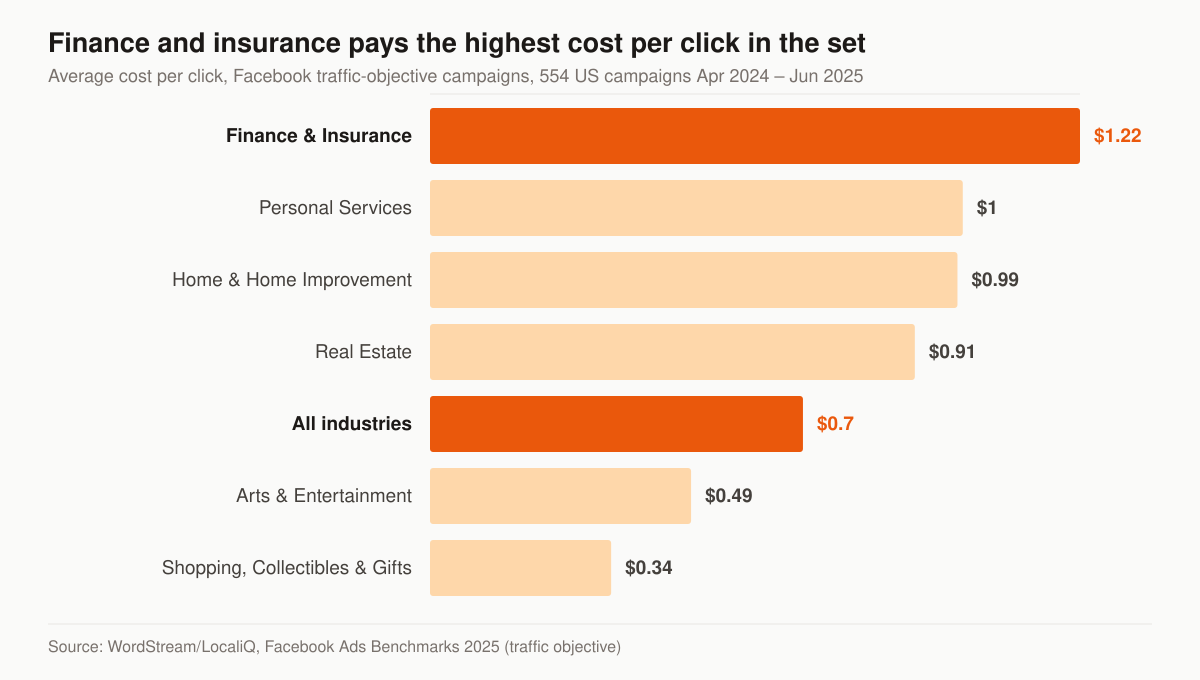
Average cost per click, Facebook traffic-objective campaigns, by business category. Source: WordStream/LocaliQ, Facebook Ads Benchmarks 2025, from 554 US traffic-objective campaigns running April 1, 2024 to June 30, 2025.
Finance and Insurance carries the highest cost per click in that traffic-objective set at $1.22, against $0.70 across all industries — and one of the three lowest click-through rates in the set at 0.98%, against 1.71% overall. An expensive click on a reluctant audience is the starting condition of every insurance paid-social account. It is also why the operator’s job on auto is conversion rate and follow-through rather than click volume: you are not going to out-click a travel advertiser, so the win has to come after the click.
Against search, the same report reads the other way round.
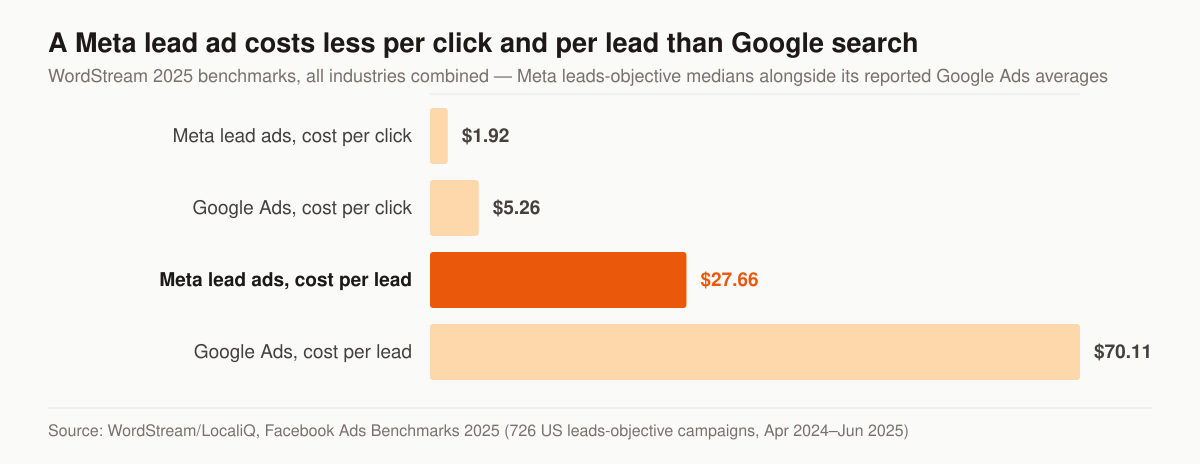
Meta leads-objective medians alongside the report’s Google Ads averages, all industries. Source: WordStream/LocaliQ, Facebook Ads Benchmarks 2025, 726 US leads-objective campaigns, April 2024 to June 2025.
One caveat worth stating plainly, because it is the kind of thing an agency deck usually hides: the leads-objective breakdown in that report does not carry a Finance and Insurance row at all. The $27.66 cost per lead and the 7.72% conversion rate are all-industry medians, and the report notes its cost per lead “increased 20.94% overall to $27.66” year over year. Treat them as a direction of travel, not as your number. The head-to-head between the two channels for agents is worked through in Facebook ads vs Google ads for insurance agencies, and the search side of the mix is its own service — insurance PPC management.
The buyer you are advertising to is also worth designing around. JD Power’s 2026 U.S. Insurance Shopping Study, based on 12,437 insurance customers who requested an auto quote from at least one competitive insurer in the previous six months and fielded from January 2025 through January 2026, found customers now receive an average of 3.5 quotes, the highest level in the study’s history, and that the share of customers shopping for auto insurance declined from 57% to 53% year over year. Nearly half — 48% — of new auto policies are now purchased digitally, up from 36% five years ago. Your ad is landing in a comparison, not a vacuum, and the comparison finishes online.
The bundle number in that study is the one that pays for the campaign. Among recent customers actively shopping an auto policy, 45% say they have a homeowners policy, but only 20% received a homeowners quote while shopping for auto insurance. JD Power’s Stephen Crewdson put the mechanism this way: “Most customers are only shopping their auto policy, and if the auto quote isn’t competitive, they don’t stick around to discuss home, life or other financial products. In practice, if an insurer can’t be competitive on auto, the door usually closes on any chance to bundle additional policies.” You paid Meta once to acquire that household; the second policy is a conversation, not a second campaign. The mechanics are in cross-selling and account rounding for P&C agencies.
Start with the numbers
We will not quote you a CPL we have not earned in your market yet. We will pull your states, your offer, and your current capture setup and tell you what is realistic. Book a free marketing audit and we will map the account before you spend a dollar, or talk through the wider plan on the auto insurance marketing pillar and our final-expense lead operation that proves the operating model.
If you already know you want managed paid social and just need the scope and the number, the service page is insurance Facebook ads and the tier is on pricing. If you would rather ask a question first, contact us — a short answer about whether your market and budget make this work costs nothing and saves both of us a quarter.
The services behind it
Guides that go deeper