How to Get More Google Reviews for Insurance Agents (Without Gaming It)
To get more Google reviews as an insurance agent, ask every satisfied client at the moment coverage is bound and send a direct review link by text the same day. BrightLocal found 83% of consumers asked for a review in 2026 left one. Never incentivize or gate the ask.
For a local insurance agent, Google reviews are not a vanity metric. They are one of the strongest signals feeding the map pack, they lift the trust of every prospect comparing agents, and they even influence Local Service Ads ranking. And yet the review profile is where agency marketing quietly stalls — not because clients are unwilling, but because nobody asked at the right moment, in the right way. BrightLocal found 78% of US consumers were asked for a review by some business in the last twelve months; the question is whether yours was one of them.
This is the practical playbook for changing that, without touching any of the tactics that get profiles penalized. It is built on three primary sources you can open and check yourself: Google’s Maps user-generated content policy, the FTC’s Rule on the Use of Consumer Reviews and Testimonials at 16 CFR Part 465, and BrightLocal’s Local Consumer Review Survey 2026, a February 2026 survey of 1,002 US adults.
Why reviews punch above their weight for agents
Three things make reviews unusually valuable in insurance specifically:
- Trust in a trust-poor category. People are wary of anyone selling them financial products. BrightLocal found 85% of consumers say positive reviews make them more likely to use a business and 77% say negative ones make them less likely — a wall of recent, specific reviews does the reassuring your own copy cannot.
- Local ranking. Review score, volume, and recency feed Google Business Profile and map-pack visibility — and the same signals help you get cited by AI engines like Perplexity, which lean on third-party corroboration. Reviews are one pillar of our insurance local SEO service, alongside profile optimization and citations.
- A hard consumer floor. BrightLocal found 47% of consumers will not use a business with fewer than 20 reviews, and only 9% would use one with five or fewer. Below that floor the profile is not underperforming, it is being skipped.
All three compound, which is why the review ask belongs inside insurance agency reputation management as a standing monthly number — velocity, star average, response rate — rather than a task someone remembers once a quarter.
What the numbers say about asking
The gap here is rarely willingness. It is the request.
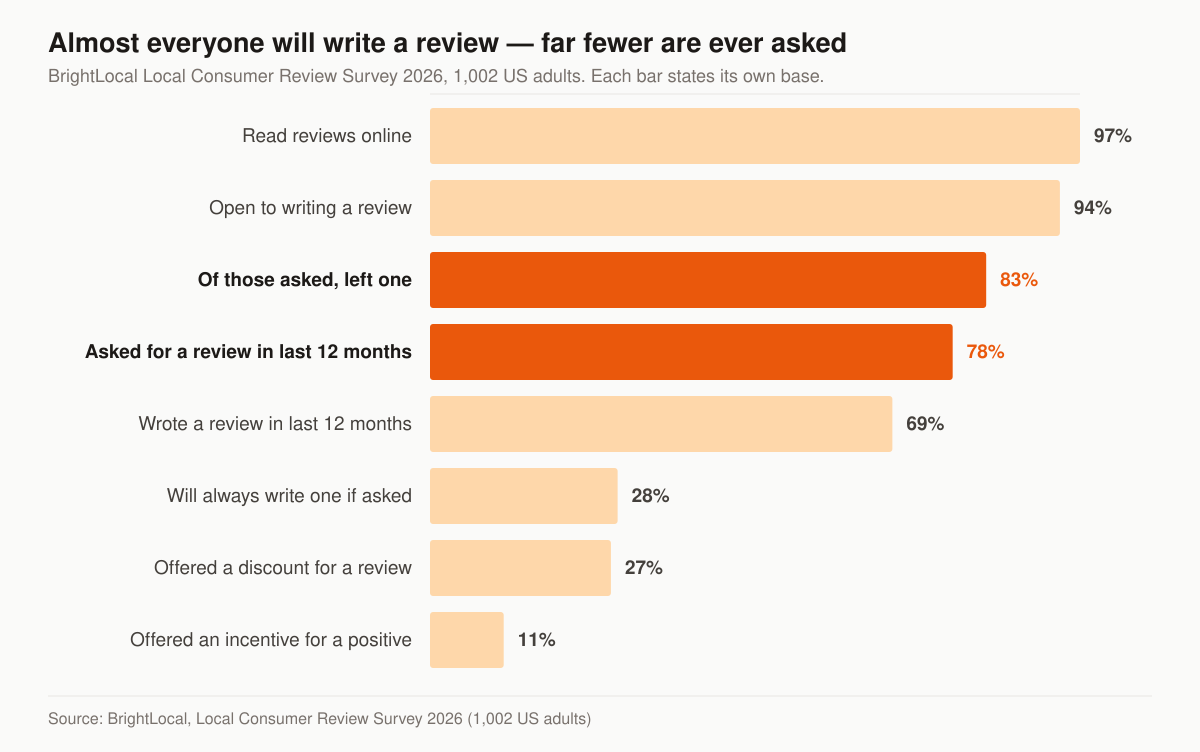
Chart: consumer review behaviour from BrightLocal’s Local Consumer Review Survey 2026, a representative panel of 1,002 US adults surveyed via SurveyMonkey and published 11 February 2026.
Read the bars in pairs. 94% of consumers are open to writing a review and only 6% say they never would, yet 69% actually wrote one in the last twelve months — the shortfall is the ask, not the appetite. And when the ask happens it converts: 83% of the people who were asked went on to leave a review, and 28% say they will always write one if prompted, up from 16% in 2025.
The bottom two bars are the warning. 27% of consumers were offered a discount for a review and 11% were offered an incentive to write a positive one. That second group is the conduct two separate rulebooks name, and the sections below quote both.
Ask at the moment of goodwill
We treat timing as the first thing to fix in a review program, because the ask is free and the moment is not. Goodwill peaks immediately after a positive milestone and decays. Ask then, not next week.
The moments worth building the ask around:
- Right after coverage is bound, while relief and gratitude are fresh.
- After you helped with a claim or resolved a problem for them.
- After an annual review where you saved them money or improved coverage.
- After a warm referral thank-you, when they already feel good about you.
Ask verbally in that conversation, then remove all friction with a direct link. One caution on the verbal ask: Google’s policy says that when soliciting reviews, “merchants should not require or pressure users to leave ratings or write reviews while on the premises”. Asking a client at the kitchen table whether they would be willing to leave a review later is a request. Handing them your phone and waiting is pressure.
Make it one tap: the direct-link method
The gap between “I’ll leave a review” and an actual review is friction. Google publishes the mechanism for closing it. Its help page on creating a Google link or QR code to request reviews walks the exact path: go to your Business Profile, select Read Reviews, then Get more reviews, then copy the link or right-click and save the QR code. Google notes that “Currently, reviews QR codes can only be generated on a computer browser, not on mobile devices,” so generate yours at a desk once and store it.
Google lists four placements for the link and code, all of which have an agency equivalent:
- “Include it on your receipts” — for an agency, the policy-delivery packet.
- “Include it in thank you emails” — the post-bind confirmation.
- “Add it at the end of a chat interaction” — your website chat or SMS thread.
- “Print and display the QR code in your store” — the card on the desk where clients sign.
Google adds that you can also send review requests through email, WhatsApp, or a Facebook post. For an agency, a text message the same day as the bind conversation is the version that fits the workflow — clients already have your number, and an older client who would struggle to navigate to your profile can tap a link. BrightLocal’s own recommendation to businesses reads the same way: “send requests with timely emails or SMS requests, and include links and QR codes on printed materials to make responding simple.”
Keep the message short and personal: thank them, one sentence on why it helps a small local agency, the link. Nothing more, for reasons the next two sections make specific.
What Google’s policy actually permits when you ask
Google states what a compliant request looks like, and it is worth reading in Google’s own words, because the permitted version is narrower than the phrasing agencies reach for.
Google’s Maps user-generated content policy says merchants may: “Solicit or encourage the posting of content that does represent a genuine experience, without offering incentives to do so or attempting to influence the rating or the contents of the review.”
Three prohibitions sit against that permission. Under fake engagement, Google says merchants and users may not “Solicit or encourage the posting of content that does not represent a genuine experience” or “Offer incentives – such as payment, discounts, free goods and/or services - in exchange for posting any review or revision or removal of a negative review.” Under rating manipulation, it says merchants may not “Discourage or prohibit negative reviews, or selectively solicit positive reviews from customers,” and adds that when soliciting reviews, merchants “should not require or pressure users to leave ratings or write reviews while on the premises, nor should they request that specific content be included.”
That last clause has two named examples that hit agency sales floors directly: “Merchants requesting that staff solicit a certain number of reviews” and “Merchants requesting that staff solicit reviews that include specific content, including content that identifies a staff member.” A monthly review quota for producers, and a script that asks clients to mention the producer by name, are both listed as rating manipulation.
This table turns Google’s policy language into the four decisions an agency actually makes about a review request.
| The decision | What Google’s policy says | Compliant version |
|---|---|---|
| Who you ask | Selective solicitation of positive reviews is prohibited | Ask every client you served, regardless of how you expect them to score you |
| Whether you sweeten it | Incentives “in exchange for posting any review” are prohibited | Nothing of value changes hands, in either direction |
| What the review says | Merchants “should not request that specific content be included” | Ask for their honest experience; suggest no wording, no star count, no name-drop |
| Where and when you ask | No requiring or pressuring users to review “while on the premises” | Ask in conversation, send the link afterwards, let them choose the moment |
Google also restricts what reviewers themselves may post: reviews may not contain “email addresses, phone numbers, social media links, or links to other websites”. If a delighted client wants to tell the world how to reach you, the review is the wrong place, and coaching them to include it invites removal.
The federal rule that governs review asks: 16 CFR Part 465
Since 21 October 2024 there has been a federal trade regulation rule on this, not just a platform policy. The FTC’s Rule on the Use of Consumer Reviews and Testimonials was published at 89 FR 68077 on 22 August 2024 and codified at 16 CFR Part 465. It binds “any other commercial entity that sells products or services”, which is every agency reading this.
This table maps the sections of the rule that a review-generation routine can actually touch, with the operative language from each.
| Section | What it prohibits | The words that matter |
|---|---|---|
| 465.4 | Buying positive or negative reviews | Providing “compensation or other incentives in exchange for, or conditioned expressly or by implication on, the writing or creation of consumer reviews expressing a particular sentiment” |
| 465.2(a) | Writing, creating, or selling a fake review or testimonial | Materially misrepresenting that the reviewer exists, used the service, or had the experience described |
| 465.5(a) | Undisclosed insider reviews | An officer or manager writing a review of their own business without “a clear and conspicuous disclosure” of the relationship |
| 465.5(c) | Soliciting staff or relatives without disclosure | Two elements: an undisclosed review results, and the officer or manager encouraged non-disclosure, gave no instruction to disclose, or knew and took no remedial step |
| 465.7(a) | Suppressing a review by threat | An “unfounded or groundless legal threat, a physical threat, intimidation, or a public false accusation” made to stop or remove a review |
| 465.8 | Fake social proof | Buying indicators of social media influence “that they knew or should have known to be fake” |
Read 465.4 slowly, because the condition is the whole point. What it names is compensation “conditioned expressly or by implication on… reviews expressing a particular sentiment”. The rule’s definition at 465.1(m) is broad about the currency — “money, gift certificates, products, services, discounts, coupons, contest entries, or another review” — but the violation is buying the sentiment, not asking for the review.
The rule is explicit that the ordinary ask survives. Section 465.2(d)(1) carves out of paragraphs (b) and (c) any “Reviews or testimonials that resulted from a business making generalized solicitations to purchasers to post reviews or testimonials about their experiences with the product, service, or business.” Texting every bound client a link and asking for their honest experience is a generalized solicitation to purchasers. That is the routine this page describes, and the rule leaves it intact.
Exposure, if it goes wrong, is not theoretical. Civil penalties for rule violations run under 15 U.S.C. 45(m)(1)(A), which reaches a business that violates a rule “with actual knowledge or knowledge fairly implied on the basis of objective circumstances that such act is unfair or deceptive and is prohibited by such rule” — a scienter element, not strict liability. The statute sets a ceiling of not more than $10,000 per violation, and inflation adjustment carries it higher: 16 CFR 1.98(d) sets the current maximum at $53,088 for penalties assessed after 17 January 2025. The broader compliance picture for agency marketing sits in our guide to insurance marketing compliance for agents.
Review gating on Google versus on your own website
Gating — routing unhappy clients to a private feedback form while sending happy ones to Google — is treated differently depending on where you do it, and agencies conflate the two.
On Google, it is a policy violation and a ranking and suspension exposure. Google’s rating manipulation policy bars merchants from selectively soliciting positive reviews, and Whitespark’s 2026 Local Search Ranking Factors survey scored “Reports of Review Gating” at 134, the sixth-highest of the 42 suspension risk factors its 47 contributors ranked. In the same survey’s negative ranking factors list, gating scores 92. If a producer has been quietly filtering, that is a live risk to the listing itself — see what to do when a Google Business Profile is suspended for the recovery path.
On your own website, a different provision applies. 16 CFR 465.7(b) reaches a business that materially misrepresents that the reviews displayed in a review section of its own site “represent most or all the reviews submitted to the website or platform when reviews are being suppressed… based upon their ratings or their negative sentiment”. The section then lists what is not suppression: withholding applied equally to all reviews regardless of sentiment, such as reviews containing confidential commercial information, defamatory or abusive content, another person’s personal information or likeness, discriminatory content, or content that is clearly false or misleading — plus reviews the seller reasonably believes are fake, and reviews wholly unrelated to what the business offers.
The practical reading for an agency testimonial page: a filter that removes one-star reviews is the problem. A filter that removes any review naming a client’s policy number, applied to every review, is not.
What lifts reviews vs what gets you penalized
This table is the short version of everything above — the left column is the routine, the right column is the conduct Google’s policy and the FTC rule name.
| Do this | Never do this |
|---|---|
| Ask every satisfied client, promptly | Filter to only ask happy clients (gating) |
| Send a direct one-tap review link | Make clients search for your profile |
| Text within a day of the goodwill moment | Wait weeks until the moment cools |
| Respond to every review | Argue publicly or share client details |
| Ask for their honest experience | Offer discounts, gifts, or cash for reviews |
| Ask for the review only | Request specific wording, a star count, or a name-drop |
| Let producers ask as part of the workflow | Set producers a monthly review quota |
| Build a steady monthly rhythm | Buy reviews or run a one-time blast |
How many reviews you need, and how recent they have to be
Google publishes no review threshold. Consumers behave as though they have one, and BrightLocal’s 2026 numbers put a floor under the guesswork.
This table sets out what US consumers told BrightLocal they require before they will use a business, and what each threshold means for an agency profile.
| What consumers said | Figure | What it means for your profile |
|---|---|---|
| Will not use a business with fewer than 20 reviews | 47% | Twenty is the first real target, not fifty |
| Would use a business with five or fewer reviews | 9% | A near-empty profile is filtered out before you are compared |
| Look for reviews written in the last three months | 74% | Three months with no new review puts you outside what 74% look for |
| Look for reviews written in the last two weeks | 32% (up from 20% in 2025) | A monthly cadence is the floor worth planning against |
| Only swayed by reviews from the last week | 18% | For this group your newest review is the only one that counts |
| Will only use a business rated 4.0 or higher | 68% (up from 55% in 2025) | Below 4.0, roughly two thirds of the market stops considering you |
| Will only use a business rated 4.5 or higher | 31% (up from 17% in 2025) | Expectations moved sharply in a single year |
| Will only use a five-star business | 10% | You do not need a perfect average |
Two of those rows deserve emphasis for an agency. The 4.5-star bar moved from 17% to 31% in one year, which means a profile that read as acceptable in 2025 can read as substandard now with no change in your service. And BrightLocal’s ranked list of what makes a review persuasive puts “the review is backed up by other reviews with similar sentiment” first at 56%, ahead of a high star rating at 42% — consistency across reviews carries more weight than any single glowing one.
Which review signals move an insurance agency’s map pack
Whitespark’s Local Search Ranking Factors report asks 47 local search experts to weigh and score 187 factors across local pack, local organic, conversion, and AI search visibility. Nobody in that survey has access to Google’s algorithm, and Whitespark says so — the scores are practitioner consensus, not documentation. But they are the closest public read on which review behaviours matter, and they rank differently for ranking than for conversion.
This table pulls the review-specific factors out of Whitespark’s 2026 local pack and conversion lists, with each factor’s score in each.
| Review factor | Local pack score | Conversion score |
|---|---|---|
| Quantity of native Google reviews with text | 170 (9th of 187) | 173 (5th) |
| Recency of reviews | 164 (11th) | 165 (7th) |
| Sustained influx of reviews over time, rather than bursts | 154 (14th) | 127 (25th) |
| Keywords in native Google reviews | 117 (36th) | 110 (44th) |
| Positive sentiment in review text | 112 (42nd) | 179 (2nd) |
| Quantity of reviews with photos | 111 (43rd) | 125 (27th) |
| Presence of owner responses to most reviews | 70 (122nd) | 136 (17th) |
The split in that table is the useful part. Positive sentiment scores 42nd for local pack ranking and 2nd for conversion — it barely moves the listing, and it decides whether the person reading picks up the phone. Owner responses run the same way: 122nd for ranking, 17th for conversion. Replying to reviews is a conversion investment first, which is a better reason to do it than a ranking rumour.
Two negatives balance it. On Whitespark’s negative ranking factors list, “Low Numerical Ratings of Google Reviews (e.g. 1-2)” scores 168, the fourth-highest of 42, and “Receiving Too Many Google Reviews Too Fast” scores 68. On the suspension risk list, the same burst factor scores 104. Sustained influx scores 154 while bursts score against you on two separate lists — the survey is telling you the same thing twice.
What to put in the review request
Because Google prohibits requesting that specific content be included, the compliant text message is short. It thanks, it explains, it links, and it stops.
What belongs in it:
- A thank-you naming the thing you just did (bound the policy, handled the claim).
- One sentence on why it helps a small local agency.
- The review link, on its own line, nothing after it.
What does not belong in it: a requested star rating, a suggested sentence, your producer’s name to mention, a prize draw, a follow-up that changes the offer, or any hint that the message is only going to clients you expect to be happy. If you would be uncomfortable showing the message to the client’s neighbour who had a worse experience, it is a gating message.
One clarification on follow-up, because agents ask: BrightLocal’s advice to businesses is explicitly “Don’t be afraid to follow up,” and a second reminder is not an incentive. Persistence is permitted. Payment is not.
Automating the send is fine and is usually where this becomes durable — a trigger on policy status change, rather than a person remembering. The mechanics of that sit in insurance marketing automation, and the same trigger can drive the rest of the post-bind sequence.
Respond to everything — especially the hard ones
Responding to reviews signals an active, trustworthy business to prospects and to Google. BrightLocal quantifies the expectation: 89% of consumers expect business owners to respond to reviews, 80% say they are likely to use a business that responds to all of its reviews, and 42% say they are unlikely to use one that never replies. Responding selectively is worse than it sounds — only 47% are likely to use a business that replies only to negative reviews, and 45% one that replies only to positives.
Speed and sincerity both count. 19% of consumers expect a same-day response (up from 6% in 2025), 32% want one by the following day (up from 18%), and 81% expect to hear back within a week. At the other end, generic or templated replies put off 50% of consumers, so a rotation of copy-pasted thank-yous works against the reply it is meant to deliver.
Keep it simple:
- Positive: a brief, personal thank-you. Name the thing they mentioned.
- Negative: stay calm, acknowledge, and move specifics offline. The audience is not the angry reviewer — it is the prospects reading silently, judging how you handle pressure.
The insurance-specific trap is the reply itself. A public response that confirms someone is your client, names their carrier, references a claim outcome, or corrects their account of a coverage decision discloses information you were given in confidence. Google’s own policy bars posting another person’s personal information without consent, and that applies to what you write as much as to what they write. Say that you would like to resolve it, give a way to reach you, and stop. Health-related lines carry a further layer: a Medicare or ACA client’s plan, condition, or enrollment status is not yours to reference in public, and our guides to Medicare marketing rules for agents and ACA marketing compliance cover the surrounding regime.
What to do about a review you think is fake or off-topic
Flag it rather than fight it. Google’s user-generated content policy removes content in defined categories, and several of them cover what actually lands on agency profiles: fake engagement (content “not based on a real experience”), content posted “due to an incentive offered by a business”, content “based on a conflict of interest” including current or former employment and familial relationships, off-topic content — Google says to “Only post content that is based on your experience or questions about experiences at a specific location” and does not allow “general, political, or social commentary or personal rants” — and advertising or solicitation, including reviews carrying phone numbers or links.
A competitor review is covered too: Google’s fake engagement policy prohibits posting “content on a competitor’s place or business to undermine that business’ or product’s reputation.”
What not to do is send a letter. 16 CFR 465.7(a) makes it an unfair or deceptive act or practice to use “an unfounded or groundless legal threat, a physical threat, intimidation, or a public false accusation” — where the accusation is made knowing it was false or with reckless disregard for its truth — to prevent a review being written or to get one removed. The rule defines an unfounded or groundless legal threat as one “based on claims, defenses, or other legal contentions unwarranted by existing law or based on factual contentions that have no evidentiary support or will likely have no evidentiary support after a reasonable opportunity for further investigation or discovery.” A demand letter over a review you simply dislike is the conduct that provision describes.
Reply once, publicly and calmly, then use the flagging path. Then dilute it with volume — new honest reviews move the average and push the old one down the page, which is the same routine as everything above.
Reviews are now feeding AI answers too
The map pack is no longer the only place a review does work. BrightLocal found that use of ChatGPT and other generative AI tools for local recommendations rose from 6% in 2025 to 45% in 2026, making AI the third most popular source of business recommendations. 82% of consumers read AI-generated review summaries, and 23% say they would be happy to read only that summary to guide their decision.
For an agent, that changes what the review corpus has to contain. A summary generated from ten reviews that all say “great service” says nothing an AI can repeat back to a prospect. A corpus where clients independently mention Medicare Advantage enrollment, a home claim handled in a week, or a commercial auto policy rewritten cheaper gives the summarizer something specific to cite. You cannot request that content — Google’s policy forbids it, and manufactured specificity reads as manufactured — but you can ask at moments that produce specific memories, which is the whole argument for asking right after the thing happened.
The wider surface is covered in how to get your insurance agency recommended by ChatGPT.
Make it a system, not a sprint
A one-time push gives you a spike that goes stale in months, and the survey data says bursts actively score against you. Whitespark’s contributors put “sustained influx of reviews over time, rather than bursts” at 154 in the local pack list while scoring “receiving too many Google reviews too fast” as both a negative ranking factor and a suspension risk. Review velocity is a prominence signal, and prominence is only one of the map-pack inputs — how local SEO fits the wider agent SEO playbook puts it next to the content, technical, and authority work that carries the rest.
Build the ask into the workflow rather than the calendar:
- Add “send review link” as a step in your post-bind checklist, owned by whoever issues the policy documents.
- Batch a weekly reminder to text recent, happy clients you missed in the moment.
- Track reviews per month as a real metric, like you track leads — plus star average, response rate, and median response time, since consumers measure all four.
- Re-read every producer-facing instruction for a quota or a script, and delete both.
One caution on tooling. Reputation platforms that promise to protect your rating by intercepting unhappy clients before they reach Google are selling gating with better branding. A platform that sends one message to everyone is fine. A platform that branches on a satisfaction score is the thing Google’s policy names.
What running this properly costs
Review generation is not a standalone purchase, which is why our published pricing folds it into the tier that also carries local SEO and AI-search work. Reputation and reviews sit in the Growth tier at $3,500 a month, alongside the ongoing SEO and content engine and GEO work; Foundation is $2,500 and Full-Funnel is $5,500, with a one-time website build of $2,500–$8,000 and ad spend billed at cost.
If you would rather have the profile optimization, review-generation workflow, and response cadence run for you as one system, that is exactly what our reputation management for insurance agents covers, and a free marketing audit will show where your current profile is leaking trust. For the wider local-visibility picture, see how to rank an insurance agency website on Google, or talk to us about your market before you commit to anything.
The takeaway
More Google reviews is not a trick — it is a habit with two rulebooks around it. Ask every satisfied client at the moment of goodwill, hand them a one-tap link, request nothing about what the review says, respond to everything within a week, and keep the flow steady month after month. Stay away from gating, incentives, quotas and scripts, and your profile becomes the quiet salesperson working every time a prospect compares you to the agent down the street.
- Insurance SEO Cost, Timeline, and the DIY-vs-Hire Decision
What insurance SEO costs in 2026, how long it takes to pay back, and whether to run it yourself or hire it out — with the four layers ranked by payback.
- How to Rank an Insurance Agency Website: The Insurance Agency SEO Guide
How to rank an insurance agency website on Google: a practitioner's SEO guide to technical setup, content, local signals, and the cadence that holds it.
- How to Get Cited by Perplexity and Google AI Overviews as a Local Business
How to get cited by Perplexity and Google AI Overviews as a local business: answer-first passages, structured data, consistent NAP, and third-party citations.
- Google Business Profile Suspended: The Insurance Agency Recovery Guide
Why insurance agency Google Business Profiles get suspended and how to appeal using Google's own process — evidence checklist, steps, and prevention.