Who we serve
IUL Appointment Setting for Agents
IUL appointment setting for agents is a done-for-you layer that runs the ad, the funnel, and the follow-up so the only thing hitting your calendar is a scheduled call with a prospect who already asked about indexed universal life. The dials, no-shows, and 'let me think about it' texts become someone else's job.
Free · 15-minute teardown · no pitch deck
- We run our own final-expense book
- No pitch deck — we screen-share real numbers
- TCPA-aware · CMS/AEP-compliant · Meta Special Ad Category
- Core Web Vitals < 2.0s LCP
Most IUL producers don’t have a lead problem. They have a follow-up problem. The lead came in, you were on another call, you texted back four hours later, and the prospect already forgot they filled out a form. IUL appointment setting for agents exists to close that gap: someone owns the dials, the reminders, and the reschedules so you only ever look at a calendar with confirmed times on it.
This is the quick-win spoke under our IUL agent marketing program. If you want the full demand-generation engine, start at the insurance lead generation service. If you just want appointments on the books this month, you’re on the right page.
What “done-for-you IUL appointments” actually includes
A real appointment-setting program isn’t a list — it’s a sequence of jobs that slip whenever the person responsible for them is also the person selling. We run all of them:
- Demand: factual IUL ads and funnels that generate genuine interest in indexed universal life, not bait.
- Speed-to-lead: first contact in minutes, not hours, because the first responder usually wins the appointment.
- Qualification: age, budget fit, and intent checked before anything hits your calendar.
- Booking: a confirmed time slot, synced to your calendar, with the prospect’s expectations set.
- Reminders: SMS and email cadence before the call to protect your show rate.
- Recycling: no-shows and reschedules worked again instead of written off.
Appointment setting vs. buying leads — know the line
These get conflated constantly, and the difference decides where your money goes.
| Raw lead | IUL preset appointment | |
|---|---|---|
| What you get | Contact info | Confirmed time on your calendar |
| Follow-up owner | You | The setting team |
| Speed-to-lead risk | Yours | Absorbed |
| Priced on | Cost per lead | Cost per kept appointment |
| Your job | Chase, then sell | Show up and sell |
One more boundary worth stating plainly: we sell the marketing system, not the appointments themselves as a product. If your goal is to buy preset IUL appointments or live transfers off the shelf, that’s a different business model — you’d buy leads direct from getinsureleads, our sister brand built for that. This page is about building the booking machine inside your book.
An IUL booking is two appointments, not one
This is where an IUL program differs from a final-expense one, and it is the part vendors quietly leave out of the quote. Final expense can close on the call it books. Indexed universal life rarely does, because the buying decision needs a personalized illustration in front of the prospect. So the real sequence is a fact-finding conversation first — income, existing coverage, qualified-plan status, time horizon, what the person is actually solving for — and then a second, scheduled walkthrough of the illustration you build off that fact-find.
Programs that instrument only the first appointment leak at the join. The producer ends the fact-find with “I’ll send you something and we’ll talk Thursday,” Thursday is never entered anywhere the reminder system can see, and the case dies in a calendar gap the report never shows. A setting layer that stops at the first booking has handed you half a system.
This table splits the two appointments in an IUL sequence so you can see which reminders, which owner and which failure mode belong to each.
| First appointment | Second appointment | |
|---|---|---|
| Purpose | Fact-find, confirm fit, agree what gets illustrated | Walk the illustration, answer objections, take the application |
| Booked by | The setting layer, off the inbound opt-in | The producer, live on the first call |
| Typical channel | Phone or video | Video or in person, depending on case size |
| Reminder job | Protect a slot booked by someone the prospect has not met | Protect a slot booked by the person they just spoke to |
| Failure mode | No-show from a cold booking | Silent drift — nothing scheduled, nothing chased |
| What we instrument | Opt-in to booking, booking to kept | Kept first call to booked second, booked second to application |
The fix is boring and it works: the second appointment gets created in the same system as the first, with the same reminder cadence, before the first call ends. If your CRM cannot hold both, that is a platform decision worth making early — our read on the options is in the best CRM for insurance agents.
What the setter screens for before it gives away a slot
Selling hours are the resource this whole program exists to protect, and IUL premium comes out of discretionary income for decades. A setter that books anyone who answers the phone is transferring your problem, not solving it.
One screen comes up in almost every IUL script we are shown: has the prospect already maxed their qualified plan? It is a fair question — the accumulation case for indexed universal life usually starts after the tax-advantaged room is used up — but it is worth knowing how narrow a filter it is before you build a script around it.
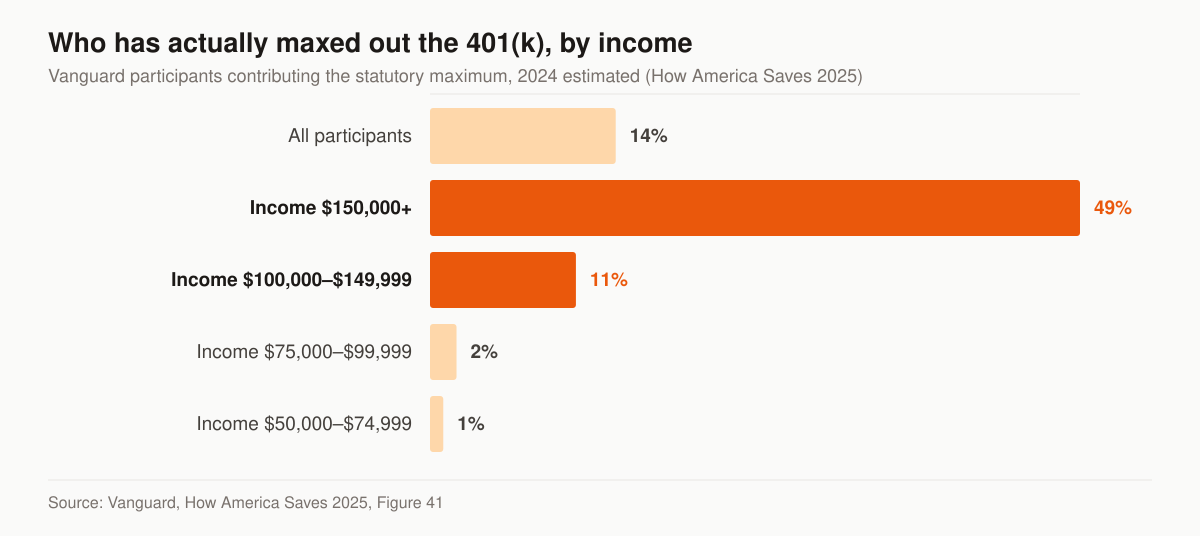
Source: Vanguard, How America Saves 2025, Figure 41, “Participants contributing the maximum by participant demographics, 2024 estimated.”
Vanguard’s report covers its own defined-contribution plan participants, not the whole workforce. It states that “During 2024, 14% of participants saved the statutory maximum amount of $23,000 ($30,500 for those age 50 or older)”, and that “Forty-nine percent of participants with income of more than $150,000 contributed the maximum allowed, as did 41% of participants with an account balance of more than $250,000.” Figure 41 puts the $100,000–$149,999 band at 11%, the $75,000–$99,999 band at 2%, the $50,000–$74,999 band at 1%, and prints each band below $50,000 as “<0.5%”.
Two things follow for a booking script. The maxed-out accumulation buyer concentrates hard above $150,000 of income, so a screen built on that question is aiming at a real but thin slice — and the setter should be asking about income band and existing contributions early, not at minute eighteen. And the same numbers say do not let that screen disqualify everyone else, because the protection-first IUL buyer, the one who wants a death benefit with cash value behind it, never had to max anything. Those are two different scripts and two different appointment types, and the setter has to know which one it just booked.
This table lists what we have the setter establish before a slot is released, and what each answer changes downstream.
| Screening question | What it decides | What goes wrong if it is skipped |
|---|---|---|
| What prompted you to look at IUL? | Accumulation script or protection script | The producer opens on the wrong problem and spends the call recovering |
| Roughly what income band are you in? | Whether the qualified-plan angle is live at all | An illustration gets built at a premium the household cannot sustain |
| Are you contributing to a 401(k) or IRA, and is it maxed? | Where IUL sits against existing tax-advantaged room | The “why not just use my 401(k)” objection lands unanswered |
| What life insurance do you already have? | Replacement rules, and whether term is the honest answer | A suitability problem the producer inherits at the close |
| Who else is part of this decision? | Whether both decision-makers need to be on the call | A kept appointment that ends in “I need to talk to my spouse” |
| What does your calendar realistically allow? | Slot length and format | A 20-minute booking for a conversation that needs 45 |
None of that requires a license, which is the point. The setter gathers facts and books time; the producer makes every product representation. Where that line sits in practice is set out in our insurance appointment setting service.
The first touch is a text, not a dial
Speed-to-lead is usually described as dialing faster. That skips a step, because the dial has to be answered before speed means anything.
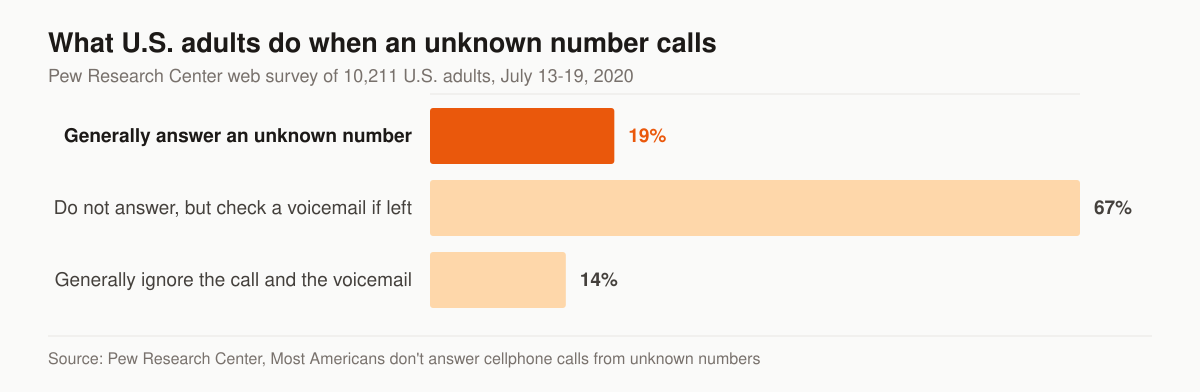
Source: Pew Research Center, Most Americans don’t answer cellphone calls from unknown numbers, a survey of 10,211 U.S. adults, July 13 to 19, 2020.
Pew reports that 19% of U.S. adults say they generally answer a cellphone call from an unknown number, 67% do not answer but check a voicemail if one is left, and 14% generally ignore the call and any voicemail after it. Your setter is an unknown number to a person who filled in a form twenty minutes ago.
So the opening move is a text that names the form, names the agency, and offers two times. It converts the caller from a stranger into something the prospect can place, and it gives the 67% who screen calls a reason to pick up the follow-up dial. The dial still happens — it just stops being the identification step. The full cadence we run, channel by channel, is in insurance lead follow-up cadence.
How fast is fast enough, in published numbers
The InsideSales.com/MIT Lead Response Management Study, presented in 2007 by InsideSales.com and Dr. James Oldroyd of MIT Sloan, examined three years of data across six companies that generate and respond to web leads, covering over fifteen thousand leads and over one hundred thousand call attempts. Its finding on timing is stated plainly: “The odds of contacting a lead in 5 minutes versus 30 minutes drop by 100 times! In fact, from just 5 minutes to 10 minutes the odds decrease by 5 times.” On qualification it reports: “The odds of qualifying a lead in 5 minutes versus 30 minutes drop 21 times. And from 5 minutes to 10 minutes the dial to qualify odds decrease 4 times.”
The study is old and it is not about insurance, so read it for the shape rather than the coefficient: the decay is steep and it happens inside the first half-hour. That is a window a producer sitting in an appointment structurally cannot cover, and it is the clearest argument for a setting layer that exists independently of your selling hours. It also reframes what “24-hour response” means in a vendor’s service-level promise — by the standard above, a day is not a response time, it is a recycling strategy.
The TCPA rules an IUL booking and reminder cadence runs on
Every part of this — the first text, the confirmation, the day-before reminder, the no-show follow-up — is a regulated contact. The governing rule is 47 CFR 64.1200, and the paragraphs each carry their own scope, so read the opening clause before assuming one applies to you.
Paragraph (a)(2) covers automated outreach to mobile numbers. It bars any person or entity from initiating “any telephone call that includes or introduces an advertisement or constitutes telemarketing, using an automatic telephone dialing system or an artificial or prerecorded voice,” to the lines listed in (a)(1)(i) through (iii) — which include “any telephone number assigned to a paging service, cellular telephone service, specialized mobile radio service, or other radio common carrier service” — “other than a call made with the prior express written consent of the called party”, a sentence that runs on to carve out tax-exempt nonprofit calls and HIPAA “health care” messages, neither of which describes an IUL booking text. Note both halves of the trigger: the content has to be telemarketing and the delivery has to be automated or prerecorded.
The rule then defines what that consent has to look like. Paragraph (f)(9) says prior express written consent “means an agreement, in writing, bearing the signature of the person called that clearly authorizes the seller to deliver or cause to be delivered to the person called advertisements or telemarketing messages using an automatic telephone dialing system or an artificial or prerecorded voice, and the telephone number to which the signatory authorizes such advertisements or telemarketing messages to be delivered.” The written agreement must also disclose that “The person is not required to sign the agreement (directly or indirectly), or agree to enter into such an agreement as a condition of purchasing any property, goods, or services.” That sentence is why a checkbox cannot be pre-ticked and cannot gate the quote.
Revocation is where booking programs most often go wrong, because the reminder sequence is automated and the opt-out arrives as a human reply. Paragraph (a)(10) says a called party may revoke consent “by using any reasonable method to clearly express a desire not to receive further calls or text messages from the caller or sender”, treats “stop,” “quit,” “end,” “revoke,” “opt out,” “cancel,” or “unsubscribe” in reply to a text as reasonable per se, and requires that all such requests “must be honored within a reasonable time not to exceed ten business days from receipt of such request.” Paragraph (a)(12) permits one confirmation text, provided it “merely confirms the text recipient’s revocation request and does not include any marketing or promotional information,” and adds that “If the confirmation text is sent within five minutes of receipt, it will be presumed to fall within the consumer’s prior express consent.”
This table maps each rule in 47 CFR 64.1200 onto the part of an IUL booking cadence it governs.
| Paragraph | What it says, in short | Which touch it governs |
|---|---|---|
| (a)(2) | Automated or prerecorded telemarketing to a wireless number needs prior express written consent | The first outbound text and any automated reminder |
| (f)(9) | Defines that consent as a signed written agreement naming the seller and the number, with a no-purchase-condition disclosure | The funnel’s opt-in language and how it is stored |
| (a)(10) | Consent can be revoked by any reasonable method; honour within ten business days at most | Reply handling on every reminder and recycle message |
| (a)(12) | One confirmation text is allowed if it carries no marketing content | The automatic “you’re unsubscribed” reply |
| (c)(1) | No telephone solicitation to a residential subscriber before 8 a.m. or after 9 p.m. local time at the called party’s location | Dial windows and scheduled send times |
| (c)(2) | Registered do-not-call numbers must be honored indefinitely unless the consumer cancels the registration or the database administrator removes the number; the safe harbor requires a registry version obtained no more than 31 days before the call | List hygiene before any outbound dial |
| (d)(3) and (d)(6) | Internal do-not-call requests recorded at the time made, honored within ten business days at most, and kept for 5 years | Your own suppression list |
| (f)(15) | “Telephone solicitation” excludes calls made with the person’s prior express invitation or permission, or under an established business relationship | Why an inbound form fill is a different posture from a cold list |
Paragraph (e) is the one people miss: it applies the (c) and (d) rules “to any person or entity making telephone solicitations or telemarketing calls or text messages to wireless telephone numbers to the extent described in the Commission’s Report and Order, CG Docket No. 02-278, FCC 03-153”. Read the section yourself at eCFR rather than relying on a vendor’s summary, and take the plain-English tour of how this bites lead buyers in TCPA compliance for insurance agents buying leads. We are marketers, not your counsel — the funnel is built to these rules and your compliance officer signs off on the wording.
IUL is not Medicare, and that changes which rulebook applies
Agents who write both lines sometimes assume the CMS marketing rules follow them into life sales. They do not. 42 CFR 422.2264 sits in Part 422, the Medicare Advantage Program, under Subpart V, Medicare Advantage Communication Requirements, and it opens by defining its own scope: “For the purpose of this section, beneficiary contact means any outreach activities to a beneficiary or a beneficiary’s caregivers by the MA organization or its agents and brokers.” An indexed universal life prospect who filled in a web form is not a Medicare beneficiary being contacted by an MA organization, so the unsolicited-contact bar at (a)(2)(iv) — which prohibits unsolicited “telephone solicitation (that is, cold calling), robocalls, text messages, or voicemail messages” — is not the rule you are working under. The TCPA is.
The exposure runs the other way. At a Medicare personal marketing appointment, the same section says MA organizations may not “Market non-health related products, such as annuities.” Life insurance is not the named example, but it is not a health-related product either, and we treat an IUL pivot inside a Medicare appointment as the same exposure: book it as a separate appointment, with its own opt-in, on its own calendar. If you run a dual practice, the scope-of-appointment mechanics are covered in scope of appointment and TPMO compliance for Medicare agents.
What does govern the IUL side is your state’s insurance advertising rules and your carrier’s advertising review, both of which care about how the product is described rather than how the appointment was booked. Guaranteed-return language, “be your own bank” framing and illustrations shown at a single optimistic rate are the exposures worth reviewing before a campaign runs. The line-by-line version is in marketing IUL compliantly.
No-shows are a scheduling problem, not a lead problem
A no-show gets blamed on lead quality because that is the explanation that costs nothing to accept. The structural explanations are worth ruling out first: the booking was made by a stranger, the date sat far enough out that the prospect’s interest cooled, and the format was never restated. Each of those is fixable in the cadence rather than in the lead source.
Four things we build into the sequence:
- Shorten the gap. We shorten the distance between opt-in and appointment before we add reminders. A slot inside 48 hours is a different conversation from one nine days out.
- Restate the job of the call. A reminder that says “confirming Thursday at 2” is a diary entry. One that says “Thursday at 2, 30 minutes, we’ll look at what an IUL would cost at your age and whether it beats topping up the 401(k)” is a reason to show up.
- Confirm on the prospect’s channel. Whoever they replied to first is the channel they will read. Reminders that switch channel for the sender’s convenience get missed.
- Recycle rather than write off. A no-show is a lead who has already told you the topic is relevant. It goes back into the sequence with a new offer of times, not into a spreadsheet marked dead.
That last one is a reporting choice as much as an operational one, and it is where honest programs separate from flattering ones. A vendor paid on booked appointments has no reason to chase a no-show; one measured on kept appointments has nothing but reason to.
Why trust operators to run it
We don’t theorize about lead economics from a slide deck. We run our own final-expense and senior-market lead operation, so this comes from live campaigns, not a slide. That’s the discipline we carry into IUL: the same speed-to-lead rules, the same reminder cadence, the same obsession with cost per kept appointment rather than vanity booking counts.
IUL sits further from final expense than, say, term life — so we don’t claim senior-market lineage on the indexed-life buyer. What transfers is the system: the conversion mechanics and ad discipline that already work for our clients, applied to a higher-consideration product where follow-up matters even more. See how that plays out in the life insurance agent case study.
What you should measure (and what we report)
Booked appointments are a vanity number. Three metrics decide whether this is profitable for you:
- Cost per kept appointment — booked counts lie; kept counts pay.
- Show rate — driven almost entirely by reminder cadence and lead warmth.
- Appointment-to-issued-policy rate — your close on what we hand you.
We report all three monthly so you can see the math, not just feel busy. Industry show rates on cold-ish preset appointments vary widely, which is exactly why we recycle no-shows instead of pretending they don’t exist.
The reporting argument that follows is about timing. An IUL program cannot be judged on its close rate in month one, because the cases booked in month one are still in illustration or underwriting. Agreeing up front which number is legible when is what stops a working program being cancelled at week six.
This table sets the reporting sequence for an IUL appointment program, ordered by the point at which each figure starts telling the truth.
| Metric | What it tells you | When it becomes readable |
|---|---|---|
| Opt-ins by source | Whether the ad and funnel are producing interest at all | Week one |
| Time to first touch | Whether the speed-to-lead rule is actually holding | Week one |
| Opt-in to booked rate | Whether the qualification script is too loose or too tight | Week two to four |
| Show rate | Whether the reminder cadence and the booking gap are working | Month one to two |
| Cost per kept appointment | The real unit price of the program | Month two onward |
| Kept first call to booked second | Whether the illustration appointment is being created at all | Month two onward |
| Application rate on kept appointments | Whether we are booking the right buyer for your script | Month three onward |
| Issued cases and placed premium | The number that pays you | Month four onward |
Two build requirements make that sequence possible and both are marketing work rather than sales work. Source has to be stamped on the lead at capture, so an appointment can be traced back to the ad that produced it. And the case outcome has to be written back against that source once the carrier issues, or every review reverts to arguing about booking counts. The instrumentation is the same one described in our insurance sales funnel service.
What IUL appointment setting costs, and which tier it sits in
Our rates are published rather than quoted, and they do not move by niche. Managed programs run $2,500 per month at Foundation, $3,500 at Growth and $5,500 at Full-Funnel, with a one-time website build of $2,500–$8,000. Ad spend is billed at cost, straight to Google or Meta, and never marked up. Programs run month to month.
This table shows where the appointment-setting work described on this page actually sits across the three published tiers.
| Tier | Monthly | What it carries for an IUL appointment program |
|---|---|---|
| Foundation | $2,500 | Optimized website and landing pages, local SEO and Google Business Profile, on-page SEO, monthly reporting |
| Growth | $3,500 | Everything in Foundation, plus the ongoing SEO and content engine, AI-search visibility, and reputation and reviews |
| Full-Funnel | $5,500 | Everything in Growth, plus managed paid ads, landing-page CRO, marketing automation and CRM, full-funnel reporting |
Read that against what appointment setting needs to run. The booking cadence, the reminder automation and the write-back that produces a cost-per-kept-appointment number all live in marketing automation and CRM, which is a Full-Funnel line. That is the honest answer rather than the comfortable one: if the goal is preset IUL appointments landing on your calendar with paid demand behind them, Full-Funnel is the tier that carries it. Foundation is the right start when there is no landing page worth sending traffic to yet, and Growth is where an organic IUL question corpus gets built alongside. Tier detail, including what the monthly fee excludes, is on the pricing page, and the arithmetic against commission rather than clicks is in our insurance agency marketing budget guide.
Where IUL appointment programs stall
Four failure modes account for the programs we get asked to rescue, and none of them is a lead-quality problem.
The offer is a product, not a question. An ad that says “learn about IUL” books people who want to learn about IUL. An ad built on the question the buyer already has — what tax-free retirement income would actually look like on their numbers — books people with a decision in front of them. The messaging angle is worked through in how to talk about tax-free retirement.
The calendar is fiction. Slots are opened that the producer never intended to defend, the setter fills them, and half get moved. Show rate collapses and the lead source takes the blame. Capacity is an input to the campaign, not an output of it.
Nobody owns the second appointment. Covered above, and it is the quietest of the four because the first-appointment numbers look fine while the pipeline empties behind them.
The destination cannot convert. Paid demand arrives on a page that explains indexed universal life for eight scroll-lengths and offers a contact form at the bottom. Booking has to be the primary action, above the fold, on a page built for it — which is why we treat IUL website design as part of the appointment budget rather than a separate project. If you want that read on your own funnel before committing to anything, get in touch.
Where appointment setting sits next to your other IUL marketing
Setting is a conversion layer. It needs demand above it and a system around it:
- Paid demand for this quarter. IUL Facebook ads fill the top of the funnel while slower channels mature.
- Organic demand that compounds. IUL agency SEO lowers the blended cost of every appointment over time.
- A destination that books. The IUL agent website has to make the calendar the obvious next step.
- The generation mechanics behind all of it. How to generate IUL leads with marketing covers where the opt-ins come from in the first place.
How to start IUL appointment setting
- Take the free marketing audit — we’ll size your calendar capacity and a realistic cost per kept appointment.
- We build the funnel, scripts, and reminder sequence; compliance copy stays factual per IUL rules.
- Appointments start landing on your calendar; you sell.
If you’d rather own the whole pipeline long-term, pair this with the IUL marketing pillar so demand generation and appointment setting run as one system instead of two disconnected line items. Either way, you stop chasing and start showing up to confirmed calls.