Case File · Life Insurance Agent, CA
From Referral-Dependent to a Predictable Pipeline
This illustrative composite example shows a referral-dependent California life agent building a senior-market funnel — fast site, exclusive lead flow, and a follow-up cadence. Within a quarter the model produces a steady inbound pipeline and a cost per lead the agent can plan a budget around.
- Inbound leads / mo
- 038
- Cost per lead
- n/a$14
- Pipeline predictability
- Referrals onlyDaily flow
Illustrative example modeled on real engagement patterns — verified client case files replace these as we publish them.
Illustrative composite. The figures on this page are a modeled composite showing how the method works — not verified results from a named client. Verified case data replaces this page as it is published.
The situation: a referral-only life insurance producer
A California life insurance agent had a good close rate and no marketing system. Every month started at zero, waiting on referrals.
Referral-only production has a ceiling that has nothing to do with the agent’s skill. It is unforecastable by nature — a strong month and a dead month look identical in advance, so the agent can’t plan spend, staff, or income around it. Worse, it can’t be scaled on demand: you can’t ask for more referrals the week the pipeline runs dry, and the people best positioned to refer send leads on their own timeline, not yours. A closer this good was leaving most of his capacity idle simply because nothing predictable fed him. The problem to solve was not conversion — it was supply. He needed an owned, measurable lead source he could turn up or down like a dial, and he owned no such asset: no funnel, no pixel, no list, nothing that captured demand while he slept.
What we diagnosed first: lead supply, not close rate
Because the close rate was already strong, we deliberately did not touch the sales motion. Adding a fragile new funnel on top of a good closer breaks the thing that already works, so the mandate was to feed the existing strength, not replace it. We scoped a senior-market funnel narrow enough for a single producer to work every lead personally — no call center, no lead overflow he couldn’t service. The design constraint throughout was predictability over peak volume: a steady daily trickle he could actually follow up beats a spiky flood he’d let cool.
What we changed to build the senior-market life funnel
- Built a fast, conversion-focused site and senior-market landing pages — each aimed at a specific senior-market intent rather than a generic “life insurance” homepage, so the message matched what the prospect typed and the form asked only for what was needed to make a first call.
- Turned on exclusive lead generation flow, so every inquiry belonged to him alone. Exclusivity matters most for a solo producer: he’s not racing three other agents to the phone, so his first call is the only call, and his close rate carries over intact instead of being taxed by shared-lead competition.
- Installed a follow-up cadence so leads converted instead of cooling off — a defined sequence of touches that ran whether or not he remembered, turning “I’ll call them back” into a system.
- Wrote consent and disclosure into the form itself, not into a footer nobody reads. California’s senior-insurance article and the federal telephone rules both attach at the point of capture, so the form is where they get satisfied. The two sections below set out exactly which text applies.
How the inbound life insurance pipeline unfolded
The first weeks were about calibration, not volume. Early leads told us which senior-market angles actually drew the right prospects, and we tightened the landing-page targeting around what converted. The real adjustment was behavioral: a referral-fed agent isn’t used to inbound leads arriving on the internet’s schedule, so we had to make the cadence do the remembering for him. Once daily flow became reliable, the value wasn’t just the leads — it was that he could finally forecast, budget against a known cost per lead, and decide to scale supply up when he wanted more, the exact lever referrals never gave him.
The result: inbound life insurance leads and cost per lead
In this illustrative model, the agent goes from 0 inbound leads to ~38 per month at a ~$14 cost per lead — a pipeline he can finally forecast.
How to read the numbers on this page
A case study is only useful if you can tell which figures were measured and which were assumed. On this page, none of the performance figures were measured on a named client. They are a model. Everything else — lead prices, market size, distribution mix, statute text — comes from a public source cited inline, and you can open every one of them.
This is the full provenance ledger for the page; if a figure is not in the second column, treat it as modeled.
| Figure on this page | Status | Where it comes from |
|---|---|---|
| 0 → 38 inbound leads per month | Modeled | Composite pattern, not a client’s reported result |
| $14 cost per lead | Modeled | Composite pattern; benchmarked against published figures below |
| “Trailing 90 days” timeframe | Modeled | Illustrative program window |
| Purchased life lead price bands | Published | ActiveProspect, insurance leads cost |
| Meta leads-objective cost per lead | Published | WordStream/LocaliQ, Facebook Ads Benchmarks 2025 |
| Life insurance ownership and need gap | Published | LIMRA and Life Happens, 2026 Insurance Barometer Study |
| Final expense premium and channel mix | Published | LIMRA/Life Insurers Council Final Expense Survey, 2025 |
| California advertising and in-home rules | Published | California Insurance Code sections 787 and 789.10 |
| Consent, revocation and calling-hour rules | Published | 47 CFR 64.1200, current text on eCFR |
| Program pricing | Published | Our own pricing page |
Is a $14 cost per lead plausible for life insurance?
This is the number a skeptical reader should push on hardest, so here is the outside context rather than a reassurance.
Buying a life lead from a vendor costs far more than $14. ActiveProspect, the company behind the TrustedForm consent-certificate product, publishes bands for life specifically: shared life insurance web leads at $20 to $45, exclusive life insurance leads at $75 to $150, real-time exclusive or live transfer life leads at $80 to $200 or more per transfer, and aged life insurance leads at $5 to $15. The same guide notes that once close rates and follow-up time are factored in, “the total acquisition cost per life client can easily reach $2,000 to $3,000.”
Published lead prices are the yardstick a modeled cost per lead has to be measured against.
| Lead route | Published price | What you are buying |
|---|---|---|
| Aged life lead | $5 to $15 per lead | An old record, already worked by others |
| Shared life web lead | $20 to $45 per lead | A prospect several agents are dialing at once |
| Exclusive life lead | $75 to $150 per lead | One buyer, no race to the phone |
| Real-time exclusive or live transfer | $80 to $200+ per transfer | A prospect already on the line |
| Self-generated inbound (this model) | $14 per lead, modeled | Your own creative, your own form, your own list |
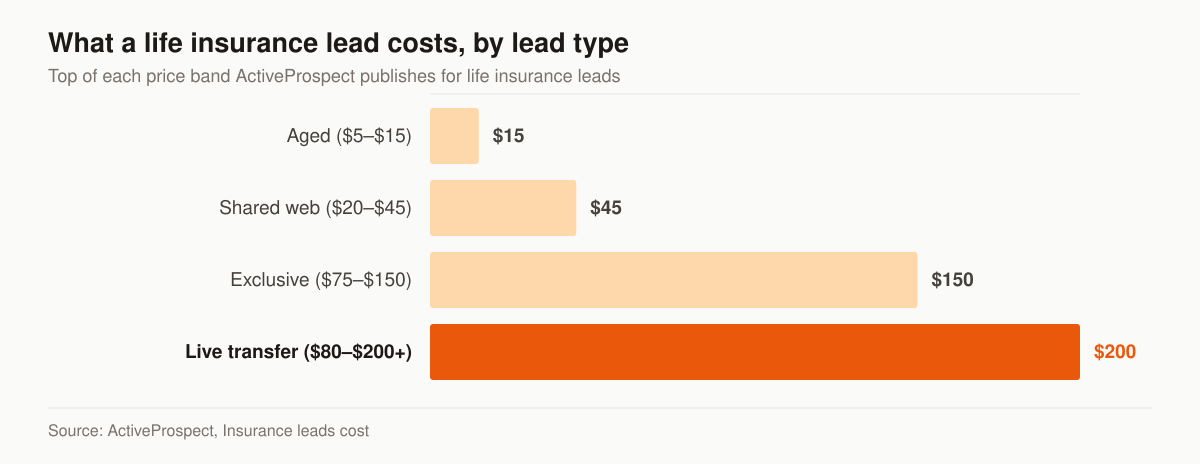
Top of each published band. Source: ActiveProspect, Insurance leads cost, read September 2026.
Self-generated leads are a different product from bought leads, so the fair comparison is to paid-social benchmarks rather than to vendor price lists. WordStream and LocaliQ’s Facebook Ads Benchmarks 2025 analysed 726 US leads-objective campaigns running between April 1, 2024 and June 30, 2025 and reported a median cost per lead across all industries of $27.66, up 20.94% from $22.87 the prior year, on a median cost per click of $1.92 and a median conversion rate of 7.72%. Their traffic-objective table puts Finance and Insurance at a $1.22 median cost per click and a 0.98% click-through rate, which WordStream names as one of the three lowest click-through rates in that table.
Read together, those two sources say something useful and unflattering: $14 is below the all-industry median for a Meta lead, in a category whose ads earn clicks below the all-industry rate — 0.98% against 1.71% in WordStream’s traffic table. A model can land there with a narrow senior-market offer, a form that asks for little, and creative that has had time to learn. It is not a number to assume before your own account has produced it. That is why this page prints it as a modeled figure and prints the benchmark next to it.
Why the senior market carries this funnel
The senior-market framing is not a stylistic choice. It follows the demand.
In the 2026 Insurance Barometer Study — the annual consumer research LIMRA runs with Life Happens, based on a survey of more than 5,200 US adults ages 18 to 75 who share responsibility for household financial decisions — 52% of American adults own life insurance and 48% do not. 38%, roughly 92 million adults, say they need coverage or need more than they have. Asked why they own it, 57% say to help pay final expenses, 39% to leave an inheritance or transfer wealth, and 27% to replace lost income if a wage earner dies. Final expenses tops that list at 57%, and it is a senior-market reason.
The product data agrees. LIMRA’s 2025 Final Expense Survey, run with the Life Insurers Council, collected results from 30 participating carriers: $1.383 billion in annualized premium, 1,299,667 policies issued, and an average annual premium of $1,064 per policy. Premium rose from $1,045,515,603 in 2024, a 32.23% increase; policies issued rose 24.60%; applications received rose 28.37% to 2,061,231. Texas, Florida and North Carolina led the country in final expense premium among reporting carriers, with Georgia and California rounding out the top five states.
Where that premium is written matters more to a solo producer than how much of it there is.
| Final expense distribution channel, 2025 | Share of premium | Share of policies |
|---|---|---|
| Independent agents and brokers | 79% | 75% |
| Affiliated distribution | 15% | Not reported |
| Direct-to-consumer | 6% | Not reported |
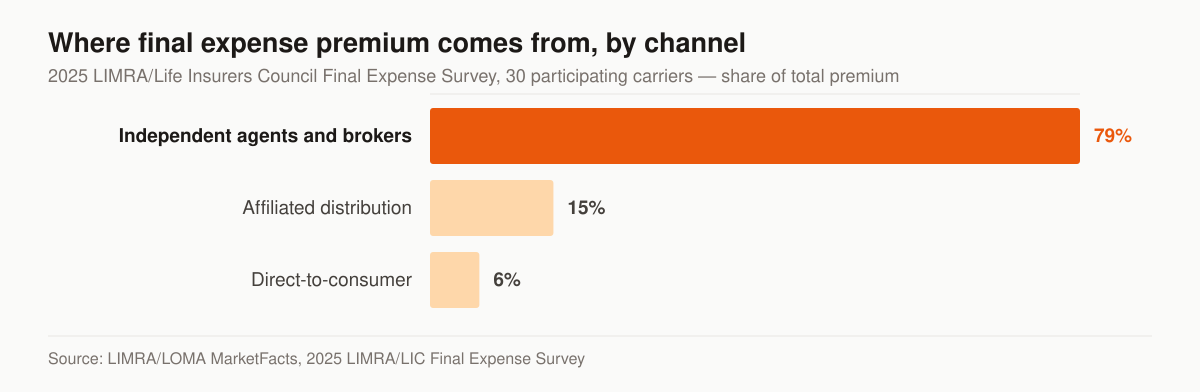
Source: LIMRA/LOMA MarketFacts, “Final Expense Market Surges As Sales Top $1.38 Billion”, reporting the 2025 LIMRA/LIC Final Expense Survey of 30 carriers.
Independent distribution generated $1.09 billion of that premium. Direct-to-consumer took 6%. For an independent producer deciding whether to build an owned funnel, that split is the argument: the buyer in this line still reaches a person, and the person they reach is usually an independent agent rather than a carrier’s own website. A funnel that puts your name in front of that buyer is competing with other agents, not with a national D2C machine.
One more finding shapes the creative rather than the channel. The same Barometer study reports that 37% of Americans describe themselves as only somewhat knowledgeable, or not knowledgeable at all, about life insurance, and that among Americans who use social media, 66% use YouTube to learn about financial products and services and 62% use Facebook. We write senior-market copy that explains rather than pitches, because explanation is what this audience says it is missing. Our life insurance marketing and life insurance lead generation pages go deeper on how that translates into offers.
What California law changes about a senior-market life funnel
California writes senior-insurance marketing rules into statute, in Article 6.3 of the Insurance Code. Two sections reach directly into a lead funnel, and one of them names lead generation explicitly.
Section 789.10(a) sets its own scope: the section “applies to the sale, offering for sale, or generation of leads for the sale of life insurance, including annuities, to senior insureds or prospective insureds by any person.” Subdivision (b) then requires a person who meets with a senior in the senior’s home to deliver a written notice “no less than 24 hours and no more than 14 days prior to that individual’s initial meeting in the senior’s home,” as a stand-alone document in 16-point bold type, carrying the agent’s full name as it appears on the California license, the license number, the mailing address and telephone number listed on that license, and the disclosures the statute spells out — including that the senior has the right to have other persons present, the right to end the meeting at any time, and the right to contact the Department of Insurance. Where the senior has an existing insurance relationship with an agent and requests a same-day meeting in the home, the notice is delivered before that meeting.
That single provision is a funnel design constraint, not a footnote. If your booking flow offers a home visit tomorrow morning, the flow is fighting the statute. Scheduling logic, calendar availability and the confirmation email all have to carry the notice window.
Section 787 governs the advertisement itself. Its opening sentence reads: “Any advertisement or other device designed to produce leads based on a response from a potential insured that is directed towards persons 65 years of age or older shall prominently disclose that an agent may contact the applicant if that is the fact.” The same paragraph adds that an agent who makes contact after acquiring a name from a lead generating device “shall disclose that fact in the initial contact with the person.” Subdivision (b) defines advertisement broadly enough to catch the form: it includes “worksheets, questionnaires, or other materials designed to describe and encourage the purchase of a policy or certificate of disability insurance, life insurance, or an annuity, or to collect personal or financial information about a prospective insured or purchaser of an annuity.”
These are the provisions that changed how the funnel was built, not a general compliance overview.
| Provision | What it requires | Where it lands in the funnel |
|---|---|---|
| Cal. Ins. Code § 787, opening paragraph | A lead-producing device aimed at persons 65+ must prominently disclose that an agent may contact the applicant, if that is the fact | Landing-page form, above the submit button |
| Cal. Ins. Code § 787, opening paragraph | The agent must disclose, in the initial contact, that the name came from a lead generating device | Opening line of the first call script |
| Cal. Ins. Code § 787(b) | A questionnaire collecting personal or financial information counts as an advertisement | The form is regulated copy, not neutral UI |
| Cal. Ins. Code § 787(c) | Advertisements shall not employ words, letters, initials, symbols or other devices so similar to those used by governmental agencies, a nonprofit or charitable institution, a veterans organization or agency, a senior organization, or another insurer that they could have the capacity or tendency to mislead the public | Ad creative, brand marks, page naming |
| Cal. Ins. Code § 787(i) | All advertisements used by agents for a policy of an insurer “shall have written approval of the insurer before they may be used” | Carrier review step before launch |
| Cal. Ins. Code § 787(k) | An advertisement for an event where insurance products will be offered for sale at, or as a result of, the event may not use “seminar,” “class,” “informational meeting,” “benefits assistance,” “qualification information” or substantially equivalent terms unless it adds “and insurance sales presentation” immediately after, in the same type size and font | Seminar and workshop pages |
| Cal. Ins. Code § 789.10(b) | Written stand-alone notice in 16-point bold type, no less than 24 hours and no more than 14 days before an initial in-home meeting | Appointment scheduling rules and confirmation email |
| Cal. Ins. Code § 789.10(c)–(d) | State the purpose of the contact before any statement other than a greeting; provide written identification at the meeting | Appointment script and agent kit |
Separately, California Insurance Code § 1725.5 requires a person licensed under the producer sections it enumerates to print its license number on business cards, written price quotations for insurance products, and print advertisements for insurance products distributed exclusively in this state, and to include that number in emails that involve an activity for which a license is required; our insurance marketing compliance guide covers the type-size mechanics of that one in detail. Read the statutes yourself before you launch: section 787 and section 789.10 are both short. This is marketing guidance, not legal advice.
What the federal telephone rules require before the first call or text
An inbound web lead is not a licence to dial however you like. The operative federal text is 47 CFR 64.1200, and its paragraphs each carry their own scope — the rule that applies depends on how the call is placed and to what kind of line.
Under paragraph (a)(2), a call that “includes or introduces an advertisement or constitutes telemarketing,” placed with an automatic telephone dialing system or an artificial or prerecorded voice, to a wireless number, requires the prior express written consent of the called party. The paragraph carves out two things that do not describe an agent’s telemarketing: calls made by or on behalf of a tax-exempt nonprofit organization, and “health care” messages made by or on behalf of a “covered entity” or its “business associate” under the HIPAA Privacy Rule. Paragraph (f)(9) defines that term precisely: “an agreement, in writing, bearing the signature of the person called that clearly authorizes the seller to deliver or cause to be delivered to the person called advertisements or telemarketing messages using an automatic telephone dialing system or an artificial or prerecorded voice, and the telephone number to which the signatory authorizes such advertisements or telemarketing messages to be delivered.” The agreement must disclose that signing authorizes such calls and that the person “is not required to sign the agreement (directly or indirectly), or agree to enter into such an agreement as a condition of purchasing any property, goods, or services.” An electronic signature counts.
Revocation is the part of a follow-up cadence we check first. Paragraph (a)(10) lets a called party revoke consent “by using any reasonable method,” and treats an automated opt-out mechanism, a website or phone number designated for opt-outs, and the reply words “stop,” “quit,” “end,” “revoke,” “opt out,” “cancel,” or “unsubscribe” as reasonable per se. Other words count too where “a reasonable person would understand those words to have conveyed a request to revoke consent.” All revocation requests “must be honored within a reasonable time not to exceed ten business days from receipt of such request,” and a caller “may not designate an exclusive means to request revocation of consent.” Paragraph (a)(12) permits one confirmation text, carrying no marketing content, and presumes it falls within consent if sent within five minutes.
Each row below attaches to a different step of the funnel, which is why they cannot be handled by one checkbox.
| Rule | What the text requires | Funnel step it governs |
|---|---|---|
| 47 CFR 64.1200(a)(2) | Prior express written consent for autodialed or prerecorded telemarketing calls to a wireless number | Form consent language and signature capture |
| 47 CFR 64.1200(f)(9) | Signed agreement naming the number, plus the two required disclosures | Form design and record retention |
| 47 CFR 64.1200(a)(10) | Honor revocation made by any reasonable method within a time not to exceed ten business days; no exclusive opt-out channel | Cadence suppression logic |
| 47 CFR 64.1200(a)(12) | One non-marketing confirmation text; presumed consented if sent within five minutes | Opt-out confirmation message |
| 47 CFR 64.1200(c)(1) | No telephone solicitation to a residential telephone subscriber before 8 a.m. or after 9 p.m., local time at the called party’s location | Dialer schedule for a multi-time-zone book |
| 47 CFR 64.1200(c)(2) | No telephone solicitation to a residential subscriber registered on the national do-not-call registry; the error safe harbour requires, among other conditions, a registry version obtained no more than 31 days before the call | Scrubbing routine |
| 47 CFR 64.1200(d) | For calls for telemarketing purposes to a residential telephone subscriber: a written internal do-not-call policy available on demand, trained personnel, and requests recorded and honored within ten business days | Operating procedure |
| 47 CFR 64.1200(f)(15) | “Telephone solicitation” excludes a call made with the person’s prior express invitation or permission, or where the caller has an established business relationship | Why an inbound inquiry is treated differently from cold outreach |
Note the last row carefully, because it is frequently overstated in both directions. The registry rules in paragraph (c) bite on “telephone solicitation,” and paragraph (f)(15) excludes from that term a call made with prior express invitation or permission or to a person with whom the caller has an established business relationship. That exclusion is about the do-not-call rules. It does not remove the separate paragraph (a)(2) consent requirement for autodialed or prerecorded calls to a cell number, and it does not remove the internal do-not-call duties in paragraph (d). Read the current text on eCFR rather than a summary, and see our note on TCPA compliance when you buy leads for the third-party-consent version of the same problem.
What we would measure, and how each metric is defined
Case studies get argued about because the words are used loosely. These are the definitions this program runs on, so that a number can be checked rather than believed.
Definitions first, results second — a metric with no definition cannot be audited.
| Metric | Definition used here | Why it is defined this way |
|---|---|---|
| Inbound lead | A form submission or inbound call from a channel the agent owns, with consent captured | Excludes referrals and purchased records, so the funnel is measured on its own |
| Cost per lead | Media spend divided by inbound leads, retainer excluded | Keeps the media number comparable to published benchmarks |
| Fully loaded cost per lead | Media spend plus retainer, divided by inbound leads | The number that matters for a budget decision |
| Speed to first attempt | Minutes between form submission and the first dial | The cadence’s own health check |
| Contact rate | Share of leads reached by a human within the cadence window | Separates a supply problem from a follow-up problem |
| Cost per issued policy | Total spend divided by policies issued, not applications taken | Applications are not revenue |
Only the first three are modeled on this page. The remaining rows are the measurements a live program would report, and they are listed so an owner reading a future version of this page knows which figures we intend to publish.
What a program like this costs
The stack described above — managed paid ads, landing-page conversion work and marketing automation — sits in the Full-Funnel tier at $5,500 a month. The Foundation tier at $2,500 covers an optimized site and landing pages, local SEO and Google Business Profile, on-page SEO and monthly reporting; Growth at $3,500 adds the ongoing SEO and content engine, AI-search visibility, and reputation and reviews. A one-time website build runs $2,500 to $8,000. Paid media spend is billed separately, at cost, straight to the platforms.
That separation is the part worth reading twice. In a model like this one, media spend and retainer are different line items with different behaviour: media buys volume this month and stops the day you stop paying, while the retainer buys assets — pages, consent-captured lists, tracking, ranked content — that keep working. Set the modeled $14 against ActiveProspect’s $75 to $150 for a bought exclusive life lead and the arithmetic of owning the funnel is visible without anyone having to assert it.
What would have to be true for a model like this to repeat
A case study that cannot fail is not evidence. These are the conditions this model depends on, stated so you can check them against your own situation before you assume the outcome.
- The close rate is already good. This program feeds a closer. Pointing it at a weak sales motion produces expensive leads and the same conversion problem.
- The offer is narrow. A senior-market offer with a specific promise converts on a low form. A generic “get a life insurance quote” page competes with everyone.
- The producer can service the volume personally. We scope thirty-eight leads a month as a workable load for one licensed agent and would not point three hundred at him, because unworked leads are worse than no leads.
- Consent is captured at the form, not bolted on. Without it, the follow-up cadence is unusable and the cost per lead is meaningless.
- The pixel gets time to learn. Paid social optimization improves with conversion volume, so the first weeks are calibration and the cost per lead reported in week two is not the steady-state number.
- Someone actually works the cadence. A funnel nobody works is a follow-up failure wearing a lead-generation costume.
Where to go next
If you are weighing this against a shared-lead buy, the final expense case study works the same economics from the other direction — starting from purchased shared leads rather than from referrals. If your line is senior-market but not life, the senior market marketing overview covers the shared audience mechanics, and the insurance sales funnel service covers the plumbing under all of them. For the search side of the same build, see SEO for life insurance agents.
Want the same predictability? Start with a free marketing audit, or tell us what your month looks like now.