IUL Marketing Compliance: What to Say, What to Avoid
IUL marketing compliance comes down to one rule: every claim in an ad, landing page, or post must be defensible by the policy's own mechanics, not by a best-case illustration. Hype — 'guaranteed returns,' 'be your own bank,' or any chart implying the cap rate is a promise — draws carrier warnings and Meta rejections.
IUL marketing compliance is not a legal exercise first — it is a creative-writing constraint. The product is fine. The trouble is almost always the framing: an honest indexed universal life policy gets described in language that turns a non-guaranteed illustration into a promise. Get the framing right and most of your compliance problems disappear before they reach a carrier desk or a regulator.
This is a marketing playbook, not legal advice. We sell marketing services, not legal opinions — you are the licensed party, and your carrier’s advertising-review process and your state department of insurance rules are the final word. What follows is how we write IUL creative that tends to clear review on the first pass.
A quick note on who’s talking: we run a real final-expense and senior-market lead operation. IUL sits a few steps away from that book, so we don’t claim final-expense lineage here. What transfers is the ad discipline: the same conversion systems and compliance-aware creative that keep our senior-market campaigns out of trouble apply directly to indexed universal life.
The one rule that prevents most IUL compliance problems
Every claim in an ad, landing page, or reel has to be defensible by the policy’s own mechanics, not by the best-case illustration. An IUL credits interest based on an index, subject to a cap rate and participation rate, with a downside floor (often 0%) that protects against index losses. Those are facts about how the product works. The illustrated 7% average? That’s a projection — non-guaranteed, dependent on caps that can change. The moment your marketing treats the projection as the product, you’ve created the violation.
So the test for any line of copy is simple: Is this true because of how the policy is built, or only true if the illustration plays out? Ship the first kind. Cut the second.
What to say vs. what to avoid
The difference between a clean ad and a flagged one is usually a few words. Here’s the swap table we hand clients:
| Avoid (hype / non-guaranteed-as-fact) | Say instead (factual / mechanism) |
|---|---|
| “Guaranteed returns” | “Indexed crediting with a 0% downside floor” |
| “Tax-free retirement income” (as a headline promise) | “Potential tax-advantaged access via policy loans, when structured properly” |
| “Be your own bank” / “infinite banking” | “Cash value you can borrow against” |
| “Get rich” / “build wealth fast” | “A long-term cash-value and protection strategy” |
| “8% guaranteed growth” | “Growth tied to index performance, subject to caps” |
| “Never lose money” | “A floor that limits index-driven losses (charges still apply)” |
The right-hand column isn’t weaker — it’s more credible. Sophisticated buyers and compliance reviewers both trust the operator who describes the floor, the cap, and the charges over the one shouting “guaranteed.”
The five phrases that draw heat
These are the recurring triggers for carrier rejections, Meta ad disapprovals, and DOI complaints. Treat each as high-risk:
- “Tax-free” with no qualifier — loans and withdrawals can be income-tax-free when structured correctly and the policy stays in force; a lapse or a MEC changes that. Never headline it as a flat promise.
- “Guaranteed” returns or growth — caps and participation rates are not guaranteed and can be lowered by the carrier.
- “Be your own bank” / “infinite banking” — implies banking guarantees an insurance product doesn’t provide, and describes the policy as something other than life insurance.
- Get-rich / wealth-fast framing — invites both regulatory scrutiny and platform rejection.
- Illustrations shown as fact — any chart implying the average crediting rate is a promise.
Which rulebook is judging your IUL ad
The question “is this compliant?” assumes a single desk answers it. Four separate documents decide, and clearing one of them says nothing about the other three. Three are NAIC model texts that bind you only in the version your state adopted — read your own state’s rule, not the model — and the fourth is a private ad platform that owes you no appeal.
Each row below is enforced by a different party, which is why a carrier approval is not a clean bill of health.
| What it governs | Where the text lives | Who it reaches |
|---|---|---|
| What an ad may say about a life policy | Advertisements of Life Insurance and Annuities Model Regulation (#570), as adopted in your state | The insurer, and the producer who created or presented the advertisement |
| What an illustration may show and how it is labeled | Life Insurance Illustrations Model Regulation (#582) | The insurer, its illustration actuary, and producers through the Section 6B prohibitions |
| How the index-linked numbers inside that illustration are set | Actuarial Guideline XLIX-A | The illustration actuary who certifies the scale |
| Whether the ad is allowed to run at all | Meta and Google advertising policies | The advertiser account, on the platform’s own timetable |
The practical consequence: a carrier’s brand-review approval covers the first row. It does not stop Meta from rejecting the creative, and it does not fix an illustration screenshot that the state’s illustration rule never permitted in an ad.
Your reel is an advertisement, and the carrier is on the hook for it
It is easy to read “advertisement” as meaning a paid ad. The advertising model defines it far wider. Model #570 §2A(1) covers material “designed to create public interest in life insurance or annuities or in an insurer, or in an insurance producer,” and then names the media: “Printed and published material, audiovisual material and descriptive literature of an insurer or insurance producer used in direct mail, newspapers, magazines, radio and television scripts, telemarketing scripts, billboards and similar displays, and the Internet or any other mass communication media.” Paragraph (d) adds “Prepared sales talks, presentations and materials for use by insurance producers.”
An organic reel, a webinar deck, a lead-magnet PDF and a recruiting slide are all inside that definition. Nothing in it turns on whether money changed hands with a platform.
Then §3B assigns the blame in one sentence: “All advertisements, regardless of by whom written, created, designed or presented, shall be the responsibility of the insurer, as well as the producer who created or presented the advertisement.” The same subsection requires the insurer to “establish and at all times maintain a system of control over the content, form and method of dissemination of all advertisements of its policies,” and to give producers “regular and routine notification, at least once a year,” of “the requirement and procedures for company approval prior to the use of any advertisements that is not furnished by the insurer” — and of the most serious consequence of not getting that approval.
That is the paragraph behind every carrier advertising desk you have ever waited on. It also explains why carriers react to a producer’s viral post the way they do: under the model, the post is theirs as well as yours.
Two more provisions decide how long the exposure lasts. Section 9A requires the insurer to keep a specimen copy of every advertisement in a file, and says the file “shall be subject to inspection by the department.” It adds that “All advertisements shall be maintained in the file for a period of five (5) years after discontinuance of its use or publication.” Section 10 sets the model’s own penalty: an insurer or its “officer, directors, producers or employees” that violate the regulation, “or knowingly participate in or abet such violation, shall be subject to a fine up to $1000 for each violation and suspension or revocation of its certificate of authority or license.” States that adopted the model set their own numbers, so check yours rather than the model’s.
The words the advertising model names out loud
The swap table earlier is our house style. This one is the regulator’s, and it is more specific than agents expect. Read the qualifier on the first row carefully, because it is the whole test: the terms are not banned outright, they are banned in a context that misleads.
Every phrase below appears in the text of Model #570 itself, not in an interpretation of it.
| Provision | What it says | Why IUL creative trips it |
|---|---|---|
| §4B | An ad may not use “investment,” “investment plan,” “deposit,” “profit,” “profit sharing,” “savings,” “savings plan,” “private pension plan,” “retirement plan” or similar terms “in a context or under such circumstances or conditions as to have the capacity or tendency to mislead” a buyer into thinking they receive something other than a policy | “Your own tax-free retirement plan” is the headline this paragraph was written about |
| §5D | An ad may not use as the name or title of a life policy “any phrase that does not include the words ‘life insurance’ unless accompanied by other language clearly indicating it is life insurance” | Branding a policy as “the wealth vault” and never saying life insurance |
| §5J | Analogies between cash value and savings accounts “shall be complete and accurate”, and an ad may not emphasize investment or tax features “to such a degree that the advertisement would mislead the purchaser to believe the policy is anything other than life insurance” | Every bank-account metaphor, tested against one sentence |
| §5K | An ad may not state or imply that loan interest, or the reduction of death benefits by outstanding loans, “is unfair, inequitable or in any manner an incorrect or improper practice” | “The banks charge you interest — with this, you pay yourself” |
| §5N | A producer may not use “financial planner,” “investment adviser,” “financial consultant,” or “financial counseling” so as to imply an advisory business “in which compensation is unrelated to sales unless that actually is the case” | Bio lines and LinkedIn headlines, not ad copy |
| §5O(2) and (6) | An ad may not state or imply non-guaranteed elements are guaranteed, and if it refers to one it “shall indicate that the insurer reserves the right to change any such element at any time and for any reason” | Cap rates quoted as a product feature with no change language |
| §5R | An ad may not carry statistical information unless it “accurately reflects recent and relevant facts”, and “The source of any statistics used in advertisement shall be identified” | The unattributed “the average American retires on $X” slide |
| §5V | An ad may not make “unfair or incomplete comparisons of policies, benefits, dividends or rates of other insurers”, nor disparage other insurers, producers, policies “or methods of marketing” | The IUL-versus-401(k) carousel, and swipes at term-only agents |
Two of those deserve a note because agents read them backwards.
§4B is a context rule, not a word filter. The terms are prohibited where they carry “the capacity or tendency to mislead”. A page that says “cash value can supplement retirement income, and here is how the loan provision works” is using the concept without the misdirection. A page titled “The retirement plan the banks don’t want you to have” is not.
§5O(3) is why a growth chart needs a twin. Unless the state’s illustration rule says otherwise, an ad based on non-guaranteed elements “shall set forth, with equal prominence comparable illustrations or statements containing or based upon the guaranteed policy elements.” Equal prominence is a design requirement. A 9-point grey footnote under a full-bleed accumulation curve does not meet it, which is a layout problem before it is a legal one — and the reason our insurance landing page work treats the guaranteed column as part of the hero, not the fine print.
Disclaimers and carrier review are part of the creative, not an afterthought
If your ad or landing page shows or implies growth, you’re referencing non-guaranteed values — which means you need clear language that illustrated rates aren’t guaranteed, caps and participation rates can change, and results depend on index performance and policy charges. Carrier advertising desks exist because §3B makes the insurer responsible for your material; expect specific disclaimer text and pre-approval for anything that names the product or shows numbers.
Build that into the workflow:
- Write creative to the mechanism, not the illustration.
- Send anything naming the product or showing numbers through the carrier’s advertising-review desk before launch, not after a complaint.
- Keep an approval record for each asset.
- On paid social, lead with education or a planning conversation rather than a return figure — that single move clears most Meta and Google financial-claim filters.
This is the same discipline behind our IUL Facebook ads approach: factual hooks, a clean landing page, and an offer that’s a conversation, not a number.
What AG 49-A lets an illustration show, and what changes on April 1, 2026
Model #582 governs illustrations generally, but it was adopted in 1995 and, as the NAIC puts it, these policies are subject to Model #582 but “not all of their features are explicitly referenced in the model”. Actuarial Guideline XLIX-A closes that gap for index-based interest. It applies to policies sold on or after December 14, 2020, and the NAIC’s Executive (EX) Committee and Plenary adopted a revised version on December 11, 2025 that tightens what an illustration may display.
Three of its limits change how a number looks by the time it reaches your slide deck:
- The illustrated rate has a ceiling. For the Benchmark Index Account — defined in §3.D as an account tied to the percent change in the S&P 500 over a one-year period, with an annual cap, a floor that “shall be 0%,” a participation rate that “shall be 100%,” and interest credited once per year — the Annual Rate of Indexed Credits may not exceed the lesser of a lookback average and “145% of the Annual Net Investment Earnings Rate.”
- Loan leverage is capped at half a point. Section 6: “If the illustration includes a loan, the illustrated Policy Loan Interest Credited Rate shall not exceed the illustrated Policy Loan Interest Rate by more than 50 basis points. For example, if the illustrated Policy Loan Interest Rate is 4.00%, the Policy Loan Interest Credited Rate shall not exceed 4.50%.” The arbitrage story an illustration is allowed to tell is 50 basis points wide.
- A second, lower ledger sits beside the first. The Alternate Scale runs the indexed credits at the lesser of the maximum illustrated rate “less 100 basis points” and the credited rate for the Fixed Account — or, where the insurer offers no Fixed Account with the policy, the average of the maximum and guaranteed rates — and §7 requires that “A ledger using the Alternate Scale shall be shown alongside the ledger using the illustrated scale with equal prominence.”
For policies sold on or after April 1, 2026, the revision goes further and restricts historical returns directly. Section 7.C says neither the basic illustration nor the supplemental illustration may include:
i. Historical returns, including historical geometric average returns, other than the historical returns required by Section 7.B.ii. and Section 7.B.iii.
ii. Neither tables nor disclosures that either explicitly or implicitly compare historical returns and maximum illustrated rates, such as a side-by-side presentation.
Section 7.D then requires the basic illustration to carry “a statement which is substantially similar to the following, as applicable: ‘Historical index changes shown in this illustration are not indicative of future returns.’”
Read that as a marketing instruction. The side-by-side “here’s what the index did versus what we illustrate” comparison is the exact artifact the guideline names.
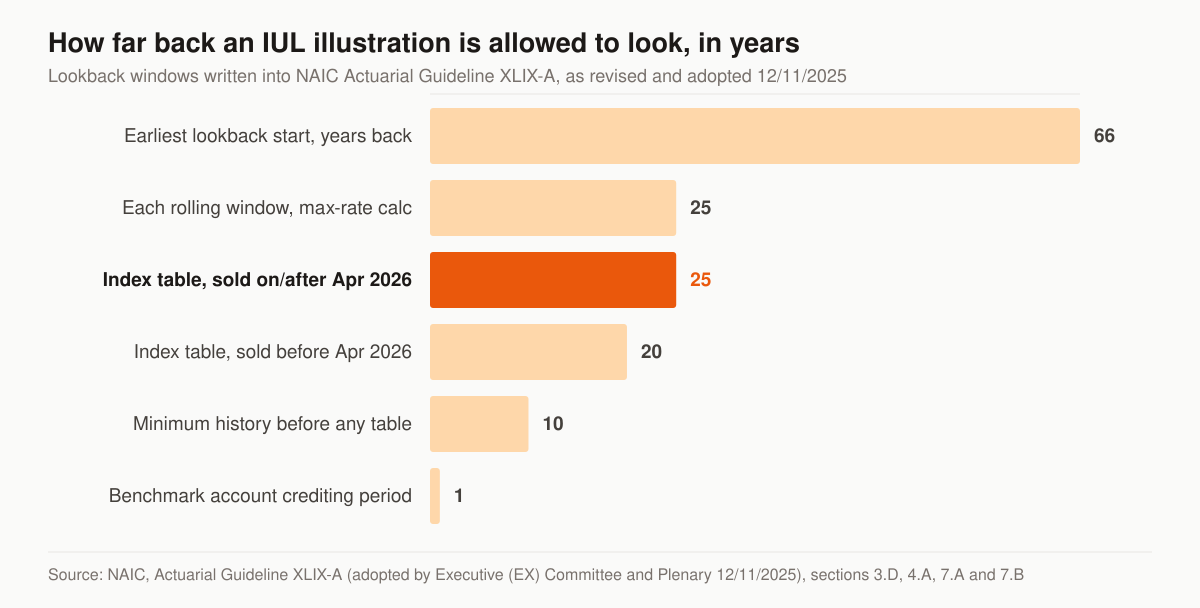
Every window is written into the guideline text. Source: NAIC, Actuarial Guideline XLIX-A, sections 3.D, 4.A, 7.A and 7.B, adopted by the Executive (EX) Committee and Plenary on December 11, 2025.
The guideline binds the illustration actuary, not your caption. The bridge to your ad is Model #570 §5X: an advertisement that illustrates non-guaranteed values “shall only do so in accordance with current applicable state law relative to illustrating such values for life insurance policies and annuity contracts.” Screenshot a ledger into a post and you have republished a document built under all of the above — minus, usually, the Alternate Scale that was required to sit next to it.
Whether “tax-free” is defensible depends on four tax provisions
“Tax-free” carries four separate conditions, and it usually ships with none of them attached. The underlying treatment is real, and it is also conditional in four specific places. Learn the four and you can write the sentence honestly instead of avoiding it.
These are the provisions a “tax-free” claim actually rests on, with the condition each one attaches.
| Provision | What it establishes | The condition inside it |
|---|---|---|
| 26 U.S.C. §72(e)(5) | For a life insurance contract, an amount not received as an annuity “shall be included in gross income, but only to the extent it exceeds the investment in the contract” | Basis comes out first — which is a cost-recovery rule, not an exemption |
| 26 U.S.C. §7702A(b) | The 7-pay test: a contract fails it if the accumulated amount paid under the contract “at any time during the 1st 7 contract years exceeds the sum of the net level premiums which would have been paid” under a 7-pay funding pattern | Overfunding is the design goal of most IUL sales illustrations, and the test is where overfunding stops |
| 26 U.S.C. §72(e)(10) | A modified endowment contract loses the cost-recovery ordering and is taxed income-first | A MEC is still life insurance; the death benefit treatment is not what changes |
| 26 U.S.C. §72(v) | Tax “increased by an amount equal to 10 percent of the portion of such amount which is includible in gross income” on a MEC distribution | Three exceptions: made on or after the date the taxpayer attains age 59½, attributable to the taxpayer’s becoming disabled within the meaning of subsection (m)(7), or part of a series of substantially equal periodic payments, not less frequently than annually, “made for the life (or life expectancy) of the taxpayer or the joint lives (or joint life expectancies) of such taxpayer and his beneficiary” |
One more line belongs in the file, because it is the sentence a client will quote back at you. The IRS states in Publication 525: “If you surrender a life insurance policy for cash, you must include in income any proceeds that are more than the cost of the life insurance policy.” A policy that lapses with a large loan outstanding is the version of that sentence nobody planned for.
There is also a scope trap worth naming. Model #570 §5O(7) says an advertisement “shall not refer to dividends as ‘tax-free’ or use words of similar import, unless the tax treatment of dividends is fully explained and the nature of the dividend as a return of premium is indicated clearly.” That paragraph is written about dividends, which an IUL does not pay — so quoting it as if it banned “tax-free” in IUL advertising is the kind of overreach that costs you credibility with a reviewer who knows the text. The rules that actually reach your IUL headline are §4B, §5B (omitting material information about “state or federal tax consequences”) and §5J. Cite those.
Our deeper treatment of the positioning question sits in marketing tax-free retirement to clients, and the same discipline applied to plain-language claims is in our guide to insurance copywriting.
“Be your own bank” fails three rulebooks at once
The slogan is not a grey area, and it is worth knowing exactly why, because the reasoning also tells you what you can say.
Start with the illustration model. Model #582 §6B(1) prohibits an insurer, producer or authorized representative using an illustration from representing the policy “as anything other than a life insurance policy”. A bank is another thing. So is a savings account, a pension and a brokerage account.
Then the advertising model, §5J, which is the sentence to know for this purpose: an advertisement “shall not emphasize the investment or tax features of a life insurance policy to such a degree that the advertisement would mislead the purchaser to believe the policy is anything other than life insurance.” Bank metaphors do not fail because the metaphor is inaccurate about loans. They fail because the whole point of the metaphor is to stop the buyer thinking about life insurance.
Then §5K, which forecloses the setup line. An ad may not state or imply that “interest charged on a policy loan or the reduction of death benefits by the amount of outstanding policy loans is unfair, inequitable or in any manner an incorrect or improper practice.” The standard opener — banks charge you interest and keep the spread — is that implication with a friendlier tone.
Finally the platform. Meta’s Unacceptable Business Practices standard bars ads that “Use deceptive or exaggerated claims about the success of a product or service to mislead people into purchasing or sharing sensitive information”, and lists where its reviewers see the pattern: “Investment or banking opportunities” is the first item on that list. Your ad does not have to be a scam to be scored by a classifier that was trained on them.
The compliant version of the same idea is short and it converts: an IUL builds cash value, you can borrow against that cash value through the policy loan provision, the loan accrues interest, and an unpaid loan reduces the death benefit. That is the mechanism the slogan was standing in for, and describing it is a stronger sales argument than the metaphor because the buyer can check every clause of it.
The premium that pays for itself has its own prohibition
There is a second slogan family with an explicit rule against it, and it survives in IUL marketing under new wording: the policy that eventually funds itself.
Model #582 §6B(7) prohibits representing “in any way that premium payments will not be required for each year of the policy in order to maintain the illustrated death benefits, unless that is the fact”. Paragraph (8) names the vocabulary directly: no use of “the term ‘vanish’ or ‘vanishing premium,’ or a similar term that implies the policy becomes paid up, to describe a plan for using non-guaranteed elements to pay a portion of future premiums”.
“Similar term” is doing the work. “Self-funding,” “the policy takes over,” “stop paying in year ten” and “your money does the paying” are all the same representation in fresh packaging, and all of them describe non-guaranteed elements carrying future charges.
The model even scripts the honest alternative. Section 7A(13) requires that where an illustration shows the option to let policy charges be paid from non-guaranteed values, it “must clearly disclose that a charge continues to be required and that, depending on actual results, the premium payer may need to continue or resume premium outlays.” That is the sentence to put in the ad. It is also the sentence that prevents the year-twelve phone call where a client asks why a bill arrived.
While you are in that section, note §7B(5), the narrative-summary language the model requires on the face of a basic illustration: “This illustration assumes that the currently illustrated nonguaranteed elements will continue unchanged for all years shown. This is not likely to occur, and actual results may be more or less favorable than those shown.” An illustration carries a printed statement that the illustrated outcome is not likely to occur. Marketing that treats the same numbers as the expected outcome is contradicting the document it came from.
What Meta and Google actually enforce
Platform policy is not law, and it is the layer that stops your campaign first. Both platforms publish the standards their reviewers apply, and both are worth reading in the original rather than in summary.
Read the right-hand column as the ad you were about to write.
| Platform standard | The published wording | What it catches in IUL creative |
|---|---|---|
| Meta, Financial and Insurance Products and Services | “Ads promoting credit cards, loans or insurance services must be targeted to people 18 years or older.” Advertisers “are also required to comply with disclosure requirements set by law” | Age-targeting defaults, and disclaimers the state requires but the ad omits |
| Meta, same standard, licensing | Advertisers “may be required to be licensed in the country they are targeting”; insurance products are listed among products that may require a license, subject to Meta’s review | Agency accounts running for producers whose licensing Meta cannot verify |
| Meta, same standard, US-only restriction | For ads targeting the United States, ads can’t “Promote investment products or opportunities that suggest user interaction with the advertiser via on-platform or off-platform direct messaging services” | “Comment BANK and I’ll DM you the strategy” — the framing that makes it an investment opportunity is what pulls it into this line |
| Meta, Unacceptable Business Practices | Ads can’t “Use deceptive or exaggerated claims about the success of a product or service to mislead people into purchasing or sharing sensitive information”, and “Investment or banking opportunities” heads the list of areas where Meta says it sees the pattern | Income screenshots, bank metaphors, before-and-after account graphics |
| Google Ads, Misrepresentation — unreliable claims | “Making inaccurate claims or claims that entice the user with an improbable result (even if this result is possible) as the likely outcome a user can expect is not allowed” | The parenthetical is the whole rule: a best-case illustration can be possible and still be disallowed as the promised outcome |
| Google Ads, Misrepresentation — clickbait | Ads that “use negative life events such as death, accidents, illness, arrests or bankruptcy to induce fear, guilt or other strong negative emotions to pressure the viewer to take immediate action are not allowed” | Fear-led life insurance hooks, including the funeral-cost open and the widow-and-kids open |
| Google Ads, Misrepresentation — unacceptable business practices | Not allowed to “Offer products or services that you don’t have or can’t deliver, including not having the right licenses or qualifications”; Google states accounts “will be suspended upon detection and without prior warning” | Advertising lines or states you are not appointed or licensed for |
The unreliable-claims line is the one to internalize. Google is not asking whether your number is achievable. It is asking whether you presented an improbable result as the likely one — which is the same question Model #570 §5O asks about non-guaranteed elements, arriving from a completely different direction.
If paid is the channel you are building on, the mechanics of getting these campaigns approved and profitable sit in our guides to Facebook ads for insurance agents and Google Ads for insurance agents, and in our managed insurance Facebook ads service.
If you also hold a securities registration, there is a fourth desk
An IUL is not a registered product. Model #570 §2I defines “registered product” as an annuity contract or life insurance policy “subject to the prospectus delivery requirements of the Securities Act of 1933”. A conventional, non-registered indexed universal life policy is not one. That is why the state department of insurance, and not the SEC, is your primary regulator on this product.
The picture changes if you are also a registered representative. Under FINRA Rule 3270, no registered person may be compensated “from any other person as a result of any business activity outside the scope of the relationship with his or her member firm, unless he or she has provided prior written notice to the member, in such form as specified by the member.” Selling insurance for commission is that kind of activity.
The supplementary material is where marketing gets pulled in. On receiving notice, the firm must consider whether the proposed activity will “be viewed by customers or the public as part of the member’s business based upon, among other factors, the nature of the proposed activity and the manner in which it will be offered.” The firm may then impose “specific conditions or limitations” or prohibit it. “The manner in which it will be offered” is your website, your handle, your reels and your business card. A dually-registered producer whose IUL content looks like firm content has handed their compliance department a reason to restrict the channel.
If that describes you, get the outside-business-activity notice on file before the content calendar starts, not after a post performs. The same principle governs how we scope content marketing for insurance for agents inside a broker-dealer.
Where compliance and conversion actually agree
Here’s the part agents miss: the compliant version usually converts better. Hype attracts tire-kickers and unsubscribes; a factual, mechanism-led message attracts buyers who are actually planning. Our IUL marketing system is built on that overlap — pages and ads that pass review and book appointments because they sound like an advisor, not a pitchman.
If your goal is a steady IUL pipeline rather than a viral post, the build is: a credible IUL landing page and website that explains the mechanism, SEO and AI-search content that answers the “is IUL tax-free?” questions buyers actually type, and an appointment-setting motion that turns the conversation into a sit. For the deeper tax-positioning angle, see our guide on marketing tax-free retirement to clients and the broader compliant IUL lead-generation playbook.
One boundary worth stating: we build the marketing systems that generate IUL conversations. We don’t sell leads. If you want to skip the build and buy IUL or annuity leads direct from getinsureleads, that’s a different product — getinsureleads handles lead purchasing; this side of the house builds the asset you own.
Running this without a compliance department
If you do not have a review team, the fix is not reading three model regulations before every post. It is moving the decision upstream so it gets made once and then inherited by everything you publish.
We run it as four artifacts rather than a process.
- A claims file. One row per number, phrase or comparison that appears anywhere in your marketing, with the source next to it and the date you checked. When a carrier desk asks where “0% floor” or “tax-advantaged access” came from, the answer is a row, not a search.
- Templates that carry the disclosures. The non-guaranteed language, the equal-prominence guaranteed figures and the not-legal-or-tax-advice line belong in the page template and the ad-copy template, not in a writer’s memory. A disclosure someone has to remember to paste is the disclosure missing from the asset that performs best.
- An approval record per asset. Which carrier desk approved what, on what date, in which version. Model #570 §9A keeps the insurer’s copy in a file for five years after use stops; keeping your own copy costs a folder and settles arguments.
- A dated re-read. These texts move on their own schedule — the advertising model was last amended in 2015, and the AG 49-A revision above was adopted in December 2025 with new limits landing April 1, 2026. Put one calendar entry against each rulebook you are exposed to, and re-read the section itself rather than a summary of it.
That is deliberately small, because a compliance habit that gets kept beats a program that gets abandoned. What each engagement covers and what it costs is published on our pricing page — Foundation, Growth and Full-Funnel, month to month. If you would rather talk through your carriers, states and current creative first, get in touch.
Quick-start checklist
- Audit every live ad and page for the five trigger phrases above.
- Rewrite to mechanism: floor, cap, participation rate, policy loans, charges.
- Check every headline against Model #570 §4B’s term list, applying the context test rather than a find-and-replace.
- Add carrier-required disclaimers wherever growth is shown or implied, and give guaranteed values equal prominence in the layout, not the footnotes.
- Pull any cropped illustration screenshot out of your social library, and any side-by-side of historical index returns against illustrated rates.
- Route every product-naming asset through carrier advertising review before launch, and keep the approval.
- Lead paid social with education, not a return number, and keep DM-bait framing off investment-shaped IUL ads.
- If you hold a securities registration, confirm the outside-business-activity notice is on file before the content calendar starts.
Want us to pressure-test your current IUL funnel against carrier and platform rules? Grab a free marketing audit — we’ll flag the lines likely to get rejected and show you the compliant swaps that still convert. (Reminder: marketing guidance, not legal advice.)
This article is general information for marketing purposes and is not legal, tax or compliance advice. Verify every requirement with counsel, your carriers’ advertising desks, and the departments of insurance in the states where you are licensed.
- Tax-Free Retirement Marketing: A Compliant Playbook for IUL Agents
A compliant tax-free retirement marketing playbook for IUL agents: how to message TFRA and Section 7702 without hype, and the offers that convert.
- AI Search for Annuity Agents: The GEO Playbook to Get Cited, Not Skipped
AI search for annuity agents: a GEO playbook for getting cited by ChatGPT, Perplexity, and Google AI Overviews, with structure, schema, and proof tactics.
- How to Generate IUL Leads With Marketing
How to generate IUL leads with your own marketing versus buying them. Published lead prices, the consent rules on a bought lead, and the channel plan.
- How to Get Annuity Clients With Marketing (Without Buying a Single Lead)
How to get annuity clients without buying leads: a numerate, repeatable system for annuity client acquisition you can run week after week.