Who we serve
SEO for Life Insurance Agents
SEO for life insurance agents ranks your site for the terms buyers actually search, from 'term life quote' to 'whole life insurance [city]' and 'no exam life insurance', so qualified traffic finds you without paying per click. Because life insurance is a YMYL category Google scrutinizes for trust, thin pages do not rank; intent-mapped, expert content does.
Free · 15-minute teardown · no pitch deck
- We run our own final-expense book
- No pitch deck — we screen-share real numbers
- TCPA-aware · CMS/AEP-compliant · Meta Special Ad Category
- Core Web Vitals < 2.0s LCP
Most life insurance agents treat SEO like a brochure: put up a site, list products, wait. Then they wonder why the phone is quiet. The site never ranked because it never targeted what buyers type, and life insurance is a category Google treats as YMYL (“your money or your life”) — it demands real trust signals before it sends you traffic. This page lays out what actually moves the needle, and we build it the same disciplined way we run our own senior-market lead operation.
What “SEO for life insurance agents” actually means
It is three jobs working together:
- Get found — rank for the searches buyers run before they ever call an agent.
- Earn trust — give Google (and AI search engines) the expertise, accuracy, and proof signals a YMYL topic requires.
- Convert — turn that ranked traffic into quote requests, not just visits.
Skip any one and the other two are wasted. A page that ranks but doesn’t convert is a vanity metric. A great offer on a page nobody finds is a secret.
Where life insurance buyers look before they call you
Research on life insurance stopped being a Google-only activity, and the shift is measured rather than assumed. In the 2025 Insurance Barometer Study from Life Happens and LIMRA, 62% of Americans said they use social media when looking for financial and insurance information, up from 29% in 2019. Among Gen Z the figure is 84% and among Millennials 78%. Over half of respondents reported using AI tools for research (51%) and shopping (55%). One in four consumers said they would complete a life insurance purchase entirely online.
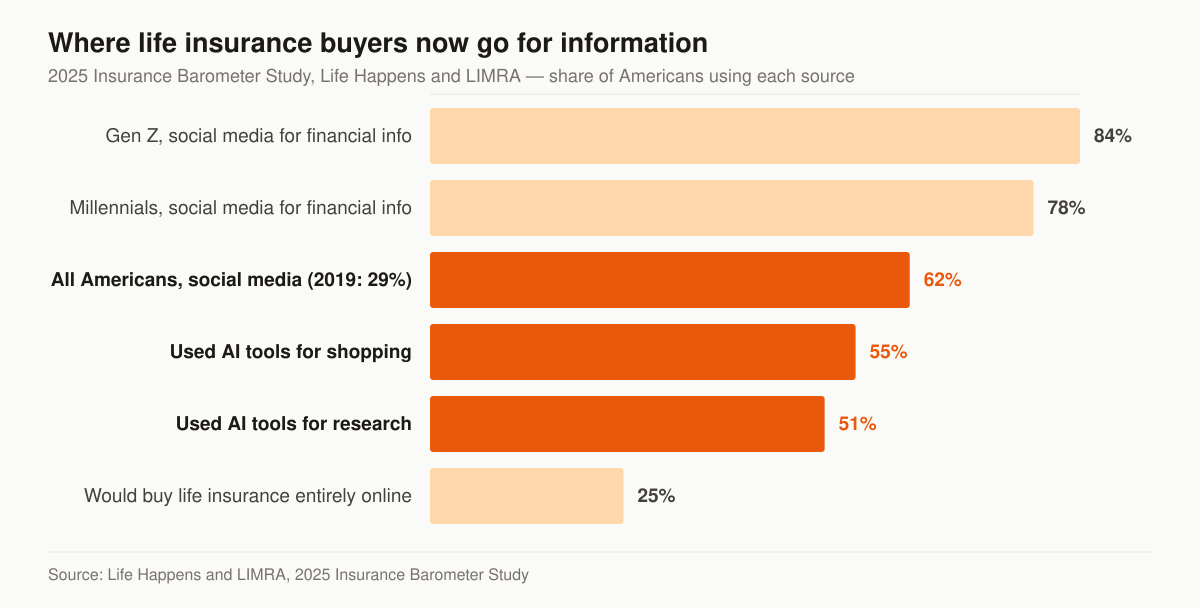
Source: Life Happens and LIMRA, 2025 Insurance Barometer Study, read September 2026.
Two conclusions pull in opposite directions, and both are useful. The first is that a search-only plan catches part of the demand rather than all of it, which is why organic work sits alongside your other channels instead of replacing them. The second is the counterweight from the same study: three in four people say they still want professional help in the life insurance buying process, and among those who want help, 36% would turn to a professional after narrowing the product type but before deciding amount and price.
That is the moment a ranked, specific page can catch — someone who already knows they want term or whole life and is trying to work out how much. So the page to rank is not a general explainer about life insurance. It is the page that meets a decided buyer at the amount-and-price question, in your state, with a way to reach you on it.
The keyword map: match intent, not volume
The mistake is chasing “life insurance” (massive volume, owned by carriers, near-impossible). The win is buyer-intent and local terms an agent can actually rank for and close.
| Intent stage | Example searches | What the page should do |
|---|---|---|
| Researching | “term vs whole life,” “how much life insurance do I need” | Educate, build authority, capture email |
| Comparing | “no exam life insurance,” “best whole life for [age]” | Position your offer, address objections |
| Ready to buy | “life insurance agent [city],” “term life quote near me” | Drive the quote/booking — highest convert |
We start with the bottom two rows because they pay first, then build research content to feed the funnel. For the term and whole life money pages specifically, we pair this with dedicated pages like our term life marketing and whole life marketing work so each product silo has its own ranking surface.
What Google says it rewards on a page like this
Life insurance sits inside the category Google weights hardest for trust, and Google spells that out in its own documentation rather than leaving it to interpretation. In Creating helpful, reliable, people-first content, Google writes that its systems “give even more weight to content that aligns with strong E-E-A-T for topics that could significantly impact the health, financial stability, or safety of people, or the welfare or well-being of society.” It calls those Your Money or Your Life topics, or YMYL.
Three lines from that same document change how a life insurance page should be built:
- Trust is the load-bearing part. Google states: “Of these aspects, trust is most important. The others contribute to trust, but content doesn’t necessarily have to demonstrate all of them.”
- E-E-A-T is not a dial you can turn. The document is explicit that “While E-E-A-T itself isn’t a specific ranking factor, using a mix of factors that can identify content with good E-E-A-T is useful.” Anyone selling you an E-E-A-T score is selling you a proxy for a proxy.
- Bylines are asked for by name. Google’s self-assessment questions include “Is it self-evident to your visitors who authored your content?” and “Do pages carry a byline, where one might be expected?” The page adds: “We strongly encourage adding accurate authorship information, such as bylines to content where readers might expect it.”
For a licensed agent, that last item costs nothing and a content mill cannot copy it. You already hold what the signal is made of: a licence number, a resident state, an appointment list, and years of conversations about the exact objection the page is answering. Put the name and the licence on the page, link it to a real bio, and say what the author actually does all day.
Technical and trust signals Google won’t skip
Life insurance SEO fails on fundamentals more than on clever tactics. The checklist that matters:
- Core Web Vitals — slow, layout-shifting pages get throttled. Fast loads are non-negotiable.
- Schema markup — Organization, LocalBusiness, FAQ, and Service schema so search and AI engines parse you correctly.
- E-E-A-T proof — named, credentialed authors; accurate product descriptions; real reviews; honest disclaimers. No “guaranteed returns,” no hype that invites compliance risk.
- Local SEO — a complete Google Business Profile, consistent NAP data, and city-specific pages for the local pack.
- Clean internal links — pillar pages linking to product subpages and back, so authority flows where it should.
This is exactly the technical discipline our broader insurance SEO service is built around — the life insurance silo just applies it to a YMYL vertical with tighter trust requirements.
The first item on that list has published thresholds attached, so it is worth writing them down instead of saying “fast”.
| Core Web Vital | What it measures | Threshold for “good” |
|---|---|---|
| Largest Contentful Paint (LCP) | How long the main content takes to paint | Within 2.5 seconds |
| Interaction to Next Paint (INP) | How fast the page responds to a tap or click | 200 milliseconds or less |
| Cumulative Layout Shift (CLS) | How much the layout jumps while loading | 0.1 or less |
Those three thresholds come from web.dev’s Core Web Vitals guide, which also sets the measurement rule that catches people out: the target is judged at the 75th percentile of page loads, segmented across mobile and desktop. An average that looks acceptable can still fail, because a quarter of your visitors are having a worse experience than the average describes. Quote calculators, carrier iframes and chat widgets are the usual culprits on an agent site, and each one is a decision rather than an accident. Our life insurance website design work treats the quote widget as a line in the performance budget, not a free add-on.
Local search: the levers you actually control
Local is where an individual agent can beat a national brand, because proximity and profile completeness are weighted in a way that domain authority is not. Whitespark’s 2026 Local Search Ranking Factors survey, scored by 47 local search practitioners, puts the primary Google Business Profile category at the top of the local pack list with a score of 227, ahead of proximity of the address to the searcher at 225.
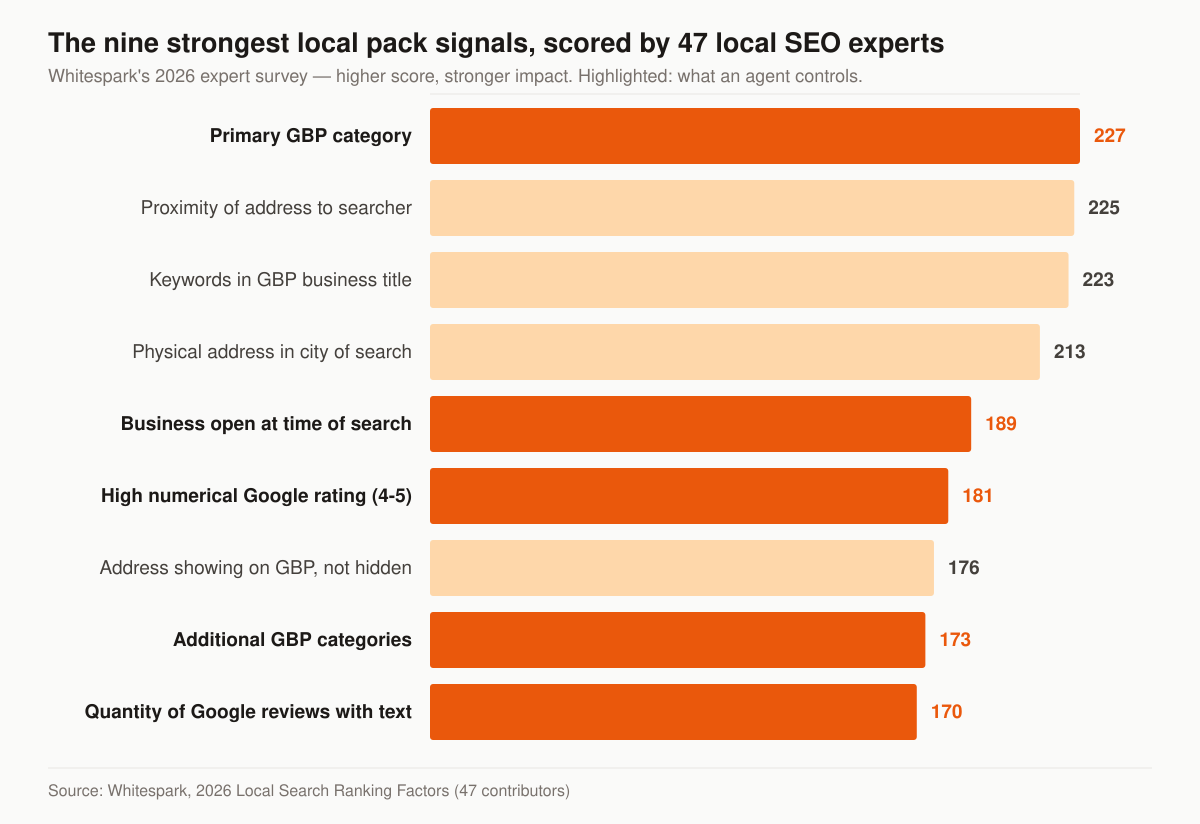
Source: Whitespark, 2026 Local Search Ranking Factors, a survey of 47 contributors, read September 2026. On the same survey’s localized organic list, a dedicated page for each service scores highest at 210, followed by geographic keyword relevance at 190 and quality or authority of inbound links at 187 — which is the empirical case for a page per product line rather than one page listing everything you sell.
Read the third bar carefully, because it is a trap. Keywords in the Business Profile title score 223 in the expert survey, and putting them there breaks Google’s own rule. The guidelines for representing your business on Google state: “Including unnecessary information in your business name isn’t permitted, and could result in the suspension of your Business Profile.” The banned additions in Google’s own examples include service or product information and location information. A profile that ranks until it is suspended is not a ranking, and we have written up what that recovery looks like in our guide to a suspended Google Business Profile.
Four more rules from that page decide whether an agent qualifies at all:
- Insurance agents are named as individual practitioners. Google’s wording: “An individual practitioner is a public-facing professional, typically with their own customer base. Doctors, dentists, lawyers, financial planners, and insurance or real estate agents are all individual practitioners.”
- Producers inside a corporate sales structure are not automatically eligible. The same section states: “Sales associates or lead generation agents for corporations aren’t individual practitioners and aren’t eligible for a Business Profile.” It also rules out stacking listings by product: “A practitioner shouldn’t have multiple Business Profiles to cover all of their specializations.”
- A solo agent under a carrier brand shares one profile. Google prescribes the format: “Create a single Business Profile, named using the following format: [brand/company]: [practitioner name].” The acceptable example Google gives is “Allstate: Joe Miller”.
- Work from home and the address comes down. “If you’re a service-area business, you should hide your business address from customers.” Google also caps the radius: the boundaries of the service area “shouldn’t extend farther than about 2 hours of driving time from where your business is based.”
Reviews sit alongside all of this — a high numerical rating scores 181 on the same survey and review quantity 170 — and collecting them is a process, not a hope. Our insurance local SEO service runs the profile and the review request cadence together, because a profile with the right category and no reviews stalls in the same place every time.
Your website is an advertisement under state insurance law
This is the part of life insurance SEO that general SEO guides skip, and it is the part that can cost you a licence rather than a ranking. State insurance advertising rules define “advertisement” broadly enough to cover the page you are optimising.
Alabama Department of Insurance chapter 482-1-132, titled Advertisements of Life Insurance and Annuities Regulation, defines an advertisement as material designed to create public interest in life insurance or annuities, in an insurer, or in an insurance producer — and its list of covered media includes “the Internet or any other mass communication media” and, separately, “web pages”. The NAIC publishes a model regulation of the same name, numbered 570; states adopt their own versions, so read the one that governs your licence rather than this one.
The rules below map onto copy decisions a life insurance page makes every week, and each is quoted from that chapter.
| Copy decision | What the rule requires | Cite |
|---|---|---|
| A page targeting “no exam life insurance” | Where issue is not guaranteed, terms such as non-medical or no medical examination required “shall be accompanied by a further disclosure of equal prominence and in juxtaposition thereto to the effect that issuance of the policy may depend upon the answers to the health questions set forth in the application.” | 482-1-132-.06(3) |
| Cash-value pages that lean on returns | An advertisement “shall not emphasize the investment or tax features of a life insurance policy to such a degree that the advertisement would mislead the purchaser to believe the policy is anything other than life insurance.” | 482-1-132-.06(10) |
| The words investment, savings, profit, retirement plan | Barred where used “in a context or under such circumstances or conditions as to have the capacity or tendency to mislead a purchaser or prospective purchaser of such policy” into believing they will receive something other than a policy. | 482-1-132-.05(2) |
| Your author bio and title | A producer may not use terms such as financial planner, investment adviser, financial consultant or financial counseling “in such a way as to imply that he or she is generally engaged in an advisory business in which compensation is unrelated to sales unless that actually is the case.” The rule “is not intended to preclude persons who hold some form of formal recognized financial planning or consultant designation from using this designation even when they are only selling insurance.” | 482-1-132-.06(14) |
| Testimonials on the page | They “must be genuine; represent the current opinion of the author; be applicable to the policy advertised, if any; and be accurately reproduced with sufficient completeness to avoid misleading or deceiving prospective insureds as to the nature or scope of the testimonial, appraisal, analysis or endorsement.” | 482-1-132-.06(17) |
| Statistics you cite in content | “The source of any statistics used in advertisement shall be identified.” | 482-1-132-.06(18) |
| A free quote or free policy review offer | Free, no cost and similar words “shall not be used with respect to any benefit or service being made available with a policy unless true. If there is no charge to the insured, then the identity of the payor shall be prominently disclosed.” | 482-1-132-.06(13) |
Two structural provisions matter as much as the wording rules. Responsibility is shared: “All advertisements, regardless of by whom written, created, designed or presented, shall be the responsibility of the insurer, as well as the producer who created or presented the advertisement.” And there is a retention duty on the insurer, which keeps a file at its home or principal office — “All advertisements shall be maintained in the file for a period of five (5) years after discontinuance of its use or publication.” Under the penalties section, an insurer or its officers, directors, producers or employees that violate the chapter, or knowingly participate in or abet a violation, are subject to “a fine up to $1000 for each violation and suspension or revocation of its certificate of authority or license.”
The operational version of that is short. Version-control your page copy so you can produce what a page said on a given date. Route new product copy through carrier or IMO approval before it publishes, not after it ranks. And treat the disclosure as part of the layout rather than a footer afterthought, because equal prominence and juxtaposition are specific words with a design consequence. We provide marketing services, not legal advice; your compliance counsel signs off on the copy. Our write-up of insurance marketing compliance covers the sibling rules that govern other lines.
Schema markup: what still earns a rich result, and what does not
Structured data is worth adding, but the reason changed in 2023 and a lot of the advice ranking today has not caught up. On 8 August 2023 Google reduced FAQ rich results, writing that “Going forward, FAQ (from FAQPage structured data) rich results will only be shown for well-known, authoritative government and health websites. For all other sites, this rich result will no longer be shown regularly.” The same post limited How-To rich results, which “will only be shown for desktop users, and not for users on mobile devices.”
That does not make schema pointless on an agent site. Google’s own note in the same post: “While you can drop this structured data from your site, there’s no need to proactively remove it. Structured data that’s not being used does not cause problems for Search, but also has no visible effects in Google Search.” The reason to keep FAQ markup on a life insurance page now is that it hands a machine a clean question-and-answer pair, which is the shape an answer engine can lift. The reason to stop budgeting for it is that Google said the accordion in the blue links is not coming back for a commercial site.
Here is where the markup effort belongs on a life insurance agent site.
| Schema type | What it describes | What to expect from it |
|---|---|---|
| InsuranceAgency or LocalBusiness | The physical location, hours and service area | Feeds the entity behind your local pack presence |
| Person, on the author | The licensed producer behind the page | Supports the byline Google’s guidance asks for |
| Service | The specific product line the page sells | Clarifies the page’s subject for crawlers and answer engines |
| FAQPage | Machine-readable question-and-answer pairs | No rich result for a commercial site; still parseable |
| BreadcrumbList | Position in the site hierarchy | Breadcrumb display in results |
The content plan, and the two spam policies that end city-page sprees
The instinct after a keyword export is to spin up a page for every city in the state. Google names that pattern twice in its spam policies. Doorway abuse “is when sites or pages are created to rank for specific, similar search queries. They lead users to intermediate pages that aren’t as useful as the final destination.” Scaled content abuse “is when many pages are generated for the primary purpose of manipulating search rankings and not helping users,” a practice the policy describes as “typically focused on creating large amounts of unoriginal content that provides little to no value to users, no matter how it’s created” — that last clause closes the loophole an AI writing tool appears to open.
A city page earns its slot when it carries something only that city has: your office or service radius, that state’s rules, local carrier availability, a named producer who writes business there. If a page differs from its neighbour by the city name and nothing else, it is the pattern Google just described.
Google’s Creating helpful, reliable, people-first content guidance, quoted earlier on YMYL, is worth returning to on length, because it contradicts a brief you have probably been handed. Among the warning signs it lists for search-engine-first content: “Are you writing to a particular word count because you’ve heard or read that Google has a preferred word count? (No, we don’t.)” Depth is a count of questions answered, not of words. Our insurance content marketing service plans clusters against a question list, and our guide to insurance SEO keywords covers how to pull that list before anything gets written. For the mechanics of turning a cluster into rankings, see how to rank an insurance agency website.
AI search is the same work aimed at a second surface
Half the audience is already there: the Barometer study puts AI tool use at 51% for research and 55% for shopping. What changes for the page is smaller than the vendor pitches suggest. An answer engine reads the same HTML, prefers the same clean structure, and cites pages that state a claim plainly and attribute it. The levers are the ones already on this page — a direct answer near the top, headings phrased as the question a person asks, tables an engine can parse, named sources with links, and an author with a licence number.
The part that is genuinely different is measurement, because a citation inside a chat window produces no Search Console row. Our AI search and GEO service tracks it as its own surface, and our guide to getting cited by Perplexity and AI Overviews covers the page-level mechanics.
What SEO costs, and what the spend should return
Published price data on SEO exists, and it is wide. Ahrefs surveyed 439 SEO providers and reports the $501–$1,000 per month band as the most popular monthly retainer at 20.4% of respondents, while agencies average $3,209 per month. On one-time projects, the same survey puts freelancers at an average of $2,348.63, consultants at $8,685.53 and agencies at $9,507.84.
Our prices are published rather than quoted: Foundation at $2,500 per month, Growth at $3,500, Full-Funnel at $5,500, plus a one-time website build of $2,500–$8,000. Ad spend sits outside the retainer — media budget is a pass-through billed at cost, straight to the platforms. Full detail, including what each tier excludes, is on the pricing page.
For a life insurance agent the tier follows the constraint, not the ambition. No site worth ranking? Foundation covers the build, the local profile and on-page work. A sound site nobody finds? Growth adds the ongoing SEO and content engine, AI-search visibility and reputation work. Organic handled and volume is the limit? Full-Funnel adds managed paid ads, landing-page CRO and the automation behind follow-up. If you would rather buy the pipeline than build it, our life insurance lead generation page prices that motion instead.
What to measure, and when to expect it
Rankings alone will mislead you in a niche this narrow, because a term with tiny volume can sit at position one and send nothing. Watch a short list instead, in the order the funnel actually fills.
These are the numbers to review on a life insurance SEO program, and the sequence they move in.
| Month | What should be moving | What is too early to judge |
|---|---|---|
| 1–2 | Pages indexed, Core Web Vitals at the 75th percentile, Business Profile complete and categorised | Rankings, traffic, leads |
| 3–4 | Impressions in Search Console, first long-tail positions, local pack appearance for the home city | Revenue attribution |
| 5–6 | Clicks on buyer-intent terms, quote-form starts, calls from the profile | Head-term rankings |
| 7–12 | Quote requests per month, cost per acquired policy from organic, assisted conversions | Whether to expand into new cities |
Two rows deserve a note. Impressions arriving before clicks is the normal order, and rising impressions with flat clicks points to ranking on the wrong half of the query set rather than to SEO failing. And cost per acquired policy is the figure that decides whether to keep going, because traffic that never books is a report rather than a result.
Where life insurance SEO programs stall
Each of these is a process failure rather than an algorithm problem, and each has a fix that does not require more content.
| Where it stalls | What it looks like | The fix |
|---|---|---|
| Carrier-supplied microsite | The agent’s site is one of many near-identical templates on a shared domain | Own the domain, own the pages, make the content specific to you |
| One page for every product | Term, whole, IUL and final expense share a single thin page | A page per product line, each with its own intent and call to action |
| No local surface | The site ranks nationally for nothing and locally for nothing | Business Profile with the right primary category, plus a real page for the office city |
| No named author | Product copy with no producer behind it, in a YMYL category | A byline with the licence, linked to a bio page |
| Quote widget bolted on last | A third-party embed pushes LCP past the threshold | Budget the widget into the page; load it on interaction |
| Content with no question behind it | Posts written to a word count | A question list from search data, one page per intent |
| Compliance review after publication | Copy edits arrive weeks after the page ranks | Approval before publish, with a dated record of what shipped |
How this connects to the rest of your marketing
SEO is one channel in a system. It works best when your life insurance marketing strategy lines up the offer, the landing experience, and the follow-up. Organic traffic that hits a weak page leaks; a strong page with no ranking starves. We sequence them.
A note on the brand boundary: we build lead-generation systems — sites, content, and rankings that produce your own leads. If what you actually want is to buy leads, live transfers, or aged data as a product, that’s a different motion — buy leads direct from getinsureleads rather than forcing it through SEO.
Why work with operators, not theorists
Most “life insurance SEO” is sold by people who have never run a campaign that had to close. We have. We run live senior-market lead campaigns — real ad spend that has to close. So the SEO we build is judged by leads and closes, not rankings on a dashboard. The same conversion discipline that works for our senior-market clients is what we apply to your life insurance pages.
Next step for life insurance agent SEO
Want to know exactly where your site leaks and which terms are winnable? Get a free marketing audit — we’ll map your keyword gaps, technical issues, and the fastest path to ranked, converting pages. Prefer to talk it through first? Get in touch, or read how we think about the broader strategy before you commit a dollar.