Telemarketing Insurance Leads: What Still Works in 2026
Telemarketing insurance leads still work, but insurance telemarketing is a narrower channel than it was: Do Not Call and TCPA rules mean you must scrub lists and hold consent or an established business relationship before dialing. Direct-mail and live-transfer leads have taken share. Winners treat telemarketed leads as one input to an owned, compliant follow-up system.
If you search “telemarketing insurance leads,” you land in a strange split. Half the results are vendors and call centers selling you leads; the other half are agents declaring telemarketing “dead.” Both are selling something — a list, or a different program. The truth sits in between, and it’s more useful.
We build marketing systems for agents rather than sell raw leads, so here’s the straight version: telemarketed and direct-mail leads still work for the right lines, but the compliance rules and the economics have changed enough that how you use them matters far more than where you buy them. This guide covers the lead types, whether they still pay, the Do Not Call and TCPA reality, and how to make them worth the spend.
What “telemarketing insurance leads” actually means
The phrase covers several very different products that get lumped together. Knowing which one you’re buying is half the battle.
| Lead type | How it’s generated | Cost | Best for |
|---|---|---|---|
| Telemarketed (data) lead | Callers phone prospects, qualify interest, hand off a record | Low per lead | Final expense, Med Supp — high volume, fast dialing |
| Live transfer | Caller qualifies, then transfers the prospect to you live | High per lead | Agents who close on the first call |
| Direct-mail responder | Prospect returns a mailer/reply card in writing | Medium | Final expense; warmer, cleaner consent trail |
| Aged lead | Older telemarketed/web leads resold at a discount | Very low | Volume dialers with strong follow-up systems |
| Exclusive vs. shared | Sold to one agent vs. several | Exclusive costs more | Exclusive when close rate matters most |
Two practical takeaways: a “cheap lead” is often a shared or aged record you’ll work harder, and direct mail sits in a different compliance lane than phone outreach — which is exactly why it’s held on in final expense while pure cold telemarketing has shrunk.
Do they still work?
Yes — for specific lines and specific agents. Telemarketed and direct-mail leads remain a staple in final expense and Medicare supplement, where the buyer is often older, responds to phone and mail, and the sale can happen over the phone. They work far less well when an agent buys a batch, calls each lead once, and moves on.
What’s changed is the surrounding market. Live-transfer and inbound leads have taken share because they arrive pre-qualified, and Do Not Call enforcement has made sloppy cold-dialing riskier. The channel didn’t die; it professionalized. The agents still winning with it treat a telemarketed lead as the start of a multi-week follow-up sequence, not a one-and-done call.
What a telemarketed lead costs, and what a policy costs
Per-record price is the number vendors lead with and the number that predicts the least. ActiveProspect’s published breakdown of insurance lead pricing puts shared web leads at $10 to $45, exclusive web leads at $45 to $120, live transfers at $80 to $200 or more, and aged records at $0.50 to $15. Narrowed to life, the same page gives shared leads at $20 to $45, exclusive at $75 to $150, live transfers at $80 to $200-plus, and aged leads at $5 to $15 (ActiveProspect, insurance leads cost).
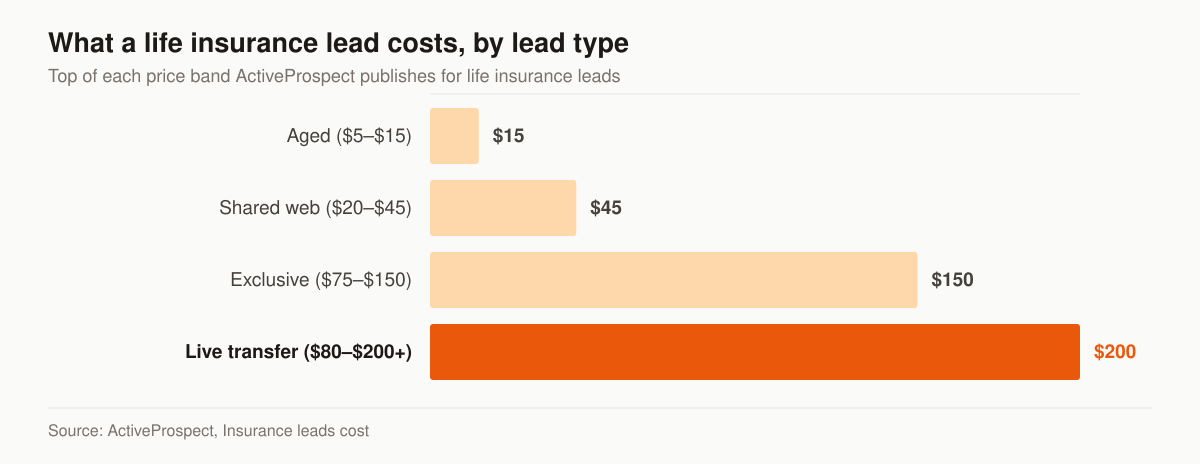
Chart: top of each published price band, from ActiveProspect’s insurance lead cost breakdown.
The distance between the bottom and the top of that ladder is not a pricing error. It is four different products, each asking you to supply something different.
This table sets the published price bands beside the work each product still requires from you, so the sticker price stops looking like the whole cost.
| Product | Published band (life) | What you have to supply | Where it stops paying |
|---|---|---|---|
| Aged record | $5–$15 | Volume dialing capacity, a multi-week cadence, tolerance for dead numbers | When one caller tries to work a file sized for a call floor |
| Shared or telemarketed record | $20–$45 | Speed to the phone, a script, follow-up discipline | When the same record is sitting in other agents’ dialers too |
| Exclusive record | $75–$150 | A close rate high enough to justify the premium | When exclusivity is a label with no resale clause behind it |
| Live transfer | $80–$200+ | Someone free to take the call the moment it lands | When transfers arrive while you are already on a call |
The reconciling number is lead cost per issued policy, and it is built from two figures only you can measure: the share of records you reach, and the share of those you place. Multiply them and you get policies per hundred leads; divide the lead price by that and you get lead cost per policy. At $30 a record and one issued policy per fifty records, the lead cost is $1,500 a policy. At $8 a record and one per two hundred, it is $1,600 — the cheaper lead produces the dearer policy. Those two inputs are yours to observe over a few hundred records, and no vendor can supply them for you, because they are as much a fact about your dialing as about their data. We work through the same arithmetic in more detail on final expense lead cost versus true cost per sale and on the exclusive-versus-shared trade-off.
Set that per-policy figure against the alternative before you decide. Our own pricing is published — Foundation at $2,500 a month, Growth at $3,500, Full-Funnel at $5,500 — precisely so the comparison is arithmetic rather than a sales call: a monthly retainer that produces leads you own, against a per-record price that resets every month and produces leads you rent.
The compliance reality (read this before you dial)
This is where most “telemarketing is dead” takes come from — and where agents get into trouble. The rules aren’t a reason to avoid the channel; they’re the operating manual. Per the FTC’s Telemarketing Sales Rule guidance:
- Scrub against the National Do Not Call Registry every 31 days. Telemarketers must access the registry and remove registered numbers from call lists on that cadence.
- You can’t call a registered number without an exception. The two that matter are an established business relationship (EBR) or the consumer’s prior express written consent.
- The EBR clock is specific: roughly 18 months after a purchase or transaction, and 3 months after a consumer’s inquiry or application about your services.
- Written consent must be real and transferable. A purchased lead is only callable if the consent that came with it is valid and actually permits your call — buying a record doesn’t manufacture consent.
- The stricter “one-to-one consent” rule is gone — but consent isn’t. In January 2025 the Eleventh Circuit vacated the FCC’s one-to-one consent rule in Insurance Marketing Coalition v. FCC, so the earlier “prior express written consent” standard still governs autodialed and prerecorded telemarketing calls. The requirement to have consent didn’t go away.
This is why direct-mail responders are attractive: a returned reply card is a written expression of interest that sidesteps much of the phone-outreach risk. It’s also why we tell agents to build a documented consent trail rather than rely on a vendor’s word. For calling purchased or aged records specifically, see our deeper note on TCPA rules when buying leads.
We’re a marketing provider, not your compliance counsel. Agents are the licensed parties — confirm your Do Not Call scrubbing and consent flow with your own compliance review.
How a dial has to be placed, not just whether it may be
The registry answers one question: may this number be called at all. The Telemarketing Sales Rule then governs the mechanics of the call itself, and those rules bind whether or not the number was on a list. This is the part of the file that call-centre vendors handle for their own dialers and that agents dialing from a laptop tend to discover late.
This table lists the TSR’s operating requirements for how an outbound call is placed, each with the paragraph it comes from.
| Requirement | What the rule says | Citation |
|---|---|---|
| Calling window | Absent that person’s prior consent, no outbound calls to a person’s residence outside 8:00 a.m. to 9:00 p.m. local time at the called person’s location | 16 CFR 310.4(c) |
| Caller ID | Transmit the telephone number, plus the name when the telemarketer’s carrier makes it available; the seller’s name and a customer-service number answered during regular business hours may be substituted | 16 CFR 310.4(a)(8) |
| Abandoned call | A call is abandoned if a person answers and the telemarketer does not connect it to a sales representative within two seconds of that person’s completed greeting | 16 CFR 310.4(b)(1)(iv) |
| Abandonment ceiling | Safe harbour requires technology ensuring abandonment of no more than three percent of all calls answered by a person, measured over a single campaign under 30 days or over each successive 30-day period | 16 CFR 310.4(b)(4)(i) |
| Ring time | Let the phone ring at least fifteen seconds or four rings before disconnecting an unanswered call | 16 CFR 310.4(b)(4)(ii) |
| Opening disclosures | Disclose truthfully, promptly and clearly the identity of the seller, that the purpose of the call is to sell goods or services, and the nature of those goods or services | 16 CFR 310.4(d) |
Read the abandonment pair together, because they are what a predictive dialer is for and what it gets wrong. Two seconds is the entire budget between a prospect saying hello and a human voice arriving. Three percent is the ceiling on how often that budget can be blown, and it is measured across a campaign rather than forgiven day by day. An agent dialing one line at a time is already on the call when it connects, so neither limit bites. A multi-line predictive dialer pointed at a purchased file can cross both inside a single session, which is the practical reason to keep the dialer conservative until you have contact-rate data worth tuning against.
The FCC writes the calling window separately and in its own words: no telephone solicitation to “Any residential telephone subscriber before the hour of 8 a.m. or after 9 p.m. (local time at the called party’s location)” (47 CFR 64.1200(c)(1)). Local time is the prospect’s clock, not yours. An 8 a.m. start on the East Coast is not 8 a.m. in Arizona, and a purchased file sorted by nothing in particular will mix both. Sort the file by time zone before the first dial, not after the first complaint.
Your own do-not-call list is a separate obligation
Scrubbing the national registry does not discharge the entity-specific rule. It is a separate obligation, not a subset of the national one, and it survives every argument that the vendor handles compliance. Section 64.1200(d) bars any call for telemarketing purposes to a residential telephone subscriber unless the caller has instituted procedures for maintaining a list of people who asked not to be called. The regulation then sets out what those procedures have to contain, and each item is a document, not an intention:
- A written policy for maintaining a do-not-call list, “available upon demand.” Available upon demand means someone can ask you for it, so it has to exist in writing before the call, not after the complaint.
- Trained personnel. Anyone “engaged in any aspect of telemarketing must be informed and trained in the existence and use of the do-not-call list” — which includes a contracted call centre dialing on your behalf.
- The request recorded at the time it is made, with the subscriber’s name, if provided, and telephone number placed on the list then and there.
- Honored within a reasonable time, which the rule caps: “This period may not exceed ten (10) business days from the receipt of such request.”
- Caller identification on every call: “the name of the individual caller, the name of the person or entity on whose behalf the call is being made, and a telephone number or address at which the person or entity may be contacted.”
- Retained for five years. “A do-not-call request must be honored for 5 years from the time the request is made.”
One sentence in that section decides who carries the risk when you buy the calling rather than doing it: “If such requests are recorded or maintained by a party other than the person or entity on whose behalf the call is made, the person or entity on whose behalf the call is made will be liable for any failures to honor the do-not-call request.” A vendor holding your opt-outs is a convenience, not a shield. Ask for opt-outs to be delivered back to you on the same schedule as the leads, and store them where your dialer reads them. If you are choosing a system to hold all of it, our CRM guide for insurance agents covers which platforms treat consent and disposition as real fields rather than free text.
Paragraph (e) of the same section extends the rules in (c) and (d) to “any person or entity making telephone solicitations or telemarketing calls or text messages to wireless telephone numbers to the extent described in the Commission’s Report and Order, CG Docket No. 02-278, FCC 03-153.” Do not assume the wireless numbers in a purchased file sit outside paragraphs (c) and (d) because they are cellphones.
What one bad call is worth to the person who answers it
Telemarketing risk is unusual in that the consumer, not a regulator, is the party with the fastest remedy. Two federal provisions and, in some states, a third set the price.
This table gives the statutory measures a called party can sue for, straight from the text of each provision.
| Provision | What the called party can recover | Uplift | Precondition |
|---|---|---|---|
| 47 U.S.C. 227(b)(3) — autodialed or prerecorded calls | Actual monetary loss, “or to receive $500 in damages for each such violation, whichever is greater” | Up to three times, if the court finds the defendant “willfully or knowingly” violated the subsection | None stated in the paragraph |
| 47 U.S.C. 227(c)(5) — do-not-call regulations | Actual monetary loss, “or to receive up to $500 in damages for each such violation, whichever is greater” | Up to three times, on the same willful-or-knowing finding | “more than one telephone call within any 12-month period by or on behalf of the same entity” |
| Fla. Stat. 501.059(10) — telephone solicitation | “Recover actual damages or $500, whichever is greater” | Up to three times, on a willful or knowing finding | Statute applies to telephone solicitors doing business in the state |
Three details in that table are worth reading twice. The first is that section 227(c)(5) carries an affirmative defense written directly into the statute: it is a defense “that the defendant has established and implemented, with due care, reasonable practices and procedures to effectively prevent telephone solicitations in violation of the regulations prescribed under this subsection.” That is the legal payoff of the written policy, the training records and the dated scrub logs. They are not paperwork for its own sake; they are the defense.
The second is that section 227(c)(5) requires more than one call in a twelve-month period from or on behalf of the same entity, while section 227(b)(3) as written carries no such precondition. A single autodialed or prerecorded call is a different exposure from a single manual dial.
The third is Florida, and it is why state law belongs in a vendor conversation about state mix. Section 501.059 adds a fee-shifting rule — in any civil litigation resulting from a transaction involving a violation of the section, the prevailing party, after judgment in the trial court and exhaustion of all appeals, “shall receive his or her reasonable attorney fees and costs from the nonprevailing party” — and an evidentiary shortcut: “There is a rebuttable presumption that a telephonic sales call made to any area code in this state is made to a Florida resident or to a person in this state at the time of the call.” The same statute requires a solicitor making an unsolicited call to a residential, mobile or paging number to identify themselves “by his or her true first and last names and the business on whose behalf he or she is soliciting immediately upon making contact by telephone with the person who is the object of the telephone solicitation.” Other states run their own versions. Check the ones you are appointed in before you let a vendor decide your geography for you.
We are describing published law, not advising on your exposure. Our page on insurance marketing compliance for agents covers the wider advertising rules; for the phone rules specifically, use counsel.
Where the complaints actually come from
Complaint volume is the closest thing this channel has to a public scoreboard, and the split inside it matters more than the total. The FTC logged 1,601,611 robocall complaints and 802,144 live-caller complaints in fiscal year 2025, with 214,322 more where the consumer did not report the call type.
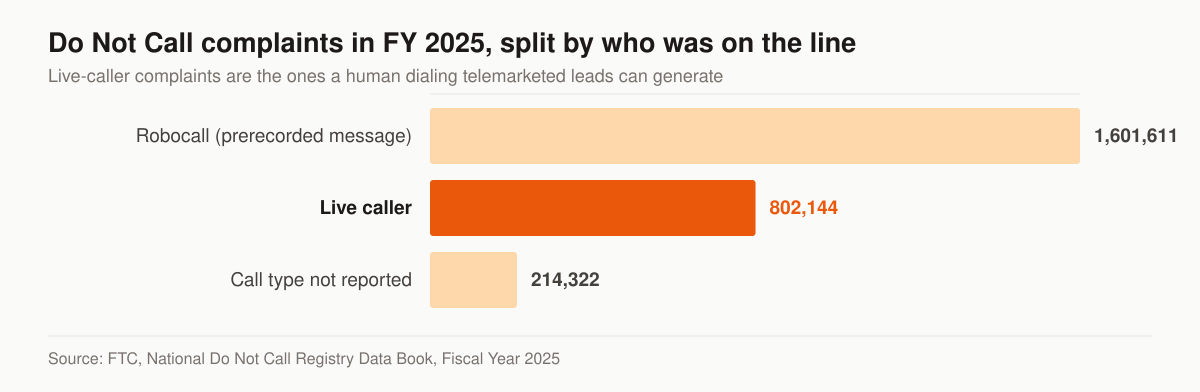
Chart: FY 2025 complaint counts by call type, from the FTC’s National Do Not Call Registry Data Book for Fiscal Year 2025.
The live-caller bar is the one that describes an agent with a headset, and the Data Book explains what sits behind it: “when it’s a live caller, we verify that the consumer’s telephone number was registered on the DNC registry before we take the complaint.” Every one of those 802,144 live-caller entries is therefore a complaint the FTC screened against a registration before accepting it. The registry those checks run against held 258,515,050 active registrations as of September 30, 2025.
The direction of travel is friendlier than the headline suggests. The FTC’s release accompanying the Data Book states that while overall complaints rose in FY 2025, unwanted calls remain about 48% lower than in FY 2021, when the Commission received approximately five million reports about unwanted calls (FTC, December 11, 2025). The Commission does not attribute that decline to any single cause, and neither will we. What the numbers do support is the shape of the channel today: smaller than it was five years ago, and still generating hundreds of thousands of live-caller complaints a year against registered numbers.
Business-to-business dialing runs on a different rulebook
The rules above are built around consumers, and the Telemarketing Sales Rule says so. Section 310.6(b)(7) exempts from the entire part “Telephone calls between a telemarketer and any business to induce the purchase of goods or services or a charitable contribution by the business,” with two carve-outs the paragraph names itself: the misrepresentation requirements at 310.3(a)(2) and (4), and calls to induce the retail sale of nondurable office or cleaning supplies (16 CFR 310.6). That is why the phone sits in a structurally different position for commercial lines, group benefits and key-person prospecting than it does for consumer final expense.
Read the exemption for exactly what it says, though. It exempts calls to a business from the TSR. It does not touch section 227(b) of the TCPA, whose prohibition on calls made “using any automatic telephone dialing system or an artificial or prerecorded voice” to “any telephone number assigned to a paging service, cellular telephone service, specialized mobile radio service, or other radio common carrier service” is written around the number, not around whether the person answering is at work. That prohibition carries its own carve-outs on the face of the statute — calls made for emergency purposes, calls made with the prior express consent of the called party, and calls made solely to collect a debt owed to or guaranteed by the United States — but being a business number is not among them. A small-business owner’s mobile is a cellular number regardless of what the call is about. Manual dialing to a business landline sits in a genuinely different place from an autodialer aimed at owner cell phones, and the two get talked about as though they were the same thing.
If commercial lines are where you are heading, our playbooks on marketing group life and employee benefits and key person and buy-sell insurance marketing cover the offer side of that market.
Medicare and final expense add a layer on top
The two lines where telemarketed and direct-mail leads still get bought in volume each carry their own layer of product-specific marketing regulation on top of the phone rules. A telemarketing file that is clean under the TSR and the TCPA can still create a problem under the Medicare marketing rules, because those govern what may be said, when a call may be converted into an appointment, and what disclaimers a third-party marketing organisation owes. They are a separate body of rules with separate clocks, and we cover them where they belong rather than compressing them here: start with the CMS Medicare marketing rules for agents and the scope of appointment and TPMO requirements.
Final expense carries less federal marketing regulation and more practical risk, because the buyer is older, the sale often closes on the same call, and resale is a standing question to ask about any file in that market. Our final expense marketing hub and the guide to selling final expense over the phone cover the sales mechanics that decide whether a bought record turns into a placed policy.
Buy or generate? The question that decides your economics
Buying telemarketed leads is renting demand. It’s fast, but you compete for shared records, inherit someone else’s consent, and start over every month. Generating your own is building an engine: the leads are exclusive, the consent is yours, and the cost per acquisition falls as the system matures.
This is the fork we help agents cross. Our sister lead brand exists for agents who want to buy raw leads — but on the marketing side, we’d rather build you a source you own. That usually means generating exclusive leads you keep and turning conversations into booked appointments instead of paying per record forever. If you’d rather not cold-dial at all, we’ve written about generating leads without cold calling.
Be honest about which purchase you are making. If you want telemarketed leads or live transfers delivered as finished inventory, that is a lead-purchasing transaction, not a marketing service — buy leads direct from getinsureleads, our sister brand built for exactly that. We don’t sell leads on this site; we build the systems that generate them.
How to test a vendor before you scale the order
A first order is a measurement, and it only measures anything if you hold the other variables still. What follows is the protocol we hand agents, not a survey of what vendors offer.
- Ask where the consent came from, and ask for the artefact. The channel — direct-mail reply card, telemarketed qualification, digital form fill, co-registration — predicts contact rate better than price does. A vendor who cannot name the channel in writing is selling you a record with no provenance.
- Get the exclusivity window in days, with a resale clause. Exclusive with no definition and no bar on reselling the file once it ages is a word, not a term.
- Read the replacement policy for its two failure points: a reporting window measured in hours rather than business days, and credit issued only as more leads rather than money back.
- Run one vendor per test window. Same script, same dial cadence, same hours. Two vendors at once measures your week, not their data.
- Tag every record with its source at intake, so cost per issued policy stays attributable months later when the placements finally land.
- Expect placement to lag the buy. Underwriting and delivery mean issued-policy counts arrive weeks after the records did, so judge a vendor on placed business rather than submitted applications.
- Ask who runs the scrub, and how recently. A file bought six weeks ago is not covered by a scrub run when it was bought.
The vendor-category map on final expense lead generation companies covers what each type of provider is really selling, and working aged final expense leads covers the bottom of the price ladder specifically.
How to make telemarketed and direct-mail leads actually pay
Whether you buy or generate, the difference between profit and a wasted spend is the follow-up system behind the lead:
- Dial fast. We treat speed to lead as the first thing to fix on any bought file. A record worked in minutes and the same record worked in days are not the same asset, and the gap costs nothing to close.
- Sequence, don’t single-call. A bought record that gets one dial has been discarded, not worked. Set a cadence across phone, text and mail, write it down, and automate the parts that do not need you — our insurance lead follow-up cadence lays out a structure you can copy.
- Script the opening for the disclosure, not around it. The TSR wants the seller identified, the purpose stated and the product named, promptly and clearly. Agents who bolt that on after a warm-up line make the call sound evasive; agents who build the script around it sound like the licensed professional they are. The final expense telesales script is a worked example.
- Use a real CRM and dialer. A record in a spreadsheet is a lost record. Pick the right tool from our CRM guide for insurance agents so consent, notes, and next steps live in one place.
- Track cost per issued policy by source. The cheapest lead is whichever one produces the most policies per dollar — not the lowest sticker price.
- Match the lead to the line. Telemarketed and direct-mail leads shine in final expense marketing; higher-consideration lines usually need a warmer first touch.
Not sure whether your leak is the lead source, the follow-up, or the compliance setup? Get a no-pitch marketing audit and we’ll tell you which one to fix first.
Sources
Compliance details were verified in July 2026 against the FTC’s Q&A for Telemarketers & Sellers about the DNC provisions of the Telemarketing Sales Rule and the Eleventh Circuit’s decision in Insurance Marketing Coalition v. FCC (No. 24-10277, Jan. 24, 2025). The September 2026 update added and verified:
- 16 CFR 310.4, abusive telemarketing acts or practices — calling window, caller ID transmission, abandoned-call definition and safe harbour, ring time, required oral disclosures.
- 16 CFR 310.6, exemptions — the business-to-business exemption at paragraph (b)(7) and its two carve-outs.
- 47 CFR 64.1200, paragraphs (c) and (d) — the 8 a.m. to 9 p.m. solicitation window, the entity-specific do-not-call list standards, the ten-business-day and five-year clocks, and the liability sentence covering requests held by another party.
- 47 U.S.C. 227, subsections (b) and (c) — the private rights of action, the $500 measures, the treble uplift, and the affirmative defense at (c)(5).
- Fla. Stat. 501.059 (2026), telephone solicitation — damages, fee-shifting, the area-code presumption and the caller-identification requirement.
- FTC, National Do Not Call Registry Data Book, Fiscal Year 2025 and the FTC’s December 11, 2025 release — complaint counts by call type, active registrations, and the change since FY 2021.
- ActiveProspect, insurance leads cost — the published per-lead price bands by lead type.
Rules change and enforcement varies by state — confirm current requirements with qualified counsel before launching outreach.
- Final Expense Lead Generation Companies for Agents: A Buyer's Map
A practitioner's breakdown of final expense lead generation companies: the vendor types, real cost-per-sale math, and when building your own wins.
- Exclusive vs Shared Final Expense Leads: A Cost-Per-Sale Breakdown
Exclusive vs shared final expense leads, compared on real cost-per-sale math, contact rates, and close rates so agents can pick what actually pays.
- Aged Final Expense Leads: What They Are and When the Math Works
Aged final expense leads cost a fraction of fresh leads. Here's what they are, the ROI math that decides if they work, and when to skip them.
- How to Get Final Expense Leads Without Cold Calling
How final expense agents get qualified leads without cold calling: inbound forms, paid social, live transfers, referrals, and SEO, with tradeoffs compared.