How to Get Final Expense Leads Without Cold Calling
Getting final expense leads without cold calling means buying or generating leads that ask to be contacted: inbound web forms, paid social, live transfers, referrals, and SEO. You still dial, but you call people who raised a hand, which lifts contact and close rates over cold lists.
“Without cold calling” does not mean without a phone. In final expense, the demographic still buys best by voice. What changes is who you dial. Instead of working a cold list of strangers, you call people who filled out a form, requested a callback, or got transferred to you live.
That shift matters because contact and close rates climb when the prospect already raised a hand — the same dials against a cold list convert at far worse odds.
This page covers five channels that replace cold calling: inbound web forms, paid social, live transfers, referrals, and SEO. Each has a different cost, speed, and effort profile. If you’re weighing which source to buy, our side-by-side comparison of every final expense lead source ranks them by cost and contact rate; if you’d rather build the flow yourself, see how to generate final expense leads.
Why the cold list stopped working
Two things squeezed the cold dial at the same time. Consumers stopped picking up for numbers they do not recognize, and the rules governing outbound dialing got specific about what you may do while trying.
Start with the behaviour, because it sets a ceiling nothing in your script can lift.
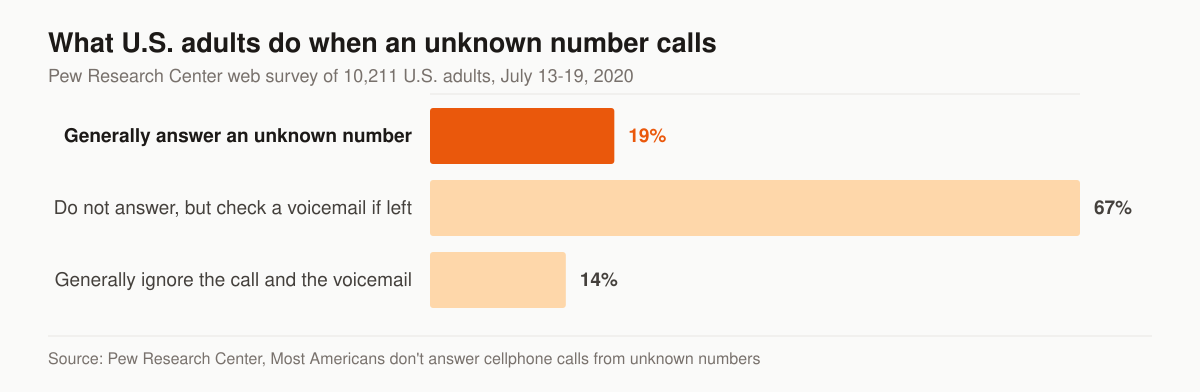
What U.S. adults do when an unknown number calls. Source: Pew Research Center, Most Americans don’t answer cellphone calls from unknown numbers, web survey of 10,211 U.S. adults, 13–19 July 2020.
Nineteen percent of adults said they generally answer a cellphone call from an unknown number. Sixty-seven percent said their practice is not to answer but to check a voicemail if one is left, and 14% said they generally ignore both. Your caller ID is an unknown number to a cold prospect. It is a known number to someone who filled out your form eleven minutes ago and is waiting for the call — which is the whole mechanical argument for inbound, before anyone mentions close rates.
Now the rules, which apply to the dialing operation itself rather than to the list. Under 47 CFR 64.1200(a)(6) no person or entity may “Disconnect an unanswered telemarketing call prior to at least 15 seconds or four (4) rings.” Paragraph (a)(7) forbids abandoning “more than three percent of all telemarketing calls that are answered live by a person, as measured over a 30-day period for a single calling campaign”, and defines the term: “A call is ‘abandoned’ if it is not connected to a live sales representative within two (2) seconds of the called person’s completed greeting.” And 47 CFR 64.1200(c)(1) bars any telephone solicitation to “Any residential telephone subscriber before the hour of 8 a.m. or after 9 p.m. (local time at the called party’s location).”
Read those together and the cold dial looks like what it is: a slow, legally conditioned way to spend the most expensive hour an agency owns. None of the three provisions is a problem for an agent returning a call to someone who asked for one. We are a marketing provider, not compliance counsel — confirm your own process with your own review.
Is the final expense buyer actually online?
The standard objection to inbound in this niche is that the 65-and-older buyer is not on the internet, so the leads must come from a dialer or a mailbox. The numbers do not support it.
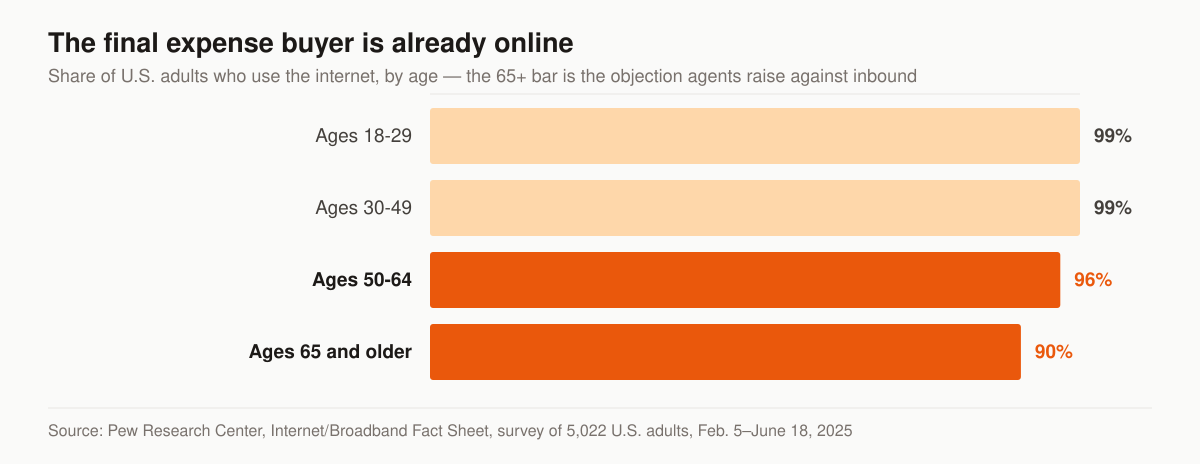
Internet use among U.S. adults by age. Source: Pew Research Center, Internet/Broadband Fact Sheet, survey of 5,022 U.S. adults fielded 5 February to 18 June 2025.
Ninety percent of adults 65 and older use the internet, against 96% of adults aged 50 to 64, the band sitting immediately below it. Home broadband in the 65-plus group sits at 70% in the same fact sheet. Pew’s Mobile Fact Sheet, drawn from the same survey, puts smartphone ownership among adults 65 and older at 78% and cellphone ownership of some kind at 95%. Its Social Media Fact Sheet puts YouTube use in that age group at 64% and Facebook at 57%.
Three practical consequences follow. First, an ad or a search result can reach this buyer, which is what makes paid social and SEO viable rather than theoretical. Second, the form has to survive a phone screen. With smartphone ownership at 78% in this age group, assume a share of your traffic is thumb-typing on a small screen, and treat every extra field as a field someone abandons. Third, the share of that age group who do not use the internet is still reachable by post, which is the honest case for keeping mail in the mix rather than declaring it dead.
For the platform-by-platform version of that last point, see social media for final expense agents.
The five ways to get final expense leads without cold calling
| Channel | Who you call | Typical cost | Speed to first call | Effort to run |
|---|---|---|---|---|
| Inbound web forms | People who submitted a quote request | Medium | Minutes to hours | Medium (needs traffic source) |
| Paid social (Meta) | People who clicked an ad and opted in | Low–medium per lead | Minutes | Medium–high (ad management) |
| Live transfers | People already on the line, pre-qualified | High per lead | Instant | Low (someone else dials first) |
| Referrals | Warm intros from existing clients | Near-zero | Days | Low–medium (needs a system) |
| SEO / organic | People who searched and found you | High upfront, low ongoing | Weeks to months | High to build, low to maintain |
No single channel wins on every axis. Live transfers buy you speed and skip the dialing grind, but cost the most per lead. SEO is the cheapest per lead once it ranks, but takes months and real content work. A durable agency runs two or three of these at once so one bad week on one channel does not zero out the calendar.
1. Inbound web forms
An inbound lead is someone who searched, landed on a page, and asked for a quote. They expect a call. The work is getting qualified traffic to a page that converts, then calling fast.
Speed is the whole game. A form filled out 15 minutes ago contacts at a far higher rate than one touched the next morning. We treat slow, inconsistent follow-up as the first thing to fix on an account, ahead of changing the lead source, because it costs nothing and it is entirely inside your control. We break the exact dialing schedule down in our guide to insurance lead follow-up cadence, and the short version is: first dial inside five minutes, then a structured sequence over the next two weeks.
If you want to understand the page mechanics that turn clicks into form fills, our final expense lead generation overview walks through the offer, the form, and the call flow as one system. The build side of that — one offer per page, a form short enough to finish on a phone, consent language that is readable and specific — is what our insurance landing pages service exists to standardize.
2. Paid social (Meta and beyond)
Paid social is the highest-volume channel for final expense. You run an ad, the prospect clicks, fills a form, and becomes a lead, usually within minutes. The catch is compliance and creative.
Insurance ads on Meta fall under the Special Ad Category, which strips out detailed age, ZIP-radius, and demographic targeting. You cannot micro-target seniors the way you can with other products. That forces you to win on creative and offer instead of targeting precision. It is a real constraint, not a footnote.
Done right, paid social produces a steady flow. For the full setup, targeting workarounds, and creative angles that survive the Special Ad Category, see our breakdown of Facebook ads for insurance agents, or the final expense specific version at final expense Facebook ads. If you would rather hand the account over, insurance Facebook ads management is the managed version.
A few rules that keep paid social profitable:
- Track cost per issued policy, not cost per lead. A cheaper lead that never closes is the expensive one.
- Reply in minutes. Social leads go cold faster than search leads.
- Document consent. Keep clean records of how each lead opted in and who they agreed to hear from.
3. Live transfers
A live transfer is a lead that is already on the phone. A call center or vendor pre-qualifies the prospect, confirms interest, then transfers the live call to you. You skip dialing entirely and start with a warm conversation.
This is the closest thing to “no cold calling” that still uses a phone. The tradeoff is price: live transfers carry the highest cost per lead of any channel here, because someone else did the dialing and screening. They make sense when your close rate and average premium are high enough to absorb the cost, or when you simply cannot staff the dials.
A practical comparison of channels by true economics lives in final expense leads: cost vs true cost per sale, which is the right lens before you commit budget to transfers.
4. Referrals
Referrals are the cheapest and warmest leads you will ever work, and they are also the ones easiest to leave on the table. A satisfied final expense client knows other people in the same life stage, often a spouse, sibling, or neighbor.
Referrals dry up for want of a system rather than for want of goodwill. A referral engine needs three things:
- A trigger — ask at the right moment, usually right after the policy is issued and the client is relieved it is done.
- A script — a specific, low-pressure way to ask, not “send anyone my way.”
- A follow-through — a way to log, contact, and credit the referral so it does not get lost.
Referrals will not fill a calendar by themselves, but bolted onto a paid channel they lower your blended cost per sale meaningfully. They cost near nothing and close fast because trust is pre-loaded.
5. SEO and organic search
SEO is the long game. When someone searches “burial insurance for my mother” and finds your page, that is a lead with high intent and zero per-click cost. The catch: ranking takes months of content and technical work, and final expense search volume is modest.
SEO does not replace paid channels; it compounds underneath them. Over a year, an agency that ranks for local and product terms builds a base of free leads that lowers blended cost. If you want the mechanics of ranking a final expense site, our final expense SEO guide covers the page structure, content, and local signals that move the needle. For final expense content ideas that attract inbound leads, we keep a 40-angle swipe list mapped to search intent.
If you would rather buy the inbound volume than build it, that is a lead-purchasing transaction, not a marketing service — buy leads direct from getinsureleads, our sister brand built for exactly that. We don’t sell leads on this site; we build the systems that generate them, which is what makes the cold-call-free version durable.
Where direct mail fits
Direct mail belongs to the same family as the five above — the prospect responds before you dial, so the call goes to a responder rather than a stranger. It sits outside the list because it runs on a different clock and a different balance sheet. You commit the entire cost of the drop before you know the response, and the reply card arrives days later instead of seconds later.
The postage line is the part you can price exactly. USPS Notice 123, the published price list effective 12 July 2026, sets a carrier route saturation Marketing Mail letter at $0.255 per piece, a First-Class automation 5-digit postcard at $0.453, and a First-Class automation 5-digit letter at one ounce at $0.621.
Postage is the floor, not the cost. Add design, print, the list, and the response rate your own drop achieves, and you have a cost per returned card. That number is the one to set against an inbound lead price — not the postage. Our final expense mailer templates covers the creative side, and aged final expense leads covers what happens to a response record once it has sat for a few months.
Mail also answers the reachability gap from the section above. Pew puts internet use among adults 65 and older at 90%, which leaves a real population that a web form will never reach; post is how you reach it. Treating mail and inbound as rivals is a mistake, because they cover different people.
What each no-cold-call channel actually costs
Vendors publish prices, and reading them side by side is the fastest sanity check on a budget. Every figure below comes from the seller’s own live page or a published vendor guide, not from an average we constructed.
The table below sets published prices next to what the buyer is actually paying for — read the right column before you compare the middle one:
| Lead type | Published price | What the price is buying |
|---|---|---|
| Aged final expense record, 15–45 days | $1.50–$1.88 per lead (Aged Lead Store) | A contact record that already had one round of interest, no exclusivity, no live connection |
| Aged final expense record, 365+ days | $0.15–$0.30 per lead (Aged Lead Store) | Volume for a dialer, with a consent trail you have to verify yourself |
| Shared web life lead | $20–$45 per lead (ActiveProspect) | A live form fill, sold to several agents, so speed decides who talks first |
| Exclusive life lead | $75–$150 per lead (ActiveProspect) | The same form fill, sold once, so you get the conversation |
| Live transfer | $80–$200+ per transfer (ActiveProspect) | Someone else’s dialing labor, plus a screened prospect on the line |
| Qualified inbound final expense call, 2026 | $45–$85 per call (AllCalls) | A caller who dialed the advertised number, with a buffer to qualify before the charge |
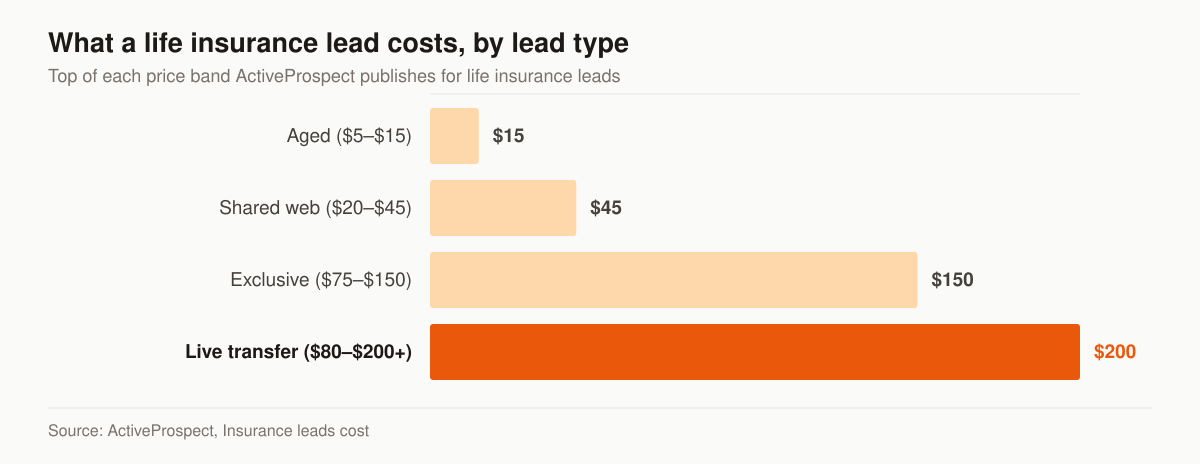
Top of each published price band for life insurance leads. Source: ActiveProspect, Insurance leads cost.
Two things stand out. The spread from an aged record to a live transfer is more than two orders of magnitude, so any comparison stated as “leads cost X” is meaningless without the lead type attached. And the price tracks how much of the work the vendor has already done for you: nobody sells screening labor cheaply.
That is why the arithmetic has to run to the issued policy. Divide the lead price by the product of your contact rate and your close rate, and the ranking changes. A vendor comparison for this niche sits in the best final expense lead generation companies; the math itself is in cost vs true cost per sale.
What to say when they pick up
A lead that raised a hand still needs a call that sounds like a return call rather than a pitch. Two openers decide the conversation.
The first is identification. Under 47 CFR 64.1200(d)(4), a person making any call for telemarketing purposes must provide the called party with “the name of the individual caller, the name of the person or entity on whose behalf the call is being made, and a telephone number or address at which the person or entity may be contacted.” That is the rule, and it doubles as good practice: leading with your name, your agency, and the reason you are calling resolves the caller-ID problem the chart above describes.
The second is the “I never filled anything out” opener, which you will hear on shared and aged records in particular. The answer is not to argue. Name the form, the date, and what the prospect asked for, then give them the point of the call in one sentence. If they still do not recall it, treat it as a request to stop and log it — 47 CFR 64.1200(d)(3) requires that a residential subscriber’s do-not-call request be recorded at the time it is made and honored “within a reasonable time,” and states that “This period may not exceed ten (10) business days from the receipt of such request.”
Everything after those two openers is product conversation, and it is the same conversation whether the lead came from a form or a transfer. Our final expense telesales script and the longer guide to selling final expense over the phone cover the qualification, the health questions and the close.
Who should not build an inbound-only pipeline
Inbound is not a universal upgrade, and the honest version of this page says where it fails.
Agents who cannot answer during business hours. Inbound leads are perishable. If your licensed selling time is evenings and weekends, buy a fraction of the volume and work it properly rather than paying for a flow that ages while you are at another job.
Agents without the appointments to write the traffic. Paid channels deliver whoever clicks. If you are appointed in three states and licensed in two, a national campaign wastes a share of every dollar. Fix the licensing and the carrier appointments first, or restrict the geography.
Agents whose test budget is too small to read. A handful of leads produces a close rate that is noise, not a benchmark. If your budget only funds a sample that small, the sensible move is a cheaper channel, more time, or both — not a conclusion.
Agents who want the price to be zero. Referrals and SEO are the two channels here with near-zero marginal cost, and both take months of consistent work before they carry a calendar. Everything faster has a bill attached.
If two or more of those describe your situation, the sequencing advice on how to grow a final expense insurance agency is a better starting point than a lead budget.
What it costs to have the system built
You can assemble all of this yourself. If you would rather not, our rates are published rather than quoted per prospect, so the arithmetic is available before you talk to us.
The tiers below cascade — each one contains everything in the tier above it:
| Tier | Monthly | What it covers |
|---|---|---|
| Foundation | $2,500 | Optimized insurance website and landing pages, local SEO and Google Business Profile, on-page SEO, monthly reporting |
| Growth | $3,500 | Everything in Foundation, plus the ongoing SEO and content engine, AI-search visibility, reputation and reviews |
| Full-Funnel | $5,500 | Everything in Growth, plus managed Google and Meta ads, landing-page CRO, marketing automation and CRM, full-funnel reporting |
| One-time build | $2,500–$8,000 | The website build itself, depending on scope |
Ad spend sits on top and is billed at cost, straight to the platforms. Keep that separation when you compare providers: a retainer that quietly absorbs media makes it impossible to tell whether you are paying for management or for clicks.
Which tier fits is a question about your weakest link rather than your revenue. No real web presence and an empty map pack: Foundation. A decent site nobody finds in Google or in AI answers: Growth. Visibility handled and ready to buy volume with managed ads: Full-Funnel. Full detail on what changes between them is on the pricing page, and the whole-stack version is our insurance lead generation service.
The numbers that tell you it is working
An inbound program fails quietly, because nobody agreed in advance what “working” would look like. Name the numbers before the first campaign goes live and the argument at week six becomes a reading rather than an opinion.
Check these weekly, broken out by channel — a blended average hides the channel that is losing money and the one carrying it:
| Metric | What it tells you | Where to look when it drops |
|---|---|---|
| Leads per week, by channel | Whether the top of the funnel is filling | Budget, ad approval status, ranking changes, form errors |
| Time to first touch | Whether the cadence is actually running | Routing, notifications, who owns the dial |
| Contact rate | Whether the records are real and reachable | Lead source quality, number validation, call times |
| Quoted rate | Whether the conversation is qualifying | Script, offer match, targeting |
| Placed and issued rate | Whether the underwriting is catching people | Carrier fit, health questions asked too late |
| Cost per issued policy | Whether any of it pays | All of the above, in that order |
Two rules keep the scoreboard useful. Do not judge a channel before it has produced enough issued policies for a close rate to mean anything. And measure placed business rather than submitted business — final expense has simplified underwriting, so a submitted application is not yet a commission.
A note on compliance and lead quality
Two things separate a clean program from a liability.
First, TCPA. The rules still govern how you contact consumers, even after the FCC’s one-to-one consent rule was vacated in January 2025. You need documented proof of how each lead opted in. We provide marketing services, not legal advice; confirm your process with qualified counsel.
The definition that does the work here is 47 CFR 64.1200(f)(15), which defines a telephone solicitation as “the initiation of a telephone call or message for the purpose of encouraging the purchase or rental of, or investment in, property, goods, or services, which is transmitted to any person,” and then excludes a call or message “To any person with that person’s prior express invitation or permission” and “To any person with whom the caller has an established business relationship.” A genuine hand-raise is how you land inside those exclusions.
The established business relationship has a clock on it, and the clock matters if you buy aged records. For telephone solicitations, 47 CFR 64.1200(f)(5) defines it as a relationship formed by voluntary two-way communication “on the basis of the subscriber’s purchase or transaction with the entity within the eighteen (18) months immediately preceding the date of the telephone call or on the basis of the subscriber’s inquiry or application regarding products or services offered by the entity within the three months immediately preceding the date of the call, which relationship has not been previously terminated by either party.” An inquiry buys three months. A transaction buys eighteen. Either party can end it.
Second, lead type. Exclusive leads are sold only to you. Shared leads go to several agents, so you compete on speed. For programs built without cold calling, exclusive or live-transfer leads protect your contact rate and your sanity. Our take on exclusive vs shared final expense leads lays out when each one pays, and the cross-line compliance overview is insurance marketing compliance for agents.
Where to start
Pick one paid channel for volume and bolt on referrals for cheap warm leads. Add SEO once the paid math works. Then obsess over follow-up speed, because the lead is only as good as the first five minutes.
A four-week version: week one, pick the channel that matches your line and build one dedicated landing page. Week two, turn on a small budget, install consent-compliant forms, and stand up the cadence. Week three, call every lead inside five minutes and track contact rate rather than lead count. Week four, calculate cost per issued policy and decide with a number.
If you want a numbers-first look at which channel fits your premium, close rate, and budget, request a free marketing audit and we will map the math against your book before you spend a dollar. If you already know what you want built, tell us about the book and we will scope it against the tiers above. Sell more than final expense? The cross-line version is insurance leads without cold calling.
- How to Get Final Expense Leads: Sources, Costs, and Contact Rates
How to get final expense leads: five sources compared on cost, exclusivity, and contact rate, plus a 30-day plan to prove your first channel pays.
- Aged Final Expense Leads: What They Are and When the Math Works
Aged final expense leads cost a fraction of fresh leads. Here's what they are, the ROI math that decides if they work, and when to skip them.
- How to Get Insurance Leads Without Cold Calling
How to get insurance leads without cold calling: inbound systems, paid channels, cost-per-lead math, and the follow-up cadence that makes them convert.
- Telemarketing Insurance Leads: What Still Works in 2026
An honest guide to telemarketing insurance leads: telemarketed vs direct-mail vs live-transfer, DNC and TCPA compliance, and whether to buy or generate them.