Aged Final Expense Leads: What They Are and When the Math Works
Aged final expense leads are prospect records that were generated 30 to 120-plus days ago and resold at a discount. They work when your cost per lead drops faster than your close rate does, and when you have the call volume to dial deep cadences before the contact data goes stale.
Aged final expense leads are prospect records that were generated weeks or months ago, then resold at a steep discount. Someone filled out a form or responded to a mailer asking about burial or final expense coverage. That lead got worked, maybe resold once or twice, and now it lands in your CRM for a fraction of what a fresh lead costs.
The pitch writes itself: same prospect, less money. The reality is narrower. Aged leads pay off only when the cost drops faster than the close rate does. This page lays out the math so you can decide before you buy a list, not after.
What “aged” actually means
There is no industry-standard definition, which is the first thing to understand. Different vendors use different age bands:
- Recently aged (30–60 days): Worked once or twice, still reachable, priciest of the aged tiers.
- Standard aged (60–120 days): Contact data is starting to decay. On Aged Lead Store’s published ladder this is the middle of the range, at $0.62–$1.25 for 46–85 days and $0.40–$0.75 for 86–180 days.
- Deeply aged (120 days to 12+ months): Cheapest. Many numbers are dead, disconnected, or on the Do Not Call registry. Volume is what makes these work at all.
The prospect’s intent doesn’t vanish at 90 days — people still die, and budgets for burial coverage don’t expire. What decays is the contact data and the novelty. By the time a lead is aged, several agents have likely called it. You are not the first voice; you’re the persistent one.
What is actually inside an aged final expense record
Before price, ask what a record contains, because two lists at the same price can be different products. Aged Lead Store publishes the field list it includes on every aged final expense lead: full name, phone number “verified at time of original inquiry (filter by cell or landline)”, email address, mailing address including ZIP code, date of birth or age, the coverage type and amount requested, and the inquiry date (Aged Lead Store, final expense leads for sale).
This table takes that published field list and says what each field decides once the file is in your dialer.
| Field in the record | What the seller publishes | What it decides for you |
|---|---|---|
| Inquiry date | The date the prospect originally requested information | Which age band you actually bought, and whether any consent clock has already run out |
| Phone type | Filterable as cell or landline | Whether texting is even on the table, and how you sequence attempts |
| Date of birth or age | Given as the 50–85 final expense target range | Whether the record is quotable at all before you dial it |
| Coverage interest | Type and amount of coverage requested | Your opening line, and whether the prospect’s stated budget matches your carrier shelf |
| Mailing address and ZIP | Included for geographic targeting | Whether you are licensed there, and whether a mail or door follow-up is possible |
| Email address | Included for multi-channel follow-up | Whether the record can carry a drip sequence between call attempts |
Geographic filtering is the field we check first. Aged Lead Store filters by state, ZIP code, lead age and phone type; Niche Market Insurers filters its aged direct-mail inventory “by COUNTY ONLY” (Niche Market Insurers, aged direct mail final expense leads). That difference is not cosmetic. County-level filtering on a rural list can hand you a driving radius you will never work, and you pay for every record in it.
Aged internet leads and aged direct-mail leads are different products
The phrase “aged final expense leads” gets used for two things that behave differently on the phone.
Aged internet leads started as an online form fill. They are cheap, sold in bulk, and usually resold more than once. The prospect typed their number into a quote form and has since been called by whoever bought that form.
Aged direct-mail leads started as a reply card the prospect filled in and posted back. Niche Market Insurers sells these as B and C leads, defined on its own page as “aged leads that have been previously worked by an agent but were never sold” — B leads “typically less than a year old”, running 30 days to 18 months, and C leads “typically older than 18 months”. Its published prices are $5.50 each for B leads and $3.00 each for C leads, with a minimum order of 25.
A returned reply card is a written expression of interest in the prospect’s own handwriting, which is a cleaner artifact than a form fill you cannot see. That is the same reason direct mail keeps its place in this niche generally, and we cover the lane difference in more depth on telemarketing insurance leads. It does not, on its own, create the consent an autodialed call needs.
Aged vs. fresh: where the trade lives
The honest comparison isn’t “aged is worse.” It’s that aged and fresh leads sit at different points on the same curve. You trade contact rate and close rate for a much lower price, and the question is whether the price drop outruns the performance drop.
| Factor | Fresh exclusive leads | Aged / shared leads |
|---|---|---|
| Cost per lead | Highest | Far lower (often a fraction) |
| Contact rate | Highest | Lower, decays with age |
| Close rate | Highest | Lower (prospect already pitched) |
| Competition on the lead | None or minimal | Several agents have called |
| Attempts needed to connect | Fewer | Many more |
| Best fit | Lower-volume, high-touch agents | High-volume dialers with a cadence |
If you want a deeper breakdown of how shared distribution changes the economics, we cover that in exclusive vs. shared final expense leads. The aged-lead decision is essentially the shared-lead decision pushed further down the price-and-decay curve.
What sellers publish as the price of an aged final expense lead
Price is the one thing in this market you can check yourself, because several sellers publish a list. Aged Lead Store’s price ladder falls with age: $1.50–$1.88 at 15–45 days, $0.62–$1.25 at 46–85 days, $0.40–$0.75 at 86–180 days, $0.25–$0.50 at 181–365 days, and $0.15–$0.30 at 365 days and older.
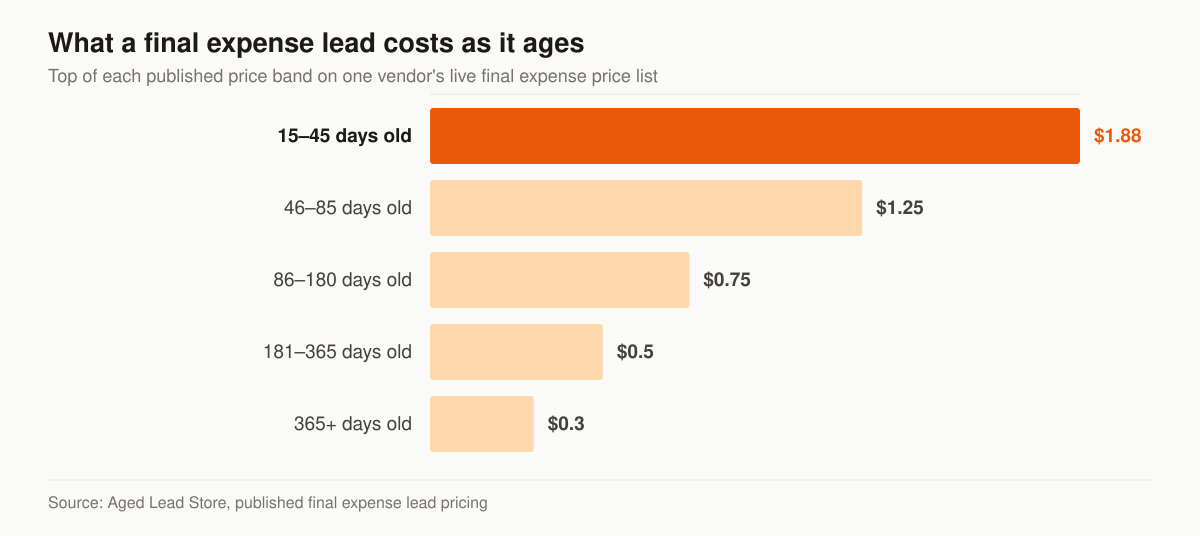
Chart: top of each published price band, from Aged Lead Store’s final expense price list.
This table sets four published aged final expense price lists beside each other, worded as each seller states them.
| Seller | Published price | What that price buys |
|---|---|---|
| Aged Lead Store, by age tier | $1.50–$1.88 at 15–45 days down to $0.15–$0.30 at 365+ days | Internet-generated records, filterable by state, ZIP, lead age and phone type |
| Aged Lead Store, headline range | “$0.15 to $1.88 per lead depending on lead age and volume” | The same inventory read end to end |
| Badass Insurance Leads | “between 0.75 to $2.00 per lead” | Aged final expense data; the page attributes the spread to order quantity, geography, the data fields and lead age |
| The DIG Agency | “between $1 to $15 a lead, depending on the age” | Aged leads sold inside a national agency to its own contracted agents |
| Niche Market Insurers | $5.50 per B lead, $3.00 per C lead, 25-lead minimum | Aged direct-mail responders, filtered by county only |
Two things fall out of reading those lists together. First, the word “aged” covers everything from $0.15 a record to $15 a record on the published prices above, so a quote means nothing until you know the age band, the origin and the filters attached to it. Second, only two of the four sellers publish a price that visibly moves with age: Aged Lead Store’s ladder falls tier by tier from $1.88 to $0.30, and Niche Market Insurers prices its newer B leads above its older C leads. Badass Insurance Leads publishes a single range and names lead age as one of four things that set it, alongside “the quantity you order, the geographic area, the data you receive”; The DIG Agency says only “depending on the age” without saying which way. So where a discount does track age, it puts the cheapest records on exactly the inventory where the consent and contact problems below start to bite — but on two of these lists you cannot read the age discount off the price at all, and have to ask. If you are still comparing vendors at this stage, our roundup of final expense lead generation companies sets out what to check before an order, and the truth about free final expense leads covers what you actually trade for lead inventory that costs nothing.
The ROI math that decides it
Stop comparing cost per lead. Cost per lead is the number vendors want you anchored to because aged leads always win on it. The number that pays your bills is cost per sale.
Here is the formula:
Cost per sale = Cost per lead ÷ (contact rate × close-of-contacted rate)
Run an illustrative example. Say a fresh exclusive lead costs $30, you reach 60% of them, and you close one in six of the people you reach. (We run our own final-expense and senior-market lead operation, so these are the levers we watch on live campaigns, not theory.) Now compare that to an aged lead at $3 where you only reach 25% and close 1 in 9 of those.
| Scenario | Cost/lead | Contact rate | Close-of-contacted | Cost per sale |
|---|---|---|---|---|
| Fresh exclusive | $30 | 60% | one in six (16.7%) | ~$300 |
| Aged, decent cadence | $3 | 25% | 1 in 9 (11%) | ~$109 |
| Aged, weak cadence | $3 | 12% | 1 in 12 (8%) | ~$313 |
The middle row is the whole argument for aged leads: a 10x lower price absorbs a worse contact and close rate and still lands at a lower cost per sale. The bottom row is the warning: the same cheap lead, dialed lazily, costs you more per sale than the fresh lead did. Aged leads don’t fail because they’re aged. They fail when nobody works them hard enough to overcome the contact decay.
Three inputs decide which row you live in:
- Contact rate — driven entirely by attempt count and timing. Aged leads need more dials across more days, not fewer.
- Close-of-contacted rate — driven by your script and whether you can reframe a prospect who’s already been pitched.
- List freshness within “aged” — a 60-day lead and a 9-month lead are not the same product. Buy the youngest aged band you can afford.
What the sellers themselves publish about contact and close rates
You do not have to guess at the rates in that formula for a first pass, because several sellers publish their own expectations. Read them as marketing claims about the seller’s own inventory rather than as independent measurement, and use them as the numbers you are trying to beat.
This table collects the performance figures three lead sellers publish. Every one is the seller’s claim about its own product.
| Published figure | Who publishes it | How we treat it |
|---|---|---|
| Contact rate 25–35% on 30–90 day aged leads, against 50–65% on fresh | Aged Lead Store’s aged-versus-fresh comparison | A benchmark to test against on your own dials, in your own states |
| Contact rate 15–25% on leads aged 90–365 days | Aged Lead Store | The number that decides whether the deep-aged tiers are worth the dialer hours |
| Close rate 1–3% on aged leads, 5–8% on fresh | Aged Lead Store | Measured against total leads, not against contacts — check which denominator a quote uses |
| “about 30% of the data to be bad” on leads 3 to 12 months old | Badass Insurance Leads | Take it off the top of the list size before you calculate anything |
| “3-4 appointments and 1 sale out of 100 aged FE leads” | Badass Insurance Leads | A working assumption for sizing an order |
| “five to seven touch points to sell an aged lead a policy” | Badass Insurance Leads | The floor for your cadence, not the ceiling |
| Up to a 20% replacement guarantee on bad data | Aged Lead Store | Get the replacement policy in writing before the first order |
Notice what the bad-data figure does to a purchase. If about 30% of the records are bad, as Badass Insurance Leads publishes for leads three to twelve months old, the list you paid for is not the list you can dial, and your real cost per usable record is higher than the sticker. That is the first adjustment to make before the cost-per-sale formula runs, and it is the reason a replacement guarantee is worth more than a small discount. Our framework on true cost per sale versus headline cost per lead walks the same adjustment through a full pipeline.
How to test a list before you commit a budget to it
A seller has an obvious interest in how much you buy first, so that is the one question worth answering for yourself. Here is the method we use when an agent asks us to sanity-check a purchase.
- Fix one variable at a time. One age band, one state, one cadence. A test that mixes a 45-day Texas batch with a 300-day Florida batch tells you nothing about either.
- Size the batch to your dialer, not your budget. If your cadence is seven attempts across three weeks and you can make 120 dials a day alone, a 2,000-record order is a list you will abandon at record 400. Aged Lead Store recommends starting with at least 500 leads, adding: “Smaller samples produce unreliable results due to variance.” Read that as a floor; your dialing capacity is the ceiling.
- Subtract the dead data before you count. Scrub, then count what is left. That is your real list size.
- Log dispositions from the first dial. Wrong number, disconnected, do-not-call, no answer, contacted, appointment, sold. Without dispositions you cannot tell a contact-rate problem from a script problem, and those have opposite fixes.
- Judge the batch on issued policies, not on how it felt. Early impressions run ahead of the evidence in both directions, and a single good call is not a result. Wait for the number.
Any of that is easier with a system holding the attempts than with a spreadsheet, which is why the CRM choice for insurance agents matters more on aged lists than on fresh ones — the cadence is the product here. Our breakdown of insurance lead follow-up cadence shows the attempt structure that moves contact rates, and how to sell final expense over the phone covers the reframe an already-pitched prospect needs.
When aged final expense leads are the right buy
Old final expense leads earn their place in a few specific situations:
- You have idle dialer capacity. A team or a power dialer sitting under-utilized can absorb a cheap aged list to fill the gap between fresh-lead drops.
- You’re building a cadence engine, not chasing instant sales. Aged leads reward systems. Plug them into a structured follow-up sequence and let volume do the work.
- You want to lower blended cost per acquisition. Mixing a base of cheap aged leads with a smaller spend on fresh leads can pull your overall cost per sale down — if your contact discipline holds.
And when to skip them: if you can only make two or three attempts per lead, if you don’t have a script tuned for already-pitched prospects, or if you’re a newer agent who needs the higher close rate of fresh leads to stay motivated and solvent.
If aged data is the play and you just want records to dial this week, that is a lead-purchasing transaction, not a marketing service — you can buy leads direct from getinsureleads, our sister brand built for exactly that. We don’t sell leads on this site; we build the systems that generate them, which is the fix for why your pipeline keeps needing aged data in the first place.
Don’t skip compliance because the lead is cheap
A discounted price does not discount your risk. TCPA applies to aged leads exactly as it does to fresh ones — the lead’s age does not refresh, transfer, or replace the consent the prospect originally gave. Older records also carry a higher chance that a phone number was reassigned to a new person or added to the Do Not Call registry since the form was filled out.
Before you dial a single aged record:
- Scrub the full list against the DNC registry and a reassigned-number database.
- Confirm the vendor can produce the original consent record (timestamp, source URL or form) for each lead.
- Keep those records. If a complaint lands, the paper trail is your defense.
We go deeper on the rules in TCPA compliance for insurance agents buying leads. The short version: aged leads are the highest-risk category for stale consent, so the scrubbing step is not optional.
The consent clock runs out before the lead does
This is the part of the file that is specific to aged inventory, and it is why a cheap old lead can be the expensive one.
Both the FTC and the FCC recognize an established business relationship as a way past a number sitting on the national registry. Both define it with a clock, and on the inquiry side that clock is short. The FTC’s Telemarketing Sales Rule defines an established business relationship as a relationship between a seller and a person based on two things. One is “The person’s purchase, rental, or lease of the seller’s goods or services or a financial transaction between the person and seller, within the 540 days immediately preceding the date of a telemarketing call”. The other is “The person’s inquiry or application regarding a good or service offered by the seller, within the 90 days immediately preceding the date of a telemarketing call” (16 CFR 310.2(q)). The FCC’s parallel definition, at 47 CFR 64.1200(f)(5), applies to telephone solicitations, requires “a voluntary two-way communication” with a residential subscriber, and runs on “the subscriber’s purchase or transaction with the entity within the eighteen (18) months immediately preceding the date of the telephone call or on the basis of the subscriber’s inquiry or application regarding products or services offered by the entity within the three months immediately preceding the date of the call”. It carries two conditions worth reading twice: the relationship must be one that “has not been previously terminated by either party”, and the rule states that a subscriber’s seller-specific do-not-call request “terminates an established business relationship for purposes of telemarketing and telephone solicitation even if the subscriber continues to do business with the seller”.
Read that against how aged leads are sold. The records these sellers describe are inquiries — people who requested information and did not buy — rather than purchases, so the longer window never reaches them. And the seller whose relationship the clock measures is the seller making the call, which is you, not the vendor who generated the form.
This table lines the consent clocks up against the age bands aged final expense lists are actually sold in.
| Clock | What the rule says | Where a 120-day-old inquiry lead lands |
|---|---|---|
| FTC established business relationship, from an inquiry | Within the 90 days immediately preceding the date of a telemarketing call | Outside the window |
| FTC established business relationship, from a purchase or financial transaction | Within the 540 days immediately preceding the call | Does not apply — the prospect never bought |
| FCC established business relationship, from an inquiry or application | Within “the three months immediately preceding the date of the call” | Outside the window |
| FCC established business relationship, from a purchase or transaction | Within “the eighteen (18) months immediately preceding the date of the telephone call” | Does not apply |
| Age of the registry version used to scrub | A version “obtained from the Commission no more than thirty-one (31) days prior to the date any call is made” | Re-pull it; the scrub you ran last quarter does not carry |
The 31-day figure comes from the safe-harbor conditions at 16 CFR 310.4(b)(3)(iv), and the FCC’s rule at 47 CFR 64.1200(c)(2)(i)(D) sets the same interval. An aged list sat in your CRM for two months is a list whose scrub has expired even if nothing about the list changed.
What is left, once the relationship clocks have run out, is a written agreement. Under the Telemarketing Sales Rule a seller calling a registered number has to demonstrate that it “has obtained the express agreement, in writing, of such person to place calls to that person”, and that the agreement “shall clearly evidence such person’s authorization that calls made by or on behalf of a specific party may be placed to that person, and shall include the telephone number to which the calls may be placed and the signature of that person” (16 CFR 310.4(b)(1)(iii)(B)(1)). Separately, for autodialed, artificial and prerecorded telemarketing calls, the FCC’s prior express written consent means “an agreement, in writing, bearing the signature of the person called that clearly authorizes the seller to deliver or cause to be delivered to the person called advertisements or telemarketing messages using an automatic telephone dialing system or an artificial or prerecorded voice, and the telephone number to which the signatory authorizes such advertisements or telemarketing messages to be delivered”. Whether an agreement captured on someone else’s form authorizes a call from you is a question about that specific form’s wording. Ask to see it before the order, not after a complaint.
We’re a marketing provider, not your compliance counsel. Agents are the licensed parties — confirm your scrubbing and consent flow with your own compliance review.
The number may not belong to your prospect any more
The other thing that ages on an aged lead is the phone number itself. Under the FCC’s rules, service providers must report permanent disconnections to the Reassigned Numbers Database administrator on the 15th of every month, and must age a disconnected number for at least 45 days after disconnection before reassigning it to someone new.
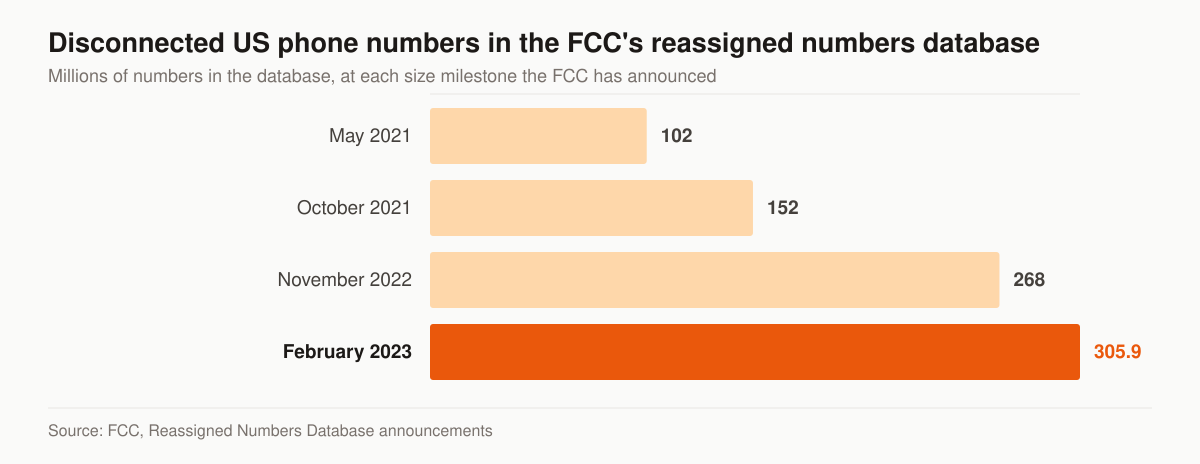
Chart: database size at each milestone announced by the FCC’s Reassigned Numbers Database page, which reported over 102 million numbers in May 2021 and over 305.9 million as of February 17, 2023.
That is a pool of numbers that have left the person who first gave them out. A query against the database takes the number plus “either the date the caller obtained consent from the consumer or the last date the caller was able to verify that the consumer was at that telephone number”, and returns yes, no, or no data. On an aged lead, the date you supply is the original inquiry date on the record — which is exactly why the field matters and why a vendor who cannot give you one is selling you a number with no provable history.
The safe harbor is narrow and it is yours to prove. It covers the prohibitions in paragraphs (a)(1) through (a)(3) of the rule — the autodialed, artificial-voice and prerecorded-voice calls — and it protects a caller who, “bearing the burden of proof and persuasion”, had previously obtained prior express consent, queried the database, received a response of “no”, and called only because that “no” was erroneous (47 CFR 64.1200(m)). Skipping the query does not get you the safe harbor; neither does a query you cannot evidence later.
The records you have to be able to produce
Buying a lead does not outsource the paperwork. The Telemarketing Sales Rule puts the retention duty on the seller and the telemarketer, and several of the required records concern facts only the original generator observed — which is the whole argument for buying from a vendor who documents its own sourcing.
This table lists the records the Telemarketing Sales Rule expects you to hold for a lead someone else generated.
| Record | What it has to contain | Citation |
|---|---|---|
| The inquiry behind an established business relationship claim under § 310.2(q)(2) | The person’s name and last known telephone number, the date that person submitted the inquiry or application, and the goods or services inquired about | 16 CFR 310.5(a)(5) |
| Consent | The name and telephone number of the person providing consent, a copy of the request for consent “in the same manner and format in which it was presented”, the purpose for which consent was requested and given, a copy of the consent, and the date it was given | 16 CFR 310.5(a)(8) |
| Registry version used | The name of the entity which accessed the registry, the date it was accessed, the subscription account number that was used, and the telemarketing campaign for which it was accessed | 16 CFR 310.5(a)(11) |
| Entity-specific do-not-call requests | The person’s name, the telephone numbers associated with the request, the seller the request covers, the telemarketer that called, the date of the request, and the goods or services being offered | 16 CFR 310.5(a)(10) |
| Retention period | “a period of 5 years from the date the record is produced unless specified otherwise” | 16 CFR 310.5(a) |
Turn that list into three questions for the vendor before the first order: can you give me the inquiry date and the form the prospect saw, will you replace records that fail on bad data, and what happens to my order if I need the consent artifact eighteen months from now. A seller who answers all three in writing is a different proposition from one who quotes a per-record price and nothing else.
What to fix if you keep buying aged lists
There is a pattern worth naming. We read a heavy aged-data habit as a cash-flow symptom rather than a sourcing choice: the aged list is a low-cost way to keep a calendar full this month, and it has to be bought again next month at the same price, because nothing in the arrangement produces a lead on its own.
The alternative is arithmetic you can do yourself. Our pricing is published — Foundation at $2,500 a month, Growth at $3,500, Full-Funnel at $5,500, with one-time builds from $2,500 to $8,000 — so a retainer that produces leads you own can be set against a per-record spend that resets every month and produces leads you rent. Where the crossover falls depends on your close rate and your premium, and we would rather you ran the numbers than took our word for it. The build-versus-buy question specifically is worked through on burial insurance lead generation, build versus buy, and what an owned pipeline involves is set out on our insurance lead generation page.
The bottom line
Aged final expense leads are a volume-and-cadence play, not a shortcut. The cheap price is real, but it only converts into a lower cost per sale if your contact discipline is strong enough to overcome the decay. Buy the youngest aged band you can, scrub it inside the 31-day window, dial it deep, and judge it on cost per sale — never cost per lead.
If you’d rather not anchor your whole pipeline to resold lists, a managed flow of fresher, intent-matched prospects usually beats chasing aged volume. See how we structure that on our final expense lead generation page, and read our framework on true cost per sale vs. headline cost per lead to pressure-test any vendor’s numbers.
Want us to run your current numbers against the cost-per-sale formula above? Grab a free marketing audit and we’ll show you where aged leads fit — and where they’d quietly cost you money.
- Exclusive vs Shared Final Expense Leads: A Cost-Per-Sale Breakdown
Exclusive vs shared final expense leads, compared on real cost-per-sale math, contact rates, and close rates so agents can pick what actually pays.
- Final Expense Lead Generation Companies for Agents: A Buyer's Map
A practitioner's breakdown of final expense lead generation companies: the vendor types, real cost-per-sale math, and when building your own wins.
- How to Get Final Expense Leads Without Cold Calling
How final expense agents get qualified leads without cold calling: inbound forms, paid social, live transfers, referrals, and SEO, with tradeoffs compared.
- How to Get Insurance Leads Without Cold Calling
How to get insurance leads without cold calling: inbound systems, paid channels, cost-per-lead math, and the follow-up cadence that makes them convert.