How to Get Final Expense Leads: Sources, Costs, and Contact Rates
To get final expense leads you have five sources: direct mail, Facebook lead forms, telemarketed transfers, aged data, and self-generated funnels. Each trades cost against exclusivity and contact rate. Direct mail runs $25–$40 per lead; Facebook leads run $9–$20 but need a five-minute callback. Judge every source on cost per issued policy.
Getting final expense leads comes down to matching one lead source to your follow-up speed and budget — not chasing the cheapest record. Leads come in five flavors, and this guide compares all five side by side: what each costs, how exclusive it really is, how many you’ll actually reach, and the 30-day plan that tells you whether the source you picked is paying.
If your goal is narrower, start where it fits: to build your own flow instead of buying, see the final expense lead generation system guide; to avoid cold-calling entirely, see final expense leads without cold calling.
For context, we run our own final-expense and senior-market lead operation, so the comparisons below come from live campaigns, not theory. Strong numbers are achievable, but only with the right source and a disciplined dialer.
The 5 ways to get final expense leads
Every final expense lead you can buy or build falls into one of these buckets. The differences that matter are cost per lead, whether the lead is exclusive or shared, and the contact rate — the share of leads you can actually reach by phone.
- Direct mail leads — A mailer goes to a senior, they fill out a reply card asking for final expense information. Highest intent, highest cost.
- Facebook lead forms — A paid ad with an in-platform form. Cheap and fast, but intent is softer and you must call quickly.
- Telemarketed / transfer leads — A call center pre-qualifies the prospect, sometimes warm-transferring them live to you.
- Aged leads — Data that was generated weeks or months ago and resold at a discount.
- Self-generated leads — Leads you produce through your own ads, landing pages, and funnels.
Two more sources exist that never appear on a vendor’s price list, because nobody sells them: referrals off your own book, and events you host or attend. They are covered further down, after the five priced sources, because they behave differently — you cannot buy volume on Monday and measure it on Friday.
What does each final expense lead source cost?
This table compares typical ranges across the five priced sources. Treat the numbers as planning anchors, not guarantees — your geography, carrier, and cadence move them.
| Lead Source | Typical Cost/Lead | Exclusivity | Contact Rate | Intent | Best For |
|---|---|---|---|---|---|
| Direct mail | $25–$40 | Exclusive | High (50–70%) | Strong | Agents with patience and a tight callback window |
| Facebook lead form | $9–$20 | Exclusive or shared | Medium (35–55%) | Soft | Fast dialers who call in minutes |
| Telemarketed / transfer | $20–$45 | Exclusive | High when live-transferred | Medium–strong | Telesales closers who want connected calls |
| Aged leads | $0.50–$5 | Shared (resold) | Low (under 10%) | Variable | High-volume dialers filling gaps cheaply |
| Self-generated | Varies (no markup) | Exclusive | Medium–high | Medium–high | Agencies building a durable, lower true cost per sale |
Price is one of the few things in this market you can check for yourself, because some publishers post a list. Insurance Leads Guide’s final expense pricing table, live as of 5 September 2026, gives social media leads at $12-25+, shared leads at $15-35, direct mail at $20-40, telemarketed at $25-60+, exclusive web leads at $30-80+, and live call transfers at $40-120+.
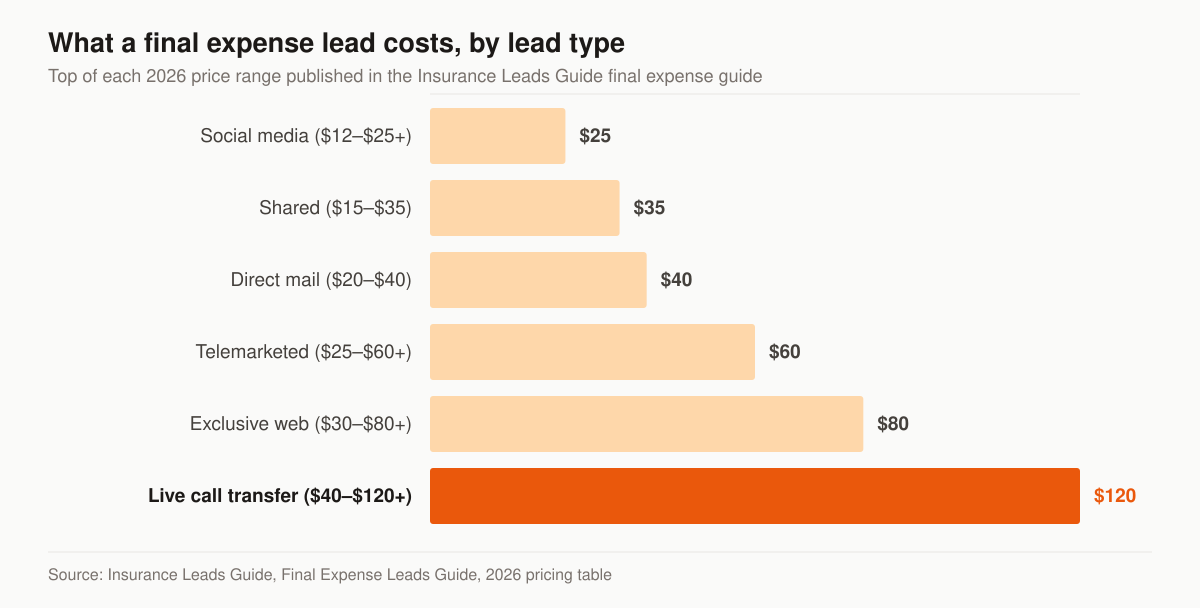
Chart: top of each published price band, from the Insurance Leads Guide final expense leads guide.
Notice how far the top of each band sits above the planning ranges in the table. A quoted “final expense lead” can mean a $12 social record or a $120 live transfer, and the word tells you nothing. Ask which of those six rows the vendor is actually selling before you compare anyone’s price to anyone else’s.
A few patterns repeat across thousands of records. Direct mail and live transfers convert best per contact but cost the most and arrive slowly. Facebook leads are cheap and immediate, but speed-to-lead decides everything — the contact rate listed above collapses if you wait an hour. Aged data is nearly free per record, yet you dial five to reach one; the full math on when that trade pays lives in our breakdown of aged final expense leads. For a deeper look at how upfront price hides the real number, read our analysis of what a final expense lead actually costs per sale.
Can you reach them? What phone a final expense prospect carries
Contact rate is treated as a property of the lead source. Part of it is a property of the phone number, and for this market the federal government measures that directly. The National Center for Health Statistics tracks household and personal telephone status in the National Health Interview Survey, and its July–December 2024 early release breaks the results out by age.
Among adults aged 65 and over, 57.9% were wireless-only adults, 16.7% were wireless-mostly, 11.7% were dual users, 8.0% were landline-mostly, 4.3% were landline-only, and 1.0% were phoneless. NCHS defines the first group precisely: “Wireless-only adults are adults who live in households with only wireless telephone service and have their own wireless telephone.”
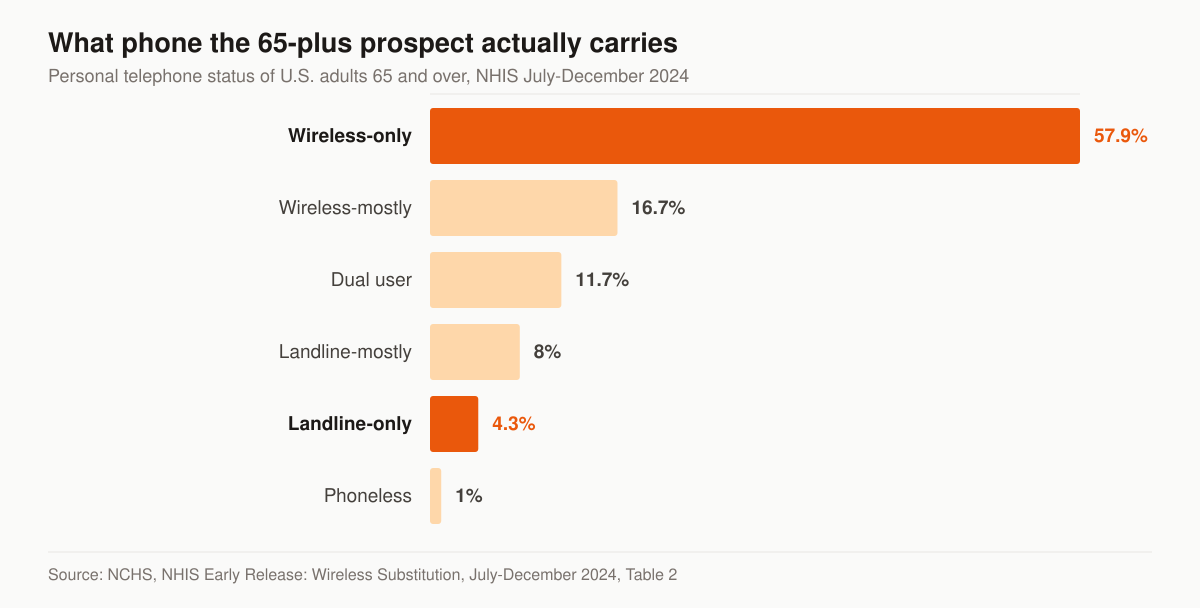
Chart: personal telephone status of adults 65 and over, from NCHS, Wireless Substitution: Early Release of Estimates from the National Health Interview Survey, July–December 2024, Table 2.
Three things follow from that distribution, and each one changes how you buy.
The number on a final expense lead is usually a cell number. That matters because the strictest part of the federal rule attaches to the technology you dial with, not to the product you sell. 47 CFR 64.1200(a)(1) provides that no person or entity may, “Except as provided in paragraph (a)(2) of this section, initiate any telephone call (other than a call made for emergency purposes or is made with the prior express consent of the called party) using an automatic telephone dialing system or an artificial or prerecorded voice” to, among other lines, “any telephone number assigned to a paging service, cellular telephone service, specialized mobile radio service, or other radio common carrier service, or any service for which the called party is charged for the call.” Read the opening clause before you relax, in both directions: the prohibition in that paragraph is scoped to autodialed, artificial-voice and prerecorded-voice calls and carries its own consent exception, and the cross-reference to paragraph (a)(2) points at a stricter standard for calls that include an advertisement or constitute telemarketing. A power dialer and a hand-dialed phone are not the same purchase decision.
A landline segment still exists, and it is the oldest part of the market. 4.3% of adults 65 and over were landline-only and another 8.0% were landline-mostly. A telesales desk configured to drop landline records is discarding part of the age band this product is written for. If your vendor offers a phone-type filter, decide deliberately rather than accepting a default.
Dual users mean the record can be right and still be the wrong number. 11.7% of this age group used both. A card filled in at the kitchen table and an in-platform form do not necessarily collect the same number. Same person, different answer rate, different cadence.
The reachability problem gets worse as a record ages, because the number can leave the person entirely — we cover the reassigned-number mechanics and the FCC database that tracks them in our guide to aged final expense leads.
What Meta’s special ad category does to a final expense Facebook lead
Facebook lead forms sit at the cheap end of the table, and for a new agent they are the usual first test. What the price row cannot show is that you are no longer allowed to aim them the way you would aim a mailing list.
Meta’s own Business Help Center guidance on choosing a Special Ad Category states: “Starting January 21, 2025, using this category is required for financial products and services campaigns for advertisers based in the United States or showing ads to audiences in the United States. Ads may be rejected if an appropriate category is not chosen.” Meta also notes that “The Credit Special Ad Category has been replaced by the financial products and services category.”
The designation is not a checkbox. It withdraws tools. In Meta’s words, for housing, employment and financial products and services ads: “Certain audience options are limited or unavailable for these ads for advertisers based in or reaching the US and advertisers reaching Canada and certain countries in Europe: age, gender, ZIP code or postal code, exclusion targeting, lookalike audiences and saved audiences. Some interests will also be unavailable when you create your audience. Audiences based on city or pin drop locations will include an expanded radius.”
Sit with that for a product written for an older buyer. Age is the selector you would reach for first, and it is gone. So is ZIP, so are lookalikes built from your existing buyers, so is excluding the audiences you already wrote. And a city or pin-drop target — the way a local agent normally fences a campaign to a drive time — comes back wider than you drew it.
The practical consequence for lead quality is direct. Qualification has to move out of the audience picker and into two places you still control:
- The creative. The ad itself has to say who it is for, in plain words, so the wrong age self-selects out before the form opens. An image and a headline are doing the filtering job that a targeting slider used to do.
- The form. Age band, state, and coverage intent become questions on the form rather than assumptions about the audience. Fewer submissions, better ones, and a cost per lead that rises while cost per issued policy falls.
That is also why a $9 Facebook lead and a $20 Facebook lead can come off the same platform on the same day: same auction, two different filter settings. We build these campaigns as part of insurance Facebook ads management, and the vertical-specific version lives on our final expense Facebook ads page; the platform-level mechanics are in Facebook ads for insurance agents.
Exclusive vs. shared: where the premium gets wasted
Exclusivity is a lever on close rate that is easy to misjudge. A shared lead is sold to three to five agents at once, so the prospect gets a half-dozen calls and the fastest dialer wins. An exclusive lead is yours alone, which is why it costs more.
The trap: agents buy exclusive leads, then call them like shared ones — slowly, sporadically — and waste the premium. If you cannot call within minutes, the exclusivity advantage evaporates. We cover the trade-off in detail in exclusive vs. shared final expense leads, but the rule is simple:
- Buy exclusive only if your follow-up is fast and structured.
- Buy shared only if you have a dialer running and accept that you’ll lose races.
- Never buy exclusive leads to sit in a spreadsheet.
Contact rate is decided by your cadence, not the source
The contact rates in the table assume competent follow-up. In practice, the source sets your ceiling and your cadence sets your floor. A batch written off after one or two dials was never actually tested, and the bulk of connected sales land on attempts two through six over a 10-day window.
This is the baseline cadence we run against a fresh final expense lead.
| Day | Action |
|---|---|
| 0 (within 5 min) | Call, then text if no answer |
| 0–1 | Second call, different time of day |
| 2 | Call + voicemail |
| 4 | Call |
| 7 | Call + text |
| 10 | Final call, then move to long-term nurture |
If you’re starting from cold or want to validate your sequence, our insurance lead follow-up cadence guide lays out the timing logic. The point: a $9 Facebook lead worked with a real cadence beats a $35 direct mail lead worked lazily.
The calling window your cadence has to fit inside
The cadence above has a line reading “different time of day,” and there is a legal edge to it. 47 CFR 64.1200(c)(1) states that no person or entity shall initiate any telephone solicitation to “Any residential telephone subscriber before the hour of 8 a.m. or after 9 p.m. (local time at the called party’s location).”
Two words in that provision do the work. Solicitation scopes it — the paragraph governs telephone solicitations to residential subscribers, which is what a lead call is. And local time at the called party’s location means the clock is the prospect’s, not yours. A desk in California working a Florida list is out of window at 6 p.m. its own time, because 9 p.m. Eastern has already passed, and cannot start until 5 a.m. its own time either. Buy leads two time zones away and you have bought a shorter working day, not just a list.
Because the clock keys off where the prospect is rather than where the number was issued, we set the dialer window from the address on the record and treat the area code as a label, not a location. Check your state’s own calling rules on top of the federal window before you commit to a list, and know which states a list actually covers before you buy it — our TCPA compliance guide for agents buying leads covers the state layer. We provide marketing services, not legal advice.
How many leads can one agent actually work?
Before you decide how many leads to buy, price the labor. The cadence above specifies six calls per lead across ten days. A lead exits the cadence once you reach someone, so six is the ceiling per lead rather than the average. Priced at that ceiling, a weekly buy of N leads commits you to as many as 6N calls a week.
This table converts a weekly lead budget into the dial volume it commits you to at that ceiling.
| Leads bought per week | Calls per week at the ceiling (6 per lead) | Of those, calls that must happen within minutes of arrival |
|---|---|---|
| 10 | 60 | 10 |
| 15 | 90 | 15 |
| 25 | 150 | 25 |
| 50 | 300 | 50 |
The 60 or 150 dials are the easy part; they can be batched. The right-hand column is the constraint, because those calls cannot be scheduled — they interrupt whatever you were doing, including an appointment with someone else. That is what makes a batch easy to under-work, and it is why the 30-day plan below tells you to add a follow-up day in week four instead of doubling your order. Doubling the order doubles the interruptions, not just the dial count.
It is also the arithmetic behind a result that surprises people: a $9 lead and a $35 lead can land at the same cost per issued policy, because the six calls cost the same either way. If the right-hand column exceeds what you will honestly do, buy fewer leads, or hand first-touch to a setter — that is the job our insurance appointment setting service does, and the telesales mechanics are in how to sell final expense over the phone.
Measure cost per issued policy, not cost per lead
This is the idea we treat as the dividing line between agents who survive and agents who quit. A cheap lead is not a good lead; a profitable lead is. Run the same four numbers on every batch, whatever the source:
- Cost per lead — what you paid the vendor.
- Contact rate — how many you actually reached.
- Close rate — apps written ÷ contacts.
- Cost per issued policy — total spend ÷ policies that issued and stuck.
A shared lead that issues 1 in 20 can cost more per policy than an exclusive lead at four times the price that issues 1 in 7. We unpack that trap in detail in final expense lead cost vs. the true cost per sale — it is the calculation that decides whether a source stays funded, and the reason “the leads are bad” is usually a measurement problem.
A 30-day plan to prove your first lead source
You do not need a complex system to find out whether a source works. You need one source, a phone, and a tracker. A realistic first month:
- Week 1: Pick one lead source. Buy 15–25 fresh leads. Dial every one within minutes of receipt.
- Week 2: Repeat the same source. Track contact rate and apps in a spreadsheet — nothing fancy.
- Week 3: Calculate cost per issued policy from weeks 1–2. Keep the source if it pays; switch if it does not.
- Week 4: Double down on what worked. Add a follow-up day for older leads instead of buying more.
The goal is not volume in month one. It is a proven, repeatable cost per issued policy you can scale with confidence. Buying 100 leads on day one commits you to 600 calls under the cadence above, which is how a batch ends up under-worked and the vendor ends up blamed.
If what you actually want is finished inventory — exclusive final expense leads or live transfers delivered as a product, priced per record — that is a lead-purchasing transaction, not a marketing service, so the clean move is to buy leads direct from getinsureleads, our sister brand built for exactly that. We don’t sell leads on this site; we build the systems that generate them.
Referrals: the source with no per-lead cost
Every issued policy creates two people worth calling. There is the client, who has just spent an hour thinking about a subject other people avoid, and there is the beneficiary, who now knows the payout exists and may have the same gap. No vendor sells access to either.
Referrals belong in a cost comparison for a blunt reason: their cost per lead is zero and their cost per issued policy is the labor of asking. That puts them under every row of the price table above on cost, and it puts the whole comparison on a different footing. What they do not have is a volume dial. You cannot buy twenty on Tuesday.
Three moments where the ask fits without changing your presentation:
- Policy delivery. The client is holding a document they understand and is at peak confidence in the decision.
- The annual check-in. A short call to confirm the beneficiary and the draft date, then the ask.
- The claim. Handled well, this is the moment a family sees the product work. Handled as an admin task, it produces nothing.
One compliance point people get backwards. A referral does not hand you a legal shortcut. The federal do-not-call rule does contain a relationship exception: under 64.1200(c)(2) a caller “will not be liable for violating this requirement” if, among other listed conditions, “The telemarketer making the call has a personal relationship with the recipient of the call.” Note the scope carefully. That exception is written against the national registry restriction in paragraph (c)(2), and it turns on the caller’s own personal relationship with the person being called — your client’s relationship with their neighbor is not yours. Treat a referred name like any other name: consent, window, records. Again, we provide marketing services, not legal advice.
The measurement mistake is subtler. Because referrals feel free, they usually go untracked, so nobody can compare them against the paid batches. Put them in the same tracker with the same four numbers. Retention work feeds this source directly, which is why we treat insurance client retention as lead generation rather than service, and why the review engine in how to get more Google reviews compounds it.
Seminars, community events and funeral-home partnerships
The other unpriced source is a room. Senior centers, church groups, library community rooms, a table at a county event, a standing relationship with a funeral home that fields pre-need questions all day. The cost is a venue, refreshments and your Saturday, not a per-record fee, so it never appears in a lead price comparison — and the lead it produces is exclusive by construction, with a contact rate set by a sign-in sheet rather than a dialer.
The constraint is the calendar. Events do not scale the way a media buy does, and a bad month has no fix. Treat them as a base layer under paid flow, not a replacement for it.
The compliance question agents ask here is whether the Medicare event rules apply. They are worth reading precisely rather than assuming. The CMS marketing definitions agents know sit in 42 CFR part 422, subpart V, headed “Medicare Advantage Communication Requirements,” and § 422.2260 opens by stating: “The definitions in this section apply for this subpart unless the context indicates otherwise.” The same section defines a third-party marketing organization as “organizations and individuals, including independent agents and brokers, who are compensated to perform lead generation, marketing, sales, and enrollment related functions as a part of the chain of enrollment (the steps taken by a beneficiary from becoming aware of an MA plan or plans to making an enrollment decision).”
Read the boundary that language draws. The chain those rules describe runs to an MA plan, and a final expense life policy is not one. The parallel Part D rules sit in a different part again — 42 CFR part 423, “Voluntary Medicare Prescription Drug Benefit”, whose subpart V is headed “Part D Communication Requirements” — and a final-expense-only event sits outside both. The moment the same event, the same table, or the same follow-up call turns to Medicare Advantage or Part D, you are inside it, and the Scope of Appointment machinery comes with you. Our guides to CMS Medicare marketing rules for agents and Scope of Appointment and TPMO compliance cover what that means in a room.
What does still apply to a final expense event is your state’s insurance advertising and anti-rebating law, and that is the part to settle before a funeral home, a florist or a senior center is compensated for anything. Our overview of insurance marketing compliance for agents sets out the categories; your compliance counsel and your state department of insurance settle the specifics.
Compliance: treat it as a trust signal
Before you dial anything, your consent trail matters. The TCPA governs how you contact leads, and proper prior express consent is required before using automated dialing technology, especially to wireless numbers. The FCC’s one-to-one consent rule was vacated in January 2025, but the underlying consent obligations did not disappear — keep the consent language and source for every lead. On the ad side, Meta’s Special Ad Category limits how you can target by age and geography for insurance, which shapes what your Facebook funnels can do.
The useful way to run this is as a purchasing standard, not a legal seminar. A vendor either produces the paperwork or does not, and the federal rule tells you exactly which paperwork to name.
This table lists the four artifacts to request in writing, and the provision that points at each one.
| Ask the vendor for | The rule it maps to |
|---|---|
| The signed agreement itself, naming your agency as the party the consumer agreed to hear from | The prior express permission in 64.1200(c)(2)(ii) “must be evidenced by a signed, written agreement between the consumer and seller which states that the consumer agrees to be contacted by this seller” |
| The specific phone number written into that agreement | The same provision requires the agreement to include “the telephone number to which the calls may be placed” |
| The date and version of the do-not-call scrub, plus the written procedures behind it | The safe harbor in 64.1200(c)(2)(i) is available to a caller who “can demonstrate that the violation is the result of error” and whose routine practice includes written procedures, trained personnel, and “a version of the national do-not-call registry obtained from the administrator of the registry no more than 31 days prior to the date any call is made” |
| The revocation path, and who honors it | Under 64.1200(a)(10) revocation requests “must be honored within a reasonable time not to exceed ten business days from receipt of such request”, and callers covered by paragraphs (a)(1) through (3) and (c)(2) “may not designate an exclusive means to request revocation of consent” |
Two details in that last row are worth knowing, because they decide whether your CRM is configured correctly. The rule names words that revoke consent per se when sent in reply to a text — “stop,” “quit,” “end,” “revoke,” “opt out,” “cancel,” or “unsubscribe” — and it requires a caller to treat a different reply as a valid revocation request “if a reasonable person would understand those words to have conveyed a request to revoke consent.” A keyword-only opt-out list is not the same as compliance with that sentence.
We provide marketing services, not licensed insurance or legal advice — you’re the licensed party. For the practitioner’s view, see our primer on TCPA compliance for agents buying leads.
Which final expense lead source should you start with?
There’s no single “best final expense leads” answer — there’s a best fit for your situation:
- New agent, limited budget: Start with a small Facebook lead test and one cadence you actually follow. Cheap to learn on.
- Telesales closer: Live transfers or direct mail give you connected, higher-intent conversations.
- Scaling agency: Build self-generated funnels so you stop paying a per-lead markup forever and lower your true cost per sale.
Picking the source is half the job; picking who to buy it from is the other half. Our map of final expense lead generation companies sorts vendors into four categories and gives you the due-diligence questions to ask before you wire money. Carrier fit belongs in the same decision, because a source that produces impaired-health prospects is only worth what your final expense carrier lineup can actually issue.
Buy first, generate later. Buying leads funds today; generating your own builds an asset you keep. But owned lead flow takes a budget, a landing page, compliant consent capture, and time to tune ads — which is why buying while you learn the pitch, then building once the close rate is proven, is the order we recommend. The four owned layers and the 90-day build order are mapped in our guide to building a final expense lead generation system, and the funnel mechanics are in our final expense sales funnel breakdown.
Next step
If you’re tired of renting leads at someone else’s margin, the durable move is a self-generated system tuned to your carriers and geography. See how we build owned pipelines that produce exclusive final expense leads for the agents we run campaigns for, or get a no-pitch read on your current numbers with a free marketing audit — we’ll show you the math on your current cost per sale versus what an owned funnel would run. Our pricing is published, so you can compare a managed program against a monthly lead spend before you talk to anyone. For adjacent decisions, see the burial insurance build-vs-buy analysis, the insurance agency marketing budget, and the full marketing for final expense agents playbook that puts lead-buying inside a complete operation.
- Exclusive vs Shared Final Expense Leads: A Cost-Per-Sale Breakdown
Exclusive vs shared final expense leads, compared on real cost-per-sale math, contact rates, and close rates so agents can pick what actually pays.
- How to Get Final Expense Leads Without Cold Calling
How final expense agents get qualified leads without cold calling: inbound forms, paid social, live transfers, referrals, and SEO, with tradeoffs compared.
- Aged Final Expense Leads: What They Are and When the Math Works
Aged final expense leads cost a fraction of fresh leads. Here's what they are, the ROI math that decides if they work, and when to skip them.
- How to Get Insurance Leads Without Cold Calling
How to get insurance leads without cold calling: inbound systems, paid channels, cost-per-lead math, and the follow-up cadence that makes them convert.