Marketing for Final Expense Agents: A Working Playbook
Marketing for final expense agents comes down to five moves: get exclusive or live-transfer leads instead of shared lists, contact them within minutes, run compliant Facebook and Google campaigns, follow up on a fixed cadence, and measure everything by cost per issued policy. Owning the assets — site, pixel, CRM — is what lowers your acquisition cost over time.
Most final-expense agents don’t have a marketing problem — they have an economics problem dressed up as a marketing problem. They buy shared leads raced by ten other agents, call them hours late, follow up twice, and judge it all by cost per lead instead of cost per sale. Here’s the playbook we actually run, move by move, with the mechanism behind each one.
Start with the buyer, not the lead vendor
Every move below is easier to judge once you know who is on the other end of it. The National Funeral Directors Association has tracked evolving consumer attitudes toward funeral service since 2012; its 2025 Consumer Awareness & Preferences Study was conducted in the spring of 2025 among 1,126 Americans age 40 and older. Three of its findings should change how a final expense agent writes an ad.
The first is where this buyer already transacts. NFDA reports that 40 percent of consumers have used the services of a funeral home they found on Facebook, which the association describes as “nearly doubling from 21% in 2023.” That is a funeral-home finding rather than an insurance one, but it is the same household, at the same moment, on the same platform your lead form sits on. The senior market being “not online” stopped being a safe planning assumption some time ago.
The second is what the buyer wants the transaction to feel like. NFDA reports that 44.4 percent would feel not very confident or not at all confident planning a funeral without a funeral director’s help, up 7.1 percent since 2024, and that 31.8 percent prefer a hybrid approach combining online planning with direct funeral director consultation. Read that across to your own funnel: the winning offer is a human conversation that starts online, not a self-serve quote engine that ends there. An ad promising “a licensed agent will call you today and walk you through it” is selling what the research says the buyer is short of.
The third is money. NFDA notes that 55.4 percent of its 2025 respondents earned less than $50,000 annually, against 38.5 percent of the 2024 sample. That is a change in who answered the survey rather than a measured drop in household income, but it tells you what a study of this market now sounds like, and it lines up with an offer that leads with a monthly figure rather than a face amount.
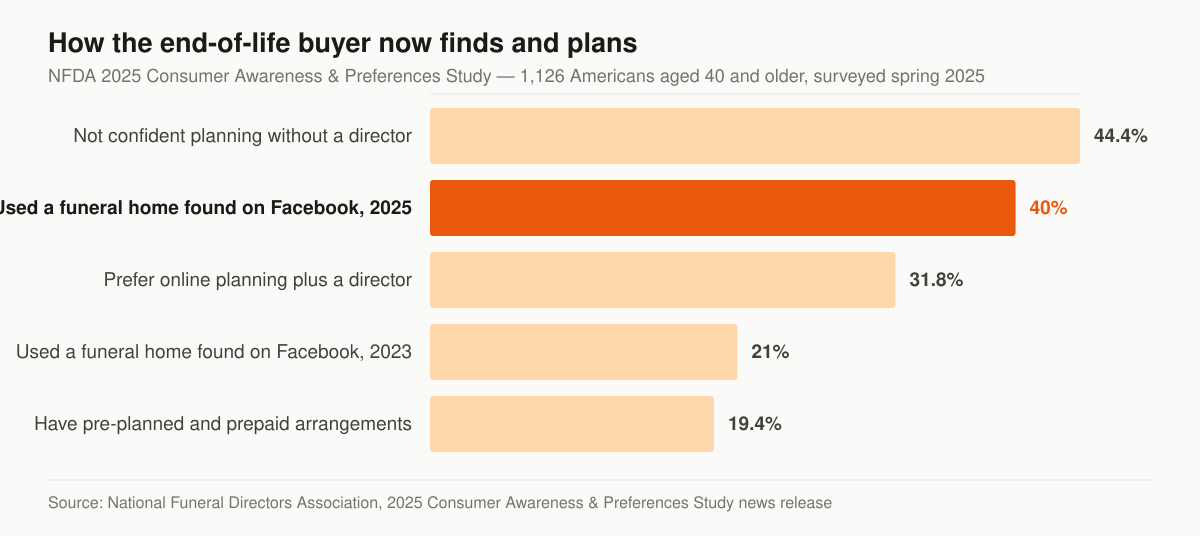
Source: National Funeral Directors Association, 2025 Consumer Awareness & Preferences Study news release. Survey of 1,126 Americans aged 40 and older, spring 2025.
One more number from the same study is worth keeping in your objection file: NFDA puts the share who have pre-planned and prepaid for arrangements at 19.4 percent. So when a prospect tells you they are “already taken care of,” the useful next question is which thing they mean — a prepaid contract with a funeral home, a policy someone else is paying for, or a general intention. Those three answers lead to three different conversations, and only one of them ends the call.
1. Stop renting shared leads
Shared lists are the default because they’re cheap per lead. But cheap per lead and cheap per policy are different numbers. The mechanism is simple: a shared lead is sold to three-to-eight agents at once, so the prospect fields a half-dozen calls in the first hour and the fastest dialer — not the best agent — wins the conversation. You paid for a name you’re statistically unlikely to reach first.
Exclusive and live-transfer leads invert that. You are the only agent calling, so contact and close rates climb enough to offset the higher price. Example: two agents each spend the same weekly budget. The one buying shared leads dials more names but connects with a fraction of them because someone beat him to the phone; the one buying fewer exclusive leads connects with most of his and writes more apps from a smaller pile. Same spend, different outcome — because the lever is contact rate, not lead count. If you only change one thing, change this. The full trade-off is in exclusive vs. shared final expense leads.
2. Win on speed-to-lead
Speed-to-lead is the lever we pull first in a final expense operation, because it changes contact rates without changing spend. The study people cite for it is the 2007 InsideSales.com/MIT Lead Response Management Study, run by Dr. James Oldroyd across three years of data from six companies, “over fifteen thousand leads and over one hundred thousand call attempts.” Two of its findings are the ones worth memorising: “The odds of contacting a lead in 5 minutes versus 30 minutes drop by 100 times” and “The odds of qualifying a lead in 5 minutes versus 30 minutes drop 21 times.” The study also reports that the odds of calling to contact a lead “decrease by over 10 times in the first hour.” (Lead Response Management Study, Oldroyd and InsideSales.com, 2007)
Read those numbers with their limits attached, because they are usually quoted without them. The study covers web-generated leads at six unnamed companies in 2007, not final expense in 2026. Its authors define a contact as a connected call lasting a company-specific minimum, and they state plainly: “This study did not address close ratios.” So the honest claim is about reaching people, not about closing them. That is still the claim that matters here — a lead you never reach cannot be closed at any skill level, and intent decays fast on Facebook form leads, where the prospect may have forgotten they opted in by the time the sun sets.
The mechanism is attention: you’re calling while your offer is still the freshest thing in the prospect’s mind. Example: a lead that fills out a form at 9:12 a.m. and gets a call at 9:14 a.m. answers as “the burial-coverage people I just asked about.” The same lead called at 4 p.m. answers as “an unknown number interrupting dinner prep.” Build your operation so new leads fire straight into a dialer or a live-transfer queue the instant they arrive — never a batch you work at the end of the day.
3. Run compliant paid acquisition
Final-expense Facebook ads run under Meta’s Special Ad Category, which limits or removes age, ZIP and detailed-interest targeting — so the creative and the offer have to do the qualifying those settings used to do. The mechanism: a hook like “worried about leaving funeral costs to your kids?” self-selects the right senior far better than a demographic checkbox ever did. Pair paid social with Google Search to catch the high-intent prospect already typing “burial insurance near me.” Our step-by-step is in how to run Facebook ads for insurance agents, and because creative fatigue is the real constraint once targeting is gone, keep a bank of angles ready — the 40 content ideas for final expense agents list doubles as a hook file for ads and organic posts alike.
That category assignment is no longer a judgment call. Meta’s business help center states that “Starting January 21, 2025, using this category is required for financial products and services campaigns for advertisers based in the United States or showing ads to audiences in the United States,” and warns that “Ads may be rejected if an appropriate category is not chosen.” Meta’s companion page listing what counts spells out the in-scope US products, and “Insurance products” is one of the bullets. A final expense campaign run from a US ad account is inside the category whether or not you tick the box; ticking it is how you avoid the rejection.
Meta publishes the exact audience tools the category takes away, and each one maps to a habit final expense advertisers built before 2025 — the right-hand column is what has to carry that work now.
| What the category limits | Meta’s wording | What now does the qualifying |
|---|---|---|
| Age | “age” is limited or unavailable | Creative that names the situation: fixed income, grown children, a funeral already paid for once |
| ZIP or postal code | “ZIP code or postal code” limited; city or pin-drop audiences “will include an expanded radius” | Locale in the copy and the landing page, plus organic pages that rank where you write |
| Interests | “Some interests will also be unavailable” | Offer and hook, tested against each other rather than against a targeting stack |
| Lookalikes and saved audiences | “lookalike audiences and saved audiences” limited or unavailable | Broad delivery with a clean conversion signal from your own pixel |
| Exclusions | “exclusion targeting” limited or unavailable | Suppression handled downstream in your CRM and dialer, not in the ad set |
Source: Meta Business Help Center, How to choose a Special Ad Category and About ads for financial products and services.
The practical consequence is that a final expense ad account now competes on offer and creative rather than on audience craft. That is a fairer fight for a small agency than it sounds — you cannot out-target a national carrier, but you can out-write one, because you actually talk to these buyers every day.
Bake consent capture into every form. TCPA exposure is real even after the FCC’s one-to-one consent rule was vacated in early 2025 — the underlying consent obligation didn’t disappear. We provide marketing services, not legal advice; keep the consent language and source for every lead, and confirm your process with counsel.
4. Send direct mail as a standalone channel
Direct mail is the oldest final-expense lead source and still the highest-intent one, so it deserves its own play rather than a footnote. The mechanism is physical commitment: a senior receives a simple reply card — often designed to look like a benefit notice about final-expense or state-regulated burial coverage — fills in their name and date of birth by hand, and mails it back. That physical act filters out idle curiosity; the people who return a card are self-identified buyers.
The trade-offs are real. Mail is slow (cards trickle back over one to three weeks), it ties up cash before the first response lands, and volume is lumpy. But contact and close rates run high because intent is strong and the lead is exclusive to you. Example: an agent drops a mailer to a tight rural county where he already has clients; returned cards convert well because the brand feels local and the audience skews older and phone-answering. Direct mail rewards patience and a disciplined callback window — work returned cards like they’re perishable, because a card that sits a week goes cold like any other lead.
5. Follow up like it’s the job
Final expense policies get written after several touches, not on the first dial. The mechanism is persistence against a household that screens unknown numbers: the connect often lands on a later attempt, and that is exactly where an agent working from memory rather than a cadence has already given up. A fixed cadence in a CRM removes the decision fatigue that makes agents abandon leads early — the software decides who gets dialed next, so nobody has to feel like re-dialing.
We plan the first week of a final expense lead’s life on this cadence and adjust it against the agent’s own connect data, not the other way round.
| Touch | Timing | Channel |
|---|---|---|
| 1 | Within 5 minutes | Call |
| 2 | Same day | Call + text |
| 3–6 | Days 1–7 | Call / text / voicemail |
| 7+ | Weekly | Call + email |
The exact timing logic — and why attempts three through eight matter most — is broken down in our insurance lead follow-up cadence guide.
6. Build a telesales dialer cadence
If you sell final expense over the phone rather than at the kitchen table, your dialer is your marketing engine, and it needs its own operating rhythm. The mechanism is throughput plus discipline: telesales lives or dies on how many quality conversations you can start per hour and how consistently you work the callback pile.
A working telesales day looks like this:
- Front-load fresh leads. Dial brand-new leads first, within minutes, while intent is hottest — before touching yesterday’s callbacks.
- Block your power hours. The Lead Response Management Study cited above found 4 to 6pm the best block for making contact, “114% better than calling at 11 to 12am,” and named “8-9am and 4-5pm” the best times to call to qualify a lead, with 8-9am “164% better than calling at 1-2pm.” Those are 2007 figures from six unnamed companies, so treat them as a hypothesis to test on your own dial log rather than a rule — then protect whichever windows win and push admin work to the dead hours.
- Use a dialer, not a spreadsheet. A CRM-connected dialer that logs every attempt and auto-schedules the next touch is what keeps the cadence in section 5 from collapsing under volume. Live transfers slot in here too — someone else dials and screens, and you start on a warm, connected call.
- Separate “no answer” from “not interested.” A no-answer goes back into the cadence; only a real objection or a firm no comes out of it. Conflating the two is how agents throw away half their paid leads.
For the on-call mechanics once someone picks up, see how to sell final expense over the phone.
The dialer rules that decide whether the spend is legal
A telesales operation is a marketing channel with a regulator attached. The FTC’s Telemarketing Sales Rule, 16 CFR part 310, governs how outbound calls are placed, and its abusive-practices section carries clocks and counters your dialer software either enforces or quietly breaks. These are the settings we check before we look at anything else in a call operation, because a campaign that violates them is not an underperforming campaign, it is a liability.
Start with the hours, because it is the rule agents most often assume they know. Section 310.4(c) reads: “Without the prior consent of a person, it is an abusive telemarketing act or practice and a violation of this part for a telemarketer to engage in outbound telephone calls to a person’s residence at any time other than between 8:00 a.m. and 9:00 p.m. local time at the called person’s location.” Two details in that sentence do work. The window is measured where the prospect is, not where your dialer is, which matters the moment you buy leads outside your own time zone. And it opens with a consent carve-out, so a prospect who has agreed to a later call is a different case from a cold dial at 9:30 p.m.
Six provisions of the Telemarketing Sales Rule translate directly into dialer settings and list hygiene — every quoted span below is the rule’s own wording; the one unquoted row paraphrases it.
| Setting | Citation | What the rule says |
|---|---|---|
| Calling window | 310.4(c) | Outbound calls to a residence only “between 8:00 a.m. and 9:00 p.m. local time at the called person’s location,” absent prior consent |
| Abandonment definition | 310.4(b)(1)(iv) | A call is abandoned “if a person answers it and the telemarketer does not connect the call to a sales representative within two (2) seconds of the person’s completed greeting” |
| Abandonment ceiling | 310.4(b)(4)(i) | Safe harbor requires technology ensuring abandonment of “no more than three (3) percent of all calls answered by a person,” measured per campaign under 30 days or per successive 30-day period |
| Ring time | 310.4(b)(4)(ii) | Let the phone ring “for at least fifteen (15) seconds or four (4) rings before disconnecting an unanswered call” |
| Registry freshness | 310.4(b)(3)(iv) | Use a registry version “obtained from the Commission no more than thirty-one (31) days prior to the date any call is made,” and keep records documenting the process |
| Caller ID | 310.4(a)(8) | Transmit the telephone number and, when the carrier makes it available, the telemarketer’s name, to any caller identification service in use |
Source: eCFR, 16 CFR 310.4, Abusive telemarketing acts or practices, current as of the eCFR’s 9/02/2026 update.
Three scope points that get dropped when this rule is repeated secondhand. First, the do-not-call registry provision at 310.4(b)(1)(iii)(B) has an established-business-relationship route out, but it is conjunctive: the seller must demonstrate the relationship and that the person “has not stated that he or she does not wish to receive outbound telephone calls” under the entity-specific provision. A prior sale does not survive a later opt-out. Second, the entity-specific list under 310.4(b)(1)(iii)(A) is separate from the federal registry and binds on the seller’s own behalf, so a prospect who tells your setter to stop calling has to stop receiving calls from every campaign you run, not just that one. Third, complying with the TSR does not settle your TCPA position: the rule’s own footnote states that “This provision does not affect any seller’s or telemarketer’s obligation to comply with relevant state and federal laws, including but not limited to the TCPA, 47 U.S.C. 227, and 47 CFR part 64.1200.”
We sell marketing, not legal advice. The point of the table is that these are configuration values — a dialer’s abandon rate, its ring timer, its scrub schedule, its caller ID string — and configuration is something an operator can be asked to show you. If a vendor selling you live transfers cannot say when their registry copy was pulled, you have learned something about the leads before you have bought any. The wider compliance picture for an agency is in our guide to insurance marketing compliance for agents.
7. Measure cost per issued policy
Cost per lead is a vanity number. Track the whole chain: cost per lead → contact rate → close rate → cost per issued policy. That is the figure we scale against, because it is the first one in the chain that contains both what you paid and what you got. A cheaper lead that never issues is the expensive one; the math is walked through in final expense leads: cost vs. true cost per sale.
Illustrative example (not agency results): suppose you commit a fixed weekly lead budget and split it across two sources. If one source produces more issued policies from fewer, higher-intent leads, cost per issued policy tells you to shift budget toward it — even if its cost per lead looks higher on the invoice. Use the illustration to see the logic, then run your own numbers.
Channels that do not bill you per lead
Everything above assumes a lead you paid for. Three sources of business do not carry a per-lead invoice, and agents who write consistently tend to have at least one of them running underneath the paid volume. They are slower to start and they cost calendar time instead of cash, which is exactly why they get skipped in a month when the dialer is busy.
Community education is the oldest of them. Ritter Insurance Marketing’s published playbook for selling final expense lists it plainly: “Hold life insurance seminars or Q&A sessions at local churches and community events,” presented, in Ritter’s words, as “free public education by an expert in the industry,” alongside a second suggestion to “Build your profile in the community by contributing to and volunteering at local community events and causes.” The mechanism is not the room, it is the framing. You arrive as the person explaining how funeral costs work rather than the person selling a policy, and the appointment request comes afterwards from someone who already decided you are credible. The catch is throughput: a Saturday session that fills a room is still one Saturday, and it will not carry an agency that needs volume this quarter.
Your existing book is the second. Every issued policy comes with a household, and that household has a spouse, adult children, and often a parent — the same conversation, one degree away. The referral ask works best attached to a moment the client already feels good about: the policy delivery, the first anniversary, a beneficiary update. Set that as a step in the CRM rather than an intention, for exactly the reason the follow-up cadence exists.
Reviews are the third, and they compound. A prospect who was referred still checks you, and so does the person who clicked your ad and wants to know whether you are real. The mechanics of asking without breaking platform rules are in how to get more Google reviews for insurance agents. This is also where the NFDA numbers above matter a second time: an audience that has begun finding end-of-life services through Facebook and online arrangement tools is an audience that reads the profile attached to your name.
None of the three replaces bought leads. They change what bought leads cost you, because an agent with a warm referral stream and a visible reputation converts the same paid lead at a better rate than an unknown number does. If you want the version of this argument that runs at agency scale rather than solo-producer scale, it is in how to grow a final expense insurance agency.
Underwriting knowledge is a marketing asset
Most marketing guides for this niche stop at the lead. That is a mistake, because in final expense the underwriting rules decide which message can honestly be run at which prospect, and an agent who knows them writes ads that do not waste clicks on people no carrier will take.
The category is defined by its underwriting. Ritter’s guide states that “All final expense policies offer simplified underwriting” and that “Simplified underwriting refers to underwriting that requires no medical or physical exams.” That single fact is the strongest thing your creative can say, because it answers the objection the prospect has not voiced yet: that they will be examined, and rejected, and embarrassed.
From there the market splits into three offers, and each one wants its own hook:
- Level benefit. For the prospect with no disqualifying condition. The hook is price and immediacy — full death benefit from day one. Carrier selection matters here more than copy; the spread between carriers on the same medical answer is where a good agent earns their commission. See best final expense carriers for agents.
- Graded or modified. For conditions that make a carrier hesitate rather than decline. Ritter’s list of examples includes diabetes, chronic obstructive pulmonary disease without oxygen use, alcohol or drug use, and regular narcotic pain medication. The hook is honesty: coverage is available, and the first years are reduced. Selling this as though it were level benefit is how chargebacks are made.
- Guaranteed issue. For the conditions Ritter lists as typically disqualifying for a traditional final expense policy: a heart attack or stroke within the last 12 months, cancer within the last two years, AIDS/HIV, ALS, congestive heart failure, oxygen use, residing in a nursing home, or being unable to perform all activities of daily living. Marketing this line has its own rules, which we cover in how to market guaranteed issue final expense.
Ritter also publishes a figure worth carrying into your offer design, with the caveat that the company puts no sample or method behind it: “The average premium on a final expense policy is usually less than $50 per month.” Treat it as a vendor’s rule of thumb rather than a benchmark. What it does justify is a structural choice — quoting monthly rather than annually, and quoting three options rather than one. Ritter’s own suggestion is to offer three coverage-and-payment combinations, for instance death benefit amounts Ritter writes as $7K, $10K and $12K with their corresponding monthly payments, so the prospect chooses between amounts instead of choosing between buying and not buying.
Own the search result, not just the ad account
An ad account is a rented audience. It stops the day you stop paying, and since January 2025 the Special Ad Category has limited the age and ZIP targeting available inside it. An owned page does not have that problem: it holds the location, the product, and the specificity your ad set can no longer select for, and it keeps working on a month when the card is declined.
The moment to be visible is when someone is researching rather than being interrupted. NFDA’s 2025 study says nearly 30 percent of families now complete all funeral arrangements online — again a funeral-home finding, not an insurance one, but a signal about who is doing this research on a screen. The queries that follow that research are the ones you want a page for: what burial insurance costs, whether a policy pays for cremation, whether coverage is available after a diagnosis.
Three assets do that work, in this order:
- A site that answers the specific question. Not a brochure. The final expense agent website examples breakdown shows which page structures actually convert this traffic.
- Search visibility for the terms your prospects type. The mechanics are in SEO for insurance agents, and the managed version is our insurance SEO service.
- Presence in AI answers. More of these questions are now answered inside a chat interface than a results page, and the citation goes to pages structured for extraction. That is a different discipline, covered in how to get your insurance agency recommended by ChatGPT.
The compounding argument is the same one that governs lead buying. Bought leads cost the same next year. A page that ranks costs less every month it stays there, which is why the agents with the lowest acquisition costs are usually the ones who started this three years ago.
What a done-for-you program costs
If you would rather run the book than run the marketing, here is what handing it over costs, published rather than quoted on a call.
Our retainers are productized, month to month, and ad spend is billed separately, straight to the platforms — so the number below is the management cost, not a bundled media buy.
| Tier | Monthly | What it covers | Fits the agent who |
|---|---|---|---|
| Foundation | $2,500 | Optimized website and landing pages, local SEO and Google Business Profile, on-page SEO, monthly reporting | Has no real web presence and is buying every lead |
| Growth | $3,500 | Everything in Foundation, plus an ongoing SEO and content engine, AI-search visibility, reputation and reviews | Has a decent site that nobody finds in Google or AI search |
| Full-Funnel | $5,500 | Everything in Growth, plus managed Google and Meta ads, landing-page CRO, marketing automation and CRM, full-funnel reporting | Has visibility handled and is ready to buy volume |
A one-time website build runs $2,500 to $8,000 depending on scope. The full breakdown, including how the tiers compare line by line, is on our pricing page.
Which lead source fits your operation?
No source wins on every axis. Pick by the intent you want, the effort you can sustain, and how fast you need to be dialing. The table below is qualitative on purpose — costs swing too much by geography, carrier, and cadence to quote reliably.
Read the columns as constraints rather than scores: the source that fits is the one whose weakest column you can actually live with.
| Lead source | Buyer intent | Contact speed | Effort to run | Best fit |
|---|---|---|---|---|
| Direct mail (reply cards) | Highest | Slowest (1–3 weeks) | Medium | Patient agents with a callback discipline |
| Live transfers | High | Instant | Lowest (someone else dials) | Closers who want warm, connected calls |
| Exclusive Facebook leads | Medium | Fast | Medium–high (ad management) | Fast dialers who call in minutes |
| Shared internet leads | Lowest | Fast | Low | High-volume dialers racing for contact |
Read the table as a fit decision, not a ranking: a patient direct-mail agent and a high-volume shared-lead dialer can both profit — they’ve just built different operations around different lead economics.
This is the exact structure behind our final-expense marketing program — done for you, by a team that runs its own book. If you’d rather see where your current setup leaks first, grab a free marketing audit. To see the same structure written up on a book rather than in the abstract, our documented client case files show the numbers and label plainly which figures are illustrative.
- Digital Marketing for Final Expense Agents: The Channels That Actually Produce
A practitioner's guide to digital marketing for final expense agents: which channels produce leads, what each costs, and how to sequence them by budget.
- Best Final Expense Agent Website Examples: What Actually Converts
What separates the best final expense agent websites from brochure sites: a criteria checklist, conversion patterns, and a scoring table to run on yours.
- Burial Insurance Leads: When Building Your Own Funnel Beats Buying Them
Burial insurance lead generation, build vs buy: when your own funnel beats bought leads, the CPL math involved, and how to decide on your own numbers.
- Guaranteed Issue Final Expense Marketing: How Agents Actually Sell It
How to run guaranteed issue final expense marketing that profits: who to target, compliant ad angles, and how to message the graded death benefit.