Guaranteed Issue Final Expense Marketing: How Agents Actually Sell It
Guaranteed issue final expense marketing works when you target the right buyer — seniors declined elsewhere or who fear being declined — and lead with honest messaging about no health questions and the graded death benefit, not price gimmicks. The product sells on certainty: coverage that can't be turned down.
Guaranteed issue final expense marketing fails for one of two reasons: agents either advertise it to the wrong people, or they sell certainty dishonestly. Get those two things right and it becomes one of the cleanest products to market in the senior space — because the promise is simple and the buyer is motivated.
This page is the campaign side of the product, not the product brochure. It covers what a guaranteed issue policy actually pays, who a carrier will even issue, what Meta and your state insurance department let you say about it, and what the phone work has to look like afterwards.
What you’re really marketing: certainty, not coverage
A guaranteed issue (GI) policy has one feature that does all the selling — no health questions, no exam, no decline. For a senior with COPD, a recent cancer history, or who was already turned down twice, that is the entire value proposition. You are not marketing a death benefit; you are marketing the end of being told “no.”
That reframes the whole campaign. Your headline isn’t “$10,000 in coverage.” It’s closer to “Coverage that cannot be turned down — even if you’ve been declined before.” The product specs follow the emotional promise, not the other way around.
The catch you must respect: GI almost always carries a graded death benefit — a two-year waiting period where natural-cause death pays a reduced or returned-premium amount before the full face value kicks in. Honest marketing names this. Dishonest marketing implies day-one full coverage and earns chargebacks, complaints, and a reputation that follows you. In several states, as the compliance section below sets out, naming it is not a matter of taste.
What a guaranteed issue policy pays in the first two years
Before you write a single ad, get the mechanics right, because the mechanics are what the disclosure has to describe. Choice Mutual’s guaranteed issue page states that “All guaranteed final expense policies have a mandatory two-year waiting period,” and that if the insured dies in that window from natural causes, “the insurer will only refund your premiums, plus roughly 10% interest.” It also flags the one carve-out: “Accidental death is the only exception to the waiting period.”
That is a different shape from the product agents loosely call “graded,” and the difference is visible inside a single carrier’s shelf. Foresters PlanRight has three certificate types. A Level certificate pays a death benefit “based on 100% of the face amount in effect.” A Graded certificate “has a limited death benefit in the first two years, which is based on the greater of a) the sum of the total premiums paid accumulated with 4.5% interest, or b) 30% of the face amount in effect in the first year, and 70% of the face amount in effect during the second year,” reaching 100% of face from year three onward. A Modified certificate pays a first-two-year benefit “based on the return of premiums paid plus 10% interest,” also reaching 100% from year three (New Horizons Insurance Marketing, Foresters PlanRight product information).
Read those side by side and the vocabulary problem shows itself. A graded certificate can pay a share of the face amount early, subject to a greater-of test. The return-of-premium shape is what Choice Mutual describes for guaranteed issue. Those are different promises, and “graded” is the friendlier-sounding word for the friendlier of the two. If your ad copy borrows the softer word for the harder product, you have written a misleading advertisement without meaning to.
Two more product facts shape what you can promise. Choice Mutual writes that guaranteed issue “is always a whole life policy” with no guaranteed issue term option, and that because of the risk “nearly all insurers cap coverage at $25,000.” That cap is the ceiling on your offer. An ad promising a funeral fully covered has to survive contact with a $25,000 maximum and a two-year wait.
Who a carrier will even issue, and how that boxes your audience
Targeting starts with eligibility, not interest. Three of the guaranteed issue carriers Choice Mutual profiles publish narrow, similar boxes.
This table takes the three carrier cards on Choice Mutual’s guaranteed issue page and reads them as targeting parameters rather than product specs.
| Carrier | New applicant ages | Death benefit options | Two-year waiting period | $10,000 policy cost |
|---|---|---|---|---|
| AAA | 45–85 | $3,000–$25,000 | Yes | $55.00/month |
| Mutual of Omaha | 45–85 (50–75 in NY) | $2,000–$25,000 | Yes | $41.01/month |
| Physicians Mutual | 45–85 (varies by state) | $3,000–$20,000 | Yes | $48.00/month |
Source: Choice Mutual, Guaranteed Issue Final Expense Insurance. Policy costs are the figures on each carrier card, quoted for a 65-year-old female non-tobacco user.
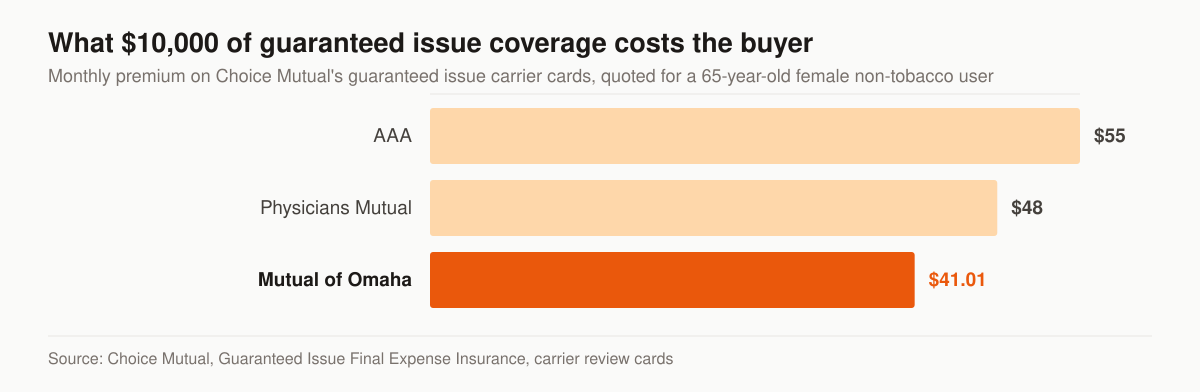
Chart: the published $10,000 monthly premiums on Choice Mutual’s guaranteed issue carrier cards, same age, same gender, same tobacco status.
Read the spread as a campaign fact. The same buyer, on the same day, is quoted a third more by one carrier than another. That is why a price-led guaranteed issue ad is fragile: whatever number you put in the creative belongs to one carrier’s rate card, and the moment you switch carriers the ad is wrong. Certainty travels between carriers. Price does not.
Eligibility also has a floor nobody advertises. Choice Mutual lists three requirements to buy at all: the applicant must be “Mentally capable of signing a legal contract,” must be located in the United States at the time of application, and must have a Social Security number. It notes that insurers “strictly forbid anyone with power of attorney from signing the application on behalf of the person who is mentally incapacitated,” and that guaranteed issue is “Not available to those age 86 or older.”
Those three lines are the best qualifying questions you will ever put on a GI landing page, because each one removes a lead you cannot place. An adult child filling out a form on behalf of a parent with dementia is a lead you will spend forty minutes on and never write. Ask early. For how the rest of the page around those questions should be built, see our breakdown of final expense landing pages and site structure.
“Guaranteed issue” means two different things, and one of them is Medicare
One collision is worth clearing up before you build a keyword list, because it quietly drains ad budget. In Medicare Supplement, guaranteed issue is not a product with no health questions. Medicare.gov defines guaranteed issue rights as “Limited situations when insurance companies must sell you certain Medigap policies, cover your pre-existing health conditions, and can’t charge you more because of health problems,” and notes you have to “give the company proof of your situation” (Medicare.gov, Buying a Medigap policy).
The related Medigap window is time-boxed rather than health-boxed: “Under federal law, you get a 6 month Medigap Open Enrollment Period. It starts the first month you have Medicare Part B and you’re 65 or older,” after which “The insurance company is allowed to deny you a policy if you don’t meet their medical underwriting requirements” (Medicare.gov, Get ready to buy).
So a search for “guaranteed issue” pulls two populations who want opposite things: someone who wants burial coverage despite their health, and someone who wants to switch Medigap plans without underwriting. Three practical consequences:
- Negatives before budget. Medigap, Medicare Supplement, Plan G, Plan N and open enrollment belong on the negative list of a GI burial campaign from day one, not after the first invoice.
- Landing-page disambiguation. One line near the top that says this page is about life insurance for final expenses, not Medicare Supplement, will save the call.
- A real cross-sell, handled separately. The same person often holds both problems. Route the Medicare half to the Medicare Supplement marketing motion rather than trying to serve it with burial creative.
Target the narrow buyer (and route everyone else)
One targeting error decides whether marketing guaranteed issue life pays: selling it to people who don’t need it. If a prospect can answer the health questions and qualify for a simplified issue policy, that product is better for them — full benefit on day one — and better for you. GI is the fallback, not the default.
So your funnel should sort, not just collect:
- Best fit for GI: declined applicants, serious chronic conditions, age 50–85, fixed income, “I just want my family not to be stuck with the bill.”
- Better off with simplified issue: healthier seniors who assume they can’t qualify but actually can. For how to market that adjacent product, see our breakdown of marketing simplified issue life insurance.
- The broader senior pipeline: everything else flows through the standard final expense marketing engine.
The deeper economics of low-underwriting burial coverage — pricing, positioning, and the build-vs-rent decision — live on our burial insurance marketing page, which is the natural next read once you’ve decided GI is a line you want to push. Which carriers sit behind the routing decision is a separate question, covered in choosing final expense carriers.
The channel mix that fits a fear-driven buyer
GI buyers are reachable, but the channels behave differently than a general life campaign.
| Channel | Why it works for GI | Watch-out |
|---|---|---|
| Paid social (Facebook) | Senior audience is there; “request info” offers convert on the certainty angle | Special Ad Category limits targeting; offer must do the qualifying |
| Search ads | Catches “guaranteed acceptance life insurance” intent — people already shopping | Higher cost per click; tight keyword + negative lists required |
| Local SEO / content | Lowest-cost leads once ranked; families search on behalf of parents | Slow to compound (3–6 months) |
| Referral / reactivation | A placed GI client knows neighbors in the same situation | Needs a scripted ask and a process |
Paid social is where we start an agent who needs volume this quarter, and our team builds those campaigns under final-expense PPC management and managed insurance Facebook ads. Before you launch either, read the next two sections — the platform rules and the state rules both bite at the creative stage, not at the reporting stage.
What Meta’s Special Ad Category actually takes away
Insurance advertising on Meta now runs under a specific category, and the name matters when you are setting the campaign up. Meta’s help centre states: “Starting January 21, 2025, using this category is required for financial products and services campaigns for advertisers based in the United States or showing ads to audiences in the United States. Ads may be rejected if an appropriate category is not chosen” (Meta Business Help Center, How to choose a Special Ad Category).
The cost of the category is a named list of tools, not a vague warning. Meta says: “Certain audience options are limited or unavailable for these ads for advertisers based in or reaching the US and advertisers reaching Canada and certain countries in Europe: age, gender, ZIP code or postal code, exclusion targeting, lookalike audiences and saved audiences.” It adds that “Some interests will also be unavailable when you create your audience,” that “Audiences based on city or pin drop locations will include an expanded radius,” and, plainly, “We encourage you to broaden—not restrict—your audience.”
This table maps each restriction onto the workaround that actually survives it on a guaranteed issue campaign.
| What Meta removes | Why it hurts a GI campaign | What replaces it |
|---|---|---|
| Age targeting | The product is issued 45–85; you cannot exclude 30-year-olds | Creative that names the age band and the situation in the first line |
| ZIP or postal code targeting | Licensing and carrier availability are state-level facts | State-level geo, plus a licensing question on the form |
| Exclusion targeting | You cannot suppress existing clients or the wrong segment | Suppression moved downstream, into the CRM and the call script |
| Lookalike audiences | Your best-buyer signal cannot be cloned into a new audience | Feed conversions back as an optimisation signal, not an audience |
| Saved audiences | No reusable audience template across campaigns | Standardise the offer instead of the audience |
| City or pin-drop radius | Radius quietly expands beyond your drive time | Budget for a wider spill; qualify location on the call |
The pattern is consistent: qualification moves out of the targeting panel and into the offer, the form and the first ninety seconds of the call. That is not a workaround; it is the design. A campaign that cannot filter on the way in has to filter on the way through, which is why the follow-up section below is load-bearing rather than optional.
What state advertising rules require of a guaranteed issue ad
Federal platform policy is only half the constraint. Life insurance advertising is regulated at state level, and several states carry near-identical language derived from the same model. Wisconsin’s rule is worth reading in full because it addresses graded benefits directly.
Wisconsin Administrative Code Ins 2.16(25)(a) says: “An advertisement, representation, or solicitation for a policy containing graded or modified benefits shall prominently disclose this fact.” It then defines the category in a way that captures guaranteed issue squarely: “Graded or modified benefits shall include, but are not limited to, life insurance policies that, within a specified period after the policy is issued, may pay no death benefits or death benefits that are less than premiums paid should the insurer pay the death benefits.”
Prominent is not left to judgement either. Ins 2.16(25)(b) sets a format per medium, including, for pre-printed advertisements intended for general distribution, “a written description of the graded or modified benefits printed on the first page of the advertisement and in at least 12 point bold type,” and for television “an announcement describing the graded or modified benefits to be displayed during the advertisement for at least 10 seconds” (Wisconsin Legislature, Ins 2.16).
This table pulls the provisions of Wisconsin’s advertising rule that a guaranteed issue campaign touches most often, and states what each one changes in the work.
| Provision | What it says | What it changes in your campaign |
|---|---|---|
| Ins 2.16(3)(a)1 | Advertisement includes descriptive literature, sales aids, and “Prepared sales talks, presentations and material for use by intermediaries” | Your phone script and your landing page are advertisements, not internal documents |
| Ins 2.16(5)(a) | “No advertisement may contain words or phrases the meaning of which is clear only by implication or by familiarity with insurance terminology” | “Graded death benefit” alone is jargon; write the plain-English sentence next to it |
| Ins 2.16(7)(d) | An advertisement may refer to guaranteed issuance “only if suitable administrative procedures exist so that the policy is issued within a reasonable time” | Do not advertise instant approval on a carrier whose turnaround you have not checked |
| Ins 2.16(15)(b) | Benefits obtainable only by buying two or more policies must be disclosed as such | Stacking $25,000 caps across carriers cannot be advertised as one policy |
| Ins 2.16(16)(a) | Statistical claims “shall identify the source of the statistical information” | Every number in your creative needs a citation you can produce |
| Ins 2.16(25)(a) | Graded or modified benefits “shall prominently disclose this fact” | The waiting period goes in the ad, not only in the fine print |
| Ins 2.16(26)(a) | Where issue is not guaranteed, terms like “No Medical Examination Required” need an equally prominent disclosure about health questions | Simplified issue creative cannot borrow guaranteed issue language |
| Ins 2.16(29)(b) | Insurers must require intermediaries and agencies acting on their behalf “to submit proposed advertisements to it for approval prior to use” | Carrier ad approval is a step in the launch checklist, with lead time |
| Ins 2.16(30) | The advertising file is kept while in use and “for a period of 3 years after” authorised use | Archive every creative, every variant, with dates |
Virginia’s rule reaches the same place through a general standard. 14VAC5-41-30 B provides that “An advertisement shall be truthful and not misleading in fact or by implication,” judged “from the overall impression that the advertisement may be reasonably expected to create within the segment of the public to which it is directed,” and 14VAC5-41-30 C adds that an offer to refund the premium “does not remedy misleading statements” (Virginia Administrative Code, 14VAC5-41-30).
Read those two together and the practical rule for a GI campaign is simple: the disclosure has to live where the promise lives. A headline that says coverage cannot be turned down, with the waiting period two clicks away on a policy page, fails the overall-impression test even when every individual sentence is true. Neither Wisconsin nor Virginia governs your state; both tell you what the model language looks like, and your own department’s rule is the one to read before launch. Our general guide to insurance marketing compliance covers the surrounding obligations.
Messaging that converts without overpromising
The creative formula for guaranteed issue final expense leads is consistent:
- Lead with the certainty — “no health questions,” “you can’t be turned down.”
- Name the buyer — declined before, on a fixed income, wants to cover the funeral.
- Be honest about the graded period — a short, plain line beats a hidden surprise.
- Make the ask small — “see if you qualify” / “request rates,” not “apply now.”
- Promise a human — these buyers want to talk to a person, not a portal.
Point three is where the state rules land. A plain line that says the policy returns premiums rather than paying the face amount if death is from natural causes in the first two years does the job in one sentence, and it does it in the ad rather than the footer. It also does something the compliance framing undersells: it raises persistency. A buyer who understood the waiting period at the point of sale doesn’t lapse in month three when a family member reads the policy.
Point one carries a trap worth naming. “No medical exam” and “no health questions” are not synonyms, and Wisconsin’s Ins 2.16(26)(a) treats the difference as a disclosure obligation. Choice Mutual makes the consumer-side version of the same point, writing that people who see a no-exam headline often read it as no health questions, “which is not the case.” If your GI creative and your simplified issue creative share a headline template, one of them is wrong.
What TCPA still requires after the one-to-one rule was vacated
Guaranteed issue campaigns run on the phone, so the consent rules are operational rules, not legal trivia. The rule that dominated agent chatter in 2024 is gone: the Eleventh Circuit vacated the FCC’s one-to-one consent restriction in Insurance Marketing Coalition Ltd. v. FCC, No. 24-10277 (11th Cir. Jan. 24, 2025), holding that the restriction exceeded the agency’s authority and stating flatly, “One-to-one consent is not required” (opinion via Justia).
What did not change is everything the 2012 rule already required. Under 47 CFR 64.1200(f)(9), prior express written consent means “an agreement, in writing, bearing the signature of the person called that clearly authorizes the seller to deliver or cause to be delivered to the person called advertisements or telemarketing messages using an automatic telephone dialing system or an artificial or prerecorded voice, and the telephone number to which the signatory authorizes such advertisements or telemarketing messages to be delivered.” The agreement has to disclose that the person “is not required to sign the agreement (directly or indirectly), or agree to enter into such an agreement as a condition of purchasing any property, goods, or services.”
This table lists the timing rules in 47 CFR 64.1200 that a fast-dialling final expense operation runs into first.
| Requirement | The rule | Where it bites |
|---|---|---|
| Calling window | No telephone solicitation “before the hour of 8 a.m. or after 9 p.m. (local time at the called party’s location)” (64.1200(c)(1)) | A five-minute callback on a 7:40 a.m. lead in another time zone |
| Do-not-call scrub | Registry version obtained “no more than 31 days prior to the date any call is made” (64.1200(c)(2)(i)(D)) | Monthly scrub cadence, documented |
| Internal do-not-call | Requests honoured within a reasonable time, “not [to] exceed ten (10) business days” (64.1200(d)(3)) | Your CRM needs a suppression field the dialler respects |
| Revocation | Honoured “within a reasonable time not to exceed ten business days from receipt of such request” (64.1200(a)(10)) | Stop, quit, end, revoke, opt out, cancel and unsubscribe are per se valid replies |
| Inquiry-based relationship | Runs on “the subscriber’s inquiry or application… within the three months immediately preceding the date of the call” (64.1200(f)(5)) | An aged GI lead older than three months has no inquiry-based cover |
Source: 47 CFR 64.1200, eCFR, current text.
The last row is the one that catches guaranteed issue buyers specifically. These are anxious, slow-moving prospects who often go quiet for months and resurface, so the temptation to re-dial an old inquiry is constant. The three-month inquiry clock does not stretch to fit that pattern. Written consent that is still valid does; an old form fill on its own does not. We run the ad mechanics and the routing; you, the licensed agent, own the disclosure and the call.
On buying GI leads as a product
Some agents would rather skip ad-building and just buy guaranteed issue or aged final-expense leads outright. That’s a legitimate path — but it’s a lead-buying decision, not a marketing-services one, and the two shouldn’t be blended. If you want to purchase exclusive or aged GI leads as a product, buy leads direct from getinsureleads rather than through a marketing agency markup, then judge them on the measure that survives scrutiny: cost per issued policy after a fixed follow-up cadence, not cost per lead.
Generating your own leads is the other route, and it builds an asset whose cost trends down as the account matures instead of up as an auction heats. Many growing agents blend both and shift budget toward whichever channel posts the lower cost per sale. The build-versus-buy arithmetic for the same low-underwriting product is worked through in burial insurance lead generation: build vs. buy.
Speed and cadence decide the whole thing
Channels create contacts. Follow-up turns contacts into placed policies. GI buyers are anxious and shopping out of fear — a lead called in five minutes reaches someone who still remembers the form and still expects the call, and the worry that drove the inquiry is still live.
A minimum viable cadence:
| Touch | Timing | Channel |
|---|---|---|
| 1 | Within 5 minutes | Call |
| 2 | Same day | Text + call |
| 3 | Day 2 | Call |
| 4–8 | Days 3–14 | Alternating call/text |
We treat close rate as a cadence number as much as a lead-quality number. Build the follow-up before you scale spend, or you’ll buy expensive contacts and waste them. The full sequence, with scripts and the reasoning behind each touch, is in our insurance lead follow-up cadence guide; the phone half of the job is covered in selling final expense over the phone.
What to measure on a guaranteed issue campaign
Three numbers decide whether the line is worth running, and none of them is cost per lead.
- Cost per issued policy. GI applications approve at issue, so the gap between submitted and issued is smaller than in underwritten lines — which means the honest denominator is available to you early. Use it.
- Contact rate inside the first hour. This is the number your cadence controls directly, and it is the first thing to fix when the leads look bad.
- Month-three and month-thirteen persistency. Guaranteed issue chargebacks cluster where the waiting period was a surprise. Persistency is the measurement that tells you whether your disclosure worked, which makes it a marketing metric rather than a service metric.
Track those three against a fixed follow-up cadence and a fixed creative set, change one thing at a time, and the line either pays or it doesn’t within a quarter. Our published retainer tiers and what each one includes set out which of that work is managed for you at each level.
Where to take it next
Guaranteed issue final expense marketing isn’t a separate machine — it’s a precise segment of the senior pipeline, sold on certainty and honest about the graded benefit. Target the narrow buyer, route the healthier ones to simplified issue, respect the platform category and your state’s advertising rule, and dial fast.
If you want this built and run for you, our managed final expense marketing program is the engine; the burial insurance vertical page covers the low-underwriting economics in depth. Or get a no-pitch teardown of your current funnel with a free marketing audit and see where the leaks are before you spend another dollar.
- Free Final Expense Leads for Agents: What They Really Cost
An operator's honest breakdown of free final expense leads: where they come from, what they really cost you in time, and how to build cheap leads instead.
- Final Expense Sales Tips That Actually Move Placed Policies
Final expense sales tips from a working book: lead routing, speed-to-dial, scripting, and the close mechanics that turn contacts into issued policies.
- Burial Insurance Leads: When Building Your Own Funnel Beats Buying Them
Burial insurance lead generation, build vs buy: when your own funnel beats bought leads, the CPL math involved, and how to decide on your own numbers.
- Final Expense Mailer Templates: Four Free, Editable Downloads
Four free final expense mailer templates: reply-card letter, 6x9 postcard, turning-65 letter, and referral card. Editable HTML + print-ready PDFs.