The Final Expense Telesales Script That Holds Up Call After Call
A final expense telesales script is a structured phone call that opens by confirming the request, frames the product as small whole-life burial coverage, qualifies health and budget early, quotes one carrier, and closes by booking the policy on the call. The script matters less than the lead behind it.
When a phone shift goes badly, the script is the first thing an agent rewrites. We treat it as the last thing to change. A final expense telesales script is a way to keep control of a call that ends, when it works, with a bank draft rather than a callback. The lead behind the call decides most of the outcome before you dial.
This page gives you a script structure you can run today, the disclosures federal telemarketing law puts inside that structure, two rebuttal tables for the objections you will hear on every shift, and an honest read on which lead types hold up in a phone room.
What a final expense telesales script actually does
A script is not a monologue. It is a sequence that moves a senior from “I filled out something online” to “draft my account on the 3rd.” Three jobs only:
- Keep you in control of the call order.
- Qualify the prospect out early if they cannot buy.
- Get to a bank draft while intent is still warm.
Everything else is listening. Agents who close consistently are not reading faster. They are qualifying harder and quoting one carrier, not five.
The script structure (run it in this order)
This is the spine of a working final expense phone script. Adapt the wording to your voice; do not reorder the steps.
- Confirm the request (15 seconds). “Hi, is this Mary? This is [Name] with the burial coverage you requested online — I’m the licensed agent assigned to get you a quote.” You are not cold-calling. Name the request so they remember it.
- Frame the product (30 seconds). “This is a small whole-life policy that covers your funeral and final bills so your kids aren’t stuck with them. It never expires and the price never goes up.” Plain language. No “final expense insurance solution.”
- Build the why (1–2 minutes). Ask who they’d want protected and whether they have anything in place now. Let them tell you the gap. This is where intent gets confirmed or killed.
- Qualify health (2–3 minutes). Run the knockout questions in the carrier’s order. Tobacco, height/weight, and the big conditions — oxygen, recent cancer, heart procedures, kidney issues. Qualifying here is what separates telesales from face-to-face: you cannot recover a bad quote later.
- Quote ONE carrier (1 minute). Match the health answers to a single carrier and give one monthly number, then stop talking. Presenting three options on the phone stalls the sale.
- Assume the close (1–2 minutes). “We’ll set this up to draft from your checking or savings — which do you usually use?” Move to banking as if the decision is made.
- Lock the draft and read-back (2 minutes). Collect banking, confirm the draft date, and read the policy terms back so it sticks through the free-look period.
If the lead is genuinely warm, this runs eight to fifteen minutes. If you are fighting for every answer, the lead — not the script — is the issue. The step-by-step version of the same call, with rapport cues and draft-date timing, is in our guide to selling final expense over the phone.
What the rule makes you say in the first breath
Step one above is not only a rapport move. It is where a federal disclosure lands.
The FTC’s Telemarketing Sales Rule makes it an abusive practice for a telemarketer “in an outbound telephone call or internal or external upsell to induce the purchase of goods or services to fail to disclose truthfully, promptly, and in a clear and conspicuous manner to the person receiving the call, the following information: (1) The identity of the seller; (2) That the purpose of the call is to sell goods or services; (3) The nature of the goods or services” (16 CFR 310.4(d)). Three items, one breath, before the health questions.
Whether that paragraph reaches you depends on how the call ends, and this is the split that catches agents who moved indoors from the field. The rule’s exemption list at 16 CFR 310.6 exempts “Telephone calls in which the sale of goods or services or charitable solicitation is not completed, and payment or authorization of payment is not required, until after a face-to-face sales or donation presentation by the seller or charitable organization” — with a proviso preserving § 310.4(a)(1), (a)(8), (b) and (c). Paragraph (d) is not in that proviso. So a field agent who books a kitchen-table appointment sits outside the oral-disclosure requirement; a telesales agent who authorises the draft on the call does not. Same product, same words, different rule set. Nothing in that exemption list carves out insurance as a category.
The caller-identification side of the same opener — the name and callable number a solicitation has to transmit — is covered in our primer on telemarketing insurance leads. We provide marketing services, not legal advice.
Four openers for the four calls you actually make
One opener does not cover a shift, because a phone room makes four different calls and each needs a different first sentence. The disclosures above belong in all four; the framing changes.
| Call type | What the prospect remembers | Opening line that fits |
|---|---|---|
| Real-time lead, dialed within minutes | The form they just submitted | “Hi Mary, this is [Name] with [Agency] — you just asked about burial coverage online, and I’m the licensed agent who handles those requests. Did I catch you at an okay moment?” |
| Same-week callback, second or third attempt | The request, vaguely | “Hi Mary, [Name] with [Agency] again about the burial coverage quote you requested on [date]. I’ve got your numbers ready — takes about ten minutes.” |
| Aged lead, weeks or months old | Often nothing at all | “Hi Mary, this is [Name], a licensed agent with [Agency]. Back on [date] you asked for burial coverage pricing. I’m not sure if you got that sorted — did you?” |
| Direct-mail response | The card they mailed back | “Hi Mary, [Name] with [Agency] — I’ve got the reply card you sent in about the state burial program in front of me. I’m the agent who follows up on those.” |
The aged opener is a different call, not the same call later. It has to survive “I don’t remember doing that,” which means it opens with a date and a question rather than a pitch, and it has to be dialed against a consent record you can still produce. What that record needs to contain, and how quickly aged data goes stale, is set out in our page on aged final expense leads.
Write the voicemail, not just the opener
Before you rewrite a single line, check whether the opener is being heard at all.
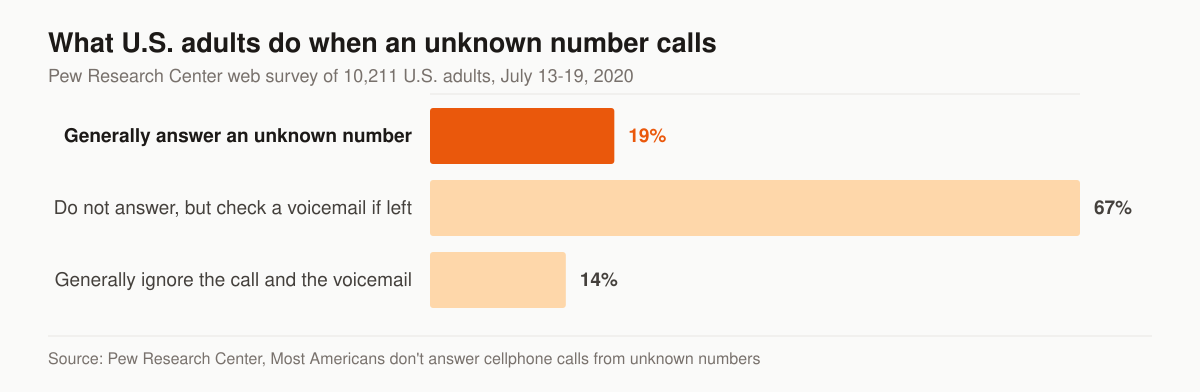
Chart: Pew Research Center web survey of 10,211 U.S. adults, 13–19 July 2020 — most Americans don’t answer cellphone calls from unknown numbers.
Two numbers in that chart decide how you write a voicemail. Only 19% of U.S. adults say they generally pick up when an unknown number calls, and 67% say their practice is to not answer but to check a voicemail if one is left. Pew also reports that “Americans ages 18 to 29 are more likely to take calls from unknown numbers than those in older age groups” — which is the wrong direction for a book of 60-to-80-year-olds.
So the voicemail is not a consolation prize. For the two-thirds of U.S. adults who tell Pew they check a voicemail rather than answer, the message is the first contact you actually make, and it should carry the same three disclosures the live opener carries, in under fifteen seconds:
“Mary, this is [Name], licensed agent with [Agency], calling about the burial coverage quote you requested on [date]. I have your pricing. My direct line is [number] — call me back any time today and I’ll read it to you.”
Name, purpose, product, request date, callback number. No pitch, no urgency theater, no “important matter regarding your account.” The cadence that carries those attempts across the first two weeks is laid out in our insurance lead follow-up cadence; if the dial hours are the constraint rather than the leads, appointment setting for insurance agents moves confirmed calls onto the calendar instead.
Rebuttal table: the five you hear every shift
Five objections come up so reliably that we script them rather than improvise, and each answer is shorter than agents expect. Keep responses short. A long rebuttal sounds like a sale; a quick reframe sounds like an expert.
| Objection | What it usually means | One-line rebuttal |
|---|---|---|
| “I need to talk to my kids first.” | Trust and price uncertainty | “Smart — most folks do. Let’s get you the exact number so the conversation is about a real plan, not a guess.” |
| “I can’t afford it right now.” | Quote felt too high, or budget unconfirmed | “Totally fair. What number per month would feel comfortable? Let me build the plan around that.” |
| “I already have insurance.” | Often a lapsed or tiny policy | “Good — is that through work or your own policy? A lot of folks find theirs ends when they retire. Mind if I check the gap?” |
| “How did you get my information?” | Forgot the lead form | “You requested a burial coverage quote online on [date] — that’s why I’m the one calling instead of a 1-800 number.” |
| “Just mail me something.” | Soft brush-off | “I can, but rates depend on your health answers, so mailing a generic price wastes your time. Two quick questions and I’ll have your real number.” |
For deeper objection work and tonal cues, our guide to selling final expense over the phone goes line by line, and these final expense sales tips cover the pacing that keeps seniors on the call.
Rebuttals after the price is on the table
The five above happen before the quote; a second set arrives after it, and they are the ones that turn a sold call into a chargeback if you answer them badly. These need accuracy more than they need charm, because each one is really a question about the contract.
| Objection | The real question underneath | Response that keeps the sale honest |
|---|---|---|
| “Why do you need my bank account?” | Is this a scam? | “It’s how the carrier collects the premium — same as your utility. I’ll read the account back to you before anything is submitted, and I’ll give you the number to call the company directly.” |
| “Can I pay with a card instead?” | Cash-flow control | “Tell me what the carrier accepts before I promise it.” Check the carrier’s billing options rather than guessing; the payment method also changes which authorization rule applies to the call. |
| “What if I can’t pay one month?” | Fear of losing everything paid in | “Here’s the grace period and what happens if a draft misses.” Read the actual contract language for the carrier you quoted — do not generalise across carriers. |
| “So my family gets the full amount right away?” | Waiting period | Answer with the plan you actually quoted. If it is a graded or modified plan, say what pays in year one and year two before you take the draft. Carrier-by-carrier differences are in our comparison of final expense carriers for agents. |
That last row is where a script becomes a compliance question rather than a sales one, which is the next section.
Say the price and the restriction in the same sentence
Step five of the script says quote one carrier and stop talking. It does not say quote the premium alone.
Before a customer consents to pay, the Telemarketing Sales Rule makes it a deceptive practice to fail “to disclose truthfully, in a clear and conspicuous manner, the following material information: (i) The total costs to purchase, receive, or use, and the quantity of, any goods or services that are the subject of the sales offer; (ii) All material restrictions, limitations, or conditions to purchase, receive, or use the goods or services that are the subject of the sales offer” (16 CFR 310.3(a)(1)). The same paragraph adds refunds: if the seller makes a representation about a refund, cancellation, exchange or repurchase policy, the disclosure must carry “a statement of all material terms and conditions of such policy.”
On a final expense call those three clauses have obvious homes:
- Total cost. The monthly premium, and that it is monthly and ongoing — not “about forty dollars,” but the exact figure the carrier’s quote engine returned for that health class.
- Material restrictions. A graded, modified or guaranteed-issue plan does not pay the full face amount in the first years. That is a material limitation on what the buyer is purchasing, and it belongs in the quote sentence, not in the policy packet that lands ten days later.
- Refund and free-look terms. If you tell a prospect they can cancel and get their money back, the terms of that promise come with it.
The commercial argument points the same way as the rule. A waiting period the buyer hears from you is a term of the plan; the same waiting period discovered in the policy packet ten days later is a reason to cancel inside the free-look window, and the chargeback lands on you. Our page on marketing guaranteed issue final expense covers how to advertise those plans without over-promising in the first place.
The read-back the payment rule actually specifies
Step seven of the script says “read-back.” Federal law is unusually specific about what that read-back contains when the money moves off a checking account.
16 CFR 310.3(a)(3) makes it a violation to cause “billing information to be submitted for payment, or collecting or attempting to collect payment for goods or services or a charitable contribution, directly or indirectly, without the customer’s or donor’s express verifiable authorization, except when the method of payment used is a credit card subject to protections of the Truth in Lending Act and Regulation Z, or a debit card subject to the protections of the Electronic Fund Transfer Act and Regulation E.” A routing-and-account draft is neither of those exceptions.
The rule then names three ways authorization is deemed verifiable: an express written authorization carrying the customer’s signature; an express oral authorization that is audio-recorded and made available on request; or a written confirmation mailed first class, marked as such on the envelope, before the billing information is submitted. Route (ii) is the one that fits a close where the authorization happens out loud, and the regulation lists exactly what the recording has to evidence.
Eight items have to be on the recording, and a script that skips one is a script with a hole in it.
| What § 310.3(a)(3)(ii) requires | Where it goes in the call |
|---|---|
| “An accurate description, clearly and conspicuously stated, of the goods or services… for which payment authorization is sought” | “This is the [carrier] whole-life policy, $[face] of coverage.” |
| “The number of debits, charges, or payments (if more than one)” | “This draws every month for as long as you keep the policy.” |
| “The date(s) the debit(s), charge(s), or payment(s) will be submitted for payment” | “First draft on the [date], then the [date] of each month.” |
| “The amount(s) of the debit(s), charge(s), or payment(s)” | “$[premium] each time.” |
| “The customer’s or donor’s name” | “Confirming this is Mary [surname].” |
| Billing information “identified with sufficient specificity such that the customer… understands what account will be used” | “From your checking account at [bank] ending [last four].” |
| “A telephone number for customer or donor inquiry that is answered during normal business hours” | “The carrier’s service line is [number], staffed weekdays.” |
| “The date of the customer’s or donor’s oral authorization” | “Today is [date] — do I have your okay to submit this?” |
Read in order, those eight items add a short block to the end of the call. We treat that block as a persistency tool rather than paperwork: a buyer who has heard the amount, the bank and the date said out loud has nothing left to be surprised by when the first draft posts. Whether your carrier satisfies the requirement through its own e-application signature (route i) or a recorded voice authorization (route ii) is a question for the carrier and your upline, not something to assume.
If you record the call, say so
The paragraph above quietly creates a recording. The recording creates a second question, and it is answered state by state rather than federally.
Federal law is permissive. Under 18 U.S.C. 2511(2)(d), “It shall not be unlawful under this chapter for a person not acting under color of law to intercept a wire, oral, or electronic communication where such person is a party to the communication or where one of the parties to the communication has given prior consent to such interception unless such communication is intercepted for the purpose of committing any criminal or tortious act in violation of the Constitution or laws of the United States or of any State.” You are a party to your own sales call, so the federal floor is satisfied.
State law is not uniform, and telesales is interstate by design. California, for one, penalizes “A person who, intentionally and without the consent of all parties to a confidential communication, uses an electronic amplifying or recording device to eavesdrop upon or record the confidential communication, whether the communication is carried on among the parties in the presence of one another or by means of a telegraph, telephone, or other device, except a radio” — punishable by “a fine not exceeding two thousand five hundred dollars ($2,500) per violation, or imprisonment in a county jail not exceeding one year, or in the state prison, or by both that fine and imprisonment” (Cal. Penal Code § 632(a)). Section 632(b) then excludes from the definition of “person” anyone “known by all parties to a confidential communication to be overhearing or recording the communication.”
That exclusion is the whole fix, and it costs one sentence: announce the recording, get the acknowledgment, keep dialing. Put it immediately after the required oral disclosures and before the health questions, so the acknowledgment is on the tape from the start rather than spliced in before the banking. Where those recordings then live, and for how long, is a CRM decision — our comparison of CRMs insurance agents actually run covers retention and disposition logging for phone rooms.
Fit the premium to the check, not to your commission
Step three of the script builds the why. Step six asks for the draft. Between them sits the budget question, and the reason it decides the sale is that the money it is competing with is usually one fixed monthly deposit.
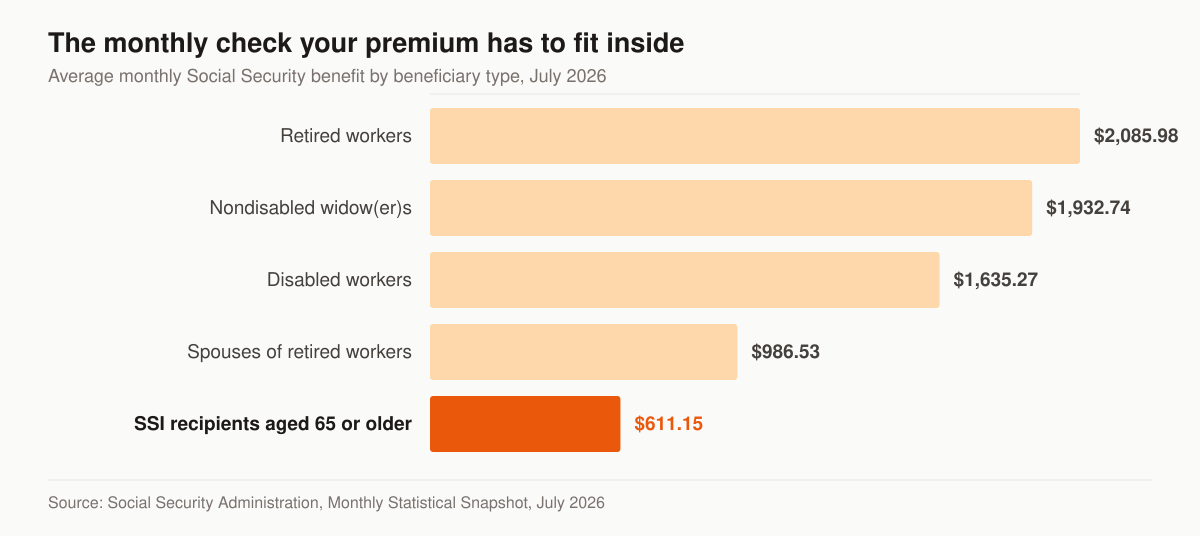
Chart: average monthly benefit by beneficiary type, Social Security Administration Monthly Statistical Snapshot, July 2026 — retired workers $2,085.98, nondisabled widow(er)s $1,932.74, disabled workers $1,635.27, spouses of retired workers $986.53, and SSI recipients aged 65 or older $611.15.
The SSA’s July 2026 snapshot puts 59,317,000 people aged 65 or older on Social Security, SSI, or both. A retired worker’s average benefit that month was $2,085.98. A widow or widower drawing a nondisabled survivor benefit averaged $1,932.74. An SSI recipient aged 65 or older averaged $611.15.
Two script consequences follow, and neither requires you to know the prospect’s balance:
- Ask for the number before you quote one. “What would feel comfortable per month?” invites a number. “Does $[premium] work?” asks a senior on a fixed income to defend their budget to a stranger, and the polite answer to that is a callback that never happens.
- Build the face amount down to the answer, not the answer up to the face amount. A $10,000 policy that keeps drafting is worth more to the family than a $20,000 policy that lapses.
The widow row is worth a second look. A surviving spouse is often the person who watched a funeral get paid for out of savings, which means the “why” step lands faster and the objection you get is about price rather than need. That is a different call from a married couple’s call, and the budget question is the place the difference shows up.
The lead types that work for telesales
A script is downstream of lead quality, and four lead types behave differently enough on the phone that the same talk track produces different results on each. In a phone room, two variables decide everything: intent (how badly they want coverage) and freshness (how recently they asked). Telesales lives and dies on freshness because phone intent decays fast.
| Lead type | Typical intent | Best worked | Trade-off |
|---|---|---|---|
| Real-time Facebook lead form | Moderate | Within minutes | Cheap and high volume, but noisy — you dial more to reach fewer |
| Direct-mail response | High | Within days | Strong intent, higher cost, slower flow |
| Live transfer | Very high | Live | Best contact rate, highest price per unit |
| Aged internet leads | Low | Anytime | Cheap, but you eat heavy non-contact and re-shopped prospects |
For a phone agency the answer is a blend: fresh exclusive social leads for volume, a smaller direct-mail or live-transfer allocation for closers who want warmer, fewer conversations. We treat lead freshness as the first variable to fix and the script as the last. Whether those fresh leads should be exclusive to you is its own decision, worked through in exclusive vs shared final expense leads.
Two more rules that matter more than wording:
- Speed is the cheapest variable you control. Intent decays, and a record worked tomorrow is not the record that came in ten minutes ago. Build a follow-up cadence that hits hard early instead of one weak attempt.
- Consent is the floor, not a nicety. The TCPA still governs how you dial and text, and you need the timestamped consent your vendor captured. The FCC’s one-to-one rule was vacated in January 2025, but consent itself did not go away. See our TCPA primer for agents buying leads. We provide marketing, not legal advice.
The referral ask at the end of the script
A referral ask is a standard closing beat in a final expense telesales script, and the published versions sometimes attach a gift to it — a bonus policy rider, a gift card, a credit. The ask is good practice. The gift is where a state insurance code can bite.
Offering something of value in connection with insurance runs into anti-rebating statutes, and those are written state by state with ceilings set in dollars that do not match each other. Four of them, with the exact statutory language, are laid out on our done-for-you newsletter page, which faces the same problem in print. The safe default for a telesales script is the one we use in every referral CTA we write: ask for an introduction, not a transaction.
“Mary, the people I help usually know somebody in the same spot. If a friend or your sister asks about this, would you give them my number? I’m not going to call anyone who hasn’t asked me to.”
That last sentence is doing double duty. It keeps the referral outside rebating territory, and it keeps the referred name outside the TCPA problem you would create by dialing someone who never consented to anything.
When the script is fine and the numbers are not
At some point rewriting lines stops paying. The diagnostic is a ladder, and you climb it in order because each rung has a different fix.
- Nobody answers. That is a caller-ID, cadence and speed problem, not a wording problem. Fix dial timing and number reputation first.
- They answer and hang up in ten seconds. That is the opener and the disclosure order. Confirm the request before you say anything that sounds like a sale.
- They talk but never qualify. That is lead intent. The person filled a form for a reason that was not buying coverage, which points at the ad or the lead form promising something the product is not.
- They qualify but do not close. Now it is the script — the quote, the restriction disclosure, the assumptive move to banking.
- They close and then lapse. That is draft-date timing and the read-back, not the pitch.
Only rung four is a script problem. The economics underneath the ladder — what a lead costs against what a sale costs — are worked through in final expense leads: cost per lead vs true cost per sale, and the lead-source options themselves are compared on our exclusive final expense leads page.
How the pieces fit together
The agents who win at telesales treat the script as the cheap part. The expensive part is a steady flow of fresh, consented, exclusive leads matched to the right carriers — which is the whole job of a real final expense marketing program. If you are buying recycled data and reading a great script to people who never asked for a call, the math will not close.
If you want a straight read on your current cost per sale versus your cost per lead, our final expense lead generation service is built around phone-room economics, and our published pricing starts at $2,500 a month with no lock-in. You can also get a no-pitch teardown of your funnel through a free marketing audit.
The script holds up call after call when the lead behind it is fresh, the prospect actually asked, the disclosures are inside the talk track rather than bolted on afterwards, and you quote one carrier and ask for the draft. Fix the lead source first. The pitch was never the bottleneck.
Sources
Verified in September 2026 against the primary text:
- 16 CFR 310.3, deceptive telemarketing acts or practices — the material-information disclosures at (a)(1)(i)–(iii), the express-verifiable-authorization requirement at (a)(3) with its credit-card and debit-card exceptions, and the eight items an audio-recorded oral authorization must evidence at (a)(3)(ii)(A)–(H).
- 16 CFR 310.4, abusive telemarketing acts or practices — the required oral disclosures in an outbound call at paragraph (d).
- 16 CFR 310.6, exemptions — the face-to-face exemption at (b)(3) and the provisions its proviso preserves.
- 18 U.S.C. 2511, interception of communications — the one-party-consent provision at (2)(d) and its criminal-or-tortious-purpose limit.
- California Penal Code § 632 — the all-party-consent offense at (a), the penalty, and the exclusion at (b) for a person known by all parties to be recording.
- Social Security Administration, Monthly Statistical Snapshot, July 2026 — 59,317,000 beneficiaries aged 65 or older; average monthly benefits of $2,085.98 for retired workers, $1,932.74 for nondisabled widow(er)s, $1,635.27 for disabled workers and $986.53 for spouses of retired workers; average monthly SSI payment of $611.15 for recipients aged 65 or older.
- Pew Research Center, Most Americans don’t answer cellphone calls from unknown numbers — web survey of 10,211 U.S. adults, 13–19 July 2020: 19% generally answer, 67% do not answer but check a voicemail, 14% ignore both.
Telemarketing rules change and states legislate on top of the federal floor. Confirm your own call script, recording policy and referral offer with qualified counsel before a phone room runs them.
- Final Expense Telesales: How to Sell Final Expense by Phone, Call by Call
How to sell final expense insurance over the phone: a tested telesales process, rapport openers, a rebuttal table, draft-date timing, and the federal call rules.
- Final Expense Sales Tips That Actually Move Placed Policies
Final expense sales tips from a working book: lead routing, speed-to-dial, scripting, and the close mechanics that turn contacts into issued policies.
- Burial Insurance Leads: When Building Your Own Funnel Beats Buying Them
Burial insurance lead generation, build vs buy: when your own funnel beats bought leads, the CPL math involved, and how to decide on your own numbers.
- Guaranteed Issue Final Expense Marketing: How Agents Actually Sell It
How to run guaranteed issue final expense marketing that profits: who to target, compliant ad angles, and how to message the graded death benefit.