Final Expense Telesales: How to Sell Final Expense by Phone, Call by Call
To sell final expense insurance over the phone, you confirm the prospect requested coverage, build quick rapport, qualify health and budget, quote one simple plan, and ask for the card. The phone sale is a structured seven-step call, not a pitch, and federal telemarketing rules set the hours, the disclosures and the consent record around it.
Selling final expense over the phone is a repeatable process, not a personality contest. The agents who close consistently on our own book aren’t smoother talkers — they run the same call structure every dial, control the conversation, and ask for the card before the prospect drifts.
This guide lays out the telesales call step by step, the rebuttals that actually move people, the draft-date timing that keeps policies on the books, and the federal call rules that decide when you may dial and what you must say. It’s written for agents working senior-market final expense leads, whether you generate your own or buy them.
Why the phone changes the sale
Field appointments give you body language, a kitchen table, and time. The phone gives you none of that. You have your voice, your structure, and the first few sentences before the prospect decides whether you’re worth listening to.
That trade is worth it. Phone selling lets one agent cover any state they are licensed in, run 30+ dials a day, and skip windshield time. But it punishes sloppiness. A weak opener or a rambling pitch loses the call instantly. So the entire game is structure plus speed.
One consequence is legal rather than tactical, and it catches agents who moved indoors from the field. The FTC’s Telemarketing Sales Rule exempts calls “in which the sale of goods or services or charitable solicitation is not completed, and payment or authorization of payment is not required, until after a face-to-face sales or donation presentation by the seller or charitable organization” — while §310.4(a)(1), (a)(8), (b) and (c), covering threats and profanity, caller-ID transmission, the pattern-of-calls rules and the calling hours, still apply (16 CFR 310.6(b)(3)). A field agent who books an appointment by phone and signs at the kitchen table sits inside that exemption. A telesales agent who takes the bank draft on the call does not, because payment is authorized on the call. Same product, same script, different rule set.
Before you dial: licensing, states, and the desk
Telesales scales by state, and the state you cannot write in is a state whose leads you should not buy. You need a resident license at home and a non-resident license wherever you solicit. Applications go through the National Insurance Producer Registry, which states plainly that “States typically take 7 to 10 days to review applications” (NIPR). Carrier appointments come after that, on the carrier’s timeline, not yours.
Sequence it deliberately. Pick the states your carriers write competitively in, get the licenses and appointments in place, and only then turn on lead flow for those states. Reverse that order and you are paying for records you cannot legally work until the paperwork clears.
The desk itself is short: a dialer that records, a CRM that holds the consent trail and the next action, e-application access for each carrier, and a quiet room. If you are still choosing the CRM half of that, our comparison of the CRMs insurance agents actually run covers what matters for a phone room specifically — call logging, disposition codes, and a queue that tells you who to dial next.
The 7-step final expense telesales call
This is the spine of how to sell final expense insurance over the phone. Each step has one job. Don’t skip ahead.
- Confirm the lead. Reference the exact request they sent in. This re-establishes consent and reminds them they raised their hand.
- Build rapport (2–4 minutes). Ask about them, their family, why they looked into coverage. Listen more than you talk.
- Set the frame. “I’m going to ask a few health questions, find the company that fits you best, and get you a price. Sound fair?”
- Field underwriting. Tobacco, height/weight, the knockout health questions. This is where you protect against chargebacks — qualify honestly.
- Present ONE plan. Pick the face amount and carrier that fits their budget and health. One option. Multiple quotes create paralysis.
- Close on the draft. “We’ll set the first draft for the 3rd, right after your check hits. What card or account do you want that on?”
- Lock the beneficiary and confirm. Restate coverage, premium, and draft date. Reassure them it’s done.
A common failure is collapsing rapport and underwriting into a pitch. Slow down on steps 2 and 4 — they’re where the sale is won.
Step 5 is where this page disagrees with a lot of published advice. Several competing guides teach a three-option close: quote three face amounts and let the prospect self-select. That works in a room where a prospect can see three numbers side by side on paper. On a phone call the prospect is holding three prices in working memory while a stranger talks, with nothing in front of them to compare. We quote one plan sized to the budget they already told us, and hold a smaller face amount in reserve as the answer to a price objection rather than as an opening option.
Rapport that works on a 72-year-old
Rapport isn’t small talk for its own sake. It’s information gathering. Every personal detail — the grandkids, the church, the late spouse, the worry about leaving a bill behind — becomes a reason to buy later in the call.
Use plain language. Talk about “covering the funeral so the kids don’t have to,” not “mortality protection vehicles.” Mirror their pace; seniors on a fixed income don’t respond to fast, high-energy pitching — they respond to someone who sounds like they’re not in a hurry to take their money.
Jargon does quiet damage here, because it makes a simple product sound like a contract the prospect needs a lawyer for. Swap the industry word for the household word every time.
This table pairs the term on your carrier’s application with the phrase to actually say out loud on a senior-market call.
| On the application | What to say on the phone |
|---|---|
| Death benefit | The amount your family receives |
| Face amount | How much coverage you’re carrying |
| Underwriting | A few health questions, no exam and no nurse visit |
| Premium | Your monthly payment, and it never goes up |
| Beneficiary | The person you’d want the check to go to |
| Contestability period | The first two years the company can review a claim |
| Bank draft authorization | The account it comes out of each month |
The rule behind the table: if a word would not appear in a conversation between the prospect and their daughter, it does not belong in your sentence.
What the health answers actually decide
Field underwriting is not a formality you get through before quoting. It is the branch point that decides which product exists for this person, and the call changes shape depending on where they land. Run the health questions before you name a price, so you are never walking a number back.
This table maps the four benefit structures a final expense prospect can land in to what changes in the conversation once you know.
| Benefit structure | What the prospect gets | What changes on the call |
|---|---|---|
| Level | Full benefit from day one | Quote it straight; there is no waiting period to explain |
| Graded | Partial benefit that steps up over the early policy years | Say the steps out loud, in years, before quoting the premium |
| Modified | Return of premium plus interest in the early years, full benefit after | Explain the early-year payout plainly; a surprised beneficiary is a complaint |
| Guaranteed issue | No health questions, with a waiting period for natural-cause death | Never let the waiting period be discovered later; state it before the price |
The discipline is the same at all four levels: name the limitation before the premium, not after. A waiting period the prospect discovers in the policy packet reads as something you hid, and a cancellation inside the advance period claws money back out of your account. That mechanic is worth understanding before you scale dials, and we break it down in how final expense commission levels and advances really work.
Guaranteed issue in particular deserves its own handling rather than being treated as the consolation prize at the end of a failed level quote. Our guide to marketing guaranteed issue final expense honestly covers who it is genuinely right for. And because the underwriting niche is what actually decides whether a diabetic or a COPD prospect gets level benefits, keep the carrier-selection criteria that matter for telesales next to your quoting sheet.
Sizing the policy to a real funeral bill
We treat a price objection as a sizing problem first. The prospect has no idea what a funeral costs, so the number you quoted feels arbitrary next to a budget they picked out of the air. There is a federal rule that helps with exactly that, and it costs nothing to use.
The FTC’s Funeral Rule requires funeral providers to give price information by phone. The obligation sits on the funeral home, not on you, and it reads: “Tell persons who ask by telephone about the funeral provider’s offerings or prices any accurate information from the price lists described in paragraphs (b)(2) through (4) of this section and any other readily available information that reasonably answers the question” (16 CFR 453.2(b)(1)). The same section sets out what the general price list must itemize, including forwarding and receiving of remains, the price range for direct cremations, the price range for immediate burials, transfer of remains, embalming, use of facilities and staff for a viewing, a funeral ceremony and a memorial service, the hearse, and the limousine. A funeral home also has to hand over an itemized written statement of goods and services selected at the conclusion of the arrangement discussion.
So the talk track writes itself, and it costs you nothing: tell the prospect they can call any two funeral homes in their town and get real prices over the phone, for free, before they decide on a face amount. That single sentence does three things a discount cannot. It moves you from salesperson to advisor, it replaces an argument about your number with research into their number, and it gives the callback a concrete purpose.
Which funeral they are pricing matters, because the two paths are not close in cost or in popularity.
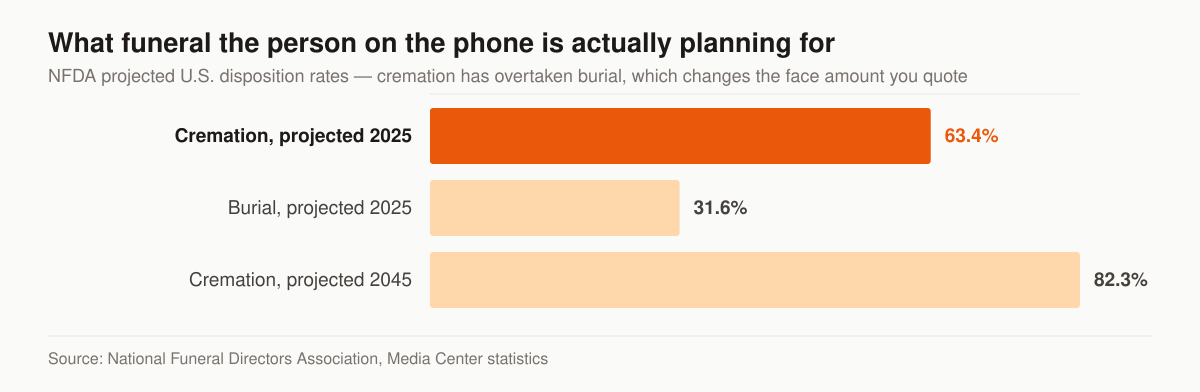
Chart: projected U.S. disposition rates published by the National Funeral Directors Association — cremation at 63.4% and burial at 31.6% for 2025, with cremation projected to reach 82.3% by 2045.
Ask which one they have in mind before you pick a face amount. A prospect planning a direct cremation and a graveside gathering is sizing a different bill from one who wants a viewing, a casket and a plot, and quoting the same face amount to both means you overshot one budget and undershot one need. The NFDA also counts 15,401 funeral homes operating in the United States, roughly 75% of them family- or privately owned — so there is usually a local one for the prospect to call.
Rebuttal table: the objections you’ll hear every day
Objections in final expense telesales are predictable. Memorize the response, then say it like a human, not a script. The goal is to surface the real concern, which is almost always price or trust.
This table is the working sheet: the objection as spoken, the concern underneath it, and the reframe that gets you back to qualifying.
| Objection | What it usually means | Response framing |
|---|---|---|
| “I need to think about it.” | Price or company, unstated | “Usually that’s the monthly amount or which company. Which is it for you?” |
| “It’s too expensive.” | Face amount too high for budget | Lower the coverage, re-quote a smaller plan they can afford today |
| “I already have insurance.” | May be lapsed or tiny burial policy | “Smart. Is that enough to cover the full funeral, or just a piece of it?” |
| “Let me talk to my kids/spouse.” | Wants validation or stalling | “Of course. Most kids are relieved a parent handled this. Want to add them as beneficiary now?” |
| “Call me back later.” | Low interest or bad timing | “Happy to — but you took 5 minutes to request this, let’s just see if you even qualify first.” |
| “Is this Medicaid / free?” | Confused about the offer | Clarify honestly: it’s a paid life policy that pays the funeral, not a government program |
| “How do I know you’re legitimate?” | Scam fear, entirely reasonable | Give your name, the agency, a callback number, and the carrier name unprompted |
| “I can’t afford it on my check.” | Cash-flow timing, not price | Move the draft date to just after their deposit rather than cutting coverage |
Notice the pattern: you never argue. You reframe the objection into a question that gets you back to qualifying. The last two rows are the ones with mechanical answers rather than persuasive ones — identify yourself properly, and move the draft date.
The draft date is a Social Security question
Policies lapse for regret, and they lapse for a much more boring reason: the draft hit an account that was empty that week. The second one you can act on during the call, with a single question — what day of the month is your birthday — and a draft date set to match.
The Social Security Administration assigns payment days by birth date for anyone who applied after April 30, 1997. People who were receiving or applied for benefits on or before April 30, 1997, or who receive both Social Security and Supplemental Security Income, are paid on the third of the month; people receiving only SSI are paid on the first.
This table converts the client’s birthday into the day their money arrives, which is the day your draft should follow.
| Client’s date of birth | Social Security payment day | Sensible first draft |
|---|---|---|
| 1st through 10th | Second Wednesday | Thursday or Friday of that week |
| 11th through 20th | Third Wednesday | Thursday or Friday of that week |
| 21st through 31st | Fourth Wednesday | Thursday or Friday of that week |
| Claimed on or before 30 April 1997, or draws both Social Security and SSI | Third of the month | 4th or 5th |
| SSI only | First of the month | 2nd or 3rd |
Source: Social Security Administration, “Can I change the date I receive my benefits?”.
Two notes on using it. First, ask for the birthday you are already collecting for the application, then say why — “I want the payment to land after your check, not before it.” It reads as competence at exactly the moment you are asking for account details, which is the moment a senior is most alert to a scam. Second, if a carrier only offers fixed draft dates, pick the one that falls after the deposit rather than the one nearest the sale date. Defaulting everyone to the 1st ignores the calendar the client’s income actually runs on.
Compliance is a closing tool, not a hurdle
Skeptical prospects relax when you sound compliant and organized. Treat the rules as a trust signal.
- TCPA still applies. The FCC’s one-to-one consent rule was vacated in January 2025, but the underlying TCPA framework governing autodialed and pre-recorded calls did not go away. Call leads with proper consent and honor do-not-call requests. If you buy leads, document the source and consent trail — see our breakdown of TCPA compliance when buying insurance leads.
- You’re the licensed party. We provide marketing services, not insurance or legal advice. The agent on the call is the licensed, responsible party for what’s said and sold.
- Don’t misrepresent. No implying you’re with the government, Medicare, or the prospect’s existing carrier. Honesty lowers chargebacks and complaints.
- Record-keep. Keep consent records and call notes. Clean files protect your renewals.
For the bigger picture on staying clean across channels, our guide to insurance marketing compliance for agents covers the rest.
The federal clocks a phone room runs on
Two rulebooks govern the dial itself: the FCC’s TCPA rules at 47 CFR 64.1200 and the FTC’s Telemarketing Sales Rule at 16 CFR part 310. Each paragraph carries its own scope, so read the opening clause before assuming a number applies to your situation. Nothing here is legal advice, and state telemarketing statutes stack on top of both.
This table collects the specific numbers a final expense phone room has to operate inside, each with the paragraph it comes from.
| The limit | What the rule text says | Citation |
|---|---|---|
| Calling window (FCC) | No telephone solicitation to a residential telephone subscriber before 8 a.m. or after 9 p.m., local time at the called party’s location | 47 CFR 64.1200(c)(1) |
| Calling window (FTC) | Outbound calls to a person’s residence outside 8:00 a.m. to 9:00 p.m. local time at the called person’s location are abusive, absent that person’s prior consent | 16 CFR 310.4(c) |
| Who you say you are | On any call for telemarketing purposes to a residential telephone subscriber, give the name of the individual caller, the name of the entity on whose behalf the call is made, and a telephone number or address for contact | 47 CFR 64.1200(d)(4) |
| What you disclose | On an outbound call to induce a purchase, truthfully, promptly and clearly disclose the identity of the seller, that the purpose of the call is to sell goods or services, and the nature of those goods or services | 16 CFR 310.4(d) |
| Abandoned calls | A call is abandoned if a person answers and the telemarketer does not connect it to a sales representative within two seconds of the person’s completed greeting | 16 CFR 310.4(b)(1)(iv) |
| Abandonment safe harbor | No more than 3% of calls answered by a person, measured over a single campaign under 30 days or over each successive 30-day period | 16 CFR 310.4(b)(4)(i) |
| Ring time | Let the phone ring at least fifteen seconds or four rings before disconnecting an unanswered call | 16 CFR 310.4(b)(4)(ii) |
| DNC scrub freshness | The safe harbor requires a registry version obtained no more than thirty-one days before the call | 16 CFR 310.4(b)(3)(iv) |
| Honoring an opt-out | An internal do-not-call request must be recorded at the time it is made and honored within a reasonable time not to exceed ten business days | 47 CFR 64.1200(d)(3) |
| Revoking consent | For calls made under the robocall and robotext consent paragraphs, revocation made in any reasonable manner must be honored within a reasonable time not to exceed ten business days | 47 CFR 64.1200(a)(10) |
Sources: 47 CFR 64.1200 and 16 CFR 310.4 on the eCFR.
Three of those rows change how the call actually sounds. The identification requirement means your opener already has a compliance job to do, which is why the script names you, the agency and a callback number in the first breath — the version in our full final expense telesales script is written to do exactly that. The abandonment rules mean a predictive dialer set too aggressively is a regulatory exposure, not just an annoyance. And the revocation rule means an opt-out has a clock on it, so “I’ll tell the office” is not a process; a disposition code in the CRM is.
The exemptions are worth reading once, too. The Telemarketing Sales Rule’s exemption list at 16 CFR 310.6 covers customer-initiated calls, calls answering an advertisement, calls answering a compliant direct-mail piece, business-to-business calls, and sales completed only after a face-to-face presentation. Insurance is not carved out as a category. So a prospect who calls your number after seeing an ad sits in a very different position from a prospect whose form fill you dialed — and the second one describes the ordinary outbound final expense shift.
Why nobody picks up, and what to do about it
Before you rewrite the script, check whether the call is being answered at all. A senior who never heard your opener is not rejecting it.
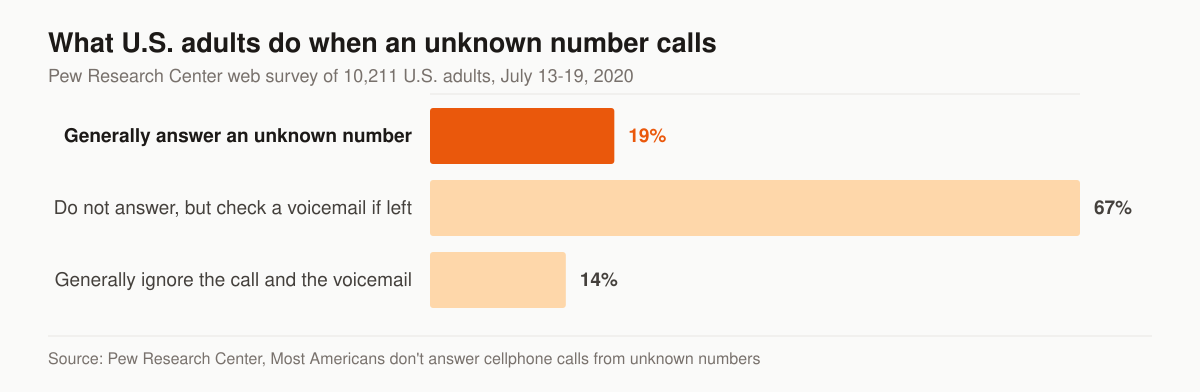
Chart: Pew Research Center web survey of 10,211 U.S. adults, 13–19 July 2020 — most Americans don’t answer cellphone calls from unknown numbers.
Pew found that 19% of U.S. adults say they generally answer a cellphone call from an unknown number, 67% say they do not answer but will check a voicemail if one is left, and 14% say they generally ignore both. Pew also reported that adults aged 18 to 29 are more likely to take calls from unknown numbers than older age groups — which is the wrong direction for a senior-market phone room.
Read the 67% as an instruction rather than a discouragement. The group that will not pick up is the same group that says it checks the voicemail, so the voicemail is not a fallback — it is the first impression. Leave one that names the request they submitted, gives your name and the agency, and states a callback number slowly and twice. That is also the caller-identification content the FCC rule asks for, so the compliant voicemail and the effective voicemail are the same voicemail.
The rest is mechanical. We dial new records the same hour they arrive rather than the next morning. Rotate outbound numbers so no single DID absorbs all the spam flags. Text where you have consent to text, because a senior who will not answer an unknown ring will often read a message. And plan more than one attempt per record before you write it off — the cadence we run is in our insurance lead follow-up cadence.
The number that decides whether telesales works
Phone selling lives or dies on lead economics. Your true cost isn’t cost per lead — it’s cost per sale. If you pay $20 per lead and close one-in-six qualified contacts, your acquisition math looks very different from the sticker price. Aged leads cost less but contact worse; fresh exclusive leads cost more but close faster.
This table lists the four levers that move a phone close rate, and which direction each one pulls.
| Lever | Effect on phone close rate |
|---|---|
| Lead freshness | Fresh = higher contact + intent; aged = cheaper, more dials needed |
| Exclusive vs shared | Exclusive removes the “I already talked to someone” wall |
| Speed-to-lead | We dial new records the same hour they arrive rather than the next morning |
| Call structure | The one lever entirely inside your control |
Work the real math before you scale dials — we lay it out in final expense lead cost vs true cost per sale. The exclusivity question is the one that usually decides the rest of the model, and we compare the two sides in exclusive versus shared final expense leads.
Track four things per source, not one. Contact rate tells you whether the data is real. Quote rate tells you whether your underwriting questions are landing. Submit rate tells you whether the close is working. Placed-and-paid rate, thirteen months out, tells you whether any of it was worth doing — and it is the number a lead vendor cannot move with a discount. Judge a source on the fourth number, and judge your script on the second and third.
What separates closers from dialers
Three habits, consistently:
- They control the call with the 7 steps instead of reacting to the prospect.
- They quote one plan, not a menu, and they ask for the card directly.
- They protect their book by underwriting honestly and drafting after the deposit, which keeps chargebacks low and renewals alive.
The product is simple. The process is what compounds. Agents who want the leads and the system behind them — feeding qualified, consented prospects into a phone room that closes — should look at our final expense marketing programs, built specifically for senior-market telesales, or the underlying insurance lead generation service if you want the engine rather than the niche packaging. And if the dialing itself is what you want off your plate, outsourced appointment setting puts qualified prospects on your calendar so your phone time is all closing.
Managed programs are published rather than quoted case by case: Foundation is $2,500 per month, Growth $3,500 and Full-Funnel $5,500, with a one-time website build of $2,500–$8,000 and ad spend billed at cost straight to the platforms. The full breakdown of what sits in each tier is on the pricing page.
If you’re not sure where your funnel is leaking — bad leads, weak follow-up, or a call structure that loses people at minute three — grab a free marketing audit and we’ll show you the numbers, not a pitch.
- Final Expense Sales Tips That Actually Move Placed Policies
Final expense sales tips from a working book: lead routing, speed-to-dial, scripting, and the close mechanics that turn contacts into issued policies.
- The Final Expense Telesales Script That Holds Up Call After Call
A final expense telesales script with numbered structure, two rebuttal tables, the federal disclosures the call must carry, and the leads that close.
- Final Expense Commission Levels for Agents: What Your Contract Actually Pays
How final expense commission levels and contract levels work for agents, what the ranges mean, and how your contract changes your real cost per sale.
- Digital Marketing for Final Expense Agents: The Channels That Actually Produce
A practitioner's guide to digital marketing for final expense agents: which channels produce leads, what each costs, and how to sequence them by budget.