How to Grow a Final Expense Insurance Agency: The Four Levers
To grow a final expense insurance agency, you pull four levers in order: predictable lead flow, agent recruiting, repeatable systems, and owned marketing assets. Growth stalls when one lever lags the others. Fix the binding constraint first, measure cost per sale, then scale spend against a proven close rate.
Growth in a final expense agency is not a mystery. It is four levers, pulled in the right order, measured against one master number: cost per acquired sale. It is easy to pull the wrong lever at the wrong time, spend into a bottleneck, and wonder why revenue plateaus while spend climbs.
Here is the operator’s view of the books.
The four levers of final expense agency growth
Every durable final expense agency runs on four interlocking levers. Pull one without the others and growth stalls.
Each lever has its own failure mode, and each failure mode shows up in a different number, which is why a single revenue figure never tells you where you are stuck.
| Lever | What it controls | Failure mode if neglected | Key metric |
|---|---|---|---|
| Lead flow | Top of funnel volume and quality | Agents idle, morale drops | Cost per lead, lead quality |
| Recruiting | Production capacity | Leads age out unworked | Agent payback period |
| Systems | Conversion and consistency | High variance, leakage | Contact rate, close rate |
| Marketing assets | Owned demand and margin | Stuck renting every lead | Cost per acquired sale over time |
The discipline is simple: find the binding constraint and fix it first. If your agents are sitting idle, lead flow is the constraint. If leads pile up unworked, you need either more agents or a tighter follow-up system. Do not pour money into the lever that feels urgent. Pour it into the one that is actually capping output.
The levers below are the ones we plan against, in that order.
Before the levers: what you are legally growing into
A producer with a personal license and a growing book is not yet an agency. In most states the entity gets licensed alongside the people inside it, and that entity licence hangs on one named human being.
NIPR, the industry’s licensing gateway, describes the application type plainly on its state requirements page: a business entity is “an agency, organization, partnership, or LLC that holds or is attempting to apply for a license.” The named human is the designated responsible licensed producer, or DRLP, and the rules governing that role are written state by state rather than nationally.
Three states, three different DRLP rules, each published by NIPR on its own state requirements page — read them side by side before you decide where to incorporate and who signs.
| State | How many DRLPs | What the NIPR page states |
|---|---|---|
| Texas | At least one | “At least one (1) Designated Licensed Responsible Producer (DRLP) must be provided on the application and must hold an active resident or non-resident license in Texas.” DRLPs “must also be specified as owners, partners, officers or directors.” |
| Arizona | Exactly one | “Exactly one Designated Responsible Licensed Producer (DRLP) must be provided on application.” The DRLP “must have an active equivalent Arizona license class on PDB (resident or non-resident) for the license class supplied in the transaction.” |
| New York | Page sets no cap | “Any Designated Responsible Licensed Producer (DRLP) listed on the application must be listed as an officer, owner, director, partner, member or manager.” |
Sources: NIPR, Texas resident business licensing, NIPR, Arizona resident business licensing, and NIPR, New York resident business licensing.
Two growth consequences fall out of those three rows. First, in Texas and New York the DRLP has to occupy a real position in the entity, so the person whose licence carries the agency is somebody with an ownership or officer stake, not a name borrowed for the form. Second, Arizona caps the count at one while Texas sets a floor of one, which means a multi-state agency cannot run a single template application across its footprint. Every state you write in has its own page, its own answers, and its own definition of who is accountable when a producer under your banner does something wrong.
Settle this before you recruit, not after. An agency that adds ten producers and then discovers its entity filing named the wrong person spends its next quarter on paperwork instead of production.
Lever one: predictable lead flow
You cannot scale on leads you cannot forecast. The goal is not the cheapest lead; it is the most predictable cost per acquired sale.
Buying leads is the normal starting point, and that is fine, it gets agents producing this week. But buying alone caps your margin and your control. The agencies that scale durably build toward owned channels so lead cost trends down over time instead of up.
A practical sequence:
- Buy to start. Use vendors to keep agents busy while you build. Understand the difference between exclusive and shared lead economics before you commit budget.
- Measure true cost. Cheap shared leads can cost more per sale than pricier exclusive ones. The math is in cost per lead versus true cost per sale.
- Build owned demand. A website, search presence, and retargeting turn marketing into an asset you own, not rent. This is the core of final expense marketing as a discipline.
On compliance: TCPA still governs how you call and text lead data, and Meta’s Special Ad Category limits how you can target housing, employment, credit, and certain other categories, though final expense lead campaigns operate under standard ad rules. The FCC’s one-to-one consent rule was vacated in January 2025, but consent hygiene is still your liability shield. Treat compliance as a trust signal, not a tax.
Lever two: recruiting that pays for itself
Recruiting is a production multiplier, but only if your systems are ready to absorb new agents. Recruit against your systems, not against promises.
Agents stay where they make money fast. That means lead availability, a working CRM, real training, and clear commission levels matter far more than recruiting pitches. The metric that governs recruiting is agent payback period, how long until a new agent covers their onboarding and lead cost.
- If payback is predictable, recruit aggressively. You have a machine.
- If payback is unknown, stop. Fix the system before adding headcount, or you will burn cash onboarding agents into a leaky funnel.
A rough planning frame for new agent ramp:
The three phases below are a scheduling frame, not a benchmark — the week numbers are where we start a plan and then move once the agency’s own first-sale data arrives.
| Phase | Weeks | Focus | Owner’s job |
|---|---|---|---|
| Onboard | 1–2 | Licensing, carrier contracting, scripts | Remove friction |
| Ramp | 3–8 | Supervised dials, first sales | Coach the close |
| Productive | 9+ | Full lead allocation | Hold the standard |
Recruiting volume without a payback model is just expensive churn. When we diagnose agent attrition, we look at the onboarding sequence before we look at the competitor down the road.
Where new agents actually come from
Recruiting plans are usually written as though the pool of licensed agents were growing underneath them. The federal numbers say otherwise, and the shape of those numbers should change how you write a recruiting offer.
The Bureau of Labor Statistics counts 572,600 insurance sales agents in 2025 and projects employment to grow 3 percent from 2025 to 2035, an increase of 18,800 jobs across the entire decade. In the same handbook: “About 43,100 openings for insurance sales agents are projected each year, on average, over the decade.” BLS attributes many of those openings to “the need to replace workers who transfer to different occupations or exit the labor force, such as to retire.”
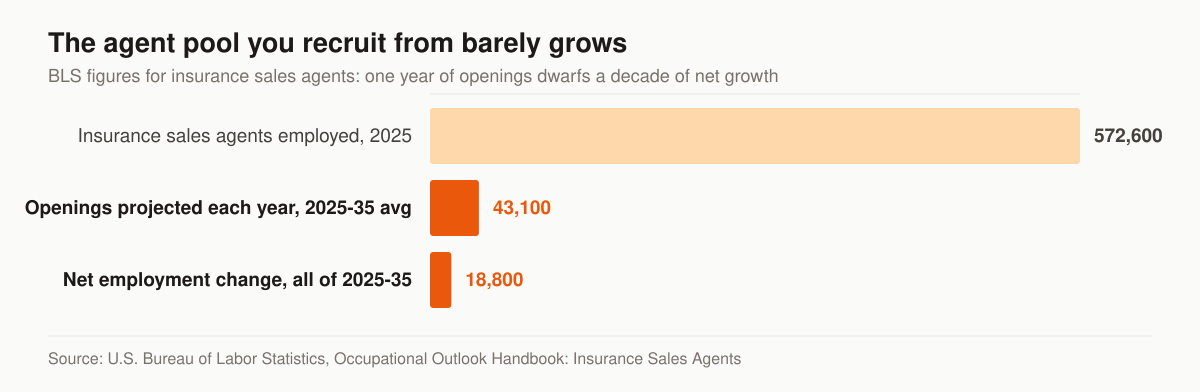
Projected openings in a single average year, 43,100, set against 18,800 of projected net employment change across the whole of 2025 to 2035. Source: U.S. Bureau of Labor Statistics, Occupational Outlook Handbook, Insurance Sales Agents.
Read those three bars together and the recruiting market comes into focus. The openings figure is an annual average; the 18,800 is the net change across the full ten years. BLS itself puts replacement, not expansion, behind many of those openings. So you are not recruiting from a pool that is filling up underneath you. You are recruiting from other people’s rosters, and your own roster is the pool somebody else is recruiting from.
That reframes two decisions:
- Retention is a recruiting activity. Every producer you keep is a seat a competing agency does not get to fill. The cheapest recruit is the agent who does not leave.
- Your offer competes on economics, not enthusiasm. BLS puts median pay for insurance sales agents at $62,280 a year, or $29.94 an hour, in its 2025 quick facts. A licensed agent weighing your opportunity has that figure, or their own version of it, in the back of their head. A pitch that cannot beat it with real lead flow and a real contract is a pitch that recruits people who leave.
The full mechanics of writing and running that offer are in our guide to recruiting insurance agents, and the contract half of the conversation sits in final expense commission levels.
Employee, contractor, or statutory employee
Before headcount grows, settle how the people you add are classified, because that classification changes what an agent costs and therefore what payback period you can promise.
Life insurance sales has its own named carve-out in the tax code. The IRS lists four categories of worker who may be treated as a statutory employee, and one of them is this: “A full-time life insurance sales agent whose principal business activity is selling life insurance or annuity contracts, or both, primarily for one life insurance company.”
That category does not sweep in every producer. It comes with three conditions, and the IRS states that social security and Medicare taxes must be withheld only when all three apply.
All three conditions have to hold at once, and each one maps to something an agency actually decides — who does the work, who owns the equipment, and how long the relationship runs.
| IRS condition, as published | The agency decision it touches |
|---|---|
| “The service contract states or implies that substantially all the services are to be performed personally by them” | Whether your producer agreement permits substitution or subcontracting |
| “They do not have a substantial investment in the equipment and property used to perform the services (other than an investment in transportation facilities)” | Who buys the dialer seat, the CRM licence, and the leads |
| “The services are performed on a continuing basis for the same payer” | Whether the relationship is ongoing or case-by-case |
The statute behind the category carries the same limits. Under 26 U.S.C. 3121(d)(3), the category reaches an individual only “if the contract of service contemplates that substantially all of such services are to be performed personally by such individual; except that an individual shall not be included in the term ‘employee’ under the provisions of this paragraph if such individual has a substantial investment in facilities used in connection with the performance of such services (other than in facilities for transportation), or if the services are in the nature of a single transaction not part of a continuing relationship with the person for whom the services are performed”.
Note the scope limiter that does most of the work in a final expense agency: primarily for one life insurance company. An independent producer writing eight carriers off your contracting is not the person that category describes. A captive-style producer writing almost everything with a single carrier under your banner may be.
We sell marketing, not tax advice. Take the classification to your CPA before you scale the roster, and take the producer agreement to counsel. What matters for the growth model is that the answer changes the fully loaded cost of one agent, and the fully loaded cost of one agent is the denominator of your payback period.
Lever three: systems that hold conversion
Systems are where good agencies separate from average ones. Two agents working identical leads can post wildly different numbers, and process is where we look before talent.
The system we fix first is follow-up cadence. A sale can land on the fifth touch as readily as the first, and the lead is already paid for either way, so we treat the sequence rather than the first dial as the unit of work. A disciplined lead follow-up cadence recovers sales you already paid for. The leads are sunk cost; the follow-up is free margin.
Core systems to standardize:
- CRM and lead routing so no lead sits unworked and aging. If you are still choosing one, start with the CRM comparison for insurance agents.
- A tested phone script so close rate does not depend on who picks up the dial.
- Speed-to-lead so fresh leads get worked while intent is high.
- Persistency tracking so you write business that sticks, not chargebacks waiting to happen.
Track the funnel, not just the top: cost per lead, contact rate, close rate, average annual premium, and chargeback rate. The master metric is cost per acquired sale. It is the reading we plan against, because it is the one that answers whether spending more on leads or agents is actually profitable. Raw lead count is a vanity metric that hides the truth.
The call system the FCC requires before somebody else dials for you
A solo producer dialing their own leads carries their own compliance record in their own head. An agency does not have that luxury, and the rule that catches growing agencies is not the famous one about consent. It is the unglamorous internal do-not-call requirement.
47 CFR 64.1200(d) opens by stating that “No person or entity shall initiate any artificial or prerecorded-voice telephone call pursuant to an exemption under paragraphs (a)(3)(ii) through (v) of this section or any call for telemarketing purposes to a residential telephone subscriber unless such person or entity has instituted procedures for maintaining a list of persons who request not to receive such calls made by or on behalf of that person or entity.” Then it lists what those procedures must contain.
Six minimum standards, each written into the rule itself, and each one turns into an operational artifact the moment more than one person is dialing under your name.
| Standard in 47 CFR 64.1200(d) | What the rule requires, as printed | What it becomes in an agency |
|---|---|---|
| (1) Written policy | A “written policy, available upon demand, for maintaining a do-not-call list” | A document, not a habit |
| (2) Training of personnel | Personnel “engaged in any aspect of telemarketing must be informed and trained in the existence and use of the do-not-call list” | An onboarding module every new agent completes |
| (3) Recording, disclosure of do-not-call requests | Record the request and place the name and number on the list “at the time the request is made”; honor within a period that “may not exceed ten (10) business days from the receipt of such request” | A field in the CRM, not a note in a notebook |
| (4) Identification of callers and telemarketers | Provide “the name of the individual caller, the name of the person or entity on whose behalf the call is being made, and a telephone number or address at which the person or entity may be contacted” | A scripted opening nobody is allowed to improvise |
| (5) Affiliated persons or entities | A request applies to the entity making the call and “will not apply to affiliated entities unless the consumer reasonably would expect them to be included” | A decision about how your downline shares data |
| (6) Maintenance of do-not-call lists | “A do-not-call request must be honored for 5 years from the time the request is made.” | A retention policy that survives an agent’s departure |
Source: eCFR, 47 CFR 64.1200, current text.
One sentence in standard (3) is the one to reread if you are outsourcing dialing or handing lists to a downline: “If such requests are recorded or maintained by a party other than the person or entity on whose behalf the call is made, the person or entity on whose behalf the call is made will be liable for any failures to honor the do-not-call request.” Outsourcing the dialing does not outsource the liability.
The revocation clock runs on the same ten-business-day schedule. Paragraph (a)(10) of the same section, which governs calls made pursuant to paragraphs (a)(1) through (3) and (c)(2), states that “All requests to revoke prior express consent or prior express written consent made in any reasonable manner must be honored within a reasonable time not to exceed ten business days from receipt of such request,” and it adds that callers “may not designate an exclusive means to request revocation of consent.” A “reply STOP only” policy is not a compliant policy on its own.
On the consent rule that agencies still ask about: in Insurance Marketing Coalition Ltd. v. FCC, No. 24-10277, decided 24 January 2025, the Eleventh Circuit wrote that “we agree with IMC that the FCC exceeded its statutory authority under the TCPA because the 2023 Order’s new consent restrictions impermissibly conflict with the ordinary statutory meaning of ‘prior express consent.’” The court’s disposition was narrow and specific: “we grant IMC’s petition for review, vacate Part III.D of the 2023 Order, and remand for further proceedings.” What came off the board was Part III.D of that order. The consent requirement itself, and the internal do-not-call machinery above, did not move. The wider compliance picture for a growing shop is in our guide to insurance marketing compliance for agents.
Lever four: marketing assets you own
Bought leads are fuel for today. Owned marketing assets are equity for tomorrow.
An agency that rents every lead is always at the mercy of vendor pricing and exclusivity. An agency that builds owned channels, a fast website, organic and AI search presence, an email list, and retargeting audiences, watches its blended cost per sale fall over time. That is the difference between a job and an enterprise. If building those assets yourself isn’t realistic, it’s worth understanding what an insurance marketing agency actually does and how to choose the right one for your line before you hand the work to anyone, and our own pricing page publishes the three monthly tiers and the one-time build range, so you can put a real number against the build-versus-buy decision. Agencies and FMOs that want the whole engine run under their own brand can use white-label marketing for FMOs and agencies instead of building it in-house.
Where to invest, in rough priority:
- A conversion-built website. Speed matters; Google’s Core Web Vitals thresholds affect both rankings and conversion. See our approach to final expense websites.
- Search visibility. Ranking and getting cited by AI engines compounds. Our guide on growing an agency’s organic presence covers the mechanics.
- An owned lead engine. Build toward generating your own final expense leads so you are not solely dependent on vendors.
What to review every month
A growth plan that is reviewed annually is a wish. The review that changes behaviour is monthly, short, and built out of readings rather than trophies. Each row below is a question the number answers, plus the move a bad reading argues for.
Eight readings, one page. Notice that only one of them is a spend figure — the rest describe what happens to the money after it is spent.
| Reading | The question it answers | What a bad reading argues for |
|---|---|---|
| Cost per lead | What the top of the funnel costs this month | Nothing on its own; only meaningful next to close rate |
| Contact rate | Whether you are reaching the people you bought | Check dial timing, caller ID reputation, and the source |
| Close rate per contact | Whether the conversation works | Coach the script before buying more leads |
| Cost per acquired sale | Whether spending more is profitable | If it is climbing, stop scaling and diagnose |
| Average annualized premium | What one sale is worth to you | Look at carrier and product mix |
| Agent payback period | How long a new producer costs you money | If it is unknown, pause recruiting until it is not |
| Chargeback and persistency | Whether the business you wrote stays on the books | Examine underwriting fit and draft dates |
| Lead age at first dial | Whether speed-to-lead survived your growth | Route leads automatically instead of in batches |
Two of those rows deserve a note. Cost per acquired sale is the reading that lets you compare two completely different growth moves, a lead-price increase against a new hire, on the same scale. And lead age at first dial is the reading that quietly degrades as an agency grows, because a routing habit that works with three agents stops working at twelve. The final expense sales funnel breakdown shows where those leaks normally sit.
A 90-day sequence for one binding constraint
Diagnosis is worth nothing without a calendar attached to it. Pick the single constraint you identified, then run one quarter against it rather than four half-quarters against four things.
The same 90 days look completely different depending on which lever is binding, which is the entire argument for diagnosing first.
| If the constraint is | Days 1–30 | Days 31–60 | Days 61–90 |
|---|---|---|---|
| Lead flow | Measure cost per acquired sale by source, not cost per lead | Cut the worst source, move that budget to the best one | Add one owned channel so next quarter’s mix is not all rented |
| Recruiting | Write down the payback period you can actually evidence | Fix the onboarding step where new agents currently stall | Recruit against the fixed system, not against a promise |
| Systems | Instrument the funnel so contact and close rates exist as numbers | Standardize the script and the follow-up cadence | Automate routing so lead age at first dial stops drifting |
| Marketing assets | Audit the site, the tracking, and the consent records | Ship the pages that answer buyer questions | Measure blended cost per sale against the quarter you started from |
At the end of the quarter you re-measure cost per acquired sale and ask the diagnosis question again. The constraint has usually moved, which is the point. An agency that fixes lead flow and keeps spending on lead flow is an agency that will spend the following quarter drowning agents in leads they cannot work.
Pull the levers in order
Growth is sequential, not simultaneous. Diagnose the binding constraint, fix it, re-measure cost per acquired sale, then move to the next lever. Idle agents? Lead flow. Unworked leads? Recruiting or systems. Thin margins? Owned assets. Skipping this diagnosis is how owners spend more every quarter and grow slower every year.
If you want an operator to look at your numbers and tell you which lever is actually capping your agency, start with a free marketing audit. We will show you the math, not the hype. For the marketing engine underneath that growth, see the marketing for final expense agents playbook. Agencies that grow through a downline rather than headcount usually need that engine packaged under their own brand instead — that is white-label insurance marketing.
- Best Final Expense Agent Website Examples: What Actually Converts
What separates the best final expense agent websites from brochure sites: a criteria checklist, conversion patterns, and a scoring table to run on yours.
- How to Evaluate the Best Final Expense Carriers for Agents
How to evaluate the best final expense carriers for agents: underwriting niches, issue ages, graded wording, ratings and a scoring framework.
- Digital Marketing for Final Expense Agents: The Channels That Actually Produce
A practitioner's guide to digital marketing for final expense agents: which channels produce leads, what each costs, and how to sequence them by budget.
- Final Expense Sales Tips That Actually Move Placed Policies
Final expense sales tips from a working book: lead routing, speed-to-dial, scripting, and the close mechanics that turn contacts into issued policies.