How to Evaluate the Best Final Expense Carriers for Agents
The best final expense carriers for agents are the ones that pay your case mix — match a carrier's underwriting niche (tobacco, diabetes, COPD), commission level, and modal rate to the clients your leads actually produce. There is no single "best" carrier; there is a best fit per book.
There is no universal “best” final expense carrier. There is a best carrier for a 67-year-old diabetic smoker in Texas at standard build, and a different one for a clean-health 61-year-old non-smoker. The agents who out-earn their peers are not the ones who found a secret carrier — they are the ones who match each case to the carrier that underwrites it cheapest and approves it fastest.
So the right question is not “who is the top carrier?” It is “how do I evaluate the best final expense carriers for agents for the clients my leads actually produce?” This guide gives you a scoring framework instead of a leaderboard that will be stale by next rate change.
We sell into this market ourselves. From running our own final-expense and senior-market lead operation, we treat carrier fit as a front-end problem rather than a back-office one: the lead source decides which health profiles sit down at the table, and the health profile decides which carrier can place them.
Why “best carrier” is the wrong frame
Final expense underwriting is niche-driven. Each carrier prices health conditions differently, and a carrier that is brutal on COPD may be the cheapest in the country on insulin-controlled diabetes. Rankings you find online average across every profile, which means they are wrong for almost every individual client.
Your lead source decides which niches you need covered. If you run direct-mail seniors with heavy health issues, you need strong graded and guaranteed-issue options. If you run cleaner digital leads, immediate-benefit rate competitiveness matters more. Choosing carriers before you understand your case mix is backwards — start with the leads, not the leaderboard. If you are still defining that flow, our breakdown of building a predictable final expense lead system walks through what kind of client each channel produces.
The size of the field is the other reason a leaderboard is a poor tool. The ACLI’s 2025 Life Insurers Fact Book reports that “The U.S. life insurance industry in 2024 is made up of 711 companies with sales and operations across the country and U.S. territories,” with the data as of December 31, 2024 (Table 11.1) (ACLI 2025 Life Insurers Fact Book, chapter 11). Not all 711 write small-face senior whole life, and your FMO will only offer a slice of the ones that do. But a five-name list is a filter someone else applied for you, and the filter was not built around your case mix.
The criteria that actually matter
Evaluate every carrier against the same scorecard. Score each 1–5, weight by what your book needs, and total it.
| Criterion | What to check | Why it matters |
|---|---|---|
| Underwriting niche | Which conditions get immediate vs. graded benefit | Decides who you can place at the best rate |
| Modal premium | Monthly rate at your common ages/rate classes | This is what closes the sale, not the brand |
| Decision speed | Point-of-sale approval vs. days-long review | A same-day “approved” prevents buyer’s remorse |
| Rate class structure | Tobacco/non-tobacco, build chart, table ratings | Determines how many clients you place clean |
| Issue ages and face band | The published minimum and maximum on each product | A case outside the band never gets quoted at all |
| Commission level | Street vs. your contracted level | Affects income, but not in isolation (see below) |
| Persistency / chargebacks | Lapse behavior, advance vs. as-earned terms | Quietly decides your real take-home |
| E-app & tools | Quoting, e-signature, voice signature | Speed at the table and on the phone |
| Carrier stability | Financial strength rating | Trust signal for you and the client |
| Complaint record | Individual life complaint index | The service experience your client will have |
| State availability | Product approval chart for the states you work | A carrier not approved in your state is not on your list |
A practical way to use this: pull three or four real client profiles from your last month of leads, quote them across candidate carriers, and let the modal premiums and approval outcomes rank the carriers for you. That beats any published list.
Which carriers agents actually name, and why the published lists disagree
Before you score anything you need a candidate list, and the honest way to build one is to read several published lineups and notice where they overlap.
Three sources agents commonly land on name overlapping but not identical rosters, which is itself the argument against treating any one of them as the answer.
| Published list | What it names |
|---|---|
| Pinnacle Financial Services, “Top Final Expense Insurance Companies for Agents” (last updated 4/23/2026) | Mutual of Omaha – Living Promise Final Expense; Americo – Eagle Series Final Expense; Accendo/CVS Health – Final Expense; AIG – Guaranteed Issue Final Expense; Foresters Financial – PlanRight Final Expense |
| New Horizons Insurance Marketing, final expense carrier page | Aetna, Corebridge Financial (AIG), CVS Health, Foresters, Gerber Life, Liberty Bankers Life, Mutual of Omaha, Oxford Life, Royal Neighbors of America, Transamerica |
| Choice Mutual, consumer-facing burial insurance comparison | Mutual of Omaha, Aflac, AARP, Aetna, TruStage, AAA, plus Foresters, Liberty Bankers, American Amicable, Royal Neighbors, USAA, Physicians Mutual, Lincoln Heritage, Gerber, State Farm, AIG and Colonial Penn |
Sources: Pinnacle Financial Services, New Horizons Insurance Marketing and Choice Mutual, all read on 5 September 2026.
Two things are worth reading out of that table. The first is that an FMO’s list is a distribution roster — it tells you which carriers that FMO can contract you with, not which ones underwrite your cases best. The second is that a consumer comparison site and an agent-facing FMO are answering different questions: one is ranking on retail price and service, the other on what it can appoint you to sell. Neither is your scorecard. Both are useful raw material for it.
Pinnacle’s page also makes a product-level point worth carrying into your own evaluation: on the plans it lists, “all these plans will include a no-cost accelerated death benefit rider for chronic and terminal illnesses.” Riders that come free change the pitch, and they are a comparison dimension that is easy to skip past on the way to the rate.
Same client, three carriers: what the price spread looks like
The clearest evidence that brand ranking and case fit are different things comes from quoting one impaired profile across several carriers.
Choice Mutual publishes a worked example on the page above. Its stated profile is “a 65-year-old female diagnosed with diabetes at age 42 who does not use tobacco,” quoted at $20,000 of coverage.
Same client, same face amount, same published comparison — and the carrier the page rates first is both the priciest of the three and the only one of them imposing a waiting period.
| Carrier | Monthly premium at $20,000 | Waiting period |
|---|---|---|
| Aflac | $83.77 | No waiting period |
| Aetna | $91.70 | No waiting period |
| Mutual of Omaha | $98.79 | Two-year waiting period |
Source: Choice Mutual, “6 Best Burial Insurance Companies In 2026,” updated 8 June 2026, read 5 September 2026.
Run the consequence for the agent rather than the buyer. The three published premiums for the same client at the same face amount are $83.77, $91.70 and $98.79 a month, and the distance between the ends of that range is also the distance between a policy that pays a full death benefit from day one and one that does not. When a client compares your quote against a competitor’s and yours is the graded one at the higher price, you do not lose on price alone — you lose on the explanation you now have to give. That is a placement problem created before the appointment, by which carriers you were contracted with.
What “graded” actually pays in the two years that decide the complaint
Agents describe graded plans in shorthand at the table — “partial for two years” — and the shorthand is where the complaints come from. The certificate wording is specific, it varies between carriers, and it is written down.
Foresters publishes three certificate types on its PlanRight whole life final expense product. The Level certificate is straightforward: “the death benefit is based on 100% of the face amount in effect.” The Graded certificate “has a limited death benefit in the first two years, which is based on the greater of a) the sum of the total premiums paid accumulated with 4.5% interest, or b) 30% of the face amount in effect in the first year, and 70% of the face amount in effect during the second year. From year three onward, the death benefit is based on 100% of the face amount in effect.” The Modified certificate is different again: it “has a limited death benefit in the first two years which is based on the return of premiums paid plus 10% interest,” then pays full face from year three (New Horizons Insurance Marketing, Foresters PlanRight product information).
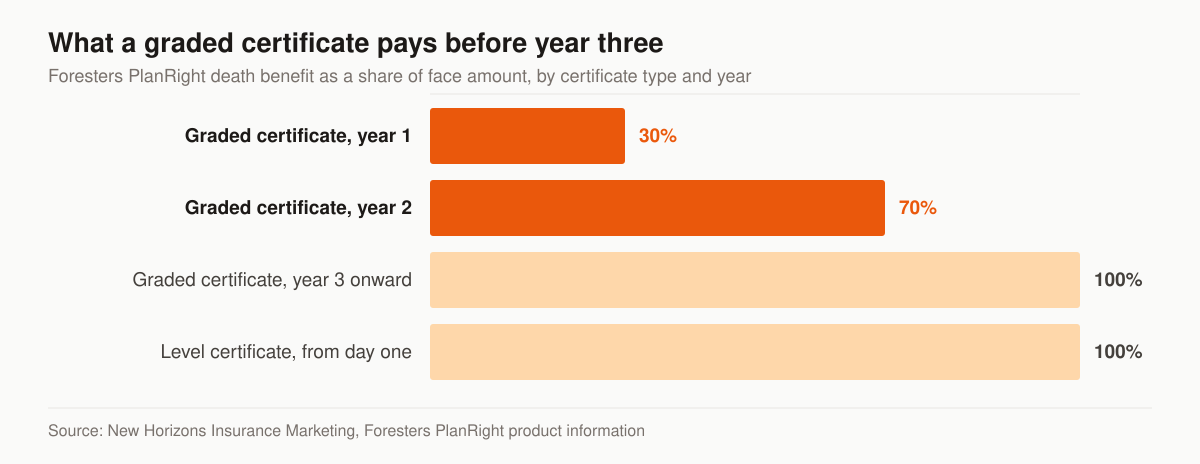
The graded figures are a floor, not the whole formula — the certificate pays the greater of that share of face or premiums paid accumulated with 4.5% interest. Source: New Horizons Insurance Marketing, Foresters PlanRight product information.
Three practical notes follow from reading it that closely.
First, “graded” and “modified” are not synonyms, even inside one carrier’s product family. A percentage-of-face floor and a return-of-premium-plus-interest formula pay very different amounts on an early death, and a client who was told “partial benefit” heard neither of them.
Second, the interest rate is part of the promise. A graded certificate that accumulates premiums at 4.5% and a modified certificate that returns premiums plus 10% interest are two different products for the same shorthand, and the difference shows up in the one conversation you never want to have with a beneficiary.
Third, this is the wording that belongs in your own marketing, not a paraphrase of it. Ad copy and landing pages that promise “full coverage, no health questions” while the certificate pays a return of premium for two years is exactly the mismatch that generates complaints and chargebacks. We treat that alignment as a compliance requirement, which is why guaranteed issue marketing gets built as its own campaign with its own promise rather than as an overflow bucket for declines, and why simplified issue campaigns get separate creative.
Read the product parameters before you read the brand
Issue ages and face bands are a hard filter on your book, and they are quick to check. A case outside the band never gets a quote regardless of how good the carrier’s diabetes underwriting is.
Four carrier products, as published on their FMO’s own agent pages in September 2026 — note that no two share the same age band, face band and rider set.
| Product | Issue ages | Face amount | Underwriting notes |
|---|---|---|---|
| Mutual of Omaha, Living Promise level benefit | 45–85 | $2,000–$40,000 | Standard tobacco/non-tobacco classes; accidental and accelerated death benefit riders; “No death benefit reductions in early years” |
| Mutual of Omaha, Living Promise graded benefit | 45–80 | $2,000–$20,000 | “Standard underwriting class (no tobacco distinction)”; no riders |
| Royal Neighbors of America, Simplified Issue Whole Life | 50–85 (age last birthday) | $5,000–$25,000; graded death benefit $5,000–$10,000 | Tobacco/non-tobacco; “No Substandard”; “No Preferred”; Montana applications must use male rates for both male and female applicants |
| Corebridge Financial (AIG), Guaranteed Issue Whole Life | 50–85 | $5,000–$25,000 | Guaranteed acceptance, no medical exam; the total of all such policies on one person cannot exceed $25,000; chronic and terminal illness living benefits included at no extra cost |
Sources: New Horizons Insurance Marketing agent pages for Mutual of Omaha, Royal Neighbors of America and Corebridge Financial (AIG), read 5 September 2026.
Read the Royal Neighbors row twice. “No Substandard” and “No Preferred” means the product has no table ratings to fall back on — a case either fits the class or it does not, which makes the product fast at the table and useless as a catch-all. The Montana rating note is the kind of state-specific rule that never appears in a top-five list and changes a quote on the spot. And the AIG aggregate limit means a client who already holds a $25,000 guaranteed issue policy from that carrier is not a prospect for a second one, no matter what the lead card said.
The same reading applies to the Mutual of Omaha rows. The level plan carries a tobacco distinction and the graded plan does not, which means a smoker’s relative cost between the two plans is not what the level-plan rate table implies. And the graded plan carries no riders at all — so the accelerated death benefit that made your presentation work on the level plan is gone on the case that most needs a fallback.
One honesty note about published parameters, because it matters more than the parameters themselves. Two of the sources cited on this page disagree about the same product: the New Horizons agent page lists a $2,000–$40,000 benefit on the Living Promise level plan, while the Choice Mutual card for Mutual of Omaha lists coverage limits of $2,000–$50,000. Both were read on the same day. Neither is the underwriting document. Use published summaries to build your shortlist and the carrier’s current field guide and state approval chart to quote a case.
Financial strength ratings: what an A+ does and does not tell you
Every FMO page leads with a rating. New Horizons states plainly that “Mutual of Omaha is A+ Rated by A.M. Best.” It is tempting to repeat that letter at the kitchen table as a claims-payment guarantee. The rating guide says it is not one.
A.M. Best’s own published guide defines a Financial Strength Rating as “an independent opinion of an insurer’s financial strength and ability to meet its ongoing insurance policy and contract obligations,” then draws the boundary explicitly: an FSR “is not assigned to specific insurance policies or contracts and does not address any other risk, including, but not limited to, an insurer’s claims-payment policies or procedures; the ability of the insurer to dispute or deny claims payment on grounds of misrepresentation or fraud; or any specific liability contractually borne by the policy or contract holder.” It also states that an FSR “is not a recommendation to purchase, hold or terminate any insurance policy” (A.M. Best, Guide to Best’s Financial Strength Ratings).
The scale itself is also easy to misread. On the published FSR scale, the Superior category carries the rating symbol A+ with A++ as its notch, and the Excellent category carries A with A- as its notch. The guide’s footnote explains the mechanism: every category from A+ down to C carries a rating notch, expressed as either a second plus or a minus, reflecting a gradation of financial strength inside that category.
| Category | Symbol and notch | What A.M. Best says it means |
|---|---|---|
| Superior | A+, A++ | “a superior ability to meet their ongoing insurance obligations” |
| Excellent | A, A- | “an excellent ability to meet their ongoing insurance obligations” |
| Good | B+, B++ | “a good ability to meet their ongoing insurance obligations” |
| Fair | B, B- | “a fair ability to meet their ongoing insurance obligations. Financial strength is vulnerable to adverse changes in underwriting and economic conditions.” |
| Marginal | C+, C++ | “a marginal ability to meet their ongoing insurance obligations” |
| Weak | C, C- | “a weak ability to meet their ongoing insurance obligations” |
| Poor | D | “a poor ability to meet their ongoing insurance obligations” |
The table above is the published scale verbatim; the practical use of it for an agent is narrower than the letter suggests. Treat the rating as a floor test — a screen you apply once, at contracting, to rule a carrier in or out — rather than a tie-breaker between two carriers you would otherwise both write. Two carriers holding the same rating can still quote very different monthly premiums on the same client, and that difference is the one your prospect can see.
The complaint index that belongs in your scorecard
Financial strength describes whether the money will be there. Complaint data describes what your client’s experience will be after you leave the house, which is the part that generates cancellations, replacement calls and the reviews that decide whether your referrals compound.
The NAIC scores insurers on a complaint index normalized to market share. Choice Mutual’s carrier cards state the convention plainly and link each score to the NAIC’s own database: “The Complaint Index compares a company’s performance to other companies in the market. The National Complaint Index is always 1.00. That means a company with a complaint index of 2.00 is twice as high as expected in the market.” Its cards plot three years of individual life scores, valid as of 17 June 2026 — the Aetna card shows 0.0 across the three plotted years 2023 to 2025; the Mutual of Omaha card shows 0.66, 0.43 and 0.78; the Aflac card shows 3.26, 3.33 and 3.30; the AAA Life card shows 2.67, 2.4 and 1.6 (Choice Mutual).
Hold two scope limits on those numbers. They cover all individual life business at the company level, not final expense specifically, and they measure complaints filed with state departments of insurance relative to a company’s share of the market — not the quality of any one product. They are a signal about service, and they belong next to the rate and the underwriting niche in your scorecard, not above them.
The reason this matters commercially is retention. Service problems turn into cancellations, and a cancellation inside the advance window comes back to you as a chargeback. That is the same mechanism we describe in cost per lead versus true cost per sale, arriving from the carrier side instead of the lead side.
Underwriting niches: where the money is made
Your placement edge comes from knowing which carrier eats which condition. Build a simple cheat sheet:
- Immediate (day-one) benefit — your default goal; the cleanest rate and the easiest close.
- Graded benefit — partial payout in years 1–2; for moderate health issues.
- Modified benefit — return of premium with interest in years 1–2 on the carriers that use this structure.
- Guaranteed issue — no health questions, two-year waiting period; your fallback so you never leave the house empty-handed.
The specific conditions each carrier rewards — insulin diabetes, blood thinners, recent cardiac events, oxygen use, height-and-weight — change with every underwriting update. Do not trust a number you cannot pull from the current field guide. Verify niches directly before you contract.
Guaranteed issue deserves a hard look, because it is where an under-built shelf quietly costs you. The Corebridge product above accepts ages 50 to 85 and caps at $25,000 across all such policies on one person. A prospect aged 86, or one already holding that carrier’s maximum, has no product on that shelf at all — and if guaranteed issue is your only fallback, that appointment ends with nothing written. If your lead source runs heavily impaired, a second guaranteed-issue contract earns its keep for exactly that reason.
Policy fees, e-apps and the mechanics that decide speed at the table
Rate comparisons run on base premium. Your client pays the billed amount, and your commission is usually calculated on collected premium, so the mechanics between those two numbers are worth a line in your scorecard.
The Mutual of Omaha page lists a $36 policy fee on the Living Promise plans, alongside a policy “guaranteed to age 100 as long as premium is paid,” simplified underwriting, and the iGo e-App. On a small-face policy a flat annual fee is a real share of the modal premium, and it is charged the same whether the face amount is $5,000 or $40,000 — which makes fee structure a bigger deal at the bottom of the face range than at the top.
Foresters attaches a Common Carrier Accidental Death Rider automatically to PlanRight certificates and offers an optional Accidental Death Rider at extra cost on the level death benefit version. The published rider descriptions carry no age limit; the age figure belongs to the base certificate, which Foresters markets as providing “lifetime life insurance coverage (up to age 121)”. Royal Neighbors attaches an “Accelerated Living Benefit - Terminal Condition and Permanent Confinement (Form Series 1766)” at no additional premium in approved states, which allows “Up to 75% of eligible death benefit” to be accelerated as a single payment with a minimum of $5,000.
Those three details do the same job in a presentation: they are things the client keeps that do not show up in a rate comparison. An agent who leads with rate and never mentions them is competing on rate alone, which any competitor can undercut. If your website and follow-up sequences never surface them either, that is a content problem as much as a sales one — our final expense sales funnel breakdown covers where in the sequence product detail belongs.
State availability is a filter, not a footnote
A carrier your state has not approved is not a carrier, and the pattern is consistent enough to plan around. On the pages read for this guide, the Mutual of Omaha Living Promise level benefit “is available in all states except New York,” Corebridge’s Guaranteed Issue Whole Life is described as available in 49 states with New York excluded, Royal Neighbors notes that “Rider not available in all states; contractual provisions may vary by state,” and Foresters “is available in every state.”
Two consequences for how you build a book. If you write New York, your entire shortlist changes and national final expense comparisons written around a 49-state shelf are not written for you. And if you write across state lines — which a telesales operation does by design — your shelf has to be checked state by state before the campaign runs, not after a case is declined. The mechanics of running that kind of multi-state operation are in our guide to selling final expense over the phone.
Commission level is real money — but read it with persistency
Commission level matters. It is also the number agents over-index on. A higher street level on a carrier that declines your client, or whose policies lapse in month four and trigger a chargeback, pays you less than a slightly lower level on a carrier that approves and sticks.
Three things to weigh together:
- Contracted level — what you actually get, not the advertised street level.
- Advance terms — how much is advanced vs. as-earned, and the chargeback window.
- Persistency — whether this carrier’s policies stay on the books in your market.
If you want the full mechanics of how levels are set and what to negotiate, see our explainer on final expense commission levels for agents, which reads a published carrier-by-carrier grid line by line. And before you assume more leads fixes a thin income, read cost per lead vs. true cost per sale — carrier fit and persistency move that number more than lead price does.
There is a direct link between the product parameters above and your blended commission rate. Guaranteed issue and graded rows sit at the bottom of the published 2026 grid that piece reads line by line, so a lead source weighted toward impaired risk pushes your average rate down without anyone renegotiating anything. Carrier selection and lead sourcing are one decision made twice, and the FMO you contract through sits in the middle of both.
A repeatable evaluation process
Run this every time you consider adding a carrier:
- List your real case mix. Pull 20–30 recent leads; tag age, tobacco, and top health conditions.
- Check the hard filters first. Issue ages, face band and state approval — a carrier that fails these never reaches the scorecard.
- Quote 3–4 carriers across those exact profiles using your FMO’s quoting tool.
- Read the graded and modified wording on any product you might place an impaired case with, and write down what it pays in year one.
- Score each carrier on the criteria table; weight by how often each profile appears.
- Check the contract terms — level, advance percentage, chargeback window.
- Confirm decision speed — point-of-sale matters more than a 1% rate edge.
- Re-run quarterly. Rates and underwriting move; your “best” list should too.
Carry three to five carriers, not fifteen. One or two for clean immediate-benefit cases, the rest covering your specific niches and a guaranteed-issue fallback.
What your carrier shelf does to your marketing plan
The shelf you contract sets the audience you can profitably advertise to, and that is where carrier selection stops being a back-office decision.
If your strongest contracts are level-benefit products with tobacco distinctions and $40,000 face ceilings, your marketing should be pulling newly retired, relatively healthy buyers — and your targeting, creative and landing-page copy should say so. If your shelf is weighted toward guaranteed issue and graded, your campaigns should be built for impaired prospects, priced against a lower average commission, and written so nobody arrives expecting day-one coverage. Running impaired-risk creative against a level-benefit shelf produces appointments you cannot place; running clean-health creative against a guaranteed-issue shelf produces prospects who will out-shop you.
Three campaign decisions follow directly from the shelf:
- Age band. Your carriers’ published issue ages are the outer edge of your targeting. Advertising to 86-year-olds when your shelf stops at 85 buys declines.
- Offer wording. “No health questions” is only honest where you hold a guaranteed-issue contract, and it carries a two-year waiting period you have to state.
- Follow-up length. Impaired prospects compare more and close slower, which means a longer cadence and a lower tolerance for slow speed-to-lead.
That alignment between shelf and campaign is the work we do. Our lead generation programs are built around a defined buyer profile rather than a volume target, and the monthly programs on our pricing page run from $2,500 to $5,500 a month depending on how much of the funnel we operate.
Compliance and the leads behind the sale
Carrier choice is only half the equation. The lead has to be one you can legally and consistently work. TCPA still governs how you contact prospects, and how you generate and follow up on leads determines whether your best carrier ever gets a quote. If your front end is shaky, even a perfect carrier match dies on the dial. The wider set of rules that govern lead sourcing, advertising claims and disclosure sits in our insurance marketing compliance guide.
There is a second compliance dimension specific to this page. Product literature is the document your advertising has to agree with. If the certificate pays a return of premium plus interest for two years, your ad cannot promise a full benefit, and your script cannot round the wording off. Building the campaign from the field guide rather than from a competitor’s headline is an inexpensive compliance control for a small agency.
That is the part we build for agents. If your lead flow is inconsistent or your follow-up is leaking deals, get a free marketing audit and we will show you, with numbers, where the book is losing money before it reaches a carrier.
Bottom line
The best final expense carriers for agents are the ones that underwrite your case mix at a competitive modal rate, approve at the point of sale, and stay on the books. Skip the leaderboards. Check the hard filters — issue ages, face band, state approval — before you score anything, read the graded and modified wording on every product you might place an impaired case with, and treat the financial strength rating as a floor test rather than a tie-breaker. Then score carriers against the criteria above using your own leads, verify every niche and rate directly, and re-run it quarterly. When the front-end lead engine and the back-end carrier fit both line up, your close rate and your persistency rise together — and that is where the income actually comes from.
- Final Expense Commission Levels for Agents: What Your Contract Actually Pays
How final expense commission levels and contract levels work for agents, what the ranges mean, and how your contract changes your real cost per sale.
- How to Grow a Final Expense Insurance Agency: The Four Levers
How to grow a final expense insurance agency on four levers: lead flow, recruiting, systems, and marketing assets, with numbers and tables for each.
- Best Final Expense Agent Website Examples: What Actually Converts
What separates the best final expense agent websites from brochure sites: a criteria checklist, conversion patterns, and a scoring table to run on yours.
- Digital Marketing for Final Expense Agents: The Channels That Actually Produce
A practitioner's guide to digital marketing for final expense agents: which channels produce leads, what each costs, and how to sequence them by budget.