Best Insurance Marketing Agencies & Companies: A Buyer's Guide
Insurance marketing companies fall into eight provider models, priced from self-serve software up to $5,000+/mo done-for-you retainers. Our own tiers run $2,500–$5,500/mo plus a $2,500–$8,000 build. Judge on vertical depth, pricing model, compliance, and asset ownership — and check whether a 'top 10' list ranked anything or just sorted alphabetically.
There is no single best insurance marketing agency — the right provider depends on your line, your budget, how much you want done for you, and how much you value owning what you build. Search the phrase — or “companies,” or “firms,” the terms get used interchangeably — and you’ll mostly find listicles that rank a “#1” and hand out star ratings, usually to whoever paid for the placement. That’s not useful when you’re the one signing the check.
So this isn’t a ranking. It’s the buyer’s framework we’d use ourselves, plus the types of providers in the market — full-service companies, specialist firms, consultants, freelancers, platforms — and their tradeoffs. We build marketing systems for agents, so we’re one option on this map, and we’ll say plainly where a different model fits you better. What we sell is insurance marketing services, all lines, one program: the same engine — site, search, ads, content, follow-up — run for final expense, Medicare, life, annuity, group, ACA, auto, home and P&C agents, priced as fixed retainers rather than a per-channel menu.
Declaring the bias up front: we run insurance marketing services for agents as a done-for-you program, and we’re an insurance marketing agency anchored in the senior market. If you already know you want the system built and operated for you, skip to where we fit or go straight to what it costs — the rest of this page is the criteria you’d use to judge us, or anyone else, against the alternatives.
4 things an insurance marketing agency should do for you
At minimum, an insurance marketing agency should build and run the system that turns strangers into booked appointments: a website that converts, traffic from ads or search, lead capture and follow-up, and reporting tied to policies written — not impressions. Anything less is a vendor selling you an activity.
The exact mix shifts with the model you hire: a full-service company runs the whole funnel, a consultant hands you the plan and leaves the execution to you, a platform gives you tools and a login. If you want the complete service list before comparing anyone, start with the breakdown of what these agencies actually do day to day — it defines every service in plain terms so a sales call can’t hide behind jargon.
“Best way to advertise my insurance agency”: local search, then ads
The order we recommend for advertising an insurance agency is to own local search first, then buy paid reach once your intake converts. A Google Business Profile, a steady review flow, and a site that answers buying questions compound month over month; ads rent attention and stop the day the card stops.
That ordering is the whole argument. Search and reviews are assets you keep — they keep producing after the invoice clears — while Google Ads, Meta, and lead-vendor spend are rented traffic that disappears at zero budget. The mistake agents make is buying rented traffic before the thing it points at can convert, which is how you end up paying twice for the same lead. Fix the site, the offer, and the follow-up first; then let ads pour volume into something that holds water.
Channel choice after that is a function of your line: Medicare and final expense reward direct mail, referral partnerships, and educational content within CMS rules; P&C and auto reward local SEO, review volume, and account rounding. The full sequencing lives in our digital marketing playbook for insurance agents, and if you want it as a written plan rather than a channel list, use the insurance agency marketing plan template. An agency worth hiring will argue for this order too — if the first thing a pitch reaches for is ad spend, you’re being sold a channel, not a system.
What to look for in an insurance marketing company: 6 criteria
Before you compare any two providers, decide what you weight most. These are the axes that separate a good fit from an expensive mismatch:
- Line and vertical depth. Does the provider live in your market — Medicare, final expense, P&C, life, annuity — and know its compliance rules, or is insurance one industry among forty?
- Done-for-you vs. self-serve. Is it a team that builds and runs the system, or a platform and login you operate yourself?
- Pricing model. Retainer, per-service, platform subscription, or ad-spend-plus-management — and what’s actually included versus billed on top.
- AI-search / GEO readiness. Buyers increasingly ask ChatGPT, Perplexity and Google’s AI answers for recommendations before they click anything, so ask a provider how they get your agency cited — answer-first pages, structured data, entity clarity — not just how they rank it. We break the mechanics down in how to get your insurance agency recommended by ChatGPT, and it is the core of our insurance AI-search and GEO service.
- Compliance. For regulated lines, do they build within CMS Medicare marketing rules and TCPA outreach rules, or improvise?
- Ownership vs. rental. If you leave, do you keep the website, content, and audience — or does it all disappear with the contract?
No provider tops every axis. The exercise is matching a provider’s strengths to the two or three criteria you weight highest.
8 types of insurance marketing companies, compared
The market isn’t one category. “Agency,” “company,” “firm,” and “consultant” describe genuinely different models, each solving a different problem — and mispicking the model costs more than mispicking the vendor within a model:
| Provider type | What they do best | Watch-out |
|---|---|---|
| Full-service marketing company (generalist) | Broad creative, ad, and web skill across industries | May miss insurance compliance and buyer nuance |
| Specialist insurance marketing firm (done-for-you) | Full pipeline built and run for a specific line | Higher retainer; verify true DFY vs. template |
| Insurance website / marketing platform (self-serve) | Fast, templated sites + built-in tools at lower cost | You operate it; depth and differentiation are limited |
| Marketing consultant | Diagnosis, strategy, and a written plan | Advice isn’t execution; results depend on your follow-through |
| Freelancer / contractor | One channel done affordably (ads, content, design) | You become the project manager; no strategy layer |
| In-house marketing hire | Full-time focus on your agency alone | Salary plus management overhead; one person can’t cover every channel |
| Lead vendor | Volume of contacts fast | Shared lists; you rent, you don’t own |
| AI-search / GEO specialist | Visibility in AI answer engines | Newer discipline; confirm real methodology |
Named examples make the archetypes concrete, so here are three, each described from what the provider currently publishes about itself. AgentMethods is the platform archetype: a marketing platform for health and life insurance agents offering insurance websites, marketing automation (AMPlify), and client scheduling with e-signature for scope-of-appointment — a self-serve tool set for agents who run their own marketing (agentmethods.com). Stratosphere is the specialist insurance-firm archetype: an insurance-only digital marketing agency selling websites, SEO — including AI-search visibility — social, and reputation management to agencies (joinstratosphere.com). WebFX is the generalist archetype: a full-service digital marketing agency with an insurance industry practice offering SEO, PPC, email, social, and web design (webfx.com) alongside 21 other industry categories.
None of those three is “better” than the others in the abstract — they solve different problems, and the mispick that costs the most is choosing the wrong archetype, not the wrong vendor inside one.
Marketing agency vs. insurance marketing organization (IMO/FMO) vs. broker: only one you pay
An insurance marketing agency, an IMO/FMO, and an insurance broker are three different businesses agents routinely confuse. An agency is a vendor you pay to build and run marketing. An IMO/FMO is a distributor that contracts you with carriers and earns an override. A broker places risk for its own clients — it is not your supplier at all.
| What it is | How it gets paid | What you should expect from it | |
|---|---|---|---|
| Marketing agency | A vendor that builds and runs your marketing — site, search, ads, content, follow-up | You pay it: retainer, project fee, subscription, or ad-spend management | Pipeline and owned assets; no carrier contracts, no commissions |
| IMO / FMO | A wholesale distributor that appoints you with carriers and provides back-office support | Carrier override on everything you write — so “free” leads and marketing are financed out of your comp | Contracts, training, lead programs; marketing depth varies enormously |
| Insurance broker | A firm that places insurance for its own clients (mostly commercial risk) | Commission or fee from the client/carrier on placed policies | Nothing, if you are an agent — it is a peer or competitor, not a vendor |
The naming collision is real: Ritter Insurance Marketing, for instance, has “Insurance Marketing” in its name but describes itself on its own site as “a national FMO” (ritterim.com) — distributor, not agency. If you are weighing that path, read how to choose an FMO before you sign, because contract level and release policy matter more than any bundled marketing.
One regulatory note that catches agents out: in the Medicare space, CMS defines a third-party marketing organization (TPMO) as “organizations and individuals, including independent agents and brokers, who are compensated to perform lead generation, marketing, sales, and enrollment related functions as a part of the chain of enrollment” (42 CFR 422.2260). That definition sweeps in your agency, your FMO, and whatever marketing vendor you hire — so a Medicare-focused provider that cannot discuss TPMO disclaimers and the 48-hour scope-of-appointment rule is not ready to market on your behalf. Our Medicare marketing hub covers what compliant Medicare acquisition actually looks like.
And the “big broker” questions — who is the #1 broker, who are the big three or big five — are a different category entirely. By AM Best’s 2025 global brokers ranking, Marsh McLennan holds the top spot for a fifteenth consecutive year, with Aon at No. 2, Arthur J. Gallagher at No. 3, WTW at No. 4, and Alliant at No. 5 (Best’s Review, July 2025). Those are commercial brokerages placing corporate risk. None of them will market your agency.
Vet insurance marketing firms and companies: 6 checks
Once you have a shortlist, the brochures all sound identical. The signal is in how a firm proves itself. Put every candidate — company, firm, or consultant — through these checks:
- Read reviews somewhere the company doesn’t control. Google reviews, industry Facebook groups, agent forums — not the testimonial carousel on their homepage. Look for patterns rather than star counts: do reviewers work your line, do complaints cluster around the same failure (slow communication, leads that don’t answer), and how does the firm respond when someone’s unhappy?
- Interrogate the case studies. A credible case study names the line, the timeframe, the starting point, and the metric that moved. “Tripled leads” with no baseline, no line, and no dates is marketing, not proof. Ask whether the numbers are from a real client engagement or modeled, and whether you can speak to the client.
- Ask what happens when it doesn’t work. Good firms have a straight answer: what they measure, when they call a channel dead, and what changes. Vague reassurance here predicts vague accountability later.
- Check the company’s own marketing. A firm selling SEO should rank for something. A company selling AI-search visibility should show up when you ask ChatGPT about them. Operators eat their own cooking; resellers don’t.
- Confirm ownership in writing. Before you sign, get contract language on who owns the website, the content, the ad accounts, and the lead list if you leave. This is the single most expensive clause to discover late.
- Talk to a current client in your line. Five minutes with a Medicare agency using the firm today beats an hour of sales calls.
None of this requires marketing expertise — just the same diligence you’d apply to appointing with a new carrier.
How do “top 10 insurance marketing agency” lists actually get built?
A “top 10 insurance marketing agency” list is only as good as the methodology printed on it. Before you trust an order, establish which of three things produced it: a stated, testable criterion; an alphabetical or arbitrary sort dressed up as a ranking; or a commercial arrangement — a paid listing, a sponsorship, or the publisher ranking itself first.
You can settle that with four checks. Look for a methodology statement — criteria, sample, and who paid. Check whether the order is alphabetical — and note that this is not hypothetical. The Insurance Business guide currently on page one for this term states in its own copy that “the list is arranged alphabetically,” and its ten picks duly run from Amsive to Stratosphere. Check whether every “winner” happens to be a member of the same directory, which makes the list a customer roster rather than a market survey. And check the disclosure.
That last one has a legal frame you can lean on. The FTC’s endorsement guides say a connection “should be disclosed clearly and conspicuously” usually when an endorser “has been paid or given something of value to tout the product,” and the same applies to affiliate arrangements: “You should disclose your relationship to the retailer clearly and conspicuously on your site, so readers can decide how much weight to give your endorsement” (FTC endorsement guides). Contrast that with a list that does show its work — AM Best ranks global brokers by reported revenue, and says so. If a ranking page carries no methodology and no disclosure, treat its order as advertising and go back to scoring providers against your own six criteria.
What the lists on this page actually do
We checked the two roundups ranking alongside this page, and this one, against the same four questions. Every claim below was read off the live page on 5 September 2026.
| List | Entries | Author appears in own list? | Ordering method it states | Publishes prices? |
|---|---|---|---|---|
| Insurance Business — “Top 10 insurance marketing companies” | 10 | No | “The list is arranged alphabetically” — stated openly, so it is a sort, not a ranking | None anywhere on the page |
| Web Tonic — “26 Top Insurance Marketing Agencies for 2026” | 26 | Yes, at #3 | No stated ordering rule | Yes, including its own “Starting at USD $3,000 per month” |
| This page | 8 provider models, not companies | Not applicable — we rank no one | Deliberately not a ranking; the six criteria are stated above and the models are unordered | Yes — our own bands, below |
One category check is worth running yourself on any list before you trust it. Web Tonic’s 26 “insurance marketing agencies” include Openly at #18, which is a homeowners insurance program administrator; MediaAlpha at #15, an advertising exchange; BoomTown at #21, a real-estate CRM; and MarketSharp at #22, a home-improvement CRM. None of the four sells marketing services to insurance agents. A list that has not sorted its own categories has not vetted anything, whatever its stated review process.
That is also why this page ranks nobody. We sell marketing services to insurance agents, so any ordered list we published would put us in it, and you would be right to discount it. What we can honestly offer instead is the criteria, the provider models, our own prices, and a plain statement of where we fit.
6 red flags when comparing insurance marketing agencies
Six signals should make you slow down when comparing insurance marketing agencies. None is automatically disqualifying on its own; two or more together is our cue that you’re being sold rather than served:
- Alphabetical or unexplained “top 10” ordering. If the rank has no stated criteria, the rank is decoration.
- Pay-to-play placement. The provider’s proof is a directory badge or an award it bought a listing to receive.
- No methodology behind the results. Case studies with no line, no timeframe, no baseline, and no metric that moved.
- Asset lock-in. The website, content, ad accounts, or lead list stay with the agency if you leave. Get ownership in the contract, in writing.
- No line specialization. The provider cannot name the compliance rules that govern your line — CMS marketing guidelines, TCPA consent, state advertising rules — because insurance is one of forty industries on its menu.
- Vague accountability. No answer to “what happens if this doesn’t work?” — no kill criteria, no reporting cadence, no defined scope you can measure.
If you want the compliance dimension in depth before you brief anyone, our insurance marketing compliance guide covers the rules a provider should already be building around.
Which insurance marketing company is right for your agency?
Run yourself through this quickly:
- You have time and enjoy marketing, budget is tight → a self-serve website/marketing platform. You keep costs low and stay hands-on.
- You’re busy selling and want a pipeline, not a project → a done-for-you specialist in your line. You pay more and buy back your hours plus specialist skill.
- You want strategy but plan to execute in-house → a marketing consultant or a fractional CMO. You buy judgment and a plan, and keep the hands-on work internal.
- You need contacts today while a pipeline matures → a lead vendor, as a stopgap, paired with fast follow-up — not as your permanent strategy.
- Your line is heavily regulated (Medicare, final expense) → weight vertical depth and compliance above everything; a generalist is the riskiest pick here.
How much does an insurance marketing agency cost?
The cost of an insurance marketing agency depends on which pricing model you’re buying, not on a single market rate. Five models are in play: monthly retainer, per-project fee, platform subscription, ad-spend-plus-management, and per-lead. Ad budget is almost always billed separately on top, whatever the model you choose.
| Pricing model | Who charges this way | Typical range | What the fee buys | Almost always extra |
|---|---|---|---|---|
| Monthly retainer | Done-for-you specialist agencies | $2,500–$5,500/mo (ours) | An operating team and an owned system, run continuously | Ad spend; sometimes the initial website build |
| Per-project / per-service | Consultants and freelancers | $2,500–$8,000 one-time for a build (ours) | One deliverable — a plan, a site, a campaign | Everything outside the statement of work |
| Platform subscription | Self-serve website/marketing tools | Varies; not published here | Software and templates; you supply the labor | Your own time; ad spend; add-on modules |
| Ad spend + management | PPC-centric shops | Varies; not published here | Campaign build and optimization, priced off spend | The media budget itself, which scales the fee |
| Per-lead | Lead vendors | Varies; not published here | Contacts, often shared with other agents | Your follow-up capacity; wasted spend on dead leads |
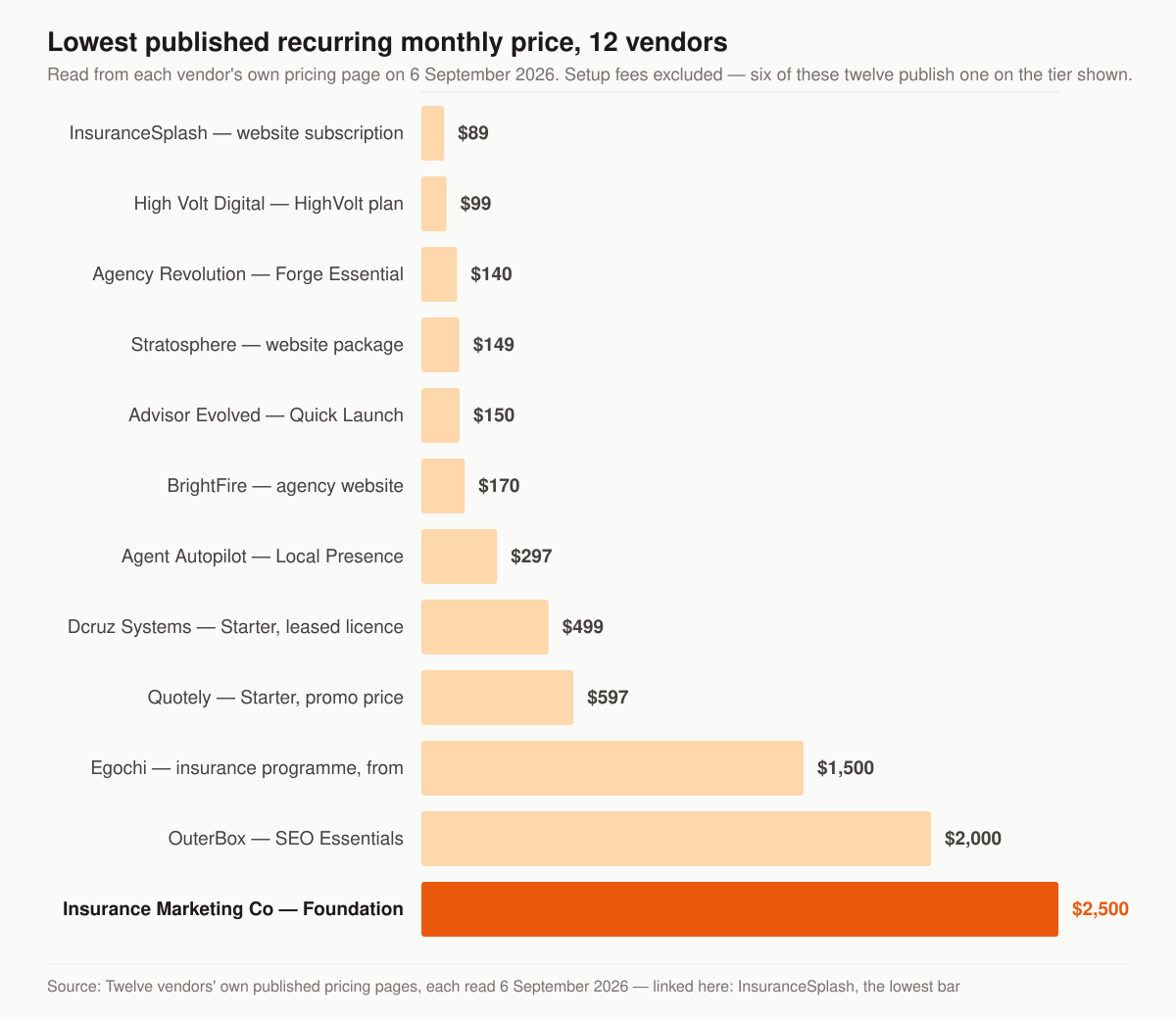
Chart: the lowest recurring monthly figure each of twelve vendors publishes on its own site, setup fees excluded, each page read 6 September 2026 — from InsuranceSplash at $89 to our own Foundation tier at $2,500. That spread is the point: the number depends on which model you are buying. All twelve figures, with every vendor’s pricing page linked, sit in the table in our insurance marketing agency pricing guide.
Any provider worth a call will tell you plainly which of those five it uses and exactly what sits inside the fee. Judge the model against outcomes — a cheap retainer that produces nothing is more expensive than a larger one that produces bound policies.
For a concrete example of one model, our own pricing is productized: three flat monthly tiers (Foundation, Growth, Full-Funnel), a one-time website build as the entry point, ad spend passed straight through to Google or Meta, and no long-term lock-in. Whether you’re looking at our tiers or anyone else’s, apply the same two tests — get what’s included versus billed extra in writing, and judge the fee against cost per bound policy rather than against a cheaper vendor doing less. A retainer that produces policies at an acquisition cost your commissions clear is cheap; a bargain that produces activity is not.
Does your marketing agency need to be local?
No. An insurance marketing agency does not need an office in your city, and searching “insurance marketing agency in California” or “in Texas” filters on the wrong variable. Every channel that matters — search, ads, email, content, CRM — is operated remotely. What has to be local is your marketing, not your marketer.
The distinction is worth holding onto because it is where agents overpay. A nearby generalist who has never read a CMS marketing guideline is a worse pick than a remote specialist who runs your line every day. The things proximity genuinely buys — in-person seminar support, local media relationships, walking your office — are real but narrow, and if they matter to your plan, say so explicitly and weigh them as a criterion rather than a filter.
What a remote agency does have to prove is that it can execute local search, since that is where geography actually lives: Google Business Profile management, service-area pages, review generation in your metro, and NAP consistency across directories. That work is done from anywhere. If a provider can show local rankings and review velocity for agents in markets it has never visited, distance is a non-issue — see insurance local SEO for what that execution looks like. The two caveats worth naming: state advertising and licensing rules vary, so the agency must build to your state’s rules, and it must be reachable in your time zone when a campaign breaks.
Being straight about where we fit
We’re a done-for-you marketing operation anchored in the senior market (final expense and Medicare) and extended across lines like final expense and P&C. That means we’re a strong fit if you want the system built and run for you with vertical depth and AI-search built in — and a poor fit if you’d rather run a low-cost self-serve platform yourself, in which case a tool like the platforms above serves you better. You can see our full scope in insurance marketing services and how we package it in pricing. If what your agency actually needs is a marketing leader rather than another vendor, that engagement has its own name and its own price: a fractional CMO for insurance agencies. And before you shortlist anyone, it is fair to ask who is behind the advice — our operator background is on the record, and you can put questions to us directly without booking anything.
The point of a buyer’s guide is that you leave able to judge, not just to pick us. Score any shortlist against the six criteria, weight the two or three that matter most to your book, and make the provider model the math with you before you sign. If you’d like an outside read on where your current marketing leaks — with no obligation to hire anyone — our free marketing audit is exactly that. And if you want to score us against the same six criteria, the agency behind this guide states its offer, the lines it covers, and its senior-market proof anchor on one screen.
- What Does an Insurance Marketing Agency Do? Services, Scope, and When to Hire One
What an insurance marketing agency does for agents: the services included, DFY vs DIY vs lead vendors, how to evaluate one, and when you actually need it.
- Digital Marketing for Insurance Agents: The Channel-by-Channel Playbook
Digital marketing for insurance agents, channel by channel: which of SEO, PPC, social, email, and AI search to run first — by line and budget. Free audit.
- How to Choose an FMO Without Signing Away Your Book
How to choose an FMO as an insurance agent: contract levels, release policy, the honest economics of free-lead programs, and red flags to avoid.
- How to Recruit Insurance Agents: The Recruitment-Marketing Playbook
How to recruit insurance agents with marketing, not just job boards: employer brand, recruitment ads, funnels, and referral systems for agencies and FMOs.