How to Recruit Insurance Agents: The Recruitment-Marketing Playbook
Recruiting insurance agents works best when you treat it like marketing, not hiring. Build an employer brand, run recruitment ads and funnels to reach licensed and aspiring agents, and back it with fast follow-up and onboarding. Agencies and FMOs that market their opportunity — training, leads, and support — attract better producers than those that post a job and wait.
Search “recruiting insurance agents” and the results are mostly staffing firms who’ll place a hire and bill you a fee. That works for the occasional executive search. It doesn’t work when you’re an agency, FMO, or IMO that needs to recruit producers — steadily, affordably, and at volume. For that, recruiting isn’t a hiring task; it’s a marketing system.
We build marketing engines for insurance businesses, and recruiting is one of the highest-leverage ones: every productive agent you add compounds your book. Here’s how to recruit like a marketer instead of a job-poster.
Why recruiting is really a marketing problem
A job post is a passive net. Recruitment marketing is an active pipeline. The difference shows up in results: post-and-pray fills seats slowly with whoever applies, while a marketing approach lets you choose who you attract by putting a clear, compelling opportunity in front of the right people repeatedly.
The agencies winning the recruiting game do three things job-posters don’t: they treat their opportunity as a product (with a real value proposition), they run channels continuously instead of only when a seat opens, and they measure cost per recruit the way you’d measure cost per lead.
There is a second reason the marketing frame is the right one. A candidate deciding between two agencies runs the same evaluation a consumer runs between two carriers: they read the website, they search the name, they ask people they trust, and they compare what each side will actually do for them. Every asset that wins that comparison is a marketing asset. If a candidate searching your name lands on a consumer page about auto quotes, you are recruiting with a brochure written for somebody else.
How many agents are there to recruit, and where do the openings come from
Before you build the funnel, size the pool. The Bureau of Labor Statistics counts 572,600 insurance sales agent jobs in 2025 and projects employment to grow 3 percent from 2025 to 2035 — “about as fast as the average for all occupations” — an increase of 18,800 positions across the whole decade (BLS Occupational Outlook Handbook).
The number that matters more for recruiting is the flow, not the level. BLS projects that “About 43,100 openings for insurance sales agents are projected each year, on average, over the decade.” It attributes them mostly to churn rather than expansion: “Many of those openings are expected to result from the need to replace workers who transfer to different occupations or exit the labor force, such as to retire.”
Read that as a recruiting brief rather than a statistic. Four figures set the terms of the market you are competing in.
| BLS figure (2025 data) | Value | What it means for your pipeline |
|---|---|---|
| Number of jobs, 2025 | 572,600 | The licensed pool you can poach from is large but finite, and every competitor is working the same list |
| Projected growth, 2025–35 | 3% (18,800 jobs) | Almost no net new seats — recruiting is mostly a share fight, not a land grab |
| Projected annual openings | 43,100 | Movement is constant, so a candidate who says no in March may be open in October |
| Typical entry-level education | High school diploma or equivalent | The barrier to entering the occupation is low, which is why volume is never your constraint |
BLS also lists work experience in a related occupation as “None” and on-the-job training as “Moderate-term on-the-job training”. Together those two rows explain the recruiting problem precisely: almost anyone can apply, so the expensive part of your process is not attracting bodies. It is filtering, licensing, and getting a new producer to a first sale before they lose interest.
What the work pays, and what you can honestly say about it
A commission-only seat asks a candidate to bet a year of their income on your offer, so anchor what you tell them about pay to published figures rather than to what you hope a good producer will earn.
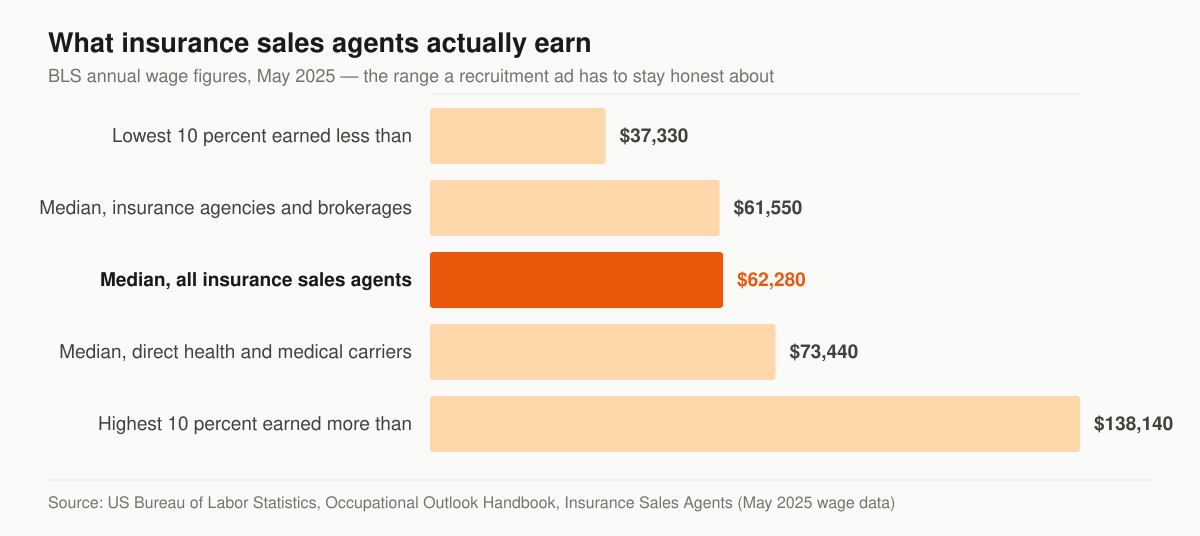
Annual wages for insurance sales agents, May 2025. Source: US Bureau of Labor Statistics, Occupational Outlook Handbook, Insurance Sales Agents.
BLS reports that “The median annual wage for insurance sales agents was $62,280 in May 2025.” It adds: “The lowest 10 percent earned less than $37,330, and the highest 10 percent earned more than $138,140.” The same page breaks the median down by employer type: $73,440 at direct health and medical insurance carriers, $63,810 at direct insurance carriers other than life, health and medical, and $61,550 at insurance agencies and brokerages.
Three things follow for your ad copy. First, the spread is wide enough that an honest ad can promise real upside without inventing anything — the top decile figure is published and you can cite it. Second, the agency and brokerage median sits below the all-agent median, so a candidate comparing your offer against a carrier job is not being unreasonable, and your pitch needs an answer to that. Third, any income number you print should be one you can substantiate on request, because a candidate who takes a commission-only seat on the strength of a figure you made up leaves within a year and tells people why. The same discipline we apply to consumer claims in insurance marketing compliance for agents applies to the recruiting side of the house.
The recruitment channels that work
Different channels reach different candidates. Run a mix rather than betting on one:
| Channel | Reaches | Best for |
|---|---|---|
| Recruitment ads (Meta/LinkedIn) | Active + passive candidates | Volume, both new and licensed |
| Referral program | Warm, pre-vetted candidates | Highest quality, lowest cost |
| LinkedIn outreach | Experienced licensed agents | Targeted, senior producers |
| Licensing schools / campuses | New-to-industry candidates | Build-your-own producers |
| Recruiting landing page + funnel | Everyone you drive to it | Capturing and qualifying interest |
| Content / employer brand | Passive candidates over time | Making agents come to you |
The pattern mirrors lead generation on purpose: referrals are your cheapest, highest-quality source, ads buy volume and speed, and content compounds your employer brand so candidates arrive pre-sold.
Sequence them by what each one costs to start. A referral push costs an email to your existing producers and a written payout schedule, so it goes first. Recruitment ads cost money the day you turn them on, so they go second, once you have a page to send the traffic to. Content is slow and cheap and pays later, so it starts immediately and gets judged in quarters — the same build order we use for consumer demand in insurance content marketing.
Two recruiting tracks, and why they need separate funnels
Experienced producers and career-changers are two different products sold to two different buyers. Running them through one funnel produces a page that speaks to neither.
A licensed producer is comparing your contract to the one they already have. They want contract level, carrier lineup, lead support, release policy and what happens to their book. They will do diligence on you the way agents do diligence on an upline, which is the entire subject of how to choose an FMO — read it as your candidate’s checklist, because that is what it is.
A new-to-industry candidate is comparing your opportunity to a job. They want to know how long licensing takes, what it costs, whether you pay for it, what they will earn while they learn, and who trains them. Answer those before you ask for a phone number.
The licensing timeline is a hard schedule constraint on your pipeline, and requirements are set state by state. California, to take one published example, requires a 20-hour product-specific prelicensing course plus a 12-hour course on code and ethics for a Life license — “a 32-hour prelicensing requirement for this license (Sections 1749 [c] and [e] of the California Insurance Code)” — and more for combined lines (California Department of Insurance).
Prelicensing hours are the gap between “candidate says yes” and “candidate can write a case,” so build them into your forecast.
| California license (CDI figures) | Product-specific hours | Code and ethics hours | Total before the exam |
|---|---|---|---|
| Life | 20 | 12 | 32 |
| Accident and Health or Sickness | 20 | 12 | 32 |
| Life and Accident and Health or Sickness | 40 | 12 | 52 |
| Accident and Health, Property Broker-Agent and Casualty Broker-Agent | 60 | 12 | 60 + 12 |
Those are California’s numbers, not a national standard — every state department of insurance publishes its own, and some require no prelicensing coursework at all. Look up the ones for the states you recruit in and put the real figure in your candidate materials. The same page notes that a Life-Only or Accident and Health agent must complete 24 hours of continuing education each license term, which is a recurring cost you can either absorb as a recruiting perk or leave the agent to pay.
The recruitment funnel, step by step
Treat candidates like leads and move them through a funnel:
- Define the offer. Spell out commission, lead support, training, technology, and growth path. “Join our agency” is not an offer; “we give you exclusive leads, a CRM, weekly training, and a path to build a team” is.
- Build a recruiting landing page. One page that sells the opportunity and captures interested agents — separate from your consumer site. A purpose-built landing page converts far better than a careers tab.
- Drive candidates to it with recruitment ads and social campaigns, LinkedIn outreach, and a referral push to your current team.
- Respond fast and qualify. Speed-to-lead applies to recruits too — the agency that replies first often wins the candidate. Track them in a CRM so none go cold.
- Onboard structurally. The first 30 days decide retention. Give new agents leads, training, and a mentor immediately.
What a recruiting landing page has to answer
Because the ad platforms will not let you filter the audience much (see the next section), the page does the filtering. Write it to answer the questions a serious candidate has and to bore the ones who are not serious.
- What am I selling, and to whom? Lines, market, and whether the work is field, telesales, or both.
- How do I get paid? Commission structure, advance policy if you offer one, and whether there is any base or draw.
- Where do the appointments come from? Company-provided leads, self-generated, or a mix — and who pays for them. If the answer is “you’ll prospect,” say so; the candidates who leave over it were leaving in month two anyway.
- What does week one look like? Named training, a schedule, and who the new agent reports to.
- Am I an employee or a contractor? State it plainly. It changes taxes, benefits, expenses and expectations, and burying it is how you lose a producer at the offer stage.
- What does it cost me to start? Licensing, E&O, tools, lead purchases.
- Who already works here and what do they say?
That is a lot of copy for one page, which is why a careers tab bolted onto a consumer site rarely does the job. Build it as a standalone landing page with its own form, its own tracking and its own thank-you flow, so you can measure candidate conversion separately from customer conversion.
What the ad platforms will not let you target in a recruitment campaign
This is the operational detail that surprises agencies the first time they run agent recruitment ads: both major platforms treat employment advertising as a restricted category and switch off the targeting levers you use every day on consumer campaigns.
Meta requires employment campaigns to be declared in a Special Ad Category, which exists to apply “Limited audience selection tools for ads about employment, housing opportunities or financial products and services to help protect people from unlawful discrimination across our platforms”. The restriction is specific: “Certain audience options are limited or unavailable for these ads for advertisers based in or reaching the US and advertisers reaching Canada and certain countries in Europe: age, gender, ZIP code or postal code, exclusion targeting, lookalike audiences and saved audiences. Some interests will also be unavailable when you create your audience. Audiences based on city or pin drop locations will include an expanded radius.” Meta’s own guidance is to “broaden—not restrict—your audience” (Meta Business Help Center).
Google Ads draws the same line under its personalized advertising policy. For employment ads it states that “In the United States and Canada, you can’t target audiences using” gender, age, parental status, marital status or ZIP codes, while “Targeting geographic locations using radius, as well as city and country-based targeting is allowed. Radius targeting requires setting at least 1 km around any given location.” (Google Ads policy: Restricted targeting in Personalized advertising)
Plan the campaign around what remains available rather than discovering the restrictions in a disapproval notice.
| Targeting lever | Meta employment ads | Google Ads employment ads |
|---|---|---|
| Age | Limited or unavailable | Cannot be used in the US and Canada |
| Gender | Limited or unavailable | Cannot be used in the US and Canada |
| Parental or marital status | Not addressed by the policy page | Cannot be used in the US and Canada |
| ZIP or postal code | Limited or unavailable | Cannot be used in the US and Canada |
| Lookalike and saved audiences | Limited or unavailable | Not addressed; predefined Google audiences are allowed apart from the demographics and ZIP codes above |
| Exclusion targeting | Limited or unavailable | Not addressed by the policy page |
| City, radius, country | Available, with an expanded radius | Available; radius must be at least 1 km |
Two consequences for the build. The ad creative and the landing page have to carry the qualifying load that targeting normally carries, so write copy that names the license, the line and the commitment in the first line. And the audience you buy will be broader than a consumer campaign, which means your cost per candidate looks worse and cost per contracted agent becomes the figure we optimize against — the same distinction we draw between clicks and cases in Facebook ads for insurance agents. If you are running these campaigns alongside consumer lead-gen, keep them in separate accounts or at least separate campaigns, so the employment declaration and the restricted targeting sit on the recruiting work and nowhere else — the separation we set up for clients running managed Meta campaigns.
Recruitment copy and the age-discrimination rule
The platform restrictions exist because the underlying law restricts what an employment advertisement may say. The Age Discrimination in Employment Act puts it in one sentence: “It shall be unlawful for an employer, labor organization, or employment agency to print or publish, or cause to be printed or published, any notice or advertisement relating to employment by such an employer or membership in or any classification or referral for employment by such a labor organization, or relating to any classification or referral for employment by such an employment agency, indicating any preference, limitation, specification, or discrimination, based on age.” (29 U.S.C. § 623(e), via Cornell LII)
Scope matters here, so read the definition alongside it. For ADEA purposes, “The term ‘employer’ means a person engaged in an industry affecting commerce who has twenty or more employees for each working day in each of twenty or more calendar weeks in the current or preceding calendar year” (29 U.S.C. § 630(b), Cornell LII). A two-person agency is below that federal threshold. That is a narrower point than it looks: your state’s fair-employment statute sets its own coverage threshold and its own rules, the platform policies above apply to your ads regardless of your headcount, and whether a 1099 producer counts as an employee for any given statute is a fact question rather than something the contract label settles. Treat all four as separate checks, and take the specific ones to an employment lawyer rather than to a marketing agency.
The practical translation for copywriting: describe the work, not the worker. “Recent grads” and “young, energetic team” describe the worker. “Requires a resident life license or willingness to obtain one within 60 days” describes the work, filters harder, and does not create the problem.
Following up with candidates without creating a TCPA problem
Recruiters reach for automated calling and texting as soon as the pipeline grows, and the rule they usually rely on is narrower than they think.
A recruiting message is not telemarketing. The FCC defines the term precisely: “The term telemarketing means the initiation of a telephone call or message for the purpose of encouraging the purchase or rental of, or investment in, property, goods, or services, which is transmitted to any person” (47 CFR 64.1200(f)(13)). An invitation to interview does not encourage a purchase, so the rules that attach specifically to telemarketing calls — the written-consent standard, the do-not-call registry provisions — are not the ones in play.
That is where the reasoning usually stops, and it stops too early. The prohibition in paragraph (a)(1) is not limited to telemarketing at all. It bars a person from initiating “any telephone call (other than a call made for emergency purposes or is made with the prior express consent of the called party) using an automatic telephone dialing system or an artificial or prerecorded voice” — including “(iii) To any telephone number assigned to a paging service, cellular telephone service, specialized mobile radio service, or other radio common carrier service, or any service for which the called party is charged for the call” (47 CFR 64.1200(a)(1), eCFR). Content is irrelevant to that clause. What matters is the equipment and the consent.
The regulation also defines the equipment narrowly: “The terms automatic telephone dialing system and autodialer mean equipment which has the capacity to store or produce telephone numbers to be called using a random or sequential number generator and to dial such numbers” (47 CFR 64.1200(f)(2)).
So the workable design is straightforward. Collect the phone number through your own form with a clear statement of what you will use it for, log the consent with a timestamp against the candidate record, keep the outreach manual or one-to-one rather than blasted, and honor an opt-out the moment it arrives. That is the same consent hygiene the consumer side of the business needs, and the same CRM discipline described in our lead follow-up cadence and built into marketing automation. None of this is legal advice; it is a description of what the cited paragraphs say, and the version that binds you is the one your counsel reads.
Cost per recruit: the arithmetic that decides whether any of this works
Recruiting spend is easy to justify and hard to evaluate, because the payoff arrives months later as override on business somebody else writes. Build the measurement in from day one.
Track five numbers per quarter and the decision about whether to keep spending makes itself.
| Metric | How to calculate it | Why it matters |
|---|---|---|
| Cost per candidate | Total recruiting spend ÷ candidates who submitted the form | Tells you whether the ads and the page are working |
| Candidate-to-contract rate | Contracted agents ÷ candidates | Tells you whether you are attracting the right people or just people |
| Cost per contracted agent | Total recruiting spend ÷ contracted agents | The headline figure, and the one to compare against a staffing fee |
| Time to first case | Days from contract to first submitted application | Exposes onboarding and licensing bottlenecks |
| 12-month retention | Agents still producing after a year ÷ agents contracted | Turns cost per recruit into cost per productive agent |
Two habits make the table honest. Count the coordinator hours, not just the ad spend — the time someone spends screening candidates is a real cost that never appears on an invoice. And date-stamp the cohort, so the agents you contracted in Q1 are measured on their own retention rather than blended into a running average that hides a bad quarter. If you want the same treatment applied to your consumer spend, the framework is in how to set an insurance agency marketing budget.
Qualifying candidates before you spend an hour on the phone
Broad targeting means volume, and volume means screening. Put the qualifying questions in the form and the first reply rather than in a discovery call.
Ask these in writing, and read the non-answers as answers.
| Ask this | A workable answer sounds like | Treat this as a warning |
|---|---|---|
| Which licenses do you hold, in which states? | Specific lines and states, with a license number | “I’m looking into it” from someone applying for a licensed-only role |
| What have you written in the last twelve months? | Cases, premium or policy count they can describe | A job title with no production behind it |
| Where do you expect appointments to come from? | A clear expectation, whether self-generated or provided | An assumption you have not stated on your page |
| What are you earning now, and what would make a move worth it? | A number and a reason | Vagueness that turns into a counteroffer later |
| Who holds your current carrier contracts, and can you be released? | A named upline and a straight answer on release | Surprise at the question |
| What does your week look like now? | A described routine — appointments, calls, follow-up | A description of intentions rather than activity |
| When could you start, and what has to happen first? | A date and a list | An open-ended maybe |
We put the release question first with experienced recruits, because an agent who cannot move their carrier contracts cannot write for you on those carriers yet. That is not a reason to pass — it is a reason to plan a start date around it, and to understand the arrangement they are leaving. The mechanics are covered from the agent’s side in how to choose an FMO, and the commission implications for life and final expense in final expense commission levels.
Recruit, then retain — or you refill the same seats
Recruiting hard while onboarding poorly is a leaky bucket. Agents stay where they get real support: lead flow, training, mentorship, and a path to grow income. If you want producers to stick, give them what makes them productive fast — which usually means feeding them a working lead-generation system rather than telling them to prospect from scratch.
Structure the first ninety days rather than improvising them:
- Week one — access and orientation. Contracting submitted, CRM login, phone and email set up, calendar of training dates, and a named person to ask questions. A new agent who spends week one waiting on credentials has already learned something about how the agency runs.
- Weeks two to four — product and script. One line of business, one script, one objection set. Depth beats breadth here, because a producer who can handle one product all the way to issue will learn the second one on their own.
- Weeks two to twelve — appointments from day one. Whatever your lead model is, the new agent needs conversations in the first two weeks. Nothing else in onboarding survives contact with a producer who has nobody to call.
- Week four and week twelve — a real review. Activity numbers, first cases, what is blocking them, and an honest read on fit. Both of you benefit from finding out at week twelve rather than month nine.
Retention is also a marketing problem in one specific sense: an agent who cannot be found online, whose quotes go unanswered and whose referrals dry up will leave regardless of the split. Producers who get a steady flow of conversations tend to stay where the flow is, which is why the retention work and the lead-generation work are the same work. Our approach to keeping producers and clients from drifting is in insurance client retention.
Recruiting a downline versus hiring onto the payroll
The two models look similar from the outside and behave differently in every respect that matters to your marketing.
Hiring producers onto an agency. You are competing against other local employers as much as other agencies, the candidate is comparing your seat to a salaried job, and the pitch has to answer stability, benefits and training. Your recruiting assets look like employer-brand assets: a real careers page, named people, a described week, and the sort of local visibility covered in how to rank an insurance agency website on Google.
Recruiting a downline as an FMO or IMO. You are competing against other uplines, the candidate is comparing contracts, and the pitch has to answer commission level, release policy, carrier lineup, lead economics and tooling. Recruiting here never really finishes, because an agent who can be recruited can be recruited away, and your retention argument is whatever the agent cannot easily replace — which in practice is marketing infrastructure rather than a few basis points of contract level.
That is the whole logic of a white-label program. Branded lead generation, capture pages and follow-up your downline runs under your name are simultaneously a recruiting pitch, an onboarding asset and a retention mechanism, which is what our FMO and white-label marketing program is built to deliver. The alternative — recruiting on contract level alone — puts you in an auction you have to keep winning.
A ninety-day build for the recruiting engine
If you are starting from a job post and a careers tab, build in this order.
- Days 1–10: write the offer. Commission, lead model, training, tech, employment status, and the honest version of what the first six months look like. Everything downstream is a rendering of this document.
- Days 10–25: build the recruiting page. Standalone, its own form, its own tracking, answering the questions listed above. Do not launch ads before it exists.
- Days 20–30: turn on referrals. A written payout, a deadline, and a personal ask to every producer already on your team. It buys no media, which is why it runs before the ads do.
- Days 25–45: launch paid. Declare the employment category, buy a broad audience, and let the copy filter. Watch cost per contracted agent, not cost per click.
- Days 30–90: publish for the passive candidate. A handful of pages a licensed agent would actually read — what you pay, what you provide, how contracting works, who trains them. This is what makes candidates arrive pre-sold twelve months from now.
- Days 45–90: instrument and review. The five metrics in the table above, by cohort, with a scheduled review date on the calendar before you need it.
Our own programs are priced the same way we would tell you to price a recruiting spend — published, month to month, comparable against the alternative — on the pricing page.
Want to build a recruiting pipeline that runs without you chasing every candidate? Start with a no-pitch marketing audit and we’ll map what to build first.
- How to Choose an FMO Without Signing Away Your Book
How to choose an FMO as an insurance agent: contract levels, release policy, the honest economics of free-lead programs, and red flags to avoid.
- Best Insurance Marketing Agencies & Companies: A Buyer's Guide
Best insurance marketing agencies compared by provider type, real cost ranges, and the six vetting criteria that matter. See which model fits your agency.
- 40 Content Ideas for Final Expense Agents You Can Steal This Week
40 content ideas for final expense agents: cost and qualifying answers, video hooks, offline angles, and the capture step that turns views into leads.
- Digital Marketing for Insurance Agents: The Channel-by-Channel Playbook
Digital marketing for insurance agents, channel by channel: which of SEO, PPC, social, email, and AI search to run first — by line and budget. Free audit.