Digital Marketing for Insurance Agents: The Channel-by-Channel Playbook
Digital marketing for insurance agents is the mix of online channels — website, local search, paid ads, email and SMS nurture, and AI search — that turns strangers into booked appointments. Sequence beats spread: fix the site, run one acquisition channel, plug the follow-up leak, then compound with organic and AI visibility.
Search “digital marketing for insurance agents” and you’ll find the same listicle over and over: “12 tips,” “7 strategies,” a bulleted parade of channels with no guidance on which one to do first or which fits your line. That’s the gap this fills. Below isn’t a list of tactics — it’s the sequence and the tradeoffs, from an agency that runs these channels for agents every day.
The one idea to hold onto: doing every channel badly loses to doing the right two channels well. Your line and budget decide the order.
The channels, and what each one is actually for
Digital marketing isn’t one thing — it’s a stack of channels that do different jobs at different speeds. The table below sorts them by the job they do, the line they suit, and how fast you get an answer out of them:
| Channel | What it does | Best for | Speed to results |
|---|---|---|---|
| Website + booking | Converts interest into a booked call | Everyone — the foundation | Immediate once live |
| Paid social (Meta) | Buys reach to generate leads fast | Final expense, Medicare, life | Days to weeks |
| Google / PPC | Captures active buying intent | P&C, high-intent searches | Days to weeks |
| Local SEO / GBP | Wins the map pack near you | P&C, local agents | Weeks to months |
| SEO / content | Compounds free organic traffic | All lines, long term | 3–9 months |
| Email + CRM nurture | Stops leads from leaking | Everyone with a pipeline | Immediate leverage |
| AI search / GEO | Gets you cited by ChatGPT & AI Overviews | All lines, emerging edge | Weeks to months |
Two takeaways most listicles miss. First, paid channels buy speed and organic channels buy margin — you usually want both, started in that order. Second, a reliable way to waste money is to generate leads (paid) with no nurture (email/CRM) behind them; the leak eats the spend.
Which channels do insurance brokers actually run?
There is survey data on this, and it is more useful than another opinion. BBSI, a professional employer organization, polled its referral partners — insurance brokers and advisors — on which digital marketing strategies they use. It reported that 71% of respondents had used digital marketing strategies for one year or longer, and another 24% intended to start.
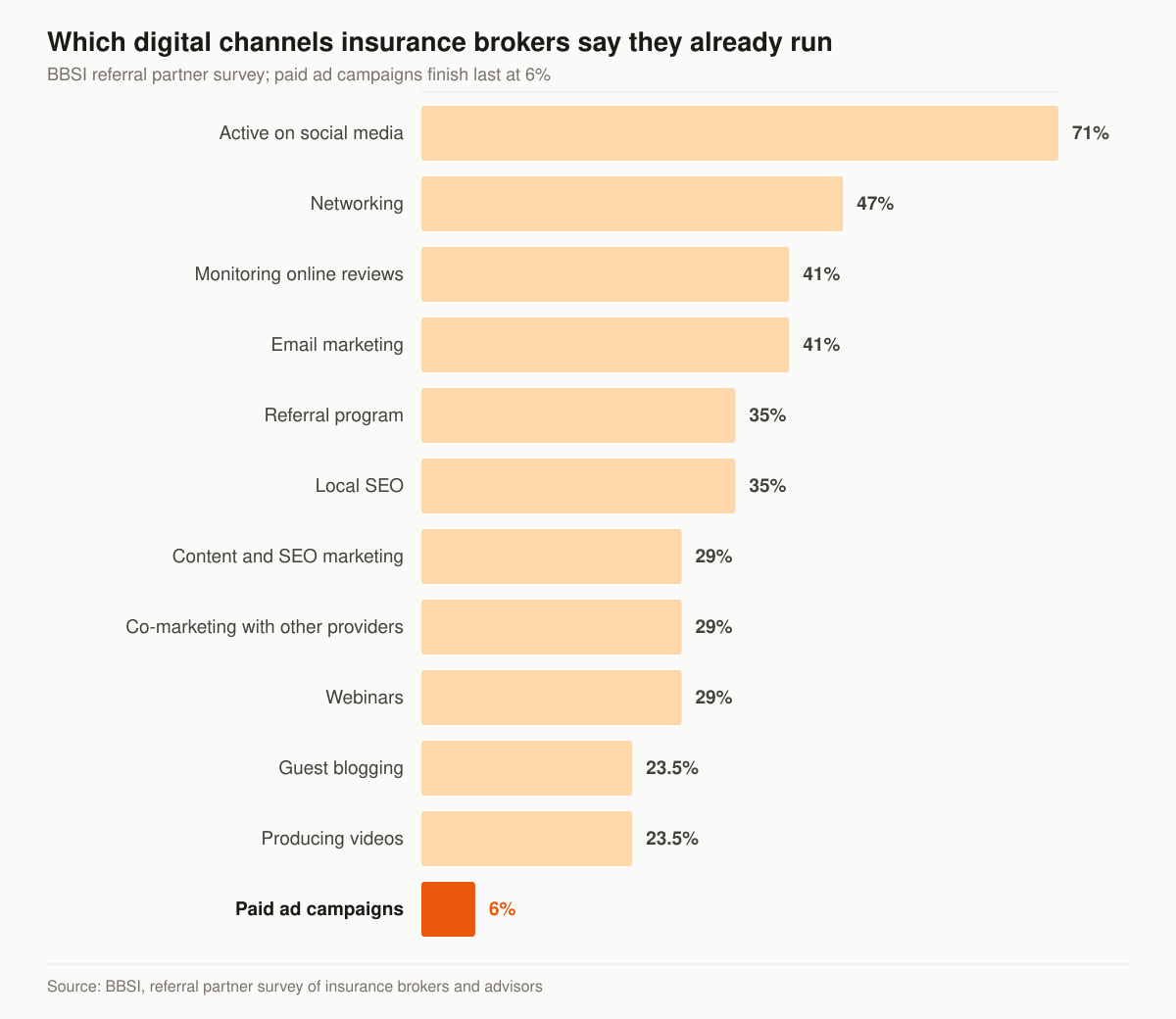
Channel adoption among brokers and advisors. Source: BBSI, referral partner survey.
Read the shape of that chart rather than any single bar. Adoption tracks how easy a channel is to start, not how well it works. Being active on social media costs nothing and 71% do it. Local SEO takes setup and sits at 35%. Content and SEO marketing takes a publishing habit and sits at 29%. Paid ad campaigns — the one channel that produces a measurable cost per lead in the first month — sits at 6%, which BBSI itself calls the least adopted of the strategies polled and attributes to the capital expense required.
Two caveats before you act on it. BBSI’s respondents are its own referral partners, which skews toward commercial-lines brokers and advisors rather than senior-market telesales agents, and the published article gives percentages without a respondent count. Treat it as a picture of a crowded shallow end and an empty deep end, not as a national census.
The practical read: the free channels are where your competitors already are, and the channels that cost money or take a cadence are where they aren’t. That is the whole argument for sequencing.
The sequence that actually works
Run these in order rather than all at once — and write each step into a one-page insurance agency marketing plan so it has a quarter, a budget, and a number to hit:
- Fix the foundation. A fast, mobile-friendly insurance agent website with one clear offer and a booking path, plus a claimed Google Business Profile. Every other channel points here, so a leaky foundation caps everything downstream.
- Turn on one acquisition channel that matches your line — Facebook and Meta ads for senior-market lines, or Google Ads and PPC for high-intent P&C searches. One, run well, with tracking.
- Plug the leak with email and CRM nurture so no lead goes cold. This is the highest-ROI, lowest-cost step and the one agents skip most.
- Compound with organic — SEO for insurance agents and local SEO — so your cost per acquisition falls as rankings hold. Our insurance SEO guide covers which layer to start with by line.
- Claim the AI-search lane with generative engine optimization so you’re cited when buyers ask ChatGPT, Perplexity, and Google’s AI answers — a channel most competitors have ignored.
You don’t need step 5 before step 1 works. But you do need step 1 before any of the paid steps pay off. And if you’d rather hand the whole sequence to a specialist, our guide to the best insurance marketing agencies for agents shows how to vet one.
Match the channel to your line
The best mix isn’t universal — it tracks the buyer:
- Final expense & Medicare: senior buyers respond to paid social and direct response; lead the mix with Meta ads plus fast follow-up, and keep it inside CMS and TCPA rules.
- P&C (auto/home): buyers search when they need a quote, so Google Ads, local SEO, and reviews do the heavy lifting.
- Life, IUL & annuity: higher consideration, so content and nurture matter more; pair education with retargeting rather than expecting a cold form-fill to close.
- Any line, long game: SEO and AI-search visibility compound into the cheapest leads you’ll ever get — they’re just slower to arrive.
The line also decides where the buyer physically is. A P&C agent sells inside a service area, so distance is a ranking input and the map pack is a real acquisition channel. A telesales final expense or Medicare agent sells across state lines, so the map pack barely matters and the entire budget should point at paid social, content, and AI answers instead. Choosing local SEO when your book is national is an expensive misallocation, and an easy one to make because generic guides recommend local SEO by default.
What the paid channels actually cost per lead
Before you set a budget, look at what the auction charges people in your category. LocaliQ’s 2026 search advertising benchmarks, drawn from campaigns across Google Ads and Microsoft Ads, publish four figures for the finance and insurance category.
These are the numbers to hold your own account against:
| Metric | Finance & insurance | How it reads against the other 22 categories LocaliQ lists |
|---|---|---|
| Average cost per click | $3.39 | Below attorneys and legal services at $9.87 and home improvement at $8.33 |
| Average click-through rate | 9.83% | Second only to arts and entertainment at 12.75% |
| Average conversion rate | 2.64% | The lowest figure in the table |
| Average cost per lead | $74.44 | Between dentists at $72.97 and industrial and commercial at $75.19 |
Sit with that combination for a second, because it contains the whole diagnosis. Insurance clicks are cheap relative to other regulated, high-value categories, and people click them at a rate almost nothing else matches. Then the conversion rate collapses to the bottom of the table. The auction is not the problem. The page the click lands on is.
That is why the sequence puts the website before the ad account. If you send $3.39 clicks at a slow, generic homepage with a “contact us” form, you are buying the industry’s worst conversion rate on purpose. Point them at a landing page built for one offer instead, and the same spend produces a different invoice. Our breakdown of insurance PPC cost per click by line goes deeper on where inside insurance those clicks get expensive.
The website foundation, in numbers
“Make your site fast” is advice nobody can act on. Google publishes actual thresholds. The Core Web Vitals are three field metrics with defined “good” values, and Google’s guidance is to measure them at the 75th percentile of page loads, segmented across mobile and desktop — meaning three-quarters of your real visitors have to clear the bar, not your best-case test on office wifi.
Here is the whole standard, which fits in four rows:
| Metric | What it measures | “Good” threshold |
|---|---|---|
| Largest Contentful Paint (LCP) | When the main content finishes rendering | Within 2.5 seconds of when the page first starts loading |
| Interaction to Next Paint (INP) | Responsiveness to taps and clicks | 200 milliseconds or less |
| Cumulative Layout Shift (CLS) | Visual stability while the page loads | 0.1 or less |
| Measurement point | Which visitors have to clear the bar | The 75th percentile of page loads, mobile and desktop |
Those thresholds come from Google’s own Web Vitals documentation. They matter twice over for an agent: they are a ranking consideration, and they are the difference between a $3.39 click that reaches your quote form and one that bounces on a spinner. A quote form below a hero carousel that shifts as it loads is failing CLS and losing leads in the same instant.
The fix list is short and boring. Compress and correctly size images. Drop the sliders, chat widgets, and tracking scripts you are not actively reading. Put the offer and the booking path above the fold. Serve the same layout on a phone that you serve on a laptop. That is most of what an insurance web design engagement does in its first week, and you can do it yourself with PageSpeed Insights open in one tab.
Local search: what Google says decides the map pack
For agents who sell inside a service area, the map pack is high-intent real estate, and Google is unusually direct about how it is won. Its Business Profile documentation names three factors: relevance, which it defines as “how well a Business Profile matches what someone is searching for”; distance, “how far each business is from the customer who’s searching”; and prominence, “how well-known a business is,” which it says is influenced by links, review count, and ratings.
Google also states, in the same document, that “There’s no way to request or pay for a better local ranking on Google.” Keep that sentence handy the next time a cold-caller offers to fix your map ranking for a monthly fee.
Of those three factors, distance is fixed and relevance is a one-time completeness exercise: pick the right primary category, fill every field, list your services and hours, add real photos. Prominence is the one that rewards ongoing work, and Google names review count and ratings among its inputs — which is why we treat a standing review-request habit as the recurring local task rather than a one-off campaign. Our guide to getting more Google reviews as an insurance agent covers the ask, the timing, and the compliance limits. If the profile itself goes dark, a suspended Google Business Profile has its own recovery path and it is worth following precisely.
Email and SMS: the rules that decide whether the channel is legal
Nurture is the cheapest revenue in the stack, and it is also the part of digital marketing with statutory penalties attached. Two rule sets govern it, and both are readable in an afternoon.
Commercial email is governed by CAN-SPAM. The FTC’s compliance guide for business lists eight requirements, including accurate header information, a subject line that reflects the content, identification of the message as an advertisement, “your valid physical postal address,” and a clear explanation of how to opt out. On timing, the FTC says opt-out requests must be processed within 10 business days, and the opt-out mechanism must be able to process requests for at least 30 days after the message was sent. The guide also states that “Each separate email in violation of the law is subject to penalties of up to $53,088,” and that hiring a vendor to send for you does not transfer responsibility.
Phone and text outreach is governed by the TCPA rules at 47 CFR 64.1200, and each paragraph carries its own scope. Paragraph (c) opens “No person or entity shall initiate any telephone solicitation to:” and (c)(1) covers “Any residential telephone subscriber before the hour of 8 a.m. or after 9 p.m. (local time at the called party’s location)”. Paragraph (d) is the internal do-not-call rule. It reaches both certain exempted artificial or prerecorded-voice calls and “any call for telemarketing purposes to a residential telephone subscriber unless such person or entity has instituted procedures for maintaining a list of persons who request not to receive such calls made by or on behalf of that person or entity”; the paragraph then sets minimum standards for those procedures, starting with a written policy.
Read the operational consequence rather than the citation. Your CRM needs a suppression list that a person can add themselves to and that your dialer actually honors, your send windows need to respect the recipient’s local time rather than yours, and your email footer needs a working unsubscribe and a real postal address. Build those into the marketing automation before you buy the first lead, not after the first complaint. For the wider picture across lines, see our page on insurance marketing compliance for agents, and for the cadence itself, insurance lead follow-up cadence.
The Medicare disclaimer that belongs on your website
If you sell Medicare Advantage as a third-party marketing organization for more than one MA organization, a specific piece of standardized text has to appear on your site. It is codified at 42 CFR 422.2267(e)(41). The version that applies if the TPMO does not sell for all MA organizations in the service area reads:
“We do not offer every plan available in your area. Currently we represent [insert number of organizations] organizations which offer [insert number of plans] products in your area. Please contact Medicare.gov or 1-800-MEDICARE to get information on all of your options.”
The same paragraph sets out where it has to appear. Among the requirements: the disclaimer must be “Verbally conveyed during sales calls prior to the discussion of any benefits”; “Electronically conveyed when communicating with a beneficiary through email, online chat, or other electronic means of communication”; “Prominently displayed on TPMO websites”; and “Included in any marketing materials, including print materials and television advertisements, developed, used or distributed by the TPMO.”
Two scope notes that get lost in blog summaries. Part 422 is the Medicare Advantage program; the parallel Part D requirements are codified in Part 423, so check both if you sell drug plans. And the second variant of the disclaimer applies if the TPMO does sell for every MA organization in the service area — the regulation supplies different text for that case.
For the rest of the CMS marketing surface — call recording, events, and the Scope of Appointment — see CMS Medicare marketing rules for agents and Scope of Appointment and TPMO compliance.
AI search: what the click data changed
The newest channel is the one with the least competition and the clearest evidence behind it. Pew Research Center analyzed the browsing data of 900 U.S. adults covering 68,879 unique Google searches in March 2025, of which 12,593 produced an AI summary. Users clicked a traditional search result link in 8% of visits where an AI summary appeared, against 15% of visits where one did not. They clicked a link inside the AI summary itself in 1% of visits. And 26% of pages with an AI summary ended the browsing session, against 16% of pages showing only traditional results.
The searches did not disappear; the click did. For an insurance agent that reframes the goal. Ranking a blue link is still worth doing, and it now shares the job with being the source an AI answer draws from and names. The optimization overlaps heavily — clear structure, direct answers near the top of the page, specific and checkable facts, a real entity behind the site — which is why generative engine optimization is not a separate budget line so much as a different acceptance test on the same content.
Two companion pages go deeper: how to get cited by Perplexity and AI Overviews covers the citation mechanics, and how to get your insurance agency recommended by ChatGPT covers the recommendation surface, which behaves differently from citation.
What digital marketing for insurance agents costs
Two separate budgets get confused constantly: what you pay someone to run the work, and what you pay platforms for traffic. They scale differently and should be tracked separately.
Media is priced by auction, and the LocaliQ benchmarks above give you the anchor — a $3.39 average click and a $74.44 average cost per lead in the finance and insurance category. Your media budget is whatever volume you want at that kind of number, and it is a pass-through: it goes to Google or Meta, not to an agency.
Management is priced by scope. We publish ours rather than quoting on a call: Foundation is $2,500 a month, Growth is $3,500, Full-Funnel is $5,500, and a one-time website build runs $2,500–$8,000. What separates the tiers is which layers of the stack are switched on. Foundation covers the website and landing pages, local SEO and Google Business Profile, on-page SEO, and monthly reporting. Growth adds the ongoing SEO and content engine, AI-search visibility, and reputation and reviews. Full-Funnel adds managed paid ads on Google and Meta, landing-page CRO, and marketing automation. The pricing page lists every line item and what is not included.
The useful comparison isn’t tier against tier. It is total monthly cost — management plus media — against what a bound policy is worth to you over its life. If that math doesn’t clear with margin at the volume you can actually service, the answer is a smaller program, not a cheaper vendor. Our insurance agency marketing budget guide works through the arithmetic on your own numbers.
What to measure, in the order it matters
Reporting is where agency relationships break down: the report measures effort instead of outcome. Four numbers, in this order:
- Cost per lead by source. Not blended. A blended CPL hides the channel that is subsidising the one that is failing. LocaliQ’s $74.44 finance and insurance average is the reference point for search; your Meta number will sit somewhere else entirely.
- Speed to lead. The interval between form submission and first human contact attempt. It costs nothing to fix and it is the number that decides whether the leads you already bought convert. Your CRM should timestamp it automatically.
- Lead-to-appointment rate by source. This is where lead quality separates from lead volume. A cheap source with a poor appointment rate is an expensive source wearing a disguise.
- Cost per issued policy. This is the number that pays. Everything upstream is a diagnostic; this one is the verdict, and it is what to put in front of any agency you’re evaluating.
If you can’t produce those four today, that is the project — before the next channel, before the next redesign. A tracked bad channel beats an untracked good one, because you can fix the first.
Do you need an insurance digital marketing agency, or can you DIY it?
“Insurance digital marketing agency” is what agents start searching when the DIY stack begins eating selling time. The honest split runs along four situations:
| Your situation | DIY | Hire an agency |
|---|---|---|
| One simple channel (GBP, reviews, one ad campaign) | ✔ Run it yourself with tracking | Overkill |
| Regulated lines (Medicare, senior-directed ads) | Risky — CMS and TCPA mistakes are expensive | ✔ Specialist who works inside the rules daily |
| Several channels that must work as one system | Possible, but it becomes a second job | ✔ One team accountable to one number |
| You’d rather sell than manage funnels | The plan drifts by month two | ✔ Buy the system, keep selling |
If you hire, hire vertical: a generalist local agency learns insurance compliance on your dime, and impressions-based reporting hides whether policies actually got issued. Judge any shop — ours included — on whether it reports cost per issued policy and prices transparently. And if you DIY, steal the structure anyway: two channels per quarter, written into a marketing plan with a budget worksheet and KPI tracker, reviewed quarterly.
A 90-day sequence you can actually run
Ninety days is enough to fix the foundation, prove one acquisition channel, and close the follow-up leak. It is not enough to rank a content library, which is why content starts in this window but is not judged in it.
Each phase below ends with a check you can either pass or fail — no partial credit:
| Days | The work | The check at the end |
|---|---|---|
| 1–30 | Website and landing page fixed against the Core Web Vitals thresholds; one offer above the fold; booking path live; Google Business Profile completed with the right primary category, services, hours and photos; review-request habit started | LCP under 2.5s, INP under 200ms, CLS under 0.1 at the 75th percentile; a booked appointment arrives through the site |
| 31–60 | One acquisition channel switched on with conversion tracking — paid search for P&C, paid social for senior-market lines; suppression list, send windows and unsubscribe wired into the CRM before the first send | A cost per lead you can state out loud, by source; every lead has a timestamped first contact attempt |
| 61–90 | Second channel added only if the first cleared its number; first content cluster published against real buyer questions; TPMO or line-specific disclaimers verified on every page they belong on | Cost per issued policy calculated for the first channel; lead-to-appointment rate compared across both |
Notice what is not in the table: a rebrand, a video series, a podcast, and a social calendar. Those are all legitimate work and none of them belong in the first ninety days, because none of them produce a number you can act on inside the window. More marketing ideas for insurance agents live on their own page for exactly that reason — they are the month-four list.
Where the money leaks
Before adding a channel, check the four places spend leaks out of the one you already run:
- Leads with no follow-up. Speed-to-lead and a nurture sequence — ideally from a proper CRM — recover more revenue than any new channel.
- Every channel disconnected. Ads, website, and email that don’t talk to each other waste spend; the point is one system, not six tactics.
- No number. If you’re not tracking cost per issued policy by source, you can’t scale what works. Budget against lifetime value, not a flat monthly guess.
- Ignoring compliance until it bites. For regulated lines, build inside the rules from day one rather than retrofitting.
Not sure which channel to start with, or where your current spend is leaking? Get a no-pitch marketing audit and we’ll map the shortest path for your line and budget.
- The Insurance Agency Marketing Plan That Fits on One Page
Build an insurance agency marketing plan in 7 steps: positioning, channels by line, quarterly budget, KPIs, compliance. Free fill-in one-page template.
- 45 Marketing Ideas for Insurance Agents, Ranked by Effort and Impact
45 marketing ideas for insurance agents, ranked into four tiers by effort and impact. Every idea notes the line it fits, from final expense to P&C.
- 40 Content Ideas for Final Expense Agents You Can Steal This Week
40 content ideas for final expense agents: cost and qualifying answers, video hooks, offline angles, and the capture step that turns views into leads.
- What Does an Insurance Marketing Agency Do? Services, Scope, and When to Hire One
What an insurance marketing agency does for agents: the services included, DFY vs DIY vs lead vendors, how to evaluate one, and when you actually need it.