45 Marketing Ideas for Insurance Agents, Ranked by Effort and Impact
The highest-leverage marketing ideas for insurance agents are the cheap, repeatable ones: a Google Business Profile you actually maintain, a review-request habit, a five-minute lead follow-up rule, and one weekly piece of question-answering content. Rank every idea by effort against impact, run two or three at a time, and cut anything you can't measure.
Most lists of marketing ideas for insurance agents are a hundred interchangeable bullets with no ranking and no line-of-business fit. This one is ranked. Every idea below sits in one of four tiers by effort-to-impact, carries a note on which line it fits, and assumes you will measure it against cost per bound policy — not likes.
Two data points frame why ranking matters. The Big “I” 2024 Agency Universe Study (September 2024) found 56% of independent agencies call social media a top marketing activity — down from 62% in 2022 — and that “marketing their agency effectively on the internet” ranks as agents’ second-biggest technology challenge. And paid search is not cheap: LocaliQ’s 2026 benchmarks put finance and insurance search ads at a $74.44 average cost per lead with a 2.64% conversion rate. Plenty of agents are busy; fewer are compounding. Start with Tier 1.
Which marketing ideas work best for insurance agents?
The ideas that work best share three traits: they are cheap to repeat, they touch a buying moment (a quote, a renewal, a life event), and their results can be traced to a bound policy. That is why quick operational fixes outrank flashy campaigns — run the tiers in order and fund later tiers with the margin the early ones create.
| Tier | Effort | Impact | Timeframe | Ideas |
|---|---|---|---|---|
| 1 — Quick wins | Hours, ~$0 | High | This week | 1–10 |
| 2 — Core builds | Days to weeks | High | This quarter | 11–22 |
| 3 — Compounding plays | Ongoing | Highest over time | 6–12 months | 23–34 |
| 4 — Situational bets | Varies | Line- and market-dependent | Test first | 35–45 |
Tier 1: quick wins — high impact, near-zero cost (ideas 1–10)
Everything here can be done this week without a budget. These fixes also raise the return of every paid idea later in the list.
- Finish your Google Business Profile — completely. Categories, services, photos, hours, and a booking link, not just a claimed listing. It is the free listing that sits closest to a buying moment. We treat it as the first fix for P&C and local Medicare shops, and every line benefits from it.
- Set a five-minute speed-to-lead rule. Make “new lead touched within five minutes” a measured standard rather than an aspiration, and report the miss rate weekly. Works in every line; the full lead follow-up cadence shows what happens after that first call.
- Ask for a Google review the day a policy binds. Send the direct review link while goodwill peaks, and make the ask part of the bind checklist. All lines — the review-generation playbook covers scripts and timing.
- Turn your ten most-asked client questions into website answers. Your call notes are a free content calendar; each question becomes a short page or FAQ entry in plain language. All lines, and it doubles as raw material for videos later.
- Rewrite your homepage headline to name your buyer. “Medicare plan help in [your county]” beats “Protecting what matters most.” Positioning is free; vagueness is what’s expensive. All lines.
- Put a booking link everywhere your name appears. Email signature, Google profile, social bios, quote follow-up emails. Removing the back-and-forth of scheduling lifts contact rates in every line, most visibly in phone-sold lines like final expense.
- Send one reactivation message to old, unsold quotes. A single honest line — “rates changed; want me to re-run yours?” — to prospects quoted 90+ days ago. Best for auto and home requotes and stalled life applications; texting requires prior written consent, so check your records first.
- Run a cross-sell audit of your book. List monoline clients and the obvious gap: auto without home, home without umbrella, P&C households with no life coverage. Strongest in P&C, where account rounding also lifts retention.
- Script a referral ask into the post-bind call. Timing beats incentives: ask right after you have solved the problem, and name who you help so referrals arrive pre-qualified. All lines.
- Tag every lead source before spending another dollar. Tracking links, call tracking, and a source field on every lead make the other 35 ideas measurable. Without this, the rest of the list is guesswork.
Tier 2: core builds — the machine (ideas 11–22)
These take days or weeks, not hours. Together they form the system the quick wins feed.
- Write the one-page marketing plan. Decide lines, channels, budget, and the number each idea must hit — otherwise this list is a buffet, not a strategy. The insurance agency marketing plan guide walks the seven decisions and includes a free template.
- Build one landing page per line, not one homepage for everything. Message match decides cost per lead: a final expense ad should land on a final expense page. Essential for any line running paid traffic.
- Publish one short question-answering video per week. 45–90 seconds, one question, direct answer first, captions on. Highest payoff in trust-heavy senior lines — the final expense content swipe-file has 40 topic starters.
- Rotate the five social buckets: education, proof, local, engagement, offers. Roughly 60% education, adapted to your line rather than copy-pasted across lines. The 75+ social post ideas list breaks this down line by line.
- Build a quoted-not-bound email sequence. A quote that goes quiet is not the same as a quote that was rejected on price; a 4–6 email sequence over 30 days gives the silent ones a reason to answer. Best for life and P&C, where decisions drag.
- Move the pipeline into a CRM. Follow-up rules, pipeline stages, and task automation stop leads from leaking between sticky notes. Any line; the CRM comparison for agents covers the honest trade-offs.
- Respond to every review — including the bad ones. A calm, specific response to a bad review is marketing to everyone who reads it later. All lines; pairs with idea 3.
- Create a page per city and line you serve. “Auto insurance in [city]” pages capture local intent that a generic site never sees. Best for P&C and Medicare, where buyers search locally.
- Test Facebook lead ads with one tight offer. One line, one audience, one specific promise — not “we do all insurance.” Strongest for final expense, Medicare, and mortgage protection; the Facebook ads walkthrough covers targeting limits and creative that survives review.
- Run Google Ads on high-intent local terms. Expensive but intent-rich — against LocaliQ’s $74.44 average finance-and-insurance cost per lead, tight geo and negative keywords are what keep the math workable. “CTR tells you how your ads are performing and can provide valuable information you can use to optimize your search ads to pull in more clicks—and more conversions,” notes Susie Marino, LocaliQ senior content marketing specialist. Setup details in the Google Ads guide for agents. If the account is worth running but nobody has the hours to prune search terms every week, you can have the paid search run for you against a cost-per-sold-policy target rather than a cost-per-click one.
- Build a monthly turning-65 touch system. A steady, compliant sequence to people aging into Medicare beats an AEP scramble. Medicare only, and CMS marketing rules apply to every piece.
- Calendar annual reviews across the whole book. A yearly coverage review is retention, cross-sell, and referral generation in one meeting. All lines; strongest in P&C.
Tier 3: compounding plays — slow, then unfair (ideas 23–34)
These pay little in month one and a lot in month twelve. Start them after Tiers 1–2 are running, not instead of them.
- Commit to an SEO cluster for one line. A dozen genuinely useful pages around one line and one geography can outrank generic national content. All lines; the SEO guide for insurance agents covers the build order.
- Optimize to be cited by AI search. Buyers increasingly ask ChatGPT and Perplexity before they Google; direct answers, real credentials, and consistent local data make you quotable. All lines, earliest movers win.
- Start a monthly client newsletter. One useful answer, one client story with permission, one soft offer — it keeps you the default at renewal and surfaces referrals. All lines.
- Build referral partnerships with realtors, lenders, and CPAs. A lender who hands you every closing is a lead channel with zero media cost. Best for home, mortgage protection, and life.
- Host educational seminars or webinars. Teaching “how Medicare enrollment actually works” builds trust at scale; keep educational events educational, since promoting specific plans triggers stricter marketing rules. Medicare, life, and annuity lines.
- Develop one recurring brand asset. Same face, same format, same catchphrase, for years — the consistency lesson behind every famous carrier campaign in our insurance advertising teardowns. All lines.
- Collect real service stories, with permission. A short “here’s what happened when the claim hit” story, told with the client’s consent, is proof no stock photo can fake. All lines; never invent one.
- Build a YouTube Q&A library. Long-form answers rank for years and pre-sell prospects before the first call. Senior-market and life lines especially.
- Guest on local podcasts and radio. Borrowed audiences plus a local-expert halo, at the cost of an hour. Best for commercial lines and community-facing P&C shops.
- Run a direct mail program for senior lines. Mail still reaches the 65+ buyer that digital misses; track responses per drop like any other channel. Final expense and Medicare.
- Create one lead magnet per line. A genuinely useful checklist — “what to gather before a home quote” — earns the opt-in that starts the nurture sequence. All lines.
- Build a bilingual track if your market supports it. Serving a language-defined community poorly reached by competitors is a durable moat, not a translation task. Line follows the community’s needs.
Tier 4: situational bets and test budgets (ideas 35–45)
Real upside, but only in the right market, line, or season. Test with a capped budget and a kill criterion.
- Test Google Local Services Ads where available. Pay-per-lead with a Google screening badge, worth a capped trial where your vertical qualifies — eligibility, the screening process, and how to dispute bad leads are covered in our guide to Google Local Services Ads for insurance agents. Local P&C first.
- Trial one lead vendor with strict math. Decide the maximum cost per bound policy before the first order, and hold the vendor to it after 100 leads. Senior-market and auto lines most commonly.
- Retarget your website visitors. Cheap impressions to people who already know you; insurance ad categories restrict targeting options, so keep creative broad and compliant. All lines with real site traffic.
- Show up on Nextdoor and local community groups. Answer questions as a neighbor with a license, not an ad. Local P&C and Medicare.
- Work LinkedIn for commercial and benefits lines. Decision-makers for group benefits and business coverage are reachable there in a way no consumer platform matches. Commercial only — consumer lines waste time here.
- Co-market with a complementary local business. Joint content or events with a gym, dealership, or daycare puts you in front of a warm, adjacent audience. Local lines.
- Sprint the enrollment seasons. AEP and OEP reward agents who prepared their audience in the off-season; plan the sprint in advance rather than improvising in October. Medicare and ACA — see the open enrollment ideas list.
- Run a win-back campaign for lapsed clients. Former clients already trusted you once; a rate-check offer at their renewal window is the cheapest “new” business available. P&C especially.
- Sponsor local events with a trackable offer. Sponsorship without a tracked next step is a donation; add a QR code, a landing page, or a named offer. Local lines.
- Pilot SMS nurture with explicit written consent. Text messages get read, and they also get litigated — consent records first, value-per-message second. Any line with a consent-clean list.
- Outsource the tiers you won’t realistically run. An idea that stays on this page earns nothing; if the constraint is hours, hand specific rows to a specialist and keep the measurement. Our insurance marketing services map onto these tiers one-to-one.
Which ideas fit which line of business?
The tiers rank effort against impact; the line you write decides which rows inside a tier are worth your Tuesday. An idea that carries a final expense practice can be dead weight in a commercial book, so read this table as a filter over the 45 rather than a second list.
| Line you write | Tier 1 to run first | The build that pays next | Ideas that rarely earn their hours |
|---|---|---|---|
| Auto and home (P&C) | 1, 3, 8, 10 — profile, reviews, cross-sell audit, source tagging | 18 (a page per city and line) and 22 (annual reviews), because local intent and account rounding are where P&C compounds | 39 (LinkedIn) for personal lines, 32 (senior direct mail) |
| Medicare | 1, 4, 6, 9 — profile, question pages, booking link, referral script | 21 (turning-65 sequence) and 41 (enrollment sprint), both planned before October | 44 (SMS) and 36 (lead vendors) until the consent and CMS rules below are handled |
| Final expense | 2, 6, 7 — speed, booking link, reactivation | 19 (Facebook lead ads) behind one tight offer, then 32 (direct mail) | 23 (SEO cluster) as a first move — the phone pays sooner |
| Life and IUL | 4, 9, 13 — questions, referral ask, weekly video | 15 (quoted-not-bound sequence) and 30 (YouTube Q&A library), because the decision drags | 35 (Local Services Ads), 38 (Nextdoor) |
| Commercial and benefits | 5, 9, 10 — positioning, referral script, source tagging | 26 (referral partnerships) and 39 (LinkedIn), where the decision-makers already are | 19 (consumer Facebook lead ads), 32 (direct mail) |
Two rows change nothing across lines: idea 2, speed to lead, and idea 10, source tagging. Everything else is negotiable by line, budget and season. If your book spans several lines, pick the one that pays your rent this year and let the other lines borrow the Tier 1 work — a Google Business Profile and a review habit serve every line at once, while a landing page and an ad account do not.
Which ideas are already crowded, and which are wide open?
Effort and impact produce a shortlist; how many competitors already run the idea tells you what the shortlist is worth. In BBSI’s referral-partner survey of insurance brokers and advisors, 71% reported being active on social media and 41% monitor online reviews, while paid ad campaigns finished last at 6%.
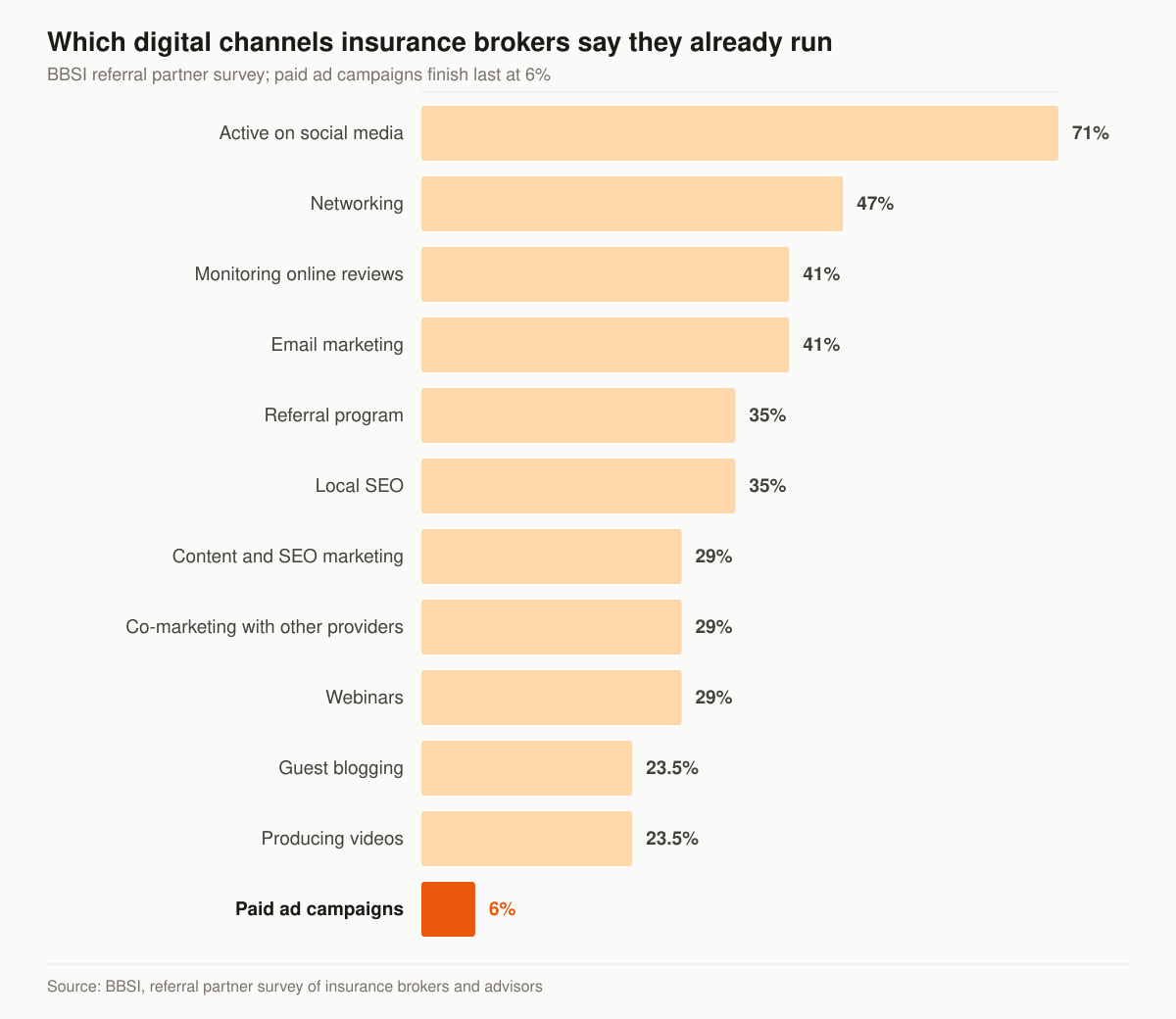
Channel adoption reported by insurance brokers and advisors, from BBSI’s referral partner survey.
The Big “I” 2024 Agency Universe Study reads the same picture from the agency side. Independent Agent magazine’s write-up reports that “More than half of agencies (56%) say social media is a top marketing activity, a slight decrease from 62% in 2022” and that “Social media is primarily used to build the agency’s brand (87%) and attract prospects (79%)”.
Read against the list, that gives you three lanes. Ideas 14 and 28 compete against a channel most of the field already occupies, so the bar is craft rather than presence. Ideas 3, 17 and 22 sit in a lane 41% watch and far fewer systematize — reviews are common; a same-day review request wired into the bind checklist is not. And paid at 6% is the thinnest lane on the chart, which is an opening and a warning at once: LocaliQ’s $74.44 average finance-and-insurance cost per lead is the price of entering it, and the reason ideas 19, 20 and 36 belong behind idea 10 rather than in front of it.
Which ideas carry legal limits before you run them?
Several ideas on this list are regulated before they are marketing, and the text is specific enough to read rather than paraphrase. None of this is legal advice; it is the material worth having open when you build ideas 7, 15, 21, 25, 27, 32, 38, 43 and 44.
| Ideas it governs | The rule | What it turns on |
|---|---|---|
| 7, 44 — reactivation texts, SMS nurture | 47 CFR 64.1200(a)(2) and (f)(9) | Whether the message is autodialed or uses an artificial or prerecorded voice, and whether you hold a signed written consent naming that number |
| 2, 7, 36 — outbound calling and purchased leads | 47 CFR 64.1200(c)(2)(ii) and (d) | An internal do-not-call list that exists before the first dial, and a signed written agreement for the registry exemption |
| 15, 25, 33 — email sequences, newsletters, lead magnets | 15 U.S.C. 7704(a)(4)(A) and (a)(5)(A) | An opt-out notice, a valid physical postal address, and honoring the opt-out within 10 business days |
| 9, 21, 27, 32, 38, 43 — Medicare outreach, seminars, sponsorships | 42 CFR 422.2264 | Whether the contact was solicited, and which event type you are actually running |
On texting, 47 CFR 64.1200(a)(2) bars initiating “any telephone call that includes or introduces an advertisement or constitutes telemarketing, using an automatic telephone dialing system or an artificial or prerecorded voice” to the lines and numbers described in paragraphs (a)(1)(i) through (iii) — a list that includes “any telephone number assigned to a paging service, cellular telephone service, specialized mobile radio service, or other radio common carrier service” — “other than a call made with the prior express written consent of the called party”, alongside the tax-exempt nonprofit and health-care exceptions the paragraph goes on to name. Both halves of that sentence are load-bearing. The prohibition attaches to the technology used, and the consent it accepts is defined in paragraph (f)(9) as “an agreement, in writing, bearing the signature of the person called that clearly authorizes the seller to deliver or cause to be delivered to the person called advertisements or telemarketing messages using an automatic telephone dialing system or an artificial or prerecorded voice, and the telephone number to which the signatory authorizes such advertisements or telemarketing messages to be delivered.” That written agreement has to disclose, clearly and conspicuously, that “The person is not required to sign the agreement (directly or indirectly), or agree to enter into such an agreement as a condition of purchasing any property, goods, or services.”
Two more paragraphs sit under every calling idea. Section 64.1200(d) provides that no person or entity shall “initiate any artificial or prerecorded-voice telephone call pursuant to an exemption under paragraphs (a)(3)(ii) through (v) of this section or any call for telemarketing purposes to a residential telephone subscriber unless such person or entity has instituted procedures for maintaining a list of persons who request not to receive such calls made by or on behalf of that person or entity” — an internal do-not-call list, built before the campaign, not after the complaint. And the national-registry exemption in (c)(2)(ii) is narrower than a checkbox: it requires that the seller “has obtained the subscriber’s prior express invitation or permission”, and that permission must be “evidenced by a signed, written agreement between the consumer and seller which states that the consumer agrees to be contacted by this seller and includes the telephone number to which the calls may be placed” — one of the three alternatives that paragraph lists.
The email ideas answer to CAN-SPAM. Under 15 U.S.C. 7704(a)(5)(A) a commercial email message has to carry “clear and conspicuous notice of the opportunity under paragraph (3) to decline to receive further commercial electronic mail messages from the sender” and “a valid physical postal address of the sender” — a requirement attached to the message, not to the platform you send it from. Once a recipient opts out, 7704(a)(4)(A) makes it unlawful “for the sender to initiate the transmission to the recipient, more than 10 business days after the receipt of such request, of a commercial electronic mail message that falls within the scope of the request”. Ten business days is the ceiling, not the target; suppression belongs in the same system that sends.
The Medicare rows are the tightest, and they are scoped: 42 CFR Part 422 governs Medicare Advantage, and the parallel Part D requirements live in Part 423. Section 422.2264 defines beneficiary contact as “any outreach activities to a beneficiary or a beneficiary’s caregivers by the MA organization or its agents and brokers”, then sorts it by whether the beneficiary asked. Unsolicited mail and email stay open — MA organizations “may make unsolicited direct contact by conventional mail and other print media (for example, advertisements and direct mail) or email (provided every email contains an opt-out option)” — which is why idea 32 survives in the senior market when idea 44 does not. Unsolicited phone and social outreach are closed: paragraph (a)(2)(iv) bars, when unsolicited, “telephone solicitation (that is, cold calling), robocalls, text messages, or voicemail messages”, and lists among the examples “Calls based on referrals” and “Calls to beneficiaries who attended a sales event, unless the beneficiary gave express permission to be contacted.” That is the limit on running idea 9 into the senior market by phone. Paragraph (a)(2)(iii) bars sending “direct messages from social media platforms” unsolicited, which is the constraint on idea 38.
Events carry their own text. Idea 27’s seminar is an educational event, and “At educational events, MA organizations and agents/brokers may not market specific MA plans or benefits” — the rule also states that at those events they may not “conduct sales or marketing presentations or distribute or accept plan applications.” Idea 43’s sponsorship, if it turns into a marketing or sales event, may not “Require sign-in sheets or require attendees to provide contact information as a prerequisite for attending an event.” And the obvious cross-sell route into Medicare is closed by paragraph (b)(1)(v): “MA organizations may not make unsolicited calls about other lines of business as a means of generating leads for Medicare plans.” What remains open is the plan-business lane in (b)(1)(i), which contemplates calling current enrollees, including “Enrollees aging into Medicare from commercial products” — the compliant spine of idea 21, and the reason that idea is written as a touch system for people already in your book rather than a prospecting list.
For the rest of the surface, the insurance marketing compliance guide covers what applies across lines, the CMS Medicare marketing rules breakdown works through disclaimers and material review, and scope of appointment and TPMO compliance handles the paperwork that has to exist before a personal marketing appointment begins.
How do you choose which ideas to run first?
Choose by constraint, not by excitement. If you have time but no money, run Tier 1 plus the free Tier 3 plays. If you have money but no time, fund Tier 2 systems or delegate them. If you have neither, fix idea 10 — measurement — and idea 2 — speed — before anything else, because they multiply whatever you run next.
- Pick one line to lead with. Message, channel, and compliance all follow from the line — a cross-line “everything” campaign serves no one.
- Take all of Tier 1 this week. It’s a checklist, not a strategy debate.
- Choose two Tier 2 builds for this quarter — one acquisition, one follow-up — and give each a target number.
- Start one Tier 3 compounding play you can sustain for a year, even at low intensity.
- Cap and test any Tier 4 bet with a written kill criterion before the first dollar.
What does it cost to have someone else run these ideas?
Every idea on this list is paid for in hours or in dollars, so the honest comparison is a tier of work against a tier of time you do not have. Our programs are published flat: Foundation at $2,500/mo, Growth at $3,500/mo, Full-Funnel at $5,500/mo, and a one-time website or landing-page build at $2,500–$8,000. Ad spend never sits inside those numbers — it goes straight to Google or Meta.
| Your constraint | Keep in-house | Worth handing over |
|---|---|---|
| Time, but no budget | All of Tier 1, plus ideas 25, 29 and 33 — the ones that need your voice and your book, not a vendor | Nothing yet. Spending before idea 10 is measured is how budgets disappear |
| Budget, but no time | Ideas 3, 9 and 22 — the asks only you can make, in the room where you make them | Ideas 12, 18, 23 and 24: the site, the city-and-line pages, the content cluster, the AI-search work |
| Both, and a team | Ideas 2, 11 and 22 — speed, plan, and the annual-review calendar belong to whoever owns the book | Ideas 16, 19, 20 and 37: CRM build, paid social, paid search, retargeting, held to a cost per bound policy |
| Neither | Fix ideas 2 and 10 this week yourself | Everything else, in tier order, once the measurement exists |
Mapped onto the published tiers: Foundation covers the site, local search and on-page work behind ideas 1, 5, 12 and 18; Growth adds the content and AI-search engine behind ideas 4, 13, 23 and 24 plus the review work in ideas 3 and 17; Full-Funnel adds managed paid ads, landing-page CRO and marketing automation for ideas 16, 19, 20 and 37. The tier-by-tier breakdown lives on the pricing page, and if you would rather size the spend before you shop it, the insurance agency marketing budget guide works backward from what a bound policy is worth. Whichever way you split it, the local groundwork under ideas 1, 5 and 18 is the same work our local SEO service runs, so the decision is who does it, not whether it gets done.
For the deeper channel-by-channel reasoning — which of SEO, PPC, social, and email to run first by line and budget — the digital marketing playbook for agents is the companion piece to this list. Two of the tiers deserve an owner rather than a to-do list: sequencing the whole thing across an agency is the job a fractional CMO for insurance agencies takes over, and the renewal, review, and referral plays on this list are run as insurance client retention marketing. And if you want a second set of eyes on which tier your agency should attack first, a free audit that ranks these ideas for your agency will tell you — whether or not you ever hire us.
- Digital Marketing for Insurance Agents: The Channel-by-Channel Playbook
Digital marketing for insurance agents, channel by channel: which of SEO, PPC, social, email, and AI search to run first — by line and budget. Free audit.
- 40 Content Ideas for Final Expense Agents You Can Steal This Week
40 content ideas for final expense agents: cost and qualifying answers, video hooks, offline angles, and the capture step that turns views into leads.
- The Insurance Agency Marketing Plan That Fits on One Page
Build an insurance agency marketing plan in 7 steps: positioning, channels by line, quarterly budget, KPIs, compliance. Free fill-in one-page template.
- Best CRM for Insurance Agents: An Honest, Vendor-Neutral Guide
A vendor-neutral guide to the best CRM for insurance agents — CRM vs AMS, the best tools by line and budget, real 2026 pricing, and where marketing fits.