Insurance Advertising Examples: 6 Famous Campaigns, Torn Down
The best insurance advertising examples share one pattern: a memorable character or hook that makes a boring product impossible to ignore — GEICO's Unskippable, Progressive's Flo, Allstate's Mayhem, Aflac's Duck. Below, each famous campaign is broken down for what an independent agent can steal, plus copy formulas for auto, home, life, final expense, and Medicare ads.
Insurance is one of the heaviest-advertised categories in America: six major auto insurers alone spent a combined $5.8 billion+ on advertising in 2022, with GEICO at $1.5 billion. Meanwhile, the average insurance search ad in LocaliQ’s 2026 benchmarks converts at 2.64% and costs $74.44 per lead. That gap — billions in brand spend above, expensive clicks below — is exactly why studying the famous campaigns pays: they show what earns attention, and the formulas further down show how to convert it on an agent’s budget.
What makes an insurance ad actually work?
An insurance ad works when it interrupts a pattern, attaches one memorable idea to the brand, and repeats until recall is automatic. Insurance is a low-interest product bought under deadline, so the winning ads don’t explain coverage — they make sure that when the deadline hits, one name surfaces first. Carriers do this with characters; agents do it with a sharp problem-first hook and a single offer.
Every campaign below passes that test in a different way. None of them lead with product features. All of them lead with something a human would choose to watch.
Famous insurance advertisement examples, torn down
Every campaign here is real, verifiable, and nationally known. The table is the map; the teardowns below it are the lessons.
| Campaign | Carrier | Debut | Agency | The stealable lesson |
|---|---|---|---|---|
| Unskippable | GEICO | 2015 | The Martin Agency | Deliver the message before the audience can leave |
| Flo | Progressive | 2008 | Arnold Worldwide | One consistent character beats a new idea every quarter |
| Mayhem | Allstate | 2010 | Leo Burnett Chicago | Personify the risk, not the policy |
| Jake from State Farm | State Farm | 2011 | The Marketing Arm (2020 relaunch) | Authenticity is castable — and refreshable |
| The Aflac Duck | Aflac | 2000 | Kaplan Thaler Group | Make an unpronounceable name unforgettable |
| Unsung Hero | Thai Life Insurance | 2014 | Ogilvy & Mather Bangkok | Emotion earns distribution money can’t buy |
GEICO “Unskippable” — respect the skip button
In 2015, The Martin Agency won the Film Grand Prix at Cannes Lions for a pre-roll ad built around one insight: nobody chooses to watch a pre-roll. Seconds in, a voice-over announces, “You can’t skip this Geico ad because it’s already over” — the family on screen freezes mid-dinner while the dog climbs the table and eats everything. Cannes jury lead Tor Myhren said the judges watched it roughly 20 times and “laughed every single time”.
Agent takeaway: front-load the message. On Facebook and YouTube the skip button and the scroll sit one thumb-flick away for the whole ad. Name the problem and the promise in the opening frame, then earn the rest of the watch time.
Progressive’s Flo — the compounding character
Flo debuted in 2008, created by Arnold Worldwide and played by comedian Stephanie Courtney ever since — across more than 1,000 commercials. That is the lesson: not the tricolor uniform, but the refusal to reinvent. Every spot deposits recognition into the same account.
Agent takeaway: your recurring character is you. The agents who win on social show the same face, same tone, same catchphrases for years. Switching your “brand” every six months resets the meter to zero — consistency is the compounding asset, which is the entire premise behind a managed insurance social media program.
Allstate’s Mayhem — personify the risk
Launched in 2010 by Leo Burnett Chicago, with Dean Winters playing every disaster a policy covers — the deer in the road, the teenage driver, the wind-blown grill — Mayhem ran long enough that Tina Fey joined the campaign in 2019. Instead of explaining coverage, Allstate made the peril the star.
Agent takeaway: sell the moment of loss, not the contract. “Your water heater doesn’t care that it’s Sunday” beats “comprehensive homeowners coverage available.” Prospects don’t visualize policies; they visualize the thing going wrong.
Jake from State Farm — authenticity, then a recast
The original 2011 “State of Unrest” spot cast Jake Stone, an actual State Farm employee, whose deadpan “Uh, khakis” became a meme. In 2020, agency The Marketing Arm relaunched the character with actor Kevin Miles ahead of Super Bowl LIV — same premise, upgraded production.
Agent takeaway: real beats polished. A genuine agent on a phone camera answering “what does final expense actually cost?” routinely out-pulls stock-footage productions, because the audience’s trust filter is calibrated for exactly this category.
The Aflac Duck — a name problem solved by sound
In 2000, Aflac’s brand recognition sat at 11%. The Kaplan Thaler Group noticed a duck’s quack sounded like the company name, and by 2014 recognition hit 94%. CEO Dan Amos put the risk plainly: “We took a big chance making fun of our name, because you’re not just doing it, you’re actually making fun of your name. And yet, it forever changed our life.”
Agent takeaway: your biggest weakness — a hard-to-say agency name, a tiny office, being new — can become the hook if you lean into it instead of hiding it.
Thai Life “Unsung Hero” — emotion as distribution
The 2014 Ogilvy & Mather Bangkok film about a man doing small good deeds hit 6 million views in its first week and 117 million on the original upload, finishing as the 9th most-shared video worldwide that year. No product shot, no price. Thai Life president Chai Chaiyawan tied it to the company itself: “Like the protagonist in Unsung Hero, we encourage all staff to be understanding and provide each other with sincere support.”
Agent takeaway: emotion travels free. You won’t make a Cannes film, but a sincere 60-second story about why you sell life insurance will be shared; your rate card never will.
How to find live insurance ad examples yourself
Every roundup of insurance ads, this one included, is a snapshot of somebody else’s judgement. The ads that decide your quarter are the ones running against you this week, in your counties — and two free public libraries hold them.
Meta’s covers the social side. “The Ad Library contains all active ads that are shown across Meta technologies,” and “Anyone can view and search the Ad Library. You can search for any term, name or Page in the Ad Library” (Meta Business Help Center). Type in a carrier, an FMO, or the agency two towns over, set the country filter, and their live creative comes back.
Read Meta’s own disclosure table before you get excited. For an ordinary insurance ad — one that is not about social issues, elections or politics, and does not deliver an impression to the EU or associated territories — the library shows the ad creative, the Page the ad ran from, and the date the ad started running. Amount spent, impression ranges, estimated audience size and targeting selections are all marked “No” for that column, and so is archival of the ads. Screenshot anything you want to keep; when the advertiser switches it off, the public record goes with it. The seven-year archive and the spend ranges that people talk about apply to ads about social issues, elections or politics, which a Medicare lead ad is not.
Google’s equivalent covers the search side. The Ads Transparency Center is “a searchable repository of advertisers and the ads they’ve served on Google platforms like Search, Display, Gmail, and YouTube,” searchable “using the advertiser or website name” and filterable “by details like date and targeted location” (Google Advertising Policies Help). Google also displays the advertiser’s name and location, labels the account verified or unverified, and names the entity that pays for the ads — which is how a “local” insurance ad turns out to be paid for by a national lead vendor.
Here is what each library will and will not hand you.
| Library | What you can search | What it shows on an ordinary insurance ad | What it will not tell you |
|---|---|---|---|
| Meta Ad Library | Any term, name or Page, with a country selector | The ad creative, the Page it ran from, the date the ad started running, and Page Transparency details | Amount spent, impression ranges, estimated audience size, targeting selections — and these ads are not archived once they stop |
| Meta branded-content search | A Facebook Page or Instagram account, within a date range | Creator, brand partner, post type, creation date and a link, for content carrying a paid partnership label created on or after August 17, 2023 | Anything about payment or performance |
| Google Ads Transparency Center | Advertiser or website name, filtered by date and targeted location | Ads served on Search, Display, Gmail and YouTube, the advertiser’s name and location, the paying entity, and a verified or unverified badge | Keywords, bids, budgets or match types |
We treat run length as the one public signal in there worth reading: an ad a competitor has kept live for months is an ad they have not turned off. That is not proof it converts, because you cannot see their numbers. It is still better evidence than a listicle.
What do good life insurance ad examples look like?
Good life insurance ads attack the two documented barriers: people underestimate their need and wildly overestimate the price. LIMRA’s 2025 Insurance Barometer Study (June 2025) found adults under 30 overestimate life insurance cost by 10–12x, while 40% of American adults — roughly 100 million people — say they need coverage or more of it. The strongest ads either dramatize the stakes (Unsung Hero) or detonate the price myth (“less than your streaming bills”).
Bryan Hodgens, head of LIMRA Research, called the price myth “one of the biggest challenges for our industry to overcome — convincing consumers that life insurance is far more affordable than they realize”. That sentence is a creative brief. An affordability-surprise hook (“$_/month surprised her too”) plus a family-stakes image is the working skeleton of most winning life ads — more angles in our life insurance marketing ideas guide.
Insurance advertisement examples by channel
Every campaign torn down above is a film, because film is what wins Cannes and what people still quote twenty years later. It is not where an agent’s money goes. The channel changes the job of the ad more than the line of business does: on search the prospect has already said the problem out loud, so the ad has to be the most specific answer on the page; on social nobody asked anything, so the ad has to manufacture the moment before it can sell anything.
Read the table as a format brief, not a menu — pick one channel, run it properly for a quarter, then add the next.
| Channel | What the example looks like | What it is actually good at | The failure mode |
|---|---|---|---|
| Search ad | A headline that repeats the searcher’s own words, one offer, a location line | Catching demand that already exists | Sending the click to a homepage instead of a matched page |
| Meta lead ad | Problem-first hook in the opening frame, one promise, an in-platform form | Volume and comparatively cheap attention inside a radius | Leads that go cold because nobody calls them |
| Short video (Reels, Shorts, pre-roll) | Your face, one question answered plainly, no intro sequence | Building the recurring character the Flo lesson describes | Production polish that reads as an ad and gets scrolled past |
| Direct mail | One envelope, one line of type, a state-specific offer and a phone number | Reaching senior buyers who are not on the platforms | Design that implies a government mailing |
| Local radio or podcast read | A host saying your name and one sentence about who you help | Repetition inside a small geography | No trackable response mechanism |
| Out-of-home and sponsorships | Name, face, one category word, nothing else | Making your name familiar before the buying moment arrives | Trying to fit an offer onto a sign |
| Email and newsletter | A subject line naming a deadline or a change in the reader’s situation | Cross-sell and retention on a list you already own | Sending a newsletter instead of an ad with one ask |
The first two do different jobs rather than better and worse ones — the trade-offs are laid out in Facebook ads vs Google ads for insurance agents. Whichever you pick, the destination decides the economics: a matched insurance landing page will out-earn a better ad pointed at a homepage.
Insurance ad copy formulas by line
These are our own frameworks from writing senior-market and P&C ads — headline patterns, not scripts to copy verbatim. Swap in your market’s specifics and keep the guardrails.
| Line | Headline pattern | Hook | Offer structure | Compliance guardrail |
|---|---|---|---|---|
| Auto | “Paying more since [event]?” | Rate-increase resentment | Free 2-minute quote comparison | No “cheapest” claims you can’t substantiate |
| Home | “Your [peril] doesn’t check your calendar” | Personified risk (Mayhem pattern) | Free coverage-gap review | Don’t imply claims outcomes |
| Life | “She thought it cost 10x more” | Affordability surprise | Rate lookup by age band | No approval guarantees without qualifiers |
| Final expense | “Don’t leave the bill to your kids” | Family burden, plain words | State-specific info pack + call | No government-program implication; clear consent language |
| Medicare | “Turning 65 in [county]?” | Deadline + locality | Licensed-agent plan review | CMS marketing rules, disclaimers, scope of appointment |
Three rules that sit on top of every row:
- One ad, one promise. The moment a headline makes two claims, response drops — pick the sharpest and cut the rest.
- The offer is the ad. “Learn more” is not an offer. A quote, a rate lookup, a checklist, a call — something with a noun in it.
- Compliance is copy, not legal review at the end. Medicare creative lives inside CMS marketing rules, and any lead-gen ad that feeds calls or texts needs TCPA-clean consent language from the first draft.
These are the skeletons; the full writing craft — leads, CTAs, proof language, and a risky-to-safe phrasing table — is covered in our insurance copywriting guide.
What these ads cost to run, and why insurance clicks lie
LocaliQ’s 2026 search advertising benchmarks put finance and insurance in an odd position. The category’s average click-through rate is 9.83%, against 6.64% across all industries — insurance ads get clicked more than the average ad does. Its average conversion rate is 2.64%, against an all-industry 8.18%. Cost per click sits at $3.39 against $5.42, and cost per lead at $74.44 against $66.69.
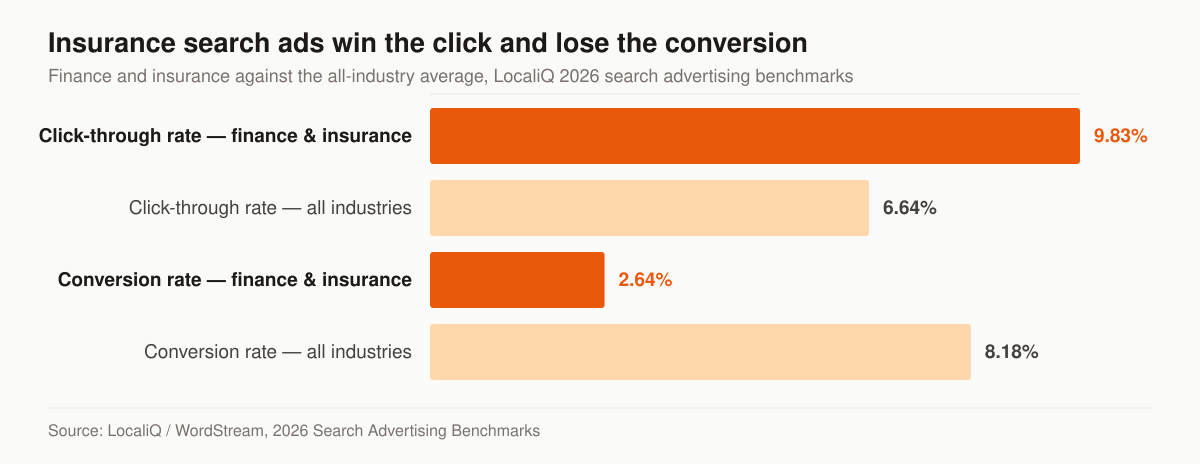
Click-through rate and conversion rate, finance and insurance against the all-industry average. Source: LocaliQ/WordStream, 2026 Search Advertising Benchmarks.
Put the four numbers side by side and they argue for spending your next hour on the landing page rather than the headline.
| Search-ads metric | Finance & insurance | All industries |
|---|---|---|
| Average click-through rate | 9.83% | 6.64% |
| Average cost per click | $3.39 | $5.42 |
| Average conversion rate | 2.64% | 8.18% |
| Average cost per lead | $74.44 | $66.69 |
Cheap attention, expensive conversion. We read that pair as a page-and-follow-up problem before a creative problem: an ad already beating the all-industry click rate is not the part that is broken. When we audit an underperforming insurance ad account, the destination page and the speed of the first call are the first two things we look at, and the creative is third. Note also that a single category average hides a wide spread — a Medicare click and a commercial-lines click are not the same purchase, and the range by line is set out in insurance PPC cost per click by line. What a managed program costs on top of media is published openly on our pricing page.
The examples that never run: what platforms and regulators reject
Copying a national campaign is safe in structure and risky in substance, because the six spots above advertise a name and make no product claim at all. Yours will make claims, and three separate readers get a vote on them.
The FTC sets the floor. Under the Federal Trade Commission Act, the agency’s small-business guidance states that “Advertising must be truthful and non-deceptive”, that “Advertisers must have evidence to back up their claims”, and that “Advertisements cannot be unfair” (FTC, Advertising FAQ’s: A Guide for Small Business). The same guidance defines a deceptive ad as one containing a statement, or omitting information, that “Is likely to mislead consumers acting reasonably under the circumstances” and that is material to a consumer’s decision to buy or use the product. Then comes the sentence that catches insurance copy: “Under the law, advertisers must have proof to back up express and implied claims that consumers take from an ad.” What your ad implies is your problem too — which is why “she thought it cost 10x more” works as a hook and “you’ll save 10x” does not.
Meta sets a second floor, and it is a targeting rule as much as a copy rule. Meta’s list of financial products and services covered by the category names “Insurance products” for US advertisers, and since January 21, 2025 the designation is required for advertisers based in the United States or showing ads to audiences in the United States, with Meta stating that “Ads may be rejected if an appropriate category is not chosen” (Meta Business Help Center). Choosing it makes age, gender, ZIP or postal code, exclusion targeting, lookalike audiences and saved audiences limited or unavailable. So any ad example whose cleverness depends on tight demographic targeting is not reproducible for you, however good the creative looks. The setup sequence is in our Facebook ads walkthrough.
The third floor is line-specific. Medicare creative sits under CMS marketing rules, life and annuity advertising sits under state adoptions of the NAIC advertising model regulation, and anything that produces a phone call or a text sits under TCPA. The full map is in insurance marketing compliance for agents.
How to judge an insurance ad example before you copy it
An ad example is a hypothesis somebody else funded. Before rebuilding one, we put it through six questions in this order:
- Who was it for? A carrier advertising a name to the whole country and an agent advertising an appointment to four counties are not doing the same job. We treat brand spots as the hardest ads in the category to copy, which is why the takeaways above are mechanics rather than scripts.
- What is it asking for? If you cannot state the next step in four words, the ad has no offer, and there is nothing to copy but tone.
- Could you legally say the same thing? Run the claim past the FTC standard above and your carrier or FMO advertising desk before you build the creative, not after the media is booked.
- Does it depend on targeting you are allowed to use? Anything aimed by age or ZIP on Meta is out for insurance, whatever the creative looks like.
- Does it depend on a budget you do not have? Frequency is a purchase. A character campaign that works at national airing volume does nothing at four impressions a week.
- What will it cost per sale, not per lead? Two ads at the same cost per lead can differ by half on issued policies. Set the reporting up before the ad goes live; afterwards you are guessing.
Run that filter over the six famous campaigns and all six fail questions one and five: each was a carrier advertising its own name at national media weight. That is the correct result, and it is not an argument against studying them. What survives the filter is the mechanic — front-load the message, personify the risk, keep one face, lean into the awkward thing about your business. Mechanics are free. Media is not.
Ads for insurance agents: running this playbook on a local budget
You don’t need a Super Bowl budget to use any of this — the carriers’ spend actually works for you, because they’ve pre-sold the category and you only have to win the local moment. Here’s the sequence we run:
- Pick one line and one audience. Final expense in three counties beats “all insurance everywhere.” If that’s your line, the final expense marketing playbook is the deeper dive.
- Write three problem-first variations using the formula table above — same offer, different hooks.
- Put them where intent lives. High-intent search goes to managed Google Ads; volume and retargeting go to Meta, inside the Special Ad Category constraints covered in our Facebook ads walkthrough.
- Send clicks to a dedicated page, not your homepage — message match decides cost per lead.
- Call new leads inside five minutes. The ad only starts the sale.
- Judge by cost per sale, kill and scale weekly. Cheap leads that never close are the expensive ones.
- Keep one brand asset compounding — a recurring face, phrase, or format, per the Flo lesson — while direct response pays the bills.
If you’d rather have the whole stack — search, social, landing pages, tracking — built and run for you, that’s precisely what our done-for-you insurance advertising engagement covers. Or start smaller: a free marketing audit will show you which of these seven steps your current ads are skipping.
- How to Run Facebook Ads for Insurance Agents (Step by Step)
A step-by-step guide to how to run Facebook ads for insurance agents: Special Ad Category setup, creative that converts, lead forms, and TCPA-safe compliance.
- The Final Expense Sales Funnel: From Click to Issued Policy
A practitioner's map of the final expense sales funnel from click to issued policy: a stage table, checkpoints, and the math that decides the profit.
- Instagram for Insurance Agents: The Organic Playbook That Actually Moves Pipeline
Instagram for insurance agents: an organic playbook covering content pillars, Reels, posting cadence, and the compliance rules that keep posts clean.
- Social Media for Final Expense Agents: Organic, Paid, and Compliant
Social media for final expense agents: which platform the 65-plus buyer uses, what Meta's Special Ad Category removes, and the TCPA and FTC posting rules.