Insurance Copywriting: How to Write Copy a Skeptical Buyer Trusts
Insurance copywriting is writing that gets a skeptical buyer to take one step — a quote, a call, a booked appointment — without promising anything a regulator or carrier would flag. The craft comes down to three habits: clarity over cleverness, specific numbers over adjectives, and compliance-safe claims written into the first draft instead of patched in at review.
Insurance copywriting has a harder job than most copywriting: the product is an intangible promise, the buyer starts out skeptical, and the words themselves are regulated. Clever slogans do not fix any of that. Clear, specific, defensible copy does.
The skepticism is measurable. LIMRA’s 2025 Insurance Barometer Study (June 2025) found adults ages 18–30 overestimate the cost of a $250,000 20-year term policy by 10–12 times, and that 48% of Millennials cite perceived cost as a reason for not owning coverage. Your prospect’s default belief is wrong in your favor — and vague copy leaves that belief intact. This guide covers the principles, the formulas for headlines, leads, and CTAs, before-and-after rewrites, and a table that converts risky phrasing into compliant phrasing. For teardowns of famous campaigns and line-by-line ad formulas, the companion piece is our insurance advertising examples breakdown.
What makes insurance copywriting different?
Insurance copy sells a regulated promise to a doubtful buyer, so the rules of persuasion invert: clarity beats cleverness, specificity beats superlatives, and every claim must survive a compliance read. The NAIC’s Advertisements of Life Insurance and Annuities Model Regulation sets the tone in Section 4: advertisements “shall be truthful and not misleading in fact or by implication” — judged by the overall impression on an average reader, not by whether each clause is technically defensible.
Three working principles follow:
- Clarity over cleverness. A confused prospect does not ask for clarification; they scroll. “Final expense insurance: what it costs at 68” outperforms wordplay because the buyer is searching for certainty, not entertainment.
- Specificity over adjectives. “Comprehensive, affordable coverage” says nothing. Who qualifies, what is covered, what happens on the call, how fast — specifics are what a skeptical reader can actually evaluate.
- Compliance in the first draft. If the claim needs an asterisk, rewrite the claim. Patching risky copy at review produces hedged, mushy ads; writing inside the rules from the start produces clean ones.
The formulas: headlines, leads, and CTAs
Formulas are scaffolding, not scripts — swap in your line, market, and offer.
Headlines
The headline’s only job is to make the right person read the next line. Four patterns that survive both the scroll and the compliance desk:
| Pattern | Skeleton | Example use |
|---|---|---|
| Question they’re already asking | “What does [product] cost at [age/situation]?” | Final expense, term life |
| Myth flip | “You probably think [belief]. Here’s the actual number.” | Life (cost overestimation) |
| Situation callout | “[Life event] in [place]? Here’s what changes for your coverage.” | Medicare turning-65, new-home P&C |
| Consequence framing | “The bill doesn’t disappear. It just moves to someone you love.” | Final expense, life |
Notice what’s absent: superlatives (“best rates in town”), absolutes (“guaranteed approval”), and borrowed urgency (“act now”). Those aren’t just weak — several are regulated, as the table further down shows.
Leads
The first sentence after the headline decides whether the promise gets cashed. Three lead types that work for insurance:
- The straight answer. Open with the fact the headline promised. Buyers reward directness, and so do AI search engines quoting your page.
- The mirrored objection. State the prospect’s actual doubt in their words — “You assume you won’t qualify” — then address it. It signals you’ve had this conversation a thousand times, which is the trust signal.
- The stakes scene. One concrete sentence about the moment the coverage exists for: the claim call, the mortgage payment after a death, the fender-bender with a teenage driver. One sentence — then back to facts.
CTAs
A CTA needs a noun. “Learn more” is not an offer; a quote, a rate lookup, a coverage review, a booked call is. Three rules:
- One CTA per piece. Two asks halve the response to each.
- Say what happens next. “Request your quote — I’ll call you once, at the time you pick” removes the fear of the phone-call ambush that suppresses insurance form-fills.
- Match the commitment to the temperature. Cold traffic gets a low-stakes ask (a guide, a rate range); warm traffic gets the appointment ask.
How do you write proof language without inventing proof?
You prove with mechanism and verifiable specifics, not with numbers you don’t have. Show how you work — response time, process steps, licensing, carrier count — because each is a claim the reader can check or experience, and none requires a statistic. Fabricating results is both an ethics failure and an advertising violation; the model regulation requires statistics to “accurately reflect recent and relevant facts” with the source identified.
What that looks like in practice:
- Mechanism copy: “I quote across 14 carriers and show you the three that fit” beats “best rates available.” (Use your real number, and only if it is real.)
- Process promises: “You’ll have an answer on the call, not a callback next week” — a service promise you control is safer and more persuasive than an outcome promise you don’t.
- Cited third-party facts: industry statistics with the source named in the copy, per the rule above.
- Real testimonials, reproduced honestly — the compliance table below covers the conditions.
Buyers’ skepticism runs deep enough that even true numbers need scaffolding. “In a separate qualitative LIMRA study, even when young adults were presented with a true median cost of an insurance policy, some participants still doubted us,” notes Bryan Hodgens, Senior Vice President and Head of LIMRA Research. The lesson for copy: don’t just state the surprising fact — show where it comes from and invite the reader to verify it.
Before-and-after rewrites
These rewrites are illustrative craft examples written for this guide — the “before” lines are composites of patterns we see constantly, not quotes from real campaigns.
Life insurance social ad. Before: “We offer comprehensive life insurance solutions tailored to your family’s unique needs. Contact us today!” After: “Most people guess life insurance costs several times what it actually does. Want your real number? Two minutes for a quote — no exam booked, no pressure.” Why it works: the before version is agency-speak with no claim to evaluate. The after version flips a documented myth, makes one promise, and lowers the commitment of the ask.
Final expense mailer opening. Before: “FINAL NOTICE: Important information regarding your state-regulated benefit program.” After: “I’m [name], a licensed insurance agent in [state]. If final expense coverage is on your mind, this explains what a policy covers and what it costs at your age — and what to watch out for.” Why it works: the before version isn’t just sleazy — official-program mimicry is specifically prohibited (see the table below). The honest version converts worse on opens and better on trust, policies, and staying licensed.
P&C follow-up email CTA. Before: “Feel free to reach out if you’d like to learn more about our services.” After: “Reply with your renewal date and I’ll re-shop your rate before it hits — takes you 20 seconds, costs nothing.” Why it works: a noun offer with a deadline logic built in, effort stated, risk removed.
Risky phrasing → compliant phrasing
The table below maps common risky copy to safer equivalents, with the rule behind each row. Sections cited are from the NAIC’s Model 570 advertising regulation — a model that states adopt in varying forms, so your state’s version, your carrier’s rules, and (for Medicare) CMS requirements govern the final word. This is orientation, not legal advice.
Read this table as a find-and-replace list for a draft you already have.
| Risky phrasing | Safer direction | The rule behind it |
|---|---|---|
| “Guaranteed approval — no health questions!” (when issue isn’t guaranteed) | “No medical exam required. Acceptance may depend on your answers to health questions.” | §5C: “non-medical” claims need an equally prominent disclosure that issuance may depend on health answers |
| “A savings plan for your family’s future” | “Life insurance: a death benefit paid to your family” | §4B: terms like “investment,” “deposit,” “savings plan,” “retirement plan” are barred where they mislead |
| “Low-cost guaranteed-acceptance coverage” | State the actual premium for a real age band; drop the cost adjective | §5H: “inexpensive” / “low cost” phrasing is barred for guaranteed-issue policies |
| “FREE child rider included” | “Included with your policy” — and disclose who pays if there’s truly no charge | §5M: “free” / “no cost” only if true, with the payor prominently disclosed |
| “Enrollment closes Friday!” (when it reopens continuously) | Use only real deadlines — actual AEP dates, actual carrier cutoffs | §5T: offers can’t be framed as special or limited when they’re the usual method of marketing |
| Official-looking “benefits update” mailers | Identify yourself plainly as a licensed agent and name the insurer | §6C: no words, symbols, or materials that resemble a governmental program or agency |
| “9 out of 10 seniors qualify” (no source) | Cite the source in the ad — or cut the number | §5R: statistics must accurately reflect recent, relevant facts and the source must be identified |
| A polished paraphrase of a client review | Verbatim, current, genuine testimonial; disclose any compensation or relationship | §5Q: testimonials must be genuine, current, applicable, and accurately reproduced |
| “Your rate will never change” (nonguaranteed elements) | Say plainly what is guaranteed and what can change | §5I & §5O: premium changes and nonguaranteed elements must be prominently described, never implied as guaranteed |
Two broader backstops sit under every row. State unfair-trade-practice law — e.g., California Insurance Code §790.03(b) makes any advertising statement that is “untrue, deceptive, or misleading” an unfair practice — applies across lines, including P&C. And Medicare copy lives inside its own regime; our CMS marketing rules guide covers what that changes, and the broader marketing compliance guide for agents covers TCPA consent language for any copy that feeds calls or texts.
How plain, and how long, should insurance copy be?
Plain enough that a reader with no insurance vocabulary gets through each sentence on the first pass, and short enough that the page carries one decision. Unbounce’s Conversion Benchmark Report for finance and insurance puts numbers on both halves.
Pages written at a 5th- to 7th-grade reading level record a median conversion rate of 18.1%. At a 10th- to 12th-grade level that drops to 9.3%, and college-level copy to 7.1%. The curve is not clean in the middle — professional-level pages come in at 14.4% and 8th- to 9th-grade pages at 6.5% — and Unbounce reads that as different audiences wanting different registers rather than as a straight line from simple to good.
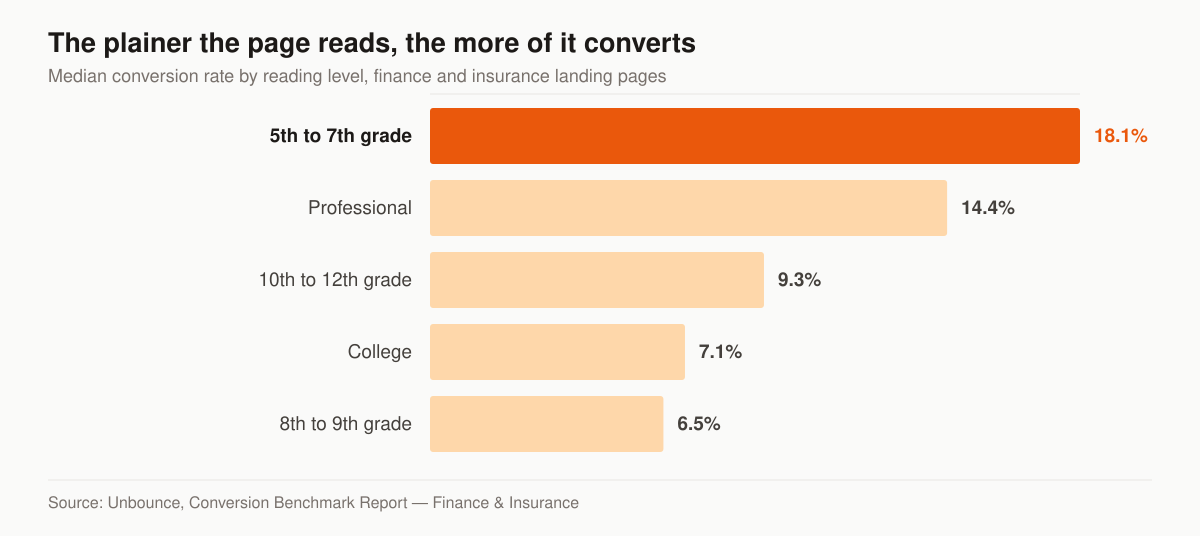
Median conversion rate by reading level, finance and insurance landing pages. Source: Unbounce, Conversion Benchmark Report — Finance & Insurance.
Reading level is the one edit you can make before you know anything else about the page.
| Reading level of the page | Median conversion rate |
|---|---|
| 5th to 7th grade | 18.1% |
| Professional | 14.4% |
| 10th to 12th grade | 9.3% |
| College | 7.1% |
| 8th to 9th grade | 6.5% |
Length has a band as well. The same report puts the finance and insurance sweet spot at 195 to 715 words, around a median 8.3% conversion rate, and caps difficult words — Unbounce’s term for words of three or more syllables — at 35 to 125 per page. Insurance runs on three-syllable nouns: deductible, beneficiary, underwriting, annuitant, indemnity, endorsement. A page can cross that ceiling without a single wasted sentence, which is why the fix is usually swapping the word rather than cutting the paragraph. “What you owe before coverage starts” costs you six short words and buys back a difficult one.
Regulators set a floor of their own, though not on advertising. The NAIC’s Life and Health Insurance Policy Language Simplification Model Act requires in Section 5A(1) that a policy form’s text “achieves a minimum score of 40 on the Flesch reading ease test or an equivalent score on any other comparable test as provided in Subsection C of this section”. Section 5A(2) sets the type at “not less than ten point type, one point leaded” for everything except specification pages, schedules and tables. Section 5A(4) requires a table of contents or an index “if the policy has more than 3,000 words printed on three (3) or fewer pages of text, or if the policy has more than three (3) pages regardless of the number of words.”
Read the scope carefully before you quote any of that in a pitch. The Act governs policy forms, not ads, and Section 4 exempts several categories outright — any policy that is a security subject to federal jurisdiction, group policies covering 1,000 or more lives at date of issue other than group credit life or credit health, and group annuity contracts serving as funding vehicles for pension, profit sharing or deferred compensation plans. Section 7 also lets the commissioner authorize a lower score in defined circumstances. What it gives a copywriter is a calibration point: a commissioner’s minimum for a binding legal contract is a Flesch reading ease of 40, and nothing prevents an ad from reading harder than the policy it sells. Score your landing page and find out which side of the contract you are on.
How much room does the channel actually give you?
Less than the claim usually needs, which is the point. A claim that will not fit the format is a claim to rewrite, not to shrink into abbreviations.
Google’s responsive search ads take up to 15 headlines of up to 30 characters each, and up to 4 descriptions of up to 90 characters each, per Google Ads Help. Thirty characters is “Final expense at 68: real cost” with nothing left over. That constraint is doing you a favor: a headline that survives 30 characters has one idea in it. Our Google Ads guide for insurance agents covers the account structure those headlines sit inside.
Disclosure runs the other way — it carries a floor, not a ceiling. For Medicare Advantage marketing, 42 CFR 422.2263(b)(9) requires that “MA organization or marketing names must be in 12-point font in print and may not be in the form of a disclaimer or fine print”. For television, online, or social media, the same paragraph requires those names “must be either read at the same pace as the phone number or must be displayed throughout the entire advertisement in a font size equivalent to the advertised phone number, contact information, or benefits.”
Write to the tightest constraint in the set, then check the disclosure still fits at its required size.
| Where the copy runs | The limit | Where it comes from |
|---|---|---|
| Google responsive search ad, headline | Up to 15 headlines, up to 30 characters each | Google Ads Help |
| Google responsive search ad, description | Up to 4 descriptions, up to 90 characters each | Google Ads Help |
| Medicare Advantage marketing, print | Plan or marketing name in 12-point font, not as a disclaimer or fine print | 42 CFR 422.2263(b)(9)(i) |
| Medicare Advantage marketing, TV / online / social | Name read at the same pace as the phone number, or displayed throughout at a font size equivalent to the advertised phone number, contact information, or benefits | 42 CFR 422.2263(b)(9)(ii) |
| Medicare Advantage marketing, radio and voice | Names read at the same pace as the advertised phone numbers or other contact information | 42 CFR 422.2263(b)(9)(iii) |
| Life and health policy forms | Not less than ten point type, one point leaded | NAIC Model 575 §5A(2) |
Medicare copy: the sentences CMS has already written
Medicare Advantage copy is the one place where the regulation drafts parts of your ad for you. The rules below come from 42 CFR 422.2263, which sits in Part 422 — the Medicare Advantage program. Part D has its own parallel subpart in Part 423. The text is written as requirements on MA organizations; carriers pass them down by contract to the agents and third-party marketing organizations selling on their behalf, which is how they land on your desk.
Four provisions change sentences rather than processes:
- Comparisons are allowed, unsupported ones are not. An MA organization may not “Compare their plan to other plans, unless the information is accurate, not misleading, and can be supported by the MA organization making the comparison” (§422.2263(b)(5)). The exception is doing the work, not skipping the comparison.
- The savings headline built on uninsured spending is out. MA organizations “may not include information about savings available to potential enrollees that are based on a comparison of typical expenses borne by uninsured individuals, unpaid costs of dually eligible beneficiaries, or other unrealized costs of a Medicare beneficiary” (§422.2263(b)(10)).
- Star ratings come with four attached sentences. References to an individual measure “must also include references to the overall Star Rating for MA-PDs and the summary rating for MA-only plans”; copy “May not use an individual underlying category, domain, or measure rating to imply overall higher Star Ratings”; it “Must be clear that the rating is out of 5 stars”; and it “Must clearly identify the Star Ratings contract year” (§422.2263(c)(1)–(4)).
- Benefits you advertise have to exist where the ad runs. MA organizations may not “Advertise benefits that are not available to beneficiaries in the service area(s) where the marketing appears, unless the advertisement is in local media that serves the service area(s) where the benefits are available and reaching beneficiaries who reside in other service areas is unavoidable” (§422.2263(b)(8)).
The practical effect on drafting is that a Medicare ad has a fixed overhead of required words, and you write the persuasion around it rather than bolting the overhead on at the end. For the full picture — review timelines, disclaimers, what counts as marketing versus communications — read our CMS marketing rules guide, and for the appointment mechanics see scope of appointment and TPMO compliance.
What does an insurance copywriter cost?
There is no insurance-specific rate survey we could find and verify, but there is a published editorial one. The Editorial Freelancers Association’s 2026 Rate Chart comes from a survey of its members — over 1,100 respondents, run from November 2025 through mid-January 2026, reporting on rates charged during the 2025 calendar year. The EFA is explicit that it “neither sets rates nor advises members on what rates or rate types to use”, and that individual rates vary with type of work, turnaround time, degree of expertise, local cost of living, training and years of experience.
These are the rows closest to agency copy — the business/marketing genre inside each service, plus the blog-post genre under work-for-hire.
| Service and genre | Per word | Per hour |
|---|---|---|
| Ghostwriting, business/marketing | 50.0¢–$1.00 | $87.50–$125.00 |
| Work-for-hire, business/marketing | 32.0¢–87.5¢ | $65.00–$75.00 |
| Work-for-hire, blog posts | 25.0¢–45.0¢ | $74.50–$87.50 |
| Line editing, business/marketing | 3.2–5.0¢ | $55.00–$75.00 |
| Copyediting, business/marketing | 3.0–4.0¢ | $50.00–$60.00 |
| Proofreading, business/marketing | 2.0–3.0¢ | $45.00–$60.00 |
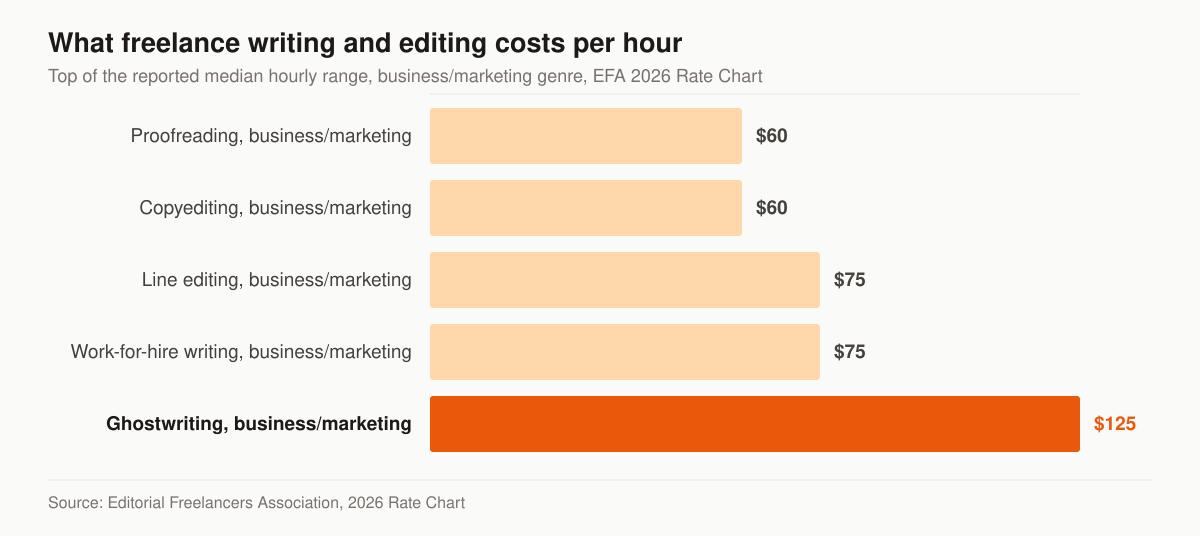
Top of the reported median hourly range for the business/marketing genre of each service. Source: Editorial Freelancers Association, 2026 Rate Chart.
Two things the numbers do not tell you. The survey covers editorial work in general; nothing in it isolates writers who can name what Section 5H does to a guaranteed-issue ad or what §422.2263 does to a star-rating line, and that knowledge is what separates a draft your compliance desk approves from one it returns. And per-word pricing quietly penalizes the discipline this whole page argues for — a 30-character headline that took an hour to get right bills as nothing, while 900 words of throat-clearing bills well.
That is why our own work is priced as a retainer rather than by the word. Pricing runs Foundation at $2,500 a month, Growth at $3,500 and Full-Funnel at $5,500, with a one-time website build from $2,500 to $8,000. Website and landing-page copy sits in Foundation; the ongoing content engine starts at Growth; managed paid ads and landing-page conversion work start at Full-Funnel.
Frameworks: PAS, AIDA, and where a formula stops helping
The frameworks that circulate in general copywriting all work in insurance, with one adjustment each. They are shapes for an argument, not scripts, and the adjustment is always the same: whatever the framework asks you to intensify, insurance rules require you to keep true.
Pick the framework by how the reader arrived, not by which one you like writing.
| Framework | The shape | Where it fits |
|---|---|---|
| PAS — problem, agitate, solve | Name the problem, make the cost of ignoring it concrete, offer the fix | Final expense and mortgage protection, where the buyer already knows the problem and has postponed it |
| AIDA — attention, interest, desire, action | Hook, relevance, want, ask | Cold social traffic, where the second line has to be earned |
| Before, after, bridge | Where they are now, where they could be, what gets them across | Renewal re-shops and account rounding, where an existing client is the reader |
| The four questions | What is it, what does it cost, who qualifies, what happens next | Search traffic that arrived with one specific question |
Where formulas break is the agitate step. In a category with no regulation, over-agitating is a taste problem. Here it walks straight into the advertising rules — manufactured urgency runs at Model 570 §5T, and a fear appeal that implies an outcome the policy does not deliver is misleading by implication under Section 4. The safe version of agitation is factual consequence: what the bill is, who receives it, when it arrives. That sentence does the same work and survives review.
The other break is the ask. A framework will tell you to close hard; the funnel will tell you the reader is not ready. Match the ask to the temperature, then check that the page you send them to repeats the promise the ad made — our insurance landing pages service exists because that hand-off is the first place we look for wasted spend. Email sequences have their own shapes, worked through in our insurance email marketing examples.
Can you write insurance copy with AI?
For drafting, yes; for publishing at volume, carefully. Google’s spam policies define scaled content abuse as “when many pages are generated for the primary purpose of manipulating search rankings and not helping users”, adding that the practice “is typically focused on creating large amounts of unoriginal content that provides little to no value to users, no matter how it’s created”, and listing “Using generative AI tools or other similar tools to generate many pages without adding value for users” as an example (Google Search Central). The trigger in that definition is purpose and value, not the tool.
The insurance-specific risk is different and more immediate than a ranking penalty. A model has no way to check which version of Model 570 your state adopted, which carriers you actually hold appointments with, whether the testimonial you pasted in is current, or whether the plan benefit you just described is available in the service area where the ad will run. Every one of those is a compliance failure that reads perfectly fluently on the page.
A workable division of labor: use the model to widen the option set — 20 headline variants, three lead angles, a plain-language rewrite of a paragraph you wrote too formally — and keep verification, numbers, quotes and every regulated claim in human hands. Then check the output against the risky-phrase table above before it ships. The same discipline is what makes a page quotable by AI search engines rather than skipped by them, which we cover in getting recommended by ChatGPT and deliver as AI search visibility.
How do you tell whether a rewrite actually worked?
By the number furthest down the funnel that you can still attribute, and by resisting the urge to call it early.
Clicks and click-through rate tell you the headline earned attention; they say nothing about whether the person was the right person. Form fills tell you the offer was low-friction, which a bad offer can also achieve. The measure that survives scrutiny is cost per bound policy, and the honest version of it accounts for the fact that a copy change made today shows up in issued business weeks later, after underwriting.
Three habits keep the read clean. Change one element at a time — headline, or lead, or CTA, never all three, because a lift you cannot attribute is a lift you cannot repeat. Let the test accumulate enough conversions that a handful of extra leads would not flip the winner; on the volumes an independent agency runs, that takes longer than the dashboard’s confidence indicator suggests. And segment by source before you conclude anything: the same ad copy behaves differently on search intent than on interrupt traffic, a gap visible in the cost-per-click spread across lines in our insurance PPC cost-per-click breakdown.
One more thing that masquerades as a copy problem: speed. A rewrite that doubles lead volume into a follow-up process that answers the next morning will read as a failed test, because the leads never converted. Fix the lead follow-up cadence before you judge the copy.
A working process: from blank page to compliant draft
- Write the buyer’s question at the top of the page. Real phrasing from a real call — the copy’s job is to answer it.
- Draft the answer in one plain sentence. If you can’t, you’re not ready to write the ad.
- Pick one formula each for headline, lead, and CTA from the sections above.
- Add one piece of honest proof — mechanism, process promise, cited fact, or genuine testimonial.
- Run the risky-phrase table against the draft. Rewrite claims rather than asterisking them.
- Read it aloud as if on a recorded line. Anything you’d hesitate to say to a regulator, cut.
- Match the landing page to the ad’s promise. Message mismatch quietly doubles cost per lead.
- Ship, measure against cost per bound policy, and rewrite the weakest element — one variable at a time.
Copy costs less to fix than any other part of an insurance funnel, and we treat it as the first place to look when a channel underperforms. If you’d rather hand the writing to people who do this inside insurance rules all day, that’s what our done-for-you insurance content and copywriting engagement covers — or start with a free copy-and-funnel audit and we’ll show you which pages and ads are leaking.
- How to Run Facebook Ads for Insurance Agents (Step by Step)
A step-by-step guide to how to run Facebook ads for insurance agents: Special Ad Category setup, creative that converts, lead forms, and TCPA-safe compliance.
- Insurance Advertising Examples: 6 Famous Campaigns, Torn Down
Six famous insurance advertising examples — GEICO, Flo, Mayhem, Aflac — broken down, plus copy formulas for auto, life, final expense, and Medicare ads.
- Facebook Ads vs Google Ads for Insurance Agencies: Which Wins?
Facebook ads vs Google ads for insurance agencies: intent, cost, lead quality, and which channel fits final expense, Medicare, and auto — plus how to run both.
- The Final Expense Sales Funnel: From Click to Issued Policy
A practitioner's map of the final expense sales funnel from click to issued policy: a stage table, checkpoints, and the math that decides the profit.