The Final Expense Sales Funnel: From Click to Issued Policy
A final expense sales funnel is the staged path a senior prospect travels from first ad click to an issued, paid policy: click, lead, contact, presentation, application, and issue-pay. Each stage has its own conversion rate, and the funnel only earns when the cost to fill the top survives the drop-off to the bottom.
A final expense sales funnel is the staged path a senior prospect travels from first ad click to an issued, paid policy. An agent who is short of sales will usually describe it as a lead problem. Often it is a funnel problem instead: leads come in fine, then leak out at a stage nobody is measuring.
This page maps the funnel stage by stage, gives you the conversion math that decides profit, and shows where the leaks usually are. Every outside number on this page is attributed to the source that published it, and every worked example is labeled as arithmetic rather than as a result.
The six stages of a final expense funnel
Every final expense sale moves through the same sequence. Skip a stage and the sale stalls. Measure each stage separately and you can see exactly where money is being lost.
This table names the six stages, the rate each one produces, and the failure we look for first when that rate is low.
| Stage | What happens | What you measure | Typical leak |
|---|---|---|---|
| 1. Click | Senior responds to an ad or search result | Cost per click, click-through rate | Wrong audience, weak creative |
| 2. Lead | They submit name, phone, DOB | Cost per lead, form completion | Friction on the form, bad targeting |
| 3. Contact | You reach them live by phone | Contact rate, dials to connect | Slow follow-up, single-touch outreach |
| 4. Presentation | You quote coverage and explain | Presentation rate, hold rate | No quote-on-call, weak framing |
| 5. Application | They apply and you submit | App rate, drop-off on questions | Health knockouts, payment hesitation |
| 6. Issue-pay | Carrier approves, first draft clears | Issue rate, first-draft success | Non-payment, NSF, buyer’s remorse |
Each stage multiplies against the next. That is the part agents miss. A funnel is not addition; it is multiplication. A modest improvement at the contact stage compounds through every stage below it.
Why the funnel is multiplication, not addition
Run the math with round numbers. Start with 100 leads.
- 100 leads, 60% contact rate → 60 contacted
- 60 contacted, 70% presentation rate → 42 presented
- 42 presented, 50% application rate → 21 applied
- 21 applied, 76% issue-pay rate → 16 issued policies
That bottom number, 16 issued from 100 leads, is roughly a one-in-six close rate. Now lift contact rate from 60% to 75% and hold everything else flat: you finish at 20 issued, not 16. A 15-point gain at one stage produced a 25% lift in issued policies. You did not buy more leads. You stopped wasting the ones you had.
This is why we tell agents to fix the funnel before scaling spend. More leads into a leaky funnel just means more wasted leads. If lead volume is genuinely your constraint, our insurance lead generation service feeds a funnel that is already converting, not one that is leaking.
Stage 1: the targeting you think you have, and the targeting Meta gives you
Final expense is a 50-plus product, so the obvious first move on Meta is to set an age floor at 50 and a ceiling somewhere in the eighties. You cannot. Insurance ads run inside a Special Ad Category, and that category takes the age control off the ad set.
Meta’s Business Help Center states the change and its scope: “In October 2024, a new Special Ad Category ‘Financial products and services’ was introduced, replacing the previous Credit ads category.” The same page names what falls inside it — “Examples of financial products and services ads include those promoting insurance, bank accounts, investment services and payment services” — and makes the designation compulsory rather than advisory: “Starting January 21, 2025, using the Special Ad Category designation is required for advertisers based in the United States or reaching audiences in the United States running financial products and services campaigns. Ads may be rejected if the advertiser does not choose an appropriate Special Ad Category” (Meta Business Help Center, Special Ad Categories have expanded).
The bill arrives on the audience page for those campaigns. Meta writes that “Age, gender, ZIP code or postal code, audience exclusion targeting, lookalike audiences, saved audiences and some interests are limited or unavailable” for advertisers based in the US or US territories and for advertisers showing ads to audiences in the US or US territories, Canada and certain European countries and territories.
This table sets each targeting tool a final expense advertiser would reach for beside what Meta’s own documentation says about it.
| Targeting tool | What Meta’s documentation says | What it does to a final expense funnel |
|---|---|---|
| Age | “Options are generally fixed to include ages 18 through 65+” | Age is listed among the limited or unavailable tools; do not plan the campaign around a 50-plus floor |
| Gender | “Audiences must include all genders. You can’t edit this option.” | No separate widow or widower audience |
| ZIP or postal code | “You can target your ads to people by geographic location (such as country, region, state, province or city), but not by ZIP code or postal code. You also can’t exclude locations.” | County and city are the floor; you cannot cut a bad ZIP out |
| City or pin-drop radius | Audiences based on a city, address or pin drop “will include an expanded radius” — 15 miles in the United States and Canada | A single-town campaign delivers across the surrounding metro |
| Detailed targeting | “Some demographic, behavior and interest options are unavailable.” | Interest stacks thin out and behave less predictably |
| Exclusions | “Excluding any detailed targeting selections is also unavailable.” | Existing policyholders cannot be suppressed by interest |
| Lookalikes | “Advantage+ lookalike is unavailable.” | No seeding a new audience off your buyer list |
Source for every quotation in that table: Meta Business Help Center, About audiences for housing, employment or financial products and services campaigns. One honest wrinkle: the summary sentence lists age among the limited tools across all three categories, while the paragraph headed “Age” is worded around “housing, employment and credit ads”. Read your own ad set’s controls rather than anyone’s summary of them, including this one.
The funnel consequence is not subtle. Stage 1 stops being mostly a targeting problem and becomes mostly a creative problem, because the qualifying that the ad set used to do now has to happen inside the ad. Copy that names the product, the age bracket and the monthly figure does the filtering the ad set used to do, and every unqualified click it fails to repel is paid for at stage 1 and wasted at stage 3. That constraint is why we plan creative sets rather than single ads on insurance Facebook ads engagements, and the mechanics are laid out in Facebook ads for insurance agents.
Stage 2 is a page and a form, not a lead
A form fill is the output of stage 2. The stage itself is a page, and the page has two jobs that pull against each other: convince a 68-year-old that this is worth her phone number, and collect enough about her that stage 3 is not a cold call.
What the page has to answer is fixed by what the buyer is actually worried about. Price for a specific age. Whether health questions are asked. Whether she can be turned down. What happens if she cannot keep paying. We build the page around those four answers rather than around a generic “get a free quote” box, on the reasoning that an objection answered on the page is an objection the agent does not spend the opening minutes of the call on. Build guidance for that page sits on our insurance landing pages service.
The second job is the form, and every field is a trade: it costs you completions and buys you qualification. Name and phone are the floor. Date of birth is the field we argue hardest for, because final expense pricing is age-banded and an agent who knows the age before dialing can quote on the first call instead of booking a second one. State matters for carrier availability. Coverage amount is useful and safe to ask. We keep health questions off the form itself: they cost completions, and you will ask them again on the application anyway.
The third job is invisible on the page and decisive later: the form is where the consent record is created. Federal rule 47 CFR 64.1200(f)(9) defines the term this way: “The term prior express written consent means an agreement, in writing, bearing the signature of the person called that clearly authorizes the seller to deliver or cause to be delivered to the person called advertisements or telemarketing messages using an automatic telephone dialing system or an artificial or prerecorded voice, and the telephone number to which the signatory authorizes such advertisements or telemarketing messages to be delivered.”
The same paragraph specifies what the agreement has to disclose. It “shall include a clear and conspicuous disclosure informing the person signing that: (A) By executing the agreement, such person authorizes the seller to deliver or cause to be delivered to the signatory telemarketing calls using an automatic telephone dialing system or an artificial or prerecorded voice; and (B) The person is not required to sign the agreement (directly or indirectly), or agree to enter into such an agreement as a condition of purchasing any property, goods, or services.” It also confirms that an electronic or digital signature counts, “to the extent that such form of signature is recognized as a valid signature under applicable federal law or state contract law” (eCFR, 47 CFR 64.1200).
Read the scope of that definition before you copy a checkbox off a competitor. It defines prior express written consent for telemarketing delivered by automatic telephone dialing system or by artificial or prerecorded voice — it is a definition of a term, not a blanket rule that every call needs a signature. What matters operationally is that the record has to exist, has to be retrievable per lead, and has to survive the lead changing hands. We provide marketing services, not licensed insurance or legal advice; your compliance counsel and your carrier decide what your form says.
Stage 3 is where most funnels die
We treat the contact stage as the first leak to check on any final expense funnel, because it sits above everything else and it is the cheapest rate to move. A lead you never reach cannot present, apply, or issue. It is worth nothing, no matter how good the lead source was.
Two things fix contact rate, and neither is a better script:
- Speed-to-lead. The interval between form submission and first dial decides connect rate more than anything else. Minutes matter, not hours.
- Multi-touch cadence. One call is not follow-up. A structured sequence of calls, texts, and voicemail over 10 to 14 days recovers contacts a single attempt misses.
We break the full sequence down in our guide to insurance lead follow-up cadence, and the email touches inside it have copy-ready skeletons in our insurance email marketing examples. The agents who win the contact stage are rarely better closers. They are just more disciplined about touch count and timing.
There is a compliance layer here too. Contact has to be consensual. TCPA still governs how and when you can call and text, even though the FCC’s one-to-one consent rule was vacated in January 2025. If you are buying leads, read our breakdown of TCPA compliance for agents buying leads before you build your cadence. We provide marketing services, not licensed insurance or legal advice; you are the licensed party and the one on the consent record.
When you are allowed to call, and how the consent ends
A cadence is a schedule, and the schedule has federal edges. Two paragraphs of 47 CFR 64.1200 set them, and both are worth reading in full rather than in summary, because each carries its own scope.
The first is the calling window. The rule says: “No person or entity shall initiate any telephone solicitation to: (1) Any residential telephone subscriber before the hour of 8 a.m. or after 9 p.m. (local time at the called party’s location)”. Three limits live in that sentence. It is written about telephone solicitations. It is written about residential telephone subscribers. And the clock is the prospect’s clock, not the call center’s — an agent dialing from the Pacific time zone into the Eastern time zone loses the last three hours of the evening block. State telemarketing statutes and your carrier’s own rules can be narrower than the federal floor, and the narrower one governs.
The second is revocation, and it is the paragraph most cadence tools were not built for. Under 64.1200(a)(10), “A called party may revoke prior express consent, including prior express written consent, to receive calls or text messages made pursuant to paragraphs (a)(1) through (3) and (c)(2) of this section by using any reasonable method to clearly express a desire not to receive further calls or text messages from the caller or sender.” The rule then names what counts as reasonable per se: an automated, interactive voice or key-press opt-out on a call; a reply to a text using “stop,” “quit,” “end,” “revoke,” “opt out,” “cancel,” or “unsubscribe”; or a website or telephone number the caller designated to process opt-outs. Other words still count where “a reasonable person would understand those words to have conveyed a request to revoke consent.”
Two operational sentences follow. “All requests to revoke prior express consent or prior express written consent made in any reasonable manner must be honored within a reasonable time not to exceed ten business days from receipt of such request.” And callers “may not designate an exclusive means to request revocation of consent” — so a cadence that only accepts STOP by text, or only a link in an email, does not meet the rule. Paragraph (a)(12) adds one allowance worth knowing: a single confirmation text that merely confirms the revocation and carries no marketing content is permitted, and “If the confirmation text is sent within five minutes of receipt, it will be presumed to fall within the consumer’s prior express consent” (eCFR, 47 CFR 64.1200).
Translate that into three fields your system needs before you scale spend: a timezone on every lead, so the 8 a.m. to 9 p.m. window is evaluated where the prospect lives; a suppression list that any channel can write to, because no single channel may be the exclusive route out; and a service level on that suppression that clears inside ten business days. None of this is theoretical for a funnel — a lead you may no longer call is a lead that still cost you money at stage 2, which is another reason cost per issued policy is measured on spend rather than on contacts. The touch-by-touch sequence that lives inside these edges is in our follow-up cadence guide, and the sending infrastructure behind it is insurance email automation.
The stage everyone forgets: issue-pay and persistency
The sale is not the application. The sale is the first draft clearing and staying cleared. A senior who applies but whose first payment bounces is not income; it is a chargeback waiting to happen.
Two metrics live below the application stage:
- Issue-pay rate. Of applications submitted, how many issue and take the first draft. Health knockouts and payment hesitation drive most of the loss here.
- Persistency. Of policies that issued, how many are still paying at month three, six, and twelve. Final expense persistency is fragile because the buyers are on fixed incomes.
Persistency is a marketing problem, not just a service problem. The way a lead is generated shapes how well it persists. A prospect who genuinely raised their hand for coverage holds far better than one pressured off a cheap, shared, semi-incentivized lead. Lead quality at stage two shows up as retained income at month twelve.
Why the first draft bounces, and what it says about who you sold
Stage 6 fails for two different reasons that get filed under the same word. One is underwriting: a health answer knocks the application out. The other is cash: the policy issues, the draft hits, and the account is short. The second one is a marketing problem, because it is decided by who you put in the funnel and what premium you sold them.
We could not find a public dataset of final expense first-draft failures. There is a public dataset of who misses a bill, and it is the closest honest proxy we could source: the Federal Reserve’s Survey of Household Economics and Decisionmaking, published as the Report on the Economic Well-Being of U.S. Households in 2025.
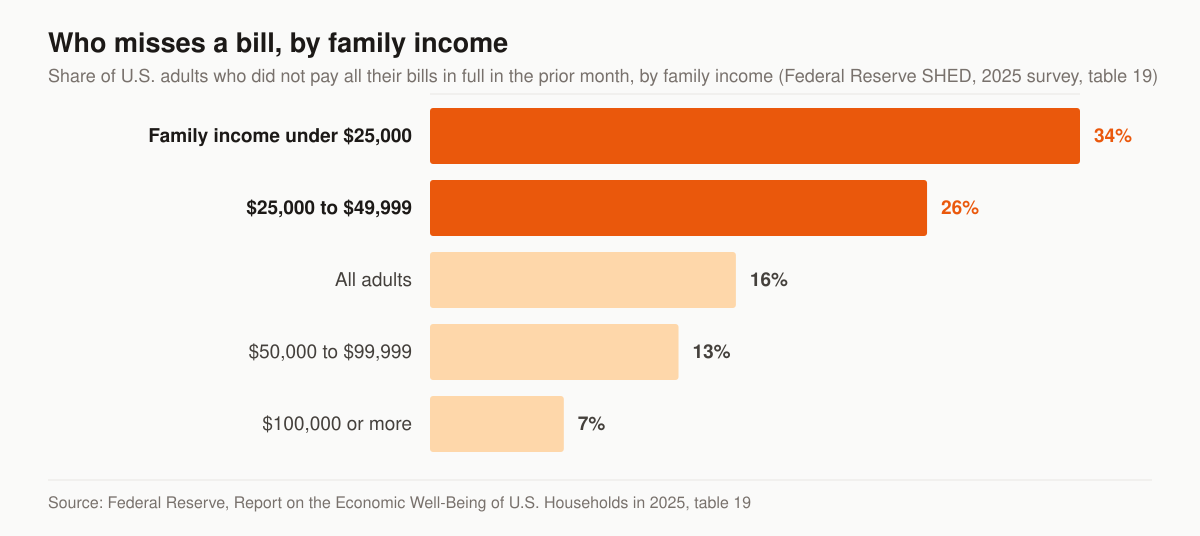
Chart: share of adults who did not pay all bills in full in the prior month, by family income. Source: Federal Reserve, Report on the Economic Well-Being of U.S. Households in 2025, table 19.
Sixteen percent of adults said they did not pay all their bills in full in the month before the survey. Split by family income, that figure is 34 percent below $25,000, 26 percent between $25,000 and $49,999, 13 percent between $50,000 and $99,999, and 7 percent at $100,000 or more. The shape is the point rather than any single figure: a monthly draft into a household under $50,000 lands in a very different pool than the same draft into a household over $100,000. Pull the income mix of your own last hundred applications and you will know which of these bars describes your book.
The same report supplies the counterweight, and it is good news for this niche. Broken out by age, the share who did not pay all bills in full runs 24 percent at 18 to 29, 20 percent at 30 to 44, 16 percent at 45 to 59, and 9 percent at 60 and over — the lowest of the four age groups. In that survey’s own terms, adults aged 60 and over missed a bill less often than any younger age group. Both facts sit in the same table: the income band your buyer occupies raises the risk and the age band lowers it. Which is why we treat persistency as a function of how the sale was set up rather than of the demographic on its own.
What a shortfall looks like in practice is in the next table of the same report. Among adults who struggled with bills in the prior month, 48 percent cut back on other expenses, 42 percent paid one or more bills late, 23 percent used a credit card to pay a bill over time and 22 percent borrowed or received money from friends or family. A footnote to that section adds that 68 percent of people who did not pay all non-credit card bills or who had difficulty paying bills in the prior month could not cover a $500 emergency expense using savings.
Two caveats before you use any of this in a sales meeting. The survey covers all U.S. adults, not final expense buyers, so it describes the pool your prospects are drawn from rather than your prospects. And it measures missed bills, not lapsed life insurance policies, which are not the same event. What it supports is a design decision, not a forecast: size the premium to what the household can carry every month rather than to the coverage the prospect first names, and set the draft date against the deposit that funds it. The mechanics of doing that on the call are in how to sell final expense over the phone.
Cost per issued policy is the number the funnel is judged on
Cost per lead is a vanity metric on its own. The number that tells you whether the funnel is a business is cost per issued policy: total lead spend divided by policies that issue and pay.
This table runs one hundred leads at an illustrative $8 cost per lead through the round stage rates used earlier in this page, so the gap between a lead price and an acquisition cost is visible in one column.
| Input | Value |
|---|---|
| Cost per lead | $8 |
| Leads purchased | 100 |
| Total spend | $800 |
| Issued policies (one-in-six) | 16 |
| Cost per issued policy | $50 |
Compare that $50 against first-year commission on a typical final expense policy and the funnel either works or it does not. A funnel with a $4 cost per lead and a broken contact stage can easily produce a higher cost per issued policy than a cheap lead worked properly. Cheap leads are not cheap if they do not issue. We walk through this trap in final expense lead cost vs. true cost per sale.
Two funnels, not one: the form fill and the inbound call
A final expense operation usually runs two funnels at once and reports them as one, which is how a good channel gets cut and a bad one gets scaled.
A form fill enters at stage 2 and has to be dragged through stage 3. An inbound call enters at stage 4 — the prospect is already on the phone, already reached, already listening. That is why the two cannot be compared on cost per lead: the call has skipped the two stages that a form fill has to survive. Stages 2 and 3 do not exist for it, so it has no contact rate to improve and no cadence to run. What it has instead is a shorter, harsher funnel: the presentation either lands in that conversation or the money is gone.
Three rules keep the two apart in the numbers.
- Separate tracking numbers per source. One number per campaign, so a call can be attributed to the ad that produced it. Averaged into a single line, one path’s price and the other’s close rate offset each other and neither is legible.
- Separate stage definitions. A call has an answer rate, a qualification rate, an application rate and an issue-pay rate. Do not force it into the six-stage table above; it starts at row four.
- One shared comparator. Cost per issued policy is the figure both funnels produce on an identical definition, so it is the one the budget decision is made on.
Run that comparison for a quarter and expect the answer to be specific to your operation rather than to the channel. Phone skill is what the call funnel rewards, because it has nothing between the connect and the close; cadence discipline is what the form funnel rewards, because stage 3 is the whole job. Our done-for-you insurance sales funnel build wires both paths into one reporting view; what that costs sits on our pricing page, where the Full-Funnel tier is the one that includes managed paid ads, landing-page conversion work and the automation layer behind the cadence.
How to find your own leak
You cannot fix what you do not measure. Pull your last 90 days and calculate one rate per stage:
- Contact rate = contacted ÷ leads
- Presentation rate = presented ÷ contacted
- Application rate = applied ÷ presented
- Issue-pay rate = issued ÷ applied
Whichever stage sits furthest below benchmark is your leak. Fix that one stage before touching anything else, then re-measure. Contact is the stage we check first, and it is the stage agents least expect to find at fault.
You cannot calculate any of those four rates from a spreadsheet of names. Each one needs a specific field captured at a specific moment, and a funnel that was never instrumented cannot be diagnosed afterwards.
This table lists the one field per stage that has to exist in your CRM before any of the rates above can be calculated at all.
| Stage | Field to log | Rate it feeds | Where it usually goes missing |
|---|---|---|---|
| Click | Campaign and ad id on the inbound URL | Cost per lead by campaign | Tracking parameters stripped by the form embed |
| Lead | Timestamp of submission, timezone of the prospect | Speed-to-lead, calling-window compliance | Timezone never captured, so the 8 a.m. rule is guessed |
| Contact | Timestamp and outcome of every dial, not just the connect | Contact rate, dials per connect | Only successful calls are logged, which flatters the rate |
| Presentation | Whether a quote was actually given on the call | Presentation rate | Conflated with “spoke to prospect” |
| Application | Date submitted and carrier | Application rate, carrier mix | Kept in the carrier portal, never written back |
| Issue-pay | Date the first draft cleared, and the draft date itself | Issue-pay rate | Recorded as “issued” and never revisited |
| Month 3 | Policy still in force yes or no | Persistency | Nobody owns the check |
Two of those rows are worth defending in an argument with whoever runs your CRM. The dial log has to include the attempts that failed, or contact rate is calculated against a denominator that quietly excludes the leads you never reached. And the issue-pay date has to be separate from the application date, or every not-taken policy stays in your numbers as a sale. Lead quality is the other half of this, and how the source affects each rate is set out in exclusive versus shared final expense leads.
If you would rather have an operator look at your numbers and tell you where the funnel is bleeding, our free marketing audit does exactly that: we map your stages, find the leak, and show the math. No pitch, just the diagnosis.
A final expense sales funnel is not complicated. It is six stages that multiply, one usually-broken contact stage, and one number, cost per issued policy, that decides whether you have a business or a hobby. Measure the stages, fix the leak, then scale. Not the other way around. And if you would rather not build the stages yourself, our done-for-you insurance sales funnel service handles pages, follow-up, and tracking end to end.
- How to Run Facebook Ads for Insurance Agents (Step by Step)
A step-by-step guide to how to run Facebook ads for insurance agents: Special Ad Category setup, creative that converts, lead forms, and TCPA-safe compliance.
- Facebook Ads vs Google Ads for Insurance Agencies: Which Wins?
Facebook ads vs Google ads for insurance agencies: intent, cost, lead quality, and which channel fits final expense, Medicare, and auto — plus how to run both.
- How to Set Up Google Ads for Insurance Agents: Step by Step
How to set up Google Ads for insurance agents: campaign structure, settings, bidding, keyword and LSA setup, TCPA-aware compliance, and conversion tracking.
- Insurance Lead Follow-Up: The Cadence and Speed-to-Lead Math That Closes More Leads
The insurance lead follow-up cadence that closes: speed-to-lead timing, a 9-touch sequence, copy-paste call, text and email scripts, plus aged-lead rules.