What Does an Insurance Marketing Agency Do? Services, Scope, and When to Hire One
An insurance marketing agency builds and runs the system that gets an agent found and turns attention into bound policies: websites and landing pages, SEO and AI-search visibility, paid ads, content, reputation, and follow-up automation. Unlike a lead vendor that sells you contacts, an agency builds a pipeline you own — done for you instead of do it yourself.
“Insurance marketing agency” is one of those phrases that means five different things depending on who’s saying it. Some are lead vendors with a nicer website. Some are website-builders. Some are full-funnel shops. Before an agent hands anyone a retainer, it’s worth being precise about what the category actually does — and what it doesn’t.
Short version: an insurance marketing agency builds and runs the system that gets you found and converts that attention into bound policies. Not a logo, not a Facebook page, not a stack of purchased leads. A connected pipeline you own.
What an insurance marketing agency actually does
The work breaks into a handful of jobs that only pay off when they connect:
- Get you found. Local and organic SEO, AI-search visibility, paid search and social ads, and content that ranks for the questions your buyers type.
- Capture the interest. A fast website and landing pages built to convert a click into a quote request instead of leaking it.
- Follow up. CRM and automation so no lead sits unanswered in the gap between a first enquiry and a bound policy.
- Build trust. Reputation and review systems that lift both search rankings and close rates.
- Measure it. Tracking that ties spend to bound policies, so budget moves toward what works.
The moat isn’t any single channel. It’s the handoffs: traffic that lands on a page built to catch it, captured leads that hit a follow-up sequence, and a feedback loop that kills what doesn’t convert. Our own insurance marketing services are organized around exactly these jobs, from lead generation and insurance SEO to paid search and follow-up automation.
Which of those jobs agencies say actually pay off
Ask insurance agencies which category of marketing produced their results and the answer is not the one an agency pitch deck opens with. In a community poll published by Agency Revolution in February 2025, 49% of insurance agencies attributed their marketing success to word-of-mouth — referrals, partnerships and event sponsorships. Content marketing, defined there as blog, social, email, video and website, took 27%. Search engine marketing, covering SEO, paid advertising and directory listings together, took 11%. Traditional print, direct mail, TV and radio took 5%, and 8% answered “I’m Not Sure.” Agency Revolution does not publish a respondent count, so read it as a directional community poll rather than a market study.
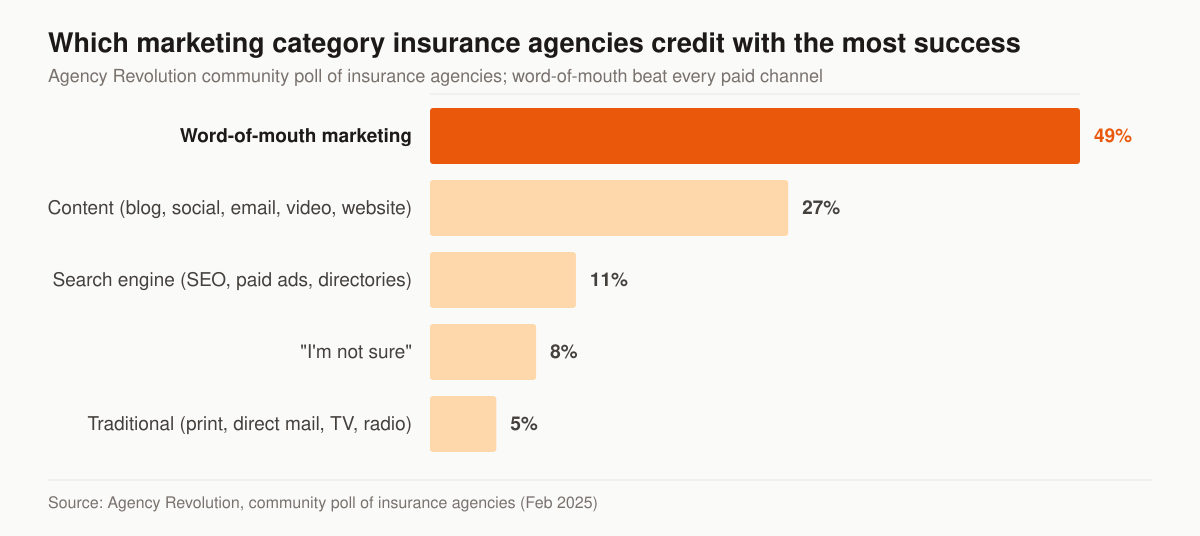
Which marketing category insurance agencies credit with the most success. Source: Agency Revolution community poll of insurance agencies, published 13 February 2025.
What that ranking does not mean is “cancel the search budget and print referral cards.” Word-of-mouth sits downstream of everything else. A referred prospect still searches your name, still reads your reviews, and still lands on whatever page your agency built. Agency Revolution says as much in the same post: “all marketing leads to word-of-mouth marketing.” Read that way, the poll is an argument for spending the retainer on the assets that make a referral convertible — a site that loads, a Google Business Profile that is accurate and open, review volume you actively ask for, and a follow-up path that answers. That is reputation and review management and local SEO doing referral work, not brand work.
Adoption tells a different story from attribution. BBSI surveyed its insurance broker and agency referral partners about the digital channels they actually run, and reported that 71% of respondents had used digital marketing for a year or longer, with another 24% intending to start.
Read the table as what this survey’s respondents said they run, not as a census of US agencies.
| What the agency or brokerage runs | Share of BBSI survey respondents |
|---|---|
| Active on social media | 71% |
| Networking | 47% |
| Monitoring and requesting online reviews | 41% |
| Email marketing | 41% |
| Referral program | 35% |
| Local SEO | 35% |
| Content and SEO marketing | 29% |
| Co-marketing with other service providers | 29% |
| Hosting or co-hosting webinars | 29% |
| Guest blogging | 23.5% |
| Producing videos | 23.5% |
| Paid ad campaigns | 6% |
Figures from BBSI’s referral partner survey of brokers and agencies; BBSI describes paid ads as “the least adopted of the strategies polled” and does not publish a respondent count.
That 71%-to-6% spread is the market an agency gets hired into: among those respondents, social posting is near-universal and paid campaigns are rare. We read that as an argument for treating paid media as a deliberate, measured line rather than the default first spend — which is also why what a click costs by insurance line is a number worth knowing before anyone spends on your behalf.
Who actually does the work behind a retainer
A retainer is not a person; it is a set of roles. Whether one operator wears four hats or a team splits them, the same seats have to be filled, and asking a prospective agency who fills each one is a faster read on capability than any capabilities deck.
- Strategy. Decides which channel gets funded next and which gets killed. Without this seat you get activity reports instead of decisions. Sold on its own, this is a fractional CMO engagement.
- Search. Technical SEO, local listings, entity consistency, and now AI-answer visibility. The person who makes sure the page is findable and the profile is right.
- Writing. Somebody has to produce copy that survives an insurance buyer’s scepticism and a compliance read. This is content marketing with a licence-aware editor attached.
- Design and build. Page speed, mobile layout, forms that submit. Handled by web design and landing pages.
- Paid media. Account structure, keyword and audience selection, negative lists, creative testing, budget pacing.
- Automation. The follow-up sequences and the CRM plumbing behind them, which is where bought attention leaks away. If you have not chosen a system yet, start with the CRM comparison for agents.
- Analytics. Call tracking, form attribution, and the monthly read that ties spend to bound policies.
The reason this list matters at the sales-call stage: an agency that is really a website builder will have three of these seats and improvise the rest. That is not disqualifying if a site is all you need. It is disqualifying if you were sold a pipeline.
What an insurance marketing agency does in the first 90 days
The first quarter is build and baseline, not volume. If a proposal promises bound policies in week two, ask what is funding that number — purchased leads and an owned pipeline are not the same product. Sequencing is the thing to interrogate, because it tells you what the agency believes has to be true before spend is worth it.
This is the sequence we run, published so you can hold any proposal — ours included — against it.
| Window | What the agency should be doing | What you should be able to see at the end of it |
|---|---|---|
| Weeks 1–2 | Discovery: lines written, geography, carriers, current lead sources, existing assets, compliance constraints. Analytics, call tracking and conversion events installed before anything changes | A written scope naming the channels, the deliverables and the reporting metric |
| Weeks 3–6 | Build: site or landing pages, offer and form, Google Business Profile cleanup, tracking verified end to end, follow-up sequences drafted | Pages live on your own domain and accounts, with test submissions arriving where they should |
| Weeks 7–10 | Launch: content publishing begins, local and on-page SEO shipped, paid campaigns switched on at a controlled budget, review requests running | First tracked leads, attributed to a channel rather than guessed at |
| Weeks 11–13 | Read and adjust: kill what is not converting, shift budget to what is, fix the capture leak the data points at | A reporting call with cost per lead by channel, and a named change for next quarter |
Two caveats worth saying out loud. Organic search and content are the slowest lines on that table — the compounding happens after the quarter, not inside it, which is why how long it takes to rank an agency site is a fair question to ask before you sign. And any agency’s timeline slips when the agent is the bottleneck on approvals, which is a shared problem, not a vendor failing.
What an insurance marketing agency does not do
Scope boundaries prevent more disputes than any service list. Here is where the work stops:
- It does not sell the policy. The agency produces and qualifies demand. The licensed agent runs the appointment, handles objections and closes. No marketing system rescues a sales process that lets voicemails pile up — the follow-up cadence is yours to run.
- It does not hold your carrier contracts. Appointments, commission levels, releases and back-office support come from an FMO or IMO, which earns an override on what you write. That is a different business model from a vendor you pay a fee; how to choose an FMO covers that side.
- It does not sign off compliance. An agency builds to CMS marketing rules, TCPA and state advertising rules, and flags what it notices. Approval of scripts, disclaimers and disclosures sits with the licensed party and its counsel.
- It cannot guarantee a ranking. No vendor controls a search engine’s index. An agency can commit to the work and to reporting on it.
- A guaranteed lead count is a lead purchase in disguise. If a “marketing” contract promises a number of leads per month, look for the media budget that funds them, or the third-party list behind them. That is a lead buy, priced as a retainer.
- It does not replace your judgment on which lines to write. An agency can tell you what a Medicare click costs against a final expense click. It cannot tell you which book you want in five years.
DFY vs. DIY vs. lead vendors
Three ways to solve the “I need more clients” problem, and they are not interchangeable.
The distinction that decides the choice is ownership: two of these three leave you holding an asset.
| Model | What you get | You own the asset? | Best for |
|---|---|---|---|
| Done-for-you agency | A full pipeline built and run for you | Yes | Busy agents who’d rather sell than run channels |
| Do-it-yourself | Tools and know-how; you do the work | Yes | Agents with time, budget-tight, enjoy marketing |
| Lead vendor | Purchased contacts, often shared | No — you rent | Filling capacity fast, testing a market |
The critical distinction: a lead vendor hands you contacts — frequently the same list sold to several agents, which is why speed-to-lead matters so much on bought volume. A marketing agency builds the machine that generates your own leads at a cost that trends down over time. Both can coexist; they just solve different problems. (This site sells the agency side — the systems. When you specifically want to buy leads or live transfers as a product, that’s a separate decision and a separate vendor: our sister operation at getinsureleads handles it, so the two functions stay clean.)
How insurance marketing agencies charge
There is no single market rate, because there is no single billing model. Ahrefs polled 439 SEO service providers on how they price. The three shares below total more than 100%.
Ask which of these three a quote is built on before comparing it to another quote.
| Pricing model | Share of the 439 providers Ahrefs polled who use it | What agencies charge on it |
|---|---|---|
| Monthly retainer | 78.2% | $3,209 per month, average across agencies |
| Per-project | 48.9% | $2,501–$5,000 is the band Ahrefs found most often for agencies |
| Hourly | 34.8% | $98.90 per hour, average across agencies |
All figures from Ahrefs’ SEO pricing survey of 439 SEO service providers. The survey covers SEO providers rather than insurance-specific agencies, so treat it as the shape of the market, not a quote. Ahrefs also reports that “$501–$1,000 per month is the most popular monthly retainer rate for SEOs, with 20.4% of respondents charging this rate” — a band we would expect to buy one channel rather than a program.
Two things sit outside almost every model and are worth getting in writing. Ad spend is a pass-through: the money goes to Google or Meta, and a fee charged as a percentage of it rewards the agency for spending more of yours. And setup — the site build, the tracking, the account structure — is often a separate one-time line rather than something the first month’s retainer covers.
Our own numbers are published rather than quoted on a call: Foundation at $2,500 a month, Growth at $3,500, Full-Funnel at $5,500, plus a one-time website build of $2,500 to $8,000, with ad spend billed at cost straight to the platforms. The full breakdown of what sits in each tier, and the in-house hiring comparison with the labour figures sourced, is on the pricing page. If you are working out what the total number should be before you shop, how to set an insurance agency marketing budget works it from revenue rather than from a vendor’s menu.
What an insurance marketing agency does about compliance
For unregulated B2C, “compliance” means an accessibility check and an unsubscribe link. In insurance it is a design constraint, and in Medicare it is a federal one that reaches the vendor directly.
CMS defines the category the vendor falls into. Under 42 CFR 422.2260, a third-party marketing organization means “organizations and individuals, including independent agents and brokers, who are compensated to perform lead generation, marketing, sales, and enrollment related functions as a part of the chain of enrollment (the steps taken by a beneficiary from becoming aware of an MA plan or plans to making an enrollment decision).” That definition captures the agent, the FMO and the marketing vendor at once. It applies to Medicare Advantage under Part 422; Part D carries its own parallel rules at Part 423.
The obligations then arrive through the plan’s contracts rather than as a direct rule on your vendor. Under 42 CFR 422.2274(g), when doing business with a TPMO, MA plans must implement specified oversight, and the contracts between a TPMO and an MA plan or its first tier, downstream or related entity must ensure the TPMO does several things. Three of them shape how a marketing program is built:
- Calls get recorded and kept. “All marketing and sales calls, including the audio portion of calls conducted via web-based technology, must be recorded and retained in their entirety for a minimum period of 6 years.” For the first three years of that retention period the records must be held in audio format; for years four, five and six, audio or a complete and accurate transcript.
- Lead generation carries a disclosure. Where applicable, a TPMO conducting lead-generating activities must “Disclose to the beneficiary that his or her information will be provided to a licensed agent for future contact” — verbally on the phone, in writing on paper, electronically over email or chat — and disclose that the beneficiary is being transferred to a licensed agent who can enrol them.
- Data cannot be passed around freely. Beginning October 1, 2024, personal beneficiary data collected by a TPMO for marketing or enrolling into an MA plan may only be shared with another TPMO with the beneficiary’s prior express written consent, obtained “through a clear and conspicuous disclosure that lists each entity receiving the data and allows the beneficiary to consent or reject to the sharing of their data with each individual TPMO.”
Those three clauses rule out an entire style of lead marketing — the shared form that quietly resells a submission to five buyers — for anyone touching Medicare. They also explain why a compliant Medicare landing page reads differently from an auto-insurance one. Agents working that market should pair this with the scope-of-appointment and TPMO rules and the wider CMS Medicare marketing rules; the Medicare marketing hub covers what compliant acquisition looks like end to end.
Outside Medicare, the same principle holds with different statutes: TCPA consent on outreach, state advertising and rebating rules on incentives, carrier approval on anything using a carrier’s name. Our insurance marketing compliance guide is the fuller version. What none of it changes is who carries the risk. The agency builds to the rules; the licensed party approves and answers for them.
What changes by line of insurance
An agency running the same playbook for a Medicare agent and a commercial P&C shop is running the wrong one for at least one of them. The channels are the same; their weighting, their compliance overhead and their buying window are not.
The channel list barely changes between lines. When the buyer is reachable, and what you are legally allowed to say to them, changes a great deal.
| Line | What the demand side rewards | The constraint that shapes it |
|---|---|---|
| Medicare | Educational content, local presence, referral partnerships, seasonal capacity around enrollment periods | CMS marketing rules and TPMO obligations, including recorded calls and lead-generation disclosures |
| Final expense | Direct response, speed of contact, telesales infrastructure | TCPA consent on outbound; the buyer is often reached by phone rather than search |
| Life and IUL | Long consideration, educational depth, adviser credibility | Suitability and advertising rules; claims about performance are heavily constrained |
| P&C and auto | Local SEO, review volume, quote-form conversion, account rounding | State advertising rules; competition from direct carriers with national ad budgets |
| Commercial | Niche authority content, partnerships with CPAs, brokers and bankers, longer cycles | Fewer searches, higher value per policy, so measurement needs a longer window |
The line-specific playbooks go deeper than a table can: final expense marketing, P&C agency marketing strategy and marketing for final expense agents each start from the buyer rather than the channel. A useful sales-call question falls straight out of this: ask a prospective agency to name the constraint that governs your line. An agency that cannot will design around the wrong one.
How to evaluate an insurance marketing agency
Not all shops are equal, and the category has plenty of website-builders wearing an agency label. Pressure-test on:
- Line and vertical depth. Do they understand your market — Medicare, final expense, P&C, life — and its compliance rules, or is insurance one of forty industries on their homepage?
- DFY scope. Is it truly done-for-you, or a template and a login you’re left to operate?
- Ownership vs. rental. Do you keep the website, content, and audience if you leave, or does it all vanish with the contract?
- AI-search and GEO. Are they optimizing for how buyers now search through ChatGPT, Perplexity, and Google’s AI answers — not just classic blue links?
- Measurement. Will they model cost per bound policy with you, or only report clicks and impressions?
- Compliance. For regulated lines (Medicare/CMS, TCPA on outreach), do they build within the rules or hope nobody checks?
We wrote a criteria-based buyer’s guide that goes deeper on this in how to choose the best insurance marketing agency for agents. The fourth point — being recommended by an assistant rather than ranked in a list of blue links — is a different optimization problem, and the subject of our AI-search and GEO service.
What the agent has to supply
Done-for-you is not hands-off. Four inputs stay with the agent, and an engagement can sit idle for weeks on any one of them:
- Access. Domain and DNS, hosting, Google Business Profile ownership, ad accounts, CRM, analytics. An agency that asks you to point the domain at an account it owns is quietly buying leverage over your exit — the ownership and cancellation terms are the place to settle that before work starts.
- Subject matter. Which carriers you are appointed with, which products you actually want more of, what you refuse to write, and the objections you hear every week. This is the raw material for copy that sounds like an agent rather than a content mill.
- Speed on approvals. Compliance reads, carrier sign-off where required, and your own review of pages and creative. Every day here is a day the launch date moves.
- Sales capacity and honest outcome data. Marketing optimises toward whatever you report back. If bound policies never make it back into the system, the agency is optimising toward form fills — which is how a program produces more leads and no more premium.
If you want the whole thing written down before you brief anyone, the insurance agency marketing plan template is the version we would hand a new client to fill in.
How to tell whether the agency is working
Retainers get cancelled for the wrong reasons: a slow month, a channel that was always going to take two quarters, a report nobody read. Agree the read before the work starts, and judge it on a schedule.
- Month one to three: leading indicators. Pages indexed, profile impressions, calls tracked, forms submitted, first cost per lead by channel. Nobody should be judging cost per policy yet — the sample is too small to mean anything.
- Month four to six: cost per lead, then cost per appointment. Now the channels can be compared against each other. This is the point at which a channel gets defunded rather than defended.
- Month seven onward: cost per bound policy against policy value. The comparison we treat as settling whether the retainer paid for itself, and the one to insist an agency will run with you before you sign.
Three failure signals are worth naming, because they show up in reporting rather than in results. A report full of impressions and rankings with no lead numbers means attribution was never wired up. A channel that has never been killed means nothing is being measured hard enough to fail. And an agency that cannot tell you which specific change it made last month is running maintenance and billing it as growth.
Reporting cadence matters as much as the metrics. We would rather run a monthly call that ends in a named change than ship a weekly dashboard nobody opens.
When an agent actually needs one
You don’t always need an agency. You need one when the math and the calendar say so:
- Lead flow is inconsistent and you can’t predict next month’s pipeline.
- You’re buying shared leads and losing the ones you paid for on slow follow-up.
- Your website looks fine but doesn’t turn visitors into quote requests.
- You simply don’t have hours to run SEO, ads, and automation while also selling.
If you have the time and genuinely enjoy the marketing side, DIY with good tools is legitimate. An agency’s real product is bought-back time plus specialist skill — worth it when the pipeline it builds binds more premium than it costs. There is also a middle model: if you have in-house hands but no senior strategy, a fractional CMO engagement supplies the direction while your team runs the channels. The honest test is cost per bound policy against the lifetime value of a policy that renews for years; a good agency will model that with you before you sign, and our pricing is structured so you can run that math up front.
Whether you build it yourself or hire it out, the shape of the answer is the same: a connected, measured system you own. If you want a second set of eyes on where yours leaks, our free marketing audit is a no-pitch teardown of your current funnel. If you would rather ask questions before anything is booked, start a conversation instead — and the team behind this is the same one that runs its own lead operation.
- Best Insurance Marketing Agencies & Companies: A Buyer's Guide
Best insurance marketing agencies compared by provider type, real cost ranges, and the six vetting criteria that matter. See which model fits your agency.
- Digital Marketing for Insurance Agents: The Channel-by-Channel Playbook
Digital marketing for insurance agents, channel by channel: which of SEO, PPC, social, email, and AI search to run first — by line and budget. Free audit.
- 40 Content Ideas for Final Expense Agents You Can Steal This Week
40 content ideas for final expense agents: cost and qualifying answers, video hooks, offline angles, and the capture step that turns views into leads.
- Insurance Agency Marketing Budget: What It Costs, and the Cost-Per-Sale Math Underneath
Insurance agency marketing budget and costs: 7-12% of gross revenue steady, 15-20% growing, with the monthly figure by tier and agency retainer bands.