Building a Final Expense Lead Generation System You Own
A final expense lead generation system is an owned pipeline that creates its own demand: paid social and search ads feeding your landing pages, layered with local SEO, referrals, and a five-minute follow-up cadence. Buying leads rents access; a system builds an asset whose cost per lead falls as it matures.
Buying leads is renting demand. The vendor owns the audience, sets the price, and resells the same name to other agents the same week. A final expense lead generation system is the opposite: an asset you control, where the cost per lead trends down as the account matures instead of up as the auction heats up.
This page covers the four layers of that system — paid social, search, local SEO and content, referrals — with cost benchmarks, a build-versus-buy table, and a 90-day build order so you can decide where your next dollar goes.
For context: we run our own final-expense and senior-market lead operation, so the playbook below comes from live campaigns, not theory.
Why build a lead generation system instead of buying leads?
Bought leads have a real advantage: zero setup. You pay, names arrive, you dial. The cost is that you compete with every other buyer of that same data, and you never build anything that lowers your cost next quarter.
Generated leads invert that. There is upfront work (a page, an ad account, tracking), but the asset compounds.
This table sets the two models side by side on the six dimensions that decide the call.
| Dimension | Buy leads | Generate leads |
|---|---|---|
| Time to first lead | Same day | 1–3 days (ads), 3–6 mo (SEO) |
| Typical cost per lead | $25–$45 exclusive | Trends toward $7–$15 at scale |
| Exclusivity | Often shared | Fully yours |
| Resold to competitors | Frequently | Never |
| Builds a durable asset | No | Yes |
| Compliance burden | Vendor-shared | You own disclosures |
The deeper breakdown of bought-lead economics lives in our analysis of the true cost per sale on purchased final expense leads, and the exclusive-versus-shared trade-off is worth reading before you spend another dollar with a vendor. If buying is where you’re starting — or you’re still weighing buy versus build at all — the cost-by-source comparison for getting final expense leads ranks every option and frames that decision. This page is for agents ready to build flow instead of renting it.
How the four layers compare on conversion rate
Before you sequence the build, it is worth knowing which channels convert traffic in your category rather than which ones are loudest.
Ruler Analytics’ Conversion Rate Benchmarks 2026, published from more than five million tracked conversions across thirteen industries, breaks the finance category out by marketing source. Email converts at 7.1%, referral at 6.5%, paid search at 6.3%, direct at 5.8%, AI referral at 5.6%, organic search at 5.4%, paid social at 3.7% and organic social at 1.57%.
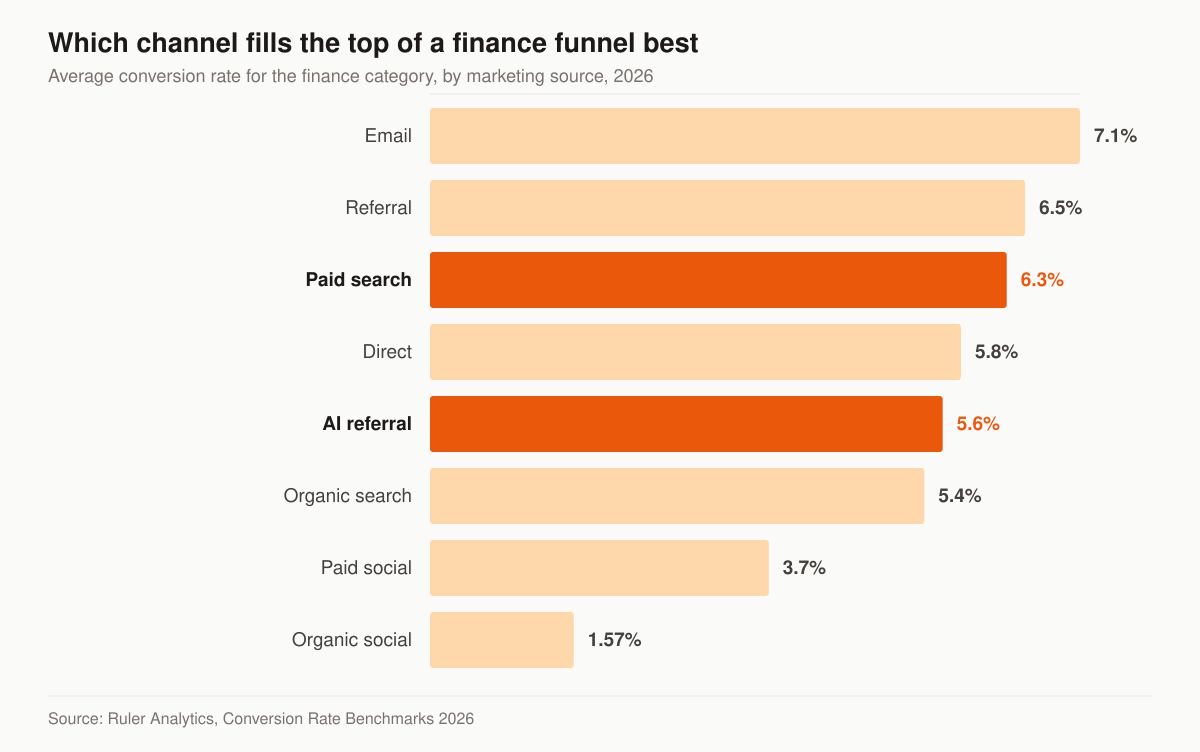
Chart: finance-category conversion rate by marketing source, from Ruler Analytics, Conversion Rate Benchmarks 2026.
Read that list as a build order rather than a ranking to chase. Paid social sits near the bottom and still goes first, because it produces flow within days of launch — a 3.7% rate on traffic you can switch on this week is worth more than a 7.1% rate on an email list you do not have yet.
The channels at the top are outputs of the system, not inputs to it. Email converts because the addresses came from somewhere. Referral converts because someone already bought. Neither exists until a lower-converting layer has been running long enough to produce them, which is the argument for building in layers instead of picking a favorite channel and defending it.
One row deserves separate attention: AI referral, at 5.6%, ahead of organic search. Ruler reports it as a distinct source and notes that it is worth tracking that way; if your own analytics does not separate it, you cannot see whether it is working. That is a tracking decision to make in week one, not after the first quarter.
Layer 1: Paid social (the fastest engine)
For most final-expense agents, paid social is the quickest path to self-generated flow and the first layer of the system worth standing up. The senior audience is on Facebook, and intent-light “request info” offers convert well there.
Two mechanics you must respect:
- Meta’s Special Ad Category. Insurance ads fall under restrictions that limit age, ZIP-radius, and detailed targeting on some objectives. You build the audience differently than a retailer would; this is a constraint, not a blocker.
- TCPA consent. Any form collecting a phone number needs clear, agent-owned consent language. The FCC’s one-to-one consent rule was vacated in January 2025, but TCPA still governs how you may call and text. We run the ad mechanics; you, the licensed agent, own the disclosure and the call.
Our full playbook is in Facebook ads for insurance agents. The pattern that works: a single-offer landing page, a lead form with honest consent, and a follow-up cadence that dials within minutes.
What a self-generated Facebook lead actually costs
The number that settles build versus buy is what a lead costs once you are the one buying the impressions. A published benchmark exists for it, with one gap worth knowing about before you plan a budget around it.
WordStream’s Facebook Ads Benchmarks 2025 reports leads-objective results from a sample of 726 US campaigns running between April 1, 2024 and June 30, 2025. Across all industries the average cost per click is $1.92, the average click-through rate 2.59%, the average conversion rate 7.72% and the average cost per lead $27.66.
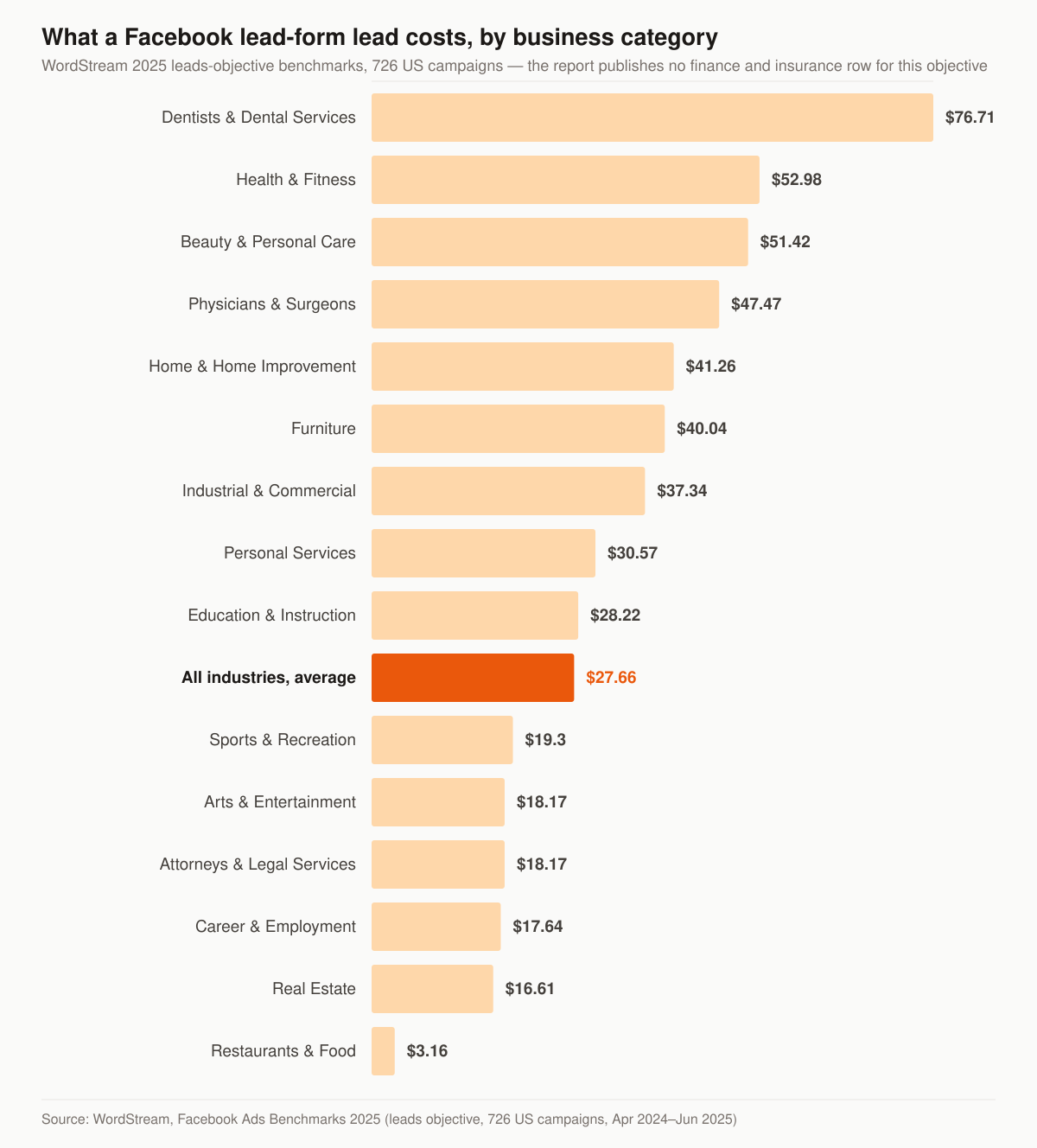
Chart: cost per lead by business category, leads objective, from WordStream, Facebook Ads Benchmarks 2025.
Now the gap. That leads-objective table publishes fifteen business categories, and finance and insurance is not one of them. There is no benchmark row telling a final expense agent what a lead-form lead ought to cost. What you get instead is the all-industry $27.66 and a set of category rows running from $3.16 for restaurants and food up to $76.71 for dentists and dental services — a spread wide enough to prove that category drives the number, and then no row for yours.
Two things follow. First, $27.66 is an anchor to test against, not a quote. Second, the comparison an agent actually cares about is against the $25–$45 an exclusive bought lead costs in the table further up this page — and on published data, a self-generated lead-form lead starts in the same neighborhood rather than an order of magnitude below it. The savings in the build case come later, from the layers that do not re-charge you per record.
Meta’s own targeting rules are part of why the number moves. Its Business Help Center guidance on Special Ad Categories states that “Starting January 21, 2025, using this category is required for financial products and services campaigns for advertisers based in the United States or showing ads to audiences in the United States” and that “Certain audience options are limited or unavailable for these ads for advertisers based in or reaching the US and advertisers reaching Canada and certain countries in Europe: age, gender, ZIP code or postal code, exclusion targeting, lookalike audiences and saved audiences.”
Sit with the first item on that list for a product written for an older buyer. Age is the selector you would reach for first, and it is withdrawn. So is ZIP, and so are lookalikes built from the clients you already wrote. Qualification has to move into the two places you still control — the creative, which says who the offer is for in plain words, and the form, where age band and state become questions instead of assumptions. Fewer submissions, better ones, and a cost per lead that rises while cost per issued policy falls. We build these campaigns under insurance Facebook ads management, and the vertical-specific version lives on our final expense Facebook ads page.
Layer 2: Search ads for high-intent clicks
Paid social interrupts people; search ads catch people already looking. Someone typing “final expense insurance near me” is closer to buying than someone scrolling a feed.
Search clicks cost more per click but often convert at a higher rate, so the cost per sale can be competitive. Budget discipline matters because broad keywords drain spend fast. See our insurance PPC cost-per-click benchmarks by line and the tactical guide to Google Ads for insurance agents for keyword and negative-list structure.
A practical split for a new generator:
- Start with paid social for volume and learning.
- Add a tight search campaign on 10–20 high-intent terms.
- Compare cost per appointment, not cost per click, after 30 days.
What a search click costs in this category
Search is the layer where a published figure exists for finance and insurance specifically, so you can budget against something firmer than the platform average.
This table sets LocaliQ’s 2026 search benchmarks for finance and insurance against the all-industry figures in the same report.
| Metric | Finance & Insurance | All industries |
|---|---|---|
| Average cost per click | $3.39 | $5.42 |
| Average click-through rate | 9.83% | 6.64% |
| Average conversion rate | 2.64% | 8.18% |
| Average cost per lead | $74.44 | $66.69 |
Source: LocaliQ, Search Advertising Benchmarks, last updated 1 June 2026.
The shape of that row is the useful part. Finance and insurance buys the click cheaply — $3.39 against a $5.42 average — and earns it easily, at a 9.83% click-through rate against 6.64%. Then the funnel gives it back: 2.64% conversion against 8.18%, and a cost per lead of $74.44 against $66.69. Cheap attention, expensive outcome.
That pattern tells you where to spend effort inside this layer. Bidding harder buys more of a click you are already winning at a discount. The gap is on the page the click lands on and the offer it carries, which is the same asset every other layer depends on. If you are weighing whether search deserves budget in this niche at all, our breakdown of whether final expense PPC is worth it works through the keyword volume problem that sits underneath these averages, and managed insurance PPC is the version we run for agents who would rather not build the account themselves.
Layer 3: Local SEO and content (the slow compounding channel)
SEO is the channel agents skip because it pays late. It also produces the lowest-cost leads once it ranks, because each lead after the content is published is nearly free.
The work is concrete: a fast website that passes Google’s Core Web Vitals thresholds, location-relevant pages, and content that answers the questions seniors and their families actually search. Our approach is detailed under insurance SEO services, and the step-by-step is in how to rank an insurance agency website on Google.
Content also feeds the AI engines. More buyers now ask ChatGPT and Google’s AI summaries for recommendations, so structuring pages for extraction matters; we cover that in getting your agency recommended by ChatGPT.
What your landing page has to clear before any layer pays
Every layer above routes to the same destination. Ads, organic listings, a referral typing your name — all of it lands on a page, which makes the page the shared dependency of the whole system. We treat it as the first thing to fix, because a gain there lifts every layer at once instead of one.
Google publishes the pass marks rather than leaving them to interpretation. Its Core Web Vitals guidance sets a threshold for each of three metrics and specifies how to measure them: “To ensure you’re hitting the recommended target for these metrics for most of your users, a good threshold to measure is the 75th percentile of page loads, segmented across mobile and desktop devices.”
This table lists the three thresholds a final expense landing page has to clear.
| Metric | What it measures | Google’s “good” threshold |
|---|---|---|
| Largest Contentful Paint (LCP) | Loading — when the main content appears | Within 2.5 seconds of when the page first starts loading |
| Interaction to Next Paint (INP) | Responsiveness — the lag after a tap or click | 200 milliseconds or less |
| Cumulative Layout Shift (CLS) | Visual stability — content jumping as it loads | 0.1 or less |
Source: web.dev, Web Vitals. Measure at the 75th percentile, split by device.
The mobile split matters more here than in most niches, because CLS is the metric that punishes a form. A phone number field that shifts down the screen as a late image loads is not a cosmetic problem when the person filling it in is seventy-one and using a thumb.
Which raises the objection agents put to inbound in this market — that the buyer is not online. Pew Research Center’s Internet/Broadband Fact Sheet, from a survey of 5,022 U.S. adults conducted 5 February to 18 June 2025, reports that 90% of adults aged 65 and older use the internet and 70% have home broadband. The audience is reachable. The question is whether the page they land on works on the device they land with. Our insurance landing page and website design work exists for exactly this constraint, and final expense agent website examples shows what the finished article looks like.
Layer 4: Referral and reactivation loops
The cheapest lead is one you already earned. Two underused systems:
- Client referrals. A placed final-expense client often knows neighbors and family in the same age band. A simple, scripted ask at delivery turns one sale into a small pipeline.
- Reactivation. Aged data and old non-buyers are not dead. A re-dial cadence on names you already paid for recovers sales at near-zero new cost. The economics of aged final expense leads explain why.
Neither system needs ad budget. Both need a process and follow-through.
The piece that decides everything: speed and cadence
Channels create contacts. Your follow-up turns contacts into sales. An agent who generates a $10 lead and calls it three days later will lose to an agent who buys a $35 lead and calls in two minutes.
We see the gap in our own book: close rate is a follow-up number as much as a lead-quality number. Build your cadence before you scale spend. The framework is in our insurance lead follow-up cadence guide.
This is the minimum cadence a self-generated lead should meet before you raise the budget behind it.
| Touch | Timing | Channel |
|---|---|---|
| 1 | Within 5 minutes | Call |
| 2 | Same day | Text + call |
| 3 | Day 2 | Call |
| 4–8 | Days 3–14 | Alternating call/text |
The compliance work that moves to you when you stop buying leads
Owning the pipeline means owning the paperwork behind it. When a vendor generates the record, the consent trail is theirs to produce and yours to demand. When your own ad produces it, both jobs are yours. Two provisions define the work.
The first is the consent itself. 47 CFR 64.1200(f)(9) defines prior express written consent as “an agreement, in writing, bearing the signature of the person called that clearly authorizes the seller to deliver or cause to be delivered to the person called advertisements or telemarketing messages using an automatic telephone dialing system or an artificial or prerecorded voice, and the telephone number to which the signatory authorizes such advertisements or telemarketing messages to be delivered.” The written agreement has to disclose that the person “is not required to sign the agreement (directly or indirectly), or agree to enter into such an agreement as a condition of purchasing any property, goods, or services.” Read the scope before you either relax or panic: the definition attaches to autodialed, artificial-voice and prerecorded-voice advertising and telemarketing, so the technology you dial with is part of the question. Our PPC guide works through the form-field version of this, and the buying-side view is in TCPA compliance for agents buying leads.
The second is the one agents miss when they switch from buying to generating: your own do-not-call list. 47 CFR 64.1200(d) reaches two kinds of call: artificial and prerecorded-voice calls made under certain exemptions, and — the branch that matters here — “any call for telemarketing purposes to a residential telephone subscriber unless such person or entity has instituted procedures for maintaining a list of persons who request not to receive such calls made by or on behalf of that person or entity.” The paragraph then states that “The procedures instituted must meet the following minimum standards”.
This table lists those minimum standards and what each one asks you to have on hand.
| Minimum standard | What the rule requires |
|---|---|
| Written policy — 64.1200(d)(1) | A covered caller “must have a written policy, available upon demand, for maintaining a do-not-call list” |
| Training of personnel — 64.1200(d)(2) | Anyone “engaged in any aspect of telemarketing must be informed and trained in the existence and use of the do-not-call list” |
| Recording requests — 64.1200(d)(3) | On a request, you “must record the request and place the subscriber’s name, if provided, and telephone number on the do-not-call list at the time the request is made” |
| Honoring the request — 64.1200(d)(3) | You must honor the request “within a reasonable time from the date such request is made”, and that “period may not exceed ten (10) business days from the receipt of such request” |
Source: 47 CFR 64.1200, eCFR current text.
One sentence in that paragraph decides how you handle outsourced dialing. Where the requests are kept by someone else, the rule provides: “If such requests are recorded or maintained by a party other than the person or entity on whose behalf the call is made, the person or entity on whose behalf the call is made will be liable for any failures to honor the do-not-call request.” Hiring a call center moves the labor, not the exposure. Build the list inside the CRM you control — our marketing automation guide covers where that record belongs — and keep the written policy where you can produce it on demand.
We provide marketing services, not licensed insurance or legal advice; you are the licensed party, and your compliance counsel settles the specifics. The broader category map is in insurance marketing compliance for agents.
What it costs to run the system
An owned pipeline has two cost lines that behave differently, and agents who conflate them talk themselves out of the build. There is the work — the site, the SEO, the ad management, the automation — and there is the media, which is what you hand the platforms. The second scales with ambition; the first does not.
This table maps our published tiers to the layers above, so you can see which parts of the system each one stands up.
| Tier | Monthly | What it covers | Layers it stands up |
|---|---|---|---|
| Foundation | $2,500 | Optimized insurance website and landing pages, local SEO and Google Business Profile, on-page SEO, monthly reporting | Layer 3, plus the page every other layer needs |
| Growth | $3,500 | Everything in Foundation, ongoing SEO and content engine, AI-search visibility, reputation and reviews, monthly reporting | Layer 3 at full weight, and the review engine feeding Layer 4 |
| Full-Funnel | $5,500 | Everything in Growth, managed paid ads on Google and Meta, landing-page CRO, marketing automation and CRM, full-funnel reporting | All four layers, with the ad accounts run for you |
A one-time website build runs $2,500 to $8,000 if you want the asset without a retainer behind it. Ad spend is billed at cost, straight to the platforms — it is not marked up and it is not included in the numbers above, which is why the benchmark figures earlier on this page matter to your budget as much as ours. Everything is month to month. Full detail sits on our pricing page, and the sizing question — how much media a book your size can absorb — is worked through in how to set an insurance agency marketing budget.
If you would rather hand the whole engine over rather than assemble it channel by channel, that is what insurance lead generation services is, and the final-expense-specific build is managed final expense lead generation.
A 90-day sequence to own your pipeline
- Weeks 1–2: Stand up one landing page and tracking. Launch one paid-social campaign with compliant consent.
- Weeks 3–4: Lock a 5-minute follow-up cadence. Measure cost per appointment, not cost per lead.
- Weeks 5–8: Add a focused search campaign. Start publishing SEO content that answers buyer questions.
- Weeks 9–12: Turn on referral asks and a reactivation re-dial. Shift budget toward your lowest cost-per-sale channel.
Where owned pipelines stall
Four failure patterns account for the systems we are asked to rescue, and none of them is a channel problem.
The budget stops before the account has learned anything. A campaign switched off in week three has produced a cost per lead and nothing else — no conversion data, no creative comparison, no answer on which age framing pulled. The spend is gone either way; only the learning is optional.
Nothing was instrumented, so no layer can be compared. Without conversion tracking, call attribution and a source field on every record, the four layers cannot be ranked against each other and budget gets moved on impressions. That is also how a source like AI referral stays invisible for a year.
The creative was never rewritten for the targeting Meta removed. Agents port an ad built when age and ZIP were selectable, then judge the lead quality that comes back. With those options withdrawn, the filtering job belongs to the headline, the image and the form questions. An unchanged ad plus a changed platform is a quality complaint waiting to be filed against the wrong thing.
Nobody was assigned the five-minute call. A cadence that exists in a document and not on a calendar is a plan to lose races. Either the agent takes the interruption or a setter does — our insurance appointment setting service exists because the first option stops scaling around the time the pipeline starts working.
A final expense lead generation system is not one tactic; it is the four layers working together — ads create flow, pages convert it, SEO and referrals lower the blended cost, and cadence closes it. When you build the channels yourself, you can drive cost down to a level no reseller will ever quote you.
If you want a read on which channel will move your numbers first, our managed final expense lead generation lays out the engine we run for agents. Or get a no-pitch teardown of your current funnel with a free marketing audit and see the gaps before you spend another dollar. Two related reads before you commit budget: our build-vs-buy breakdown for burial insurance lead generation weighs owning versus renting the pipeline, and the how to set an agency marketing budget shows how to size spend before you scale.
- How to Get Insurance Leads Without Cold Calling
How to get insurance leads without cold calling: inbound systems, paid channels, cost-per-lead math, and the follow-up cadence that makes them convert.
- How to Get Final Expense Leads: Sources, Costs, and Contact Rates
How to get final expense leads: five sources compared on cost, exclusivity, and contact rate, plus a 30-day plan to prove your first channel pays.
- Aged Final Expense Leads: What They Are and When the Math Works
Aged final expense leads cost a fraction of fresh leads. Here's what they are, the ROI math that decides if they work, and when to skip them.
- Final Expense Lead Generation Companies for Agents: A Buyer's Map
A practitioner's breakdown of final expense lead generation companies: the vendor types, real cost-per-sale math, and when building your own wins.